The Race Is On But The Cost
pp. 43-45 · Read in the full issue

May Be More Than The Prize
By June Wood
The race is on! I feel it as strongly as if I had seen the starter’s flag. The Solomons have now had more than a year with an elected majority in the BSIP Governing Council; the end of 1971 will see the last public service member leave the council and a Solo mon Islander established as chairman.
The cry of the politicians is internal self-government by 1975, and this has support among the electorate. The race towards self-determination has started and the pace will surely accele rate as the goal looms closer. Those who have, in other territories, seen the old flag run down to be replaced by the new, recognise the familiar pat tern of independence taking shape.
It is only 11 years since the first BSIP Legislative Council came into being with a very few appointed Solo mon Islanders. It may seem a short time to gain sufficient experience to govern, but in politics, where memo ries are notoriously short, 11 years is long enough.
Nobody could deny that all does not seem quite ready for this step.
Many Solomon Islanders feel that unless education is somehow speeded up, scarcely enough educated people will be available by 1975 to fill the administrative posts; professional and technical posts must lag behind even more.
• MRS. JUNE WOOD has left Honiara after many years in the BSIP. In this article for PIM she surveys the recent past and makes predictions for the future.
The Sixth Development Plan, with its struggle to implement an economic policy, is now under way and taxation rises are gloomily forecast. If this happens, the belts of some will have to be tightened, and the cold fact that independence is going to cost more may not be welcome to some.
But I do not think this will deter those bent on self-government by 1975, and perhaps it is right that, having once started the race, nothing should be allowed to stop it.
The politicians have plenty of critics though, and there are signs that voters want their money’s worth from what some obviously consider an expensive luxury. The voice of the moderates is also heard, mainly from the areas outside the capital.
The main worry here is that inde pendence will break down custom.
There are fine new buildings in Honiara and pretty mini-skirted girls working in the offices. There are a dairy and a museum, but in the dis tricts there has been little change.
People there cling closely to their
particular custom and feel a need to belong, in the fullest sense, to their own line. They do not want to lose their own custom or adopt anyone else’s. There seems little identification yet with the idea of a nation.
The sure solution to this problem would be a strong leader: one whose breadth of character and strength of personality could unite east and west Solomons under the common cause of nationhood despite the differences. He would need to be moderate enough to be accepted by the majority, but strong enough to carry the faint of heart along with him.
It is difficult to foresee a settled future for the Solomons without such a person, but even in these modern times it is not possible to produce “instant” leaders. There is no sign yet of a new personality emerging.
There is a hope that next year’s elec tions might bring one forward, and there is always the possibility that increased responsibility may awaken one lying dormant in the present council.
There is a desire among many to change the mode of government to a ministerial system based on Westmin ster, which they think would work better than the existing committees.
It is doubtful whether such a change would meet the critics of the present
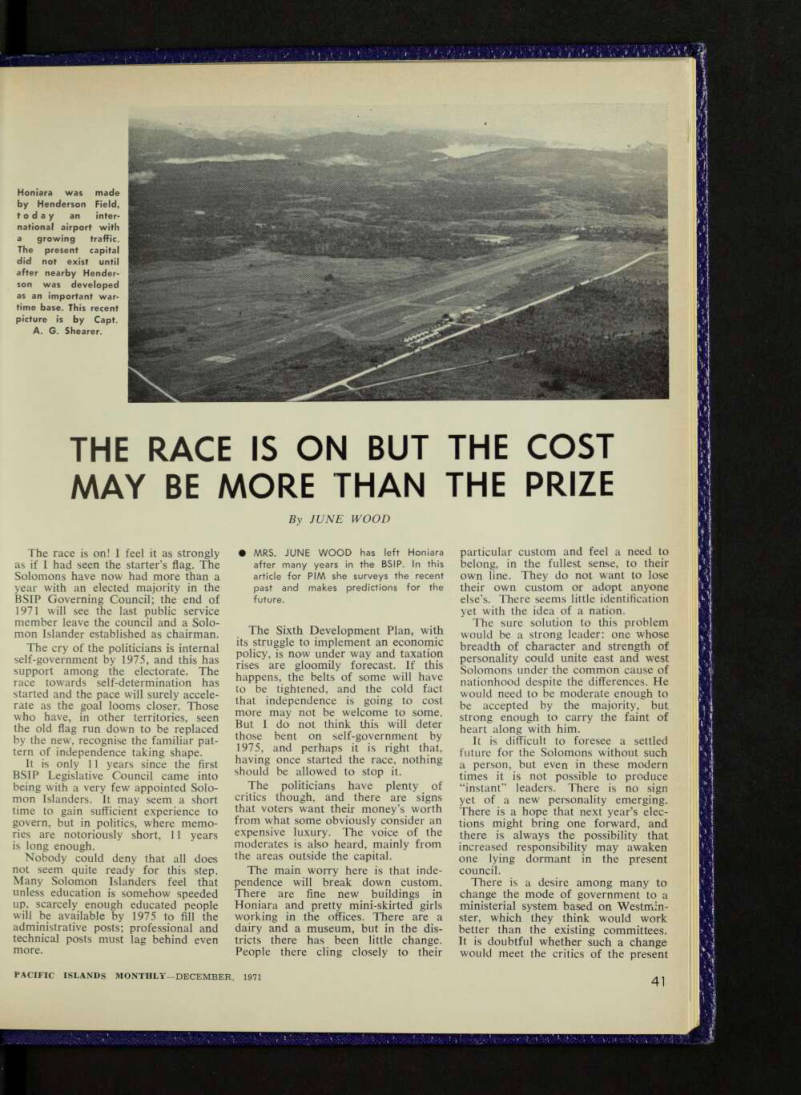
Honiara was made by Henderson Field, today an inter national airport with a growing traffic.
The present capital did not exist until after nearby Hender son was developed as an important war time base. This recent picture is by Capt.
A. G. Shearer.
Chinese worried
system, whose main complaint is that decisions are made at committee level without reference to the rest of the House. But after all, somebody has to make the decisions, be he minister or chairman, and to drag everything into debate across the floor of the House would effectively bring the wheels of government to a grinding halt.
The Chinese community is naturally apprehensive about the future. Many Chinese have worked long hours, and still do, to build up their businesses.
Solomon Islanders complain that the Chinese do not treat their labour pro perly and have little desire to inte grate.
The biggest fear though is that they are taking business opportunities away from the indigenous people. The ob server is bound to feel sympathy with both sides of this particular fence, and Solomon Islanders would do well to learn by the mistakes of other countries. By turning out the expatri ate “middle-man” some countries have found themselves without such vital agents as exporters or processers for their raw materials. Such services take time and skill to build up again.
Training in management and mar keting for Solomon Islanders has already begun under the development plan, but it may be some years before the full effect is felt. It could be fin ancially disastrous to throw out the baby with the bathwater in the Solo mons, however aggravating the baby may be.
The way Fiji handles her citizen ship problem over the next few years will doubtless have some influence on what happens in the Solomons.
How does the expatriate civil ser vant fit into the changing pattern? The civil service is traditionally good for a knock in any country, and here especially it is healthy to be able to have a go at what is often regarded as the stumbling block to progress.
Despite the criticisms that “re treads”, fresh from the vast corridors of power in larger countries, do not al ways manage to adjust their steps to the shorter passages of the Solomons, and the cry that some who have served only in the Pacific do not always wel come the experience of those from elsewhere, the present civil service is by no means the bogey man that its severest critics would have us believe.
Relations remain good, despite a few slanging matches in governing coun
cil, and seem likely to continue so.
The Solomon Islander’s confusion over the role of the civil servant is understandable. On the one hand he wants all the expert advice and help he can get, and generally he realises it. On the other hand he cannot help feeling that to have too many expatriates in the Solomons is holding back the localisation of key posts.
However, even if progress is slower than many would wish, the localisation programme is going forward.
The tourist authority has taken to describing the Solomons as the “Happy Isles” in its brochures. The
signs are that they could continue in that state after 1975, despite some inevitable upheavals. Few Solomon Islanders would seriously disagree that Solomons have earned that title under British protection, even taking mt o account some sharp clashes with authority in the past, And no expatriate, who has lived j n th ese beautiful islands and who has experienced that reserved welcome which sometimes so rewardingly gives wa y to warm friendship, could ever look back on the Solomons and the Solomon Islanders with anything but affection and gratitude.