Guadalcanal Plains
p. 41 · Read in the full issue
Harvesting war fruit on Guadalcanal Plains
From a correspondent in Honiara
Eighty ageing Japanese ex-soldiers scoured the Solomons in October digging up the fruits of war—the bones of their comrades who perished in the Guadalcanal Campaign.
The Japanese war dead in the Solomons numbered about 24,000. Many were buried where they fell. Their graves were unmarked. It was remarkable that the remains of nearly 7,000 of them were recovered in the month-long search by the Japanese Government mission. But more remarkable still were the feats of memory performed by the veterans. Many of them were able to point unerringly to the spot where comrades had fallen and been hastily buried.
The services of the local people were also obtained—for a fee. Hero Jacob Vouza volunteered information on the exact location of a number of graves and, although all the American war dead had been officially disinterred and reburied near Honolulu at the war’s end, at least one American skull was sold to the Japanese for 50c and joined the rest on the funeral pyre, the smoke from which drifted over the Guadalcanal Plains on an October day, to be followed the day after by the smoke of incense from the improvised altar at Tambea.
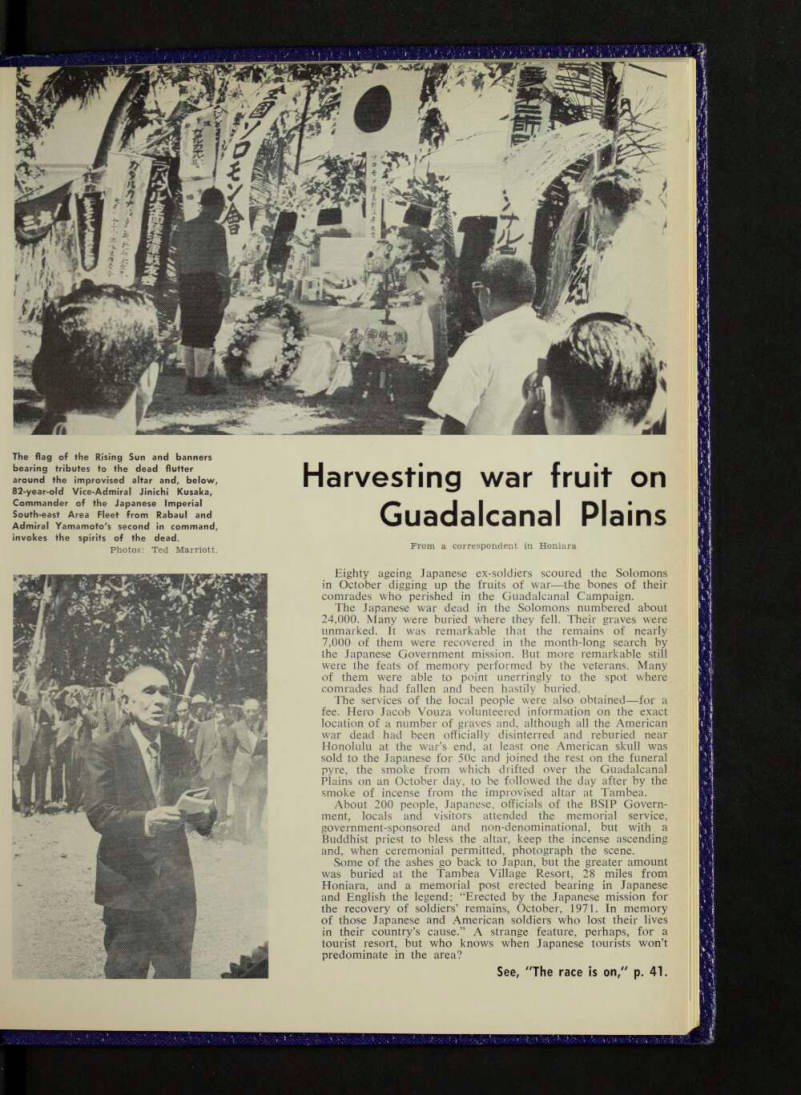
About 200 people, Japanese, officials of the BSIP Govern ment, locals and visitors attended the memorial service, government-sponsored and non-denominational, but with a Buddhist priest to bless the altar, keep the incense ascending and, when ceremonial permitted, photograph the scene.
Some of the ashes go back to Japan, but the greater amount was buried at the Tambea Village Resort, 28 miles from Honiara, and a memorial post erected bearing in Japanese and English the legend: “Erected by the Japanese mission for the recovery of soldiers’ remains, October, 1971. In memory of those Japanese and American soldiers who lost their lives in their country’s cause.” A strange feature, perhaps, for a tourist resort, but who knows when Japanese tourists won’t predominate in the area?
See, "The race is on," p. 41.
The flag of the Rising Sun and banners bearing tributes to the dead flutter around the improvised altar and, below, 82-year-old Vice-Admiral Jinichi Kusaka, Commander of the Japanese Imperial South-east Area Fleet from Rabaul and Admiral Yamamoto's second in command, invokes the spirits of the dead.
Photos: Ted Marriott.