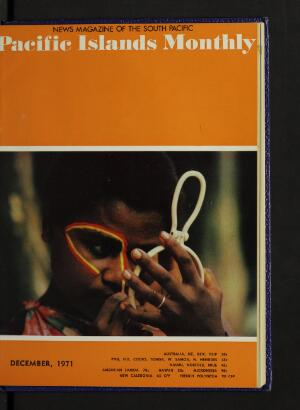
Pacific Islands Monthly
News Magazine Of The South Pacific
December, 1971
Australia, Nz, Geic, Bsip 50C
PNG, FIJI, COOKS, TONGA, W. SAMOA, N. HEBRIDES 45c
Nauru, Norfolk, Niue 45C
AMERICAN SAMOA 70c HAWAII 80c MICRONESIA 90c NEW CALEDONIA 65 CFP FRENCH POLYNESIA 90 CFP
Our Cover
Girls are the same the world over and, anyway, this New Hebridean lass has better reason than most to admire herself in the mirror. Sheree Lipton captured the pretty scene.
Advertisements & other items, pp. 2-3 (1 item)
New Guinea
WEST IRIAN
0 PAPUA
DARWIN
CORAL SEA
RINGS
50 centres throughout Papua and New Guinea on a 12,000 mile network. 100 centres in Australia.
TAA serves the lot.
Across the Territory we give you more flights to pick from.
More seats. More cargo space.
Including daily Friendship services between Moresby and all major centres. Plus daily 'Bird of Paradise’ T-Jet flights connecting the Territory with Brisbane, Sydney, Melbourne, Adelaide and Perth If you plan to take off soon, travel the Territory with TAA.
Call your Travel Agent. Or TAA. • Port Moresby 2101 • Boroko 5 3541 • Kieta 18 • Rabaul 2567 • Goroka 8 • Mt. Hagen 4 or 301 • Lae 3191 • Madang 2478 ► Wewak 103 319 3322/71
V o >r <
When you buy chocolate
always say—‘l want Cadbury’s*
Nothing else has got that Cadbury taste because there is a glass and a half of pure, fresh, full-cream milk in every half-pound of Cadbury Dairy Milk Chocolate, Look for the famous purple wrapper.
CADBURY
DAIRY MILK CHOCOLATE
the biggest selling block chocolate in Australia ■ ' ■■ -i. . i
Pacific Islands
Monthly
For the editorial contents of this issue, see p. 21
Established 1930: 42nd Year of Publication.
Owned And Published By
Pacific Publications (Aust.) Pty. Ltd.,
29 Alberta St., Sydney, N.S.W., 2000.
Postal Address: 6.P.0. BOX 3408, SYDNEY,
N.S.W., 2001.
Telegraphic Address: PACPUB, Sydney.
Telephones: 61-9197, 61-7101, 61-4369.
Chief Executives: Managing Director: R. W. Robson.
Executive Director/Publisher: Judy Tudor.
Executive Director/Business Manager: Selwyn Hughes.
Executive Director/Chief Editor; Stuart Inder.
Pacific Islands Monthly
Editor: Stuart Inder.
Assistant Editor: John Carter.
Advertising Manager: W. A. Gasnier.
Branch Offices
Fiji: Pacific Publications (Fiji) Ltd., Fiji Times Building, 20 Gordon Street, Suva. Tel.: 25601.
Fiji Times Office, Mayfair Building, Namoll Ave., LAUTOKA. Telex: 1144. Tel.: 60-422.
Papua New Guinea: LAE, P.O. Box 227; RABAUL, Mr. Steve Simpson, P.O. Box 433 c/- Rabaul Photographic. Tel.: 2677).
Representatives
Victoria: Advertising—Wilke & Co. Ltd., 37 Brown's Road, Clayton, Vic., 3168. Tel.: 544-8222.
Queensland: Advertising—Beale Media Services, 232 St. Paul's Terrace, Fortitude Valley, Qld., 4006. Tel.: 51-5827.
New Zealand: Pacific Publications, C.P.O. Box 2229, Queen St., Auckland. Tel.: 485-155.
United Kingdom: S. R. Warman, Park House, 22 Park Street, Croydon, CR9 3NP. Tel.i 01-6884177.
Overseas Newspapers (Agencies) Ltd., Cromwell House, Fulwood Place, London, W.C.I. Tel.: 01-242-0661. Cables: WESNEWS, London, DS4.
Japan: Advertising—Universal Media Corpora tion, C.P.O. Box 46, Tokyo. Tel.: 666-3036.
Agents
All main trading firms and stores in the Pacific Islands.
Pacific Publications Pty. Ltd. is the Australian agent for THE FIJI TIMES.
Subscription Rates:
"Pacific Islands Monthly" is air-freighted to all subscribers and agents in the Pacific Islands; copies to other areas go by surface mail.
Australia (including Lord Howe and Thursday Is.), 8.5.1. P., Gilbert and Ellice Is.: $5.50 Aust.; Papua-New Guinea, Norfolk Island, Nauru, Tonga and New Hebrides: $5.00 Aust.; New Zealand: $5.50 NZ; Fiji, Cook Islands, Niue and Western Samoa: $5.00 (local currency); American Samoa: $B.OO US; U.S. Mainland, Micronesia (including Guam); $lO.OO US; Hawaii: $9.00 US; New Caledonia: 750 French Pacific francs; Tahiti and French Polynesia: 850 French Pacific francs; United Kingdom and elsewhere: £3.25.
Copyright ©, 1971,
Pacific Publications (Aust.) Pty. Ltd.
Advertisements & other items, pp. 4-16 (1 item)
Burns Phiip
THROUGHOUT THE PACIFIC
FIJI. SAMOA.TONGA, NIUE Is, NORFOLK IS.
[SOUTH SEA) CLITI^^H
U\
REGISTERED OFFICE: SUVA, FIJI.
TELEPHONE NO; 22661
TELEX NO: FJ1127
Code Address: "BURNSOUTH'
SHIPPING AGENCIES
The New Zealand Shipping Co. Ltd.
Shaw Savill & Albion Co. Ltd.
Blue Star Port Line (Management) Ltd.
Bank Line Ltd.
General Steamship Corporation Ltd.
Compagnie des Messageries Maritimes Royal Interocean Lines Daiwa Navigation Company Ltd.
Sitmar Line Flotta Lauro (Lauro Lines) Australasia Pty. Ltd.
Tonga Shipping Agency.
EXCLUSIVE
DISTRIBUTORSHIPS
INCLUDE
Akai Taperecorders Sunbeam Appliances Dunlop Products Hitachi Electronics Holden Motor Vehicles Rolex Watches Revlon Cosmetics Pentax Cameras Massey-Ferguson Tractors Olympic Tyres Penfold Wines
AGENTS FOR
Queensland Insurance Co. Ltd.
Shell Company (P. 1.) Ltd.
Bureau Veritas
ASSOCIATED COMPANIES
Burns Philp (New Hebrides) Ltd.
Burns Philp Trustee Co. Ltd.
Automotive Supplies Co. Ltd.
Corrie & Co. Ltd.
Wrought Iron and Steel Construction Co. Ltd.
Bish Ltd.
SPECIALISED SERVICES
Expert advice on Shipping,- Forwarding; Customs formalities; Insurance.
COMPLETE TRAVEL
SERVICE
accredited agents for the
INTERNATIONAL AIR
TRANSPORT ASSOCIATION
OVERSEAS AGENTS: SYDNEY • LONDON • SAN FRANCISCO
Australian food is selling well
The Australians bring years of experience to the business of food production and they process it to the world's highest standards. Good reasons why consumers throughout the world associate the label "produce of Australia" with high quality.
In over 150 countries people are buying high quality food from Australia. Delicious dairyfoods, canned, dried and fresh fruits, meats, seafoods, wines and groceries of all kinds.
Attractive packaging, consistent advertising and regular promotion are helping importers achieve bigger sales of Australian foods ($A1,230 million - $U51,387 million - in the year 1969/70) - and consumers are buying Australian food at an ever increasing rate - a 25% increase in the last year.
Importers with an eye for business - and customers with an eye for value - order fine foods from Australia.
what's in Australia for you?
Find out today. All you have to do is contact the Australian Government Trade Commissioner who will put you in touch with suppliers of Australian products: cnr. Pratt and Joske Streets, SUVA (P.O. Box 1252). Tel: 25624.
Australian Department of Trade and Industry
m
SOME OF THE FIRMS
WE REPRESENT ARE:
Frappier (French Brandy) Huvet (French Brandy) Sunshine Biscuits Sunrise (Confectionery) Flamenco (Instant Coffee) Quaker Products (Oats, Jets) Merchants (Canned Soft Drinks, Cordials) Hancocks (Spaghetti, Cereals) Melbourne Canning (Jams) Water Wheel (Flour, Sharps, Wheat) A. P, & D. (Twisites, Twirlies) Edward Zorn (Margarine, Cooking Fats) Allens (Confectionery) Robert Timms (New Guinea Gold Instant Coffees and Teas) Highness (Canned Vegetables, Fruit Juices) S.P.C. (Abalone) Lunchtime (Honey) Wing Lee (See You Sauce) Magnet (Mattresses) Esteel (Cookware) Warner-Drayton (Fans) Mitchell's (Abrasives) Regent (Swiss Watches) Gainsborough (Furniture) Austramax (Pressure Lanterns) Preservene (Soap Products) Lawn Chair; Tubco (Garden Furniture) Sunrise Lustertone (S.S. Sinks, Plumbers' Supplies) Electronic Industries (Electrical Household Appliances) Jex (Steelwool) Arnbro (Folding Beds) Elmaco (Plastics —Electrical Fittings) B.X. (Plastics) Franklite (Light Fittings)
S. E. TATHAM
& Co. Pty. Ltd.
MELBOURNE, AUSTRALIA
P.O. Box 8, Cables "SET"
Telephone 60-1125
EXPORT AGENTS
PACIFIC ISLANDS
AGENTS
Australian buying and shipping agents for the Gilbert and Ellice Islands Colony Wholesale Society % 1 % % 1
DIRECT ENQUIRIES WELCOMED
Associate Company
S. E. TATHAM (FIJI) LTD.
Suva, G.P.O. Box 671.
Lautoka, P.O. Box 366. i
SINCE 1924
Little things from Holbrooks
mean a lot.
r miolbiiooks sweet mustard pickles malt vinegar A i f ©
SBLEIMItIIw :
white vine§af olives whiten : ■tel gherKi#- It’s the little things that really make a meal.
That’s why it’s important that the little
things you buy HOLBROOKS
come with a big name.
Trade Enquiries: Reckitt & Colman Pty. Limited., 44-96 Wharf Road,
WEST RYDE. 2114. N.S.W.
Cables: Rcckitts Sydney.
RC 6702
A
great bunch
of flours.
Robert Hutchinson makes the greatest bunch of flours in the Pacific. Bakers’ flour.
Superlite cake and sponge flours.
Biscuit flour and cracker flour.
Wheatcn sharps and wheaten meal.
We’re particularly proud of our bunch of flours. So we have a technical advisory service to help you use them properly.
So next time you see a Robert Hutchinson flour (or even one of our Hutmill stock feeds), remember it’s just one of the bunch.
A
ROBERT
HUTCHINSON
LIMITED
(he flour people
Hartington Street, Glenroy, Victoria, Australia. 3046. Telephone Melbourne 306 7261 rhicw
Bank of Hawaii
the bank of the Pacific w\ r -V *, v v ■ ■.■-ii.rf,'; r.', #■*. .• .- . V : .
When it comes to full banking services for the Pacific, Bank of Hawaii’s got you covered.
With over 65 offices to serve you throughout Hawaii, plus Guam, Koror, Yap, Roi Namur, Wake, Kwajalein, Ponape, Midway, American Samoa and an affiliate with Banque de Tahiti. When it comes to financial assistance reach for Bank of Hawaii.
3 V il I % i mm ■ . m V .
you need the
Esso cure from
BRECKWOLDT & CO.
This is the best combination to solve your lubrication troubles.
Esso quality combined with specialist knowledge will eliminate all your "lubrication headaches.”
Contact your local Breckwoldt Branch for the cure. (Esso 1866/86
How to catch a 74Z
NORTHBOUND 747 FLIGHTS
SUNDAY, THURSDAY
Depart NADI 11.05 p.m.
Arrive HONOLULU 7.05 a.m.
Arrive LOS ANGELES 4.55 p.m.
Pan Am 747 s are also flying between Hawaii and the Orient and California and Europe.
SOUTHBOUND 747 FLIGHTS
SUNDAY, THURSDAY
Depart NADI 6.45 a.m.
Arrive SYDNEY 8.55 am.
Nadi: Nadi Airport, 72-100 Suva: 38 Thomson Street, 25-657 Now, you can catch Pan Am’s 747 here in Fiji. The plane with all the room in the world flies twice a week to Australia, and twice a week to Honolulu and the U.S.A. If you feel you need a change of plane, call your Pan Am travel agent right now.
Fan Am’s 747-
The plane with all the room inlhe world. *** \ fi Mww l . 1 065.P.1728
n I V v» p \ #• J aw \ H -<!* t I
You’re Sitting
With the
of the World...
Executive Chair!
\nyone confined behind a desk knows his productivity, efficiency and work output greatly de jends on personal comfort. That's why smart managers in 52 countries choose the Fujiset 1000 W Executive Chair. fhe extremely comfortable, durable Fujiset Executive Chair features 3 stylish, rugged fabric upholstered seat top with tough vinyl seat sdges and backrest, attractively constructed on a beautifully finished aase with 2 inch hooded casters.
Every outstanding Fujiset product is designed for comfort and Functional convenience, and the Fujiset Executive Chair is available in a wide selection of colors and metal finishes to enhance the decor af any office.
Besides the above, 30 different :hairs and desks for office use are available from us.
L.
Trading Co. r Lt<L
2l 2-CHOME YOYOGI,SHIBUYA-KU,TOKYO 151,JAPAN
DISTRIBUTORS WANTED Ph ' e - Tokvo 379-3210 Cable. Address: CHAIRFUJISET
MFI POST HOLE DIGGER
MF4O LOADER
*• m
MFI2 TRANSPORTER
m
MF2I TRAILER
MF2I MULTI-PURPOSE BLADE
One man
and a Massey-Ferguson 135
can do almost anything
ASK YOUR MASSEY-FERGUSON DISTRIBUTOR FOR COMPLETE DETAILS ... THE MAN TO SEE IS HERE
PAPUA AND NEW GUINEA
Ela Motors Limited.
P.O. Box 75,
PORT MORESBY
Branches and Dealers throughout Papua and New Guinea
FIJI, TONGA, WESTERN
SAMOA AND OTHER SOUTH
PACIFIC TERRITORIES
Motor Division, Burns Philp (South Sea) Co. Ltd., P.O. Box 355,
SUVA, FIJI
Branches throughout the region
NEW CALEDONIA
Pacific Motors, S.A.,
B.P. 41, NOUMEA
BRITISH SOLOMON ISLANDS
R. C. Symes Ply. Ltd.,
HONIARA, GUADALCANAL
TAHITI
Els, Donald,
P.O. Box 131, PAPEETE
NEW HEBRIDES
CONDOMINIUM
Pentecost Pacific S.A., Santo and Port Vila
The easy way to
wipe out weeds-
spray'Gramoxone’
Id’s ‘Gramoxone’ (now manufactured by ICI in Lae) has revolutionised weed control in coffee, tea, cocoa, coconuts and rubber. Weeds are now able to be controlled quicker and cheaper than ever before resulting in increased yields and lower costs. ‘Gramoxone’ has proved itself essential to all plantations in these days of rising costs. ‘Gramoxone’ is safe, economical and can be combined with ICI ‘Diurex’ for long term weed control. ‘Gramoxone’ is made in New Guinea you can get supplies whenever you need them. *'Gramoxone’ is the Trade Mark of Plant Protection Ltd., England.
ICI (N.G.) Pty. Ltd., Box 1105, Post Office, Lae.
Telephone: Lae 3301.
Cables: ‘lmpkemix’.
ICI
■e, h K s
A new audio product from
Japans audio-only specialist
■ m 3 -3-tt xvx.-.;x3::>v*v . ...
Sansui's 210 A solid-state
2-band SW/MW tuner with stereo amplifier
You seldom find a high-class receiver and stereo amplifier in one compact package. But here it is.
The 210 A offers flawless reception in both MW and SW bands and boasts such big-receiver characteristics as extraarge tuning meter, direct tape monitor switch, and high-sensitivity ferrite bar antenna.
Silicon circuitry throughout guarantees axceptional signal-to-noise ratio and very wide dynamic range for fine-grained, high-linearity sound.
All of this is housed in one luxurious walnut cabinet with silver-gold aluminum panel. Uncompromising quality from the inside out. From Sansui, Japan's audioonly specialist.
SctnSTil.
TH 7n i^ A / Tfp v r> w mat 6 i> ad H . OUSe 1 , 3 ' Mldst ° ne Street ' Crey Lynn Auckland 2, New Zealand. Tel: 763064 / PRABHU BROTHERS LTD. P.O. Box 183, Nadi, Fiji Islands Tel 56406 Jin, mow *roo “VA p®"* Patee ' 6 ' ° 3 ' 29 / OCEANIA AGENCY P.O. Box 5518, Boroko, Port Moresby, Papua & New Guinea.
Box Te ‘ : 2954 1 CHIN ” MEEN & SONS P / L Tabarl Place - P °- Box 1106 ' Boroko. Tel: 56546/Kamarere Street, P.O.
Tel- 56445 / P , N CSmI hlcw P/ p & ? ' L S ‘ ree '' P ° 11 ° 6 ' B ° r ° k ° Tel: 56338 / SEETO KONC & SONS P/L Taurama Road, P.O. Box 1218, Boroko.
MICHEL MERC ERaIT D R Al c k°* M ‘ HaBe " 385 ‘ BOUCA,NVILLE COPPER Canteen, Panguna / PHOTOSON.C P.O. Box 519, Madang Tel: 2503 / !! IT t S baS,OPO ' BP - 1123 N ° Umea ' Nouveue ' Caledonia Tel: 59-11 et 40-78 / SANSUI ELECTRIC CO., LTD. 14-1 2-chome Izumi juginarm-ku, lokyo, Japan ' ' 9
iW*: ' m Wc ■ m m H m m m mm m mm ■. &**
Give your family
these all-time favourites
from Arnott’s
Everybody likes them! Nourishing Milk Arrowroot... tasty Nice... delicious Coconut Bar... the egg-and-butter goodness of Scotch Finger... they’re all-time family favourites from the great big Arnott’s range. Taste them!
The triple-wrapped packs keep the biscuits fresh.
Qrnott's/ Biscuits
There is no Substitute for Quality
Up Front
with the Editor
It’s too early yet to know if a law recently passed in Papua New Guinea will have its intended effect in reducing the number of tribal revenge killings, but the fact that the law is needed at all is a reminder of the variety of social problems that face that territory.
In the next three months Papua New Guinea will hold general elec tions that will enlarge the legislature to 100 elected members and prepare the country for full self-government by 1976, possibly earlier. It’s natural in these circumstances that we should hear a lot about the territory’s political problems rather than its social ones. The Australian news papers are filled with stories on new political parties, or old ones given a new direction, of fears by the Papuans that New Guineans will dominate the government, of secession moves on Bougainville, New Britain and Lord knows where.
But while this inevitable politicking goes on among the elite, out in the bush the population has no concept of government, let alone self-govern ment. I can never fly over those mountainous New Guinea landscapes without pondering the enormity, per haps the improbability, of getting any political coherency from the people covered in pig grease who occupy the scattered hamlets below.
The vendetta is still a way of life in too many of those hamlets. The term New Guinea uses for it is “pay back killing”, and most of the 60 to 70 convictions for murder in Papua New Guinea every year stem from paybacks. Traimya Kambipi, member for one of the rugged Highlands areas, Kompian-Baiyer, explained the pay back system eloquently in the House of Assembly a few months ago: “Western societies live in larger com munities and have a common culture, whereas here we live separately in tribal groups and have varying or completely different cultures. For in stance, during my grandfather’s time a member of his tribe was murdered, but owing to difficulties at the time a payback was not carried out. My father took over from his father. He
would remember this and if he failed to do it, this responsibility for revenge would fall on me”.
Thus murder becomes a tribal custom, with the killer earning the gold honour badge for upholding tra dition. Traimya Kambipi again: “This was part of our culture long before Europeans penetrated our land. When a tribe wronged another tribe the solution was payback, whatever the offence. Payback is still in the minds of the people of Papua New Guinea.
A portion of our present generation is aware of the foreign-introduced law and order and fear it, but those who have not gone very far away from our traditional activities still carry on with payback killings.
“Those of us who have known two cultures may try to deny the fact, but it is not very easy for our tradition oriented people suddenly to drop all traditional ways of thinking and do what modern people do. Even some of us tend to be involved in payback killings in an indirect way by telling or encouraging our traditional tribes men to cany out a payback killing.
This practice has remained with us even as we grew and learnt new things”.
Because of the tradition, one of the major problems of the government in dealing with paybacks is that often the man who does the killing is not the instigator, but simply somebody selected by the tribal leaders to do the job. The new law (the Criminal Code Amendment Bill 1971) makes it an offence for anybody to encourage an other person to kill, or to withhold the information that a killing is planned, or to hide knowledge of a killing that he knows took place. The new law thus gives the government greater opportunities to break the sys tem down. Nevertheless, nobody believes that the payback system can
be eradicated as simply as that. The new law is merely an extra weapon for fighting it.
Paybacks won’t stop until the people who support the tradition are convinced that it is not worth their while to carry on with it. Most New Guinea politicians believe the best way of convincing people is to stiffen penalties for murder. It is probably true that most Assembly members would like to see New Guinean mur derers hanged, or at least sentenced to life imprisonment. Short sentences they believe, rightly, are a holiday.
The killer gets well fed and clothed and often comes home fatter and more prosperous, wth his reputa tion enhanced.
Papua New Guinea, like most Aus tralian states, does not believe in capi tal punishment, thank heaven. The problem faced by New Guinea courts is to know what a fair penalty is for bush kanakas whose daily life is so tough that prison is a welcome im provement. In those circumstances, iustice is neither done nor appears to be done to the friends and relatives of the man or woman whose head was bashed in by an axe, and thus the payback cycle continues.
The government currently is look ing at another possible weapon for its armoury—that of supporting by the force of law the tradition of com pensation which would make it legally mandatory for compensation to be paid by the killer’s group to the vic tim’s group. As a weapon it would hardly be the deterrent that nuclear warheads currently are to the people of the West —but then, when you are dealing with Stone Age philosophies, solutions are not nearly so simple.
It's worth remembering that while some sections of Papua New Guinea are ready for self-government, the problems will come from that vast silent majority in the hinterland ham lets who are going to get it whether they understand it or not. —Stuart Inder
Advertisements & other items, pp. 17-18 (1 item)
Guinea
Keep well informed
on
New Guinea affairs
by reading
NEW
GUINEA
AND AUSTRALIA,
THE PACIFIC AND
SOUTH EAST ASIA.
Don't miss reading in the latest issue .. .
* WHERE IS THE
SOUTH PACIFIC
COMMISSION GOING?
—W. D. Forsyth. 75c a copy ($2.80 Aust. a year) at your bookstore, or direct from: The Sydney and Melbourne Publishing Co. Pty. Ltd.
29 ALBERTA STREET, SYDNEY,
N.S.W. 2000.
(Postal Address: Box 1813, G.P.0., Sydney, N.S.W. 2001.)
m
Australia,the
healthy country
Many things make Australians healthy. Perhaps the major reason for their health is Australia itself. It has been called the lucky country. It is a land of bright sunshine, dean air and green pastures.
A rich land with thriving dairy herds and abundant dairy products...butter, cheese, skim or full cream milk powder, ghee, sweetened condensed or evaporated milk, butter oil, infants’ and invalids’ food.
These same dairy products are available here.
Pure, fresh and nourishing. Try them today.
Australia’s best is the world’s best.
V Always look for the word ‘AUSTRALIA’ on the labd.
Trade enquiries to: the Australian Trade Commissioner in your area, or to the Australian Dairy Produce Board, G.P.O. Box 1657 N, Melbourne. 3001. Australia. 7533 y
PIM for Christmas
If you hurry, PlM's circu lation department can still arrange a 12-month sub scription to PIM for friends as a year-round Christmas gift, the first copy to arrive at the beginning of January.
You'll find the subscription rates on p. 1.
Advertisements & other items, pp. 19-22 (1 item)
AUth
> ■•; *, 'i ii 1
ism
o
e lonacco
Every year, Rothmans buys the finest Virginia tobacco no matter what the price.
N c Hl % JW3 2144
ROTHMANS-FAMOUS FOR QUALITY SINCE 1890
The Toyota Celica
is your dream car
come true
IP- J
fe'* £ ‘ '
■ Veliky
* ■ I K m m % s m : - -■ m wm r > m : r -! a wa® ma s M '■ I n B
PAPUA NEW GUINEAELA MOTORSLIMITED.
Scratchley Rd., Badili, Papua
U.S. TRUST TERRITORY MICROL CORPORATION,
P.O. Box 267, Saipan
FIJI ISLANDS AUTOMOTIVE SUPPLIES CO., LTD.,P.O.
Box 355, Suva
AMERICAN SAMOA BURNS PHILP(SOUTH SEA)CO.,
LTD., Pago Pago WESTERN SAMOA BURNS PHILP(SOUTH SEA) LTD., Apia GUAM RICKY'S AUTO CO., P.O. Box 1458, Agana NEW HEBRIDES NEW HEBRIDES MOTORS LTD., P.O. Box 18, Vila SOLOMON ISLANDS ZEPHYR SERVICE STATION PTY LTD., Honiara NEW CALEDONIA SOCIETE D’IMPORTATION AUTOMOBILE DU PACIFIC, Noumea
TAHITI ESTABLISSEMENTS E.A.
MARTIN & FILS, B.P. 61 Papeete
COOK ISLANDS
COOK ISLANDS TRADING
CORPORATION LTD., Rarotonga
TOYOTA
Nescafe has developed a *, completely new kind ojtgeftee. mm You can see the difference. New Nescafe takes all the flavour of those famous 43 beans and turns them into instant coffe granules big chunky granules that melt instantly in your cup to give you the biggest coffee flavour the coffiest coffee you’ve ever tasted % JW
New chunky
capture all the
natural flavour
of choice
coffee beans
In This Issue
General
Copra market ... 25 Story of the Island Agent 44
American Samoa
Dr. Margaret Mead's return 27 Congressional sub-committee's visit ... 33 Youths clean up beaches 34 Aunuu for tourists 57 Dairy factory opening 100
Cook Islands
Food shortage 26 Postal officer retires 32 Wage rises 33 Green oranges 35 Fate of "Moana Roa" 93
Fiji
Budget meeting 24 Air Pacific extends 27 Speaker's election campaign 32 New FBC manager 32 Petition mislaid 34 Six die in fire 34 Arts festival 34 Banabans' struggle 79 Ports commission 93 Trade war 97 PRO retires 117
French Polynesia
Tahiti letter 28 Legends of Polynesia 80 Book on French Pacific Islands 82
Gilbert And Ellice Islands
New stamps 24
Lord Howe Island
Fossil found 34 Shipping service 91 Air strip to be laid 101
Nauru
Air service ... 25
New Caledonia
Helen Rousseau's diary 30 Fire on Isle of Pines 34 Port extensions 85
New Hebrides
Land question 25 Embryo political party 33 Christmas stamps 33 Earthquake pictures 89, 99
Niue
A new way with canoes 59 Resident's death 117
Norfolk Island
1884 report on island 71 New hymn book 75 Historical documents 77 Preserving historic buildings 82 Karlander shipping service 91
Papua New Guinea
Final session of House of Assembly 22 University's new vice-chancellor ... 32 Election dates 33
Independent broadcasting 33
Drink bill 33 New writers wave nationalist banner 49 Percy Chatterton's column 50 A look at Daru 55
Seamen's wage rise 91 Big loan for port projects 93 Common Market 97 Own currency 100
Solomon Islands
Budget meeting 23 Copra market 25 40-hour week 26 First Islander district commissioner .. 32 Japanese war dead 39 Race for independence 41 A look at Laulasi 55 Archaeologist's finds 123
Tonga
Sunday observance laws 25 Search for treasure 26 Arts Festival 34 Oil search 99 Bank planned 99
U.S. Trust Territory
New mayor in Truk 32 Oyster expert's survey 32 Congress site 33 Hotel opens at Majuro 34 Hana meeting 35 Better harbours for Marshalls 93
Western Samoa
Budget meeting 23 Hovercraft for ferry service 131
DEPARTMENTS: Up Front with the Editor, 15; People, 32; In a Nutshell, 33; Editor's Mailbag, 35; From the Islands Press, 53; Yesterday, 62; Magazine Section, 71; Book Reviews, 79; Pacific Shipping, 85; Cruising Yachts, 94; Business and Development, 97; Produce Prices, 103; Shipping and Airways Information, 105; Deaths of Islands People, 112; Postscripts, 117; Advertisers' Index, 112.
Pacific Islands Monthly
End Of Session Blues (And Higher
Taxes) For Some Islands People
From a Port Moresby correspondent
For the greater part of the four year life of the Second House of Assembly, “party” has been a dirty word. During the last twelve months, however, the pendulum has swung with a vengeance, and one Euro pean MHA has expressed a fear that party politics is in danger of be coming a cult.
It was perhaps to be expected that our young parties currently flexing their muscles would engage in a bit of skirmishing during the last meeting of the Second House in preparation for the elections which will produce the Third House. But the violence of the emotions evoked by these skirmishes was unexpected and dis turbing.
It began on the first day of the meeting when Tim Ward, a member of the United Party, produced a document containing cargo cult type promises allegedly made by the Pangu Party, and insisted on debating it as a matter of public importance.
The debate generated a lot of heat and noise, but from the point of view of United Party campaigning was rather a damp squib. A Pangu Party spokesman was able to point out that the local government council president over whose name the promises appeared was not a mem ber of Pangu, but was in fact reputed to be, if not a member of, at least a sympathiser with the United Party.
It was bound to be only a question of time before an opportunity for “pay-back” cropped up; and a week later Pangu Party leader Michael Somare produced a letter over what was, or purported to be, the signature of none other than the United Party’s secretary, Anton Parau a letter which, it was alleged, had been circulated among Highlands students, and which was couched in terms well calculated to increase existing tensions between Highlands and Coast. This document, too, was debated as a matter of public importance.
This debate, like the earlier one, produced emotional outbursts un equalled before in this young parliament. Interjections were almost
continuous, the din sometimes be coming so great that Mr. Speaker’s calls for order could not be heard.
At one point the Speaker threatened to suspend the sitting.
The only speech listened to with out interruption during this debate was one by prominent Papuan politician Gala Oala-Rarua, in the course of which he remarked acidly that he was not a separatist and was still hoping for national unity in Papua New Guinea, but that if the New Guineans were going to quarrel among themselves with such ferocity, Papuans might do well to consider whether they would not do better going it alone.
It was Gala Oala-Rarua who secured the addition of a rider to the motion “taking note” of the revised Five Year Plan, calling on the government to promote balanced development of all areas rather than
maximised development of those areas which promise maximum returns.
Another exercise which had a strong smell of electioneering about it was a United Party instigated and supported move to raise the deposit demanded of candidates in House of Assembly elections from $5O to $lOO.
This proposal was opposed by Pangu Party, several independent members and a solitary United Party member, Fr. Nilles.
These objectors pointed out that the increase would favour firstly sitting members, whose salaries and allowances continue through the campaign period, and secondly affluent candidates and affluent parties. Pangu’s enfant terrible, Pita Lus, made no bones about accusing the United Party, reputedly the most affluent of the three parties repre sented in the House, of using this ploy to entrench its own position by reducing possible opposition to its candidates.
The proposal was nevertheless im plemented by a substantial majority.
Confrontation between parties was succeeded by confrontation between official and elected members. A gov ernment white paper on the future security of permanent overseas officers in the Public Service had been debated, and the usual motion to “take note of the paper” had been amended in terms which in effect amounted to a rejection of the pro posals contained in the paper.
This put the government in a quandary, as it had prepared a series of bills framed to give effect to the white paper’s recommendations.
Senior Official Member Tony New man, unwisely as it turned out, decided to bring down the bills regardless.
The amour propre of the House was affronted; those arch-enemies, the United Party and Pangu, joined hands, and with the Peoples’ Progress Party rallying to their support the government was forced to its knees and obliged ignominiously to with draw the whole group of bills. It was Konedobu’s most resounding defeat
Warm tributes were paid by members of the PNG House of Assembly in November to the work of Mr. Percy Chatterton, MHA, 73, retired missionary and long time parliamentarian and resident of Papua, who will not contest his seat in the House next year. He says he wants to relax—which nobody believes.
in eight years, and a sign that the Administration can no longer depend on its once faithful Highlanders.
However, Tony Newman had better luck with his Public Service (Promotion and Recruitment Pro cedures) Bill, which not only got a hearing but was, with one or two minor amendments, passed through all stages. This bill abandons the time-honoured Australian promotion and appeals system for a simpler one, which, it is hoped, will not only be less time-consuming but will also avoid a repetition of those awkward incidents in which a local officer is promoted only to lose his promotion on appeal by an overseas officer.
The closing days of the meeting found two diametrically opposed private members’ bills being brought down on the same day. One sought to re-establish the death sentence as the mandatory punishment for wilful murder. The other sought to abolish capital punishment altogether.
One would have expected that there would be strong support for the “hang the lot” school of thought, especially among the Highlanders.
Surprisingly there was not, in spite of much concern among members over the rising tide of lawlessness in the towns and in some parts of the thickly populated Highlands. Equally surprising was the large measure of sympathy with the proposal to abolish capital punishment. As John Poe, a young Papuan representing a New Guinea electorate, said crisply, “If you put the wrong man in prison, you can let him out again, if you hang the wrong man you can’t bring him back to life.”
However, after debate, the House accepted the Secretary for Law’s advice to leave the law as it stands, and defeated both bills on the voices.
So the judges will retain their present discretion to substitute a term of imprisonment for the death penalty in cases in which they consider that there are extenuating circumstances.
The question as to whether the law should give the judges more guidance as to what may properly be con sidered to be “extenuating circum stances” was left over for a future House to decide.
As the meeting drew to its close the Administrator visited the House, and addressed it with his customary clarity and conciseness, speaking in English, Pidgin and (for the first time in public) Motu.
The final exchange of verbal bouquets took place in a House from which more than half the members had departed to begin their election campaigns. Speaker John Guise sped the remainder on their way in a closing speech of benignity and charm.
Brakes off
in Samoa
From FELISE VA’A, in Apia It was all brakes off in Western Samoa’s financial machine when Minister Tofa Siaosi produced his budget in November. “Development and more development” was his mes sage.
And to hit the target, the govern ment has shown its readiness to budget for deficits in the estimates and to borrow large sums from abroad, which represent major shifts in policy.
The Mataafa Government was ultra-conservative in its approach to government and local affairs. In its budget policy it urged moderation, caution and balanced estimates. It did consider loans, but not to the extent now proposed by the new government.
Not surprisingly, therefore, the Finance Minister’s estimates for 1972 contained budgeted receipts of $8,997,430 and payments of $9,420,780 resulting in a budgeted deficit of $423,350.
Total estimated revenue is made up of ordinary revenue from gov ernment departments of $7,808,780, grants of $202,700 and various loans totalling $985,950.
On the expenditure side, capital and maintenance will total $6,925,045, statutory expenditure $534,181 and development expenditure $1,961,554.
With money from other sources, total development aid for 1972 will probably be in excess of $3 million, said the minister.
The largest individual depart mental allocations have been made to education $1,088,350, health $950,670, public works $655,670 and agriculture $383,500.
Although the 1971 main and sup plementary estimates budgeted for a deficit of $432,900, it was likely that government receipts and pay ments would be about balanced for the year, Minister Tofa said.
The minister had mixed feelings about Western Samoa’s export trade.
He was happy about the considerable improvement for the first nine months this year as compared with last year’s exports, but there was a noticeable drop in two of the main exports, cocoa and bananas. Cocoa exports of 1,694 tons earned $791,800 over the first nine months, a shortfall of 316 tons and $47,200.
Banana exports for the nine months
brought in $422,200 as compared with $430,000 in the corresponding period of 1970.
The biggest gainer was copra with 12,326 tons exported as compared with 9,619 for the same period last year.
The minister blamed the weather for the decrease in cocoa production, and irregularity of shipping, diseases and increased local consumption for keeping the banana exports down.
However, despite decreases in the cocoa and banana exports, total exports receipts for the first nine months came to $3,296,200 as com pared with $2,802,200 last year.
Timber was mainly responsible for the healthy look of exports, showing a spectacular leap in revenue from $4,600 for the nine months last year to $195,900 this year. The rest of the exports totalled $378,000, a healthy $43,000 over the $335,000 last year.
Increased overseas sales of taro were mainly responsible.
the Solomons
Tax blow for the Solomons
.From a Honiara correspondent On the evening of November 11, in places where Solomons workers gathered for a drink, a smoke and a talk after the day’s toil, easily the most popular unpopular subject of the conversation would be Financial Secretary John Smith and his budget.
Earlier in the day he’d taken the lid off his tax proposals and made it pretty clear that if the islanders want progress and all that goes with it then they’ll have to pay for it by paying more, in the first place, for their luxuries.
And he drove his point home with what smokers and drinkers would call a “brutal hand”. He slapped a $6 a gallon tax increase on spirits (i.e., $1 a bottle); 20c a gallon on beer; 10c a pound on twist tobacco and $1.05 a pound on cigarettes, but drinks and smokes are still cheaper than in most places.
He also added 1c a pound to the sugar tariff, 5 per cent, ad valorem to imported meat and for the first time ever squeezed the ice cream lickers with a 20 per cent, ad valorem duty.
His justification “No absolute necessities” had been taxed; he had to ensure all sections shared in revenue raising and, anyway, the extra duty on meat and sugar meant only an increase of $1.54 for each
of the 31,000 households. He was hoping also that dearer foreign meat would help the local meat cattle in dustry.
There was a little cheer for the copra planters—removal of the $7 a ton export duty though the 10 per cent, ad valorem levy remains. Mr.
Smith wanted a total of $13,351,400 with $6,031,010 to be raised locally and the rest coming from UK grants.
The Secretary of State, however, put a brake on recurrent spending by lopping $186,240 from the $1,900,000 grant-in-aid and refused to allow Mr.
Smith to budget for a $145,680 deficit. The capital budget is a record at $5,853,125.
Although he warned that “1972 will need all our determination and enthusiasm to see our budget pro posals implemented”, Mr. Smith was optimistic about all sorts of things.
TTie Development Plan was going well with 58 of the 286 projects already approved for aid and 32 more waiting, most of them in agriculture.
The oil palm project on Guadalcanal Plains was under way with the first 1,000 acres due for planting by mid -1972 and 250 islanders working on it by the year-end.
Other projects looking up were, rice cultivation on Guadalcanal Plains, meat production, timber— expected to reach 9 million cu. ft by the year-end—the skipjack fishing in dustry survey by the Japanese Taiyo Fishery, tourist industry expansion, exports, which should top $8 million at December’s end, nearly $1 million more than last year, and shipping, which showed a big increase of arrivals over last year’s figure—l3o in the nine months to September against 107 last year.
Then, doing some crystal gazing, Mr.
Smith described economic prospects as excellent with bauxite mining scheduled to begin on Rennell Island in 1975, the proving of a second major bauxite deposit of 30 million tons on Vaghena Island and a feasi bility study of nickel resources on Isabel.
He was cautious about bauxite mining, however. There was a sur plus of aluminium in the world and, therefore, less demand for bauxite and—what was more ominous news —in recent months technological advances have resulted in the produc tion of aluminium without the use of bauxite. There might, he warned, be some delay in the plans regarding Rennell.
But John Smith was nothing if not optimistic. They looked like having so much bauxite there was a chance they could do their own processing and, whatever happened, it looked as
if fishing would be so good their present trade deficit could be turned into a surplus by 1974.
Inflation! That was another danger which he suggested the Solomons could counter by becoming “increas ingly self-sufficient in basic foodstuffs —the most powerful weapon in our armoury against externally - imposed inflation”.
The Secretary of State’s cut in the grants and his refusal to allow a budget deficit a decision which reached Honiara only two days be fore Budget Day—brought a storm of protests from members. Forced to make cuts in agriculture, educa tion, and medical spending, Mr.
Smith faced some angry speakers.
One called the Secretary of State’s handling of the matter “irresponsible” and, at first, no one would accept any cuts.
They had to be realistic, however, and by the debate’s end they had agreed to cuts of $230,000 but were adamant over other items totalling $102,000. They insisted that it was now up to London.
GEIC will mark two international anniversaries in December with the release of two new stamps series, one to mark the forthcoming 25th anniversary of the signing of the Canberra Agreement which established the South Pacific Commission, and the other the 25th birthday of UNICEF. Both issues will be of three denominations, 3c, 10c and 35c. Above is the 10c UNICEF stamp featuring one of the colony's children and UNICEF's emblem. The other stamp is the 3c South Pacific Commission stamp which shows a map of the South Pacific with the commission's area outlined and the Gilbert, Ellice and Line Islands picked out in red.
Fiji's doing
well, thanks
From a Suva correspondent There was no doubt about it.
When Fiji’s Minister of Finance Wesley Barrett disclosed his budget secrets to the House of Representa tives on November 26, it was plain to all that the dominion, in the 13 months it has paddled its own canoe, had done very well.
On the surface it looked as if inde pendence was costing a lot. Mr.
Barrett was budgeting for a record spending of $74,979,086, which is $25,487,148 more than this year’s figure, but he wasn’t worried about it. The dominion’s economy, he said, had had a year of “dynamic and sustained” growth. He was so little worried, in fact, that his only tax increases were 10 per cent, on im ported cars—an attempt to cut those imports rather than raise the wind— and 6c on a packet of cigarettes made from imported tobacco.
The only other tax changes were downward and bound to gladden sporting hearts. He reduced, and in some cases scrapped altogether, the import duty on sports equipment and sports clothing.
The government was getting more from taxation this year than expected and would end this year with a sur plus of $1 million instead of a deficit of the same figure. He’s also hoping for a surplus next year. On the debit side, though, was a predicted trade deficit of $36 million but no trouble —receipts from tourism would whittle that down.
So far as production is concerned everything was rosy. The gross domestic product for 1971 is expected to be about $2lO million, an increase of about seven per cent, on the 1970 figure, which is 0.3 per cent, over the Development Plan’s gross domestic product target. That’s good news in anybody’s country.
Apart from smokers and those wanting a new car, perhaps the only other people saddened by some aspects of this happy budget were the foreign investors. Mr. Barrett said the government intended to put the brakes on foreign companies operating in Fiji on locally-borrowed capital. What Fiji wanted, he said, was the foreign investor who brought with him both know-how and money.
Sunday Laws - Who Cares?
The government-owned Tonga Chronicle, which has recently started to take a lively interest in public affairs in the kingdom, in November conducted its own public opinion poll on whether Tongans want changes in the restrictive Sunday Observance laws, designed to keep Sunday holy. Tongans can do virtually nothing on Sundays under these laws.
In its poll, the Chronicle got only 200 replies to questionnaires in 3,350 copies of the paper. Most of these thought the law could be relaxed and Sunday still remain holy, but when it got down to the details they weren’t so enthusiastic.
Most thought buses and taxis should be able to operate on Sundays and bakers should be able to bake bread. But they also thought that bread shouldn’t be sold on Sundays, and that no shops at all should be open.
And no sport should be allowed. Nor should aircraft be allowed to land, or tourist ships arrive, or entertainment be provided for tourists on Sundays.
But just to prove that they weren’t specially taking it out on the tourists, the survey showed that a big majority of those who answered the poll didn’t agree that Tongans should be allowed to garden around their own home on Sundays, or go fishing.
Let The Buyer Beware
From a Honolulu correspondent
Hawaii residents, who have so far bought a total of 2,500 blocks of subdivided land in the New Hebrides, 3,500 miles south-west of here, have been warned to be cautious in buying or investing in the condominium.
The warning is made in a long series of articles in the Honolulu Advertiser by staff writer I. F. Cunningham, who went to the New Hebrides especially to look into land deals there. Cunningham warns that anybody who wants to live on one of the subdivisions has to have capital, an outside income, manual skills, and
“something of a pioneer spirit and a willingness for relative isolation”.
He says the days of laissez faire and subdividing on easy entry to the condominium appear over because of new regulations made to protect the interests of the New Hebrideans. And the situation can be expected to become tougher.
The newspaper in an editorial com menting on Cunningham’s reports says the possibilities for easy living and maybe easy profits in the New Hebrides appear to have been over sold. The New Hebrides was “not necessarily some new Hawaii, or even some new Fiji, a country where tourism is booming but also one where land sales are getting a hard look from the now-independent Fiji Government”.
It adds, “Those who invest in the New Hebrides, large or small, might well take the attitude they are not buying paradise, the islands and people, or some automatic right to big profits on land speculation. And that is as it should be”.
The Hawaii Government in late August suspended sales and advertis ing of New Hebrides subdivisions in Hawaii pending a review of recent New Hebrides sales and immigration regulations. The review is still under way. Cunningham said large-scale American settlement on New Heb rides sub-divided land did not seem imminent—he was able to find only three families, all from Hawaii, who had transplanted themselves.
Nauru airborne
Nauru will inaugurate its own Australia-Nauru air service, using its own aircraft, on January 21.
The Australian Department of Civil Aviation in November approved Nauru’s application for a twice-weekly service linking Melbourne - Brisbane - Honiara - Nauru, with a 40-seat Fokker F2B jet. This will replace the present weekly service from Bris bane only, with an eight-seater Falcon fan jet under charter to Nauru. The F2B will make weekly connections from Nauru to Majuro and Tarawa. The DCA permit initially has been issued on a temporary basis, to be reviewed after six months.
the pinch
Planters feel the pinch
By a staff writer
The copra market remains sluggish and the Pacific Islands planters are feeling the pinch. Temporary unem ployment in several groups is in evitable unless there is a quick up turn in the world demand. Reports from London and the Continent sug gest a quick rise is remote for some time ahead.
International monetary troubles have taken the place of the pro longed strike by US west coast longshoremen, who effectively cut Pacific copra growers and processors out of a big market for more than three months. Copra and coconut oil, diverted to the UK and Europe did not take long to cause an over supply there.
London prices in October and November showed a decided ten dency to ease. At the end of October the price was £67.84 ($147.37), the lowest average price for the year.
November saw a further recession with the price in the week ended November 12 down to $138.60 a long ton.
In the New Hebrides on November 8, the copra price fell to its lowest ever—sAso a ton, $6 below its previous price—and the Department of Agriculture was looking at the effect this low price was likely to have on local copra production. The 1971 production was expected to be about 35,000 tons, an improvement on last year’s.
New Hebrides’ growers found their lot improved slightly halfway through November, when both Bums Philp and CFNH lifted the beach price by $3 a ton to $53. This followed a slight, but temporary rise in the European market. It was the first rise in the NH beach price since February, when it was $B5 a ton.
The BSIP Copra Board maintained lower prices of $lOO (first grade), $96 (second grade) and $B6 (third grade) in the face of lower London prices. Copra shipped in the Holly bank in November, was sold in London for only £64.50 ($138.20).
In February and March the BSIP board had been paying growers $l4O for Ist grade.
The BSIP Financial Secretary, Mr.
John Smith, introducing the 1972 budget, spoke about a “welcome increase” in copra production. He
Continued on p. 101
expected total production for 1971 to top 25,000 tons (1970 production was 24,216 tons).
Mr. Smith said the board had, buttressed the primary producer from the full realities of the world market by subsidies drawn from accu mulated reserves. The prices in the BSIP had consistently been higher than those paid in the region. Mr.
Smith also announced the removal of the $7 a ton export on copra, as a measure to help the industry.
He said the 10 per cent ad valorem duty would remain, and to ensure stability there would be no further changes in duty before 1975. Mean while money would be spent on im proving the industry (new plantings, fertiliser, training, etc.) equal to the amount of the duty collected.
Copra Board prices would be ex tended to points outside of Honiara and Gizo (taking into account freight differentials and commissions), and credit would be made available to planters.
Mr. Smith said with this new government help the planters had the opportunity to redouble their efforts
to increase production, which would
help the protectorate’s economy.
Plantations should re-invest their profits within the territory.
In New Guinea, prices fell so low that the Minister for External Ter ritories, Mr. C. E. Bames, approved in principle an increased rate of bounty from the Copra Fund. The bounty was expected to be SlO a ton, from December 1, to give grow ers an expected final return of an average of $125 a ton. The board will meet again in February to con sider copra prices for December- February.
Fiji expects some unemployment because of the depressed state of the world copra market. A number of planters have decided not to cut copra till prices improve.
Island Industries closed its coconut oil mill in Suva for three weeks in November because of a shortage of copra.
The chairman of W. R. Carpenter Holdings, Mr. C. H. V. Carpenter, said at the company’s annual general meeting in Sydney in November that Fiji should benefit in 1971/72 from higher revenue in the sugar and tourist industries, and through capital investment, all of which should alleviate the effect on Fiji’s economy by the fall in world copra prices.
There was a despairing cry of, “The copra industry is dead in its present form” from one of Fiji’s leading planters, Mr. J. V. Tarte, of Taveuni on November 25.
“We are only living on hope at the moment, and the situation is desperate,” he said, and then sug gested a remedy—a switch from copra production to the manufacture of coconut by-products such as coco nut cream and milk.
He said, “Two or three factories on Taveuni could handle everyone’s production and there would be no fluctuation of price”. He added, “Plantations are going back to bush and are not being cared for because people have no money to put into that sort of thing”.
In the US Trust Territory, Mar shall Islands co-operatives officer Eric Pyne (who is also well-known in PNG) said in November that copra “could still be the TT’s top export earner”, despite the declining world prices and the movement of islanders away from plantations to the district centres. But incentives were needed if the potential was to be tapped and nowhere was it being tapped at the moment. Tourism, with an estimated 1971 income of SUS 2.4 million, is No. 1 income earner for Micronesia. Copra is No. 2, with exports of about 51.6 million.
Tropicalities
Tonga's treasure trail
A Japanese called Charlie and a Tongan called Joe are the principal players in the latest episode of the continuing story of the Mysterious Tongan Treasure.
PIM readers with good memories may recall our reports of September, 1969 and February, 1970, when we explained how everybody appeared suddenly to be after gold from the British privateer Port au Prince, which was attacked and sunk by the Tongans at Lifuka, Ha’apai, in 1806.
What’s more, we said, some New Zealanders claimed they had found it and hidden it elsewhere on the seabed pending negotiations with the Tongan Government for a share in the booty. Not that it did them any good, because their entry permits were revoked for having carried out “unauthorised activities”, and if they had found any gold they thus had no chance of taking it away.
Next came somebody from Hong Kong in a Nauruan-registered ship wanting to search the Ha’apai area.
There were all sorts of rumours about that, including a report that the searchers had found gold and got it to Hong Kong via Nauru. But no facts. The Tongan Government merely sniffed at the suggestion, as did the Nauruans . . . and PIM.
Charlie and Joe apparently haven’t been sniffing at the story of gold in Ha’apai waters. Charlie, a Japanese fisherman married to a Tongan, and Joe, from Vavau, claimed in Nov ember that they had discovered the gold hidden in a cave on a Ha’apai reef. Charlie said it was in a chest.
Charlie and Joe allegedly brought some “samples” into the authorities at Nukualofa, and one of PlM’s mystified spies reports that the Tongan inter-island ferry Olovaha, at midnight November 18/19, did in fact arrive at the Nukualofa wharf with Charlie “and what was reported to be a treasure chest con taining gold”. The wharf was cor doned off by about 20 police until
Charlie and the chest were at police headquarters.
A few days later Charlie and Joe, with police, were off again for Ha’apai, presumably to continue the search, but meanwhile the police had reported that the gold samples were in fact brass, said our spy.
For the next instalment of this tale of mystery and imagination, we are obviously going to have to wait —but for how long and with what result we’re not game to predict.
40-hour week
comes to Solomons
The 40-hour week has come to the Solomons —fathered by the govern ment but regarded by private enter prise as a premature infant.
It had its beginnings in July with a petition from the newly-created Solomon Islands General Workers’
Union, which complained of the limited scope of a Wages Advisory Board set up the month before to consider fixing wage levels, but only in Honiara and for only five specific trades.
The government agreed to look into those complaints that concerned gov ernment employees. The Wages Board published its report in August and, among other things, recom mended a 45-hour week.
The recommendations were sub mitted to the High Commissioner, Sir Michael Gass, who was still con sidering them at the end of October when the government dropped a spanner in the works—an announce ment that the existing 45-hour week for government workers would be cut to 40 hours without any drop in pay and, in fact, there would be a four per cent, wage increase to offset cost of living increases, plus other bene fits.
There was swift reaction from the commercial and industrial firms and a strong protest from the Chamber of Commerce which described the 40-hour week as something premature and a luxury which the country could not afford.
Some employers accused the gov ernment of “bad form” in instituting a 40-hour week when it knew that the Wages Advisory Board’s recom mendation for a 45-hour week was still in the High Commissioner’s hands.
Four of the largest building firms
have also announced the adoption of the 40-hour week but, as between them they handle most of the govern ment’s building contracts, they were obliged to conform.
There is nothing surer than that the General Workers’ Union leader Peter Salaka, Governing Council Member for Honiara and workers’ champion, will be on his feet any day now de manding the same 40-hour week and the same benefits and wages for all.
Cooks were on
the bread line
Cook Islanders were down to their last crust in November. A bread famine, with flour supplies cut off by the New Zealand wharfies’ strike, sent the housewives to the bread queues.
There was plenty of flour on board the Moana Roa, which was ready to sail for Rarotonga at the end of Oc tober, but she was strike-bound, and the Lorena, on the way from Auck land with Christmas fare, broke down and was towed to Nukualofa by the Tongan tug Hifofua.
Crowds of women waited at the shops in Rarotonga and other centres for the bread vans but few came and what bread they carried was soon sold out. By the end of the first week in November, only two of Raro tonga’s seven bakeries were operating.
Breadless, the housewives looked for cake and found cabin biscuits— at a price. The Cooks now have price control, but the hungry islanders discovered that the price for the few remaining biscuits had shot up to 40c a pound. With falling employment
The anchor shows where the "Port au Prince" was sunk.
and a money shortage, few could afford to buy.
Falling back on the traditional staple food, taro, they were again foiled. There was little taro. An out break of Pythium, a fungus disease which turns the root into a rotten, evil-smelling mass, had hit the gar dens. And, in the last few years, with plenty of jobs going, the Rarotongans, particularly, have neglected the gardens which assured them a subsi stence diet.
There were few other foods either.
Tinned meats, the usual takeaway meals, even ice cream had vanished.
But there were bananas! The NZ sea men’s strike had marooned all banana cargoes in the Islands.
The islanders were in no real dan ger of starving, but they had to pull their belts in and were only able to let them out again after November 17 when the Moana Roa finally docked at Rarotonga.
The Lorena, which had a seized main thrust bearing, was expected to reach Rarotonga early December.
Then there’ll be turkeys, ducks, hams, lamb, pork and butter for sale.
The Cooks live almost hand to mouth where flour is concerned. Be cause, the bakers claim, NZ flour tends to become weevil-infested if left for long periods, and French flour from Tahiti, although superior, costs $2.50 more for a 160 lb sack, reserves are not kept. The bakers rely on the Moana Roa’s monthly visit.
The island bakeries normally im port about 66 tons a month, and another 25 tons goes to the outer islands, mainly to Aitutaki. The bill for flour came to $94,000 last year.
More and more, the Cooks people rely on overseas suppliers for their food. Last year food imports cost $1,362,000, of which tinned corned beef claimed 21 per cent. Imported fish cost $103,000 and cabin biscuits $58,000.
In Port Moresby, Papua New Guinea, the price of a loaf of bread went up 2c in November, to 20c retail unwrapped, and 21c wrapped, after the government agreed there had been a 12 per cent, increase in manufacturing costs since the last review, in 1963. The government will also extend price control on bread to more territory towns.
Sentimental
return to Samoa
When Dr. Margaret Mead made a sentimental five-day visit to Ame rican Samoa in November, the scene of her first research 46 years ago,
she termed her return the most pleasant period of her life.
The little anthropologist stopped off en route to New York following a research stint in New Guinea, to be embraced by a beaming High Chief Napoleone Tuiteleleapaga, who served as her translator and adviser in 1926 and who chaired the committee which arranged her visit. Each agreed that the other had gained a bit of weight in the past 46 years.
Governor and Mrs. John M.
Haydon whisked Dr. Mead to Gov ernment House where she had three hours sleep before boarding the tug Talitiga for a trip to the island of Ta’u, 65 miles from Pago Pago.
It was on Ta’u that she did most of her research for Coming of Age in Samoa, still a classic in the social structures of a primitive people. She watched an ava ceremony, dedicated a power plant, attended a feast and visited many people who remembered her as a studious, energetic young woman researcher.
Back in Pago Pago there was a continuous round of receptions, din ners and visits to villages where Dr.
Mead had lived in the old days.
In a pouring rainstorm she delivered the main address at the dedication of the old post office building, which shortly will be converted into the official territorial museum. She praised Mrs. Haydon and the women of American Samoa who have worked two years gathering historical and Polynesian items for the museum.
“If there is no thought for the past then you have no future,” she said as she urged everyone to work to protect the Samoan culture.
Air Pacific (ex Fiji
Air) to expand
Fiji-based Air Pacific, formerly Fiji Airways, which celebrates its 21st birthday next year, has its sights set on flying into Australia.
The first public airing of the air line’s Australian ambitions came in October, when Air Pacific’s general manager, Captain A. J. R. Duffield, said it was hoped, ultimately, to ex tend services from the Solomons across the Pacific to Brisbane. This would give direct access to Australia from the Solomons, instead of via New Guinea as at present.
Air Pacific is unhappy about Pan American’s plans to move into the region and will undoubtedly make the going tough when the international carrier starts looking for landing rights in countries like Fiji, Tonga, the New Hebrides and Western Samoa.
A Pan American spokesman in Suva has made the comment that the airline’s object was not to base regional service in the area, but to operate new international services using long-range Boeing 707 s geared for tour groups.
Overseas carriers have still to negotiate traffic rights for Nadi with the Fiji Government, probably soon after the April general elections, so that Fiji has everything to gain and nothing to lose.
Conjecture about a possible lower ing of fares in the region, following arrival of the 74-seater BAC 1-1 Is, may be more than just hot air. Spe cial promotional fares relating to groups are being seriously considered.
Air Pacific, which is investing its small profits in the new BAC 1-1 Is, is now one of Fiji’s biggest employers with a staff of 390.
Dr. Margaret Mead had a warm greeting for High Chief Napoleone Tuiteleleapaga who served as her translator when she was in American Samoa in 1926.
Tahiti
Letter
A man who lives in Tahiti had his third book published in November, and as I thought about the significance of this event during the past few weeks, and mulled over other things that have happened in Tahiti worthy of mention in my December letter, I became more and more sure that this book, The Long Way (Arthaud, Paris) by Bernard Moitessier, was the only subject worth writing about at length.
I have no intention of doing a book review.
The Long Way is so beautiful and natural, grandiose and simple, delicate and daringly profound, only a paid critic or a profit-minded publisher would have reason to contemplate it with other than the sea-swelling, heart-breaking-with-joy gratitude I felt when I read it.
My only desire is to introduce the book and the French yachtsman-author to those in the Pacific who are better prepared than, say, city-bound folk, to rejoice with me that such a man, and such a book, can exist in today’s lousy world.
My hope is that we in the Pacific can give this book a ground-swell of appreciation which, like a tidal wave, will rise up and sweep across the polluted continents give them a bath, so to speak. Those who really need this book, with our help, will be able then to use its graceful humanity and hopefulness as a demonstration of the wonderful common self their workaday lives tend to sell short.
Bernard Moitessier, 46, is one of the nine single handed yachtsmen who set out from Plymouth in 1968 to make a nonstop circumnavigation. The nine men were “participants” in a “race” organised by the London Sunday Times. The first man to reach Plymouth after rounding three capes was to receive a golden globe.
The man who made the best time won the £5,000 prize money. The remarkable English yachtsman, Robin Knox-Johnston, was the only one to finish the race.
He collected all the marbles. Nigel Tetley made it around the world, but he lost his mast in the Atlantic.
Donald Crowhurst never left the Atlantic. He sailed here and there writing a phoney log about an imaginary voyage. He disappeared at sea and was presumed dead. (Knox-Johnston gave the £5,000 he won to Crowhurst’s family).
Bernard Moitessier got past the Horn going east, and then decided the money and glory were not worth the hassle of life in Europe. He decided to continue in his own wake to the peaceful Pacific where he could leisurely savour his newly-discovered happiness.
The Long Way recounts Bernard’s voyage, what it was like to be alone at sea. It shows, and therefore very subtly tells, why he decided not to head north back to Plymouth. It is a perfect book, because it’s an agonisingly-jewelled and true one. It shows the growth and change of a man who was prepared, physically and spiritually, to go anywhere to find himself, to find a tenable meaning for life.
By giving up the excellent position he was in to win the prize money, Bernard made himself one of the noteworthy Pacific refugees from the suffocating machine-tooled life of contemporary “civilisation”. His 37,455-mile voyage in 303 days from Plymouth to Tahiti by way of five capes remains the longest non stop trip in planetary history (Robin made it back to Plymouth, a 30,000-mile voyage, in 312 days, nine more than it took Bernard to circle the globe one and a half times).
By writing The Long Way, an effort which took him almost 2i years, Bernard shares his gut-raw ex perience with us, and makes it clear, for even the most cynical of sceptics, why he abandoned the Sunday Times race.
The book, however, was definitely not written as a defence of his decision. The word “abandon” implies the reverse of what actually happened. Bernard, in fact, refused to give up. He had no choice but to follow the magnificent dictates of the ocean and his heart. To have acted in any other way, to have re lented in favour of the acknowledged temptations of Plymouth, would have been an abandonment of everything he had seen and felt and learned at sea.
The Long Way is great because it is at once un flinchingly precise narrative description, and symbolic throughout. It is unadulterated narrative of an extremely perceptive, experienced seaman (He had taken Joshua from Tahiti to Alicante, 14,216 miles, in 1966, on what then was the longest nonstop voyage. His wife, Francoise incidentally, during that trip became the first woman to round Cape Horn). Bernard’s observations are abundant and acute. They come after 25 years at sea in small boats. Not even Herman Melville has told me more about what the ocean is like (the long appendix is a handbook of technical detail for cruising yachtsmen). If the book were nothing more than ex cellent narrative, I think it would be worth reading.
Its grandeur and intelligence make it much, much more than an ocean voyage well-told. It is the true story (a parable?) of one relatively ordinary man pitting his confusion and weakness, and strength, against the entire mute universe, against the groaning colossus of the ocean, Bernard’s meticulous re-creations of sight and sound and senses always achieve a symbolic force.
His brute acknowledgement of the physical world re creates the mystery of life itself. Bernard and Joshua (named after Slocum), sail inches up and down, speed and balance, ocean creatures of which man and boat are no more or less, wind force and spiritual force,
everything is real and symbolic at the same time. The real elements become symbols for a different voyage Bernard is making towards the most exhilarating and dangerous far-reaches of his own humanity. As he says, the real log is written on the sea itself.
Just before the Horn, wind force 8, gusts 9, monster swells miraculously regular, Bernard takes off his mask and gloves to better feel part of the 56 degree latitude end-of-the-earth. He clings to Joshua which is surfing 60 to 75 feet at a time from wave crest to trough. Boat and man are at their breaking point.
Bernard waits before, ears burning, he lowers sail and goes below to resume his hypnotised but not at all crazy watch from the relative safety of his closed hatch viewpoint.
I must warn readers this book is crafted. I do not believe there is an extraneous detail. Like a sym phony, or a good poem, or any naturally and indis putably alive thing, it has a harmonious, invisible life.
Bernard lived his voyage with uncompromising honesty and he knew how to present, and let be presented, his experience in The Long Way. His book is almost written by the deft, silent understatement of life itself.
A two-lane highway was built along the Papeete waterfront while Bernard was writing. All the lovely old trees were cut down to make room for it. Bernard and his yachtsmen neighbours were distraught. A garden they themselves planted, in which every evening they sat around and talked, was bull-dozed away. They wrote a letter of protest to the governor. Soon their garden was partially returned, with the promise that trees and grass would soon line the whole waterfront boulevard.
The yachtsmen imposed their will on the bureaucrats of progress.
That is the hope proposed by this book. Every man has a choice, and one man does make a difference.
Bernard is giving his share of the money this book will make to “The Friends of the Earth”, a group
trying to return nature to man. Bernard’s unashamed message, conceived at sea and written in Tahiti, is the soft voice of the Pacific speaking to the world. If the Pacific, with articulate spokesmen like Bernard Moit essier, cannot make itself heard . . . but that’s a crazy thought. It has to make itself heard. ☆ ☆ ☆ Albeit, Bernard Moitessier’s radiant book has gal vanised my thoughts of recent weeks, life continues here at its slow but always interesting pace.
French Overseas Territories Minister Pierre Mes smer (PIM, Oct. p. 24 & Nov. p. 40) was called back to centre-stage by the Territorial Assembly at the end of October, but he was not being asked for an encore.
Assembly President John Teariki, speaking on the first day of the 1972 budget session, took offence at two remarks attributed to the minister by a French news agency dispatch. The minister had allegedly slighted the importance and authority of the local autonomist Ass embly majority during debate at the Paris National Assembly on a project to decentralise power in French Polynesia (I will write at length on this relatively com plex “communities project” in a future letter).
Prior to reading his traditional speech to the opening session, Governor Pierre Angeli jumped to the minister’s defence before what President Teariki called “a bad quarrel” developed any further. Later in the day, the governor’s office produced an official trans cript of the Paris debate. It turned out that the news paper report had considerably oversimplified the min ister’s exact words and dramatised its paraphrases with quotation marks. The assemblymen remained suspicious of a government intention to nibble away some of their prerogatives, but no further public remonstrations occurred.
The governor announced the 1972 budget of approx imately U.S. $32.6 million, a 4 per cent, increase over fiscal 1971. He gave a comprehensive review of areas in which the money would best be spent. Tourism headed his list. Agriculture and animal and fish breeding, would be encouraged to improve the disastrous balance of payments situation. A battle against rising prices and the start of oceanographic research and exploitation were also stated as priorities for ’72. ☆ ☆ ☆ Other news from Tahiti includes a narrowly averted strike by employees at the privately-owned Martin Electric Company. A one-day walkout and total blackout were avoided when the 11th hour nego tiations established a temporary truce. To get the union to push back its strike deadline to December 31, the Martin bosses had to agree to immediately and per manently link salaries to the government-calculated cost-of-living index. Martin became the first private enterprise in French Polynesia to take this step. It is a precedent which may become standard procedure for the private sector. Civil service and military people have had this advantage for some time.
Bernard Moitessier, a refugee from the suffocating machine tooled life of con temporary civilisation.
The photograph was taken moments after he arrived in Tahiti in June, 1969.
baptisms'
Memories of 'aerial baptisms'
Caledonians in November were happy to cast aside problems of the nickel market and of political leadership as they paused joyously to re-live some adventures of 40 years ago. In November they invited back to Noumea the man who, in 1931, was the first to land a plane on New Caledonian soil —Victor Roffey of Rockhampton, Australia, at the time a newly-fledged pilot of 23 years.
He was also the first to make a flight linking New Caledonia with another country, Australia.
Wherever you mentioned the name Roffey in Noumea recently, you were bound to elicit some response about this young pioneer and his single-engined de Havil- '3 nd , G T, sy n lo . th ’ th ,!, Eagle. Mr. Patrice Wright, a Noumea company sales manager, well remembers his awesome expenence of those days: I was a boy of 10 and Roffey took me up together with a woman from the New Hebrides and we both trembled with fright. We put on flying helmet and goggles since our heads were poking out the top, of course”. At the local Shell agency, Tom Hagen recalls that Shell, who supplied Roffey’s fuel, put out a special ink blotter in those days with Roffey’s head and plane printed on it.
Retail store director, Numa Daly, is the Noumea Rotarian who flew to Rockhampton to meet Roffey and arrange his memorial trip back to Noumea as guest of local Rotary. Numa Daly recalls that Roffey took many Caledonians up for their first joy rides and for what the French call “aerial baptisms”. He also undertook special charter flights, including one trip to Thio to fetch an especially-strong player to join in a soccer match agamst Numa Daly’s own team. Roffey flew the fellow down to Noumea, “but we won just the same” Mr.
Daly recalls with a chuckle, of course there were no air (ri in New Caledonia in those d but Mr . Da ly does not Golden remember Roffey ever having a mis hap, even as he put the locals through the the loop and other 6 acrobatics. Mr. Marcel L ' H uillier particularly remembers a moc j c battle carried out by Roffey as he flew his plane over an .. my .. car a nd flour bag .. bombs ” were dropped down on . * . . , t f „ After entertaining the locals for nine months, Roffey decided to fly his plane home. (He had originally brought it to Noumea by boat). Extra fuel tanks had to be attached for the 1,000 mile
New Caledonia Diary
with
Helen Rousseau
in Noumea flight and some of the mechanics who helped in the task are still in Noumea. Captain Charles Legras, a retired sea captain now living in Noumea, gave Roffey some offshore landmarks to look out for and, with a pumped-up tyre tube fitted around his waist in case of emergency, young Roffey made off for home. He was in a hurry to attend the wedding of his sister, who was to become the mother of Rod Laver, the Austra lian tennis champion.
As all New Caledonia seemed to wait with bated breath, Roffey’s flight took 11 hours. When the all-safe message came through from Brisbane, the Caledonians hastened to hoist the French and Australian flags on top of the Semaphore (Signal) hill, as a mark of triumph.
From accounts reaching Noumea, it seems that Roffey’s exploit did not raise the same enthusiasm in Australia, where the young pilot became the special object of customs and quarantine officials, because of the bunches of flowers and bottles of champagne offered to him by Caledonian well-wishers.
If Roffey forged the first air link between New Caledonia and its neighbours in 1931, other ad
Noumea's dock area, a scene which will be con siderably altered by the middle of next year. The extensions are beginning to jut out into the harbour at centre left. The nickel smelters are in the background.
venturers come these days to drive on Caledonian roads. Six over seas drivers were expected to participate in the island’s sth Safari Caledonien, scheduled for the first weekend in December.
Three teams from metropolitan France were entered in the trial, together with one Tahitian driver, two Australian teams and 40 Caledonian pairs.
Coinciding with preparations for the Safari, the island’s first significant car tyre retread plant was opened in Noumea. It is a joint venture between the Austra lian company Mac Nicol Invest ments Pty. Ltd. of Brisbane and the W.A. Johnston group in Noumea, using the American Bandag process. The factory is especially equipped to handle tyres from heavy trucks such as those used in transporting nickel ore.
Among other recent overseas interests entering the territory, two new types of precut homes from Australia were on display in Noumea in November. The Californian Home promoted by local American Vernon Dapper in collaboration with Guy Chausy is a Blunt home, from Colwel Pty. Ltd. of Adelaide. The second house was presented by a local company set up to assemble homes from Brownbuilt in Melbourne.
The two homes on display from these Australian manufacturers are offered at $A42,000 and $28,000 respectively.
Other Australian housing com panies represented in the territory include O’Neill Industries of Queensland and George Hudson of Sydney. In addition there are about nine New Zealand pre fabricated home companies selling their dwellings in New Cale donia. Noumea’s building industry has been stretched to the limits to provide adequate housing since more than 10,000 new arrivals were registered in New Caledonia in the 20 months to the end of August.
These new arrivals have, of course, been attracted by the pro mised large expansion of the ter ritory’s nickel industry. In view of the current nickel market slump and the failure of the three pro posed new nickel companies to implement their projects, there has been considerable uncertainty over the prospects in view.
Through its current summer session, the Territorial Assembly has to debate the island’s budget for 1972. While revenue cannot be estimated precisely for the next 12 months, the budget proposed by the Administration has been designed to maintain confidence and envisages an expenditure of some SABO million.
In opening the budget session late October, Governor Louis Verger told the Territorial Council lors: “1971 will have been a year of deceptions for the territory”.
After noting that none of the new nickel-treating companies was yet installed and that the nickel market was in an unfavourable position, the governor said this state of affairs had a taste of “hopes that have been disap pointed. And this taste is all the more bitter as the hopes placed in the future and development of New Caledonia are immense”. He continued “It is in this atmosphere of disenchantment, of uneasiness even, that your session is opening”.
The governor had no significant new developments to report on new nickel smelting projects for the island. He claimed, however, that the world’s large non-ferrous metal companies could not regard New Caledonia’s immense nickel wealth with disinterest. Yet he pointed out that inflation on the island is a problem for such companies, since the Canadian INCO project which was originally estimated to require an invest ment of $3OO million had since grown to double that figure.
On the positive side, the gov ernor claimed that the territory’s sole existing nickel smelting com pany, the SLN, expects to produce around 58,000 tons next year, which would be 11,000 tons more than this year. The SLN had an nounced it would produce over 60,000 tons this year, but that was before the slump or the two-month strike were taken into account.
Meanwhile, on the nickel ore front, after Paris had imposed a 4.3 million ton limit on exports in the last Japanese financial year, the quota for this year, ending March 31, 1972, is 4.7 million tons. But the Japanese have indicated they may not buy quite 3.5 million tons now, while in the next Japanese-year beginning April 1, 1972 sales of Caledonian nickel ore to Japan may not rise
far above the 2 million ton level.
In the meantime, preparations for the boom have considerably livened up many aspects of life in Noumea. Art shows, local ballet performances, imported stage artists and nightclub musicians all received popular support during the month. One of the most recent art exhibitors was a Caledonian, Mr. Patrice Nielly, who displayed some 130 paintings in Noumea, souvenirs of his voyages around the French Pacific.
Another personality appearing on the Noumea scene in Nov ember was Mr. Fred Betham, who, at the beginning of the month, took up his post as new Secretary-General of the South Pacific Commission. Mr. Betham was accompanied at the beginning of his stay by his daughter, Mrs.
Leone Forsgren, and his baby grandchild.
By now, Christmas is close at hand and Noumea’s shopping area, which has grown bigger and brighter than ever this year, is offering the most luxurious assort ment of Christmas gifts ever im ported to the island.
Only sobering note among the tempting festivities ahead has been a newly-introduced radio campaign against alcohol, and the daily midday news has been preceded by a child’s voice asking solemnly, “Say, Papa, when will you stop drinking?”
Mr. Fred Betham ... a new per sonality on the Noumea scene.
People
• Senator Henri Lafleur, longest serving member of New Caledonia’s Territorial Assembly, has resigned after 32 years’ service. He plans to devote all his time to defending New Caledonia’s economic interests in Paris where he is the territory’s representative in the French Senate. • Mr. John deYoung, who retires from the South Pacific Commission on December 7 after more than four years as director of the social develop ment programme, and acting sec retary-general, is returning to a post in Washington, in the Office of the Secretary, Department of Interior. • Mr. Ronald Kermode, Speaker of Fiji’s House of Representatives, will campaign in the general elections next year as an independent candidate.
Elected Speaker five years ago when he was an Alliance Party member, he severed his connection with the party, believing that the Speaker should be independent and impartial. He’s hoping the Alliance and National Federation Party will not oppose him.
If they do, he will not stand. “I would only fight an election if it meant contesting against another independent,” he said. He likes being Speaker because, “The job has now got a grip on me”. • Founder and president of the Polynesian Society of Sydney, Mr.
Leonard Moran was admitted to St.
Vincent’s Hospital in Sydney in November, and a leg was amputated.
Mr. Moran, who lives at 105 Har grave Street, Paddington, is recog nised as an authority on Polynesian music. • Fuchita Bossy has been named Mayor of Moen in Truk to complete the unexpired term of the late Chief Petrus Mailo, who died on September 12 (PIM, Oct., p. 132). • An ex-BBC programme editor, Mr. John Hunt, is the new general manager of the Fiji Broadcasting Commission, succeeding Mr. G. M.
Cullen who retired earlier this year.
Mr. Hunt, who arrived in Suva early in November, was, for the last 18 months, Radio London’s programme editor, concentrating on minority groups of which Britain has now got
quite a few. Radio London managed to broadcast for 12 hours a day using material they had produced them selves, some of it in Bengali and Hindustani. He has plans for multi lingual radio channels in Fiji. • Mr. William Desmond Thomas Ward, a member of the special Judge Advocate Panel of the Directorate of Legal Services at the Australian Army HQ, has been appointed a temporary judge of the PNG Supreme Court. He will serve during the absence of judges on leave and on other duties. Mr. Ward has been associated with the preparation of the 1945 annotated reprints of PNG laws. • Mr. John Glude, an oyster ex pert with the United States Fish and Wild Life Service in Seattle, Washing ton, was in the US Trust Territory in November assessing the chances of starting oyster farms as an aid to the development of TT resources.
He visited Palau, Truk and Ponape districts, spending about a week in each. • Mr. John Gough, ex-Oxford University, ex-Morris Hedstroms in
Suva is now ex-New Guinea Com pany Ltd. to which he went from Fiji in 1969 as chief merchandising executive. Having, as Mr. W. R.
Carpenter, of W. R. Carpenter and Co. Ltd., said at the 1971 New Guinea Co. Ltd’s Port Moresby managers’ conference, restored “that degree of stability in the company which will now permit the tempo of merchandising development to be ac celerated,” he has now become a senior administrator at Carpenter’s head office in Sydney. • Sir David Trench has now fol lowed in the footsteps of another former High Commissioner for the Western Pacific, Sir John Gutch, in making a visit to the Solomons and the New Hebrides. Sir David, who has just retired as Governor of Hong Kong, spent five days in the BSIP in October, staying with his old friend and colleague Sir Michael Gass. Both served together in the BSIP and Hong Kong. Sir David passed through Vila on his way to Honolulu. • Mr. Fred Osifelo, Deputy Com missioner of Lands in the BSIP, is to act as District Commissioner, Eastern, in December—which will make him the first Solomon Islander to take over a district. Mr. Osifelo was manager of the BSIP team at the Tahiti Games in September. • Rev. Justin J. Gooderham, former President of the Methodist Conference in Tonga, is currently teaching English and history on the staff of Heatherhill High School, Melbourne, until another church position is found for him. • Mr. Tauvira Maka, a senior section clerk in the Cook Islands Post Office, has retired after 36 years’ service. He’ll never forget the first year he joined the service—l93s, for $9O a year, when a hurricane cut communications between the post office and the radio station. Twice a day throughout the hurricane and until communications were restored, he walked for three hours, often waist-deep in seawater, between the two places. He worked under nine post masters in his 36 years. • Mr. Bert Speer, in the PNG Public Health Department for 24 years, has retired through ill-health.
He joined as a medical assistant and for 11 years served in the Gulf, Central Northern, Madang, Morobe and Southern Highlands districts. He has held various administrative and executive positions since 1958 and has served as regional administrative officer at Rabaul, Lae and Goroka.
NEW VICE-CHANCELLOR. Looking con siderably more hairy since his move to Canberra this year, where he has had a research fellowship at the ANU, is Professor K. S. Inglis, Foundation Profes sor of History at the University of Papua New Guinea. Presumably he'll take his beard back to Port Moresby with him when, in May, he takes over the post of vice-chancellor there from Dr. John Gunther, who is retiring. Professor Inglis' appointment was announced in November. He joined the university in 1967. He's now 42, and has a BA and MA from Melbourne and D. Phil (Oxon).
Nutshell
In a Nutshell
National Party For New
HEBRIDES.—The New Hebrides National Party, said by its president, Mr, Aiden Garae, to be an embryo political party, has been established in the New Hebrides. It has develop ed out of the New Hebrides Culture Association, and one of its main objects is to counter the New Hebridean Na-Griamel movement.
Png Election Dates.—The
PNG Government announced in November that polling in the next PNG general elections would begin on February 19 and last until March 11. The commencement date was a week later than announced earlier, to enable the electoral office sufficient time to print as many ballot papers as possible with photos of the candidates. Nominations for the elections close on December 29.
New Role For Asopa.—The
Australian School of Pacific Admin istration, which has been training patrol officers and schoolteachers for New Guinea since 1946, is soon to become a training institution for New Guineans and for people from other South Pacific countries. It aims to have 300 New Guineans enrolled by 1973, with the object of accelerating localisation within the PNG public service.
DEAD CREMATED.—The bones of some 1,000 Japanese war dead recovered on Saipan, Micronesia, were cremated at a ceremony in November in the shadow of Suicide Cliff on Saipan, where thousands of Japanese jumped to their deaths rather than be captured by Ameri can troops. Japanese Government officials and members of the Japan ese Pacific War Bereaved Families Association took part in the ceremony.
Tt Population.—As Of June
30, total population of the Trust Territory of Micronesia was 107,054.
Districts in order of population size were Truk 29,334, Marshalls 23,166, Ponape 21,423, Marianas 13,076, Palau— 12,686, Yap 7,369. Ponape is the most populated island in the TT, with 15,199 people.
Independent Broadcast
ING.—It was announced in Port
Moresby in November that the Aus tralian Government had decided that a single broadcasting authority should be established in PNG before independence, probably under strict government control. PNG broad casting responsibility is at present shared by the Australian Broad casting Commission and the Admin istration, with separate transmitters and organisations. The new single organisation will probably be called the Papua New Guinea Broadcasting Authority.
Png’S Drink Bill. Papua
New Guinea spent almost S2B mil lion on liquor in the year 1970/71, $lB million of it on beer, PNG’s Commission of Inquiry into Drink was told in Port Moresby in Nov ember. About 13 per cent, of per sonal spending in PNG was on alcohol, and the government raised $10.87 million in revenue from alcohol during that year. The brewing industry with its associated industries was economically significant to PNG because it was fairly heavily labour intensive.
Mataungan Acquitted
A New Britain Mataungan Associa tion councillor, Joseph ToGi gi e , alleged to have told village people that they must “work sorcery” and kill a plantation manager if they did not get plantation land, was acquitted in a Rabaul court in November of a charge of having been concerned in an act of sorcery. The previous month, ToGigie was one of seven Tolai men discharged on charges of having murdered East New Britain District Commissioner E. J. Emanuel.
Fourteen others have been sent for trial.
A Look At Samoa.—A Us
Congressional sub-committee will fly to American Samoa in early Dec ember for hearings on legislation to provide for an elected governor for the territory, and also to investigate complaints about conditions under Governor Haydon. The committee later goes on to Micronesia.
Papuans Appeal. “Should
West New Guinea remain incor porated with Indonesia forever, the Papuans run the risk that within a period of 25 to 30 years, the Papuan
people will be completely annihilated by the Indonesians with the help of a number of West European and American businessmen.”
The National Liberation Council of West Papua-New Guinea makes this accusation in an appeal for help to the Second Episcopal Synod meeting at the Vatican. The appeal, which comes from the council’s head quarters at Delft in Holland, asks the synod and Pope Paul “to pay sufficient attention to the fate and the future of the children of Christ living in West Papua-New Guinea and to lend a helping hand to the Papuans of both East and West New Guinea in their attempts at uniting the whole island of New Guinea.”
Signatures on the appeal are those of Nicholas Jouwe “Minister of Foreign Affairs of the Provisional Government of the People of West Papua-New Guinea”, and Bernard M. R. Tang gahma, “Minister Plenipotentiary, Special Representative for the Holy See”.
CONGRESS SITE. —A joint com mittee of the Congress of Micronesia will submit its report on a permanent site for the Congress when the second regular session begins on January 10, in Palau. The committee studied sites in Palau, Ponape, Yap and Truk, but not in the Marshalls because of limited land there. The January ses sion will have before it 208 bills and almost 100 joint resolutions and resolutions, but will also spend a lot of time debating future political status.
Wage Rises For Cooks.—
Minimum wage rates for adult male workers in the Cook Islands rose on November 1 from 27i cents an hour to 32 cents. Permanent civil servants get a 10 per cent, increase, retrospective to July 1, and gov ernment wage workers another 3 cents an hour from July 1 and an ad ditional 2 cents from November 1.
For Christmas. The New
Hebrides Condominium released four new stamps on November 23 two in English and two in French for their Christmas stamp series. They feature reproductions of famous “Adoration of the Shepherds” paint ings by Louis Le Nain and Jacopo Tintoretto. The first-day cover design shows the Interconfessional Church in the mining township of Forari on Efate Island. Forari has been built by the Companie Francaise des Phosphates de VOceanie, which is mining manganese.
MORE MOON MEN.—The people of American Samoa will get another chance to see a team of astronauts
returning from the moon. The Apollo 16 team, due for blast-off from Cape Kennedy on March 17 next year, is expected to splash down off American Samoa on March 29. Three recoveries have been made in the area including Apollo 13 which returned to earth with mission aborted after an ex plosion had damaged the spacecraft.
Majuro Hotel Opened.
The Eastern Gateway Hotel, Majuro, in the Marshall Islands, was officially opened on November 8. It’s locally owned, and general manager is Mike Nolan. The Eastern Gateway has 16 units and 16 more are to be built.
Tears For Tongans.—Tears
flowed at Wellington (NZ) railway station on November 14 when 200 Hutt Valley people bade farewell to 61 Tongan men, who have been working in the Hutt Valley for the last six months under a scheme to alleviate the valley’s manpower shortage. The men have returned to Tonga with between S7OO and SBOO each and left behind a community eagerly looking forward to the next batch due late in January or early February. “A tremendous success, a credit to their country and terrific workers,” was the tribute paid to them by Mr. E. C. D. Watson, chair man of the Hutt Valley Chamber of Commerce.
Youths’ Clean-Up. More
than 200 youngsters in American Samoa were on the government pay roll recently, working for the US Youth Conservation Corp pro gramme which involved clearing beach parks, cleaning up villages and building recreation areas. Four of the nine projects were on Tutuila, one on Aunuu and four in the Manua chain. The bill for the operation came to $48,000, most of which went to the youngsters, who spent their wages mainly on clothing and school supplies. Later, a number of palm trees, which the youngsters had planted on Tutuila’s south shore near the village of Nuu’uli, were destroyed by vandals.
Family Planning.—Fiji’S
family planning campaign has saved the country s4i million which would have had to be spent on providing an additional 1,000 teachers, 1,000 class rooms and 1,000 teachers’ quarters if the campaign had not cut the birth rate by about 34,000. It is estimated that by 1975 the number of children at school will be about the same as now.
ISLAND FIRES.—A mother and five of her children were burned to
death when fire destroyed their bure home at Legalega village, near Nadi Airport, Fiji on November 6. She was Mrs. Sulochana Devi, wife of Mr. Munsami, who was at a cinema when the fire was discovered at 10.30 p.m. The bure was built of oil drums with a thatched roof.
About 130 people holidaying on New Caledonia’s Isle of Pines had their stay cut short when fire burnt out the restaurant complex and dam aged bedrooms at the resort at the beginning of November. The only casualty was an Australian whose foot was injured.
At Mt. Hagen, New Guinea, three large shops and several flats were burned out when fire raced through the commercial section of the town in November. Two people were injured and damage was estimated at $250,000.
“Outsiders” In Tt.—The Trust
Territory of Micronesia currently has 1,680 expatriate workers, the majority of them coming from Okinawa (658) and the Philippines (577). Japan proper and the US each have 88 citizens working in the TT, Korea has 67, Nationalist China 45 and there are 22 British nationals.
OLD FOSSIL.—An almost com plete skeleton of a species of giant
horned turtle, extinct for at least 40,000 years, has been found on Lord Howe Island. The fossilised remains, discovered during excavation work for a swimming pool for a guest house, were sent to Sydney where the Curator of Palaeontology at the Australian Museum, Dr. A. Ritchie, took charge. He described it as the finest yet discovered of an ancient and mystifying reptile.
PETITION MISLAID.—A petition from Lautoka (Fiji) residents pro testing against the establishment of a brewery in the town was not seen by the Minister for Commerce, Industry and Co-operatives Mr. Vijay R. Singh, until after the decision making and planning stages. It had been mislaid in the government offices. Told that the government was allowing the introduction of the brewery to break a monopoly, the Methodist Church, through the Rev.
P. K. Davis, its director of the Christian citizenship and social service department, argued that the increased consumption of liquor was more undesirable than a monopoly.
Exclusive Schools. The
Mariana District Education Depart ment has closed its schools in Saipan to students from other districts in the Trust Territory because of a shortage of school facilities. Places will now be reserved for children whose parents live in the Marianas.
Bsip Resort Planned.
Owner of an artifacts shop in Lae where he has lived since 1960, Canadian bachelor Morris Young plans to build a tourist resort in the Solomons. He told PIM he was about to close a deal with the owners of 30 acres of land at Munda on the south-west coast of New Georgia for a 99-year lease to build a resort area of 26 suites, 32 single units and three luxury suites. The resort, complete with swimming pool and other mod. cons, would cost him and two Lae businessmen partners about $250,000.
Two native representatives of the landowners would be directors.
Lucky Thirteenth. The
13 th round of his 15-round bout with Marika Naivalu, of Fiji, in Suva Town Hall on November 22, was a lucky round for Mani Vaka, Tonga’s heavyweight boxing champion. He stopped Marika in that round and took from him the South Seas cham pionship. Vaka, the first Tongan to hold the championship since Tom Hini won it in 1957, sent Marika to his knees at the end of the 13th round and at the beginning of the 14th round Marika’s seconds threw in the towel.
Flourishing Farmer.
Starting in 1967 with 10 head of cattle, Stephen Orere, aged 36 and the first indigenous cattle farmer in PNG’s Northern District to establish his farm with a Development Bank loan, now has 42 head on his 240acre block of land about six miles from Popondetta. He borrowed more than $l,OOO from the bank and hopes to pay off the loan this year.
Marists Moving The
Roman Catholic order, the Society of Mary (Marists) has moved its South Pacific province headquarters to Suva after 130 years in Sydney.
Its new Provincial, Father F. Lambert, who has been working in the New Hebrides, left for Suva at the end of October to establish the new admin istration centre. Father Lambert’s territory covers Samoa, Tonga, Fiji, the Solomons, Bougainville, New Caledonia and the New Hebrides.
No Kolonia Trouble.—Bars
in Kolonia, Ponape District Centre in the US Trust Territory, may be allowed to open again soon, under tough regulations. The bars were ordered closed in September follow ing a fatal shooting of a Ponape policeman, and only bulk liquor sales have been allowed. Beer con sumption is down 60 per cent, and the number of arrests has been greatly reduced in Kolonia.
Forever Amber.—Now The
Cook Islanders know why their oranges don’t sell well in New Zealand. They’re the wrong colour, Mr. H. R. Lapwood, leader of an eight-man parliamentary delegation from New Zealand in Rarotonga for four days in October, toured citrus plantations and then told the islanders, “Your oranges stay green, even when ripe, but New Zealand housewives expect oranges to be yellow and won’t accept anything else’’. The islanders think it’s a deucedly bad show.
Ships Collide In Vila.—Two
ships, the Amsterdam-registered Wol tersum and the Banks Line’s North bank, were badly damaged when they collided in Vila Harbour on the night of November 19. The Northbank was entering the harbour when the Dutch ship, which was at anchor, swung on her moorings into the Northbank’s path. Five crewmen in the Woltersum dashed out of a port side cabin only seconds before the Northbank’s bow crashed through it.
The Northbank was holed in the bow and the Woltersum was badly damaged on the port side.
Advertisements & other items, p. 35 (1 item)
33
ACIFIC ISLANDS MONTHLY—DECEMBER, 1971
200 Tongans
For Festival
Prince Tu’ipelehake, Prime Minister of Tonga, made a radio broadcast in November to announce that more than 200 Tongans will take part in the South Pacific Arts Festival in Suva from May 6-20 next year, and that the kingdom would see to it that “in dress and in bearing, in artistry and presentation” the team would be “competent and culturally authentic”.
He said that the festival (in which all Pacific territories will take part) could “set the seal on a new dimension of Pacific race relations, based not on differences but on peace and harmony”.
The Tongan party will in clude skilled weavers from Keppel and Tin Can Island, traditional dancers from Vavau, tapa cloth beaters and designers from the Ha’apai Islands, and poets and singers mainly from Tongatapu and Eua.
The Editor's Mailbag
What Happened At Hana?
As A Member Of U.S.
Delegation At Micronesian
Future Political Status
Talks Held At Hana, Hawaii,
In October, And As One Of
Those Involved In Prepara
Tion U.S. Position Papers For
Those Talks, Regretfully
Must Advise You That
Story On Status Talks Ap
Pearing In November Issue
Pim Highly Biased And Ex
Tremely Inaccurate. This
Must Have Resulted
From Careless Or Only
Partial Reading Of Trans
Cripts By Your Honolulu
Correspondent.
(A) At No Time Did U.S.
Delegation Discuss Any
Provisions For Special Pro
Tection American Citizens
And Businesses In Micro
Nesia. (B) Contrary Your
Article, U.S. Declared That
Settlement Would Assure
No U.S. Eminent Domain In
Any Circumstances. Micro
Nesian Control And Juris
Diction Over Micronesian
Lands Would Be Absolute.
(C) Article Faulted U.S.
Delegation For Not Dis
Cussing Procedures For
Micronesian Adoption Of A
Micronesian Constitution.
Such A Charge Displays
Total Ignorance American
Position. That Is A Micro
Nesian Issue For Micro
Nesian Resolution Not
American. (D) Article
Found Fault With U.S.
Position That, Owing
Strategic Location Micro
Nesia, Arrangements Are
Desired For Leasing Lands
For Defense Purposes.
Article Ignores Fact Con
Gress Of Micronesia And
Micronesian Status Com
Mittee Both Have Publicly
Recognized And Acknow
Ledged U.S. Security
Interests In Micronesian
Area And Have Committed
Micronesia To Meeting
Those Requirements As
Micronesia’S Contribution
To An Association Between
Micronesia And United
States. (E) The Article
Displayed Basic Misunder
Standing U.S. Position And
Proposals By Stating, “U.S.
Believes It Should Retain
Power And Lease Most Of
It To Micronesians”. In
Point Of Fact. Basic U.S.
Position Was That U.S.
Authority And Responsibi
Lities In Micronesia Would
Be Strictly Limited To
Functions Agreed To By
Micronesia And Detailed In
Compact For Association,
Which Would Have To Be
Endorsed By Congress Of
Micronesia And Ultimately
People Of Micronesia In An
Act Of Self-Determination.
These Functions Would
Relate Primarily To
Foreign And Defense
Affairs And To Such
Services (Eg, Banking And
Currency, And Postal
Service) As Might Be Re
Quested By Micronesia.
Hope You Can Balance
Article In Question With
Further Story Based On
Facts. Regards.
John C. Dorrance.
Department Of State
Political Advisor,
Trust Territory Of
Pacific Islands, Saipan.
• Regards to you too, John, but stop splitting hairs, or else get down out of the clouds. We used several correspondents, as our dateline indicated, and our combined report developed from attitudes expressed by many delegates themselves. What happened at Hana is a matter of interpretation. It is clear, though, that what the US Administration thought it was offering the Micro nesians, and what the Micronesians understood was being offered, are not the same thing, and if John Dorrance continues to insist, as he seems to have been insisting through out the Trust Territory in recent weeks, that his Authorised Version is the one true one, then he is a cert to earn PlM’s coveted 1971 award of the Coconut Cluster for Wooden heads.
As examples of the differences in interpretation, take point (a). Quoting
from John Dorrance’s own Press statement of November 9. the Micro nesians “asked for free entry of Micronesians and Micronesian pro ducts into the US, but did not accept that such rights be reciprocal”. The US, “maintained that they must be reciprocal, but pointed out that Micronesia could exercise effective indirect controls over the entry of Americans and US products.” Well, John, since you don’t know, some Micronesian delegates see reciprocal rights as giving special protection to Americans, as opposed to the rest of the world. (b) The US certainly agreed it “would exercise no rights of eminent domain in Micronesia”. But some Micronesians are still suspicious, because they hold that the US has no right to eminent domain anyway, and should not be in a position either to exercise it or not exercise it. That subtle difference (and similar subtle differences all the way through the talks) resulted in what PIM modestly considered was its brilliant summing up of the basic difference between American and Micronesian approaches at the talks — i.e.: “the Micronesians believe they should have all the power and lease some of it to the US; the US believes it should retain power and lease most of it to the Micronesians.” Please ponder the subtlety of that.
Look at it against your point (c).
What the Micronesians were seeking was enough information on American attitudes to enable them to visualise a Micronesian constitution acceptable to the US, and when they got no encouragement, some of them wondered if the US was holding out for an ulterior motive. Is that reaction so extraordinary?
We could go on, down to point (e).
Both sides still have these sorts of differences in interpretation to clear up. They still have to under stand clearly where they are going, and trust each other. Ever optimistic as usual, PIM is among those, probably leads those, who believe this will be done, and done with goodwill. But the preparation of a position paper is no guarantee that the position is understood by the fellow on the other side of the table. — Ed.
Letters
The Western Isles
Sir, —Sheree Lipton’s interesting article on the “Half - Forgotten Western Isles” (PIM, Oct., p. 49) brought back to me a reminder of what was the first and probably the last visit to the Ninigo Group by air.
On June 10, 1947, I was pilot of the Island Airways (W. R. Carpenter)
flying boat VH-ALN —lsland Chief tain. On that morning we flew out of our base at Madang and two hours 20 minutes later landed in the beauti ful lagoon of the largest of the islets.
Canoes took us ashore and we had lunch in a large old German-built house with uncomfortable but very solid old furniture. We were all given straw-covered bottles as gifts and after looking over the plantation we took off again for Wewak and later Madang.
It was a memorable experience both for my crew and myself and for the Seimats whose relaxed and pleasant life was temporarily dis rupted by a talus, the like of which they had never seen before!
Hugh M. Birch.
Marketing Manager, Qantas, Sydney.
Games Coverage
Sir, —I must compliment you on your fabulous write up of the South Pacific Games (PIM, Oct.). It’s been the best yet.
R. A. Kennedy.
Suva, Fiji.
Discrimination
Sir, —Incredibly proficient as Mr.
K. O. Worcester apparently is in his mother tongue, his paraphrase of my letter to . . . “I HATE EXPATRI ATES” (PIM, Nov.) obviously only shows lack of discriminatory wits to tell the difference between “unscrupu lous outsiders” (see my letter of April), and “expatriates” in general.
Mr. Worcester amazes me how he still couldn’t pick out the bad apples from the good apples. Is Mr. Wor cester saying that he’d come up with some mystical numerical formulae for solving our problems? If so, well and good; I do not want us Solomon Islanders to start making enemies of other Solomon Islanders due to be witching, platonic winks of some “unscrupulous outsiders”.
If he does indeed have a magical lucky number, could he be as con siderate as to reveal it to us con cerned Solomon Islanders? Let’s hope that we would then be assured of a better future for our country with “Worcester’s Wizard Number” at our beck and call!
J. S. Saunana.
Honiara, BSIP.
Mystery Solved?
Sir, —I am sorry to disappoint my good friends, Reece Discombe and Bob Paul, but what they have there (PIM, Sept., p. 75) is a pig of ballast.
We had 15 tons of them in Arthur Rogers, and believe me, when they were lifted out for cleaning, those holes were very necessary. After a few years in oily bilge water, a piece of rope through the holes was the only way to shift the slippery pigs . . .
Tom Hepworth.
Reef Islands, Santa Cruz.
• Tom Hepworth refers to our story about the discovery of what could have been relics of Captain Cook on Tanna, New Hebrides, by Discombe and Paul recently.
Fiji Police Band
Sir, —As an ardent admirer of the Band of the Royal Fiji Police Force, it is with some regret that I note the departure of its Director of Music, Superintendent James Hemp stead, upon the conclusion of his con tract. I’m sure that many thousands of Australians who have visited Fiji on cruise ships will recall the mag nificent welcome and farewell that they were given by the RFP Band on the wharfside at Suva and count less more Australians will recall the several very successful tours that the band has made to Australia during the past four or five years.
Under the direction of Mr. Hemp stead the band has attained a high degree of excellence and versatility that would be hard to match amongst similar brass bands anywhere in the world.
May I add my congratulations to Assistant Superintendent Viliame Bale as he takes over as bandmaster, and may the band of the Royal Fiji Police continue to delight and thrill its audiences throughout the Pacific under his direction.
Garry W. Rae.
Broadway, Sydney.
Bibliography
Sir, —Continuing by interest in a part-time bibliographical project I began while serving in Hawaii during the past three years, I wonder if any of your readers would be willing to assist by furnishing information (title, author, publisher, date) of books/booklets printed or issued in their area prior to 1900.
C. D. Shores.
3200 “U” Street, Lincoln, Nebraska 68503,
Usa.
Advertisements & other items, pp. 39-40 (1 item)
|| National
the life of the party
Now you can have a ball when you want it...and where you want it.
With these National pleasure makers. 1 Portable radio (Model R-357D). Three bands (MW/SWI/SW2), 12 transistors, two deluxe speakers, linear scale indicators for volume and fine tuning. Two purpose Magic Meter for signal strength and battery check. Weighs 2-5/8 pounds. 2 Portable stereo phonograph (Model SG-207). AC/battery operation.
Four speeds, automatic record changer. 11 transistors, solid state engineered, two detachable speakers, ceramic cartridge, dual stylus. Weighs 11-1/2 pounds. 3 Portable stereo cassette tape recorder (Model RS-2555). 4-track, 2-channel.
Five watts of music power output. AC/battery operation. Two precise, easy-to-read VU meters. Comes with two high sensitivity remote-controlled microphones. Weighs 11 pounds.
NATIONAL
Complete after sales service available throughout Australia
5* I or
AGFA-GEVAERT
TS II ii ■ i
Your film.
Agfacolor
...with the natural colours.
I Take no chances. Insist on natural colours, sharpness and brilliance, ask for Agfacolor. .
Guadalcanal Plains
Harvesting war fruit on Guadalcanal Plains
From a correspondent in Honiara
Eighty ageing Japanese ex-soldiers scoured the Solomons in October digging up the fruits of war—the bones of their comrades who perished in the Guadalcanal Campaign.
The Japanese war dead in the Solomons numbered about 24,000. Many were buried where they fell. Their graves were unmarked. It was remarkable that the remains of nearly 7,000 of them were recovered in the month-long search by the Japanese Government mission. But more remarkable still were the feats of memory performed by the veterans. Many of them were able to point unerringly to the spot where comrades had fallen and been hastily buried.
The services of the local people were also obtained—for a fee. Hero Jacob Vouza volunteered information on the exact location of a number of graves and, although all the American war dead had been officially disinterred and reburied near Honolulu at the war’s end, at least one American skull was sold to the Japanese for 50c and joined the rest on the funeral pyre, the smoke from which drifted over the Guadalcanal Plains on an October day, to be followed the day after by the smoke of incense from the improvised altar at Tambea.
About 200 people, Japanese, officials of the BSIP Govern ment, locals and visitors attended the memorial service, government-sponsored and non-denominational, but with a Buddhist priest to bless the altar, keep the incense ascending and, when ceremonial permitted, photograph the scene.
Some of the ashes go back to Japan, but the greater amount was buried at the Tambea Village Resort, 28 miles from Honiara, and a memorial post erected bearing in Japanese and English the legend: “Erected by the Japanese mission for the recovery of soldiers’ remains, October, 1971. In memory of those Japanese and American soldiers who lost their lives in their country’s cause.” A strange feature, perhaps, for a tourist resort, but who knows when Japanese tourists won’t predominate in the area?
See, "The race is on," p. 41.
The flag of the Rising Sun and banners bearing tributes to the dead flutter around the improvised altar and, below, 82-year-old Vice-Admiral Jinichi Kusaka, Commander of the Japanese Imperial South-east Area Fleet from Rabaul and Admiral Yamamoto's second in command, invokes the spirits of the dead.
Photos: Ted Marriott.
Advertisements & other items, p. 42 (1 item)
shipping document.
iii
■ m m m ■ w i m m s
The Territory's simplest
shipping document.
If you're a large shipper you'll save valuable time and money by using Conpac's new, simplified Standard Import/Export Documentation. Conpac has thoroughly researched this simplified documentation system and modified it to suit the specific needs of the Territory. Small to large shippers can still use the existing and highly suitable documentation . . . only Conpac offers you a choice.
Conpac also serves you better in other ways!
Direct services to Port Moresby and Lae.
When you ship with Conpac your goods arrive the fast way. Conpac specialises with separate direct services from Sydney/Brisbane to Port Moresby and to Lae.
MV “Nimos" offers a 17 day turnabout to Port Moresby.
MV "Tenos” has a 19 day turnabout to Lae.
Exclusive “Cargo Advisory Service", Conpac has its own fully-staffed offices at Port Moresby and Lae. If you have a problem cargo or a cargo problem ask the expert cargo advisory team at either Conpac office to assist you. This service is one of the many ways Conpac is assisting in the development of the Territory.
All cargo service.
Out ships are designed to serve. So we'll carry any cargo you name from a king-sized bulldozer to a radio active cobalt unit. It's no problem for Conpac. Our ships are versatile and are designed to carry containers, pallets, flats, refrigerated cargo and any heavy lifts you like to name.
Ship your cargo the fast, efficient way through Conpac.
Offices are located at Musgrave St. Port Moresby. Telephone: 2369. And at Macdhui St. Lae. Telephone: 2269. 25837
CONTAINERS PACIFIC EXPRESS LINE
SYDNEY: 7 Bridge St. Telephone: 2 0547. BRISBANE: 133 Mary St. Telephone: 31 0391.
C0N29.87
The Race Is On But The Cost
May Be More Than The Prize
By June Wood
The race is on! I feel it as strongly as if I had seen the starter’s flag. The Solomons have now had more than a year with an elected majority in the BSIP Governing Council; the end of 1971 will see the last public service member leave the council and a Solo mon Islander established as chairman.
The cry of the politicians is internal self-government by 1975, and this has support among the electorate. The race towards self-determination has started and the pace will surely accele rate as the goal looms closer. Those who have, in other territories, seen the old flag run down to be replaced by the new, recognise the familiar pat tern of independence taking shape.
It is only 11 years since the first BSIP Legislative Council came into being with a very few appointed Solo mon Islanders. It may seem a short time to gain sufficient experience to govern, but in politics, where memo ries are notoriously short, 11 years is long enough.
Nobody could deny that all does not seem quite ready for this step.
Many Solomon Islanders feel that unless education is somehow speeded up, scarcely enough educated people will be available by 1975 to fill the administrative posts; professional and technical posts must lag behind even more.
• MRS. JUNE WOOD has left Honiara after many years in the BSIP. In this article for PIM she surveys the recent past and makes predictions for the future.
The Sixth Development Plan, with its struggle to implement an economic policy, is now under way and taxation rises are gloomily forecast. If this happens, the belts of some will have to be tightened, and the cold fact that independence is going to cost more may not be welcome to some.
But I do not think this will deter those bent on self-government by 1975, and perhaps it is right that, having once started the race, nothing should be allowed to stop it.
The politicians have plenty of critics though, and there are signs that voters want their money’s worth from what some obviously consider an expensive luxury. The voice of the moderates is also heard, mainly from the areas outside the capital.
The main worry here is that inde pendence will break down custom.
There are fine new buildings in Honiara and pretty mini-skirted girls working in the offices. There are a dairy and a museum, but in the dis tricts there has been little change.
People there cling closely to their
particular custom and feel a need to belong, in the fullest sense, to their own line. They do not want to lose their own custom or adopt anyone else’s. There seems little identification yet with the idea of a nation.
The sure solution to this problem would be a strong leader: one whose breadth of character and strength of personality could unite east and west Solomons under the common cause of nationhood despite the differences. He would need to be moderate enough to be accepted by the majority, but strong enough to carry the faint of heart along with him.
It is difficult to foresee a settled future for the Solomons without such a person, but even in these modern times it is not possible to produce “instant” leaders. There is no sign yet of a new personality emerging.
There is a hope that next year’s elec tions might bring one forward, and there is always the possibility that increased responsibility may awaken one lying dormant in the present council.
There is a desire among many to change the mode of government to a ministerial system based on Westmin ster, which they think would work better than the existing committees.
It is doubtful whether such a change would meet the critics of the present
Honiara was made by Henderson Field, today an inter national airport with a growing traffic.
The present capital did not exist until after nearby Hender son was developed as an important war time base. This recent picture is by Capt.
A. G. Shearer.
Chinese worried
system, whose main complaint is that decisions are made at committee level without reference to the rest of the House. But after all, somebody has to make the decisions, be he minister or chairman, and to drag everything into debate across the floor of the House would effectively bring the wheels of government to a grinding halt.
The Chinese community is naturally apprehensive about the future. Many Chinese have worked long hours, and still do, to build up their businesses.
Solomon Islanders complain that the Chinese do not treat their labour pro perly and have little desire to inte grate.
The biggest fear though is that they are taking business opportunities away from the indigenous people. The ob server is bound to feel sympathy with both sides of this particular fence, and Solomon Islanders would do well to learn by the mistakes of other countries. By turning out the expatri ate “middle-man” some countries have found themselves without such vital agents as exporters or processers for their raw materials. Such services take time and skill to build up again.
Training in management and mar keting for Solomon Islanders has already begun under the development plan, but it may be some years before the full effect is felt. It could be fin ancially disastrous to throw out the baby with the bathwater in the Solo mons, however aggravating the baby may be.
The way Fiji handles her citizen ship problem over the next few years will doubtless have some influence on what happens in the Solomons.
How does the expatriate civil ser vant fit into the changing pattern? The civil service is traditionally good for a knock in any country, and here especially it is healthy to be able to have a go at what is often regarded as the stumbling block to progress.
Despite the criticisms that “re treads”, fresh from the vast corridors of power in larger countries, do not al ways manage to adjust their steps to the shorter passages of the Solomons, and the cry that some who have served only in the Pacific do not always wel come the experience of those from elsewhere, the present civil service is by no means the bogey man that its severest critics would have us believe.
Relations remain good, despite a few slanging matches in governing coun
cil, and seem likely to continue so.
The Solomon Islander’s confusion over the role of the civil servant is understandable. On the one hand he wants all the expert advice and help he can get, and generally he realises it. On the other hand he cannot help feeling that to have too many expatriates in the Solomons is holding back the localisation of key posts.
However, even if progress is slower than many would wish, the localisation programme is going forward.
The tourist authority has taken to describing the Solomons as the “Happy Isles” in its brochures. The
signs are that they could continue in that state after 1975, despite some inevitable upheavals. Few Solomon Islanders would seriously disagree that Solomons have earned that title under British protection, even taking mt o account some sharp clashes with authority in the past, And no expatriate, who has lived j n th ese beautiful islands and who has experienced that reserved welcome which sometimes so rewardingly gives wa y to warm friendship, could ever look back on the Solomons and the Solomon Islanders with anything but affection and gratitude.
Advertisements & other items, pp. 44-45 (1 item)
In high places...
We have friends
* T *«• * *L X ¥ %V\ m V W ■ 7
Like these tribesmen
in Goroka
In fact we have friends all over Papua New Guinea from the tropical coast to the palm fringed islands of New Britain to the highlands. We’ve covered a lot of territory in the 31 years we have been flying here and we now serve 50 centres throughout Papua New Guinea. We find it fascinating. The stone-age living side-by-side with modern civilization. Ancient cultures and traditions that died out centuries ago in other lands are still part of everyday life. All in all it is a fascinating country and the best way to see it is with the Territory’s own airline... Ansett Airlines of Papua New Guinea...we will fly you in air-conditioned comfort to the stone-age and back again! &
AIRLINES OF PAPUA NEW GUINEA
in conjunction with ANSETT AIRLINES OF AUSTRALIA
KERR BROS. THE VICON PEOPLE
FOR THE PACIFIC ISLANDS
YOU'LL SPREAD A LOAD MORE ACCURATELY
WITH THE VICON VARI/SPREADER
And with the Vari/Spreader it is accuracy built to last —the use of corrosion resistant materials sees to that. • Strong, rust free, easy to clean hopper, moulded from glass fibre reinforced polyester. • Stainless steel regulating plate. • Polyester spreading bowl. • Stainless steel spout.
"Versatility" is the right word for the Vicon Vari/Spreader. It broadcasts fertilisers, grain, grass and clover seeds all with equal guaranteed precision. • Spreads as little as 5 lb of grass seed per acre and 2,500 lb per acre of fertiliser. • P.T.O. driven. • Effective spreading with up to 24 ft
MAKE THE VARI/SPREADER YOUR CHOICE FOR
LONG DISTANCE ACCURACY
For further information contact:
KERR BROTHERS PTY. LIMITED
65 YORK STREET, SYDNEY, N.S.W. 2000.
Institution That Hasn't Changed
MR. FIXIT, THE ISLAND AGENT - AN
By John Carter
In the rapidly-changing Pacific Islands’ scene one institution has changed not at all—the Island Agent, who is all things to all his clients, even Father Christmas to their children. But his role in the Islands’ development, his importance as a link between the Islands and the outside world has never been recognised.
He’s been around now for 80 years, as Mr. Fixit in the lives of storekeepers and families in almost every Pacific island from New Guinea to the tiny atolls of Micronesia. As agent, he arranges for supplies of almost everything and anything wanted in the Islands—the balls of twine, the pencils, the toy, the all purpose knife, the chewing gum, the vase of artificial flowers, the dozens of different things jostling each other in a store window at the side of the dirt road miles away from the tourists’ playgrounds.
The storekeeper has just received a letter from his son in a school in Australia picked for him by the agent. Another storekeeper is purring over the dividend cheque from an Australian company, fruits of a wise investment arranged by the agent.
A woman is on her way by plane to a Sydney hospital. She’s never been away from her island home before. She’s worried and apprehen sive, but her storekeeper husband
isn’t at all concerned. It’s a minor operation, and his agent is handling everything. He’ll meet the plane, take her to hospital, visit her on visiting days and take her back to her plane when she’s ready.
The list is endless and on it are almost all the good turns and services one human can do for another. It’s service with a smile and no bill at the end of it.
Who are these agents? There are dozens of them, not hundreds, many with names well known in the Islands, but it’s their names and not their activities which are known to most people. Though they deal in com merce and charge a commission, they’re mainly a family affair.
Sydney has more than its share of the best-known ones who, over the years, have become an essential part of the Island scene.
Ray Law, of Nelson and Robertson Pty. Ltd., who’s been round the Islands since 1947, says: “Some think the changing times will spell finish to the Island agents; that we are a dying race. We don’t think so. We think there will always be room for the agent, and the families who, through the years, have been helped by us, will echo that.”
Here’s Ray’s definition of the Island Agent—“one who is prepared at all costs to procure whatever his client requires and maintain goodwill with out consideration of the profit side.”
Exaggeration? Salesmanship? Bull?
The record speaks for itself.
The Island Agent was born almost by accident, fathered by a good turn.
Bob Tait, of W.S. Tait and Co. Pty.
Ltd., of Sydney, first in the field in the 1880 s, tells how Mr. William S. Tait, his grandfather, was in New Caledonia as guest of Mr. Tisdale, manager of the Vallon du Gaz works.
There were few tourists then and links with the outside world were tenuous so that he was something of a rare bird to local merchants he met.
When he was ready to return to Sydney, the merchants handed him a long list of articles they wanted from Australia. They got what they wanted and the list gave Mr. Tait an idea and the idea created the firm of W. S. Tait and Co., Island Agents.
There were thousands of merchants in the Islands, all wanting something which island traders and importers did not handle.
Mr. Tait set out to supply a need and succeeded. Others followed.
There was plenty of room. Now the Tait family has ties of friendship, and of blood, with many families in New Caledonia and Fiji. The Cako baus, for instance, have been Tait guests, and New Caledonia gave Bob Tait his mother, his father Cedric marrying into the well-known Unger family.
The pattern is the same with all the agents. They all have the same slant on the job, and all of them agree that it’s not the 2i per cent, commission that matters most. As one put it, “How can you charge 2i per cent, on meeting some youngster at the airport and taking him to school?”
George Millar, who’s been sailing, flying and even canoeing round the Islands for more than 30 years for Kerr Bros. Pty. Ltd., doesn’t talk about himself but he’s voluble when underlining the part the Island Agent plays in the development of the Islands.
Island agents, he said, have intro duced competition into trading by helping to keep prices at a realistic level so that the big trading companies have been unable to create monopolies.
By investigating for clients various processes of manufacture they have helped Island people to develop their
Ray Law ... we're not a dying race.
Bob Tait, whose grandfather started it all.
own industries. They’ve carried out preliminary economic surveys on projects to determine viability, usually on various crops, have investigated markets for those crops and even gone into the Customs angle to cut costs.
“In fact,” said Mr. Millar, “the agents have done everything there is to do in the development of a ter ritory and for what can only be described as a nominal fee.
“Speaking for all agents I say that if you compare the commission rates charged by us with those charged by export agents throughout the world, you will find the Australian agents work on a very low margin. In the case of many selected clients, the Island agents finance their businesses in the Islands. He trusts his client and very rarely is let down. Some times the client wants to invest. We are able to line him up with the right investment, and, from that angle, we are helping Australia because the Australian Government is trying to encourage investment in this country.”
Here’s another angle. Millar’s company is agent for the GEIC Wholesale Society which was short of trained staff. The society asked Kerr Brothers for help and Kerr Brothers now give society employees six months’ training in Sydney. One returned to the colony in June. The society pays the trainees’ wages but all other expenses are paid by Kerr Brothers. They haven’t charged per cent, on that!
There are rewards though, as George Millar explained. “The Island people are a nice sort of people.
Rarely do you get any objectionable ones. We find them very hospitable.
Maybe too hospitable, with the
limited time you have to spare when you are in the Islands. You can’t accept all the invitations you get.”
Mr. John Connor, of C. Sullivan Pty. Ltd., tells a similar story. “You get to the stage when this business becomes very personal. Over the years you not only become good busi ness acquaintances but very good friends. I can go to Noumea for two days or two months and I wouldn’t know what it was to have a meal by myself. Once in Noumea for three weeks, apart from breakfast, I had only one meal in the hotel. I have yet to hire a car in any of the islands.
They always insist on lending you theirs.”
From a pin to an anchor is the gamut of their trade, but in many cases it’s more outlandish than that.
Denis Sullivan recalled buying a racehorse, transporting it from Noumea to Samoa and then hiring a jockey to ride it. A few weeks ago, Sullivans shipped a horse to Honiara.
“I reckon we’ve sold everything to the Islands, and so have all the agents, even ships and aeroplanes,” he said.
Another agent sent a coffin to New Guinea. It arrived in good time. Its intended occupant was still alive.
Coffins have often been on the order form and some times the agent has to arrange for the transport of a body.
“We have to be careful about that,” he said. “Seamen are superstitious about corpses on board so we label them ‘Laboratory specimens’.”
One order received by Kerr Brothers was for bull semen to im prove the cattle strain in New Caledonia. Kerr Brothers had to organise transport in special, refri gerated containers, take a veterinary officer to the artificial insemination centre on the NSW south coast.
There were masses of paperwork and an entry in red in the ledger. In cash terms, it was a dead loss. The ampules of semen were valued at $3 each. Kerr Brothers got the usual commission.
“You can make money on, say, 100 cases of meat, but on this sort of thing you don’t make anything.
It’s a service to your client.”
George Millar produced a bulky file and said: “This is all connected with a child of one of our clients.
We are arranging for the child’s schooling, and the child hasn’t even started school yet. You can’t assess that in terms of money, but we are fostering something for the future.
“We look after that child and when he eventually takes over we will have in the Islands someone who thinks highly of us and of Australia.”
Dealing with the same angle, Ray Law related how Nelson and Robertson Pty. Ltd. arranged for the education of children of Chinese storekeepers in New Guinea.
“Before the Chinese in New Guinea became naturalised, there was always a terrible lot of travel documents and taxation clearance certificates to see to, but we handled all that. In the early days, children called into the office and asked us to help with their letters home, but the schoolboy of 20 years ago is the businessman of today and he doesn’t forget.”
Who, other than the Island Agent, would tackle some of the jobs clients expect done?
Ray Law again: “Somebody in New Guinea sends for a piece of machinery, sometimes only a very small gadget but it’s wanted urgently.
It might take the agent all day to get it and cost a mere 10c. He gets his commission on that 10c! Without the agent to fossick around and find that piece of machinery, somebody in New Guinea would have been seriously handicapped. You’d be amazed how many times that goes on. We must have 10 requests a week for articles costing less than $2 to go out by air freight.”
As several of the agents pointed out, the system makes for simpler documentation for the Island store keeper. Orders for many types of goods all go on one document.
“It is more economical to confirm orders through an Island agent than have the bother of taking out their own shipping documents,” said one.
“It is far more economical for the consignee in New Guinea, say, to get a consolidated bill of lading with
George Millar ... Islanders are nice sorts.
Denis Sullivan ... from a pin to an anchor.
lines from 10 or 11 different manu facturers on one bill rather than having to deal with 10 or 11 sets of documents.”
Documentation, according to George Millar, is something which plagued the agent and the customer hardly ever in the good old days.
“Then a man’s word was his bond,” he said. “The newer breed are more sophisticated. There are still those whose word is their bond, but there’s a greater reliance on documents rather than on a handshake.
“The trust in the old days, to my knowledge, was never misplaced. It was possible, even up to a few years ago, to pass New Hebrides Customs entries for our clients in the out ports. We did this, not only to help our clients but also to help the Customs Department because when we did it they got their declarations and payment of duty more promptly.
We paid the duty on behalf of our clients. I don't think you would find that anywhere else in the world.
“It has all been discontinued today.
Clients, whether at out-ports or not, must pass their customs declarations or use the Customs agent at the main ports of Vila or Santo. In those days too, there were no trade com missioners fostering trade. The old established agents did the work. The client would inquire about tin tacks or whatever you like and ask us to send details. Naturally, we promoted Australian goods. We still do.”
The agents have a beef—the faster the speed of travel, the slower the mail.
Said one: “In the old days, the ship came in to Sydney on time, stayed for a week and in that time you got your mail, worked on the orders, had the goods delivered to the wharf, got all the documents and the ship sailed with the goods for the client — all in a week. Now, even with air mail, it takes from five to seven days for orders to reach us from New Guinea. Fifty years ago, it took 72 hours to sail from Sydney to Noumea.
Now it takes that and longer.”
It takes a lot to surprise the Island Agent. He’s used to the strangest of inquiries and the weirdest of letters, coming as they do from relatively un sophisticated islands.
But there were some raised eye brows in one Sydney agent’s offices in 1940 when an order was received From a storekeeper in Noumea. It was for a large consignment of special toilet paper which would have angered the Nazis if it had gone into circulation. The storekeeper wanted sictured on each slip of paper the Fuhrer Adolf Hitler with his tongue aut!
“Of course,” said the agent, “we told our client that it was no go, but with great reluctance.”
The same agent got another order from the same place which he was delighted to fill—for thousands of gallons of wine. Traditional sources in France had dried up, or been blown up. Australian wine became popular in New Caledonia. The agents don’t send a drop there now.
Geoff Hughes, of Peter Jackett and Co., tells about the huge order he managed to clear just after the war—lo,ooo shovels at a farthing each. They were snapped up by a planter in the New Guinea High lands, an eccentric who used to keep a suitcase stuffed with money beside his desk. It was so full that he had to jump on it to close the lid. But there was nothing eccentric about his business acumen. The natives had plenty of money from war damage payments and they eagerly bought the shovels—at £1 each!
Another firm was inundated with orders for a particular brand of cleansing fluid. The goods were despatched with the agent still wonder ing what natives in the middle of the bush wanted with cleansing fluid.
He discovered that the natives liked the colour of the label on the tin.
It’s not all one-way traffic, of course. Island agents are also willing to help the Islanders to dispose of their goods in Australia. Roger Pelletier, of Ballande (Aust.) Pty.
Ltd. has a classic example. When France was defeated in 1940, New Caledonia lost its nickel markets and was in serious trouble. Roger’s father, Maurice, contacted Mr.
Essington Lewis, BHP’s managing
director and at that time Director- General of Munitions, and persuaded him that Australia should buy New Caledonia’s nickel.
There are others not mentioned here but all play their part. Peter Fisher, of Peter Fisher Trading Pty.
Ltd., Sydney, is a comparative new comer to the Island scene who is becoming a familiar figure among Micronesia’s far-flung atolls. There’s S.E. Tatham & Co. (since 1924), and, prominent among the New Zealanders is W. H. Grove and Sons Ltd., of Auckland who have been around since 1896. Their hands will be full maintaining links between their client friends in the Islands and the thousands of Islanders who pour into New Zealand every year. There are also the big merchanting firms like Carpenters, Burns Philp, Morris Hedstroms—not strictly Island agents but with representatives always ready to do a good turn for the Islander.
What sort of man makes an Island Agent? Bob Tait gives the formula.
He must be bi-lingual, stable and reliable—the Islands can wreak havoc on a man out for a good time and hang the consequences. He must have a good presence, be acceptable to the clients and able to get on a close, personal basis with them; he fnjjst have a large measure of initiative as he has to operate away from base; have a sound knowledge of the business and of his company’s policy and ethics, and be able to communicate with his clients.
There’s at least one more necessary attribute—to be able to produce rabbits from a hat, which is easier than making a fortune out of a 2i per cent, commission.
Geoff Hughes ... sold 10,000 shovels.
Roger Pelletier provides a classic example of helping the Islanders.
Advertisements & other items, pp. 48-50 (1 item)
doing in a place like this? #
What’s a nice jet like you doing in a place like this? jt
§ I work here
JSJLIIIIIIII3T' mfuuiT
r m I
tJTTZ
« m BAG One-ESeven 475 —the big jet for the small field
BRITISH AIRCRAFT CORPORATION
the most powerful aerospace company in Europe
100 PALL MALL LONDON SWI
British Aircraft Corporation (Australia) Pty. Ltd., 1.C.1. House, 61-69 Macquarie St., Sydney, New South Wales.
The best time
to give a
camera
v
Now., before everything changes.
Someone close to you needs pictures— -0 remember the things that change. That makes 1 Kodak Instamatic ‘X’ Color Outfit just about the Dest gift you can give. Takes flash pictures without batteries, making it even easier to take Deautiful color pictures—any time.
See the full range of Kodak Instamatic ‘X’
Dolor Outfits now. At your photo dealer.
Kodak
KODAK (Australasia) PTY. LTD.
“Kodak" and "Instamatic” are registered trademarks of KODAK (Australasia) PTY. LTD.
K6l/4tfo
The Banner Of Nationalism
New Guinea's New Writers Wave
By Don Woolford
Papuans and New Guineans are beginning to write creatively. Since 1968 there has been a steadily in creasing stream of works, particularly plays, poems and short stories.
Much of it is derivative; the quality is uneven and most of what so far has been written is probably more important historically and politically than artistically. But it is almost certainly the genesis of a distinctive body of literature, owing something to the West, something to Africa and the American Negroes and something to the territory’s own traditions. And its main message to date is clear: the writers are emerging as leaders of the territory’s still embryonic nationalist movement.
Rejection of imposed Western values and demands for rapid political advancement are among their main themes. For as long as the white man has the power, most of them agree, New Guineans will be unable to rebuild their shattered self-respect and manhood.
The movement probably began with the publication in 1968 of Albert Maori Kiki’s autobiography Kiki: Ten thousand years in a lifetime.
Kiki is a remarkable man. In 30 years he has moved from Neolithic life on the Purari River to the world of administration, politics and trade unions and today is one of the terri tory’s best known radical leaders.
His book is the story of his extra ordinary transition, told with a mix ture of bitterness and humour. The Australian is often condemned. Some administration officers “took local girls to their compound, stripped them naked, hosed them for 20 minutes then slept with them and ricked them out immediately after wards’.
Enter, when he fully entered the white man’s world, his life was full >f “slow, nagging, continuous protests igainst discrimination”.
Kiki, although he has moved into i new life with assurance, remembers he old with affection and still draws •trength from it.
Christianity, despite years at a mssion school, has left little mark.
To this day, talking to a tree or a iver is more important to me than itting down and listening to some- Kxiy else talking about God.”
Kiki largely set the pattern for vhat followed. From the university,
teachers’ colleges and senior high schools a steadily growing trickle of writing emerged. So far one novel, more than a dozen one-act plays and a large body of poetry and short stories have emerged. The novel, which Jacaranda published last year, is The Crocodile, by Vincent Eri.
Like Kiki, Eri is a Gulf District man who has succeeded in the white man’s world. One of the first gradu ates of the university, he is now acting Director of Education.
The Crocodile is largely concerned with the impact of Western culture and law on a Papuan village. The villagers’ reaction is an ambivalent mixture of bewilderment, resentment and attraction. The kiaps, the main visible agents of change, symbolise arrogant and unfeeling superiority.
One patrol officer, reclining on a canoe as press-ganged villagers paddle him up a river, swats at flies and complains: “The blasted flies—why won’t they leave me alone; why don’t you buzz around the smelly Kana kas?”
Later when Hoiri, the central character, returns from involuntary war service, he has the money he made carving artifacts for American soldiers confiscated by an ANGAU
officer and is paid off—with five sticks of tobacco.
Finally, as Hoiri is led handcuffed to court, he hopes his son will go to school and “grow up to under stand the things that baffle me”.
Eri’s bitterness is understated com pared with some of the young play wrights and poets, most of them university students, who have been published in the last two years.
Kumalau Tawali is perhaps the most lyrical, least explicitly political, of the university poets. From Manus Island, the home of the territory’s most famed mariners, most of his imagery is connected with the sea.
His best known poem of protest, Niu —a contraction of Niugini—is a gently sardonic allusion to the con servative Highlands view of Australia as a parent: You are the baby that crawls too long; All the others are walking— What has your mother been doing with you?
In The Bush Kanaka Speaks he examines race relations: The kiap shouts you are ignorant.
But can he shape a canoe, Tie a mast, fix an outrigger?
Can he steer a canoe through the night Without losing his way?
Does he know when a turtle comes ashore to lay its eggs?
Tawalis is more obviously bitter in his play Manki Masta.
The hero, Poro, is a simple villager who is forced to become a houseboy so that he can pay his tax. His em ployer, Mrs. Jones, has lines like, “I know too much of their ignorance . . . sometimes I wonder if they have any brains at all”. The white man is also scarified in John Waiko’s The Unexpected Hawk and Leo Hannett’s The Ungrateful Daughter. Waiko’s play concerns the removal of a village, enforced against the wishes of the people for the convenience of the local administration officers.
It contains pieces of Australian en lightenment like—District Commis sioner: I prefer them to remain Bush Kanakas. Some of these coastal people are getting too damned big headed for their own bloody good, Kiap: Yes, they go to school for a few years and they think they’ve become Europeans.
Continued on p. 11l
John Wills Kaniku, author of the con troversial play "King Toi", a story about a school dropout. A teacher at Badihagwa High School in Port Moresby, he has written eight plays and at present is working on his first full-length novel.
The question of wanting to be come Europeans is taken up in The Ungrateful Daughter, probably the best piece of theatre written here, with the exception of an uproarious Pidgin farce.
Hannett’s answer is an emphatic rejection of the white man’s world.
The play deals with a white couple
who adopt a native girl, Ebonita, and try to turn her into a black Australian.
The foster mother’s cry from the heart is: “We love you Ebonita, we love you. We want you to be different from them, to be like us.”
Another time she rebukes her with, “You should know better than those native girls”. Ebonita’s flat reply is “I am a native girl”.
Hannett also introduces explicit hatred. Totalabita, a conspiratorial native figure, tells Ebonita; “I too went to school. That was where I learnt to hate. That’s where I learnt about equality. When you are ready to cross the threshold they slam the door in your face.”
The writer to go furthest is John Kasaipwalova, the leader of the university’s Black Power group and the only person in PNG to publicly approve the murder of the East New Britain District Commissioner, Mr.
Jack Emanuel.
Kasaipwalova’s long poem Reluctant Flame —recently won the territory’s top poetry award. A few years ago it may have earned him a charge of sedition.
It owes much to men like Baldwin and Fanon, it is studded with trendy Black Panther obscenities, yet it has passages of remarkable power.
It is a plea for the flame of blackness to escape the smothering effect of white culture. The danger is “black stooges yessarring whitishly to make paper our destiny”. “White bastardly,” he writes later, “. . . your weighty importance has its needle into me.” In violence there is release
—“firm, beautiful black hands stoning police thugs.”
There are two important elements in the writing to date. Firstly, it represents a clearer expression of nationalism than has come from the territory’s professional politicians.
It is a sort of cultural politics, akin to negritude, which is developing as fast as, if not faster than, orthodox demands for political advance. If African experience is any guide, the writers will contribute significantly to the nationalist ideology that must emerge if any true unity is to be established.
Secondly, despite obvious short comings—particularly the almost uni versal failure to portray Australians as anything but flat caricatures—it is a lusty artistic beginning, New Guineans are writing, imagj natively and in their own distinctive idiom, of what most concerns them.
As one Papuan poet, Jack Lahui, told a seminar at Sydney’s Macquarie University recently; Australians would do well to listen.—AAP • The International Coffee Organisation has reduced by 13 per cent, the amount of coffee Papua New Guinea may export to countries other than Australia from the period October 1 to March 31. This is the equivalent of about 980 tons, but the PNG Administrator, Mr. L. W.
Johnson, said in November he ex pected there would be no difficulty in handling the whole of the crop, as Australian exports were not affected.
Footnotes
Stable Politics
Yes, But Not
At Any Price
WHAT is the use of being rich? When a man gets rich, he often wants more and more and is"never satisfied with what he has. There fore being rich isn’t a good thing.”
These words are from a letter written by a New Guinean high school student and published in the Papua New Guinea Post-Courier. The writer is probably unaware that the Greek philosopher Epicurus, and not long afterwards the anonymous Jewish author of the book of Ecclesiastes, were saying exactly the same thing over 2,000 years ago.
The theme of this young man’s letter was the burning question of land tenure —communal or individual —and he has some very decided views on it. “Individual land ownership is not good,” he writes. “It will destroy the traditions of our country.”
On the same day on which this letter was published, an older and more sophisticated com
patriot of its writer an in digenous bank officer added his bit of heresy in the course of a paper read at a seminar on “Localisation” held in Port Moresby.
Referring to the frequently-aired suggestion that localisation of the economy will lead to a falling-off in efficiency and production, he said, “I do not think we Papuans and New Guineans see a fall-off in the rate of growth of the economy as necessarily a disaster
in itself. Economic development in Papua New Guinea ought to aim to produce a better life for Papuans and New Guineans.”
It was “by no means clear”, he added, that the quality of life was directly correlated with the pace of economic growth.
A few days after this I received a letter from a young Paguinean whom I do not think I have met, but who has apparently heard of me. He writes, “I think you can understand how I feel every time I hear all these non-Melanesians pon tificating from on high about what should be done with our country. They see everything from the point of view of their technological culture to which it seems they are even prepared to
sacrifice the very continuation of the human species for the sake of a brief span of further technological development. What do they know about the outlook of a native New Guinean? Is it such a crime to want to sit under a palm tree and do nothing for a while except simply take time to enjoy life? Is economic strength and ex pansion really so much more important than domestic contentment and tranquility?
“My feelings about these matters are so in tense that I must tell someone, so that at least
the protest will have been voiced.”
My correspondent was writing from Bougainville, and has probably heard about the river in which the fish are going to be poisoned by the effluent from the copper mine.
A few months ago on this page I suggested that it was time that
Paguineans started questioning the
“western” concept of the good life, and asking themselves, “What is progress, for us?”
It looks as if a few, at any rate,
are beginning to do so. More power to their pens.
During the last few months, we have heard repeated calls from investors and would-be investors for “political stability” in Papua New Guinea.
Well, I want political stability in Papua New Guinea too. After all, I live here and want to go on living here. But not political stability at any
price.
During the last 25 years, we have witnessed some pretty horrible examples of support being given by the “free” world to regimes which were plainly corrupt, cruel and tyrannous, for no better reason than that they were “anti-communist”. I suspect that some of the business tycoons who
With Percy Chatterton
in Port Moresby
have been calling for political stability in Papua New Guinea wouldn’t really care how undemo cratic and oppressive that stability was so long as their investments were safeguarded.
A New South Wales-based civil engineer now visiting Papua New Guinea has warned his fellow engineers that they may be in danger of bringing science without wisdom to communities which have wisdom without science, and of imposing unsuitable projects on village communities. This gentleman endeared himself to me by having a kind word to say for the Rigo Road.
The Rigo Road runs eastward from Port Moresby parallel with the coast for about 70 miles to Rigo and on for another 20 miles or so to the Kemp Welch River. From time to time New Guineans, brown and white, have had hard things to say about it. “What is the use of it?” they have cried. “It doesn’t go anywhere.” “A sheer waste of money.”
However, the author of the bon mot quoted above points out that a study of this road has shown that in the first three years after it was built the value of garden produce sold in Port Moresby from the Rigo area was greater than the cost of building the road.
This is not only a vindication of the soundness of the exercise, but also an argument for extend ing the road further eastward to the fertile Cape Rodney area, an extension for which Scotty Uroe, MHA for Rigo-Abau, has been clamouring for years.
Among the small crumbs of comfort which the Papuan ministerial delegation brought back from its recent meeting with the Minister for
External Territories in Canberra was the in formation that the exploitation of the hydro electric potential of the Purari River, which flows into the Gulf of Papua, is again a live issue.
For me, this news touched off memories. Fif teen years or so ago, when my wife and I lived at Helena, on the Papuan mainland just opposite Yule Island, an organisation calling itself New Guinea Resources set up its headquarters on the island and began an extensive survey of the hydro-electric potential of all the major rivers flowing into the Gulf of Papua, from Yule Island westward, including the Purari. It was generally understood that their quest was being financed jointly by the Australian Government and bauxite
mining interests.
I saw a good deal of the NGR personnel in those days and found them very pleasant neigh bours, if “neighbours” is the right word to use for people from whom one is separated by two miles of often rough sea. (In Papua it often is.) Then one day they came across the Sound to say good-bye. Quite suddenly they had been ordered to pack up and return to base. And that was the last we heard of it all. The mass of painstakingly accumulated data which they had assembled was presumably tucked away in a filing cabinet some where, and has been gathering dust since.
Papuans cannot but wonder whether it would have stayed there undisturbed for 15 years, dur ing which World Bank Reports, UN Visiting Mission Reports and Five-Year Plans have piled up on our desks, if the Purari River flowed from its source on the PNG border northward through New Guinea instead of south through Papua.
"Well, now we've elected the bishops, where can we find some priests?"
Advertisements & other items, pp. 54-55 (2 items)
The worlds
first full cream soup*
Another example
of ♦ mm i m i ST 111; "^| I mm ST V 12 11 % Heinz made the world’s first rich, thick, full cream soups. So full of cream you only add water.
Homogenized by an exclusive process so the flavour goes right through.
This is just one of the examples of Heinz leadership in product research and development.
In being first to create products to suit all tastes-satisfy all needs.
Try any Heinz product and enjoy the taste that makes them leaders.
From the
Islands Press
News item in the 'BSIP News Sheet': A special kind of custom feast has been reported by Mr. Joel Kikolo, Guadalcanal Council member for Mbirao ward, given by the 76-year old chief of Nakambitihi village. According to Mr. Kikolo it is custom in the Guadalcanal bush areas for an old man to give a feast for his friends and relatives as a kind of farewell when he feels his life is coming to an end. At this feast, in the bush area above Marau, guests ate
34 pigs.
Extract from a PNG Government Press release on the Commission of Inquiry into Alcoholic Drink: The present problems caused by drinking could only be solved by reducing the consumption of alcohol, according to Pastor R. W. Richter, of the Seventh day (Adventist) Mission in Lae.
News item in the New Hebrides 'British Newsletter': The assessors and chiefs of North Ambrym report that a two-year tambu on visiting the Ambrym volcanoes, which was recently lifted, has proved very successful. Because of the relative inactivity of the volcanoes, the biggest yam ever seen in North Ambrym has been grown. The yam, 9i ft long, was grown in the garden of Atata of Hawor village. Atata was the man who picked the leaf which imposed the tambu two years ago. The people of North Ambrym believe that the volcanoes behave like men, and easily offended men at that. During a recent visit to one of the volcanoes the editor was assured by his guides that the volcano was disturbed by his visit and was showing its displeasure by making more noise and smoke than usual.
Notice under a cinema programme in the Nauru news bulletin: The public is advised that the above films are being passed as not suitable for children unless they prefer their children to see them.
Extract from editorial in the
'Melanesian Messenger':
Love the Expatriates (aliens)”. Give them food and clothing, treat them as your own people. This is from the Bible, the Book of Deuteronomy, and is called a Word of God ... The Solomons owe a lot to expatriates, we still need them and always shall. They must not come to fight or rule us, to take our land or destroy our way of life, or just make money and go, or to outnumber us. But to teach and help us, they should be welcome. Yet “expatriate” is almost a dirty word. They must all go say some. I am one, I came when I was 23 and am now 93. I wait rather anxiously to be kicked out.
Extract from editorial in 'The Fiji Times' on 'Wasted hours in the Senate', criticising senators
for introducing frivolous motions:
The Senate is seeking to have all parliamentary proceedings broadcast in full. If it were not for the heavy cost involved, this is something to be welcomed, as it would show the people of Fiji, or those who could be persuaded to listen, the true quality of much of those proceedings. A suggestion the proposed committee might consider is that at regular intervals throughout every live parliamentary broadcast a voice should announce what that debate has cost Fiji's taxpayers so far. From this might come pressure to impose on Parliament limitations on the length of speeches and in rules of procedure that would discourage the wasting of time on frivolous topics, a discipline which the members of neither house have so far been willing to adopt of their own accord.
Letter in the PNG Department of Information's 'Our News' from John N. Lapeap, Kavieng,
New Ireland District:
I disagree with what Bonisi Sibunakau said in the July 15 issue of "Our News". He asked why we keep Europeans in the territory. As a matter of interest to him, I don't think we are stopping the Europeans from going because they were sent here on authority to help us. I think Sibunakau, or one of his friends might have been ill-treated by their teachers. If he had thought carefully he would have found he was wrong in insulting the Europeans. Europeans are here to help us and teach us new things so we must respect them and treat them as guests. I think Mr.
Sibunakau is going back to our grandfathers' revenge of payback. What will happen if the Europeans suddenly moved out of the territory? Who will take their places?
From 'Nilaidaf, students' newspaper at the
University of Papua New Guinea:
The distinguished and well-publicised female gardener who joined our staff this year might be interested to learn that it is not considered good manners at this university to address students (even if they have been naughty and walk on the grass) as "HEY BOM". She may even find, as the sun sets on the glorious days of being a Colonial super-missus, that addressing any adult Niuginian male as "Boi" will earn her a swift kick in the backside instead of a servile endurance.
Letter from Barnabas Maesubua, Vureas High
School, Lolowai, New Hebrides, in the
'BSIP News Sheet': In every News Sheet I read letters from one-talks all over the Solomons about independence. I oppose some of my friends when they ask for it in three of four years time . . . Are we ready to say goodbye to Britain?
We should ask ourselves this question. None of us Solomon Islanders own big businesses. This means we cannot look after ourselves. Who will be supplying firearms, clothing, medicines? Do we manufacture all these? We will end up worse than our grandfathers.
From reading the letters it is clear that you live in town and have seen a few changes in town areas and then say we are ready for independence. Stop! Look back to our poor people in the villages and see if they are ready. Don’t just think of the towns. I suggest we don’t want to rush with independence for this will only increase crime and our country will be an unhappy country and the end of it will be war, brother against brother.
Small island
world
A closer look at some of the less-publicised specks in the Pacific.
Above, a village bathroom at Daru, with an un willing victim. Below, even at low tide, the children of Daru Island, Western Papua, find plenty of interest along the foreshore. Photographs are by Jocelyn Burt, who wrote the story opposite.
Will Laulasi
lose its remoteness?
Daru is an island outpost, lying just below the mouth of
Papua’s great Fly River delta,
where muddy waters from the interior of Papua New Guinea empty into the Gulf of Papua.
The Torres Strait islanders re gard Daru as the “stepping stone to New Guinea”, but the New Guineans regard the island as “the end of the road”.
Papua New Guinea mainland people appear to go to Daru only to work—to teach school or to work with the PNG Administration in other tasks—but Daru these days also gets a ration of tourists from Australia, who make the 120-mile flight from Thursday Island in a chartered six seater for a day on Daru. The visitors get an unforgettable view of Torres Strait on the way, with its myriad of islands and reefs dotted over a blue sea, which turns to browny grey as Daru approaches.
Daru, six square miles, is flat, with interior grasslands, and mangroves surrounding it. In the wet season the grass grows so high that the Austra lian eucalyptus trees appear to be lost in it. There are no sandy beaches on Daru—only stones and mud—and the outrigger canoes are left stranded when the tide is out. But the Daru children have a lot of fun even though they are poorer, like their parents, than the people of Queens land’s Thursday Island.
Trade is brisk enough in Dam’s waterfront stores, where tins of Sun shine Milk are likely to be lined up alongside Bacardi mm and packets of Aspros. The climate is steamy, and down at the Cerbems Arms—Dam’s sole pub. built opposite the modern Catholic Church the lunchtime crowds are downing pies and sausages with the help of “stubbies” of cold beer. There are no women among them, and the drinkers look tough, with sunburnt faces, but they’re friendly to strangers.
Dam is the last resting place of Papua’s most famous missionary, lames Chalmers, who was killed and a portion of him eaten in the nearby Gulf district in 1901, and whose grave in the town is well looked after by village people to whom the famed “Tamate” is only a legend.
The village people live in shanties of galvanised iron and timber built on stilts—not things of beauty. Daru is not beautiful, whether you consider it the stepping stone to New Guinea or the end of the road.
By John Hay
Laulasi village on Malaita in the Solomons is a rare discovery for the tourist. In a shrinking world, with most people busily exchanging their heritage for the plastic age and the dollar, the 300 villagers of Laulasi have discovered the nov elty of cashing in on a primitive culture.
And yet, there is nothing of the slick throughput of many South Sea Island tourist traps, but a genuine attempt to entertain tourists and dem onstrate their age-old arts the making of shell money, dances seen
nowhere else and a unique pagan ritual of shark worship.
The village, one of the largest in Langa Langa lagoon, is 90 minutes run by launch from the small, steamy administrative centre of Auki. The villages are built on man-made coral islands about the size of a suburban block, and are self-contained fort resses. Originally, they were built for defence against the warlike people from the Malaita hills, who feared the water.
Laulasi village was established about 300 years ago and is typically Melanesian with its steamy smells, its pigs roaming the people-wide lanes between the houses and its atmos phere of a brooding heat explosion.
There is a generation gap at Laulasi. On one side there are those
At top, a priest poses for his picture outside one of Laulasi's three temples, and, below, Laulasi women stage a cookery demonstration.
Advertisements & other items, p. 58 (1 item)
Make every year a bountiful year.
COFFEE
CARROT
RUBBER
TOMATO
ONION
Make every year a bountiful year.
Increase your crop yields with Showa Denko's fertilizers. And make every year a year of abundant harvests. A leading producer of chemical fertilizers, Showa Denko is prepared to meet all your plant nutrient requirements. Its urea, diammonium phosphate, 15 : 15 : 15 and other N-P-K formulations are your guarantee of bigger, better, more beautiful crops.
For detailed information on how Showa Denko's fertilizers can help you, we invite your inquiry to Showa Denko or its agents in your area. ♦SHOWA DENKO K.K . 34, Shiba Miyamoto-cho, Minato-ku, Tokyo Distributed by: THEO THOMAS & CO., PTY LTD. Rabaul Office: P.O. Box 536 TEL: 2261
There will be no
Waikiki on Aunuu
From a Pago correspondent
like our guide, young Peter Buaoka, an airline booking clerk, one of the new generation, educated and a trained mechanic. On the other, the primitives like his father, Timei, a pagan priest, said to be 102 years old. Rheumy-eyed Timei once worked on a Queensland sugar plantation, a victim of the blackbirding days.
He nods wisely but understands little as Peter shows us the pagan temples and explains the rituals.
He shows us the open, blackened rock oven where once a month pigs are killed, roasted and offered as a sacrifice to the sharks which, bid den by the priest in an ages-old ritual, swim into the lagoon through a gap in the reef. The eerie thing is that no sharks are seen in the lagoon between sacrifices and no villagers have ever been taken by sharks.
There are three temples in the village, each with its rows of skulls keeping silent watch, and a shell money “factory” where the Laulasi people make the most of the two worlds, the primitive and the modem.
There, the women, using the factory production line principle, chip, grind and drill the shells, some to be used in bride price arrangements and for circulation throughout the Protectorate; the rest for the tourist.
The men add the finishing touches to the strings of shells and also take charge of the sales division of the operation.
This is one concession Laulasi has ma.de to the world outside.
There will be others as the old people pass on and the young ones, educated and sophisticated, take over. Then modern ideas will build a bridge and Laulasi will no longer be an island.
ANYONE who thinks it’s impos sible, without travelling for hundreds of miles, to get away from traffic and telephones, has never heard of Aunuu in American Samoa, which doesn’t have any of either.
Aunuu is a small island which lies about a mile off the south-eastern tip of Tutuila, American Samoa’s main island, and its 500 residents are be ginning to cash in on their isle as a miniature tourist mecca.
Prime mover behind the project is High Chief Lutali Lolo Lauvao, a prominent Samoan business leader and political figure. Although many Aunuu residents travel by long boat to Tutuila to work, Lutali feels that tourism can do a lot for the little
island’s depressed economy and, since facilities are limited, there is little danger of it becoming another Wai kiki.
He assembled the people of Aunuu several months ago and laid out a plan based on the theory that first things must come first. Following that theory, the people pitched in in Samoan fashion and completed a sewer system which gave every family a flush toilet. Then Lutali inven toried the homes and worked out plans where vacant ones were refurb ished and families could double up on weekends. In the end the people ended up with seven clean, modern homes which can sleep about 16 visi tors. The initial appeal was made to residents of Tutuila which has traffic
Left is one of the shingle-roofed houses which the Aunuu people have made available for tourists, and below is one of Aunuu's peaceful beaches with the main island of Tutuila looming on the left.
and telephones and suffers from urbanism pangs.
Many visitors who come to Aunuu on weekends are contract employees of the American Samoa Government.
In good weather they can make the trip between the two islands by long boat, but most of them try to ride the government’s cruiser to Aunuu and go over the reef to the sandy beach by small boat.
When they reach Aunuu the visi tors all become “chiefs for a day” and the island’s people join together in showing them what real Samoan life is like. There’s Samoan food and entertainment. Aunuu actually offers a great deal, not the least of which is peace and quiet. There are long sweeps of sloping, sandy beaches that are safe for swimming. And some of the visitors take a try at reef fishing.
The southern side of the island is made up of two heavily wooded hills which offer interesting hiking to a marshy, quicksand area lying between the two hills.
The island abounds with Samoan myths and legends and the local people are happy to share them.
So far, the tourists have come only from Tutuila. Ninety-two visited the island during the Labour Day week end. Local tour companies have ap
preached Lutali about bringing pack ages of outside tourists, but he is delaying on going that far. Last year the power cable between the two islands broke and Aunuu’s electricity is being provided by a single genera tor while a new cable is fabricated in Germany. As a result, the island’s water pumps are idle at times.
When this problem is corrected,
Lutali said, Aunuu will be ready for more tourists and for those who come from outside Samoa.
At the moment, the programme is working with an experimental rate structure running from S 8 to $l2 per day and Lutali is seeking expert ad vice on what a fare rate should be.
He emphasised that he has taken pains to involve all of the Aunuu people in the programme and all will benefit from the profits of tourism.
“I don’t want just a few to corner the trade”, he said.
Advertisements & other items, p. 60 (1 item)
eggs’n’butter
The rich
and golden
shortbread:
Brockhoff
Edinburgh
Shortbread.
Farm fresh eggs and creamy dairy butter a quarter by weight, make Edinburgh Shortbread melt in your mouth. Traditional Scottish biscuits that serve so deliciously with coffee or tea.
Edinburgh Shortbread is baked oven-crisp with the flavour-fresh goodness that’s unmistakably Brockhoff.
There’s value, variety and quality in
BROCKHOFF
BISCUITS
Vf-<A '
RROCKHOff
6442/BX6 mi*
Niue tries
a new way
All the men of Niue are fishermen, and fish is the major source of pro tein on this island 300 miles east of Tonga. For centuries the young men have built their dugout outrigger canoes and carried them down the steep cliffs to the sea (above), but lately they have been introduced to a canoe crane (left) which enables them to drop the canoes into the sea with less effort.
The crane is the idea of Farquhar Flaval, a Volunteer Service Abroad worker from New Zealand, who put it into practice as a leisure-time job.
His special task involves a coconut development project.
Niue is an up-lifted coral island surrounded by cliffs and with no lagoon. Its few tiny beaches are ex posed to the fury of the open sea.
There are ancient canoe routes down the cliffs, sometimes cut through rock worn smooth by many feet. At times there are wooden ladders to enable
the men to get their canoes to the sea.
They “park” them on the cliffs, with coconut palm fronds to protect them from the sun.
Village people at Lakepa, where Flaval has been living, were doubtful about the crane idea when Flaval started on it, but—Niue fashion — they were helpful when the time came to build it and test it. They then ac cepted the crane as being quicker, safer and easier than clambering down a ladder.
Flaval plans to build another one.
The canoe, as important to the peoples of the Pacific Islands as the wheel to the peoples of the land masses, figures in Niuean legend as the bringer of the coconut.
Writing in the government-spon sored Tohi Tala Niue, T, Moresi snr., of Alofi North recalls that the “coconut was brought here by two people, Levei-Matangi and Leveifua lolo. They travelled on a two-man canoe on their voyage to an island called Manua. On arriving at the island they were given some coconuts to drink, and on drinking they felt the sweetness of the milk and the delicacy of the meat of the green nuts. They were very thankful and praised that new thing.
“Before returning to their island, Moa, the King of Manua, gave them the coconut and said, ‘This coconut is for you, take back and plant, and it will provide you with delicious food’.
“That is the meaning of the word ‘Niue’. It was originally ‘Niue Faikai’ but later changed to ‘Niue Fekai’ which means a gift. That is also the reason why our island is always hospitable up till today.”
Another legend links the island’s coconuts with Tonga, relating how a young man from the island of Motu Sefua married a Tongan princess and brought his bride and the coconuts from Tonga to Niue.
Legends are usually founded on fact and Niue’s beginnings are be lieved to date back more than 1,000 years to two main migrations, the first from Samoa and then one from Tonga.
The Cook Islands are also thought to have helped to people the island and, even today, the population is divided into two groups, those in the northern villages and those in the southern villages.
The legend related by T. Moresi, snr., however, appears to link Niue with Samoa and the Cooks. The tradition of the Cooks is that they were invaded about 800 years ago by two warriors, Karika, of Manu’a in Samoa, and Tangiia, of Tahiti.
Advertisements & other items, pp. 61-63 (2 items)
Peace, quiet and 'real' Samoan life
59
PACIFIC ISLANDS MONTHLY—DECEMBER, 1971
Continued from p. 57
Peace, quiet and 'real' Samoan life
Morris Hedstrom
MORRIS
HEDSTROM
LIMITED
HEAD OFFICE: SUVA-FIJI
LONDON OFFICE:
MORRIS HEDSTROM LTD.,
Park House,
22 Park Street,
CROYDON, CR9 BNP.
AUSTRALIAN REPRESENTATIVE;
W. R. CARPENTER & CO. LTD.,
(MERCHANDISE DIVISION),
The A. & N.Z. Building,
68 Pitt Street,
SYDNEY, 2000.
Registered Cable Addresses:
MORRISHED -SUVA, APIA, NUKUALOFA. • SUVAMARK LONDON. • MORSTROM SYDNEY.
AGENTS AND DISTRIBUTORS FOR:
SHIPPING
China Navigation Company Lloyd's Lloyd Triestino Matson Navigation Co.
Mitsui OSK Lines Oceanic Steamship Co.
Pacific Australia Direct Line Pacific Far East Lines Ltd.
MOTOR
Alfa-Laval A.R.A. Airconditioners Assoc. Battery Makers of Aust. Ltd.
Champion Spark Plug Co.
Chrysler U.K. Ltd.
D. H. Davies & Co. Ltd.
Ferodo Ltd.
Ford Motor Co.
Fram Filters Ltd.
Good-year Tyre & Rubber Co.
Hayter Exports Ltd.
Howard Rotavators Pty. Ltd.
Napier Bros. Ltd.
Norton-Villiers Outboard Marine International W. H. Wylie
GENERAL
Addis Limited Benford Ltd.
Crittall-Hope Export Electrolux Ltd.
Imperial Chemical Industries Ltd.
James A. Jobling Ltd.
John Steventon & Sons (Export) Ltd.
H. & R. Johnson Ltd.
Kelvinator International Inc. (Leonard Refrigerators) Longines SA Marley Floor Tile Co.
Nippon Kogaku (Nikon Cameras) Noritake Co. Ltd.
Olympus Optical Parker/Eversharp Pen Co.
Pilkington Bros. ltd.
Procter & Gamble Ronson Ltd.
Rowntree & Co. Ltd.
Sanyo Electrical Singer Australia Ltd.
Wiltshire File Co. Pty. Ltd.
Winstone Ltd.
Yorkshire Imperial Metals
LIQUOR
Bacardi International Drambuie Liqueur Co. Ltd.
Guinness Exports Jas. Hennessy & Co.
John Dewar & Sons Ltd.
McWilliams Wines Pty. Ltd.
Tanqueray Gordon & Co. Ltd.
PHARMACEUTICALS & COSMETICS
Burroughs Wellcome & Co. N.Z. Ltd.
Ciba Laboratories Cynamid DHA Pty. Ltd.
Elizabeth Arden Glaxo Laboratories Ltd.
Lentheric Perfumes Max Factor Rimmel Ltd.
Smith & Nephew Ltd.
West Silten Pharmaceuticals
for friendly service
and complete
satisfaction its ...
MORRIS HEDSTROM
LIMITED
Fiji-Western Samoa-Tonga
iiiiP
PEACOCK
r»A£>f MA»* v*'.»
condensed
lK
F( JLI
ten £P cream
SWEE
(arnation
PRODUCT
Now you can enjoy Peacock Full Cream Sweetened Condensed Milk ... a top quality condensed milk made by the producers of Carnation Evaporated Milk. It’s on sale at your local store at a value-for-money price.
Yesterday
Another birthday has come up. In July we celebrated PlM's 41st birthday. This time it's OUR birthday, YESTERDAY'S 20th birthday. PIM, in December, 1951, started this column under the heading "Do You Remember?", and turned back the pages of PIM, December, 1931. So now we've come full circle and qualify for mention in YESTERDAY which concentrates on the stuff that short memories are made of and not the dog-eared pages of history.
Twenty years is long enough for anybody's cranial pigeonhole, but just this once we'll quote from "Do You Remember" which is a sort of Day before YESTERDAY.
"European planters in Western Samoa," the 40-year-old item runs, "are bitter regarding the high wages they must pay their Chinese labourers (3/6 a day). In no other country where Chinese labour is employed is the rate so high. Some planters suggest a more acceptable source of labour would be found in the Gilbert and Ellice Islands."
Or, "With the low prices ruling for coconut products (£l4 a ton), efforts are being made to find new uses for the coconut. An important development is reported from the Philippines where scientists have demonstrated the practicability of using coconut oil for diesel engines.
Opinion has been expressed that this will revolutionise the coconut oil industry."
Well it didn't, and the groans of the copra planters still echo through the land.
Back to 20 years ago when life was beginning to quicken in the Islands and the winds of change were beginning to blow.
One gust which PIM recorded in December, 1951, was the opening of the new PNG Legislative Council, the first council of the combined Papua and New Guinea Administrations, the first to have elected members— though there were only three and those were Europeans— the first to be anything other than a sounding board, and, as PIM pointed out, "it was the first time that all classes in the territory had had an opportunity of really getting face to face with the Administrator and his departmental heads in a survey of territories affairs."
On the new council were: Ex-officios D. M. Cleland, Claude Champion, J. H. Jones, Dr. J. T. Gunther, Ivan Champion, H. H. Reeve, W. C. Groves, C. C. Marr, E. P. Holmes, J. B. McAdam, W. W. Watkins, T. P. M Byrne, H. L. R.
Niall, J. K. McCarthy, J. R. Foldi, S. Elliott-Smith.
Elected members, D. Barrett (New Guinea Islands), C. M.
Jacobsen (New Guinea Mainland), E. A. James (Papua).
Nominated, non-officials: Missions, Revs. D. E. Ure, J. Dwyer, F. G. Lewis. Native members, Merari Dickson, Aisoli Salin, Simogen. Non-official members, B. E. Fairfax-Ross, Mrs.
D. R. Booth, J. B. Sedgers. The Administrator, Colonel Murray, was the president. There are still a lot of those old hands around today, although a number are now dead.
One of the first measures the new council gave its approval to, and shocked the planters in the process, was a new export tax on rubber of a penny on every sixpence of the price in excess of 2/6 a lb.
We've said this before, but it's stil! a surprise when we turn up examples every month—how history, incidents
and things repeat themselves. This time, it's Rapa, that little-known island in French Polynesia. Last month PIM had two pictures of Rapa and a review of a book on the island, probably the first time it's been mentioned for years. But 20 years ago PIM had a story about Rapa.
An Englishman named Fillylove was on a visit there.
PIM recalled that Rapa was once described to the world as a Mecca for Men, and that, "it was supposed to have a dozen willing females for every male and there was nothing for any man to do once he got there but sit about and be waited upon by gorgeous native Dorothy Lamours." We know now how things have altered in 20 years. Many would now ask, "Who's Dorothy Lamour?"
But all that was just light reading. There were plenty of serious incidents to record —Mounts Benbow and Marram devastating Ambrym in the New Hebrides with volcanic eruptions, tax dodging in Fiji —about 3,000 people were dodging the £2 a year residential tax —deaths of two Norfolk Island women, Mrs. Phoebe Christian (45) and Mrs. Olivia H. Quintal (31) killed when a stove exploded at the Ball Bay whaling station (now gone) and the gaoling of a "Messiah" in New Guinea, Paliau of the Admiralties, an ex-police-sergeant who had started a cargo cult.
He was said to have five wives, which wasn't illegal, but they gaoled him for six months for adultery, which was illegal. Today he's a respected member of the PNG House of Assembly.
There was also a lot of deaths of Island people that month, among them Lady Barker, wife of Sir Alport Barker, then proprietor of "The Fiji Times" and, until a few days before his wife's death. Mayor of Suva; Sir Peter Buck, famous Pacific ethnologist and Director of the Bishop Museum in Honolulu, Mr. Dan Costello, one of Fiji's well-known six Costello brothers, Mr. R. McWilliams, of Santo, Mr. A. J, Tattersall, formerly of Samoa, who photographed almost every historical event in the territory for more than half a century, including the 1889 hurricane, the Samoan wars, the coming of the Germans and the Mau rebellion, Mr. Stanley Ralph Foy, of Rabaul, and Captain Victor Brisson, of Noumea.
A PIM contributor was doing some pants kicking 20 years ago and the butt of his anger was the BSIP Government. Under a heading "The Isles of Unwisdom", he belaboured the Administration, complained of the decline of the copra industry, the price of rations and the cost of transport and, at the end, asked, "Who here is the latest fool? Is it the white man who invests his money, gambles with his health in an effort to develop the Islands; or the Administrator who frustrates him and does nothing practical for the native and ignores the coming collapse? After me the deluge!" There was no deluge, and on page 41 of this month's issue, PIM sets its sights on the Solomons of today, and tomorrow.
Well, that was PlM's Pacific 20 years ago this month, sunshine, rain, laughter and tears, and, to end it, here's a few figures on liquor consumption among the 200 Europeans and 6,000 part-Europeans in Western Samoa. PIM reported that in the nine months to the end of 1950, the Western Samoa Government sold, for "medicinal purposes", 2,024 gallons of whisky, 544 gallons of brandy, 1,007 gallons of gin, 338 gallons of rum, 72 gallons of liqueurs, 272 gallons of port and sherry, 65 gallons of vermouth and 21,907 gallons of beer and stout. Western Samoa was technically a "dry" country with a permit system for "medical reasons". Because of the terms of the UN trusteeship, the indigenous Samoans weren't allowed "medicine".
Advertisements & other items, pp. 65-72 (1 item)
for extra freshness
Come up to Kool
c mgr r m k m
KQDi
r a- S i trW- T /
Se/ t
-■ t R / U597-8/71
Skyvan
An island beach, a jungle clearing, a hilltop in the Himalayas.
Or New York, Djakarta, Buenos Aires.
country
Shorts unique STOL transport is equally at home on an unprepared three hundred yard strip, or on a ten thousand foot concrete runway.
Able to carry 2 tons of bulky freight, or 19 passengers, or a vehicle, to fly up to 700 miles between stops and half a million between engine servicing, SKYVAN gives short-haul operators unlimited versatility and real profit.
SKYLINER, the all-passenger variant, seats up to 22 in Jumbo comfort with full facilities and new levels of high luxury and low noise. It is the World’s first wide-bodied commuter airliner.
You can see SKYLINER at the International Aerospace Show Nagoya, Japan, October 29 - November 3
SKYVAN and SKYLINER
The World’s Largest Light Aircraft
Belfast and London
O
im & ,-i j > mf# mms %
IMP
£ TT - t% / jr> • . 0 , «*■**?' ZzksffilSs ** •'
i'.-'-v.,; :.- -.,w:-. rt> -tr ■
Rally ho!
The searing sun of South East Africa ’7l blazed down upon the drivers of 113 cars as they raced across burning sands, dried sloughs, plunging straight over tumbling weeds and dried bones turned white under the dry and ofttimes steaming heat of the desert. Car by car dropped out, sometimes due to mechanical failure, ofttimes tumbling end over end landing against solid embankments, or cracking into large boulders hidden by the drifting sands until there were only 32 entrants left in the 1971 East Africa Safari. A battered, white silty-sand covered Datsun 240-Z driven by Edgar Herrmann and Hans Schuller covered the 3,900 mile course which included 620 of the toughest miles thru Tanzania ever driven in a rally competition... to sweep a winning stake of Ist, 2nd & 7th in outright, class and team events...for the second year in a row. i m.
In 1970, a very wet year for rallies in East Africa, the Datsun 1600 SSS ploughed through gully washes, swift moving shallow streams, through torrential downpours... to come in Ist, 2nd, 4th and 7th in outright, and Ist in team and class event.
A great victory!
Sweltering heat prevailed in the 1969 East Africa Safari Rally in the world’s toughest, gruelling jungle-to-mountain 3,100 mile course—and the Datsun emerged triumphantly as the top winner —sweeping Ist through 6th places in class event, outright 3rd and sth and taking Ist in team event.
An unparalleled triumph!
Datsun research and engineering has come a long way since they entered their first African Rally in 1963 with two Datsuns completing the course, although there were no prizes that year.
It has been good years for, in every rally, Nissan has learned and benefited from the knowledge and experience acquired through the rugged rally courses —and Nissan’s technology gained from these experiences goes into each and every car that rolls off their assembly line. See your nearest distributor for a true rally winner.
To bigger and better things —to Datsuns a cheering Rally Ho!
NISSAN MOTOR CO., LTD.
DATSUN
DATSUN
Around the islands with; BOROKO MOTORS LTD. Port Moresby, Lae, Madang, Mt. Hagen. RABAUL GARAGE LTD Rabaul. SUVA MOTORS LTD. Suva, Lautoka. MORRIS HEDSTROM LTD. Apia. AGENCE ALMA Noumea' PENTECOST PACIFIC S.A. Port Vila, Santo. R.C. SYMES PTY. LTD. Honiara B.F. KNEUBUHL. Pago Pago SIRIUS SERVICE STATION. Norfolk SOCIEDADE AGRICOLA PATRIA E TRABALHO LDA. Dili JACOB ENTERPRISES Nauru. RICKLEMAN BROTHERS. Nukualofa. J.C. TENORIO ENTERPRISES. Saipan. J&G MOTOR CO.,LTD. Guam.
The finest Flours and Sharps
in the South Pacific.'^'-'
k O o o 0 m 9 40 \ \ § Seafoam Mills at Brisbane, Toowoomba, Roma, Maryborough, Rockhampton
SEAFOAM FLOUR MILLS
Queensland's Largest Flour Milling Organisation a division of
The Queensland Co-op Milling Assn. Limited
Head office-Box 7 P 0. South Brisbane, Old. Cable Address: "Seafoam", Brisbane. manufacturers of High Quality Products from Queensland Hard Wheats SEAFOAM (high protein oaker's flour) TOPIC (protein rich) EXCELSIOR and
SILVERSPRAY (export flours) SHARPS ..I MEALS
All products packed under Agents brands Flours and sharps manufactured to suit your requirements—Enquiries welcome.
from the
o
THE CHINA NAVIGATION CO.
NEW GUINEA AUSTRALIA LINE
FIJI-AUSTRALIA LINE
Sincere season’s greetings to all who ship cargo with the “Big 3” during the year—and greetings, too, to those shippers who are yet to rely on the “Big 3“ for fast, regular services. Thanks to all, and smooth sailing during 1972.
SWIRE & GILCHRIST PTY. LTD.,
General Agents in Australia: Swire & Gilchrist Pty. Ltd., 8 Spring Street, SYDNEY. Phone: 2 0522 J
r ■ i ■ i ■ .. i t !
A h'- I
Cl Cl®
<r 19 r <■ KW ■6044
KLX
wA-3344 Spell it perfection and throw away your headphones. Who needs an encumbrance when a real Breath-of-Life 4-channel stereo system is waiting to take you away, not astray, to where your sights are set: A whole new world of throbbing, exciting sound. Check these important system integrals and make it a point to see them in action. 4-Channel/2-Channel Surround Sonic Stereo Tape Deck with 4 independent pre-amplifiers.
New Surround Sonic Quadrix Amp for full reproduction of 4-channel program sources. 95W Solid State Stereo Amp. Compact but packs a big performance punch. 70W 4-Way 5-Speaker Damped Pipe Duct Speaker System. Perfect up front.
Bookshelf Type 2-Way Speaker System. A great rear speaker choice.
ET YOUR SIGHTS ON KENWOOD AND TAKE THE DEAD OUT!
CW-6044 CA-3344: iA-4002: :L-5080: :LX-5: the sound approach to quality
® KENWOOD
TRIO ELECTRONICS, lINTO.
or minute information, write to: 12P —SECTION, TRIO ELECTRONICS, INC. 6-5, 1-chome, Shibuya, Shibuya-ku, Tokyo, Japan
Magazine Section
When the Norfolk Islanders were 'elegant, petted, indolent'-and had no future
What is the future for Norfolk Island, the Australian territory off the east coast of Australia? Currently the Norfolk Islanders—some of them the descendants of the "Bounty" mutineers—are asking this question of the Australian Parliament, and not for the first time in their long history. They want a greater measure of self-government, of the kind they once had. But, even back in 1884, when they had great authority, there was serious concern about their future, as a confidential report from official sources at the time illustrates.
Captain Cyprian A. G. Bridge was an experienced Royal Navy officer attached to the Australian station in 1884, and in command of HMS Espiegle, one of Her Majesty’s ships responsible for keeping the peace in the Western Pacific at a time when there were no responsible govern ments in most of the island groups.
In May, 1884, he was sent to Samoa and Tonga to report on events there, and en route visited Norfolk Island, where Espiegle anchored off King ston for a day, from May 27 to the 28th. He purchased beef and fresh vegetables and continued on his way.
On May 31, at sea, he wrote the following confidential report on con ditions on Norfolk, which included some comments of his own about his concern for the future of the islanders.
The report was sent to Commodore
James Erskine, commander of the Australian station for the Royal Navy, at Sydney.
Captain Bridge was no stranger to Norfolk Island. Earlier he had spent some time there to compile a report on the possibilities of establishing a port.
Captain Bridge rose to the rank of Rear-Admiral. He wrote the introduc tion to the popular edition, in 1914, of Sir John Barrow’s famous “Mutiny on the Bounty”.
This is what Capt. Bridge said:
Confidential
Norfolk Island
May, 1884
In 1856, people to the number of 194 arrived from Pitcairn’s Island. In 1858 two families went back to the latter island; and in 1863, four more
families went back. The members of these six families amounted to be tween 30 and 40 persons. Not includ ing the clergy, pupils, etc., of the Melanesian Mission, the present popu lation of Norfolk Island is as follows:
The oldest man on the island is Mr.
Buffett (senior), aged 87. He is in full possession of all his faculties and looks about 68. He landed at Pitcairn Island from a merchant ship about 1821. The Revd. Mr. Nobbs, the
Kingston, Norfolk Island, today. The gaol walls can be seen on the fore shore, but the build ings themselves have gone since Captain Bridge's visit. Roofless building on the left was the old officers' mess, destroyed by fire fast year and soon to be restored.
In the foreground are the tops of the underground silos of convict times. In the distance, Nepean and Philip islands.
Males Females Married couples 68 68 Above 14 years of age . . . 47 51 Under 14 years of age ... . .. 102 114 Absent pro tern. . 18 3 Strangers 5 0 Total males ...
Total females , ... 240 ... 236 476 236
They made their own laws
venerable pastor of the settlement, is now 85, and in very feeble health.
There are at present on Pitcairn’s Island 98 persons. To this number the 30 or 40 who returned to the island 21 and 26 years ago have al ready increased. It therefore appears that in 28 years the population of the two islands has been multiplied by nearly three.
In May, 1884, Mr. Buffett (junior) informed me that only 13 of the original surnames remained, and that there were many new ones. It is, con sequently, likely that some of this increase is due to immigration. But, not to mention, for the present, other facts, the parallel triplication of the inhabitants of Pitcairn’s Island, where only an insignificant immigration can have occurred, shows that it is at least probable that the addition to the population of 1856 is due almost en tirely to natural increase. Judging from the size of the actual families, this will continue at least for some time.
The total effective acreage of Nor folk Island is stated to be 8,600. Not quite 180 acres are under cultivation.
The rest is pasture land—in other words, land exactly in the state in which it was when handed over to its present possessors in 1856.
Kumeras (the Maori sweet potato), yams, maize, and potatoes, besides ordinary kitchen-garden stuff, are
grown. Oranges, bananas, apples, Chinese date-plums, and rose-apples are reared. In May, 1884, a large quantity of fine-looking bananas were being sent to the Bay of Islands by an American whaler.
There are 2,000 sheep, 1,346 horned cattle, and 267 horses on the island.
The sheep are shorn, and the wool exported; it fetches Is. 7d. a lb “in the grease”. Beef is sold to passing vessels for 4d. a lb “put on board”.
Sheep are sold for 14s. each. There are many turkeys, ducks, and other poultry. Turkeys are Bs. a pair, ducks 3s. a pair, and fowls 3s. a pair. Horses are occasionally exported to Noumea.
In the season “black” whales are caught. The season of 1883 is said to have been a bad one. In that of 1882, 18 whales, producing 70 tuns of oil. worth £25 a tun, were caught.
The sale of fresh meat and live stock to vessels probably is consider able. One of the inhabitants stated to an officer of HMS Espiegle that a week rarely passed without a vessel calling. Many of these, however, are whalers cruising; and arrivals of ships direct from any neighbouring colony are rare, and occur irregularly. There are in the island about 40 wheeled vehicles.
Every male over 25 years of age is by right a member of the Popular As sembly, which meets once a quarter, and on other occasions if specially summoned. The Assembly makes laws which, to become valid, require the assent of the Governor of New South Wales, who is also Governor of Nor folk Island.
A magistrate, who is the principal authority on the island, is elected annually on the 26th December, and enters on his office on the Ist Janu ary. He presides in the Assembly, and is invested with limited criminal and civil judicial powers. Should the necessity of trying persons charged with serious offences arise, the Gov ernor of New South Wales is em powered to constitute a tribunal for the purpose.
There is practically no budget of Receipts and Expenditure, and no taxation. A “tax”, or rather subscrip tion of 15s. per family, is raised as an addition to the resident Surgeon’s salary. It amounts to about £5B.
There is an “Island Fund”, derived chiefly from the sale of Government
Only in recent years have the authorities recognised the importance of the old colonial, convict-built dwellings on Norfolk Island. This house in Quality Row is one of a number currently being restored. A book by an Australian architect in charge of the restoration work is reviewed in this issue of PIM.
The landing stage at Cascades, although concreted, is little changed since Captain Bridge's day. There is still no harbour at Norfolk and ships have to stand off, either here at Cascades or on the opposite side of the island, at Kingston, depending on the direction of the weather. Captain Bridge once reported on the necessity for a harbour.
Melancholy appearance of settlement
lands to the inhabitants, and of cattle, sheep, etc., to passing vessels. Out of this the salary of the Surgeon (£150) is paid.
Public works are maintained by a system of corvees. Every male resi dent over 18 has to give three and a. half days’ labour a month for six months out of the 12. This labour is principally expended on the roads, which, nevertheless, are badly kept.
Fines are imposed for certain breaches of the law: e.g. ss. for shooting pheasants in the close season.
The Melanesian Mission of the Church of England has its head quarters on the island. Besides the Bishop, there are seven clergymen, one layman, several ladies (wives of the clergy), and about 120 boys and 30 girls from different Melanesian Islands. These numbers vary, as the majority of the clergy are at their stations in Melanesia during great part of the year, and many pupils are sent home at the end of each sum mer.
The Mission clergy have the right of citizenship, but they do not inter fere in island politics. Their help appears to be always at the disposal of the inhabitants; and during the pre sent year, when supplies of certain provisions have run short, they have given of their own stock to those most in need of them.
No vessel has brought supplies to the settlement since December, 1883, upwards of five months ago. As a consequence, there was at the time of our visit a great scarcity of tea, sugar, flour, and stores of that kind. In addi tion to some small presents of these articles made by us individually, I was able to permit, at the request of Mr. Francis Nobbs, the Magistrate, the purchase of about 130 yards of serge and 90 yards of flannel from the ship’s stores, and about 150 lb of flour and 100 lb of sugar from our “ship canteen”.
That the people are in no danger of starvation the enumeration of the live stock and vegetable products of the island given above will be suffi cient to prove. But that, being within four or five days’ sail of Auckland and the same of Noumea, and little more than a week’s sail of Sydney, they should permit themselves to be in want of articles that have become as necessary to their comfort as they are to our own, is a symptom of their condition which, I submit, is worthy of consideration.
In the midst of an abundance of
certain necessaries, there is an ap proach to starvation of a certain kind.
A little flour and some tea were begged of me, in order to keep an aged and respected resident alive.
Some of the more enlightened in habitants do not conceal their con viction that the race is physically de teriorating. The superior physique of the elder men is apparent to the least discriminating observer. Two or three cases of idiotcy have lately appeared.
An infusion of new blood by care fully-guarded immigration is advo cated by some who perceive the grow ing evil of the present system of inter marriage, I was told by a person qualified to form an opinion that the cattle and sheep of the island were falling off in quality, owing to neglect of the ordinary methods of the stock breeder.
The appearance of the settlement is melancholy. Fine buildings are falling into ruin; not only those which are too large—such as the old convict prisons—for the use of the present inhabitants, but also smaller buildings which would make admirable dwell ings.
Several families, I was informed, huddle together in one or other of the cottages, which are built in rows, and which probably formerly housed prison-warders and subordinate offi cials. The roads, notwithstanding the labour expended on them, are not in as good order as might be expected.
The whole place has an air of ex treme slovenliness. An excellent de scription of orange is grown; from want of proper attention, though re taining its size and juiciness, it is now nearly without flavour.
The foregoing statements—every one of which is made on what would be admitted to be high authority— will have conveyed some idea of the material condition of the community.
Its moral condition seems also to have deteriorated.
Observers worthy of credit are of opinion that the high reputation for moral purity of all kinds enjoyed by the Pitcairn Islanders was never quite deserved. Making full allowance for all possible exaggeration, there is good reason to believe that they were con siderably superior in this respect to their Norfolk Island descendants.
There is something so attractive in the history of these people and in their external manners that a visitor is predisposed to attribute to them qualities which they, probably, but seldom possess.
The stranger arriving from Austra lia is at once struck by the absence of any accent in their English, which —except for a slight drawl, apparently an inevitable result of the mixture of our section of the Teutonic family with a coloured race —they pronounce perfectly. The accuracy of their dic tion is complete.
They have inherited from their an cestresses in full perfection the well bred elegance of manner of the Poly nesians, A bare-footed man, with nothing on but a shabby shirt and pair of trousers, sitting at a mess table, manipulating his knife and fork with unimpeachable propriety, ex pressing himself in English with ac curacy and even elegance, and behav ing with a graceful dignity in which the best-born Englishman could not surpass him, is a spectacle that is both unexpected and nearly sure to pre judice the visitor in favour of a com munity able to produce such a being.
Nevertheless, with the graceful de meanour of the Polynesian they have inherited his indolence and procrasti nating habits. The act which led to the first settlement of Pitcairn’s Island [the mutiny on the Bounty ] was of a character to completely vindicate its original founders of the male sex from any suspicion of want of energy.
"Kinder to let them die out"
But they were not the ancestors of all the present inhabitants.
Early in this century strangers from merchant vessels were admitted into the young community. A knowledge of the more remote Pacific Islands will have convinced anyone who pos sesses it that even the best behaved white men who voluntarily settle in them are generally amongst the least energetic of their kind. So that on both sides many of the islanders have descended from an exceptionally in dolent ancestry.
The condition of the island is, therefore, hardly matter for surprise.
I learnt that the failure of the last whaling season was not caused by scarcity of whales, but by want of efficient guidance and supervision.
By their own free admission, many of the islanders abstain from strong drink only because they cannot get it.
The virtue, the possession of which was supposed to be the peculiar merit of Pitcairn’s Island amongst the islands of Polynesia, is now by no means universal amongst the people, and is probably much less common than formerly. It was mentioned that —to use my informant’s phrase—“un necessary immorality” was far from infrequent.
Where there is nothing to prevent those who have not the gift of con tinency from marrying almost just when they please, it is no very un usual sight to see a bride already pregnant at the altar.
The good qualities of the islanders, their gentleness, orderly conduct, sub missiveness, prevent the self-regarding virtues, temperance and charity, from flourishing rather than encourage them. They seem to be deficient in moral robustness, which is so often wanting in Polynesia. On this account it is to be feared that good advice, however freely given, would have but little effect.
For several years they have enjoyed the unusual advantage of close neigh bourhood to a society of well-born, refined, high-principled Englishmen and women, leading a life of singular devotion and self-sacrifice. Yet, unless it has diminished the speed of their moral decline, they appear to have derived no great benefit from it; ex cept, indeed, it be in a material direc tion, as it has probably led to more frequent opportunities of sending abroad for supplies.
I trust that it will not be thought improper if attention be invited to our responsibilities to these people.
To the British Navy they owe their origin. Though that origin was the result of the most serious offence against our discipline possible, the offence has long since been more than condoned.
For 60 years the islanders have been treated by us like petted, if not spoiled children. Gifts have been lav ished on them in great profusion, and then they have been left pretty nearly to their own devices for long periods.
It can hardly be matter for surprise if, in spite of the surrounding abund ance, they are likely to become mere polite claimants of the bounty of visitors.
In consequence of his great age and infirmity, the islanders have already lost the wise guidance of the venerable Mr. Nobbs (senior). It is really pain ful to contemplate their future if they are not fortunate enough to find a suitable successor to him.
The qualifications for the post would be such as fortunately have not been unfrequently combined in the persons of officers in Her Majesty’s Navy, viz., purity of life, energy of character, tact, experience in the man agement of bodies of men, and a practical acquaintance with the hand ling of ships and boats. To be the hus band of a sensible wife would also be a very desirable qualification.
The difficulty would lie less in find ing the man than in finding the means of supporting him. A capable and in dustrious man of high principles and aims going amongst them might pre serve this interesting community in its former purity, might supervise a system of immigration that would in troduce new blood into it, and might so develop the resources of the island as to secure its inhabitants against the want of any reasonable comfort, and raise sufficient funds to support a pro per establishment for their govern ment and instruction.
On this very Norfolk Island there is a company of disinterested gentlemen and ladies who have resigned every
worldly advantage in order to spend their lives in endeavours to christian ise the cannibal inhabitants of certain islands with which England, after all, has but little concern.
To further the efforts of these noble-minded persons, our country men in England and in the Colonies subscribe some £5,000 a year. A few months since the highest lady in New South Wales laboured earnestly and successfully to establish a bazaar, the proceeds of which were added to the funds of this Mission; and of honour able women, not a few cheerfully underwent the fatiguing work of act ing as shop-girls day after day that money might be sent to evangelise the savages of Melanesia.
Probably if their case could be in quired into and its state made known, equal interest would be taken in the cause of preventing the deterioration of a people whose souls are presum ably as precious as those of cannibals, and for whose existence and subse quent petting, not to say spoiling, we are responsible.
If nothing can be done to help the Islanders to stop the moral and physi cal deterioration threatening them, it would be kind to allow them to die out. That they will do so before very long is more probable than their late rapid increase may seem to imply.
That they are still prolific is evi dent enough; but a curious check is likely to be put upon their reproduc tion. More than one-fifth of the popu lation is composed of individuals of the age of puberty who are still un married.
One of the elders stated to an offi cer of HMS Espiegle that the girls were beginning to refuse to marry the young men. If this be the case—and the statistics show that it is not im probable—the cause may be found in an instinctive repugnance on the part of the members of the more perceptive sex to ally themselves with men with whom they are already intimately con nected in blood.
Advertisements & other items, pp. 74-76 (1 item)
W. S. Tait (N.Z.) Co.
EXPANDS OUR NETWORK
OFFERING A NEW ZEALAND EXPORT SERVICE
Established 1890 offering merchants in the Pacific, buying service giving prompt, careful and expert attention to all requirements.
For that service with a difference, cable "Success", Sydney.
Representing Manufacturers of: Tilley Lamps, Success Footwear, Del Monte Products, Murray Valley Drinks, etc., Lingman Italian Gas Ranges, Success Petrol Washing Machines, E. W. Pipe Fittings, Sharp Calculators, Success Canned Fish, and other leading Brands. r s £ 31 Macquarie Place, Sydney, N.S.W. 2000 Seatrans House, Gore St., Auckland, N.Z.
G.P.O. BOX 5315, SYDNEY, 2001.
CABLES: "TAITCO", SYDNEY.
P.O. BOX 2044, AUCKLAND, N.Z.
CABLES: "TAITCO", AUCKLAND.
A new
approach to
home building
You have only to compare the advantages to see why “Panel” Housing from George Hudson is the building construction system for you. Quick and simple to erect because it works on an easy-to-follow planned construction system.
“Panel” employs a minimum of parts, is fully insulated and pleasingly modern. The design is flexible. Packed in a practical fashion, it’s easily transportable and ideal for export (and keep in mind that when supplied in quantity, the services of a trained supervisor are provided free of charge.) Besides, it is the latest concept in home building, and backed by the experience of George Hudson; so you can’t go wrong. *
GEORGE HUDSON HOMES
DIVISION (PTY. LTD.)
MAX RUTTER,
Development Manager, 186 Hume Highway, Cabramatta, Sydney, Australia, 2166.
Phone: 727-9066.
Highly competitive Low priced Wide range
ROYAL BOULTON
BATHROOMWARE.
wf T Concorde "150” Suite Concorde '"Pedigree” Suite "Flair” 20” x 16” Wall Basin "Cameo 77” Vanity Basin 26/1/7
Boulton
-yMJSTRAUA^-
Forfull details send coupon nowto : Export Manager, Doulton Potteries Pty. Limited, P.O.
Box 181, Chatswood. N.5.W.2067. Australia. Please mail your "Bathroom Scene” sanitaryware leaflet.
Name Company Address (in full).
Country
New Setting For Pitcairn Treasure
When the people of Pitcairn Island left their original home and landed on Norfolk Island one of the treasured possessions they brought with them was a small collection of hymns.
They are all part of the history of Pitcairn and Norfolk but there was a danger of their being lost. The old manuscripts were tattered, many almost illegible and some had disappeared. The task of gathering up the fragments and collating them was begun by the late Arthur Morris, of Norfolk Island, husband of Grace Gabbutt, but he died before he could complete the job.
The Rev. Roger Gregson and Tom Lloyd, the island’s printer/ publisher (Greenways Press), continued the project and the result is the slimmest of hymn books Hymns of Norfolk Island containing eight of the islanders’ favourites with the original music. One, Gethsemane, was written by Driver Christian and the Rev. G. H. Nobbs, and another, Oakleigh, was written by Gustav Quintal. Of course, the Pitcairn Anthem, which is sung on June 8, Anniversary Day, is included.
Advertisements & other items, p. 78 (1 item)
it’s albplaste
Christmas
thanks to Webster’s. Get your
orders in now for . . . 2 lb. and 3 lb. iced Christmas cakes 2 lb. and 3 lb. iced Christmas cakes un * % 'jr 5^
cSS®
ICES
sv. > Sr. ♦ Si 3^ 55 ?Se JL* Vuj Vintage Christmas puddings 3 lb. Vintage Christmas cake Manufactured by
THE WEBSTER BISCUIT
COMPANY PTY LIMITED
LOOK FOR THE FAMOUS TOP TASTE BRAND.
Island's History On Microfilm
Historical documents of Norfolk Island interest are still being turned up.
On a recent visit to the island, Robert Langdon, executive officer of the Pacific Manuscripts Bureau of the Australian National University, micro filmed these documents among others: • A diary begun on Norfolk Island by John Buffett on June 8, 1856, the day the Pitcairners arrived in the Morayshire. • A journal of whaling voyages in the bark Canton, from 1881 to 1902, and in the bark Petrel, 1887, kept by Norfolk Islander Robert Edward Buffett. • An account book and diary kept on Norfolk from 1881 to 1902, and in the Solomons from 1905 to 1921, by trader Charles H.
Buffett. • Runs of Norfolk Island newspapers of the thirties, the Norfolk Island Weekly News and the Norfolk Island Times. John Buffett’s diary was written in a Commissariat register of Norfolk’s convict era, which apparently Buffett found in one of Kingston’s deserted buildings when he came ashore from the Morayshire.
Advertisements & other items, p. 80 (1 item)
Somebody
My boy friend gave me the dinkiest lighter you ever saw.
So dinky, I can’t get flints small enough to fit it.
Another boy friend gave me a lighter he got on the Continent.
When it’s empty, you throw it away.
I can’t remember which I finished with first. Him or it.
I’ve got eighty-three books of matches.
But I like to keep them as souvenirs.
Somebody
please give me
a Ronson
One of these will do very nicely Milady gas lighter < mm Comet gas lighter J 5 Adonis slim gas lighter Empress gas table lighter, in onyx To givers of Ronson gas lighters. A filling can last for i o iv i months. Re-fuelling lasts 5 seconds. The lighter-with its adjustable flame - could easily last forever. ■ B
Book Reviews
Disconcerting Problem Of The
Islanders With Two Homes
The people of Ocean Island —the small phosphate isle 160 miles east of Nauru, near the Equator—have lived since 1945 on Rabi Island in the Fiji Group, in an environment radically different from that of their homeland.
Rabi is nine times as large, six times as high and five times as wet as Ocean Island. On Ocean, the people were a special community of landholders and workers on an island thriving with industrial activity. On Rabi they feel they have been reduced to the status of exiled copra cutters and gardeners whose home estates have been nationalised, and they carry a chip on their shoulder.
How the Banabans, as they are called (Rabi is sometimes spelled Rabe, and it is pronounced Rambi) got to this state of affairs, and what they think about it, is described in detail in Martin Silverman’s Discon certing Issue: Meaning and Struggle in a Resettled Pacific Community.
Dr. Silverman is Associate Professor of Anthropology at Princeton Univer sity, and his book is mainly the result of studies he made on Rabi in 1961 and 1964.
On his lengthy 1964 visit I met Dr. Silverman, then doing his PhD.
With my wife and family I had been invited to Rabi by the hospitable Banabans while they put their point of view, and Silverman, the only European besides ourselves on the island, had learned the language and obviously had the confidence of the islanders. His objective book is a valuable study of their background, which will tell them more about themselves than they themselves know.
It’s a unique story of a struggle for identity of people with a “two island culture”, and Dr. Silverman offers no solutions. The struggle con tinues, with the Banabans at this moment still demanding justice from a British Government and a phosphate company which they believe have cheated them of their birthrights.
By coincidence, Disconcerting Issue appears (from Chicago) at the same time as Three Islands, by Maslyn
Williams, has been published in Melbourne by the British Phosphate Commissioners to commemorate the 50th anniversary of the BPC, 1920- 70.
The former is a highly-technical anthropological treatise which examines the profound effect of the BPC operations on the Ocean islanders. Three Islands is a short popular history, in the form of a tribute, of the development and work of the BPC on Ocean Island, Nauru and Christmas Island (in the Indian Ocean).
Maslyn Williams is not unsympathetic to the problems of the Banabans, and his history is not the dull, one-eyed account of a perfectly-
protected business monopoly that probably would have emerged from the pen of a less skilled or less dedicated writer. But naturally the stress is on the BPC view, which results in some contradictions between Williams’ and Silverman’s accounts of events.
Williams, for instance, gives sup port to the company view at the time (the company being the forerunner of the BPC) that an early Resident Commissioner, Quayle Dickson might have been more useful to everybody including the Banabans if he had administered the affairs of the then Protectorate instead of trying to tell the phosphate company its business, Silverman sees Quayle Dickson as
The traditional dances of the Banabans are rarely seen today except on their home ground of Rabi Island, in the Fiji Group. These girls were part of a dance group which recently paid its own expenses to perform a series of concerts in Fiji's main island of Viti Levu to raise money for the Fiji YWCA. -Photo: Bal Ram.
having been forced to interfere with the company’s actions so as to safe guard the Banaban interests from company officials “who were clearly concerned with keeping the mining going efficiently, exporting cheaply and getting more land when needed, all with a minimum of interference from the Banabans and the local government”.
The company considered “the Banabans a nuisance and the govern ment a meddler”. Quayle Dickson was apparently transferred as a result of company pressure, but his replace ment fared no better in a position where he was expected to serve two masters with opposing aims.
Williams refers to an Ocean Island king (the original phosphate deal having been made with him), but Silverman shows there was never a king, and that almost ever since the first “contract” (made with some members of one tribe) the Banabans have vocally been calling for a better deal. Nobody has ever really listened to them, or understood their attitude to land, or accepted the fact that they don’t distinguish between surface and sub-surface land rights (any official arguments attempting to
distinguish between the surface and sub-surface they regard as deception).
Silverman’s book stresses the prob lems and the injustices that arise because of the arrogance of Western ers in believing they know it all.
“Circumstances over which the Banaban people,” writes Silverman, “had little or no control brought about a situation in which they were compelled to make explicit both to themselves and to outsiders what their custom was and what their history was. Outsiders made inter pretations based on this information, their own preconceptions, and their own interests. The interpretations made by outsiders moulded the people’s own conceptions, which were then an input to subsequent inter pretations by outsiders, and so forth in an unending series.”
Today the Banabans are mixed-up, still attempting to deal with the prob lems posed by owning two islands and being involved with three nations, a colonial government and a new dominion.
That kind of trouble doesn’t make it any easier for them to discover who they are. Although they are confused and divided, Silverman feels that, painfully, a Rabi identity seems to be emerging with a measured acceptance for the need of centralised planning.
Stuart Inder.
(Disconcerting Issue. By Martin
G. Silverman. University of Chicago Press.
Susi 3. Three Islands. By Maslyn
Williams. Published by the British Phosphate Commissioners, Melbourne. No price).
Legends Of Polynesia
Just at the end of World War 11, when many people round the world were yearning to “get away from it all”, an American writer, William S.
Stone, produced an evocative and amusing book about Tahiti and Huahine called Tahiti Landfall.
The book was the fruit of a decade of residence in the Society Islands; and just as Frederick O’Brien’s White Shadows in the South Seas caused a minor exodus to the Pacific after World War I, Stone’s Tahiti Landfall probably did the same in the late 19405.
However, whereas O’Brien fol lowed up White Shadows with a couple of other South Seas best sellers, Stone was little heard of again in the Pacific literary world.
It seems, though, that Stone kept up writing on his adopted islands, for the University of Hawaii Press has now brought out an attractive volume of tales by him entitled
Idylls of the South Seas. It is a posthumous work, as Stone died in Honolulu in January, 1970 (PIM, March, 1970, p. 157).
The tales are based on legends from a variety of Polynesian islands.
They are told through the mouth of an old Tahitian called Tetua, who was also the narrator in a previous volume. The Ship of Flame (New York, 1945).
“The intention here,” the author said in a preface, “has been to pre sent a group of legends in such a way that they might have living reality for a reader who had little or perhaps no personal familiarity with Polynesian peoples or Polynesian islands. . . .”
Because of his fine gift for evoca tive writing, Stone has probably succeeded in his aim as well as any popaa writer ever could.—RL.
(Idylls Of The South Seas. By
William S. Stone. SUS6.SO).
Advertisements & other items, pp. 82-83 (2 items)
Concessionaires
FIAT
American Samoa Silver Star Transporting,
P.O. Box CB-4, PAGO PAGO.
Fiji Motibhai & Co. Ltd.,
P.O. Box 40, BA.
New Caledonia Agence Automobile S.A.,
P.O. BOX 842, NOUMEA.
New Guinea New Guinea Motors Pty. Ltd.,
P.O. Box 1027, BOROKA.
New Hebrides Societe Bourgeois & Cie.,
P.O. BOX 28, PORT VILA.
New Zealand Torino Motors Ltd.,
P.O. BOX 6240, AUCKLAND.
Norfolk Island Red Rental Ltd.,
P.O. Box 147, NORFOLK ISLAND.
Solomon Islands Chan Wing Motors Ltd.,
P.O. BOX 820, HONIARA.
Tahiti Societe Tahitienne, D’Automobile S.A.R.L.,
P.O. BOX 1723, PAPEETE.
Western Samoa E. A. Coxon & Co. Ltd.,
P.O. Box 38, APIA.
Now you can
fallinlpve
all over again.
Rat introduce a new 124 Sport Coupe You know how it is when you’ve been in love a long time. And you hardly notice you’re in love anymore. Then suddenly she changes. Just a little. And all the old magic returns.
Our 124 Sport Coupe has changed too. See the difference? The bonnet has new curving lines. There are four headlights, with quartz iodine bulbs that would light a landing strip.
Larger stop lights — a wise precaution with a new twin circuit, four disc, brake system.
And the reversing light has moved under the bumper out of harms way.
Inside, our bucket seats are now trimmed with cloth, which is cooler.
Passengers have individual ventilation, which could be hotter or cooler. And the dash looks even more aeronautical.
When will your Italian Love Affair begin? Again. mmm
81
ACIFIC ISLANDS MONTHLY—DECEMBER, 1971
Book Of Unfacts On
The French Pacific
Just as the world in general needs a good, five-cent cigar, so does the Pacific world in particular need a reliable, up-to-date reference book, in English, on France’s two most important Pacific territories, French Polynesia and New Caledonia.
In The French Pacific Islands, by two American academics, Virginia Thompson and Richard Adloff, I thought, when I first saw it, that the Pacific world had got what it wanted.
The FPI is a solid-looking tome of 540-odd pages, brought out under the imprint of the University of California Press. It claims to be, and is, a unique source book on con temporary political, social and eco nomic institutions in French Poly nesia and New Caledonia.
It has an ample bibliography, bristling with references to obscure French works.
It has numerous footnotes, citing articles of recent date in such journals as PIM, Le Monde and Marches Tropicaux, which give the impression that the authors are really on the ball—up-to-date with their reading, knowledgeable, with their fingers on the pulse of Pacific affairs.
The fact that I had never pre viously heard of Virginia Thompson and Richard Adloff did not perturb me, for the dust jacket stated reas suringly that they had previously col laborated on three books on French Africa and one on South-East Asia.
Some of their chapter headings filled me with eager anticipation.
Here, at last, I thought, was the inside story of the French Pacific by a couple of people who knew; and 1 began at the beginning—an intro duction of five pages. It was all un exceptionable stuff, with a bit of seemingly-accurate crystal-gazing at the end: “. . . because Polynesia has become the site for France’s nuclear-weapons tests and New Caledonia’s nickel has assumed international importance”, the authors said, “the two island groups are experiencing an un precedented prosperity at the same time as a curtailment of such political privileges as they previously enjoyed . . . France clearly intends to keep New Caledonia and French Poly nesia, the most distant remnants of its once far-flung empire . . .”
I hurried on to Chapter I—“ Land
and History (in French Polynesia)”.
But here some of the authors’ state ments began to stick in my gullet.
First they repeated a famous old furphy that Captain Cook had estimated the population of Tahiti at 240,000, whereas, in fact, the figure he arrived at was 204,000.
Three paragraphs further on, after misspelling the words raatira and Maiao, and trotting out a couple of non-existent Tahitian words, they stated that Cook had named the Society Islands in honour of the Royal Society of London, when, in fact, his reason was that they “lay contiguous to one another.”
However, I would have been pre pared to overlook these things if the authors had not gone on to say that Cook had made friends with “Tu, prince of Papeete”—a place that did not exist until at least 30 years later!—and that Tu had annexed Mahetia—a misspelling of Mehetia, and an error of fact, anyway!
Only half a dozen lines later there was another howler—that the first LMS missionaries to land in Tahiti did so on March 7, 1796, when, in fact, the date was March 6, 1797.
Then there was the statement that Pomare II was converted to Christ ianity in 1818—rather than 1813—
followed by an assertion that “two of the most aggressive English mis sionaries—Pritchard and Ellis”—pre vented two French Catholic mis sionaries from gaining a foothold in Tahiti in 1836, when the truth is that Ellis left the Society Islands in 1822!
After a few more ghastly errors of this kind, the authors brought their survey of French Polynesia’s early history to a merciful, but highly-inadequate end, and I turned
The young Pomare III
Preserving Norfolk Island
“With imaginative planning” it is hoped that Norfolk Island’s unique buildings, ecology and history will be preserved, writes Australian architect Philip Cox in his Building Norfolk Island, an intelligent, attractive and informative book published by Nelson at 55.95.
The volume, in which he combined with photographer Wes Stacey, should certainly help draw attention to the value of the buildings on this Australian island, 1,035 miles from Sydney, but whether imaginative planning will be followed by all the work and money needed to do the right thing, is another matter. The book itself shows graphically how much of the early architecture has disappeared. And it shows us something of what has gone up in its place, such as “the typical, depressing example” of what private enterprise
has accomplished at Burnt Pine, the dreadful shopping centre, Cox believes that today the island i s a t the crossroads. Much restora tion work is being carried out by the Administration, particularly on houses i n Quality Row, Kingston, and Kings ton, he says, “represents to Australia and New Zealand a unique Georgian Military Establishment set in an arcadian landscape which is to date unhindered by later development”.
But “this also may be threatened”, he thinks.
Building Norfolk Island is a history book, with the main points of Nor folk’s colourful story all there, but it’s history seen through the eyes of an architect. Stacey’s fine con temporary photographs are reinforced with early pictures and sketches, and architectural plans and drawings not seen before.
to the section on New Caledonia hoping, charitably, that that, at least, could not be so bad. But, alas, it was.
The authors began by claiming that the credit for discovering New Cale donia was disputed between partisans of Bougainville (who never got nearer to the place than Malekula, New Hebrides!) and Captain Cook.
Then, in the next breath, they averred that Cook—a doughty Yorkshireman —had named his dis covery New Caledonia because it “so resembled his native Scotland.”
A few lines further on was the statement that Louis XVI of France ordered La Perouse to explore New Caledonia and “assess its economic potential,” whereas La Perouse’s instructions merely stated that he was “to coast along the western shore” of the island and satisfy himself “whether it be one single island only or a cluster of several.”
Other wildly-inaccurate or mislead ing statements followed, so that I was inclined to view the rest of the book with a jaundiced, hypercritical eye.
However, some of the other chapters are, I am glad to say, con siderably more accurate.
The chapters on recent politics in both French Polynesia and New Caledonia, for example, are, as far as I can detect—without having some of the authors’ sources at my finger tips—quite reasonable summaries of events.
But always there are enough small, noticeable errors to make one suspect that there might be more, and bigger ones. The surname of the Tahitian politician Frantz Vanizette is always spelled with an ‘s’; Georges Ahnne has an ‘n’ missing from his surname; and the political parties Pupu Here Aia and Pupu Tiama Maohi are both spelled wrongly.
On p. 356, there is a positively classic booboo of this kind: the Prime Minister of Fiji, Ratu Sir Kamisese Mara, is described as Sir Ramisesi Ratu!!
But the item in the book that I read with the greatest relish was con tained in a chapter on “Education and Cultural Activities” in French Polynesia. It is there stated that: “It was in Moorea that the LMS mission set up two schools at the turn of the [l9th] century. Among the Polynesians
who began attending them in in creasing numbers was young King Pomare 111. Because the main pur pose of the mission schools was to train Polynesians for the ministry, teaching was done in the vernacular.
The LMS schools continued to flourish until the English missionaries were superseded by those of the Societe des Missions Evangeliques de Paris, who had not embarked on their educational work in the islands until 1842.”
Now, the facts of the matter are these. The LMS school that Pomare 111 attended —the celebrated South Seas Academy—was not set up until 1824. Polynesians did not attend it in “increasing numbers”. Pomare 111 was the only child of his race ac cepted—a fact that caused Com modore Wilkes of the US Exploring Expedition to criticise it severely on racial grounds. Its purpose was not to train Polynesians for the ministry, but to give an education to the mis sionaries’ children, and this was done in English. Finally, the LMS schools were not superseded by the Societe des Missions Evangeliques in 1842, but in 1863 (as the authors correctly state elsewhere in their book).
It would be easy to go on and multiply the list of errors of this kind. But that would be spoiling the fun for anyone who wants to buy the book and find them for himself.
Robert Langdon.
(The French Pacific Islands. By
Virginia Thompson and Richard Adloff.
University of California Press. $U516.75).
Rising Value
Of Island Stamps
Precious stones apart, and mining shares having taken a spectacular dive, nothing gladdens the collector’s heart so much these days as stamps which have maintained a steady appreciation in price.
Some, especially those from certain Island territories which have annoyed the philatelists by blatant attempts to flood the market, have moved not at all. But others have risen appreci ably, and sharing in the latest rises are the better grade stamps of the Australasian area.
The 1972 edition of The Austra lasian Stamp Catalogue is notable for its new four-colour cover and its hundreds of price revisions, mainly in the Commonwealth specimens which are spectacular. The series of four featuring aboriginal art, issued on September 29, are a case in point.
There are more than 300 price changes recorded in the Australian Commonwealth section, and the Papua New Guinea issues, particu larly in the 1968-70 period, have risen steadily. The old states issues are marking time, and Nauru, Nor folk Island, Christmas Island, Antarctica and Cocos Island are more or less static. (The Australasian Stamp Catalogue, 1972 ed., Review Publications Pty. Ltd., Dubbo, NSW, Australia. $1.25.)
Clever medical textbook
In tropical countries Man is a natural target for an incredible num ber of parasites. A variety of flies, bugs and other insects like to feed on his blood. Some, mosquitoes for instance, add insult to injury by simultaneously injecting him with other parasites causing malaria or elephantiasis. And then there is a long list of ‘worms’—tape worms, hookworms, round-worms— as well as the microscopic fauna that can take up residence in the gut.
All of them can produce conditions in Man which, while not necessarily causing death, may drain stamina and vitality to such low ebbs that the person becomes a husk of himself and a liability to his fellows. Most para sites can be effectively fought with simple precautions in cooking, toilet and sanitation.
Parasites of Man in Niugini sets out to describe the anatomy, way of life, the effect on Man, and the geo
graphical incidence of the diseases they produce, of all the important parasites. It is a very good textbook for students of the subject, with clear diagrams and illustrations, graphs and so on, together with a straight-forward and comprehensive text.
It is also a rather unusual text book because it is aimed not only at medical students and practitioners but local councils in New Guinea and the general educated public there, of all races. It therefore includes much material in the form of local anecdote as well as interesting moments from the history of the sub ject which usually do not find their way into a teaching text. One is, in fact, entertained while being in structed and the authors as well as the publisher must be congratulated for this achievement alone. —John Simons.
(Parasites Of Man In Niugini. By
W. H. Ewers and W. T. Jeffrey. The Jacaranda Press. $6.95).
Advertisements & other items, p. 86 (1 item)
Millers Limited
MARINE & GENERAL ENGINEERS
BARGE & BOAT BUILDERS
BOILERMAKERS
METALOCK AGENTS
FOUNDRYMEN
SHIP REPAIRERS
wmmm FIJI'S LARGEST BARGE—built for Marine Pacific Ltd., by MILLERS, of course!
Vessels up to 1,000 tons can be overhauled and fitted out at Millers' wharf and slipping facilities are available to Millers on the Government slipways. Millers have the largest workshops in Fiji, which house the latest machinery, providing prompt and efficient service. Millers can handle almost any job—Building Construction, Automotive Engineering, Joinery, Air Conditioning and Refrigeration plus Furniture and Upholstery factories.
I— / A/7 I
P.O. BOX 296, SUVA, FIJI. PHONE 23031.
Pacific Shipping
Happier days on Noumea's waterfront
From Helen Rousseau
in Noumea
Ferrying tourists from the big ships anchored in midstream will be a thing of the past in Noumea’s port by next July, completion date for a multi million dollar port extension scheme which will give the New Caledonian capital new wharves, deep water berths and a dockers’ canteen and rest hall.
The extensions will provide two berths for regional trading vessels, one wharf for medium-sized passen ger boats and two deep water berths able to take such liners as the Iberia and Oriana, which, at present, have to anchor in midstream and ferry their passengers to a small jetty which has now become the starting point of the vast port extension pro ject.
The new wharves will thrust out at right angles to the present wharf, beginning at its northern end and crossing the harbour towards the Isle of Nou.
This initial project will be com pleted by July, 1972, although some sections will be ready earlier. Eventu ally, it is hoped that further ex tensions will be possible, linking Noumea to Nou Island completely, bridging a straight-line distance of half a mile.
The first new wharf, known as the Quai FED , will be finished by next February, to take medium linens such as the Kuala Lumpur. Built on the inner harbour side of the exten sions, immediately adjacent to the present wharf, the Quai FED will offer only a short wharf for loading operations. The remainder will be a bulwark of huge rocks against the sea. Some misgivings have been ex pressed locally over the effectiveness of this wharf, which is costing about
SUS3.S million, including a grant from the European Development Fund (FED). This wharf was planned before the Port Authority was established in 1968 and its construction is being supervised by the Public Works Department in Noumea.
The main new berthing facilities will, however, be facing the outer harbour, Closest inshore are two berths for regional traders such as the New Zealand Holmburn. This wharf is already built but being used as a base for extending pylons across the harbour. The next two berths are in deep water, offering a length of about 1,000 ft in 33 ft of water, Behind, there will be 30 acres of open storage zone, besides two warehouses of nearly 54,000 sq. ft each, In addition, alongside the Quai FED there will be a welcome innovation for tourists—a visitors’ reception hall, for which tenders were to be called at the end of November. It is hoped this building can be started next April and be completed by July.
The Port Authority has obtained SUS 6 million loan money to build its new wharves, while a further $3 million is awaited to finance extra buildings.
But trade is growing fast m Noumea so the Port Authority de cided in October to build a third deep water berth, in 36 ft of water, adding another 500 ft to the new wharf, Finally, by linking up with the Isle of Nou, there would be space for three more berths, making a total of six, with the possibility of pro viding space to work container ships.
Finance is now being sought for this project, which, Mr. Louis Chaumont, Port Authority director hopes, will find a “rapid solution”. Once this third deep water berth is available (say in December, 1972), it would be possible gradually to shift vessels away from the present wharf, which dates back to 1938. Eventually, it is proposed to abandon this wharf to let expressway traffic bypass the already congested streets of Noumea, Meanwhile, the northern end of the Noumea waterfront is rapidly undergoing a considerable change of contour. The extensions out into the harbour require more than 123,000 cu. ft of filling daily. Some is sup plied in the form of slag from the Societe Le Nickel smelting works nearby. Other filling comes from the hills that are being bulldozed down in the Ducos industrial zone, while
Dots outline area to be filled in from Noumea to Isle of Nou tip in foreground. Inner harbour is on right with nickel smelters and outer harbour at left.
in the future it is thought that schist could be brought from the Isle of Nou.
The new wharf is being built by the French construction company CITRA. Among the new buildings involved, a canteen and rest hall for dockers were built by the Aus tralian construction company Wowic Industries, at a cost of more than $A200,000. This building is equipped to provide 600 meals twice daily, to cater for a maximum of 600 dockers, working on the main quay and at the nearby nickel wharves.
If dockers, shippers and tourists can all be satisfied, then 1972 should see much happier days on the Noumea waterfront.
Last Trip
For 'Dorotea'
The Dorotea, chartered in May by Messageries Maritimes from Rederi ab Frederika, of Stockholm, will make her last trip from Australia to several Pacific Island groups in December. She will then be re turned to her owners.
To replace her, Messageries Mari times will bring one of their own ships, the Grange, 8,000 tons, out from Marseilles. She will remain indefinitely on the Australian ports- Noumea-Suva-Lautoka-Vila-Santo run.
Advertisements & other items, p. 88 (1 item)
nedlloyd Koninklijke Nedlloyd nv
REGULAR SAILINGS BY FAST, MODERN, CARGO VESSELS
from CONTINENTAL PORTS via PANAMA to
PAPEETE, APIA, SUVA, LAUTOKA, NOUMEA and
NEW ZEALAND
other ports called at subject to sufficient inducement
heavy-lift facilities—refrigerated space—cargo deeptanks
For further particulars apply to agents
Ets. Donald Tahiti, Papeete.
Russell & Sommers (Wellington) Ltd., Wellington, N.Z.
Carpenter's Fiji Ltd., Suva.
Interocean Australia Services Pty. Ltd., Sydney.
Morris Hedstrom & Co. Ltd., Lautoka.
O. F. Nelson & Co. Ltd., Apia.
Agence Maritime Pentecost, Noumea.
FLEXIBLE POWER TO SHIFT FORESTS
■4 SI iV ▼ We have built Fork Lift trucks to lift 55,000 lbs U Trucks for container shipping Fork Lift with grabber holds for timber and log work in forests and on the wharves log skidders for moving logs sideways or any way required. Model illustrated features a 4 speed power-shift transmission, and power steering.
Power comes from a 100 h.p. Ford diesel unit.
Over the years we've acquired a lot of 'knowhow' on loading problems for every conceivable type of product if you've a problem then we'll solve it for you. Just ask us! Our deliveries are prompt our prices competitive.
LEES INDUSTRIES LIMITED
PRIVATE BAG, PAPAKURA, N.Z.
PHONE; 86-019 PAPAKURA
Ship Company after 96 years
Name change for Union Steam Ship Company after 96 years
Thomas Nationwide Transport, of Australia, and a consortium of New Zealand companies are expecting a smooth takeover of the Union Steam Ship Co. of NZ Ltd., from the P and O Company on January 1. On that day the USS Co., a name known throughout the Pacific for 96 years, will become Tasman Union Ltd.
The new owners will be TNT (NZ) Ltd., a Thomas subsidiary, and New Zealand Maritime Holdings Ltd.
About 30 NZ companies will take up shares in NZ Maritime Holdings.
Two of NZ’s biggest timber com panies, NZ Forest Products Ltd. and Tasman Pulp and Paper Ltd. have each subscribed $1 million.
Mr. E. H. P. Abeles, managing director of TNT, is the first chair man of Tasman Union; Sir Reginald Smythe, managing director of N.Z.
Forest Products, is deputy chairman.
No dramatic operational changes have been announced, but there is sure to be some rationalisation. One change is that P and O have taken over the booking of passengers for their own ships from the USS Co. in New Zealand. A spokesman for TNT, asked in Sydney about Transport
Union acting as P and O agents in a number of Pacific Islands ports, said that was a matter for P and O, the future of those agencies was to be discussed.
“If they wish us to retain the agencies I am sure they will ask us”, he said.
A prediction by PIM in October (p. 101) about the future of P and O agencies in the Pacific Islands produced a reaction in Auckland, where the report appeared to be misread, and in Suva. PIM had sug gested that P and O agencies might pass to another P and O subsidiary, the NZ Shipping Co. Ltd., now P and O (NZ) Ltd., for which Bums Philp are Fiji agents.
P and O (NZ) Ltd. put out a statement in November saying that P and O, London, “had confirmed there is no present intention of changing P and O agency representa tion in Fiji.”
The future of the Holm Shipping Co., a subsidiary of the USS Co. is still undecided. Holm controls 11 ships, a number of which trade to the Pacific Islands. The company is anxious to retain and expand these services.
Advertisements & other items, pp. 89-90 (2 items)
•Acific Islands Monthly—December, 1971
Manufacturers TABATA CO., LTD.
TABATA SKIN & SCUBA DIVING EQUIPMENT
- -*T‘| % mm A ■
I JP
#- 3M & NEW ZEALAND Agents Allan G. Mitchell (N.Z.) Ltd.
V mm
NORFOLK ISLAND
Norfolk Island !
Ltd The TABATA line offers the importer a complete range of RUBBER
Up SKIN & SCUBA DIVING
EQUIPMENT and ACC-
ESSORIES for both the professional and amateur. Years of specialized manufacturing experience has establidied our line's
REPUTATION FOR QU-
ALITY, ATTRACTIVE
and PRACTICAL DESI-
GNS and VERY COMP -
ETITIVE PRICES. We a-
Iso offer a varied line of rubber sundries for golfing, skiing and other popular sports.
For full particulars on our lines, write to Yajima 81dg.,2-
Manufacturers TABATA CO., LTD.
2Yoshi cho, Nihonbashi .Chuo-ku,TokyoCable:”EASTAßA”Tokyo TELEX:2S2 -2806 EASTABATA TOK Tel: (663)8651
AT LAST!
the engine
you have been
waiting for...
i m m
the new
* When Gardner introduce a new engine . . . you can bet your sweet life it's "something special"!
Like all Gardner engines, the BLXB is a meticulously designed and superlative piece of workmanship... the result of years of research, development and testing.
One of the special features of the new BLXB is its "compactness". It is a lightweight engine... due to the extensive use of aluminium a110y... and its overall size is considerably reduced by the introduction of an integrated hydraulic gearbox.
BLXB
MARINE DIESEL ENGINE
With an engine rating of 153 h.p. at 1300 r.p.m., exceptional power to weight and power to bulk ratios, the BLXB is ideal for heavy duty commercial craft. It is also suitable for installation in larger sailing vessels and motor cruisers. or technical data contact:
KNOX SCHLAPP
For information on availability
PTY
LTD.
135-139 McEvoy St., Alexandria, N.S.W. 2015. Tel.; 699-8333 Telex: AA20483 Telegrams: "Knoxschlap", Sydney.
Agents in N.S.W. and Pacific Islands for Gardner Diesels.
MARINE • GENERATING • AUTOMOTIVE • RAIL TRACTION GM/2
Santo was all shook up
Nz Seamen Cooked
Their Own Goose
Island produce growers expected to lose thousands of dollars through a strike by New Zealand seamen early in November. At the same time, businessmen in the South-West Pacific were starting to look away from traditional suppliers of perishables in New Zealand.
The NZ Government took firm action and deregistered the seamen’s union which had committed a number of irresponsible acts over several years, so much so that they were immediately isolated. The NZ Federation of Labour refused to back them in their strike, and the leader of the NZ Labour Party came out against them.
Cargo for the islands built up on the wharves while the extent of damage to perishable cargo in the three Union Steam Ship Company ships, Tofua, Waimea and Taveuni, was assessed. These three ships were all stranded, fully laden with inward aroduce, in Auckland. There was aarticular concern for the Waimea as »he had a dry cargo of 7,000 melons :rom Nukualofa. Some fruit and vegetable cargo was under refrigera ion, but even then there was serious ianger of spoilage.
After deregistration, the seamen iecided to resume work. Fiji business nen criticised delays in delivering :argo from New Zealand and Burns >hilp switched from NZ to Australia : or perishable goods.
The seamen cooked their own ;oose. Through deregistration they ost all their benefits. They now
The earthquake, which hit the northern part of the New Hebrides on October 28, left the port authorities at Santo with a problem—what to do with a sunken wharf. As the picture on the left shows, the small ships’ wharf slid under the waves and is now seen as a grey rectangular object several feet below the surface and, presumably, a danger to shipping. The main wharf was badly cracked but work has gone on as usual.
Buildings ' and machinery at the South Pacific Fishing Company’s factory at Palekula, seen below, were badly damaged, walls collapsing like a pack of cards. One man was killed by falling rock and a boy was injured when packing cases plunged through the wall between his bedroom and a storeroom. Water supplies at Lugan ville were cut off and the Sarakata bridge, the main bridge between the town and the airport, dropped about six inches and moved about three feet to one side. Re pairs on the bridge were expected to begin before the end of November. It was planned to use heavy jacks to lift the bridge and move it back into alignment. One of the walls of the CFNH store collapsed and the Hotel Corsica was badly shaken, much of its crockery and furnishings being damaged.
have to form a new union, which will have to negotiate new awards.
A mission farm project in West ern Samoa was forced to make gratuity payments to NZ seamen because the union insisted that NZ cattle were carried in USS Co. ships, instead of in a large ship belonging to another company. It had been decided to ship the cattle to Western Samoa in USS Co. ships in three lots of 400, but the USS Co. did not have suitable ships.
The Crusader Line, with a larger ship, was able to take the cattle, and the USS Co. agreed. But the seamen did not. The cattle were sent in USS Co. ships in small lots, with the sea
men demanding and getting gratuities of about SB,OOO.
Meanwhile, a group of NZ MPs, who made a goodwill tour of the Islands, are urging the government to ensure more regular shipping services to the Islands. Their leader, Mr. H. R. Lapwood, did not make it clear whether they wanted more services or rationalisation of existing services. The number of ships opera ting NZ to Fiji and points east has grown recently.
The Union Steam Ship Co. (to become Tasman Union) has three ships covering Fiji, both Samoas, Tonga and Niue; Sofrana has just launched a NZ-Tahiti service, and
here is an extra ship running to the 3ook Islands during construction of Rarotonga Airport. In addition, Holm Shipping Co. will continue to run he chartered Luhesand between NZ md Tahiti. A few weeks ago it was bought that this ship might have to >e returned to her West German iwners.
Several Pacific Islands governments [ave been talking informally about aunching a regional service, which yould almost certainly cover Fiji, "onga and Western Samoa. If estab ished, such an enterprise could cut nto the USS Co. services.
Jedlloyd Puts
Ip Freight Rates
Importers in Fiji, Western Samoa nd Tonga, and ultimately consumers i those countries, are about to be it by another rise in freight rates, 'he latest impost, in force on January , is by Nedlloyd, which operates rom Dutch, Belgian and French orts to the South Pacific.
The shipping line blames substan al increases in fuel prices, and perating and stevedoring costs for le need to lift the rates by 15 per snt. The increase does not include ruling 51 per cent, currency adjust lent charge, which will remain in :>rce till further notice.
Inother Ship
Or Three Islands
New Caledonia, Norfolk Island nd Lord Howe Island will benefit :om a service introduced by the nterprising Karlander Line in con mction with Societe Maritime Cale onienne. The 3,500-ton Salamaua as been transferred from the Sydney risbane-Lae run to the new service, 'hich will originate in Sydney.
The Salamaua has about 300 tons f space for freezer and cool room argo. She is a sideport loader, hich means that in her two main orts, Sydney and Noumea, she can e operated with fast unit loaders, he Salamaua will leave Sydney yery 16 days for the three islands.
Previously Lord Howe and Norfolk 'ere serviced on a four to five eekly basis from Sydney with the letfjord, which also took in Vila nd Santo, and occasionally Honiara, he Sletfjord will now go on to a ;mporary Sydney-Brisbane-Lae ser ice.
Societe Maritime Caledonienne as sold the Jacques del Mar (for lerly BP’s Tulagi ) to Far East iterests. The Jacques del Mar, for r hich Karlander was agent, made er last run from Sydney to Norfolk >land and New Caledonia in Novem er.
Advertisements & other items, pp. 91-92 (2 items)
’Acific Islands Monthly—December. 1971
Reliability
IN ANY WEATHER IN ANY CRAFT
A mi .
IjaM
Lees 4-75 & 150-180.
Never a moment’s worry when your craft is powered by a Lees Marine Engine. Economical too! Backed by an efficient service throughout Australia and the Pacific, covering instant replacement of spare parts . . . and expert advice free.
Send for Brochure with details of Marine Engines, orbitrol power steering, casale V-drive, jets, gearboxes, cooling systems, etc. . . . it’s FREE.
LEES MARINE LIMITED
PRIVATE BAG, PAPAKURA, N.Z.
PHONE: 86-019 PAPAKURA
I
Fibreglass Islander 43' and Karitane 29'
especially designed for tropical conditions
Satisfied Customers in the whole of the South Pacific have proven the suitability of “islander 43” and “Karitane 29” for tropical conditions.
Their fibreglass construction is highly resistant to weathering, rot, corrosion, marine organisms etc., and is easy to clean. Both boats are built to a Lloyds moulding specification. The construction is heavy duty fibreglass laminate equal in strength to an equivalent steel boat.
ISLANDER 43
Length: 42ft. 6in. Beam: 12ft.
Draught: sft. Displacement 16 tons.
KARITANE 29
Length: 29ft. Beam: 9ft.
Draught: 2ft. Tin.
Displacement tons.
For further information (including lines drawings) contact:
GEORGE & ASHTON
P O Box 2056, South Dunedin, New Zealand. Phones 54-108 & 54-109 or George & Ashton (P. 1.) Ltd., Suva, Fiji. P.O. Box 296. Phone 26-249.
Another Wage Rise For Png Seamen
Papua New Guinea seamen, serving in ships operating between Australia and PNG, have been granted their second wage hike in less than three months. The first, agreed to in September, and made retrospective to July 1, gave deckhands $32 a month (previously $26) with pro portionate increases for bosuns and quartermasters.
The latest rise, operative from October 21, sends deckhands up another $l2 a month to $44. Other new rates are $59 a month for sea men with a year’s satisfactory sea time (previously $36), $6B for
seamen with three years and more (up $3O), and appropriate rises for leading seamen and senior ratings.
Negotiations under Labour Depart ment chairmanship were by China Navigation, Karlander and Mr. Albert Maori Kiki, a union leader. At the September hearing, the shipowners asked the department to encourage seamen to form a union, so that they would have someone with whom to negotiate. Apparently this union has not yet been formed, hence the presence of Mr. Kiki, who is pro minent in PNG union affairs, as sea men’s spokesman.
Big Loan For
Png Port Projects
The PNG Government is negotiat ng with the World Bank for a loan )f up to $ll million for port develop nent projects in the territory. The srojects will include a 600 ft wharf jxtension at Lae, reclamation of two 0 three acres at Port Moresby’s :argo storage site, the overseas wharf it Alotau and coastal installations at <ieta. The loan would also finance 1 $500,000 scheme for specialised tevedoring equipment and training or indigenous port staff.
>Ort Commission
: Ormed In Fiji
A Ports Commission in Fiji will ;xamine all port and wharf facilities ind make recommendations for their hture administration and develop nent. It will also study the existing >ort labour organisation in Suva and and decide on the future landling of labour.
A further point for it to look at, vill be cargo handling. It will recom nend whether a cargo-handling )rganisation should be formed. If he commission decides that an inde >endent port authority is needed, it vill be asked to submit recommenda ions on how it should be financed.
The Fiji Government will ask the 'overnments of Singapore, Jamaica ind Malaysia to second shipping experts to sit on the commission. The ieamen’s and Dockworkers’ Union ind the Fiji Employers’ Consultative Association will each have a rep esentative on the commission.
Moana Roa's' Fate
N The Balance
The future of the New Zealandlslands service with the Moana \oa should be known in December, ndications are that she may only *ade for another 12 months.
Her cargoes have declined steadily uring the last year, and particularly n the August, September and )ctober trips. Whereas the Moana 'oa once virtually had a monopoly n the service, she now has compe tion from three other ships. The >ss of $346,527 in the last financial ear, and the continuing decline in er fortunes, will provide the key 'hen the NZ Department of Maori nd Island Affairs considers whether ie should continue to run to the 'ooks,
Anabans Lose
Lew Fishing Boat
The Banabans of Rabi Island, iji, will have to buy another small ■aft for a fishing project they plan ) launch. The Tekokona, 32 ft,
which they bought about three months ago for $lB,OOO, was smashed in an accident at Millers wharf in Suva about mid-November.
A steel-hulled Korean fishing ship, the Nam Hae 253, snapped her moorings while her engines were running and crashed into the stern of the plywood Tekokona. The Teko kona was ready for sea after an ex tensive overhaul.
The accident happened only about an hour before the Banaban crew arrived to take over the Tekokona.
The Banabans were philosophical about the loss. Mr. Tekosi Rotan, general manager of Rabi Holdings, owners of the Tekokona, said the
people would buy another boat so that they could get on with then project.
Better Harbours
For Marshalls
Several of the Marshall Islands now have better harbours following completion of demolition projects, which involved dredging and widen ing channels for small boats and ships. The projects cost about $25,000.
Channels were blasted at Ailing laplap, Airok, Jaluit, Pinglap, Ebon Taka, Namorik Namorik, Mejit Mejit, Ailuk Enjie, Uterik Uterik and Watho Watho.
Advertisements & other items, pp. 93-96 (3 items)
91
ACIFIC ISLANDS MONTHLY—DECEMBER, 1971
Peter Fisher Trading
PTY. LTD.
321 PITT STREET, SYDNEY, 2000, AUSTRALIA
TELEPHONE: 26-1109 CABLES: "FISHERION", SYDNEY
EXPORTERS TO THE PACIFIC
ISLANDS
Some of the firms and products we represent: TONGALA milk products MAURI BROS, yeast
PMU FOOD PRODUCTS
TOOHEYS beer FRENCH KNIT car seat covers REPCO automotive parts
CRAVEN confectionery
BROWNBUILT office furniture
ADVANCE CONTAINERS
HARDIE'S building products
SEBEL furniture BEARD beds and mattresses BRYANT & MAY matches WHITE ABBEY Scotch whisky PETROMAX pressure lamps CHILTONIAN biscuits ATLAS plastic ware POLARIS stainless steel ware
ADVANCE PLASTICS
WALKER frozen meat BOND'S underwear
ANDY spotlights
COUNTRY CLUB shirts WILLOW metal ware FILLETTA tinned fish PAULCALL tool industries
AND MANY MORE
Supplying butchers’ knives, cooks’ knives, sheath knives and pocket knives from Switzerland, Sweden, Norway, Finland and other countries.
Machettes and bush knives from Portugal, Spain and other countries.
in your work with
>4 % *5
ftr.
ktii
G.M. Bedford Industrial Diesel - Engine, Models 330, 330 T.
CLAE make engines. Engines for trucks. For boats.
For industry. Generators, power units and pumping sets.
CLAE are proud of its hard-earned reputation as the most reliable name in the business of precision.
They look after you from the moment your enquiry is received. And they keep looking after you—long after the sale is made —by efficient, expert sales service and by the very largest spare parts department in the country.
If your equipment is not running as well as it should—if your costs are too high—if you’re too long off the job through costly delays in finding spare parts—you NEED Clael!
CLAE Parts and Service back-up guarantees down-time being kept to an absolute minimum.
Send us details of your application NOW.
It’ll be different from all the rest, and that’s the kind of challenge we like the best.
G.M. Bedford Diesel Generator Sets. Models 220 G and 330 G.
CLAE 8D145 Diesel Marine Engine, 145 h.p.
Paragon P4OO Series Hydraulic Transmission. , Clae Engine Sales & Service, I 31 Hoskins Ave., Bankstown, N.S.W. 2200. s Clae Engine (Old.) Pty. Ltd., Lavarack Ave., Eagle Farm, Queensland 4007.
Please send me details of
I Name
Address.
Date C.
the power
h*
LIGHT
FITTINGS
LOW PRICED PLASTIC
LAMPS & PENDANTS
IN BRIGHT
DECORATIVE COLOURS
AVAILABLE FROM
L. R. BRUCE & CO.
PO. BOX 84, FITZROY, 3065,
VICTORIA, AUSTRALIA.
WILLEM II
THE CIGARS
WHICH MADE
DUTCH CIGARS
FAMOUS
r Tnnj .mi.
N.V.WILLEM lISIGARENFABRIEKEN
VALKENSWAARD HOLLAND
PRICKLY
HEAT?
relief is swift with
ISOPHYL
(for adults)
EGOZITE
(for infants or young children) ask your family chemist!
EGO LABORATORIES PTY. LTD.
MELBOURNE
Specialists lor Dermatological preparations
GENERATOR SETS
New FIAT generating sets, 40 KVA to 175 KVA. Also used sets.
STONE CRUSHERS
Both Jaw and Gyratory types.
MINING EQUIPMENT
Ball and Rod Mills, Hammer Mills, Disintegrators.
AIR COMPRESSORS
Both electric and diesel engine driven from 80 c.f.m. upwards.
WINCHES
Air, electric and diesel engine powered.
D. H. BERGHOUSE
PTY. LTD.
61-65 Macarthur Street, Ultimo, Sydney, N.S.W. 2007, Australia.
Cables: "Bergmachines", Sydney
93
ACIFIC ISLANDS MONTHLY—DECEMBER 1971
Cruising
Yachts
• UNDINE, trimaran, is beached on Ogea Island, Lau, Fiji, after hit ting the reef off the island about mid night on October 14. On board were owner, Karl Redell and his wife Rebecca. They were on their way to Suva from Tonga. They are from California and had planned to be away from home for five years. Mr.
Redell is hoping to repair the Undine so that he can sail her to Suva for repairs. The port and main hulls were badly damaged.
O VLAAG, 19 ft sloop, sailed by lone Dutchman, Ivo van Laake, 24, will wait in Fiji for the end of the hurricane season next April before ending a world cruise. He left San Francisco about three years ago and has taken his time, calling at Hono lulu and Tahiti. He is not sure of his movements after Fiji—he is sailing at leisure, and enjoys sailing alone. • KARLOO, 30 ft Waterwitch class sloop from Melbourne, with owners Geoffrey and Ruth Goodman aboard, spent two months cruising in Tonga before arriving at Suva, Fiji, in July. Since then they have circumnavigated Viti Levu and Ovalau, and planned a visit to Kadavu before leaving from Suva for New Zealand towards the end of November. ® VICKI LYNN, 36 ft trimaran which left Rarotonga in mid-October for Fiji and New Zealand with Canadians Ernie and Lee Crampton on board, returned to Rarotonga a week later for repairs. The steering cable broke when the yacht was 250 miles west of Rarotonga and Mr.
Crampton sailed the jury-rigged vessel back in 3\ days. He said that this was the first time they had ever had to turn back in almost 12,000 miles of cruising. ® ANDANTE, 34 ft American yacht, arrived at Rarotonga from Bora Bora and Honolulu on October 30. On board were Mrs. Martha Campbell, her son, lan, Jim Doughty and Jim La Pierre. Calls were also made at Tahiti and Moorea. Plans were to visit New Zealand for four months then sail to Tonga, Fiji, Samoa, Australia, South Africa and the Mediterranean.
• BOUNTY, yacht, spent the weekend October 30-31 at Samarai, Papua, and Lance H. Wilkinson, of Samarai, told PIM he had the pleasure of piloting the Bounty around the neighbouring islands fish ing and taking on water at Kana Kopi. Bounty left for Cairns in Queensland in November. “If they enjoyed Samarai as much as I en joyed their company and hospitality it should be a good boost for Samarai in cruise yacht circles,” wrote Lance Wilkinson. • BLANQUITA, yacht with Bob Amos as owner-skipper, is on the way to Japan and hopes to drop anchor there next April. Blanquita spent almost a year in Fiji and, with Colin Burgess, of NZ, and Prakash Lachan, of Fiji, as crew, is making for Japan via Santa Cruz, New Hebrides, Solomons, Carolines, Marianas, and Bonins. • SEA WYF I, yacht (Hans and Ruth Sachse), well known to all cruise yachtees in the South Seas, has given place to SEA WYF 11, which the Sachses have built in nine months of hard work at Newport Beach, California. Sea Wyf // is a 32 ft double-ended sailing craft (Atkin design) with fibreglass hull and decks and interior of teak. She has a 22 hp Albin diesel engine and a cruising range of 700 miles. • SHAULA, 40 ft yawl, arrived at Rarotonga from the Tuamotus and Tahiti on November 13 with a family from Seattle, USA, on board. They were Gordon and Dorothy Crawford and their three daughters Nina, 11, Jada, nine, and Kelly aged seven.
Travelling with them were Sidney and Claudine Jordan who left the yacht at Rarotonga. Shaula was built in Vancouver, Canada, and the Craw fords’ voyage has taken them to Mexico, Honolulu and the French Society Islands. After re-provisioning at Rarotonga, they plan to sail to Fiji and New Zealand. 9 LUANE, of San Francisco, 28 ft by 8 ft by 5i ft cutter, arrived at Whangaroa, NZ, on October 21 from Nukualofa via the South Minerva Reef area. This yacht was built in Sweden in 1946 and later shipped to San Francisco where she cruised coastwise under other ownership.
Now manned by two young engineers, Topper Hermanson and Garry Whipp, the yacht cleared San Francisco in May, 1970, on the present voyage.
After cruising the Hawaiian Islands and working there for a year, the crew signed on a PanAm stewardess, Miss Elizabeth Robinson, for the passage to Papeete direct.
Advertisements & other items, pp. 97-98 (1 item)
▲
ft
The wonds great rum:
With Bacardi rum do your own thing, tonic ... soda ... dry ... Coke; One jigger of Bacardi and they all become something else. —in will ii iii t m * \ n r "Coca-Cola” and "Coke” aie registered trade marks at The Coca-Cola Company Limited Bacardi and Bat devl
y~ -U «r- WF S 3 1 n *c. m s %» 3WH 1 mW \ n x- -
scons
FINEST
:: w r eq Q «H CJ ■ ■ ! : 1
[superbl
dney austraua m
n*rxpsB§M
mm f-16Eco«v rna -* Mi m
Flour that's milled fresh
when called for by your shipping agent Milled fresh —when called for—then packed in clean, strong sacks or drums. That's the reason why Mungo Scott's have the largest output of any mill in Australia.
Mungo Scott's skilled laboratory staff put to practice every modern method to ensure you receive the finest quality entoleted flour.
Since 1894 . . . Mungo Scott "a good firm to do business with". We pride ourselves on documentation.
BAKERS FLOUR • SHARPS • MEALS
CAKE FLOUR • BISCUIT FLOUR • SPONGE FLOUR
MUNGO SCOTT -
FLOUR MILLERS
A DIVISION OF ALLIED MILLS INDUSTRIES PTY. LTD.
Summer Hill, N.S.W., Australia Cable & Telegraphic SUPERB Sydney, Phone: 797-8333
Business and Development
Trade war on two fronts
A trade war on two fronts is loom ing between Fiji and Australia. One battle is over Japanese cameras with Australian dealers being accused of trying to pirate Fiji’s lucrative share of the duty-free trade by taking over distribution rights.
The other is over flour with an Australian millionaire flour miller ac cusing his fellow millers of exploiting the Pacific Islanders. There is a move to cut the Australians out of Fiji’s flour market with the building of a flour mill in the dominion by a Bombay company, Wallace Flour Mills.
Presumably, the Australians as camera distributors would force the Fiji dealers to sell at a fixed price.
It’s long been known in Fiji that Australian business circles resented the sound of Aussie money pouring into the tills of the duty-free traders in Fiji from the thousands of Aus tralian tourists in Fiji.
Commonwealth Customs have put the screws on several times to cut the number of duty-free cameras, radios, even television sets which are bought in Fiji by Australian tourists with a consequent loss of sales by Australian shopkeepers.
Latest move was to limit to 12 lb the weight of duty-free, tape record ers and record players allowed into Australia, and to 4 lb the weight of radios, a move which the Japanese hope to counter by producing ultra light models.
No one in Australia had thought up anything to stop Fiji hogging the camera market and selling to Aus tralians cameras at less than half the price of the same models in Aus tralia—not until now. The latest move is by the Australian dealers who are now striving to take over Fiji dis tribution rights and have made ap proaches to the Japanese camera manufacturers.
“Dirty underhand tactics”, accuse the Fiji traders who stand to lose more than $1.5 million a year in camera sales alone if the Australian
dealers can block the duty-free trade.
According to Mr. P. B. Stinson, of Stinsons Ltd., of Suva, who sells Canon and Yashica cameras, an Australian dealer had approached the Canon manufacturers who had turned him down. Stinsons, however, had lost the Bolex agency.
Morris Hedstrom Ltd., Fiji distributors of Nikon and Olympus cameras, described the Australian move as a “definite threat” and said, “We know that our equivalents in Australia dislike intensely the fact that Fiji has duty-free cameras because it cuts into their sales. We probably sell twice the Nikons they sell.”
Next gambit by the Australian dealers, which has really riled the Fiji traders, was to tell the Japanese that Fiji dealers were not competent to service the cameras they sold and hence, presumably, were not fit to sell them.
A Japanese Camera Industry Association three-man mission landed in Fiji in November to check this but they refused to comment on their findings.
Mr. Ben Jannif, managing director of Caines Jannif Ltd., Fiji distributors for Minolta and Konica, said his company and Stinsons had repair services as good as any found in Australia and accused Australian dealers of charging ridiculous prices for repair jobs which Fiji dealers did for nothing.
The Fiji Government has also got
into the fight. Prime Minister Ratu Sir Kamisese Mara warned at the November Australian trade fair in Suva that Australia was in danger of losing trade if it damaged the busi ness of others in the search for more business for itself. Loss of earnings in Fiji’s duty free goods sector, for instance, could impair the country’s ability to pay for goods it wanted from other companies with a result ant loss of orders.
In Australia, the principal of one distributor of Japanese cameras said that an association known as the Japanese Camera Importers’ Associa tion was very concerned at the busi ness being lost to Australia through Australians buying in Fiji. The as sociation was “trying to protect Aus tralian trade”.
Asked what the effect would be in Fiji if Australian firms secured dis tribution rights for Japanese cameras in Fiji, he said Fiji would still get cameras. He did not think there would be any attempt to enforce resale price maintenance, because he did not think it would be possible.
He said the cause of the trouble in Fiji was that Indian firms were pre pared to work at practically nil margins. They had never really put on an adequate profit. They tended to be cheaper than anybody.
On the flour front, Australian mil lionaire miller Mr. Asher Jedlin, managing director of Crest Mills, which has a small stock feed mill near Suva, charged that political
pressures in Australia were stopping him from shipping grain to Fiji at $3O a ton less than the price at which it is now landed.
Fiji and other Pacific Island countries were being exploited when they bought Australian flour, grains and sharps, he said. It was all the work of the Australian Country Party which had “sabotaged” the wheat industry so that it could win support from the farmers by getting wheat subsidies for them. Political influence was also behind his failure to charter small ships to carry bulk grain and primary products to Fiji. He could not use his own 480 ft Sydney Harbour wharf for grain exports and was forced to ship grain more ex pensively in sacks in ships operated by companies on high cartel prices.
The Fiji Government had two offers to build a flour mill in Fiji which would make the dominion self-sufficient in flour and its by products, one from Gillespie Brothers, the Sydney milling and baking group; the other from Wallace Flour Mills of Bombay. The government chose the latter and an agreement has now been signed. The government also offered a three-acre site in Suva’s Walu Bay industrial area for the mill and production is expected to start in about 18 months.
The mill could, when production increased, export flour to the other Island territories. It would be several dollars cheaper than the Australian flour.
A company formed to run the mill, Suva Flour Mills Ltd., will offer local shareholders a 49 per cent, stake in the $1 million project.
Mr. Jedlin is also interested in buying into the firm.
Another India-based firm moving into Fiji is Victor Apparels Ltd., of Bombay and Delhi. It has taken a 10 per cent, share in Rollex Hosiery (Fiji) Ltd., which plans to open a clothing factory at Nausori. Adi Lady Lala Mara, wife of the Prime Minister, is a director of Rollex Hosiery.
FOOTNOTE—Latest move on the camera front has been made through Australian newspaper advertisements claiming Australians have advantages in buying cameras before going over seas. To counter two admitted advan tages of buying overseas (no sales tax and a haggle over price), C. R. Ken nedy (Sales) Pty. Ltd., Asahi Pentax stockists, stresses that cameras bought in Australia have a one-year inter national guarantee and a two-year Australian guarantee on service. The firm also offers a “haggle” in the shape of a non-fixed retail price, so the buyer “may also bargain in Aus tralia”.
PNG retains European entry
Papua New Guinea’s export market in Britain is safe for the next seven years.
In the first real breakthrough since Britain began negotiations over the terms of her entry into the European Common Market, the negotiators in Brussels agreed on November 24 that Britain could continue imports from PNG during the five-year transitional period, with a promise of a review of the position before the period is up.
This is the only major concession that Australia has been able to achieve for herself or dependent territories. It comes after months of prolonged pressures exerted by the Australian and PNG governments.
The PNG Administration made many appeals and sent people direct to Europe to put the territory’s viewpoint.
Britain at present takes 30 per cent, of all PNG’s exports, mainly of copra, cocoa, tea, coffee and palm oil.
The deadline is January 1, 1978, but Sir Con O’Neill, Britain’s chief Civil Service negotiator, believes that reasonable arrangements to keep the market door open for PNG will be made when time runs out.
Advertisements & other items, p. 100 (1 item)
technical annual
1972 power farming technical annual
The most comprehensive farm machinery guide ever produced for the Australasian farmer.
The 1972 edition has more features than ever. Over 575 pages packed with new farm machinery, detailed illustrations, photographs, technical and performance data, etc.
Features include: — ★ Construction and erection of portal framed farm buildings in rectangular hollow section tube. Full plans and specifications provided.
This special article was written by Kevin J. Curtin & Partners in conjunction with Tubemakers of Australia Limited Stewarts and Lloyds Division. ★ Trends in tractor cabins. ★ Full specifications of current tractors and condensed specifications of non-current models. Tractor test reports and a guide to reading them. ★ Large comprehensive index. ★ Reader inquiry service. ★ PLUS descriptions and specifications of over 2,000 farm implements and machines!
$3.00 plus 75c posted
★ When ordering ask for our farm publications catalogue.
Pf L V >
PRICE
-ORDER FORM-
b Order from:
Pacific Publications
(Aust.) Pty. Ltd.
29 Alberta Street, Sydney,
N.S.W. 2000.
(G.P.O. Box 3408, Sydney,
N.S.W. 2001.)
Please post copy(ies) of the 1972 Farming Technical Annual", for which payment of is enclosed, to the following;
NAME
ADDRESS
An elusive
Oildorado
reached of a little over a mile is the maximum capacity of the present rig, the only one brought to the island.
Extensive electrical logs were taken and a seismic velocity check shoot carried out before the well was plugged.
Preliminary study of the results had made it clear that drilling at a second prepared site near Fua’amotu Airport, on the south coast of Tonga tapu is not recommended and will not now be carried out. This set back cannot be interpreted too seriously either way at this early stage but it will serve to dampen any over-optimism here and abroad about Tonga’s oil prospects.
Discussions between the Indian State Minister for Petroleum and Chemicals Mr. Sethi, and the King of Tonga were widely reported. Mr.
Sethi offered the King assistance in designing and building an oil refinery in Tonga.
The head of the Indian Oil and Gas Commission undertook to train Tongan technicians at the Institute of Petroleum Exploration at Dehra dum. It was during these discussions at Delhi that the King is reported to have said, “If oil is struck, Tonga will become the Kuwait of the Pacific”. Whereupon the Indian authorities offered to buy crude oil from the kingdom.
Work began in the middle of
From ALF SANFT in Nukualofa.
There had been warnings against over-optimism when the hunt for “Odldorado” started in Tonga with the spudding in of Kumifonua 1 on October 5, but it was still a great disappointment when the well was abandoned on November 2 with the drill head 5,525 ft below. Kumifonua 1, the experts announced, was as dry as a bone. There wasn’t even gas.
The decision by the six-member consortium to abandon the first ex ploration well near Nukualofa was made within days of King Taufa’ahau and his Queen inspecting the drill site for the first time after their return from a state visit to India.
According to the chief geologist, Mr. John van Deldan, the main section, beyond the upper coral for mation and water zone, consisted of a thick layer of hard grey rock of ancient volcanic origin which could be more than two million years old.
The decision to abandon opera tions at this moderate depth came as a mild shock and disappointment to many observers on the shore, especi ally as they now know that the depth
The earthquake which shook the northern part of the New Hebrides about 5 a.m. on October 28 wrecked the new store belonging to Comptoirs Francais des Nouvelles Hebrides. The picture shows the store open to the world, with the end wall com
pletely shattered.
November on a second exploration well three miles from Nukualofa, Meanwhile, if there isn’t exactly oil fever in Fiji a few brows were flushed the day after Tonga’s Kumi fonua 1 was abandoned when it was reported that a substance like oil had been bubbling up from the seabed near Malake village on the island of the same name off Rakiraki on Viti Levu.
Three Fijian women who went for their daily swim found the water bubbling and frothing and turning a deep brown. Geologists were investi gating.
Dairy factory to
open in A. Samoa
Meadow Gold Samoa Ltd., a sub sidiary of the Chicago-based firm of Beatrice Foods Co., plans to open a dairy manufacturing plant in American Samoa.
The new plant, which will be housed in the old General Supply Building, is expected to produce 8,000 gallons of milk and 400 gallons of ice cream a day. Other products will be cream, cottage cheese, sour cream, yogurt and fruit juices.
Samoans will be offered shares in the new company.
Mr. Watson has
plans for Cooks
Cook Islands’ semi-retired Scots born tycoon, Mr. Willie Watson, is back in Cambridge, NZ, after a six months world tour, planning further enterprises for his adopted islands group. With the opening of the air port at Rarotonga late in 1972 he sees a big future for the tourist industry.
Speaking to PIM as he passed through Sydney, Mr. Watson said he owned waterfront land at Avarua, where he proposed to erect a three storey building, to cater for tourists’ needs. On the ground floor there would be shops, a licensed restaurant on the first floor, and on the top a flat for himself and his wife when they leave NZ each year to winter in Rarotonga.
But this project is dependent on a liquor licence for the restaurant.
With tourists passing through the Cooks at an annual rate of 30,000 to 40,000 a year he considers licensed restaurants are a “must”.
Mr. Watson believes there will be a big influx of tourists from New Zealand, because both countries use the same currency. New Zealanders would be able to take money freely to spend in the Cook Islands, but faced restrictions when they planned to go to other countries.
He also considers tourism would
give a fillip to the citrus industry.
There would be an increased demand for oranges, and there would also be a market for mandarins, which now go to waste.
Another industry which could flourish with the opening of the air port would be tropical flowers for export. These could be sold, almost garden fresh, in New Zealand and Hawaii.
Mr. Watson, although now in his 70s, still has a refreshing outlook on life, and obviously is still quick to see commercial oportunities.
A new Bank
of Tonga
Tonga is to have a bank again— the last one having survived for only a short time last century after it was established by the Rev. Shirley Baker, then Tonga’s Prime Minister. The new Bank of Tonga will be more substantial, consisting of a consortium of the Tonga Government, the Bank of Hawaii, Bank of New South Wales and the Bank of New Zealand. Top officials from the three banks met with the Tongan Government in Nukualofa in November to discuss the details.
Tonga had announced as long ago as December, 1968, that it intended to establish a bank—but that an nouncement said the kingdom was “near agreement” with the Bank of Hawaii, and there was no mention of other banks.
In November, Tonga’s Minister of Finance, Mahe ’Uli’uli Tupouniua, said the reason for the inclusion of Australia and New Zealand was Tonga’s long-standing trading rela
tions with them; the United States had been invited in “because of the fast-growing tourist industry with that country”. With three overseas banks participating in both capital and management, Tonga would “have a balanced banking institution to assist in the overall development of the economy”, he said. • The Marianas District became the only district in United States Trust Territory to boast two banks, the Bank of Hawaii and the Bank of America, with the opening on Nov ember 1 of a branch of the Bank of Hawaii on Saipan.
Support for separate
PNG currency
The chairman of W. R. Carpenter Holdings, Mr. C. H. V. Carpenter, is known to be a supporter of the need for a separate currency for Papua New Guinea. At Carpenter’s annual general meeting in Sydney in November he got very close to asking for it out loud.
Discussing the drop in world com modity prices associated among other things “with the uncertainties of the world’s fragmented currency relation ships”, Mr. Carpenter said that these difficult trading conditions accentu ated some of the disadvantages under which PNG traded. It was unable to match the currency manipulations of its competitors—some of whom had devalued, thus cheapening their export prices. Others had held their currencies at the American dollar rate of August 13.
“In all cases, PNG has had no opportunity to combat this,” said Mr.
Carpenter. “Having no currency of its own, it has had to follow Aus tralian currency.
“To allow the exports of PNG to compete effectively on world markets, it appears essential that the country should have the ability to counter currency manipulations which threaten its basic industries.”
Experts' valuation
differed by $19,000
Two land valuers estimated the value, for rating purposes, of land reclaimed from the sea and now oc cupied by the Suva Bowling Club on Queen Elizabeth Drive. Their estimates differed by more than $19,000.
One valuation made for the council was for $19,680. The other made for the club was for $2O. The club’s appeal in the Suva Court against the City Council’s valuation of $19,680 was allowed by the magistrate, Mr.
V. H. Vivian, who pointed out that the land was restricted in its use to that, of a bowling club.
Mr. C. H. Carpenter.
W. Samoa looks
for 'easier' loans
Faced with a constantly deter iorating agricultural exports situation, Western Samoa is now reaching out for membership in various world financial institutions to make borrow ing for development purposes easier.
Over the last 12 months, the gov ernment has been sending represen tatives overseas to negotiate for membership in the International Monetary Fund, the World Bank and its affiliates especially the Inter national Development Association.
And, according to the Minister of Finance, Tofa Siaosi, such member ship is practically a certainty and the only thing now needed is passing of the enabling legislation.
“Membership of the International Monetary Fund will allow Western Samoa immediate drawing rights of foreign exchange in the event of a national catastrophe or an unexpected shortfall in our export receipts,” the minister said.
Membership of the World Bank has little attraction for Western Samoa at the present time as this organisation’s loans are all made on conventional terms, but membership of the World Bank allows member ship of the International Develop ment Association which offers some of the “softest” term loans available anywhere.
Govt, wants to
control airline
The Western Samoa Government has, at last, decided to support Poly nesian Airlines in its efforts to re equip with modern aircraft—but, it has also insisted that it must buy controlling interest in the airline, which is the country’s national flag carrier. It is not known yet what the reaction of other shareholders will be to the government’s proposal for acquiring control.
Fiji hikes its
airport landing fees
Landing fees for aircraft on inter national flights arriving in Fiji will rise by about five per cent, from next January.
This is the first increase since 1969.
The Ministry of Communications, Works and Tourism says it has be come necessary because of up grading costs at Nadi Airport.
The new scale per 1,000 lb of air craft weight for international and domestic flights is: Weight not ex ceeding 30,000 lb, 31c and 28c; from 30,0000 lb to 50,000 lb, 51c and
45c; from 50,000 lb to 100,000 lb, 75c and 65c; exceeding 100,000 lb, 51.50 and 51.30.
The increased charges will mean that it will cost about $25 more to land a Boeing 707 at the airport and about $52 more for a Boeing 747.
The present landing fee for the 707 is $488.48. It costs $1,016.73 to set a Boeing 747 down at Nadi.
Airline officials say that despite the increase, the Nadi fees will still be considerably lower than those charged by airports in Australia.
Clearing way for
Lord Howe airstrip
A start on laying an airstrip on Lord Howe Island will be made in March or April, 1972. Before then five families whose properties are on, or adjoining, the proposed area of the strip will have to be rehoused.
And, of course, the Commonwealth Government still has to “ante up” the funds.
A number of officers from several NSW Government departments flew to the island late in November to speak to the people who are to be resettled, and to try to arrange housing elsewhere for them. A senior officer of the Public Works Depart ment, who will be in charge of work on the airstrip was also in the party.
Advertisements & other items, pp. 103-104 (2 items)
Copra Situation
101
(Continued from p. 25)
PACIFIC ISLANDS MONTHLY—DECEMBER, 1971
Pull a lever and the job’s
as good as done!
You’ll do a first class job every time with these simple to operate IH ploughs and harrows... Just hitch them up to any 3 pt. linkage tractor and away you go! - 1 '
INTERNATIONAL Al-41
Disc & Mouldboard Ploughs
This unit is built around a strong frame comprising a ‘hat section’ main beam rockshaft clamp and headstock, and the one frame suits both mouldboards and discs as required. You can have a number of combinations from 1 furrow mouldboard to 4 furrow mouldboard, or from 2 furrow 26 In. discs to 4 furrow 28 in. discs.
It’s an ‘as-you-want-it’ plough with excellent side draft control. •• Vx, . •> V i Ml
INTERNATIONAL 3-3
Disc Harrow-offset You’re looking at the biggest breakthrough In 3 pt. linkage harrow design ever to be released! You get up to twice the offset without a trace of excessive side-draft. You’ll find the 3-3 easier to use, easier to manoeuvre, more convenient to store. Choose the size to suit your job —the 3-3 is available in category 1 and 2 3-pt. hitch in SVa, 6,6% and 7 1 /2 ft. sizes.
INTERNATIONAL Al-54
Disc & Mouldboard Ploughs
You could call this a more robust version of the Al-41, for it Is Ideal for the tough job of opening up land. The Al-54 model also allows you to step up to 5 furrows. The offset headstock gives excellent side-draft control. As the plough tends to move left because of side draft, the top link distance between the headstock and the tractor lengthens, thus pushing the rear plough disc deeper Into the soil.
For further details see your local distributor or send this coupon.
PAPUA: Steamships Trading Co, Ltd., Port Moresby.
SOLOMON ISLANDS: Solomon Motors Ltd., Honiara.
NEW HEBRIDES: Kerr Bros. Pty. Ltd., Sydney.
FIJI; Niranjan's Auto Port, Suva and Lautoka.
NEW GUINEA: N.G.G. Trading Co., Lae.
Steamships Trading Co. Ltd., Rabaui.
New Guinea Goldfields Ltd., Wau.
Wewak Engineers, Wewak.
Govt. Council, Mt. Hagen.
NEW CALEDONIA: Marine Agricole Electrique, Noumea.
TAHITI: Produits Shelltex, Papeete. 6708
EXPORT SALES DEPT.
International Harvester Company of Australia Pty. ltd., 171-205 City Road, South Melbourne, Vic. Aust. 3205 Please send me complete details of the equipment indicated.
Al-41 Disc & Mouldboard Ploughs Al-54 Disc & Mouldboard Ploughs 3-3 Disc. Harrow offset
NAME
ADDRESS ...
CITY POSTCODE
Produce Prices
(Unless otherwise stated, quotations are in Australian currency. Australian dollar equals $l.OO New Zealand; 98-99 cents Fiji; 89 sene Western Samoa; $l.OO Tonga, 46 new pence UK, 109-110 French Pacific francs).
Copra
Copra industries are controlled through copra boards in NG, the Solomons, the GEIC, both Samoas, Fiji, Tonga and the US Trust Territory.
New Hebrides, the Cooks, French Polynesia and New Caledonia don't have boards and copra is either sold individually by growers to overseas buyers or used for local making of soap, etc.
The boards were born after World War II and their functions, which vary among terri tories, include orderly selling overseas, main taining stabilisation funds, raising government revenue and developing copra on long-term bases.
NEW GUINEA: The board, with planters' reps, directs distribution and sales and pays planters. Shipments are made to UK, European markets and to Australia and Japan, and coco nut oil mills on New Britain.
Latest prices, delivered main ports, were: hot-air dried, $lO3 per ton; FMS, $lOO per ton; smoke-dried, $9B per ton.
FIJI: —The board fixes prices on Philippines copra, taking into account freight, taxes, selling costs, shrinkage, etc. Prices recently were: Ist grade $F93.25; 2nd grade, $F83.25, CAS, $F63.25.
WESTERN SAMOA: The board makes pay ments to producers through its agents—local firms—and sells the copra on the open market with a portion to Abels Ltd., NZ. Recent prices were to planters $56 properly dried and $2B for undried, fresh-cut.
TONGA: All copra is sold to the board which sends it to Europe and the open market. Recent prices to growers were T 574.40 Ist grade, and T 562.40 2nd grade, per ton.
Per coconut 1.2 c.
SOLOMON IS.: —All production through board at prices based on Philippines rates. Output goes to the UK, Japan, Australia and the rest to the open market. Recent prices were: Ist grade, $100; 2nd grade, $96; 3rd grade, $B6 per ton, BSIP ports (Honiara, Yandina and Gizo).
GILBERT AND ELLICE —2£c per lb (Ist grade); 2c per lb (2nd grade).
NEW HEBRIDES: Copra sold direct by planters to France and Japan. Official market price on Nov. 17 was $53. Marseilles 922 French francs (per 100 kilos) Oct. 22.
COOK IS.:—Copra goes to Abels, Ltd., of Auckland, who operates NZ's copra crushing mill. Prices for Oct. 1 to Dec. 31 were fixed, subject to freight adjustment, at $NZ147.48 Ist grade, hot air dried, $NZ145.39. Ist grade, sun dried, and $NZ143.85 standard grade.
US TRUST TERRITORY:—board pays $U5112.50 per ton, grade 1; $lOO per ton, outer islands.
Other Produce
BECHE-DE-MER: Chang Sing Loong Co., Suva, quote F3sc (4 in. to 7 in.) to F4oc (9 in. to 11 in.) lb depending on quality.
Honiara. —Live slugs, over six inches, black —six for 10c, other colours —12 for 10c.
CHILLIES. —Solomons, Honiara, Tabasco, grade one, dried 22c per lb; long red, grade one, dried, 12c per lb.
COCOA. —Islands rates are based on Ghana prices. Ghana price on Nov. 23 (Nov./Dec. shipment) was spot £stg 187 ton, c.i.f., UK, Continent. „ , .
Nov. 24, Quote No. 1: In store Rabaul, export quality, $290 per ton, delivered ex wharf Sydney $365. Quote Ho. 2: Best quality ex wharf Sydney $3BO (Jan./Mar. shipment); in store NG ports, $3OO (Jan./Mar. shipment).
W. Samoa. —No recent quotes.
Solomons. —4 cents a lb delivered to a fermentary, 3 cents a lb at buying points.
COFFEE—PNG: October 25, good quality, A grade per lb; B grade 36£c; C grade Y grade 34£c (ex-store Sydney).
W. Samoa.—Recently, WSTEC ground and dried beans, 49 sene per lb (wholesale).
CROCODILE SKlNS.—Honiara: $1.89 to $2.25 per sq. in.
Green Snail Shell.—S3So A Ton F.O.B.
(nominal).
PAPUAN GUM.—Graded gum $215 per ton, f.o.b.
PASSIONFRUIT —Cook Islands, Islands Foods Ltd. pays growers NZ2.5c per lb for good fruit PAPAW.—Cook Islands, Island Foods Ltd. pays growers NZ2c per lb for good fruit.
PEANUTS P-NG; Sydney agents reported recently f.0.b., Lae; Kernels —white Spanish 17.25 c lb.
PEARL SHELL.—Torres Strait Pearlshellers' Assn, has no recent quotes. Solomons.— Honiara, mother of pearl blacklip 15c lb, gold lip 20c lb. Cook Islands.—Penrhyn, 20-25 c per lb, del. Rarotonga 33-35 c per lb. French Poly nesia.—Tuamotu, Gambier shells, to $l,OOO oer ton, Papeete.
PYRETHRUM —NG growers 17c lb, flower* RICE (Aust.): —PNG; Dried brown, 112 lb bags, $123 a ton, 40 lb bags, $133 a ton; vitamin enriched white, 56 lb bags, $136.50 a ton; all f.o.w. Sydney/Melbourne. Pacific Is lands: Calrose med. grain, white, 56 lb bags, SAI2B-SAI33 a long ton. Kulu long grain white, 56 lb bags, SAI64-SAI67 a long ton. All prices f.o.w. Sydney/Melbourne.
RUBBER. —PNG price is based on Singapore rates which on Nov. 18, were: No. 1 RSS prompt shipment (Malayan cents a kilo), b 96.75, s 97.00; Dec., b 95.50, s 95.75; prompt, b 97.50, s 98.50.
SANDALWOOD—New Hebrides, landed on the beach Vila and Santo, $250 a ton SHARK FINS: Chang Sing Loong Co., Suva, offers 55c per lb for well-dried fins of commercial quality.
TROCHUS.—BSIP 4c to 5c per lb (with one buyer offering 7c to 8c).
TURTLE SHELL.—BSI: 20c to $1.20 per lb, depending on size and quality.
VANILLA BEANS. Prices recently were: White and yellow label processed standard packs, $7.50; green label $7.40, c.i.f., Sydney.
Tonga.—sT4.2o, f.0.b., Nukualofa; $T4.50, Mel bourne.
Uk, Us Quotes
COPRA.—LONDON, Nov, 22, Philippines, in bulk, SUSI 63 (Dec. reseller) per long ton, c.i.f,. UK/North European ports; US Pacific coast, b $U5137.50 s SUSI 39.
Coconut Oil.—London, Nov. 22, £Stgl43
(nom.) (Dec./Jan.).
RUBBER.—LONDON, Nov. 18, No. 1 RSS Spot (per kilo), b 13.55 new pence, s 14.10 new pence (Dec. shipment).
Banana hold up
Hold-ups in the shipping services between Fiji and New Zealand, mainly by striking dockers and seamen, are hamstringing Fiji’s latest drive to boost its banana exports.
A year ago, Fijian planters at Naitasiri, near Suva, joined with the Agricultural Department to improve the industry, using modem techniques, and achieved a spectacular improve ment. Recently, growers have been getting up to 200 56 lb cases of top quality fruit per acre, which is four times better than other growers, but the ships haven’t been there to take the fruit to New Zealand, the sole banana market for Pacific Islanders.
Without a banana ship every 14 days, it is impossible to keep the in dustry going. The fruit is ripening on the stems or being sold on local mar kets for only 1.6 cents a pound, which is less than the growing cost.
Exchange Rates
FlJl.—Through Bank of NSW, ANZ Bank, Bank of NZ, Bank of Baroda, First National City Bank. Sterling £ on Fiji $, buying £1 = $F2.085; selling £1 = $2.11. Aust. $ on Fiji buying $A1.0117 = SFI, selling $A1.0288 WESTERN SAMOA.—Through Bank of Western Samoa, controlled from NZ, seller $A1.2470 to SWS Tala 1.
Norfolk Is., Papua New Gulnea.—Aus
tralian currency used; no exchange payable In transactions with Australia.
FRENCH PACIFIC COLONIES.—Pacific francs (CFP) are used in New Caledonia, New Hebrides (Jointly with Australian dollars), Wallis and Futuna Is., and Fr. Polynesia. French Bank, Sydney, on Nov. 24, quoted; Selling, Noumea and Papeete, 113.74 Pac. francs to the sAust.; Paris-London: Buying, 13.7500 francs to the £ (commercial—export and import transactions). 13.53 francs to the £ (financial —nearly all other transactions). Also £ equals 250.0454 Pac. francs; 5.50 CFP to 1 metropolitan franc.
Exchange rates are fluctuating be cause of the international currency crisis. Banks should be approached
for daily quotes.
Stock Market
Sydney
Sellers
Oct. 25 Nov. 26 ANG Hold. 1.00 1.32 1.10 Bali Plantations .50 .53 .45 Burns Philp 1.00 . . . b3.10 3.25 Burns Philp (SS) 2.05 3.50 4.00 Carpenter .50 . . . 2.08 2.04 Choiseul Plntn. 1.00 b2.60 b2.72
C.S.R. 1.00
4.50 4.24 Dylup Plntn 50 b.62 .56 Fiji Industries 1.02 . bl.95 bl .80 Kerema Kupoer 5L .10 .10 Koitaki Rubber .50 b.59 .55 Lolorua Rubber .50 b.15 .18 Makurapau Plntn 50 b.64 .66 Maribc Robber 50 b.12 .15 PNG Motors .50 . .50 .48 Plantation Hldgs. .50 . .85 .85 Queensland Ins. ' 00 2.85 3.28 Rubberlands, .50 . . b.10 b.09 Sogeri Rubber, .50 . . .49 .50 Sth. Pac. Ins., .50 . . 1.70 bl .36 Steamships Tdg., .50 . .60 .70 Territory Brewery, .50 . .35 .35
Oil And Mining Shares
Bougainville .50 . . 2.30 bl .60 Crg .25 . . . 1.35 .80 Buka Mm. .10 .02 i .02
C.R.A. 50
5.60 4.60 Cultus Pacific .25 . . .23 .16 Emperor 10 . . . . .35 .32 Highland Gold .20 . . .13 .13 NG Gold Ltd. 35 . b.33 .30 Oil Search .50 .22 .16 Pacific 1 Mines .25 b.04 .06 Placer Dev * 20.00 21.00 Southland 25 .60 .50 * No oar value Sydney Stock Exchange share price ind«x for ordinaries on Oct. 25 was Nov. 26 it was 410.78. 432.58. On
Advertisements & other items, p. 106 (1 item)
|London
THE BANK LINE
MONTHLY SERVICES
U.K., CONTINENT to PAPUA-NEW GUINEA & SOLOMON ISLANDS PAPUA, NEW GUINEA to NORTH AMERICA & U.K., CONTINENT SOLOMON ISLANDS, FIJI, TONGA, SAMOA AND TARAWA to U.K.,
CONTINENT
☆ U.S. GULF/AUSTRALASIA VESSELS CALL AT FIJI WHEN REQUIRED A /. ■
FOR PARTICULARS APPLY:
THE BANK LINE (AUSTRALASIA) PTY. LTD., SYDNEY, N.S.W.
FIJI
DIRECT
SERVICE
The cargo link with the U.K.
Sailings every four weeks
|LONDON
JP|k To APIA (W. SAMOA) SUVA & LAUTOKA Also cargo at through rates with transhipment in Suva for Levuka, Labasa, Nukualofa, Vavau, Niue and Pago Pago.
BETHELL, GWYN & CO. LTD.,
Beaufort House, St. Botolph Street, London, E.C.3., England.
BURNS PHILP
(SOUTH SEA) CO. LTD.,
Suva, Fiji.
Shipping
& Airways Information
Sydney - West Irian - Indonesia
P.N. Djakarta Lloyd Shipping Company operates a six to seven weeks' cargo service from Indonesia to Sydney, Melbourne and Fremantle; there are inducement calls at Djayapura and Brisbane.
Details from John Manners and Co, (Aust.) Pty. Ltd., 4 Bridge Street, Sydney (27-9164).
Aust. - West Irian
Karlander New Guinea Line with Slembe operates cargo service every nine weeks from Sydney to Djayapura.
Details: Karlander Aust. Pty. Ltd., 19-31 Pitt Street, Sydney (27-6301).
SYDNEY - NZ - FIJI/TAHITI - UK Chandris, with Australis, Britanis and Ellinis, maintains a twice-monthly passenger service from Sydney via NZ, Suva (Australis and Britanis), Papeete (Ellinis) to Britain.
Details from Chandris Line, 135 King Street, Sydney (28-2451).
Sitmar Line, with two liners, operates a six-weekly passenger service from Sydney, Mel bourne or Brisbane to Southampton, UK, via NZ, Papeete, Panama and Lisbon.
Details from Sitmar Line, 22 Bridge Street, Sydney (27-4521).
SYDNEY ■ LORD HOWE IS. ■ NORFOLK
Is. - New Caledonia
Karlander operates 16-day service from Sydney to Lord Howe, Norfolk and New Cale donia.
Details from Karlander Aust. Ltd., 19-31 Pitt Street, Sydney (27-6301).
Charqeurs Caledoniens, with the Ville de Noumea operates two-weekly passenger/cargo
service Sydney-Noumea.
Details: Hetherington Kingsbury Pty. Ltd., 4 Bridge Street, Sydney (27-1671).
Sydney - Geic - Honolulu
Columbus Lines operates monthly passenger cargo sailings from West Coast, US to Aus tralasia, returning via Tarawa, GEIC and Hono lulu to Nth. America.
Details from Columbus Overseas Services Pty.
Ltd., 333 George Street, Sydney (29-2101).
Sydney - New Caledonia -
New Hebrides
Polynesie maintains three-weekly passenger sailings—Sydney, Noumea, Vila and Santo.
Details from France Australia, 261 George Street, Sydney (27-2654).
Sydney - Brisbane - Noumea
Sofrana, with Capitaine Scott, operates a fortnightly service.
Details from France Australia, 261 George Street, Sydney (27-2654).
Aust. - Fiji - N. Caledonia
Fiji-Australia Line's MV Taiyuan offers a regular three-weekly passenger/cargo service from Brisbane and Sydney, to Lautoka, Suva and Noumea.
Details from Swire and Gilchrist, 8 Spring Street, Sydney (20-522), Morris Hedstrom Ltd., Suva and Lautoka.
SYDNEY - NZ - FIJI - HAWAII -
Canada - Us
P and 0 Liners call regularly at Auckland, Suva and Honolulu on eastbound and westbound voyages between Sydney and the US; occasional calls at Pago Pago and Tonga.
Details from P & 0 Lines of Aust. Pty.
Ltd., 55 Hunter Street, Sydney (2-0317).
SYDNEY - NZ - FIJI • AM. SAMOA •
Hawaii - Cooks - Tahiti
Shaw Savill's Northern Star and Ocean Monarch make round-the-world voyages each year, and also cruise in Pacific. They sail from Southampton, alternately via South Africa and Panama, calling at Sydney, Wellington, Auckland, Suva, Pago Pago, Hono lulu, Rarotonga and Papeete.
Details from Shaw Savill and Albion, 8a Castlereagh Street, Sydney (28-1481).
Melbourne • Fiji - Nauru
Nauru Pacific Shipping Lines operates regu lar passenger/cargo service from Melbourne to Suva, Lautoka and Nauru.
Details from Nauru Pacific Shipping Lines, Wales Corner, 227 Collins Street, Melbourne (654-4977).
AUSTRALIA • FIJI - US - NZ Karlander (Aust.) Pty. Ltd. operates three weekly cargo services from Melbourne and Syd ney for Suva, Lautoka, Los Angeles, San Francisco and Auckland with sideport door ships, Woolgar, Slevik and Wyvern.
Details from Karlander (Aust.) Ltd., 19-31 Pitt Street, Sydney (27-6301); F. H. Stephens Pty. Ltd., 554 Flinders Street, Melbourne (62-3333); Burns Philp (SS) Co. Ltd., Suva and Lautoka.
Australia - New Caledonia -
Fiji • New Hebrides
Messageries Maritimes Line with Dorotea operates monthly cargo service from Adelaide, Melbourne, Port Kembla (occasional), Sydney, Newcastle (occasional), and Brisbane (occa sional), to Noumea, Suva, Lautoka, Port Vila and Santo.
Inquiries from France Australia, 261 George Street, Sydney (27-2654).
Australia - Png
Conpac Pacific Express (Burns Philp and AWP Line) operates three-weekly passenger cargo service from Sydney and Brisbane to Lae with Tenos, and to Port Moresby with Nimos.
Details from Burns Philp and Co. Ltd., 7 Bridge Street, Sydney (2-0547).
New Guinea Australia Line's vessel Coral Chief operates every 15-17 days from Sydney to Brisbane, Port Moresby and Samarai (alt. voyages); Island Chief operates every 20/22 days from Sydney to Brisbane, Lae and Rabaul, calling Kavieng alt. voyages; Papuan Chief operates every 21 days from Sydney and Brisbane to Honiara and Kieta; New Guinea Chief operates every 21 days from Sydney and Brisbane to Rabaul and Madang.
All are cargo services.
Details from Swire and Gilchrist, 8 Spring Street, Sydney (20-522).
Amplex NG, with Jette Bue, operates monthly cargo service Sydney-Rabaul-Lae, Fulleborne, Wilelo and Bakada.
Details: Hetherington Kingsbury, 4 Bridge Street, Sydney (27-1671).
AUST. - PNG - BSIP - NEW HEBRIDES Karlander New Guinea Line's seven cargo vessels call at Brisbane, Lord Howe, Port Moresby, Samarai, Rabaul, Lae, Madang, Wewak, Kieta, Honiara, Gizo, Yandina, Manus, Vila, Santo, Norfolk Island. Three carry passengers.
Details from Karlander Aust. Ltd., 19-31 Pitt Street, Sydney (27-6301).
AUSTRALIA - PNG - NAURU - GUAM Nauru Pacific Shipping Lines operates five
weekly passenger/cargo service from Melbourne to Port Moresby, Lae, Madang, Rabaul, Nauru and Guam.
Details from Nauru Pacific Shipping Lines, Wales Cnr., 227 Collins Street, Melbourne. (654-4977).
Australia - Guam
Karlander New Guinea Line operates a five weekly cargo service from Sydney, via Bris bane, to Guam. Details: Karlander Aust. Ltd., 19-31 Pitt Street, Sydney (27-6301).
Australia - Png - Far East
Austasia Line, with Malaysia, runs six-weekly cargo/passenger service from Australia to PNG and Malaysia.
Details: Macquarie Travel, 183 Macquarie Street, Sydney (221-3799).
E. and A. Line passenger ships, Cathay and Chitral, make monthly round voyages from Melbourne, Sydney and Brisbane calling at Port Moresby, Manila, Hong Kong, Keelung, Kobe, Nagoya, Yokohama, Tokyo and Rabaul.
Details from E. and A. Line, 55 Hunter Street, Sydney (2-0317).
FAR EAST - FIJI - NEW ZEALAND China Navigation operates a three-weekly cargo service from Hong Kong to Lautoka, Suva, NZ ports, Manila, Kaoshiung, Keelung, Hong Kong.
Details from Swire and Gilchrist, 8 Spring Street, Sydney (20-522).
Royal Interocean Lines operates monthly passenger/cargo service with three ships from Djakarta (alt. months) Bangkok, Pt. Swetten ham, Singapore to Suva, Lautoka and NZ.
Details from Interocean Australia Services, 261 George Street, Sydney (2-0573); Burns Philp (SS) Co. Ltd., Suva and Lautoka.
Far East - Png - Bsi
China Navigation operates monthly cargo service from Japan and Hong Kong to Wewak, Madang, Lae, Rabaul, Kieta, Honiara, Port Moresby. . , t Details from Swire and Gilchrist, 8 Spring Street, Sydney (20-522).
FAR EAST - NEW GUINEA - S. PACIFIC China Navigation Co. Ltd. operates monthly cargo service from Japan to NG and South Pacific ports.
Details from Swire and Gilchrist, 8 Spring Street, Sydney (20-522).
Europe - Tahiti - W. Samoa
Fiji - N. Caledonia - Nz
Nedlloyd Lines operates from Europe three weekly cargo service via Panama to Tahiti, Apia, Fiji and New Caledonia; every alternate month from the Continent to Tahiti, New Cale donia and NZ.
Details from Interocean Australia Services, 261 George Street, Sydney (2-0573).
North Europe - New Caledonia
Hamburg/Sued operates monthly cargo ser vices from Dunkirk to Le Havre to Noumea, via Panama.
Details from Columbus Overseas Services Pty. Ltd., 333 George Street, Sydney (29-2101).
Europe-Tahiti-New Caledonia
Messageries Maritimes operates five cargo services a month from north and Mediterranean European ports to Papeete and Noumea, one returning direct from Papeete, two returning direct from Noumea, one returning via Japan (after Noumea) and one returning via NZ (after Noumea).
Details from Messageries Maritimes, 332 Pitt Street, Sydney (61-6664).
JAPAN - GUAM - FIJI - SAMOA -
N. Caledonia - N. Hebrides
Daiwa Line runs a monthly cargo service from Japan via Guam to Suva, Lautoka, Pago Pago, Apia, Vila, Santo and Noumea.
Details from Burns Philp (SS) Co. Ltd., Suva.
Japan - New Guinea
Mitsui and China Nav. vessels provide fortnightly cargo services from major Japanese cities to major NG ports and return.
Details from Swire and Gilchrist, 8 Spring Street, Sydney (20-522).
New Zealand - Cook Is.
NZGS Moana Roa (40 passengers) makes monthly trips from Auckland to Rarotonga,
with calls at Niue and lower Cook Islands when cargo warrants.
Details from NZ Department of Maori and Island Affairs, Wellington (71-846) or any office of Union SS Co. of NZ Ltd.
Lorena, on charter to Cl Shipping Co. Ltd., operates three-weekly freight service from Auckland to Rarotonga and call at Aitutaki alt. voyages. Also calls at Lyttelton.
Details: Silk and Boyd, Box 131, Rarotonga, or CIS Co., Box 448, Auckland.
Jeane Philippe, on charter to Gammon-Milne, calls monthly at Whangarei and other NZ ports en route to Rarotonga.
Nz - Cook Is. - Tahiti
Holm Shipping Co. Ltd. operates a 24-day service from NZ to Rarotonga and Papeete.
Details from Holm Shipping Co. Ltd., John Bates Building, 10 Customs St. E., Auckland (33-946).
NZ - FIJI - TONGA - SAMOAS ■ NIUE IS.
Union Steam Ship Co. of NZ Ltd. operates three vessels from Auckland. Tofua (passenger cargo), calls at Suva, Pago Pago, Apia, Vavau, and Nukualofa, Suva, Auckland, every four weeks. Taveuni (cargo only) calls at Lau toka, Suva, Pago Pago, Apia, Nukualofa, Suva, Niue, Auckland, also every four weeks to provide with Tofua a regular alternate fortnightly service. In addition, Waimea (cargo only) leaves Tauranga and Auckland at approximately six weekly intervals on the route followed by Taveuni.
Details from any office of Union Steam Ship Co., Fiji, Tonga, Samoa, Auckland.
NZ - NORFOLK - N. CALEDONIA - AUST.
Holm Shipping Co. vessel, Holmburn, operates 26-day passenger-cargo service Auckland (Onehunga), Norfolk Is., Noumea, Brisbane, Lyttelton, Auckland.
Details from Holm Shipping Co. Ltd., John Bates Building, Customs St. E., Auckland (33-946).
NZ - N. CALEDONIA - N. HEBRIDES - FIJI - WALLIS IS. ■ NG ■ BSIP - TAHITI Sofrana, with four ships, operates cargo service from Auckland and Tauranga (NZ) to Noumea, Vila, Santo, Suva, Lautoka, Futuna, Wallis, New Guinea, BSIP ports and Tahiti.
Details from Sofrana, 57 Customs Street, Auckland (37-2228, 36-4521), P.O. Box 3614.
Nz - Fiji - Us
Crusader cargo ships call at Levuka and Honolulu on NZ-US west coast trips.
Details from Crusader Shipping Co. Ltd., P 0 Box 3649, Wellington (46-439).
Tonga - Fiji - Australia
Tonga Copra Board vessel Niuvakai operates a five-week cargo service between Nukualofa, Apia, Suva, Lautoka, and Sydney.
Details from Burns Philp and Co. Ltd. 7 Bridge Street, Sydney (2-0547).
UK - PANAMA - SAMOA - FIJI The Fiji Direct Service, cargo only, is main tained by Conference vessels, sailing at regu lar monthly intervals out of London, via Panama, for Apia, Suva and Lautoka.
Details from Burns Philp (SS) Co. Ltd., Suva.
UK - PNG - BSIP - GEIC - N. HEBRIDES -
N. Caledonia
Bank Line operates a monthly direct cargo service from Europe, via South Africa, to Pt.
Moresby, Samarai, Lae, Madang, Wewak, Kavi eng, Rabaul and Honiara, occasionally extend ing to Tarawa, Vila, Santo, Kieta, Djayapura and Yandina. Each alternate month vessels sail via Panama and call direct at Noumea before Pt. Moresby.
Details from Bank Line (A'asia) Pty. Ltd., 269 George St., Sydney (27-2041).
Us/Japan - Micronesia
Ml LI, with several inter-island passenger cargo ships, operates regular services out of the US west coast and Japan, via Honolulu and Guam to all major Micronesian ports, including Saipan, Yap, Koror, Ponape, Truk, Kusaie, Kwajalein and Majuro.
Details from MILI, PO Box 468, Saipan.
Us • Hawaii/Samoa - Australia
Pacific Far East Line operates monthly ser vice from Los Angeles with the Samoa Bear, Korea Bear, and America Bear to Sydney, Bris bane, Melbourne, Pago Pago and Los Angeles.
All carry passengers.
Details from PFEL, 50 Young Street, Sydney (27-4272).
Us - Fiji/Tahiti - Australia
Bank Line Ltd. operates regular cargo ser vices from US Gulf ports to Australia and NZ.
Calls at Suva, Lautoka and Papeete on demand.
Details from Bank Line (A/asia) Pty. Ltd., 269 George Street, Sydney (27-204).
Pacific Far East Line cruise ships, Mariposa and Monterey operate regularly from San Fran cisco, Los Angeles, Moorea, Papeete, Auck land, Sydney, and return via Suva, Niuafoou, Pago Pago and Honolulu to San Francisco.
Details from PFEL 50 Young Street, Sydney (27-4272).
USA - TAHITI - SAMOA - FIJI - NEW
Caledonia
Pacific Islands Transport's Thorsgaard, Thorsisle and Thor I operate three-weekly cargo services from North American west coast ports to Papeete, Pago Pago, Apia, Suva, Lautoka, Noumea and occasionally Santo, Vila.
Details from Trans-Austral Shipping Pty.
Ltd., 19 Pitt Street, Sydney (27-2441).
Cook Is. - Tahiti
Silk and Boyd Ltd. operates service from Rarotonga to Tahiti with Bodmer, Akatere, and Manutai, for general cargo and passengers.
Details: Silk and Boyd, Rarotonga, Ets Donald, Papeete.
Airways
Trans Pacific Services
US - HAWAII - BRISBANE - SYDNEY Qantas, with 7075, operates via Brisbane, leaving Sydney on Thurs., departing from San Francisco on Thurs.
SYDNEY - FIJI - TAHITI - MEXICO Qantas, with 7075, operates twice weekly out of Sydney on Tues. and Fri. and return out of Mexico City on Tues. and Sat. Stops at Acapulco.
SYDNEY - FIJI - HAWAII • CANADA CP Air, with DCBs, operates weekly services out of Sydney on Sat. and Vancouver on Thurs.
SYDNEY - NZ - HAWAII - TAHITI - USA Air-NZ with DCBs, operates out of Sydney, via Auckland, to Los Angeles on Wed., Fri., Sat. and Sun.
SYDNEY - FIJI - HAWAII - US Qantas, with 7075, operates daily services between Sydney and San Francisco via Fiji (except Thurs.) and Honolulu. Additional ser vices between Aust. and Fiji on Fri., Sat. and Sun.
BOAC, with VClOs, operates from Melbourne and Sydney to Los Angeles on Mon., Tues., Wed., Thurs., and Sat. and Los Angeles to Syd ney and Melbourne daily except Wed. and Fri.
American Airlines, with 7075, operates three daylight flights from Sydney to Nadi and Honolulu (Sat., Sun., Mon.), returning from Honolulu to Nadi and Sydney Thurs., Fri. and Sat.
Sydney - Fiji - Hawaii
American Airlines, with 7075, operates day light flights Sat., Sun., Mon., returning Thurs., Fri., Sat.
SYDNEY or NOUMEA - US (via FIJI,
Nz Or Tahiti)
UTA, with DCBs, operates out of Sydney on Mon. and Fri. and Noumea on Mon., Wed, and Sat., NZ on Thurs, SYDNEY - US (via N. CAL., FIJI,
Or Hawaii)
PanAm, with 7475, arrives Sydney from Los Angeles, via Honolulu and Nadi, on Sun., Tues.
and Thurs. and leaves on return flight the same days.
PanAm, with 7075, operates five days a week return trans-Pacific service out of Sydney and Los Angeles; Mon., Wed. and Fri. flights to Australia go to Melbourne and return to Sydney the same day. Mon. Sydney-LA flight is via Noumea and Honolulu. Jets connect with services to London, Europe and Far East. Jets fly Sydney-Hawaii non-stop both ways Wed., Fri. and Sat.
Melbourne - Fiji - Us
Qantas, with 7075, operates from Melbourne to San Francisco via Fiji on Tues. , Fri. and Sun.
Melbourne ■ Fiji - Hawaii
American Airlines, with 7075, operate day light flights from Melbourne Tues. and Thurs., leaving Honolulu on return Tues. and Sun.
MELBOURNE - NZ - HAWAII - US Air-NZ, with DCBs, leaves Melbourne for Los Angeles via Auckland and Honolulu, Wed. and Sat. and returns Wed. and Sun. (from Dec. 22).
NZ - AM. SAMOA ■ TAHITI or
Hawaii • Us
PanAm, with 7075, operates out of Auck land, via Tahiti, on Mon. and Wed., and via American Samoa and Honolulu on Thurs. and Sat. Los Angeles and San Francisco.
American Airlines, with 7075, operates out of Auckland to Honolulu, via Nadi on Wed. and Fri. and from Honolulu to Auckland, via Nadi on Mon. and Wed.
NZ - FIJI ■ HAWAII - US Air-NZ, with DCBs, leaves Auckland for Los Angeles, via Fiji and Hawaii on Thurs. and leaves on return same day.
Fiji - Hawaii
American Airlines, with 7075, operates out of Honolulu to Nadi daily (Tues. and Sun. flights via Pago Pago), and from Nadi to Hono lulu daily (Thurs. and Tues. flights via Pago Pago).
Canada • Fiji
CP Air with DCBs, operates from Vancouver to Nadi on Mon., returning Wed.
Indonesia Or Malaysia - Usa (Via
Darwin, Noumea, Nz Or Tahiti)
UTA, with DCBs, operates a weekly service ex-Djakarta to Los Angeles (connection at Tahiti) on Tues. A Noumea-Singapore flight op erates on Mon., Tues. (non-stop) and via Djakarta on Thurs.
Australia-Far East
Sydney - Png - Far East
Qantas, with 7075, operates services out of Sydney on Mon. and Wed. to Port Moresby and Hong Kong, and return from Hong Kong on Tues. and Sun. via Manila.
Australia-New Zealand
Qantas, Air-NZ and BOAC operate regular trans-Tasman services. Qantas and Air-NZ link major NZ cities with Australian east coast cities.
Australia-Pacific Islands
(For other schedules touching these islands see also trans-Pacific services.)
Melbourne - Nauru
Air Nauru, with a Falcon Fan jet, operates weekly Melbourne-Brisbane-Honiara-Nauru, but takes no passengers for Honiara (Solomons).
Details: Nauruan Government Office, 227 Collins St., Melbourne.
Sydney ■ Fiji
Air-lndia, with 7075, operates weekly services to Nadi on Tues., returning to Sydney on Wed.
Sydney - Lord Howe Is.
Airlines of NSW, with flying-boats, operates four times weekly, return services from Rose Bay, Sydney, to Lord Howe. Extras on holidays.
Sydney - New Caledonia
Qantas and UTA operate Sydney to Noumea Von. (2 flights), Wed., Fri.,- and Noumea to Sydney on Mon., Wed., Fri., and Sat.
Sydney • New Zealand - Fiji
BOAC, with VClOs, operates services out of Sydney on Mon. and Sat., and out of Nadi )n Tues. and Sun. NZ call is at Auckland.
Sydney ■ Norfolk Is.
Qantas, with DC4s, operates three times weekly. More in holiday periods,
Australia - Png
TAA and Ansett, with 727 s or DC9s, operate 14 times a week from Brisbane, Sydney or Melbourne to Pt. Moresby.
TAA Fokkers operate Townsville, via Cairns, For Port Moresby on Mon., returning same day by same route. Tues., Townsville via Cairns to Port Moresby, and Port Moresby to Brisbane, ria Cairns, Townsville, on Thurs.
Ansett, with Fokkers, operates Wed. service !airns-Port Moresby-Cairns-Townsville, and a Fhursday service Port Moresby-Cairns.
New Zealand-Pacific Is.
(See also trans-Pacific services.)
Nz - Am. Samoa
PanAm, with 7075, operates from Auckland to Pago Pago on Thurs. and Sat., and returns on Wed. and Fri.
Nz - Fiji
Air-NZ, with DCBs, operates daily return services from Auckland to Nadi with BOAC, using VClOs.
Nz - Fiji - Am. Samoa
Air-NZ, with DCBs, operates services out of Auckland on Tues. and Sat. and from Pago Pago on Tues. and Fri.
Nz - Tahiti
UTA, with DCBs, operates weekly from Auckland on Thurs. and returns Wed. Air-NZ, with DCBs, operates weekly, from Auckland on Sun., returning Sat.
Nz - New Caledonia
UTA, with Caravelles, operates weekly from Noumea on Tues. and returns Wed.
Air-NZ, with DCBs, leaves Auckland Sundays for Noumea and returns same day.
NZ - NEW CALEDONIA - NEW HEBRIDES UTA, with Caravelles, operates weekly from Auckland to Vila, via Noumea, on Wed, and returns Mon.
Nz - Norfolk Is.
Air-NZ, with chartered Qantas DC4s, operates once weekly, leaving Norfolk Is. on Sat. and Auckland on Sun.
Nz - Fiji • Hawaii
Air-NZ with DCBs, operates out of Auck land to Fiji and Honolulu on Thurs., and out of Honolulu to Fiji and Auckland on Thurs.
Nz ■ Fiji - Hawaii
American Airlines, with 7075, leave Auck land for Honolulu, via Nadi, on Wed. and Fri. and return over same route Mon. and Wed.
Inter • Territory Services
Chile - Easter Is. - Tahiti
LAN-Chile, with 7075, operates weekly, leav ing Santiago Thurs., arriving Papeete Thurs.
evening, dep. Fri. evening, arr. Santiago Sat.
Stopover Easter Is. each way.
Details LAN-Chile, 11th floor, Carlton Centre. 55 Elizabeth St., Sydney (28-9629, 28-5621).
Fiji • Geic
Air Pacific, with 7485, operates from Suva to Tarawa via Nadi and Funafuti on Satur days and returns to Suva via Funafuti and Nadi on Sundays.
Geic • Nauru
Air Pacific and Air Nauru each operate fort nightly between Nauru and Tarawa (weekly service).
Nauru - Marshall Is.
Air Nauru makes a fortnightly flight Nauru- Majuro and return.
Fiji - Western Samoa
Air Pacific, with 7485, operates one service a week from Nadi to Apia via Suva, leaving Fiji Thurs. Return service from Apia to Nadi via Suva, leaves Apia Mon.
Polynesian Airlines, with 7485, operates one service a week from Nadi to Apia, leaving Nadi on Mon. Return service from Apia to Nadi, leaves Apia on Thurs.
Western Samoa • Tonga
Polynesian Airlines, with 7485, operates a twice weekly service from Apia to Tonga, leav ing Sun. and Wed. from Apia, arriving Tonga on Mon. and Thurs. respectively. Return service leaves Tonga on Tues. and Fri., arriving Apia on Mon. and Thurs. respectively.
FIJI - N. HEBRIDES - BSIP - P. MORESBY Air Pacific, with 7485, operates from Suva on Wed., Fri. and Sun., via Vila and Santo, to Honiara. Planes leave Honiara on Tues., Thurs. and Sat. for Suva. On Mon. 748 s fly direct
to Pt. Moresby from Honiara and return to Honiara same day, staying overnight before flying to Fiji Tues.
Fiji - Tonga
Air Pacific with 748 s operates from Suva to Nukualofa four times a week.
Fiji - Wallis/Futuna
Fiji Air Services operates weekly services to Wallis and Futuna Is.
Details: Fiji Air Services, P.O. Box 1259, Suva (22-666).
Fiji ■ Am. Samoa - Hawaii
American Airlines, with 7075, operates out of Honolulu to Nadi daily (Mon. and Wed. via Pago Pago), and Nadi to Honolulu (Tues. and Thurs., via Pago Pago).
FIJI - AM. SAMOA - COOK IS.
Air Pacific (chartered by Air-NZ) with HS74Bs, operates fortnightly service from Nadi
to Rarotonga, via Pago Pago (technical stop), returning via Aitutaki and Pago Pago. Service leaves Nadi on Thurs. and returns on Fri.
Hawaii - Am. Samoa
PanAm, with 7075, operates from Honolulu to Pago Pago on Wed., Thurs., Fri. and Sat.
Hawaii - Am. Samoa ■ Tahiti
PanAm, with 7075, operates to Tahiti, via Pago Pago on Thurs. and Sat. and to Tahiti on Tues. and Sat.
Hawaii - Micronesia - Okinawa
Continental-Air Micronesia with 727 s operates
from Honolulu, Wed. and Sun. via Midway (fuel stop only), Kwajalein, Majuro, Ponape, Truk, Guam and Saipan; Tues. to Okinawa from Guam and Saipan. Return to Honolulu Wed. and Sat.
New Caledonia - New Hebrides
UTA, with Caravelles, operates four return services a week, out of Noumea on Mon., Wed., Fri. and Sat., making a call at Vila.
NEW CAL. - WALLIS IS. - NEW CAL UTA, with Caravelles, operates a twice monthly service, leaving Noumea on the second and third Ihurs. of the month.
New Guinea - West Irian
TAA operates D’CSs Madang to Djayapura and return alt. Tues.
Png - Solomons
TAA operates Fokker and DC3s three times weekly. Wed. aircraft leaves Pt. Moresby for Honiara, returning Thurs, Tues. and Sat. air craft leave Rabaul for Honiara via Buka, Kieta, Munda, Yandina, returning Wed. and Sun. A daily Fokker also leaves Pt. Moresby direct to Kieta, returning next morning.
Tahiti - Us
UTA, with DCBs, operates on Mon., Tues., Thurs., Fri., Sat. (non-stop from Papeete to Los Angeles), and returns the same day.
PanAm, with 7075, operates to San Francisco, via Los Angeles on Mon., Tues. and Fri.; to San Francisco, via Honolulu on Tues. and Sat.; and to San Francisco, via Pago Pago and Honolulu, on Sun. and Thurs.; from San Francisco via Honolulu and Pago Pago, to Tahiti on Sat., and from San Francisco, via Los Angeles, to Tahiti on Mon., Wed. and Sat.
Air-NZ, with LTCBs, flies to Los Angeles from Papeete on Sun., leaves Los Angeles Fri.
W. Samoa - Am. Samoa
Polynesian Airlines, with DC3s, operates between Apia and Pago Pago (four services, Fri.; three Mon., Thurs., Sat., Sun.; two Tues., Wed., all flights 45 min.).
W. Samoa - Fiji
Polynesian Airlines, with 7485, operates Apia-Nadi on Thurs. and Nadi-Apia on Mon.
Tonga ■ Niue - W. Samoa
Polynesian Airlines, with 7485, operates weekly service from Tonga to Niue, leaving Tues., arriving Niue Mon., leave Niue Mon., arrive Apia same day.
Tahiti - Cook Is.
Air Tahiti with Piper Aztec, operates char ter service from Papeete to Rarotonga.
Internal Services
Fiji
Air Pacific, with HS74Bs, DC3s and Herons operates regular services to Labasa, Matei, Nadi, Nausori and Savusavu.
Fiji Air Services, with Beech Baron and Nor man Islander aircraft, operates to Ovalau Is., Korolevu, Natadola on regular service basis.
Details: Fiji Air Services, P.O. Box 1259, Suva (telephone 22-666).
French Polynesia
Air Polynesia, with DC4s, Twin Otters and Islanders, operates to Bora Bora, Huahine, Moorea, Rangiroa, Raiatea, Manihj and Mar quesas.
Details from Air Polynesie, P.O. Box 314, Quai Bir Hakeim, Papeete, and UTA offices.
Air Tahiti, with light aircraft, operates shuttle service from Papeete to Moorea and charter service to Raiatea, Bora Bora, Huahine, Rangiroa and Manihi.
Gilbert And Ellice Islands
Air Pacific, with Herons, operates regular services between Tarawa, Butaritari, North Tabiteuea and Abemama.
Guam - Us Trust Territory
Continental-Air Micronesia with 727 s and DC6s operates regular service connecting Honolulu, Okinawa and Guam with Saipan, Rota, Yap, Palau, Truk, Ponape, Kwajalein and Majuro.
Details from Air Micronesia, Saipan.
Air Pacific Inc. (not connected with the Fiji based Air Pacific) with Piper Navajos, operates regular services linking Guam, Saipan, Tinian, and Rota, and charter services are available to other Trust Territory islands.
Details, Air Pacific Inc., Saipan.
Lagoon Aviation Inc. with Grumman Wid geons, operates charter services for the Mar shalls district, based on Majuro.
Papua New Guinea
TAA operates scheduled services throughout the territory, and has Fokker, DCS and Twin Otter aircraft available for charter.
Ansett operates throughout the territory.
Aerial Tours operates in Central, Western, Gulf and Sepik districts.
Territory Airlines, a charter and third level airline, operates from Madang, Goroka, Mt.
Hagen, Chimbu and Mendi to Highland and coastal centres.
Macair operates throughout the territory.
Bougainville Air Services operates charter and fare services daily throughout Bougain ville, in Cessna and Britten-Norman Islander aircraft. Details: Kieta, Phone 159; Buka, Phone 16.
New Caledonia
Air Caledonie, with Twin Otters, and Is landers operates regular services to Houai lou. Isle of Pines, Isle Ouen, Kone, Koumac, Lifou, Mare, Noumea, Ouvea Touho, Mueo, Belep, Tiga.
Details from Air Caledonie, Noumea.
New Hebrides
Air Melanesiae with Britten-Norman Islanders operates to Santo, Malekula (Norsup and Lamap), Aoba (Walaha and Longana), Pentecost (Lono rore), Erromanga, Tongoa, Aneityum, Tanna and Vila. Twenty-one direct flights connect with all UTA flights Noumea-Vila and return.
Details from Air Melanesiae, P.O. Box 72, Vila.
Solomon Islands
Solair, with Beech Barons and Islanders operates to Auki, Avu Avu, Barakoma, Bellona Is., Fera Is., Gizo Honiara, Kira Kira, Marau, Munda, Parasi, Sege, Yandina, Santa Cruz, Mono, Rennell Is. Choiseul Bay and Ballalae.
Details from Solomon Islands Airways Ltd., Box 23, Honiara, BSIP.
'Thallo' Bound For New Guinea
Sofrana recently bought the Thallo from Transpacific Marine Ltd., of Auckland. The Thallo, which has 43,000 cubic feet all reefer capacity, has been placed on the Auckland- New Guinea service to supplement
regular sailings with the Capitaine
Cook.
The Capitaine Scott, which pre viously traded from NZ to New Guinea, has been placed on a new
service—Sydney-Brisbane-Noumea.
The Thallo, for some months, was chartered to the Cook Islands Ship ping Co. Ltd., to operate a three weekly service from Auckland to Rarotonga, with occasional calls at Aitutaki. This service has now been taken over by the Lorena.
/ Niuvakai / Going For Refit
The Tonga Copra Board, in 1972,
may have two ships on its Tonga-
Fiji-Australia service. The only ship
on the run at present, the Niuvakai, will go to Japan for an extensive refit after her December voyage.
She will be off the run for several months. The Tonga Copra Board is negotiating for a suitable replacement while the Niuvakai is away. When the Niuvakai returns it is possible that the chartered ship will be re tained on the run.
Advertisements & other items, pp. 109-113 (2 items)
Micronesia Interocean Line Inc.
Regular freight and passenger service between
U.S. PACIFIC PORTS - HAWAII - JAPAN - MICRONESIA
(OTHER PORTS ON INDUCEMENT)
Home Office: Micronesia Interocean Line, Inc., P.O. Box 471, Saipan, Mariana Islands, 96950, Trust Territory of the Pacific Cables: 'Mili' U.S. General Agents: Interocean Steamship Corp., 680 Beach Street, San Francisco, California 94109, 'Phone (415)-771 -6400
TWX 910-372-7388 RCA 27-337
Cables: 'lnterco' Hawaii Agents: Hawaii Freight Lines Inc., P.O. Box 1601, Honolulu, Hawaii 96806.
'Phone 567-031 Telex: 723-407 Cables: 'Freight' Far East General Agents: Interocean Shipping Corporation, Room 627, lino Bldg., 1-1, Uchisaiwai Cho, 2-Chome, Chiyoda-ku, Tokyo, Japan.
Telex: 781-2335 Cables: 'Oceaninter'
POLYNESIA LINE LTD.
Regular freight and passenger service between
U.S. PACIFIC PORTS - CANADA - TAHITI - SAMOA U.S. General Agents: Interocean Steamship Corp., 680 Beach Street. San Francisco, California 94109, 'Phone (415)-771-6400
TWX 910-372-7388 RCA 27-337
Cables: 'lnterco'
(OTHER PORTS ON INDUCEMENT)
Tahiti Agents: Maison Morgan-Vernex, Papeete.
Cables: 'Morex' Samoa Agents: B. F. Kneubuhl, Pago Pago.
Cables: 'Kneubuhlinc' Australian Agents; American Trading Shipping Co. (Pty.) Ltd., G.P.O. Box 168, Sydney, N.S.W., 2001, Australia Telephone No.: 25-5421 Telex; AA20486 Cable: 'Amtraco', Sydney
UNION STEAM SHIP CO. of N.Z.
LIMITED
Serving the Pacific for nearly 100 years.
Regular Sailings by Modern Vessels
From Auckland to Lautoka, Suva, Pago Pago, Apia, Niue, Vavau, Nukualofa. Also from Tauranga to Lautoka, Suva, Apia, Nukualofa. Regular sailings from Australia to New Zealand to enable transhipment of cargo to all the above ports.
Ship your cargo by a Union Company Vessel.
BRANCHES AT ALL MAIN AUSTRALIAN, NEW ZEALAND AND ISLAND PORTS.
PACIFIC ISLANDS TRANSPORT LINE
Owners: Thor Dahls Hvalfangerselskap A/S —Sandefjord, Norway.
Motor Vessels "Thorsisle", "Thorsgaard" and "Thor I"
Regular Freight and Passenger Services between Pacific Coast Ports of U.S.A. and Canada and TAHITI - SAMOA - TONGA - FIJI - NEW CALEDONIA
NEW HEBRIDES
GENERAL STEAMSHIP CORPORATION LTD.
General Agents 400 California Street, San Francisco, California, U.S.A.
APIA —Burns Philp (South Sea) Company, SYDNEY—Trans-Austral Shipping Pty. Ltd.
Ltd. SUVA —Borns Philp (South Sea) Company, PAPEETE Agence Maritime Inter- , .P / ‘L ADAI „ D _... * . , nationale Tahiti. LAE/RABAUL—Burns Philp (New Guinea) PAGO PAGO—G. H. C. Reid & Co. PORT V LA Comptoirs Francais de NOUMEA —Etablissements Ballande. Nouvelles Hebrides.
EAIWA LINE
DIRECT MONTHLY SERVICE
JAPAN - GUAM - SOUTH PACIFIC
GUAMJARAWA-SUVA-NUKUALOFA-LAUTOKA
PAGO PAGO-APIA-NOUMEA-SANTO-VILA
JAPAN-WEST IRIAN-DILI
HONGKONG-DJAJAPURA-BIAK-MANOKWARI
SORONG-DILI
FLEET
'FIJI MARU" D/W 9,840 T
"ELLICE MARU" 9,9351
"SAMOA MARU" 9,5191
"PALAU MARU" 6,494 T
"TOKELAU MARU" 11,997 T
"RYUKAI MARU" 3,787 T
"TAHITI MARU" 9,058 T
"BIAK MARU" 6,430 T
AGENTS;
GUAM; Atkins, Kroll (Guam) Ltd.
TARAWA: The Wholesale Society.
APIA: Burns Philp (South Sea) Company Ltd.
PAGO PAGO; B.F. Kneubuhl., Inc.
NUKUALOFA: Tonga Shipping Agency.
SUVA; Burns Philp (South Sea) Co. Ltd.
LAUTOKA: Burns Philp (South Sea) Co., Ltd.
NOUMEA: Agence Maritime Pentecost.
SANTO: South Pacific Fishing Co. (N. 1.1.) Pty. Ltd.
VILA: Burns Philp (New Hebrides) Ltd.
HONIARA: British Solomons Trading Company Ltd.
PAPEETE: Establissements Baldwin.
HONG KONG: Ike Maritime Co. Ltd.
SINGAPORE; The Borneo Company (Singapore) SDN BHD.
DJAJAPURA: P.N. Pelajaran Nasional Indonesia.
BIAK: P.N. Pelajaran Nasional Indonesia.
SORONG: P.N. Pelajaran Nasional Indonesia.
DILI; Sang Tai Hoo.
THE DAIWA NAVIGATION CO.,LTD.
OSAKA; "DAILINE" TOKYO: "FUNEDAILINE"
HEAD OFFICE: TOKYO OFFICE:
No. 2, 5-CHOME AWAJIMACHI No. 20, 3-CHOME KANDA-NISHIKI-CHO
HIGASHIKU, OSAKA. CHIYODAKU, TOKYO.
TEL. OSAKA (203) 1871-5. TEL. TOKYO (292) 2441-5.
BOOKS, MAGAZINES, ETC.
ALL BOOKS AND JOURNALS ON AUS-
TRALASIA AND THE PACIFIC BOUGHT
AND SOLD. Catalogues issued and sent free on application. Correspondence Invited. Berkelouw, 114 King St., Sydney. 2000. Telephone: 28-7874.
BODEN’S BOAT DESIGNS PTT. LTD..
605 George St., Sydney 2000. Get your Bodens Boat Designs and Boat Building Book from newsagents everywhere. Posted direct $A2.20 surface mall.
WIDE RANGE OF BOOKS and magazines for the mature adult. Free catalogue sent upon request. Please enclose selfaddressed stamped envelope. Write to; Venus Mail Boutique, Box 3759, O.P.O., Sydney, 2001.
EVERYTHING FOR BOATS. 24 page
catalogue airmailed for one dollar bill (A. or U.S.) or equivalent. Thomas Fonlkes (PI), Lansdowne Rd., Leytonstone, London, E.ll.
PEN FRIENDS
IS THERE SOMEONE in Nauru, or any independent island, who is willing to entertain friendly correspondence with an Italian young man and, eventually, stamp exchange? If yes, write to: Giovanni de Santis, Casella Postale 97, 70100, Bari, Italy.
Classified Advertisements
Per line, 950 Aust.; Minimum rate. 4 lines.
POSITION WANTED
U.S. LICENSED aircraft mechanic. Heavy, recent experience, in air taxi operations.
Qualified DC-3 through modern twins and turbines. Seeks South Pacific Island based position. P.O. Box 1147, Kealakekua, Hawaii, 96750.
FOR SALE
CINEMA FOR SALE. Located in the heart of the capital of the Solomon Islands— Honiara. For details please write to the Manager, Point Cruz Theatre, P.O. Box 17, Honiara.
CONCRETE BLOCK MACHINE. Makes
blocks, flags, edgings, screen -blocks, garden stools—up to 8 at once and 96 an hour. SAIO7 c.l.f. main ports Send for leaflets. Forest Farm Research, Londonderry. N.S.W. 2753 FLEETS. 49 ft. bridge deck carvel cruiser, profess, bit. 1954, twin 6 LW Gardners, radio, sounder, $24,000. Fleets, Rowe’s Bldg., Edward St., Brisbane. Cable: Fleets, Brisbane.
DE-COMPRESSION CHAMBER “Seibe-
Gorman” one man unit. Write: 20 Speers Rd., North Rocks, 2151, Sydney, N.S.W.
LAND for sale at Kuranda and Cairns.
Various size blocks with or without houses. Ideal retirement situation. For further information contact landowners.
Veldjur Pty. Ltd., P.O. Box 1288, Cairns. 4870.
PUBLIC NOTICE
OUR 25TH TEAR, 1946-1971. Mr. R.
Johnson Young and staff take this opportunity to thank their friends in the Pacific Islands, Australia & N.Z. for making this celebration of our silver anniversary possible. C. S. Johnson Young Co., G.P.O. Box No. 423, Hong Kong.
VISITING BRISBANE?
Stay at TOWER MIU MOTEt. First class air-conditionea accommodation, T.V., private bathroom and verandah with a delightful view. Two restaurants.
From SlO.OO per day.
Book through your Travel Agent or Airline office or direct to 239, Wickham Terrace, Brisbane Telephone 31-1421.
PARK VIEW MOTEL—BRISBANE
Quiet location —opp. Botanic Gardens.
Single, double, family suites, all with refrig., air conditioning, phone, TV, radio, tea making facilities, from $lO. Pool and restaurant.
Phone 31-2695—Telex 40270.
Write for coloured brochure— Park View Motel, 128 Alice St, BRISBANE, Old., 4000.
GEM CUTTING
We offer a comprehensive range of saws, grinders, polishers and tumblers for the hobbyist. Write for a free catalogue to— Rytime-Robilt Pty. Ltd., 218 Bay Road, Sandringham, Victoria, 3191.
WANTED
FREEHOLD LAND
Am interested in buying a large tract of freehold land in the South Pacific, Might pay cash.
Please write: "PAM", cl - Box 3408, G.P.0., Sydney 2000, Australia.
JOHN GROVER AND ASSOCIATES
Advisers on Mineral Search and Policy in the Pacific Islands.
66 CASTLE CIRCUIT, SEAFORTH, N.S.W. 2092.
mm
MANAGER
for Southern Pacific
international standard
Resort Hotel
The man we seek will have sound, proven experience of top class hotel management at either manager or assistant manager level. Age around 30 years, preferably married.
He will be directly responsible to the board of directors, as all management facets will be in his control.
The position carries substantial salary remuneration, together with free accommodation, first class air fares and regular leave.
The Hotel is under construction, currently nearing completion and is situated on a well promoted island resort in the South Pacific.
Initial replies, showing biography, In strictest confidence to: “Hotel Manager”
Box 4373
G.P.0., SYDNEY, N.S.W. 2001
FIGHT Glare Strain
with ZEISS UMBRAE
ZEISS UMBRAL Sunglasses are made in two tints absorbing either 65% or 85% of visible light.
They protect and soothe the eyes in conditions of extreme strain. 85% lenses are recommended for use because of glare effects off water or for those who are sensitive to light. In other cases 65% lenses will give adequate protection.
St® Distributing Agents for
CARL ZEISS PTY. LTD.,
Sydney.
BRECKWOLDT & CO.
PTY. LIMITED
Rabaut • SYDNEY • KIETA
• WEWAK • PORT MORESBY • LAE
• MADANG • MT. HAGEN
• HONIARA (8.5.1. P.)
PROUDS (FIJI) LIMITED
The Triangle, Suva, Fiji
FOR SALE
70 FT. LANDING BARGE "TAMONA"
Hull built Brisbane, 1957; powered by twin 6LX Gardner diesels; hold fully hatched with cargo derrick. Price: $30,000.
Reply: "Tamona", P.O. Box 36, Madang, T.P.N.G.
CAIRNS - KURANDA
RETIREMENT HOUSING OR LAND
Private Company holding substantial area of land at Cairns and Kuranda proposes to subdivide and sell or to build and sell.
Land is either cleared or rain forest.
Subdivision will be exclusive.
Kuranda is 20 miles from Cairns at elevation of 1,200 feet.
For further information, interested persons contact:
VELDJUR PTY. LTD.
P.O. BOX 1288, CAIRNS, QUEENSLAND 4870, AUSTRALIA.
new writers
111
New Guinea s new writers Continued from p. 49
PACIFIC ISLANDS MONTHLY—DECEMBER, 1971
Deaths of Islands People
Ratu Dr. J. A. R. Dovi Ratu Dr. J. A. R. (Tom) Dovi, OBE, who died early in November at the age of 63, had a distinguished career, extending over more than 30 years, in the medical service in Fiji.
He was a younger brother of Fiji’s famous statesman, the late Ratu Sir Lala Sukuna. As Ratu Sir Lala is remembered for his work in the political arena for the Fijians, so will Ratu Dovi be remembered for his devoted service as a doctor.
He graduated from Otago Univer sity, NZ, in 1934. After three years in hospitals in NZ, he returned to Fiji to join the Medical Department.
He served in many parts of Fiji in his career, which was interrupted twice—once by service with the forces during World War 11, and the second time, at the request of Ratu Sir Lala, when, for 18 months, he was Deputy Secretary for Fijian Affairs.
On his return to the Medical Department he held posts of divis ional medical officer, Eastern, and Central. He retired from the Medical Department earlier this year, but even then continued to work for the in mates of institutions.
He was prominent as a rugby player while at university, and made one of the Otago University senior teams during a period when it was easily the strongest club side in Dunedin.
Politics was not for him to any extent, apart from being a member of the Great Council of Chiefs. But it ran in the family, and even ex tended to his wife, Adi Losalini Uluiviti, who is a member of Fiji’s House of Representatives. A brother, Ratu Tiale (Charlie) Vuiyasawa, was a member of the old Legislative Council, served a term on the Suva City Council and is now a senator.
Apart from Adi Losalini, Ratu Dovi is survived by four children.
Mr. S. H. Wilson Mr. S. H. Wilson, a prominent planter in the Savusavu area of Fiji, and a former nominated member of the Fiji Legislative Council (1947-50), died at Savusavu in November, aged 85.
He was an active worker for planters throughout his life and founder president of the Planters’
Club at Savusavu. He had two pro perties, Naseva and Oneva.
It was through his persistent efforts
that the Fiji Government eventually agreed to build a wharf at Savusavu.
Mrs. M. Refshauge Mrs Mamie Refshauge, mother of Dr. Joan Refshauge, who was once Director of Maternal and Infant Welfare in Papua New Guinea, died recently in Brisbane. Mrs, Refshauge was prominent in Country Women’s Association affairs for many years.
She lived in Port Moresby in the 50s and early 60s. She was made the first life member of the CWA in PNG in 1961, having been an active member of the Port Moresby branch, the first branch in the territory and founded in 1951.
She was seen regularly helping in the CWA tearooms, in the old Church Hall in Douglas St., Port Moresby.
She worked untiringly to help to raise funds for CWA buildings in Port Moresby and Boroko.
Mr. Gordon Barry Childs The death in a motor accident in October at Soraken Plantation, Bougainville, of Mr. Gordon Childs, district plantation manager for the Choiseul Plantations - Burns Philp group of nine Bougainville properties, reduces still further the dwindling number of long-time Bougainville residents.
Gordon Childs had been on Bou gainville since 1952, first as a plan tation overseer with Choiseul, then as manager of Teopasino from 1953 to 1962, when he took over as DPM.
He left a wife, Helen, a daughter and a son.
Mr. R. A. Khan Mr. Rahmat Ali Khan, who was a transport industry pioneer in Fiji with a horse and buggy, died in November. He was about 100. He went to Fiji from the Punjab to work in the cane fields and, after serving his indentures, settled on a cane farm at Sabeto, near Nadi.
In the 1920 s he bought a horse and buggy and opened a passenger service from Sabeto, operating to Nadi and Lautoka, This venture eventually became M. R. Khan Bros., which now operates a fleet of buses.
Mr. C. M. Smith A former district officer and plan tation manager in New Guinea, Mr.
Campbell Mills Smith, of Chatswood, Sydney, died in Concord Repatria tion Hospital on October 27 aged 77.
He became a district officer after World War I, but resigned in 1922 and married Rieka, daughter of the late J. M. Rondahl.
He remained in New Guinea as manager of Kulon plantation at Kokopo, later joining the Agricultural Department. In 1933, he left New Guinea for good.
Mr. Raymond Perry Archer
Mr. Raymond Perry Archer, who had lived in Rarotonga continuously since 1945 and was one of the island’s “senior citizens,” died at his home in Pue on November 19, aged 81.
He was born in Newport, Rhode Island, USA, and during World War I served in the US Army Air Corps and, in World War II with the Ame rican Service Administration. He was a tall, jovial man of private means.
He is survived by his Cook Islands’ wife, Pupukura, a son and three daughters.
index to Advertisers
Adams Ind. 117, 130 Agfa-Gevaert 38 Ansett 42 A. Bank 131 Arnott, Wm. 14 Aust. Dairy Board 3 B. 52 Bacardi 95 Bank of Hawaii 7 Bank Line 104 Berghouse 94 Bethell Gwyn 104 B.P. 2, 121, cov. iii Braybon 132 Breckwoldt, Wm. 124 British Tobacco 63 Brockhoff's 58 Bruce, L. R. 93 Brunton & Co. 113 Cadbury Carnation 61 Carpenter W. R. 123, cov. iv Castlemaine Perkins 130 Clae Engine 92
Classified 110, 111 Commonwealth Timbers 124 Conpac 40 Daiwa Line 109 Dept, of Trade 3 Doulton Potteries 74 Ego 94 Esso 8 Fiat Motors 80, 81 Fisher & Co. 120 Fisher, Peter 91, 127 Frigate Rum 126 Fujiset 10 George & Ashton 90 Gillespie Bros. 115 Grove, W. H. 122 Groupe Pentecost 118 Hand! Works 122 Heinz, H. J. 46 Hell aby 129 Hudson, G. 74 Hungerford Refrig. 127 Hutchinson, Robert 6
Polynesia Line 107 Qld. C-op. Milling 68 Qld. Insurance 125 Reckitt & Colman 5 Ronson 78 Rothmans 17 Sandy, J. 128 Sansui Electric 13 Short Bros. 64, 65 Showa Denko 56 Southern Pacific Insurance 123 Stapleton, J. T. 121 Stone Platt 116 Sullivan, C. 126 Swire & Gilchrist 69 T.A.A. cov. ii Tabata Co. 87 Tait, W. S. 72 Tatham, S. E. 4 Tokyo Shibaura 114 Toyota 18, 19 Trio Electronics 70 Turners Supply 120 Union S.S. Co. 108 Webster, D. 76 Willem II 93 Yorkshire Imperial 119 Yorkshire Ins. 127
1.C.1. (N.G.) Pty.
Ltd. 12 International Harvester 102 Karlander Line 129 Kerr Bros. 43 Knox Schlapp 88 Kodak 48 Lees 86, 90 Macquarie 120 Massey Ferguson 11 Matsushita 37 Millers Ltd. 84 Morris Hedstrom 60 Mungo Scott 96 Nederland Line 86 Nestle Co. 20 Nissan 66, 67 Northern Hotels 125 O'Brien, F. 128 Pacific Islands Transport Line 108 PanAm 9 P.N.G. Printing 120
Advertisements & other items, pp. 115-118 (1 item)
IfHgSl
[* rj* 4 * >,*r/Z*'#? 1 - ■ • V- VV -«* ■ te*L *' S< V& r< * IV. >
«®iJ&
9Wg2*i
’3^ lH •mß* wwwore '4in -m Srsmi-^ Mh. r* A A/i I ROBfe 'mm j *.^*ru r * •■ ■> * ■-, -’ H *?:»•' uZ*>'■ i* * if* * "v
0 - PRODUCERS OF BRUNTONS
i# FAMOUS
SIOHEY H (
FAMOUS
ROYAL.BAKERS' FIOURS
*»•? * ,7 «0 *£T( i7 .47tß) IM J I
..fill
°*i* COMPAQ «#■&*
s Vo WEV s - -"■*• l °° c f or *»s3i ' lil
1C 700 U* 293 F RT KT 270
The TOSHIBA Trio of 1C Sound
As Soothing as the
Ocean Breeze!
As cool and soothing as the sea-wind that sweeps the shore, the TOSHIBA trio of 1C sound brings you total relief ... a feeling that carries you out of this world.
KT-270 The mechanically styled cassette tape recorder with the most advanced features, such as the 1C head, high performance 1C amplifier, "Quick Selector" and four-way selection of power source RT-293F The professional performance cassette tape recorder with 1C head, pushbutton controls, automatic shut-off and built-in 3-band radio IC-700 The 3-band (AM/FM/SW) perfect tone 1C radio featuring Field Effect Transistor, switchable Automatic Frequency Control, provision for AC/DC operation.
. In Touch with Tomorrow
\ aR s ED the 50 TR fOR r ►
(jilleApie J
m
HOR
ANCHOR
FLOUR
MAINTOP HIGH PROTEIN
BISCUIT FLOURS AND WHEATMEALS
Gillespie flours are milled from selected high quality Australian wheats and are entoleted for purity. Their consistent high quality has made them the best-known, most asked-for, brands of flour in the Islands. (Entoletion is a special purification process which reduces the risk of insect infection.)
GILLESPIE BROS. PTY. LTD.
HEAD OFFICE: BRISBANE OFFICE:
52 Union St., Pyrmont, Sydney, N.S.W CABLE ADDRESS: Albion, Brisbane, Queensland. (G.P.O, Box 2518, Sydney, 2001). "GILLESPIE", (P.O. Box 8, Albion. Brisbane, 4010).
Phone: 660-4933 Sydney and Brisbane Phone: 6-1121
■ . . : i • SEAGULL a new polycarbonate zenithal lantern for buoys and beacons is designed for the toughest sea-going life.
It’s practically indestructible, needs only minimal maintenance.
The polycarbonate is ultra-violet stabilised. It does not discolour or craze with age, brings out signals in their true colours. Range is more than adequate: up to 14 miles in white light. The unit is light, completely self-contained and supplied with filament lamps and lampchanger, or with discharge tube. Flasher and photo-electric switch are standard.
Lens comes in clear, red or green.
Base is white opaque polycarbonate with watertight stainless steel band and gasket. The standard aluminium alloy mounting foot resists sea-atmospheres, is removed simply by slackening three bolts. Special fittings to order.
SEAGULL is a brilliant all-rounder right for every offshore job in every kind of weather. The safest afloat.
If you have a navigational aids problem, bring it to Stone-Chance.
Consultancy is free. Project service covers installation, commissioning, servicing and maintenance.
If you’d like to know more, send for our Navigational Aids publications.
STONE-CHANCE NAVIGATIONAL AIDS
Stone-Platt Crawley Limited, Gatwick Road.
Crawley, Sussex, England. Tel: Crawley 27711 Telex: 87132. Cables: Tostones Crawley Or contact Stone-Chance in Ontario, Canada or Springvale, Australia
Seagull
in indestructible no-fade polycarbonate
Postscripts
Niue’s loss
They’ll miss Arumaki Strickland 3n Niue. His recent death has [eft a void it will be hard to fill )n that small island to which he ailed from his native Cook Islands vhen a young man.
He’d already made a name for him elf at Rarotonga as manager of the Zook Islands Native Association, as in island councillor and general ecretary of the Cook Islands >Vorkers’ Union. On Niue he was all hings to all men; a baker, then a general merchant, theatre proprietor, )us operator, garage proprietor, and i politician. When ill-health cut >hort his career in 1969, Arumaki was i member of the Niue Executive Committee with Radio and Post 3ffice portfolios. His most endearing pft, however, was his ability to pour >il on troubled waters.
Colourful PRO
Mr. Jack Hackett, the Fiji Gov srnment’s public relations officer ince 1957, wrote his last paragraph is Fiji PRO at the end of September ind retired from the government ervice. But only from the govern nent service.
He’s still writing and establishing pod relations handling publicity or the promoters of the multi-million lollar Pacific Harbour development it Deuba which is about 30 miles vest of Suva on the Coral Coast, he official name for Viti Levu’s ;outh-west coast and coined by Jack limself.
He worked for the government up o and after the last day of his con ract, dictating thousands of words it the South Pacific Conference in Noumea for Fiji’s Press and radio.
Jut that’s Jack Hackett—always ibove and beyond the call of duty, rle began his journalistic career in icrth Lancashire in the late 1920 s >n a lively seaside weekly and be came its news editor.
World War II came along and Jack vent into the Royal Navy as an ordinary seaman and finished up as a
eutenant with the RN Patrol Service nd Damage Control Section. He re amed to his old newspaper after emob. and a few years later crossed 3 the opposition weekly as editor-in hief. But the Navy had left him nth itching feet and in 1953 he ntered the British Colonial Service i Malaya as Selangor state informa on officer.
He got a medal there, pinned on y the Sultan of Selangor, and a □mmendation from the Director of operations, Malaya. It was during ie fight with the communist
jrrorists, euphemistically called an
emergency”. Typically, Jack didn’t rant to sit at a desk when that was oing on.
He put on a bush jacket, bolstered revolver and went into the jungle 'here he waged his own wordy war nd won over many a terrorist with is propaganda. He also got the Loyal Humane Society Parchment Dr saving a soldier from drowning.
Tien he went to Fiji and, for 14 ears, has done a first-class job which as earned him an OBE. His suc essor as PRO is Mr. George Rawns iy, assistant PRO, who worked with ack in England.
No turtle soup
Hawksbill turtles and some species f birds found in Micronesia have een declared “endangered foreign pedes” by the United States Gov rnment and a ban placed on their nportation to the United States.
Tie ban even covers jewellery made rom the turtle shell. Birds which re protected include the Palau owl, tie Palau ground dove, La Perouse’s aegapode, the Ponape mountain tarling, the Palau fantail, the Tinian aonarch and the Ponape great white ye.
New faces
There are, as usual, some new aces in the higher echelons of the ;overnment service on Nauru.
Vearers of new faces are Mr. Henry Connell, sub-dean and senior lecturer n law at Monash University, Mel journe, the new Chief Secretary; At. John Matchett, formerly in haree of the Victorian Education Department’s extended post-graduate ourses, who is the new Director of education; Mr. Frank Norman Martin, new Director of Police who las served in Zambia and on St. lelena; and Mr, R. D. Purdue, for nerly of the city treasury in Salis )ury, South Australia, who is the new
'hief Accountant. One not changing is job is the Chief Justice, Mr, I.
L. Thompson, who was tentatively pped by PlM’s Coconut Radio PIM, Sept., p. 35) for the Chief ustice’s job in Fiji. Mr. Thompson, ommenting on the report, said, “I ave no intention, and have never ad any intention, of leaving my ost”. • Jesus Arriola Sonoda, of Saipan, as been appointed an associate judge f the Marianas District Court. He fas sworn in by TT Chief Justice [arold Burnett. • Mr. John Le Gras, who has held aanagerial posts in Newcastle and lydney for the Australia and New ealand Banking Group Ltd., has been ppointed manager of the bank’s loniara branch. He took up his ew post from his predecessor, Mr.
Jarry Mozley, on October 25. Mr. ,e Gras is an experienced yachtsman nd, with his wife Janette, takes a een interest in water skiing. • The Rev. Dr. L. D. Fullerton, yho spent 21 years with the Metho list Mission in Fiji, has been appoin ed principal of Theological Hall, Queen’s College, Melbourne Uni versity. He will take up this appoint nent in January, 1973. While in 7 iji, popular Dr. Fullerton was tationed at Lautoka. Ba, Nausori md Suva. In Suva he was chairman >f the Indian Methodist Mission. He eft Fiji in 1964 and went to the Jnited States for sabbatical study Je had intended to be there for two fears, but stayed for five. In the JS he was also minister of a Method st church in New York. He returned 0 his native Australia about two r ears ago to become superintendent »f the Parramatta Regional Method st Mission. While in Fiji his main nterest outside his mission work was ngby football. He was a coach, eferee, selector—one of his tasks as 1 selector was to select national earns —and administrator. For many fears he was a member of the man igement committee of the Fiji Rugby Jnion.
For art’s sake
The results of long treks off the Deaten track and into the bush by art ‘ancier Laurie Marshall in search of native artifacts in the Sepik, New Ire and, the New Hebrides, Fiji, and the Solomons are to be seen in Sydney.
Laurie and his Hungarian-born wife Antoinette have opened a private gal lery in Paddington, displaying a large fariety of masks, wands, shields, head dresses and the rest of the parapher nalia associated with native cere monial, Much of it would never have
eft the villages had not Laurie nought it in situ, sometimes paying :or it before it was used in a cere nony. Usually, in the past, many of he articles were cast aside or de itroyed after one airing on the village jreen. Now, the makers realise there’s noney in their art which is true art ind superior to some of the junk vhich today passes for art.
“You’ve got to pay for it, though,” ays Laurie. “Gone are the days when r ou could get a whole lot of stuff for i stick of tobacco, even in the middle >f the bush. Some of them even know low much their creations are selling or in Sydney.”
At one place Laurie handed over lore than $l,OOO. The jubilant vil agers spent the lot in 24 hours at a mb.
The exhibition was opened by Dr. )onald C. Dunham, until recently ead of the UNDP offices for Aus ralia and New Zealand, an American fho knows a thing or two about ative artifacts.
Digging history
Pottery 3,000 years old found in tie Reef Islands and on San Cristobal i the Solomons probably belonged to ome of the ancestors of the Mela esian and Polynesian races.
This is the belief of Dr. Roger rreen, New Zealand archaeologist and older of the first Captain Cook 'ellowship, who is attached to Auck ind University.
Lecturing in Honiara recently, Dr.
Ireen described his finds made in the olomons which, he said, was a “fine lace to dig” but almost an archaeo >gical blank. He had chosen to dig i the Eastern Solomons because iere were no less than six different ngual groups there.
It was while digging in the Reef •lands and on San Cristobal that >r. Green found evidence of early ccupation by people whose journey igs could be traced all through the astern Pacific. They were part of a reat migration of early Melanesian id Polynesian people about 3,000 ;ars ago.
The evidence was in the form of ittery fragments of the Lapita period id similar to pottery found right toss the Pacific. They contained •me particularly fine specimens of ie early Lapita period decorated with limal figurines and human masks, ests had placed the fragments in the ►gion of 1,000 to 800 BC.
An interesting point, however, was iat these people were definitely not ie ancestors of the people living in ie Reef Islands and San Cristobal ►day, who had no tradition of mak g clay pots. Reef Islanders had
found pieces of pottery in their gar lens and had mistaken them for natu al stone.
Some of the adzes Dr. Green found vere made of chalcedony, which is lot found in the Reefs or in use to lay. Obsidian was also found on the ites and this was not from the Solo nons although its source had not yet >een traced.
All the facts pointed to a people /bo had inhabited that part of the eastern Solomons 3,000 years ago, rading extensively with other parts nd importing clay and stone for forking materials; then had moved n.
Dr. Green is still digging in the olomons although, as he described , the Solomons bush is most frus ating for an archaeologist. But it will e many years before more than the irface of Melanesian and Polynesian rigins has been scratched.
One flag
Fiji’s Ministry of Labour has arned that some people who auto atically received citizenship on Oc- Ber 10, last year, may lose their tizenship if they have dual national /.
These are the people who originally jcame citizens of the UK and Dlonies by naturalisation or registra )n by the Governor.
They will lose their Fiji citizenship dess they renounce their other citi nship by May 28, 1972—0ne year ?m the date when the Fiji Citizen ip Act came into force.
People who automatically became ji citizens because of their father’s itus will also need to renounce any tier citizenship they may have ac ired by being born outside Fiji.
Very few applications for citizen ip have been received from people »o are eligible, although they have en living unlawfully in Fiji.
The government has decided that )se eligible are Commonwealth citi is who on October 10, 1970, ha 3 ed in Fiji unlawfully for at least 'en years and aliens who had lived lawfully in Fiji for at least nine irs.
Fhese people were allowed six >nths from May 28 this year to ily for Fiji citizenship.
Picking the best
3n the other side of the coin, Aus lia’s immigration policy—often terly criticised in Fiji—was restated ently by Australian Foreign Affairs nister Nigel Bowen. As others have te before him, he declared that the
Id “White Australia Policy” tests ave been eliminated.
Australia wanted to ensure that its nmigrants would fit into the com lunity, a principle not dissimilar om that applied by Fiji in relation > immigration, he said. Some coun ies would not admit a person of a articular race, but this did not apply > Australia.
“If a person is going to be able to ; into a community adequately, then j has a reasonable prospect of get ig permission to come in”, Mr. >wen said.
The rarely-aired Australian immi ation statistics relating to Fiji landers make interesting reading, icy don’t of course show how many ►pefuls have applied and been turned ray. But taking into account Austra ’s willingness to accept only the ofessional or highly skilled appli nt, the figures do substantiate sug stions that something of a brain ain exists.
Between January 1, 1966 and Be rber 31, 1970, Australia admitted r residence or accorded resident itus to 382 people from Fiji (ex iding part-Europeans, as distinct >m non-Europeans). The majority re Fiji Indians.
About 100 part-Europeans entered istralia each year during the same riod.
The number of non-European dents other than private students Australia at January 31 this year :luded 32 from Fiji, eight from > BSIP, four from GEIC, 19 from nga, 12 from Western Samoa and 3 from the New Hebrides.
Private students from Fiji number >und 300. No one knows how many gal immigrants from Fiji are in stralia, but the number is substan . Three were caught in September, ) in Sydney and one in Melbourne, Fiji Indians, working in factories more than a year. They were t back to Fiji.
Nuclear doom
Vill the French nuclear tests at ruroa in French Polynesia—now ed, at least for this year—spell un for the shellfish in the Pacific?
Environmental biologist Dr. iham Baines of the University of South Pacific in Suva, one of most vociferous members of OM (Against Tests On Mururoa) [fs at French claims that radio logical checks of pelagic fish have wn coastal fishing regions and rnational waters to be practically ! of any contamination, apart from attributable to global fallout.
Lccording to Dr. Baines, shellfish
ave an enormous capacity for con mtrating radioactivity and instances le case of the coconut crabs of ikini Atoll, site of the United States uclear tests 20 years ago.
“These delicious crabs, once a slicacy for the islanders, are so mgerously radioactive that the jople have been forbidden to eat em,” he said.
This line of thought leads one to onder about the coconut crabs of iue Island. They are also con iered a delicacy by Niueans, who e sitting on top of a highly dioactive piece of property.
So what about the coconut crabs Niue? Perhaps some investigation I the question of radioactive crabs II be conducted next June when r. J. C. Yaldwyn, assistant director the Dominion Museum, Welling a, leads a marine expedition to ue. Himself an expert on Crustacea, ’. Yaldwyn hopes to be accom nied by two marine biologists and ornithologist.
Avian Mining Pty. Ltd., of King m, Canberra, has sent two teams investigate the possibility of mium deposits and plans future 'estigations. John Barrie, who is in irge of exploration, describes ueans as “sitting on top of a vol lic mountain”.
Fiji’s “soft” loan
Five per cent, interest on $lB [lion is a lot of money to pay, but half the rate Fiji would have to et if it raised such a loan on the nmercial money market, fhe loan, coupled with some easy iditions that it hasn’t given any er of its ex-colonies, is what tain has offered in place of the right economic grants that Fiji before independence on October last year. lefore she went independent, Fiji i warned by Britain that she didn’t J ex-colonies free grants but would ►w them to take up loans on “soft” ns.
Tie agreement recently master ed in London by Fiji Finance lister Wesley Barrett amounts to 5 per cent, grant when the dif nce between the 5 per cent, in st rate and prevailing commercial i rates is worked out. he actual level of British capital flowing into Fiji will go up from I million a year in grants received 1 last year to $3.6 million a year oans over the next five years, he new level of aid, an increase !800,000 a year, amounts to more i $4 million in loan finance for 1971/75 development plan. This
reduces by that amount the borrows ings Fiji would need to make on com-r mercial markets where interest rates*: are considerably higher. As a rule,s Britain doesn’t make aid agreements;! of more than two or three years’g duration, but this one will run fon< the five years covered by the develop ment plan.
Flotsam
The people of Niue have said) goodbye to the Tofua which hagj turned up regularly every four weeks: for 20 years. Now she has beem replaced by the Taveuni, but is ex-: pected to go back to Niue when the Taveuni undergoes annual survey.
The last voyage was marked witH simple ceremonies, including a fare-;: well luncheon on board. The Niu© Government made a gift of frozem passionfruit pulp to Captain M.
Mclntyre and officers of the Tofua.i The government’s joinery factory isi also making a wooden plaque fom Captain Peter Bennett, master of the Tofua from 1963 to 1971, to mount! in the cabin of a ship he now com-s mands on the trans-Tasman service. • The 400-ton, 23-year-old ban quentine Eolus, one of the last wooden trading schooners to be built im Sweden, will leave England for Aus-< tralia at the year-end with a crewj of 56, most of whom have con-i tributed $1,400 each for the privilege; of working the ship.
Trading under sail as a general cargo schooner for 12 years, thei Eolus was stripped down as a moton trader in 1960 and brought to England in 1969. She was refitted an a luxury, full-rigged barquentine ak Ramsgate.
She will sail to Port Jacksonr Sydney, via Lisbon, the Canary Islands, Martinique, Jamaica, Panamas the Galapagos, Marquesas, Tahiti, thei Cook Islands, Tonga, Fiji, the Loyalty: Islands, Norfolk and Lord How©' islands.
Ex-Australian farmer and grazieie Hilary Hanslow, who is chairman ok the Eolus Shipping Co., said she will remain in the South Pacific and will cruise from Suva next year, catering i for the luxury tourist market. • A new combined air-sea cargo; service between Europe and Aus-? tralia, which cuts the standard all-ses;; voyage time by more than half, haa been announced by McGregor Swire- Air Services. Consignments will be»f sent by air at special rates to Hongi Kong and then by sea to Australian The transit time from British ancbi
[ainland European airports will be I days, compared with 45 days by a. An associate company, China avigation, which has regular sail gs between Hong Kong and Aus alian ports, will operate the sea ction. • The call signs of all radio ations in Fiji and vessels in Fiji iters, operated or licensed by the vernment will be changed. The RO call sign of the Posts and Tele aphs Department coast radio station Suva will become 3DP. • The New Zealand Shipping Co. d., part of the P and O group, has anged its name to P and O (NZ) d. In the past the NZ Shipping ►. Ltd. serviced a number of ports the Pacific, but now its role there mainly that of an agent. • Western Samoa may have a vercraft working as a ferry before ; end of the year. A licence to srate one between Mulifanua on >olu to Salelologa on Savaii has m granted to Mr. Tusi Taualii, merly of Illinois, USA and now Apia. Mr. Taualii said he hoped rent a hovercraft from the nadian company Pacific Hovercraft I. and have the service in opera n before the year end. The craft uld be capable of making the ssing in less than 18 minutes with passengers and freight.
Next stop Yavau
fonga’s northern island of Yavau ks like becoming a tourists’ adise. After a four-day visit re, P. & O’s passenger planning erintendent in Australia, Mr. R.
Glassford, said he would recom id inclusion of Yavau in the ific cruise itinerary by October t year. Yavau, he said, had every ig for the Australian tourist—a d anchorage, magnificent har r and beaches, good food and lity handicrafts.
> Scandinavian-type log cabins
be seen shortly on holiday sites New Caledonia. A Christchurch I) firm has won a $90,000 con t to supply prefabricated homes ed like log cabins and made of
nanent interlocking boards in
mated natural wood. Wall planks the units are made from kiln d radiata pine. Fraemoh Industries of Christchurch, will send the les in kitsets all ready for as hling.
Advertisements & other items, pp. 119-137 (8 items)
Only Pea-Beu Insecticide
guarantees to kill aH
insect pests... FAST!
Pea-Beu as the strongest insecticide
available today
A recent survey, which included laboratory testing, conclusively proved that Pea-Beu aerosol insecticide contained the highest concentration of the world’s most powerful insect-killing ingredients.
Flies, mosquitoes, in fact no insect can survive its powerful fume action. Powerful Pea-Beu penetrates to all corners with devastating effect to all flying and crawling insect pests, even seeking out and destroying those hiding in inaccessible places. Because of its strong concentration, Pea-Beu aerosol insecticide is very economical. You need only short bursts in a room to ensure complete protection from all disease-carrying insect pests.
The dangers of diseases spread by insect pests cannot be stressed enough, especially to mothers of young children. Pea-Beu is the only insecticide that will kill all insect pests, even the hardy cockroach. Regular spraying with powerful Pea-Beu aerosol insecticide will eradicate insect pests such as flies, mosquitoes, cockroaches, fleas, ants, moths and silverfish and all insect pests that bring the dangers of disease into your home.
Always remember the health of your family depends on your choice of insecticide. Powerful Pea-Beu is guaranteed to kill all diseasecarrying insect pests before they have a chance to bring illness into your home.
Powerful Pea-Beu—guaranteed the strongest, most
powerful insecticide available today.
tyrrial
Pea-Beu kills all insects
OWBpi
LIFOV
Mme
mMm
HOW BUB-CMJ&PCNIB
ILF
ves P S
GROUPE
GROUPE PENTECOST
34, RUE DE L'ALMA.
TELEPHONE: 21.14/NOUMEA.
• AGENCE ALMA S.A. 2, rue de I'Alma—Tel. 30 02. Distributor for: Citroen Nissan Jeep Willys Vespa Velosolex —Clark John Deere Evinrude Topper Craft General Tire CRC etc. . . . o AGENCE CALEDONIENNE DE G.F.A., 34, rue de I'Alma —Tel. 28 65. Insurance Agents: fire, accident, burglary, motor, transport. Marine and life insurance arranged. • AGENCE MARITIME ET AERIENNE CALEDONIENNE S.A. (A.M.A.C.) Shipping Agents, 26, rue George Cleemenceau —Tel. 21 14. Agents for: Nedlloyd Lines Nippon Yusen Kaisha Ltd. Shinwa Kaiun Kaisha Daiwa Navigation Co. Ltd. Showa Kaiun Kaisha Sakae Kaiun Kaisha Taiheiyo Kaiun Kaisha —Holm Shipping Co. Ltd. Lloyd Triestino Flotta Lauro. • CALTRAC S.A., 7 and 9, rue Jean Jaures —Tel. 34 60. Caterpillar dealer.
CLAUDE FRANCE S.A., 34, rue de I'Alma—Tel. 34 51. Everything from Paris French perfumes Fashionwear for Ladies, Children and Babies' Garment Lux lingerie Christofle silverware Novelties. • CINE OPTIC BUREAU SERVICE S.A. (C. 0.8.5.), 24, rue de I'Alma— Tel. 38 14. Distributor for: Japy and Hermes typewriters Facit Odhner Friden —3M Gestetner Kodak Zeiss Ikon Rollei Werk Bolex. • ELECTRIC RADIO S.A., 35, rue de I'Alma— Tel. 48 24. Everything dealing with radio and TV Electric supplies Fittings Installations and repairs. Distributors for: Norge Sanyo Ray-O-Vac Onan Ignis Calor Silex etc. . . . • ESTATE DEPARTMENT, 34 rue de I'Alma—Tel. 21 14. Real Estate —Builders and Contractors. • LIBRAIRIE PENTECOST S.A., 34, rue de I'Alma—-Tel. 21 14. Magazines Books School and office requisites Stationery. • L'UTILE ET L'AGREABLE S.A., 33 rue de I'Alma —Tel. 29 76. Complete kitchenware Crockery Cutlery Plated ware Pottery Ornamental brass ware Garden furniture Elna sewing machines. • METO S.A., 2 and 5, rue de I'Alma—Tel. 34 84. Repair workshops Motor cars Tractors Boat engines.
Distributor for: Mercedes Auto Union Hyster Dunlop Subaru Daf Bosch etc. . . . • MINING, GROUPE MINIER PENTECOST, 34, rue de I'Alma—Tel. 21 14. Nickel Chrome Manganese Tungstene Copper etc. . . . Exportation of Nickel ore to Japan. Agents of Mitsubishi Shoji Kaisha Ltd. (Tokyo) and of Sumitomo Shoji Kaisha Ltd. (Tokyo). • PACIFIC MOTORS S.A., 9, rue Jean Jaures—Tel. 34 75. Distributors for: Chrysler Massey Ferguson Kohler Hyster Johnson Lawn Boy Rust Oleum De Havilland boats, etc. . . . • PENTECOST AVIATION, Magenta Airport—Tel. 41 19. Cessna distributors Cessna 150, 172, 185, 206, 310 D. 310 P. Aircraft for hire. • S.C.A.T. S.A., SOCIETE CALEDONIENNE D'ACCONAGE ET DE TRANSPORTS S.A., 4, rue de la Republique— Tel. 27 91. Stevedoring Transport on the whole territory Cartage. • VOYAGENCE S.A., 26, rue Georges Clemenceau—Tel. 20 85.
Travel agents: UTA Air France Air Caledonie Air New Zealand Qantas Pan American Airways Air India, etc. Passenger sales agents. • S.V.P., SOCIETE DES VEHICULES DU PACIFIQUE S.A., 34, rue de I'Alma—Tel. 21 14. Sole representative agency for MAN trucks. ® MARKETING DEPARTMENT, 43, rue de I'Alma—Tel. 27 93. Representative agency for: Black and White Hannapier Gillette. • SOCAFLU S.A., SOCIETE CALEDONIENNE DES FLUIDES, 34, rue de I'Alma—Tel. 21 14. Water supply Heating Plumbing Air conditioning Drying. • PENTECOST PACIFIC S.A., in Port-Vila and Santo, New Hebrides. • SAT. NUI. SOCIETE D'ACCONAGE TAHITIEN, 513, rue des Remparts, Papeete, Tahiti. Stevedoring Transport on whole territory Cartage.
PENTECOST
c^Vcs 9 fi ff '
...a family
portrait from
Yorkshire Imperial
Since 'Yorksil' the Jatest addition to the Yorkshire family was introduced he's been hogging all the limelight. So we decided it's high time we gave more exposure to big brothers 'Yorkshire' and 'Yorkway'... all 'stars' in their various applications for use with light gauge copper tubing.
'Yorkshire' is of course the original capillary fitting with inbuilt solder ring. 'Yorkway' is long socket length for end feeding hard or soft solders.
'Yorksil' with short socket for economical silver brazed joints.
Ask your supplier for Yorkshire Imperial fittings: —
YORKSHIRE
IMPERIAL
YORKSHIRE IMPERIAL AUSTRALIA PTY. LTD.
144-154 Milperra Road, Revesby, N.S.W. 2212. Tel.: 77-0561 Melbourne: 569-0859, Brisbane: 36-0455, Perth: 24-1017, Adelaide: 57-4445
YL/4B
FORESTMIL PORTABLE SAWMILL
The Forestmil is portable and completely self-contained. Two sawblades cut at right-angles removing a complete section of timber in one operation.
Any size timber up to 12 inches by 6 inches including boards can be cut from logs any diameter. • The Forestmil is operated by only two men. • Weight of the complete machine is 1,560 lbs. • The heaviest section can be lifted by three men. • It is erected ready for operation in one hour.
Manufactured by
MACQUARRIE INDUSTRIES PTY. LTD.
133 BAKERS ROAD, NORTH COBURG, VICTORIA.
SPECIALIST EXPORTERS
POTATOES ONIONS
GARLIC BLUEPEAS
FRESH FRUIT AND VEGETABLES
N.Z. DAIRY BOARD GHEE
GERRARD WIRE TYING EQUIPMENT
GENERAL MERCHANDISE COOLER
FREEZER
Current Quotations from:
Turners Supply Company Limited
P.O. Box 1370, AUCKLAND. Cables "TUSCO" Auckland.
PACIFIC EXPORT DIVISION of TURNERS & GROWERS LTD. Wholesale Fruit and Produce Merchants, Auckland, New Zealand.
I need rest—
baby's exhausted,
too—
What would
you do?
I've tried to be an attentive mother but so many times I've felt at a loss to know just how to comfort my little one.
Baby, having arrived so much later than Tim and Jen, I'd really forgotten the distressing symptoms that come with teething troubles.
Then, in desperation I remembered Fisher's Teething Powder, You'd be amazed what an effective and soothing aid they are to baby's sore gums, digestive disturbances and intestinal upsets which are natural teething disorders.
Another great virtue of Fisher's Teething Powders is their safety.
They do not contain Calomel, Opiates, Bromides or any harmful substances. Even If the baby by mischance should eat several, they could do no harm.
By giving your baby a Fisher's Teething Powder as needed, you not only keep the little one happy and well, but save yourself all those upsets and nervous tensions that beset a mother when her baby suffers distress. Be sure to get a supply of Fisher's Teething Powders from your chemist or store. Only 30 cents for 20 powders, write direct to Fisher & Co., Manufacturing Chemists, 17 May St., St, Peters, N.S.W. Postcode 2044.
D
lapua new guines
printing co. pfy. ltd.
Supplying the Territory with:
• COMMERCIAL JOB PRINTING
• PAPER RULING
• STATIONERY REQUIREMENTS
• RUBBER STAMPS
Mail Orders Invited P.O. Box 633, Port Moresby Cables & Telegrams; P.O. Box 759, Lae Printer Port Moresby P.O. Box 30, Mount Hagen and Lae
Don't let your
family down
You've worked hard to give them a home, schooling and security. Don't let that hard-won security erode away because you continued to overlook making out a Will. With a properly planned Will, you can be certain in the knowledge that your property will eventually pass to the people you specify, and also that your Estate will be as large as possible after probate and duties. In this regard, we invite you to take advantage of the advisory service we provide, entirely free of
obligation. Our specialists in Estate Planning
will be delighted to help you plan your Will most efficiently, or to discuss it fully with your solicitor or accountant.
THE
BURNS PHILP TRUSTEE
COMPANY LIMITED
EXECUTOR o ADMINISTRATOR • TRUSTEE • ATTORNEY • AGENT Fiji Office: Mr. A. W. Cooper, Resident Manager, Rodwell Road, Suva. Telephone: 24 661.
Head Office: 51 Pitt Street, Sydney, 2000.
Telephone: 241 1021. Telegrams; "BURNSTRUST," Sydney.
Branches and/or Registered Offices: Parramatta (N.S.W.), Canberra, Melbourne, Brisbane, Adelaide, Fremantle (W.A.), Port Moresby (Papua). 8P34
YOUR NEXT LEAVE
Modern up to the minute homes at Palm Beach, Avalon, Newport, Church Point, Mona Vale, etc., available to Island Residents for Holidays. Write for information to;
J. T. STAPLETON PTY. LTD.
ESTATE AGENTS,
133 PITT STREET, SYDNEY, 2000. 25-5305, 25-1737 also Box 32, P. 0., Avalon Beach, Sydney 2107. 918-2221.
W. H. GROVE & SONS LTD
Established 1896
EXPORTERS
P.O. Box 490, Auckland, New Zealand.
Telegraphic and Cable Address: 'Grove' Auckland. • Entrust your requirements to the firm with more than 70 years' practical experience in exporting to the Pacific Islands.
Accredited Agents for The New Zealand Dairy Board, The New Zealand Apple and Pear Marketing Board and exporters of all classes of New Zealand manufactured goods and produce. • IN FIJI as W. H. GROVE & SONS (FIJI) LTD.
PmPimpefn/ tRON
Australia's best selling non-electric Iron I For reliability, ease of handling, and excellence of quality at a low price, you can't beat the HANOI. It's simplicity itself to operate—NO PUMPING IS REQUIRED. IT'S IMPOSSIBLE TO OVERFILL THE FUEL TANK and one filling does approximately 2 hours effortless ironing. Attractively finished in nickel plate. Spare parts always available.
THE PORTABLE OUTDOORS COOKER at a sensible prical Twin independent burners for fast cooking. Twin tanks for double capacity. Steel case, when opened, acts as triple-wind shield. Rustproof. Noisy or silent burners as required. Small or large porcelain enamel ovens also available separately. HANOl—the lowest priced QUALITY Twin Burner Portable!
Ennn
WORKS
Compo Rd., Salisbury North, Ph. 47 2121
BRISBANE, QUEENSLAND, AUSTRALIA
o /*S\
I si. I
77>M£ TO TURN
GRASS
INTO LAWN!
A mcxiel available to suit all conditions and every purpose.
Obtainable from:
SUVA MOTORS LTD.
Suva, Lautoka.
ISLAND PRODUCTS LTD.
Port Moresby.
NEW GUINEA CO. LTD.
Rabaul, Madang, Lae, Mount Hagen, Minj, Goroka.
SOUTHERN PACIFIC INSURANCE
COMPANY LIMITED
Head Office: Equitable Life Building, 80 Alfred Street, Milsons Point, N.S.W., 2061.
Specialising in Pacific Island Insurance requiremenft for over 30 years. e FIRE • FIRE AND VOLCANIC ERUPTION • HOUSEHOLD COMPREHENSIVE • MOTOR VEHICLE • COMPULSORY THIRD PARTY • COMPULSORY WORKERS' COMPENSATION
• PUBLIC LIABILITY • MARINE
Enquiries invited for all classes of insurance from special representatives aft RABAUL; Jack T. Ray—Manager for Papua & New Guinea, Mango Avenue. P.O. Box 123.
LAE: Alex B. Barker—Manager at Lae, Kam Hong's Building, Central Avenue. P.O. Box 758. PORT MORESBY: H. A. K. McKee —Manager at Port Moresby, Maloney's Building, Cuthbertson Street. P.O. Box 136. SUVA-FIJI: L. M. Rolls—Manager for Fiji, McGowan's Building, Margaret Street. P.O. Box 521.
BREWO BUSH KNIVES No. 625
SUPERIOR
QUALITY
INSUPERABLE
TWO LION BRAND
exclusively sold by:
Breckwoldt & Co. (N.G.) Pty.
P.O. Box 222, P.O. Box 1549, Boroko, P.O. Box 185,
RABAUL PORT MORESBY. MADANG.
P.O. Box 72, P.O. Box 237,
KIBTA. MT. HAGEN.
Ltd.
P.O. Box 1188,
LAE.
P.O. Box 178,
WEWAK.
BRECKWOLDT & CO.
P.O. Box 47, APIA.
BRECKWOLDT & CO. (5.1.) LTD.
P.O. Box C 5, HONIARA.
Looking for an all-purpose ply that*s
EXTRA TOUGH
but
EXTRA LIGHT?
KLINKII
Made by Commonwealth New Guinea Timbers Ltd, Bulolo, New Guinea Available from plywood suppliers in the Territory & Pacific area PA A 45 i
BENEFIT FROM 86 YEARS
OF INSURANCE EXPERIENCE
QUEENSLAND
INSURANCE
Company Limited
(INCORPORATED 1886 IN AUSTRALIA)
HEAD OFFICE: 82 Pitt Street, Sydney Fl J! —Branch Office, Suva, Manager for Fiji: K. Galloway.
LAUTOKA, BA, LEVUKA, LABASA—Bums Philp (South Sea) Co. Limited. District Manager at Lautoka: U. Singh PAPUA-NEW GUlNEA—Branch Office, Port Moresby: Manager for Papua & New Guinea: D. J. Granter.
SAMARAI, LAE, MADANG, RABAUL, KAVIENG,
MT. HAGEN—Bums Philp (New Guinea) Limited District Manager at Rabaul: C. D. Dickings. Acting District Manager at Lae: B. Wain. District Manager at Mt. Hagen- G. F. Donnelly.
HONIARA (b.s.i.p.)— Breckwoldt & Company (s.i.) Pty. Limited.
NOUMEA—W. Johnston.
VlLA—Bums Philp (New Hebrides) Limited.
SANTO—Bums Philp (New Hebrides) Limited.
NORFOLK ISLAND—Bums Philp (South Sea) Co. Limited.
TAHlTl—Arthur Chung; Immeuble B. L, Front de Mer, Papeete OTHER SOUTH SEA ISLANDS—Bums Philp (South Sea) Co. Limited.
Assets exceed $A65,000,000
A holiday in Fiji is not complete without a stay at
KOROLEVU hotel
Korolevu, the South Pacific's most famous resort, is a must for all visitors to Fiji. Situated on the beautiful Coral Coast of Viti Levu, Korolevu is a holiday-maker's dream. The beautiful curving white sand beaches and the shimmering palm fronds make a stay at Korolevu a truly memorable occasion.
Other Northern Hotels at Suva, Sigatoka, Nadi, Lautoka Ba and Tavua.
KOROLEVU BEACH HOTEL,
KOROLEVU-I-WAI, NADROGA, FIJI.
Sales Representative; Shaul International, Hotel Representatives, 34th Floor Australia Square, Sydney, N.S.W., 2000, Australia' Telephone; 27-4601 Cable: "Rephotel", Sydney.
Shaul International, 6th Floor, 330 Collins Street, Melbourne, 3000, Victoria, Australia.
♦ SULLIVAN EXPORT SERVICE *
C. SULLIVAN (EXPORT) PTY. LTD.
4th Floor, Kemblo Building,
60 MARGARET STREET, SYDNEY, 2000, N.S.W.
Telephone; 29*8144 (6 lines). Telegrams and Cables: CHASULL, Sydney.
MELBOURNE
C. SULLIVAN (EXPORT)
PTY. LTD.
59 William Street, Melbourne, 3000, Vie.
Telephone: 62-6600.
Cables and Telegrams; CHASULL, Melbourne.
BRISBANE
C. SULLIVAN (Q'LAND)
PTY. LTD.
Empire House, cnr. Queen & Wharf Sts., Brisbane. 4000 (G.P.O. Box 1697 V, Brisbane, 4001.) Telephone: 24958.
Cables and Telegrams: CHASULL, Brisbane.
NEW ZEALAND
C. SULLIVAN (N.Z.)
LTD.
Leveln Building, cnr. Paul & Alrdale Sts., Auckland, 1.
Telephone: 36-0472.
Cables and Telegrams: CHASULL, Auckland.
Also at: PORT MORESBY • LAE • RABAUL • SUVA • LAUTOKA • LONDON • SAN FRANCISCO
OFFERING A COMPREHENSIVE BUYING SERVICE
TO ISLANDS CLIENTS
For
RUM
at its best...
say
OVERPROOF AND UNDERPROOF
In 5 oz. and 13 oz. flasks and 26 oz. and 40 oz. bottles.
BLENDED AND BOTTLED BY JOHN WALKER & SONS LIMITED. s es
A
Wenger Swiss Army
unique in precision
Sole Importers:
PETER FISHER
TRADING PTY.LTD
321 Pitt Street
SYDNEY
Telephone 26 1109 Q Q
Knives,
and efficiency
WENGER
THE COLD HARD FACTS
ON REFRIGERATION
BY HUNGERFORD REFRIGERATION PTY. LTD.
Head Office PORT MORESBY, P.O. BOX 1379, BOROKO.
LAE, P.O. BOX 1099. BOUGAINVILLE, P.O. BOX 109, ARAWA.
Refrigeration and air conditioning engineers and contractors.
Rudnev pre-fabricated freezers and cold rooms.
Westinghouse air conditioning.
“Bitzer” refrigeration plant.
Hussman self-service cases.
Refrigerated cabinets for all applications.
SERVICE
DESIGN • INSTALLATION • MAINTENANCE
THE
YORKSHIRE INSURANCE
CO. LTD.
(Incorporated in England)
A MEMBER OF THE GENERAL ACCIDENT GROUP OF COMPANIES
ALL CLASSES OF INSURANCE
AUSTRALIAN HEAD OFFICE: 10-12 Spring Street, Sydney Group Manager for Australia: R. M. Trotter PAPUA AND NEW GUINEA BRANCH: Douglas Street, Port Moresby.
Manager: H. M. Harvey.
Pnr* cu . c CHIEF ISLAND representatives Ltd MaSana w™cA 6 ™ 106 !. Pty - L^-; * a * au L A^ P - ( N - G -) Ltd.; Lae, Radio Cabs (Lae) Pty. i. j ' J^” an 2; W- Stokes; Manus, Edgell & Whiteley Ltd.; Honiara, 8.5.1. P., E. V Lawson Ltd.; Suva, Williams & Gosling Ltd.; Noumea, R. Laubreaux; Norfolk Island, Martin's Agencies; Apia, E. A. Coxon & Co.
SANDYS
EXTRUDED ALUMINIUM
ADJUSTABLE LOUVRES
FITTED WITH ALUMINIUM OR GLASS BLADES
FOR SUN AND VENTILATION CONTROL
ALSO SANDYS EXTRUDED ALUMINIUM GLAZING BAR FOR
ECONOMICAL SAWTOOTH ROOF AND SIDEWALL GLAZING
AVAILABLE FROM:
JAMES SANDY PTY. LTD.
637 GARDENERS ROAD, MASCOT,
N.S.W., 2020, AUSTRALIA.
GLASS MERCHANTS
ALUMINIUM STOREFRONTS
ALUMINIUM WINDOWS AND DOORS
SHOWER SCREENS
MIRRORS
Ss
ifx ' fM
I*
w.
I p
AUSTRALIA’S FOREMOST
GLASS MERCHANTS AND
MIRROR MANUFACTURERS
SHEET. FIGURED ROLLED & PLATE •
GLASS
"ARMOURPLATE" GLASS •
ANTI-GLARE & HEAT ABSORBING
GLASS •
LAMINATED & TOUGHENED •
AUTOMOTIVE GLASS •
GLASS LOUVRE BLADES •
GLASS BENDING •
GLAZING BARS •
"COPPERBAK” MIRROR— •
CUT-TO-SIZE & STOCK SIZES •
FRAMED & UNFRAMED •
DECORATIVE WALL MIRRORS •
CHEVAL MIRRORS •
VANITY TABLE MIRRORS •
ONE-WAY VISION MIRRORS
SHOP FRONTS •
METAL MOULDINGS
"KAWNEER" ALUMINIUM SECTIONS •
ENTRANCE DOORS & SCREENS
"ARMOURPLATE” DOORS
“AQUALITE” SHOWER SCREENS
MODULAR PARTITIONING
“U-RECT-IT” STORE EQUIPMENT
GLASS & SHOP FITTING TRADE
TOOLS, HARDWARE & SUPPLIES
“COWDROY” & ‘‘LIDCO’’ SLIDING
GLASS DOORS & WINDOWS
CARD KEY SECURITY SYSTEMS
ORDERS AND ENQUIRIES THROUGH THE GENERAL MERCHANTS IN YOUR AREA Catalogues and Price Lists Available 223 Botany Rd., Waterloo, N.S.W. 2017-Telegrams: FOBRON, Sydney
TELEPHONE SYDNEY 69 0466
FG21.44
FRANK G. O’BRIEN LTD.
Continually growing
in popularity
HELLABY’S CANNED MEATS
‘CROWN’
‘PACIFIC’
‘ARROW’
i
HELLABY
MORE PORTS /MORE OFTEN
with
KMRLMIDEH
KARLANDER NEW GUINEA LINE: Serving; Pt. Moresby, Samarai, Lae, Madang, Rabaul, Wewak, Manus Is., Kieta, Honiara, Yandina, Gizo, Vila, Norfolk Is., and Lord Howe Is.
KARLANDER KANGAROO LINE: Serving; Los
Auckland, Melbourne, Suva, Lautoka.
Angeles, San Francisco,
AUSTRALIAN TERRITORY LINER SERVICES: Serving; Melbourne,
Sydney, Newcastle, Brisbane, Weipa, Gove, Thursday Is.
Managing Agents
KARIANDER (AUSTRALIA) PTY. LIMITED
19-31 Pitt Street, Sydney
.. General Agents
Brisbane: F. H. Stephens Pty, Ltd.
Melbourne: F. H. Stephens (Vic.) Pty. Ltd.
Pt. Moresby: Carpenter Shipping Agencies.
Samarai: Burns Philp (N.G.) Ltd.
San Francisco: Transpacific Transportation Co.
Los Angeles: Transpacific Transportation Co Madang: B. J. Back Pty. Ltd.
Yandma: Levers Pacific Plantations Co. Ltd Santo: Burns Philp (N.H.) Ltd Lord Howe Is.: R. Wilson, Leanda Lei.
Thursday Is.: Torres Industries Ltd, Manus Is.: Edged & Whiteley Ltd.
Rabaul: Rabaul Trading Co. Ltd.
Honiara: E. V. Lawson Pty. Ltd.
Kieta: Breckwoldt & Co. Pty. Ltd.
Lae: N.G.G. Trading Company.
Wewak: Burns Philp (N.G.) Ltd.
Fiji: Burns Philp (S.S.) Ltd.
Gizo: British Solomon Trading Co.
Vila: Burns Philp (N.H.) Ltd.
Norfolk Is.: Burns Philp (S.S.) Ltd.
7^ ? ® r > m I : I' v mmmm I i m •#s.
J ssa
The promise of a younger,
lovelier complexion
The beauty of a young, soft, flawless complexion is admired by all but enjoyed by so few women. As girls leave their teens their skin tends to lose its fine, silky smoothness after prolonged exposure to the coarsening effects of sunshine and harsh winds.
The daily use of oil of Ulan, a unique moist tropical oil that gently moisturises your skin, will help you retain your youthful complexion beauty. Moist oil of Ulan so closely resembles your skin’s own natural fluids, it enriches starved skin cells at depth because it is absorbed completely and evenly. Daily care with oil of Ulan preserves and actually revives a radiant beauty and velvety smoothness in every woman’s complexion. Moist tropical oil of Ulan— available from chemists and beauty counters.
f V.;
Buy and sell the world
with one phone call
Overseas trips to secure new markets or to investigate new trends may be beyond the financial resources of some companies ... yet the price of a local phone call can put you in touch with the world.
ANZ Banking Group will give you general or specific Information about any country ... it’s yours for the asking.
Get the facts on trade. Currency. Credit. Regulations and Legal Matters. Business transactions. Introductions.
Get through to the world through ANZ.
All enquiries to ANZ Bank, Administrative Headquarters, 351 Collins Street, Melbourne, Australia, 3000, telephone 61 2011, or to any ANZ branch In Fiji, Papua and New Guinea, British Solomon Islands and New Hebrides.
AUSTRALIA AIM CD NEW ZEALAND
BANKING GROUP LIMITED
INCORPORATING ANZ BANK AND ESA A BANK
ANZSB4
Ask for FOUREX—the clear sparkling amber beer...
available in BOTTLES, CAKS and STUBBIES
‘lts Quality Never Wholesale Distributors:
C. SULLIVAN
(NEW GUINEA) PTY. LTD.,
Port Moresby, Lae, Mt. Hagen, Rabaul, Kieta, Lautoka and Suva, Fiji.
AGENCIES:
R. Bensley—Madang. Ping Shee & Co. —Wewak. E. V. Lawson Pty. Ltd.— Honiara, British Solomon Islands.
«AIE
(jUTIEMAIH
JjfiTUMfllj nn
OCXS
«5
WtW
Brewed from the finest Ingredients by Castlemaine Perkins Limited, Brisbane, Queensland, Australia.
Braybon
Diesel electric
set—For site
illumination, AC
appliances,
power tools, etc.
Braybon Bros
V nrv i rn
w PTY. LTD.,
2 ROTHWELL AVENUE, CONCORD WEST 2138.
Tel.: 73-3246.
/ PORTABLE]
m Powered by Lister, Fetter or Honda air-cooled Diesel Engines, 2 kVA to 5 kVA, 240 volt, 50 cycle AC output.
Available Ex-Stock: — Kayco Electrics, P.O. Box 5447, Boroko, Port Moresby.
Export Sales Development Associates, P.O. Box 166, Port Vila, New Hebrides and P.O. Box 10159, Auckland, N.Z. 886875/771
BURKS PHILP (NEW GUINEA) LIMITED
GENERAL MERCHANTS
SHIPPING AND CUSTOMS AGENTS
Head Office: Champion Parade, Pori- Moresby.
PHONE: 2202. TEtEX: PAAII6. CABLE ADDRESS: BURPHIL.
-aßKsawii
BRANCHES:
BOROKO
BULOLO
* DARU
GOROKA
KAINANTU
Z KAVIENG
PAPUA NEW GUINEA
KIETA PORT MORESBY
KOKOPO RABAUL
LAE SAMARA!
MADANG WAU
MT. HAGEN WEWAK
POPONDETTA
Subsidiary Companies
Hotel Moresby Ltd.
Ela Motors Ltd.
Local Laundries Ltd.
Moresby Hire Services Ltd.
Papua Hotel Ltd.
Fhe B.N.G. Trading Co. Ltd.
Fhe Port Moresby Freezing Co. Ltd.
Overseas Agents Jurns, Philp & Co. Ltd. All Aust. States.
Sums, Philp & Co. Ltd., London.
Jurns-Philp Co. of San Francisco.
Jurns Philp (South Sea) Co. Ltd.
Jurns Philp (New Hebrides) Ltd.
Agents for lurns Philp Trustee Co. Ltd.
Queensland Insurance Co. Ltd. loyds of London. tewarts & Lloyds (Australia) Pty. Ltd. hell Company (Pacific Islands) Ltd.
Distributorships include British Paints Buckingham & Carnatic Textiles Byford Products Citizen Watches "CeCoCo" Machinery Conditionaire Air Curtain Doors Hardie's Building Products Heuga Tile Floor Coverings Jean Patou Parfums "John" Valves Johnson Ceramic Tiles Kienzle Clocks Marcel Rochas Parfums Mikimoto Pearls National Radios & Appliances Noritake Chinaware Rolex Watches Ronson Products Rover Power Mowers Sunbeam Appliances, Mowers & Rural Products Exporters of Coffee & Cocoa Beans, Peanuts, Rubber Shipping Agents for Bank Line Ltd.
Campagnie Des Messageries Maritimes Chandris Line Cogedar Line Containers Pacific Express Line Cunard Steamships Co. Ltd.
Eastern & Australian Steamship Co. Ltd.
P & O Lines of Australia Pty. Ltd.
Nederland Line Royal Dutch Mail Societe Francaise de Navigation The French Line Union Steam Ship Co. of N.Z. Ltd.
Airline Agents for Ansett Airlines Qantas Airways Ltd.
Trans-Australia Airlines International Air Transport Association Representatives Travel Department For World Wide Travel
|Gfk
BURNS PHILP (New Guinea) Ltd.
L FOR SERVICE AND REAL VALUE
% 9 \ m
WORLD TRADERS
IN THE PACIFIC
MEW '
GUINEA
\ P Ss H V
SUVA
V ° iv?a i t I % /
SYDNEY
« M
iSHARY
£^v. 1 V V * A 1971 z 14
DEC
NEW ZEALAND
G
KLAND
A The W. R. Carpenter Group has been a major trader between the Pacific Islands and the rest of the world for more than 55 years. As a grower, buyer and processor of island produce such as copra, coffee and cocoa beans the Group has contributed to the economic progress of the area and of its peoples.
Associated companies of the Group in the Pacific Island!: include:
PAPUA AND NEW GUINEA
W. R. Carpenter (T.P.N.G.) Limited Coconut Products Limited New Guinea Company Limited Boroko Motors Limited The Group is also a wholesaler and retailer and holds many
leading agencies, including
• NISSAN/DATSUN • FORD • DEWARS WHISKY
• ELECTROLUX • GORDON'S GIN
• EVINRUDE • VICTA
FIJI
W. R. Carpenter (South Pacific) Limited Carpenters (Fiji) Limited Morris Hedstrom Limited Millers Limited Island Industries Limited Suva Motors Limited
W. R. CARPENTER & COMPANY LIMITEI
68 PITT STREET CABLES: O.K. OFFICE:
rvmirv - "ftunut" oo PAPr ct fpnvnnm T
ICI
WORLD FAMOUS
POLYTHENE FILM FOR
PROVEN RELIABILITY &
VERSATILITY UNDER
ALL CONDITIONS
2 B f
Coloured Polythene Film
Available in thicknesses from 0.0005" to 0.015" in lay flat tubing and sheeting. Widths from 2 in to 36 ft.
FOR PACKAGING: Heavy gauge sacks, liners, seedling bags, consumer packs, etc.
FOR BUILDINGS: On-site protection, curing, dust screens, masking, drop cloths, sarking, etc.
FOR AGRICULTURE AND INDUSTRY: Fodder conservation, earth dams, ground tanks, mulching crops, encouraging growth, retarding weeds and for general agricultural covers. *NOTE: “Vis Queen’’ is also available in Extra Tough Outdoor Yellow and White for inexpensive covers for weather protection of coffee beans during outdoor drying and for covering of equipment, machines, cargo, etc., during transport and storage.
‘Fortecon’ the Branded
Orange Concrete Underlay
Available in 72" and 144" widths in rolls of 150 ft. Specified by architects everywhere where a tough, reliable, inexpensive moisture-proof barrier Is necessary.
“Fortecon” is branded to protect the specifier and the user.
Available from all leading island stores For further information please contact: ICI (NEW GUINEA) TRADING PTY. LTD., Box 1105, P. 0., Lae, T.P.N.G.
ICIANZ LTD., Box 764, P. 0., Suva, Fiji or ICI (AUSTRALIA) LTD., Films Division, Box 3582, G.P.0., Sydney 2001 1C17006/971
PACIFIC ISLANDS MONTHLY—NOVEMBER 1971 A
123
ICIFIC ISLANDS MONTHLY—DECEMBER, 1971
125
"IFIC ISLANDS MONTHLY—DECEMBER, 1971
!Ific Islands Monthly—December, 1971
129
IFIC ISLANDS MONTHLY—DECEMBER, 1971
Ific Islands Monthly—December 1971
Published by PACIFIC PUBLICATIONS (AUST.) PTY. LTD., 29 Alberta Street, Sydney. 2000. (Telephone: 61-9197]i. Wholly set u
and printed in Australia by The Sydney and Melbourne Publishing Co. Pty. Ltd., 29 Al^ Streep, Sydney, 2000.
REGISTERED AT THE GPO SYDNEY FOR TRANSMISSION BY POST AS A NEWSPAPER CATEGORY B.
Acific Islands Monthly—December, 1971
Page scans (137)
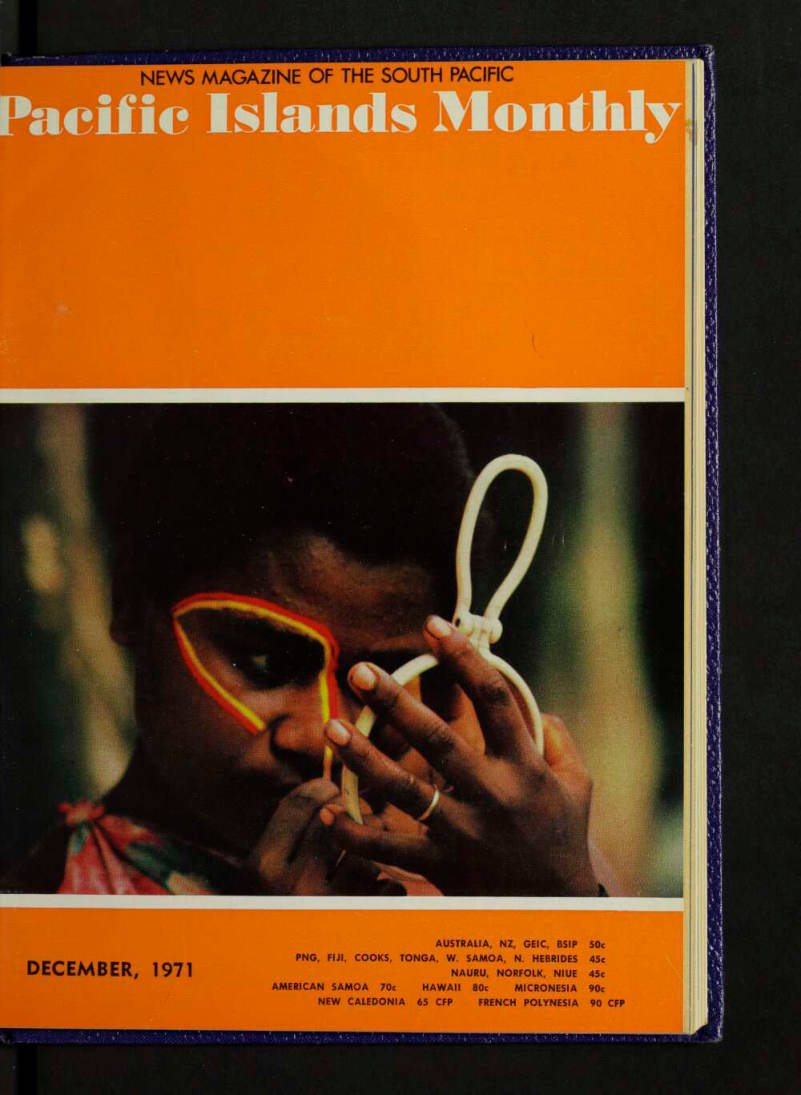 1
1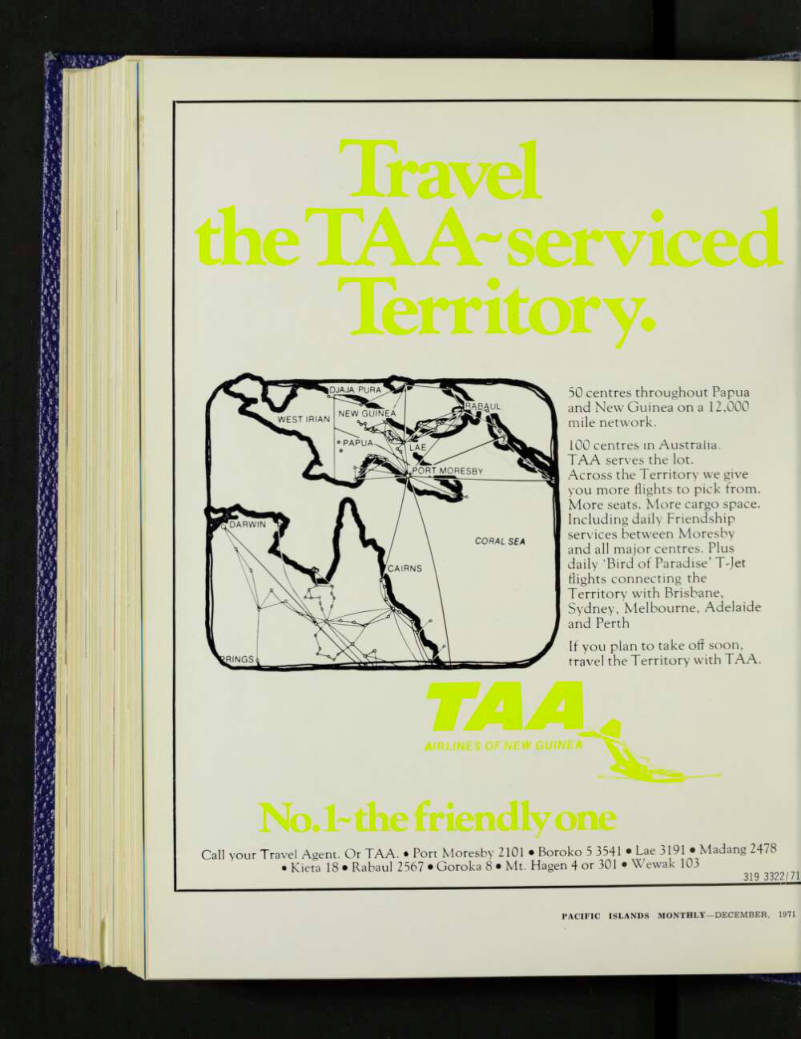 2
2 3
3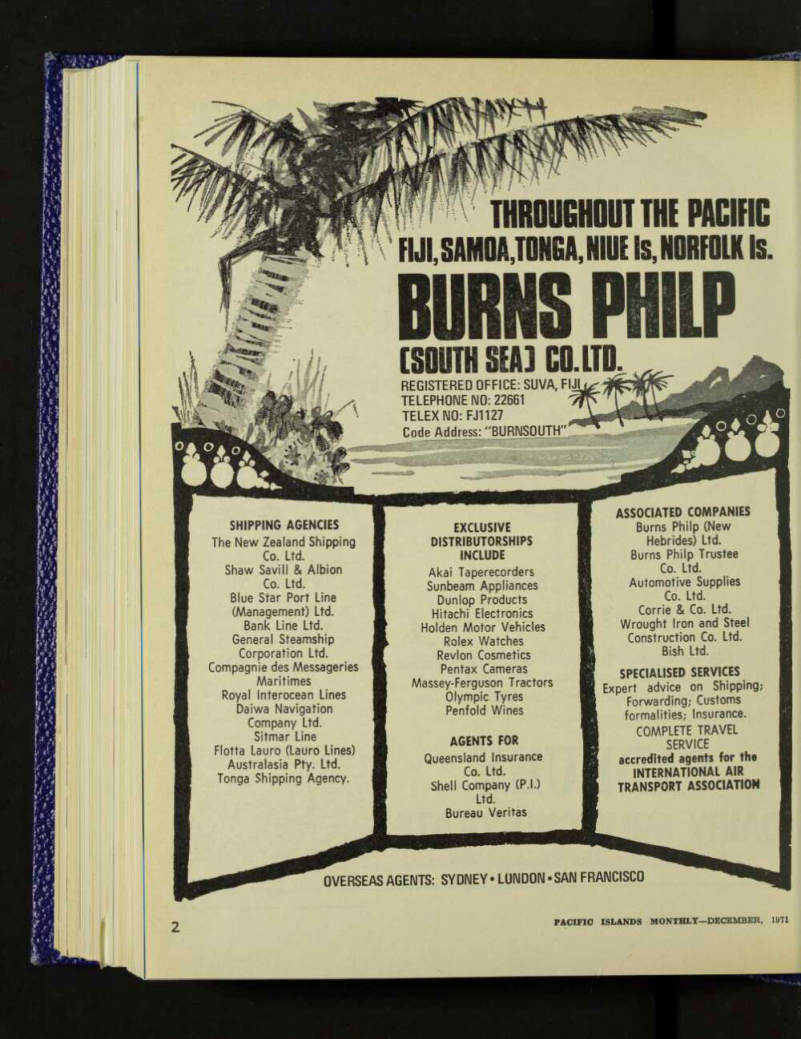 4
4 5
5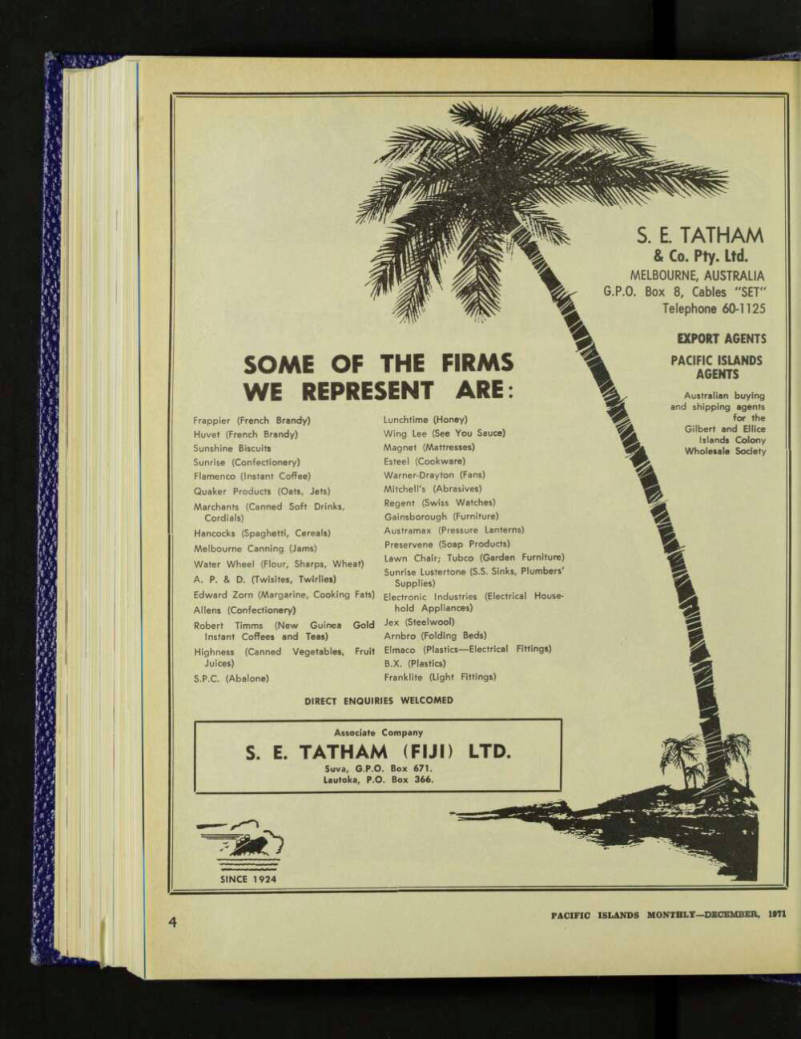 6
6 7
7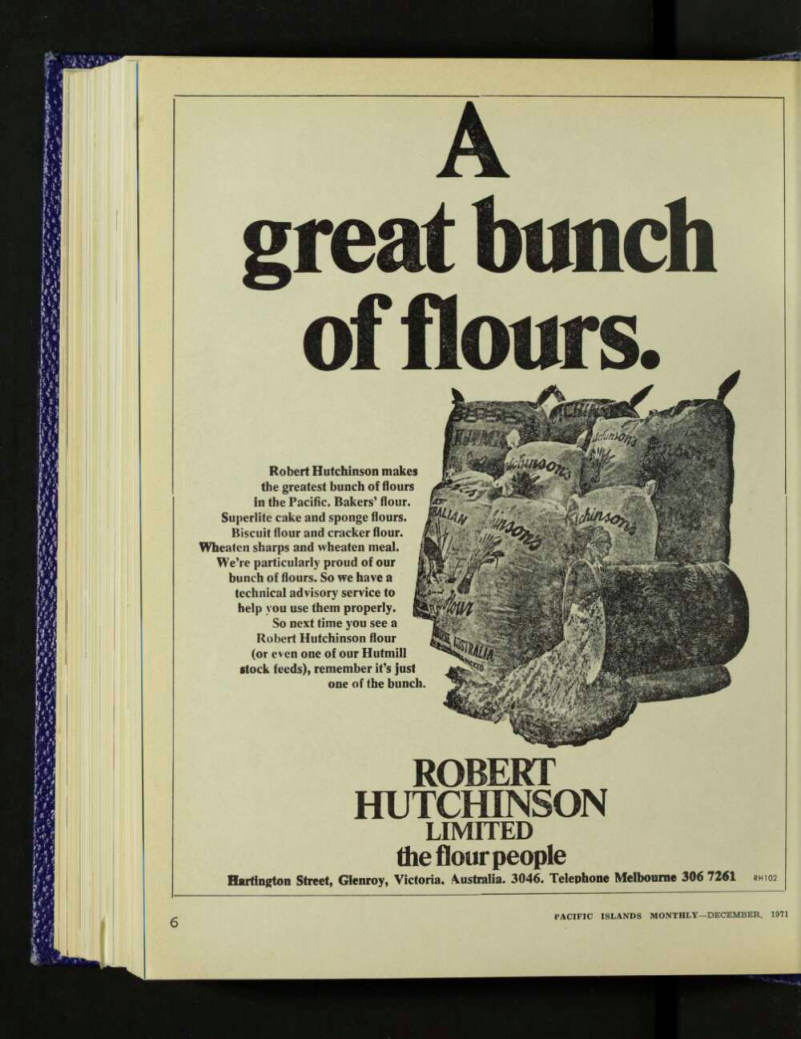 8
8 9
9 10
10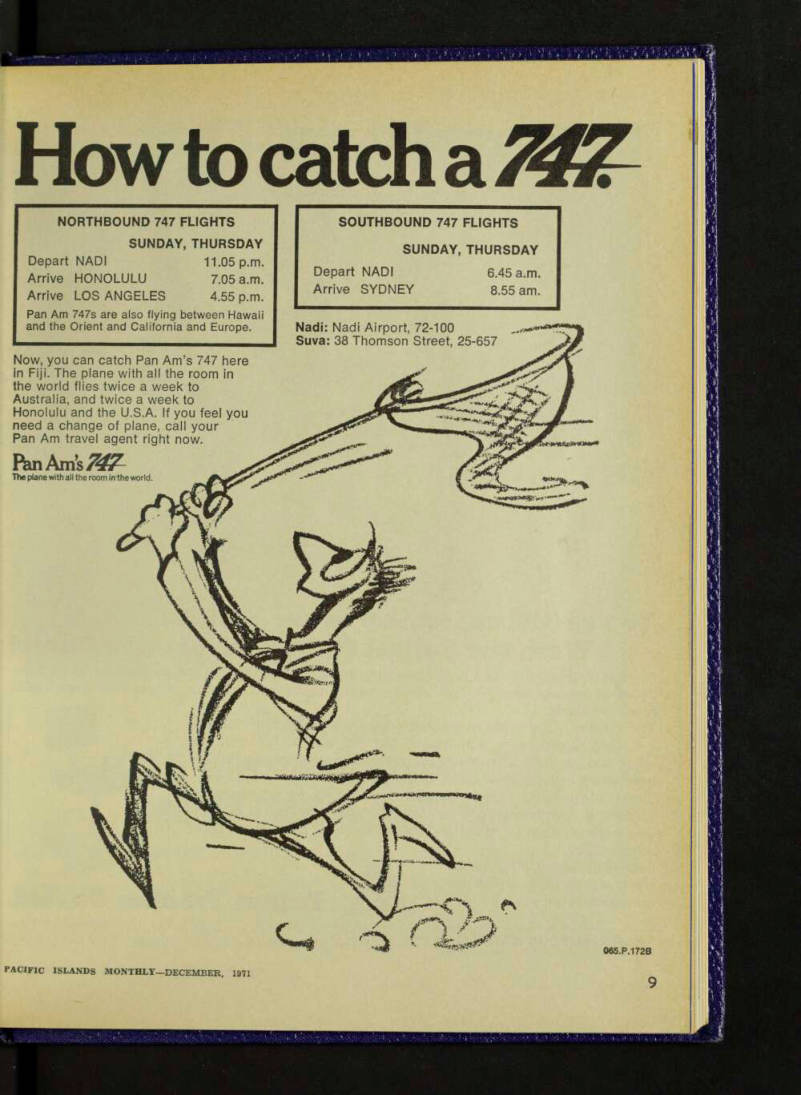 11
11 12
12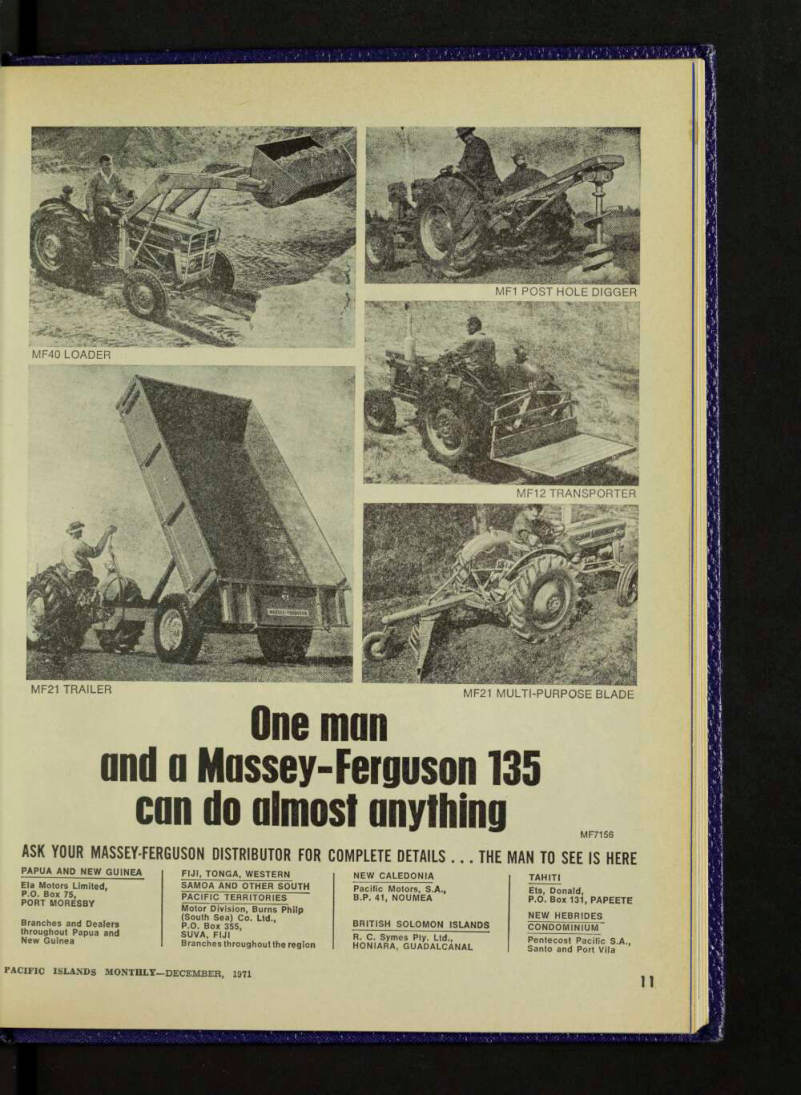 13
13 14
14 15
15 16
16 17
17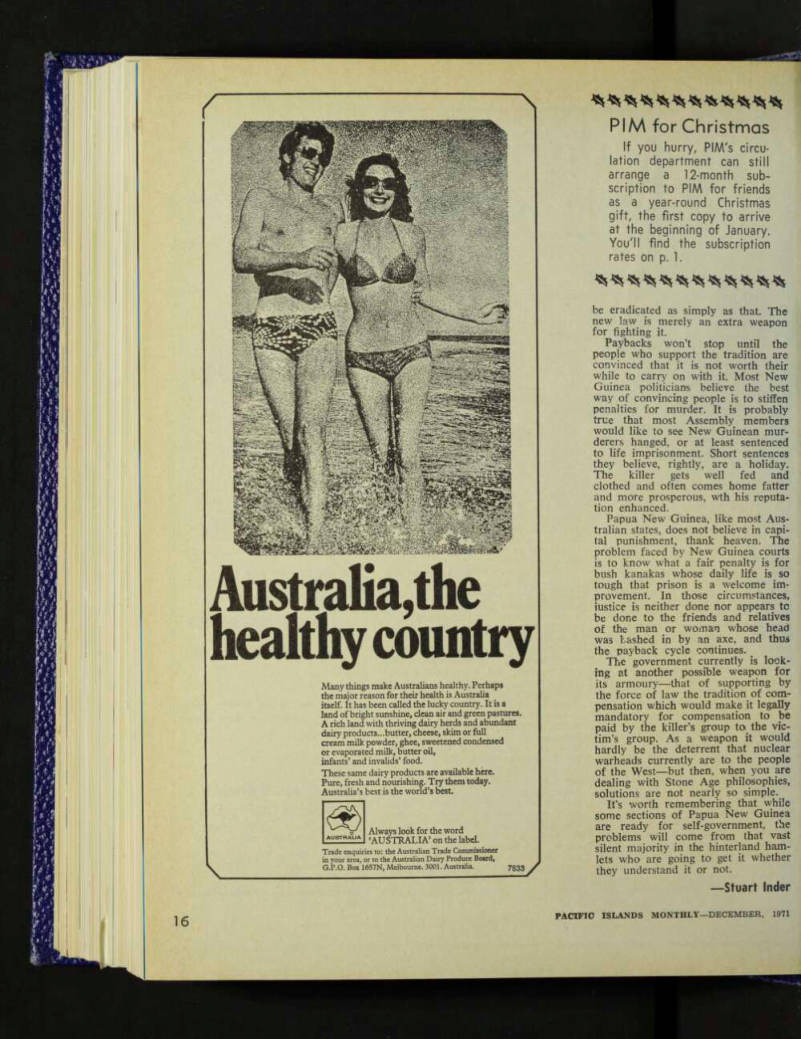 18
18 19
19 20
20 21
21 22
22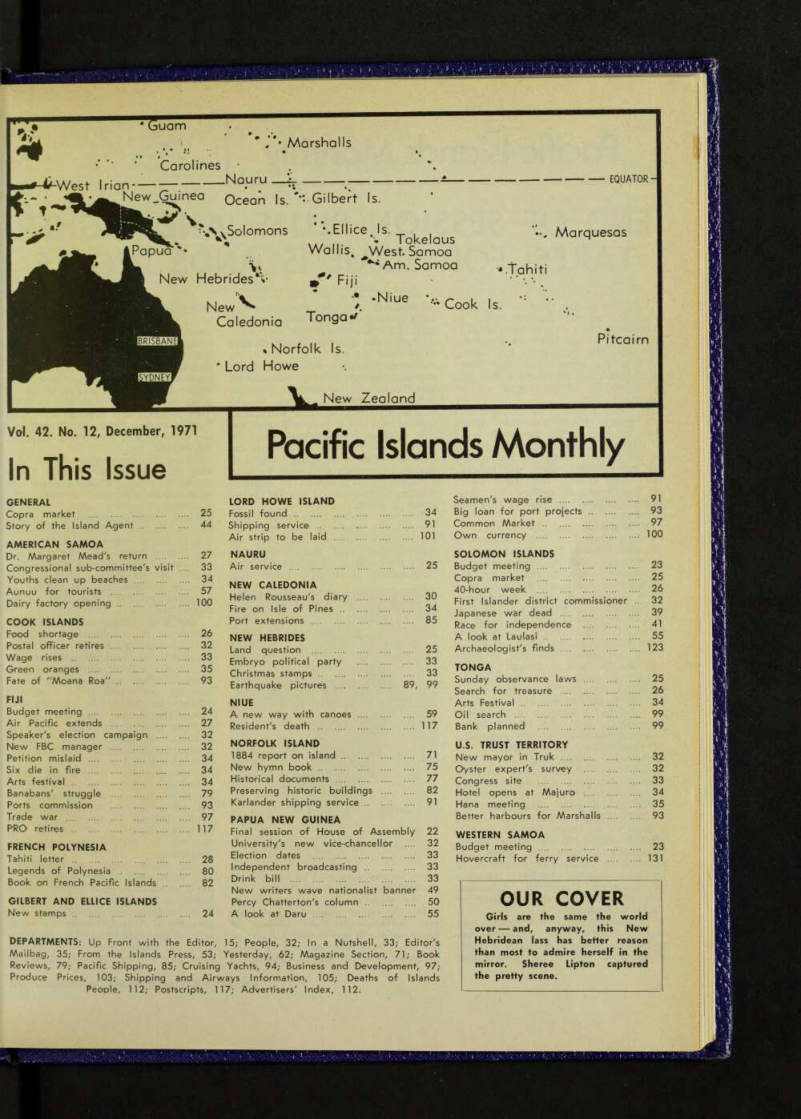 23
23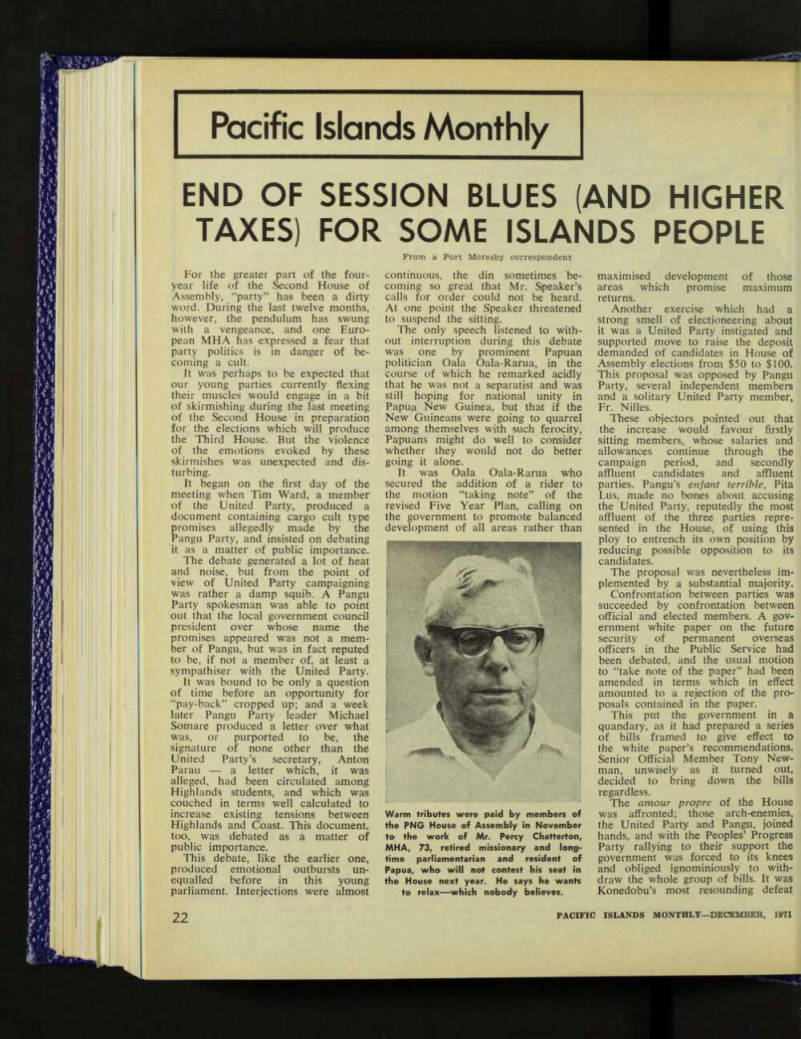 24
24 25
25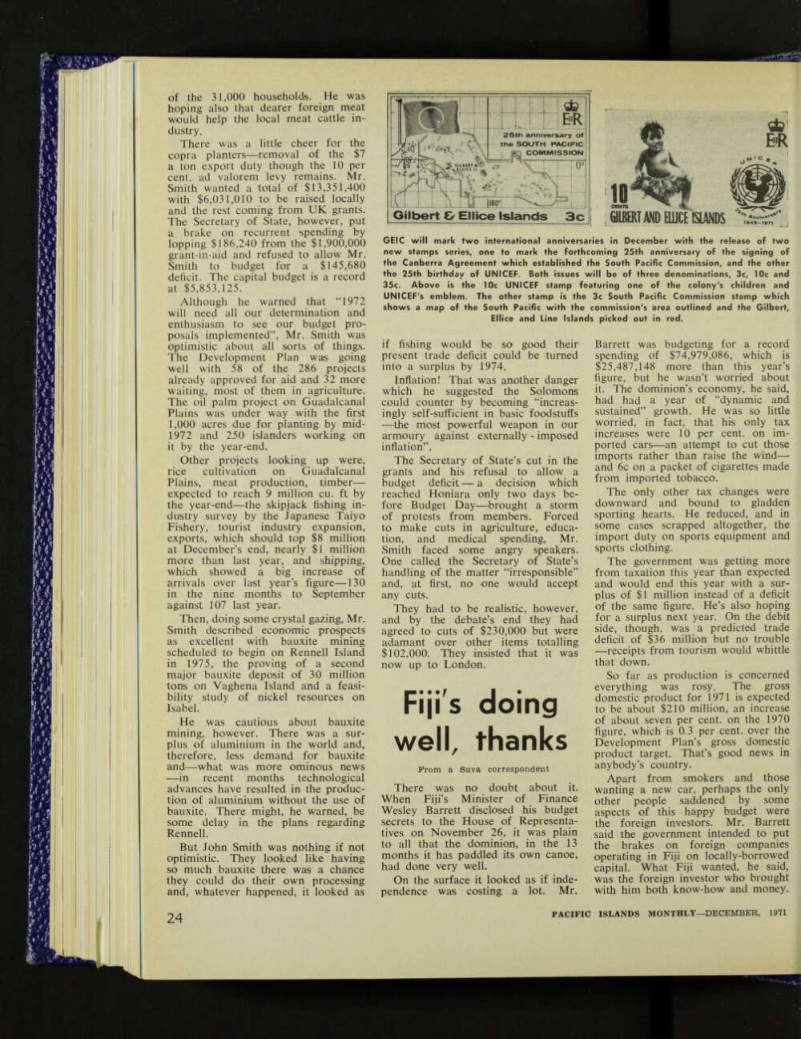 26
26 27
27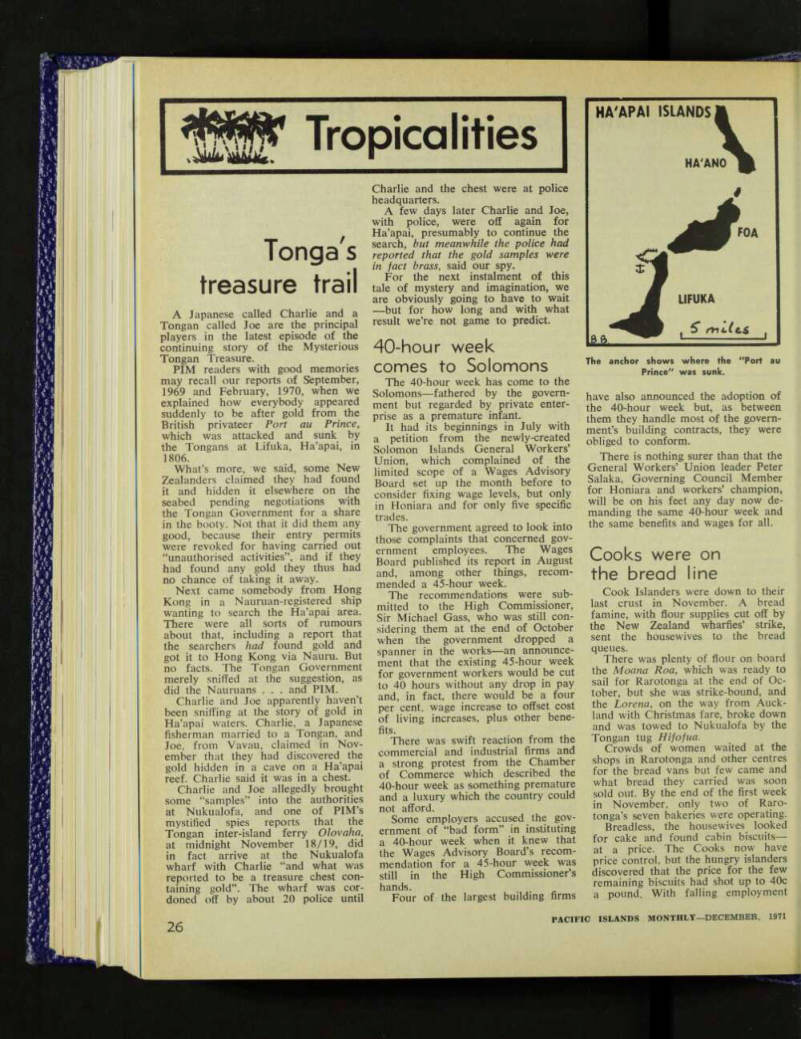 28
28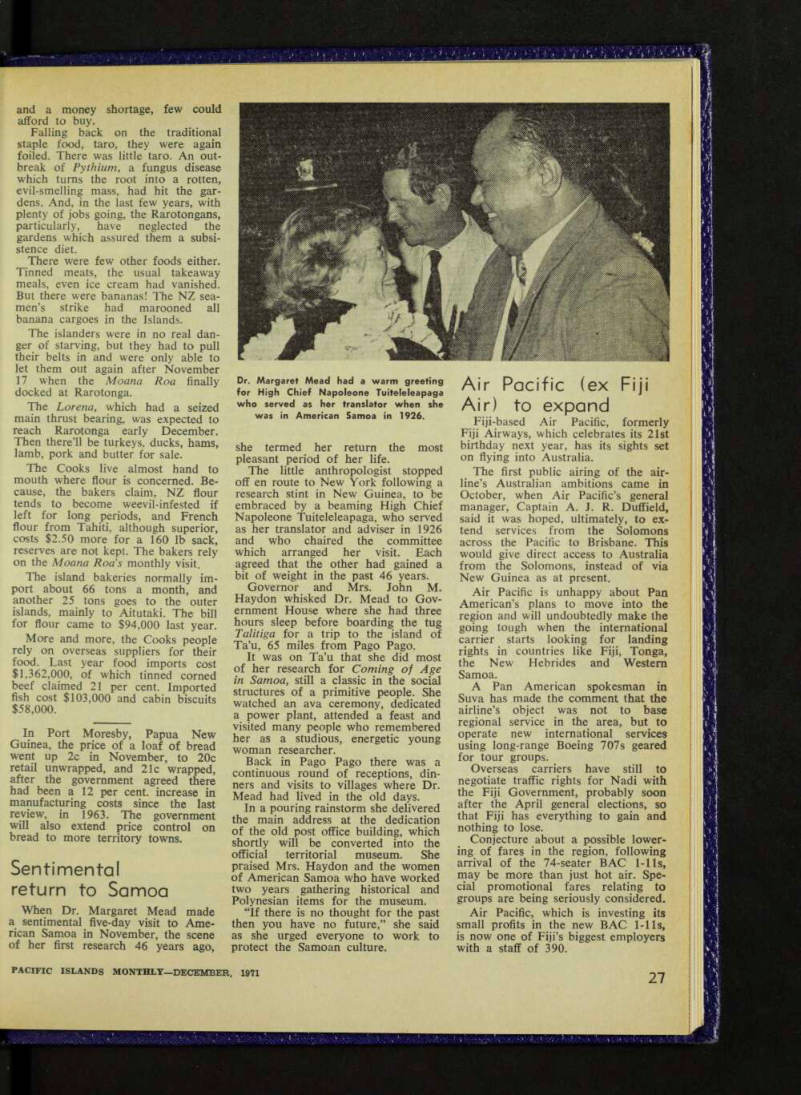 29
29 30
30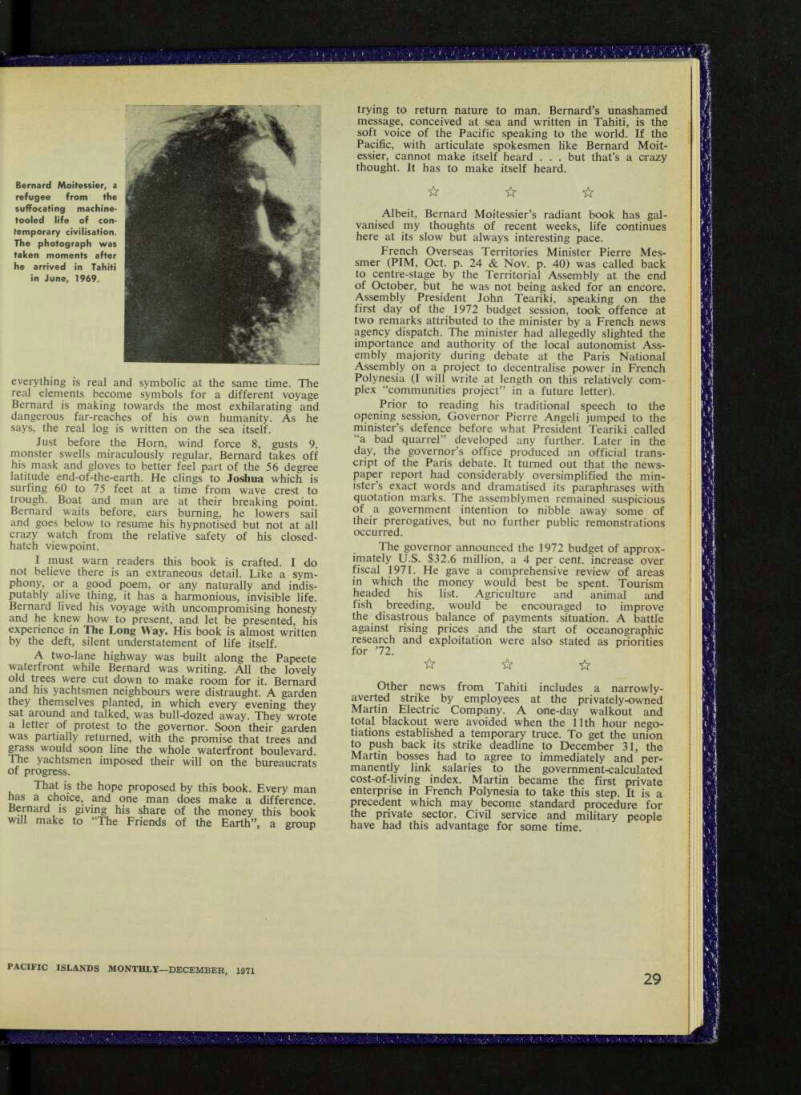 31
31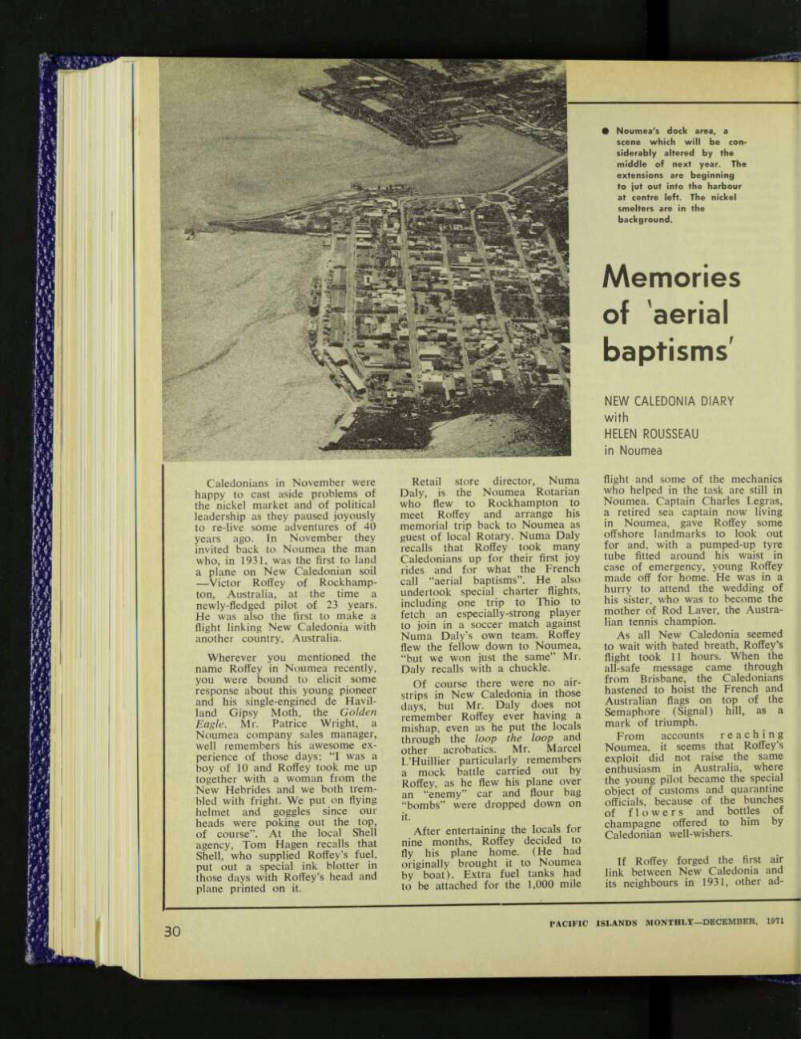 32
32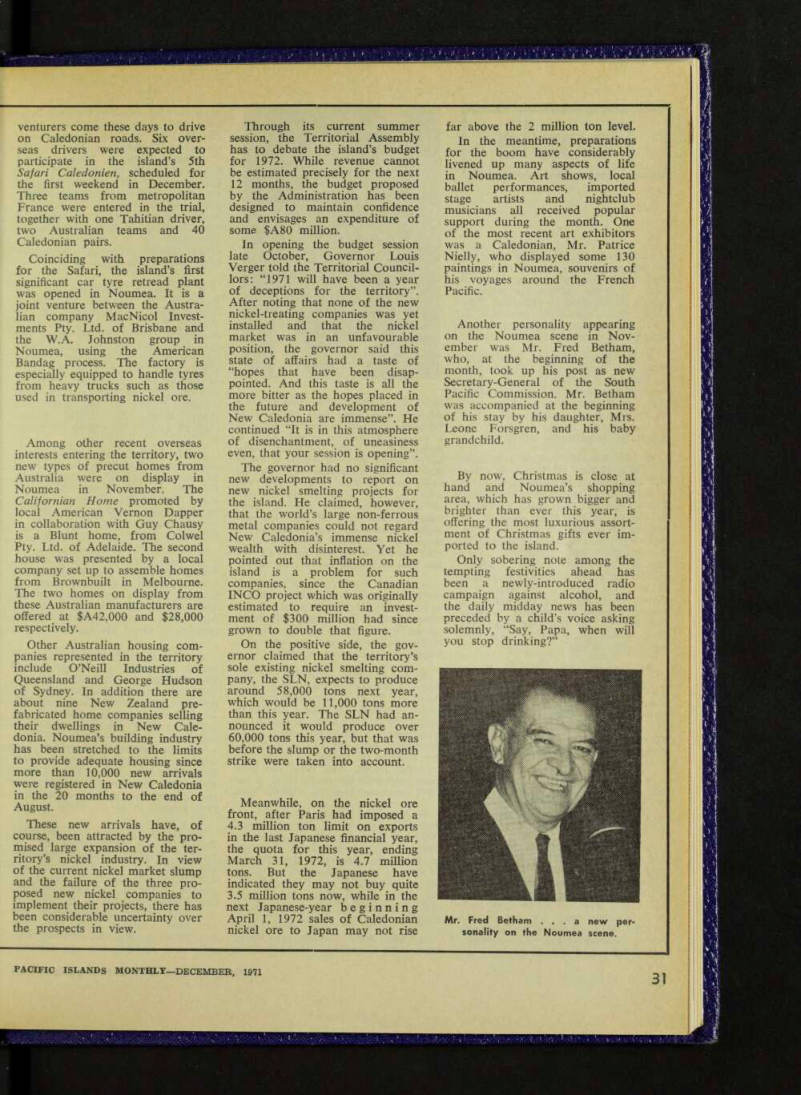 33
33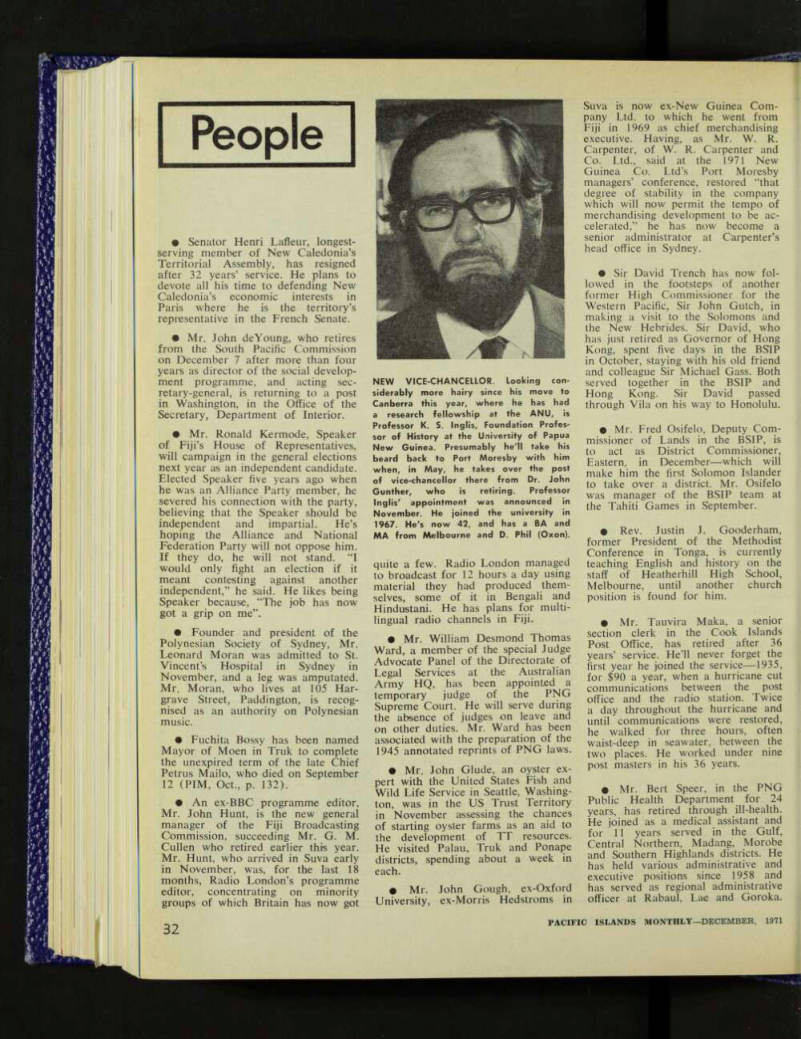 34
34 35
35 36
36 37
37 38
38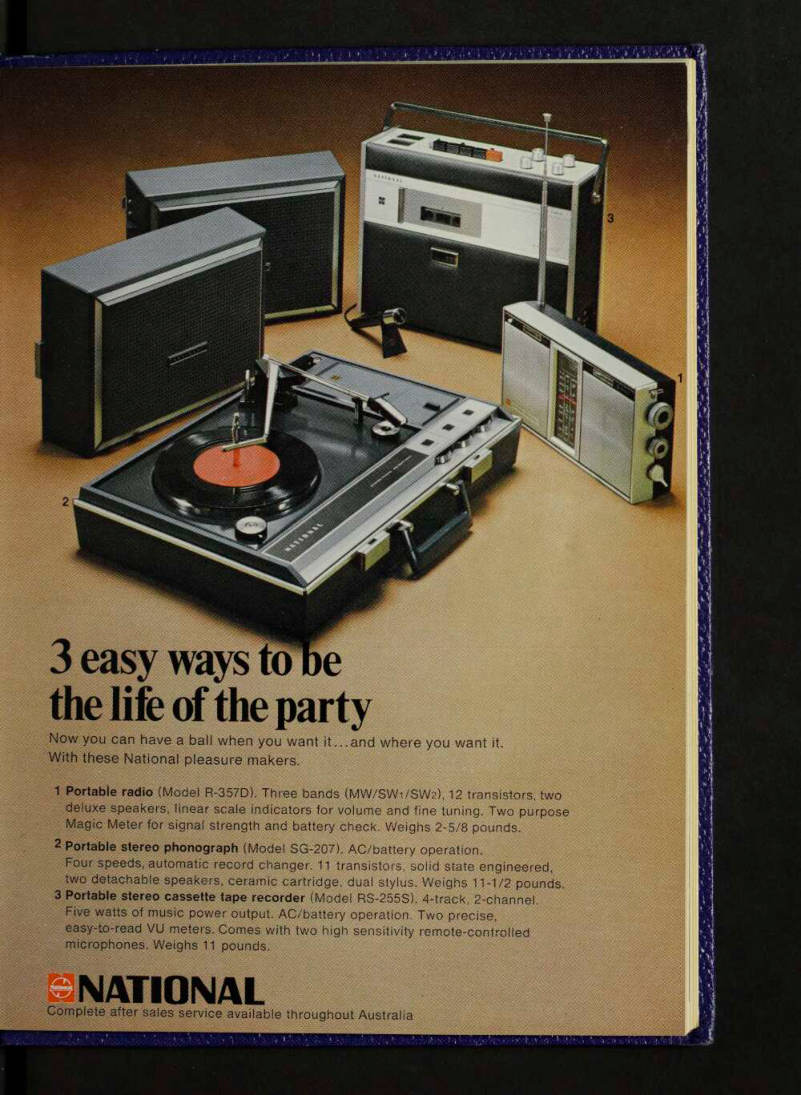 39
39 40
40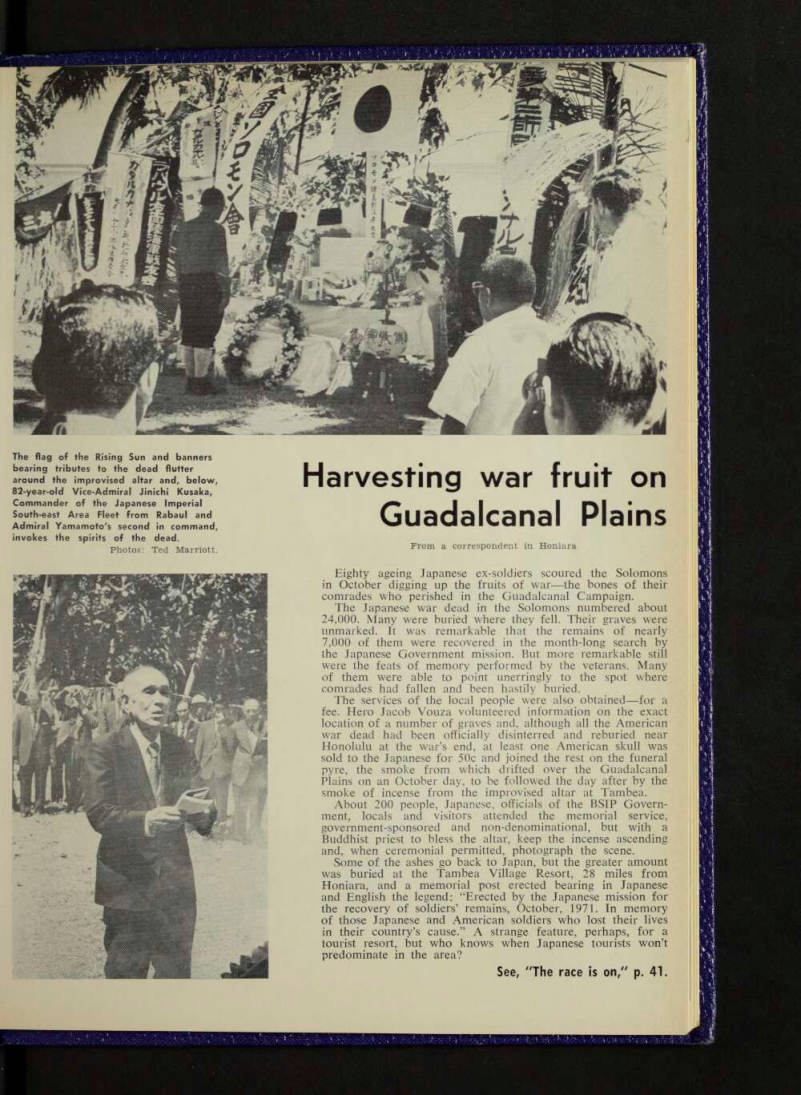 41
41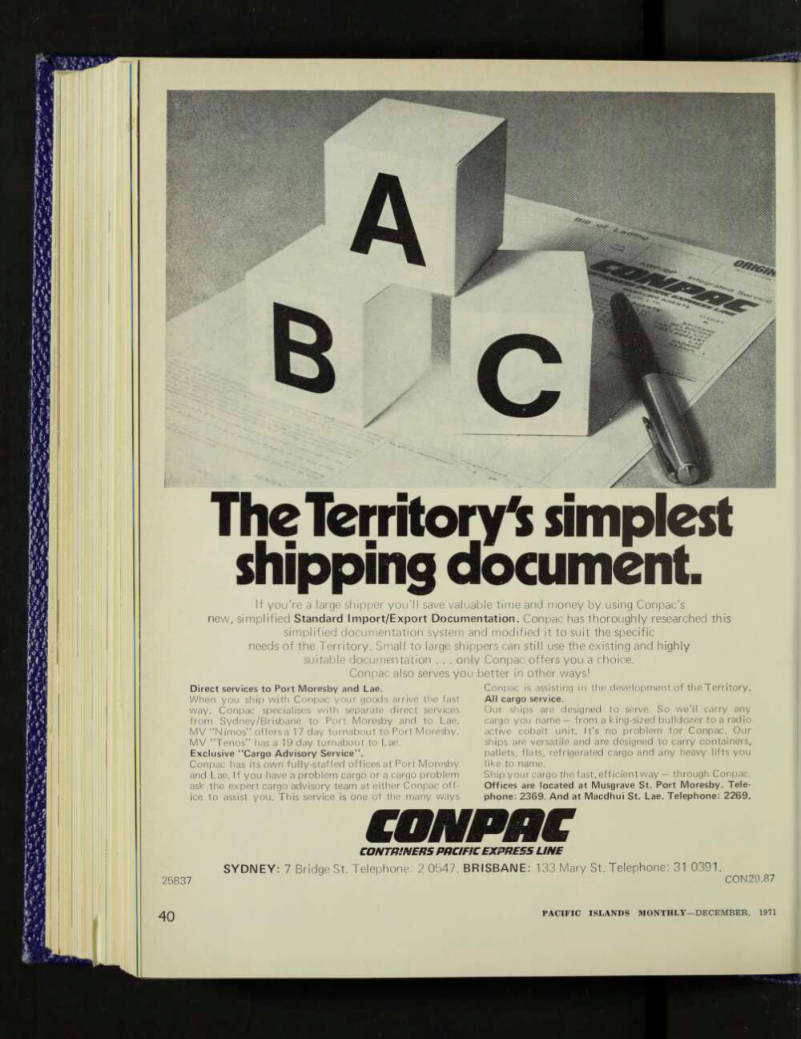 42
42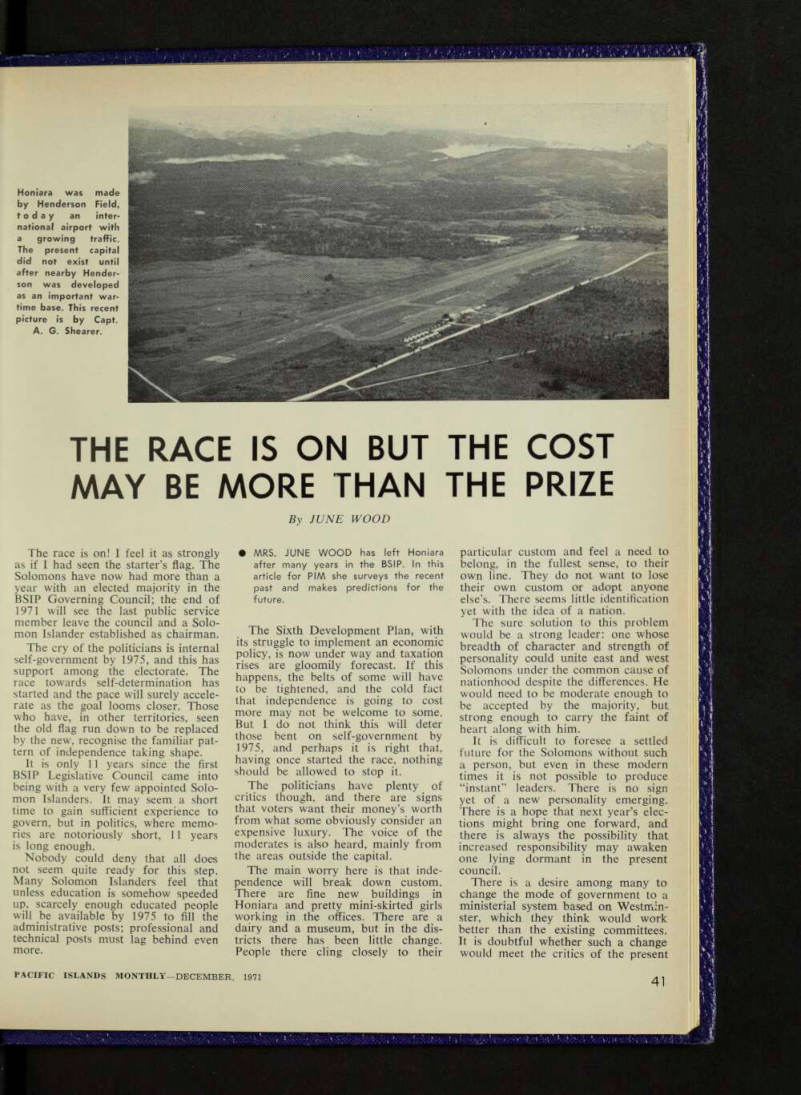 43
43 44
44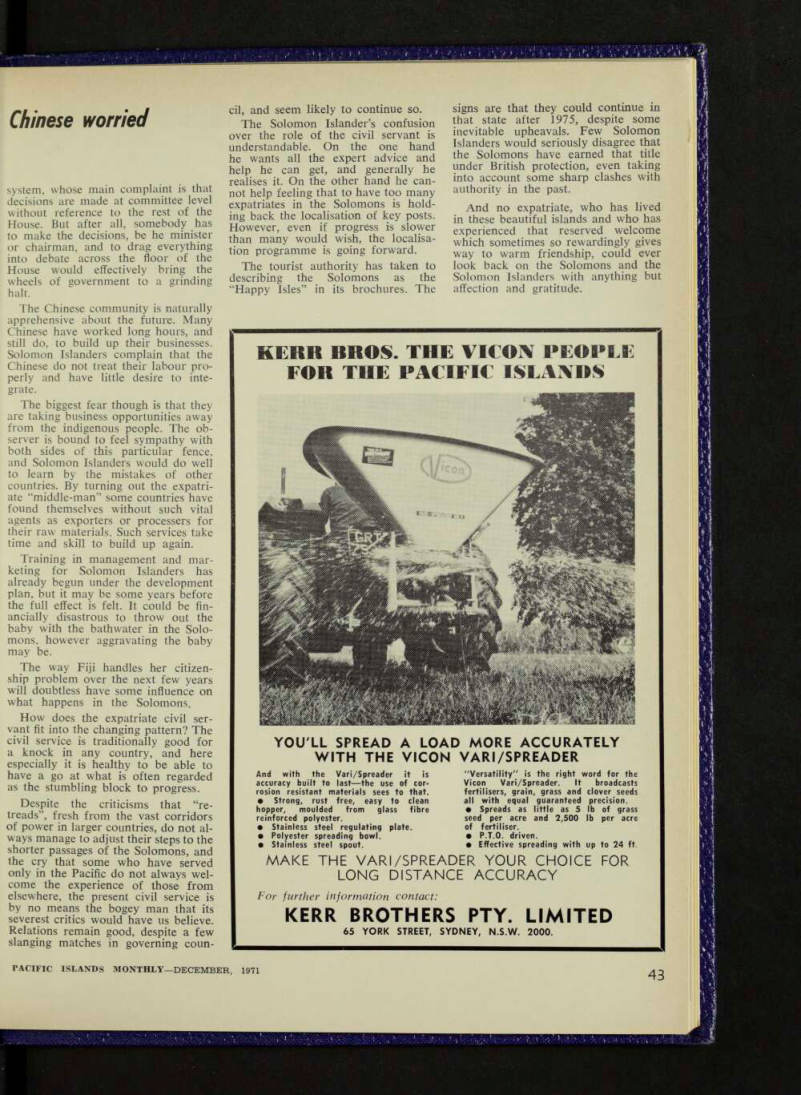 45
45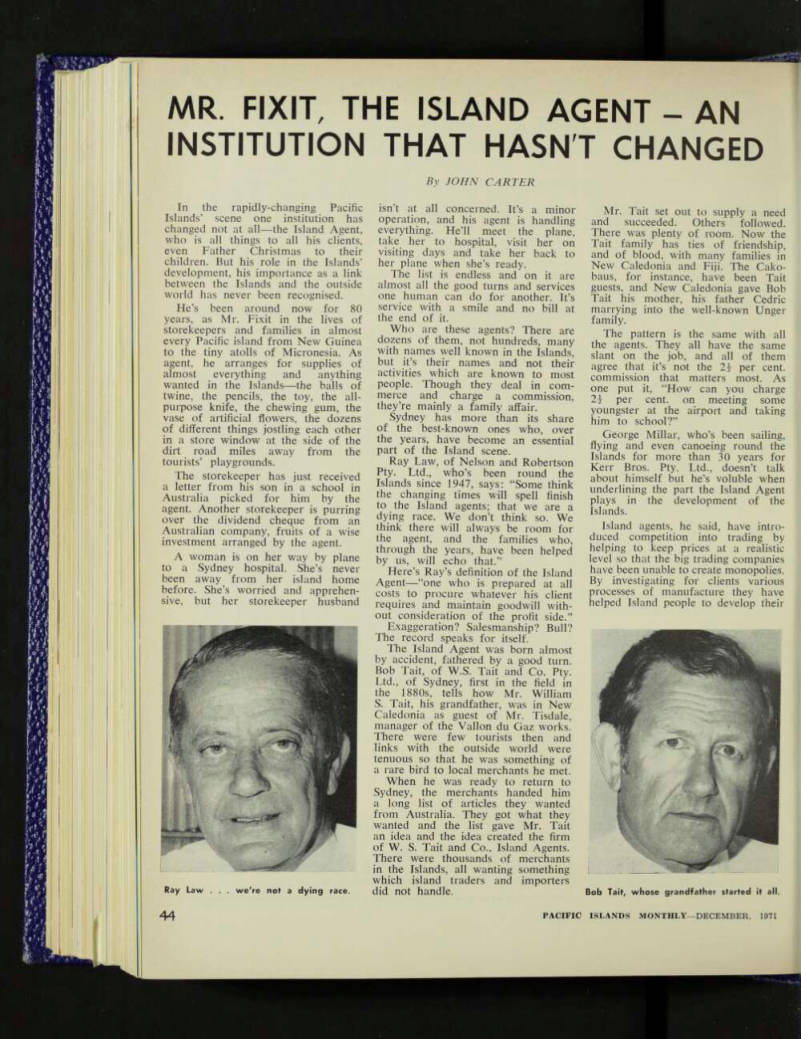 46
46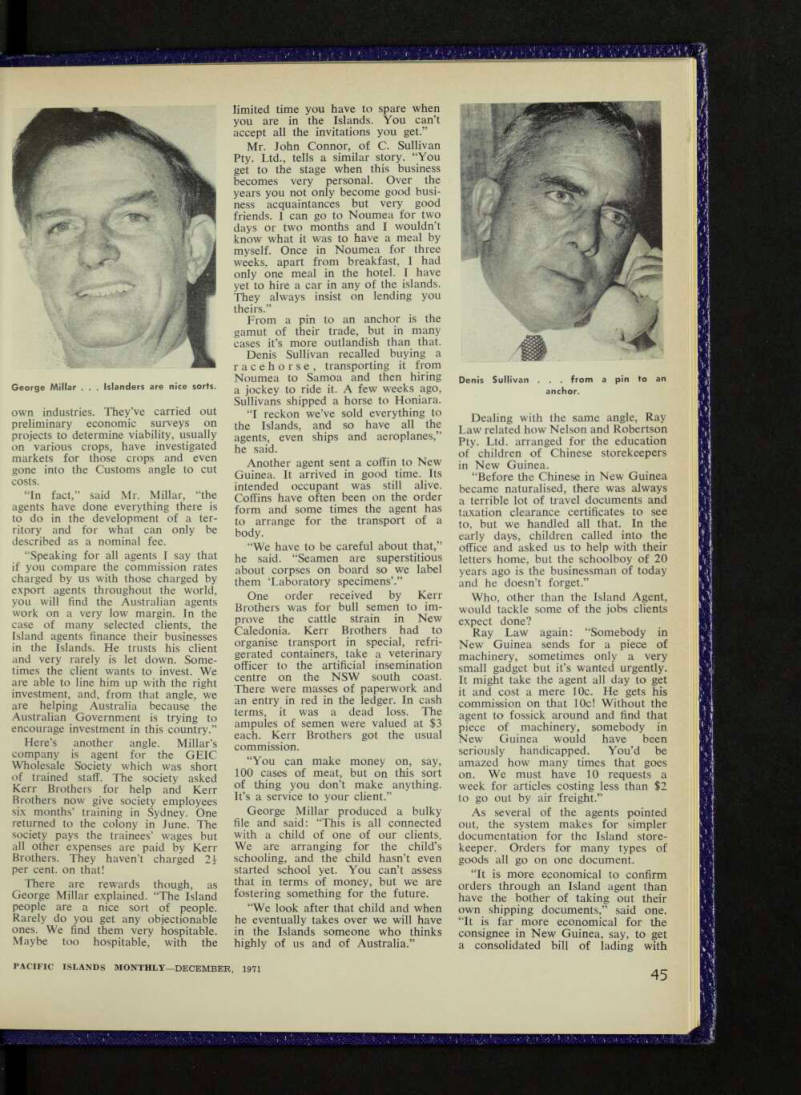 47
47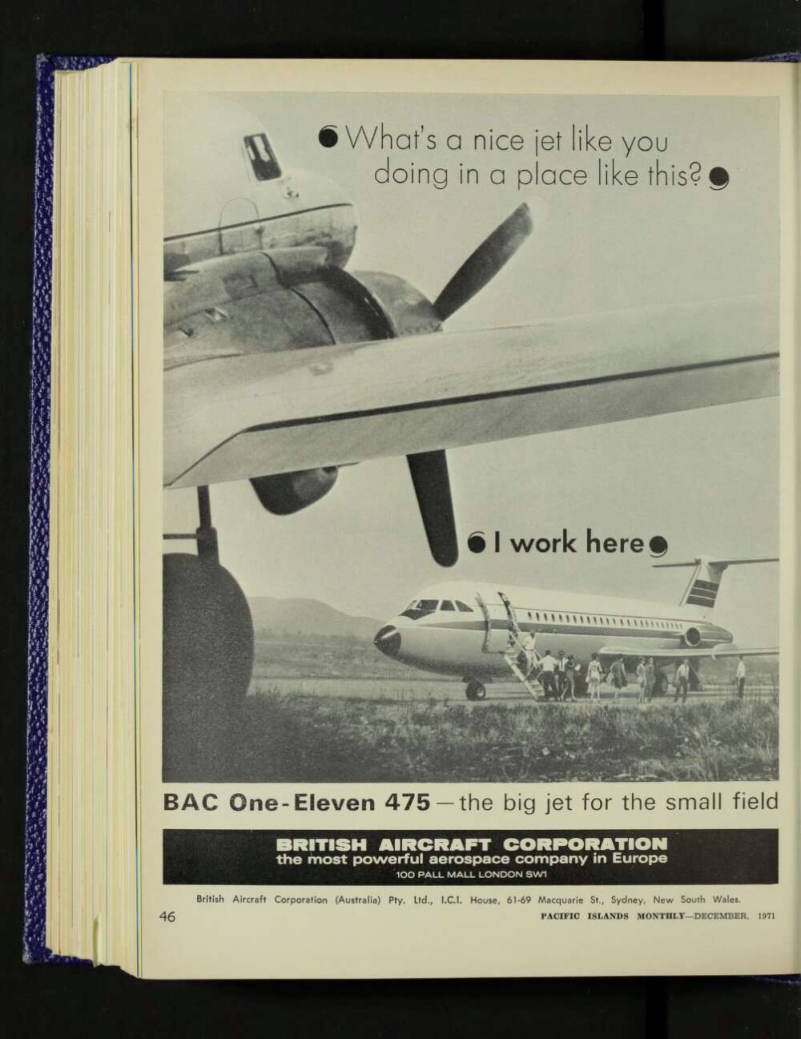 48
48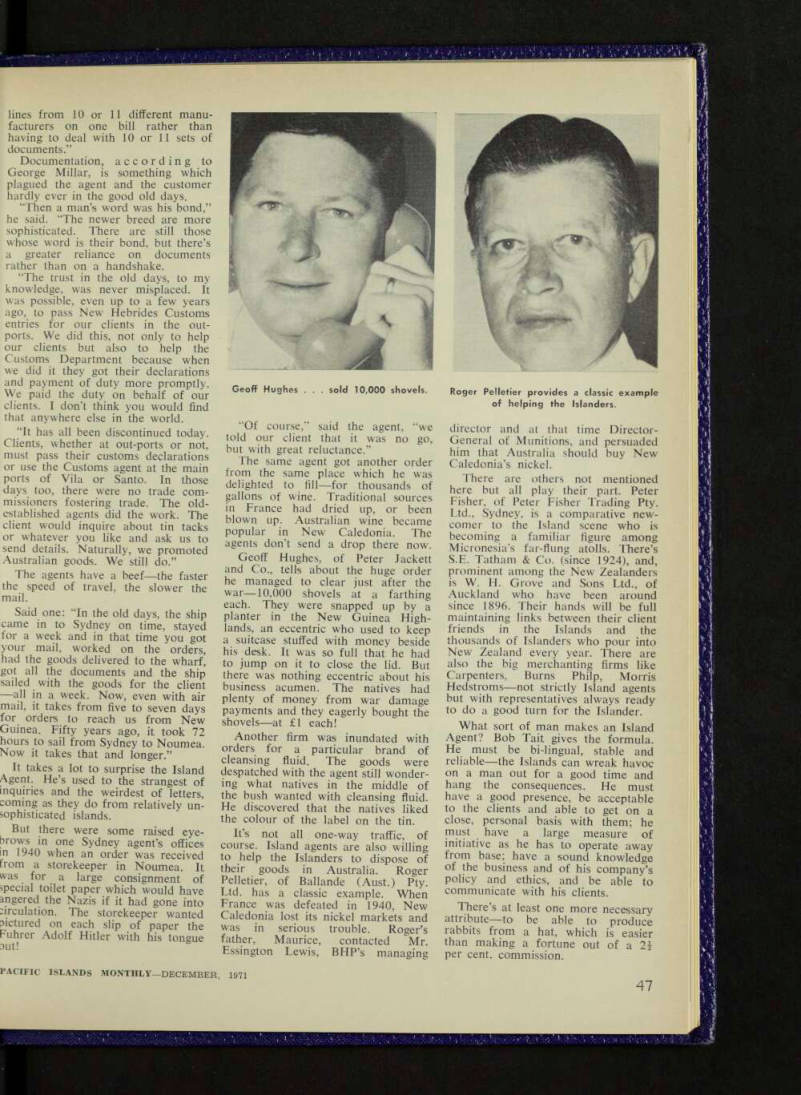 49
49 50
50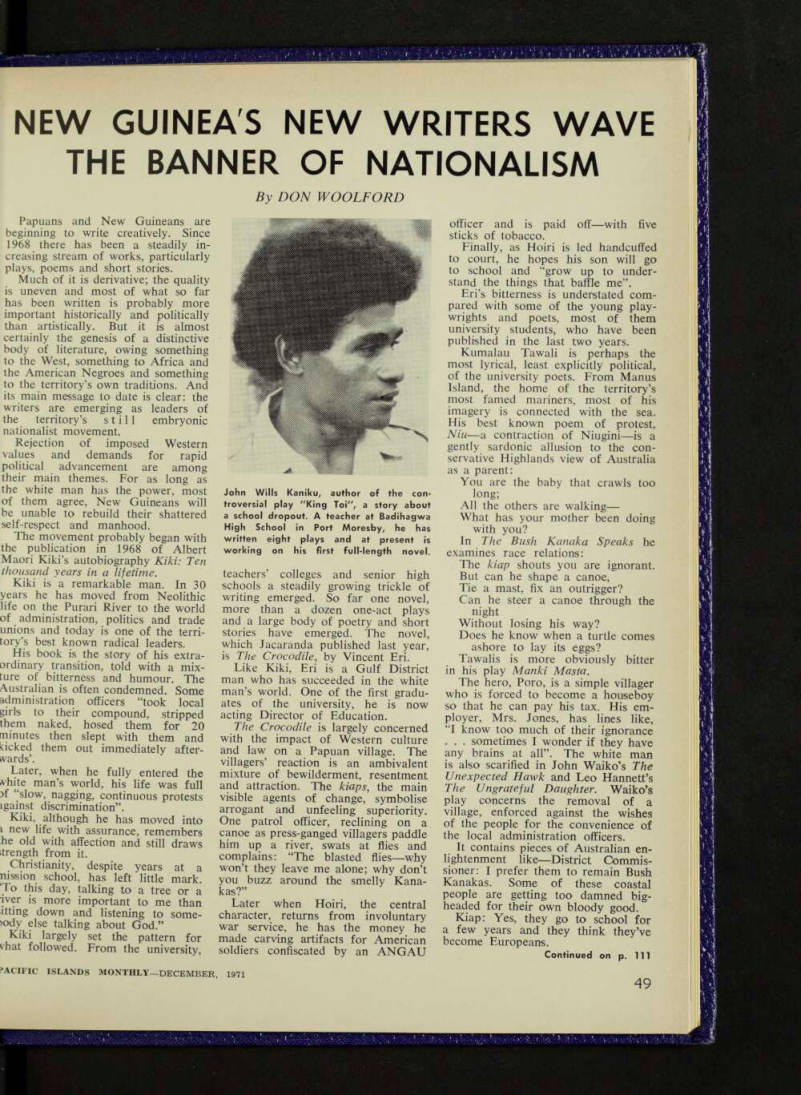 51
51 52
52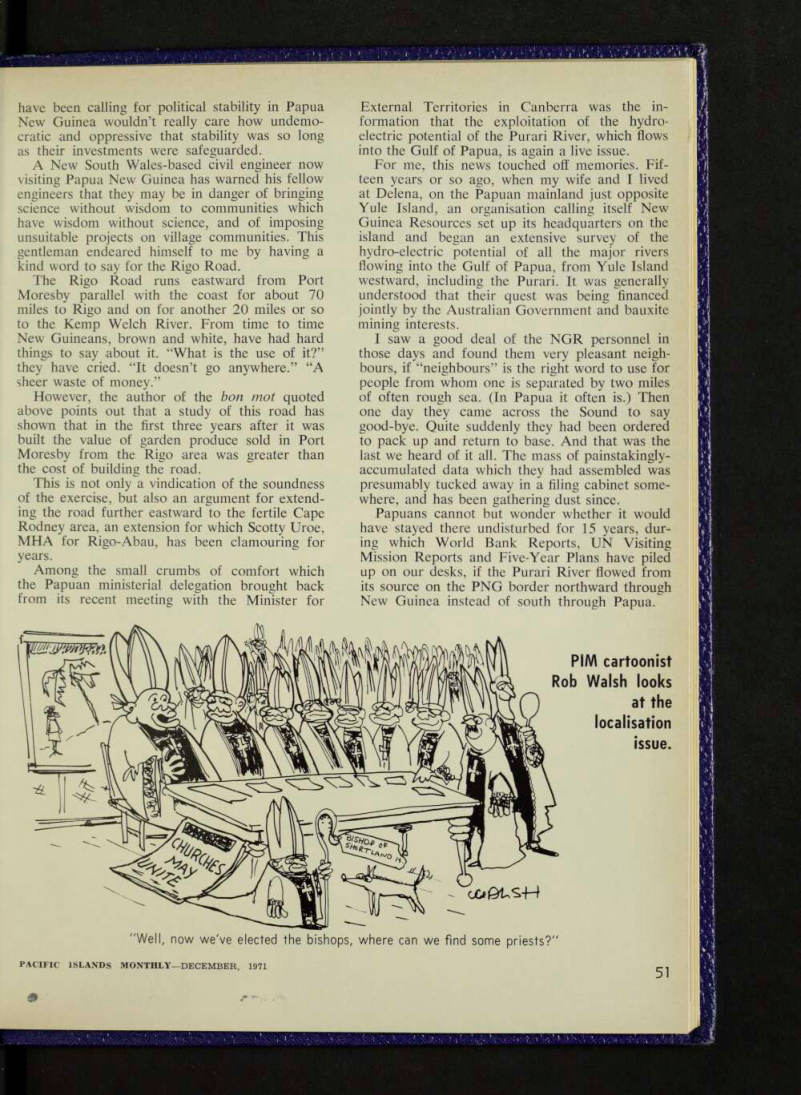 53
53 54
54 55
55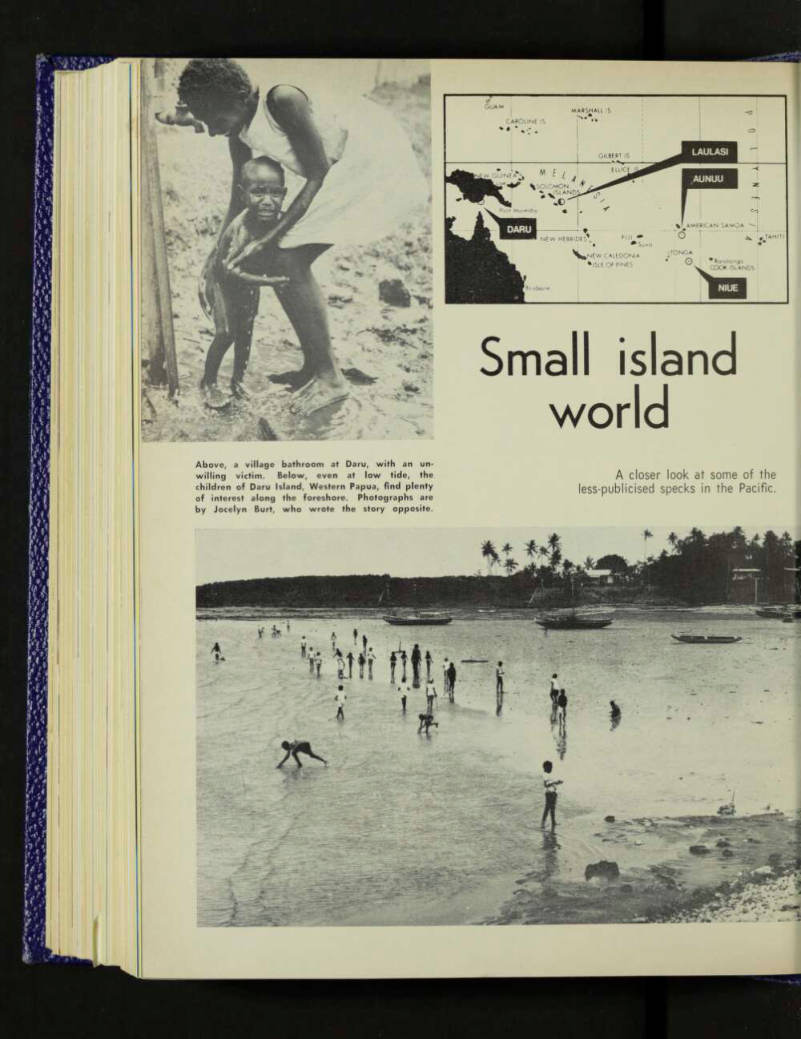 56
56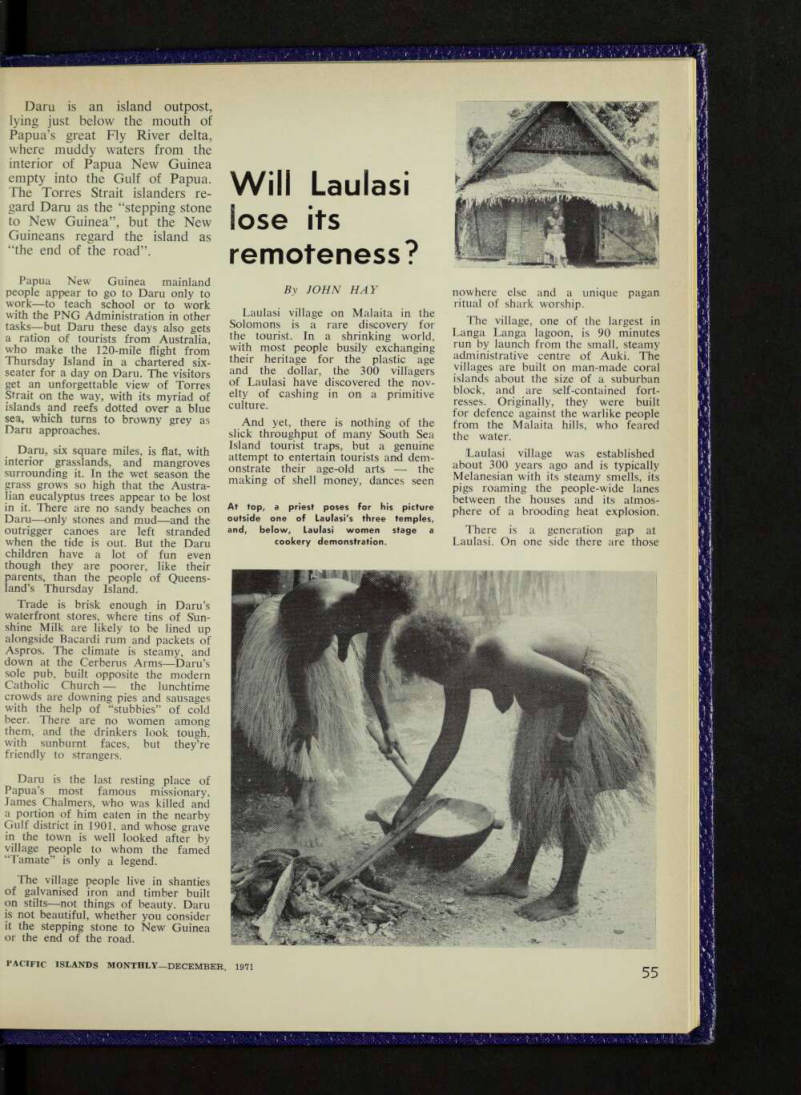 57
57 58
58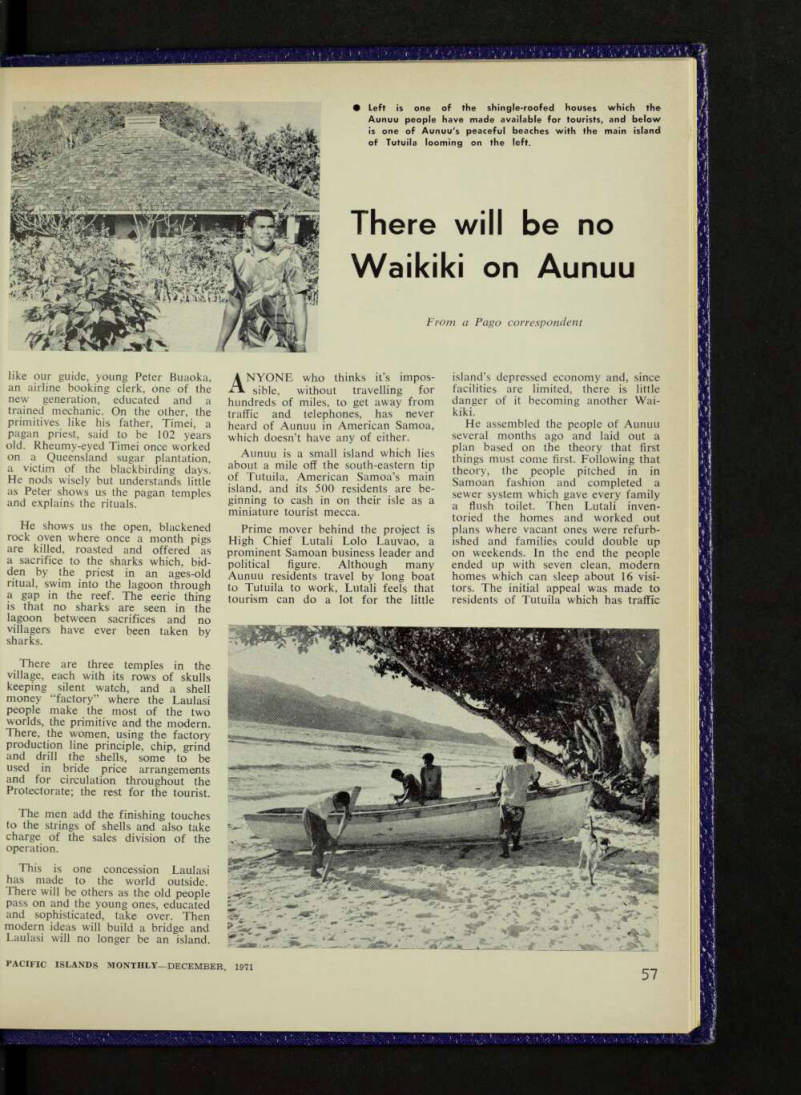 59
59 60
60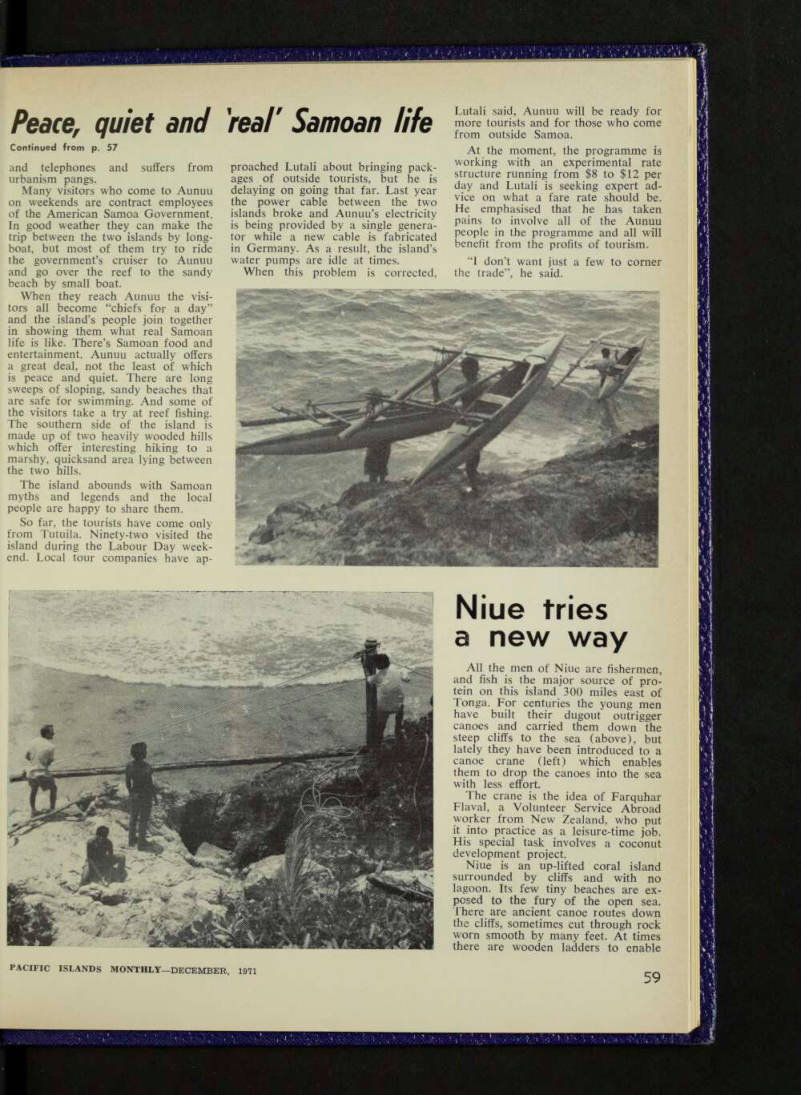 61
61 62
62 63
63 64
64 65
65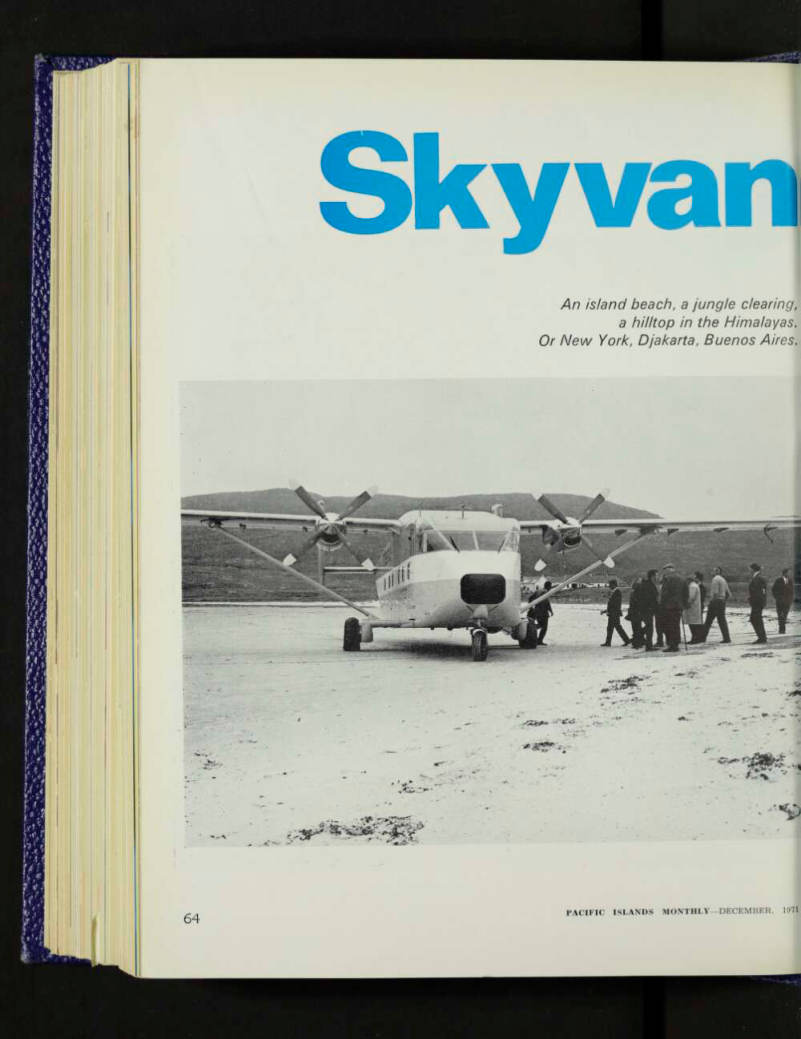 66
66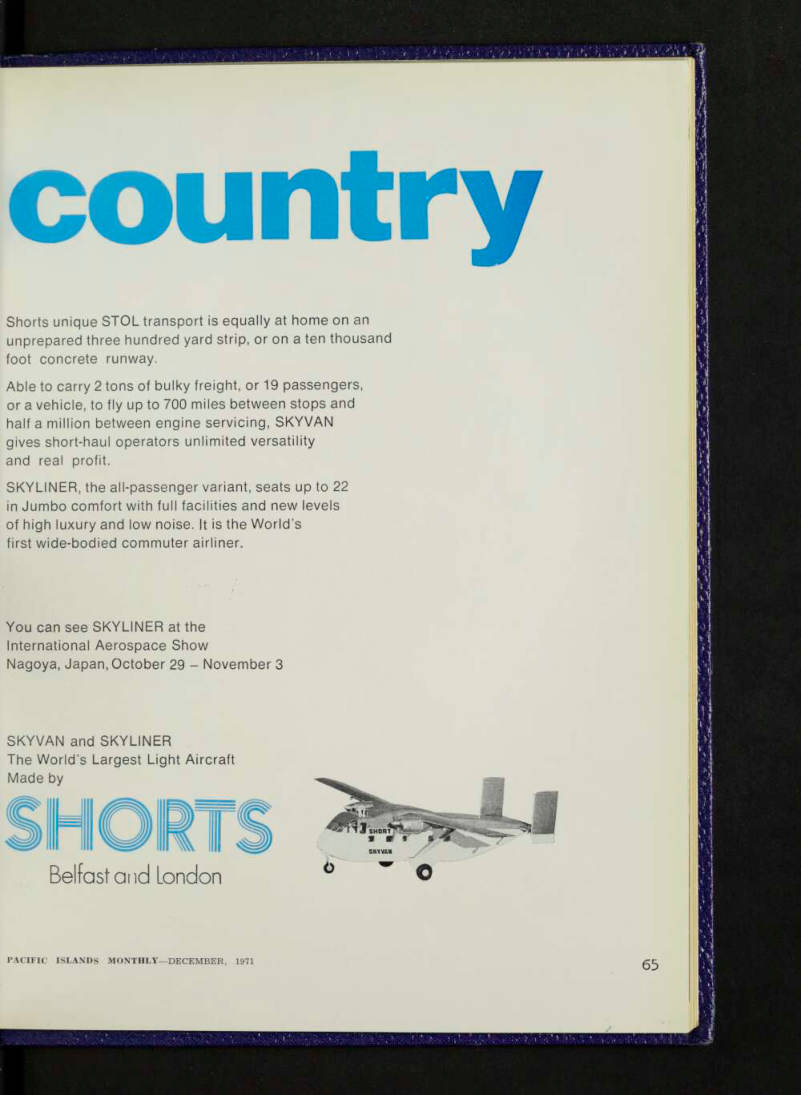 67
67 68
68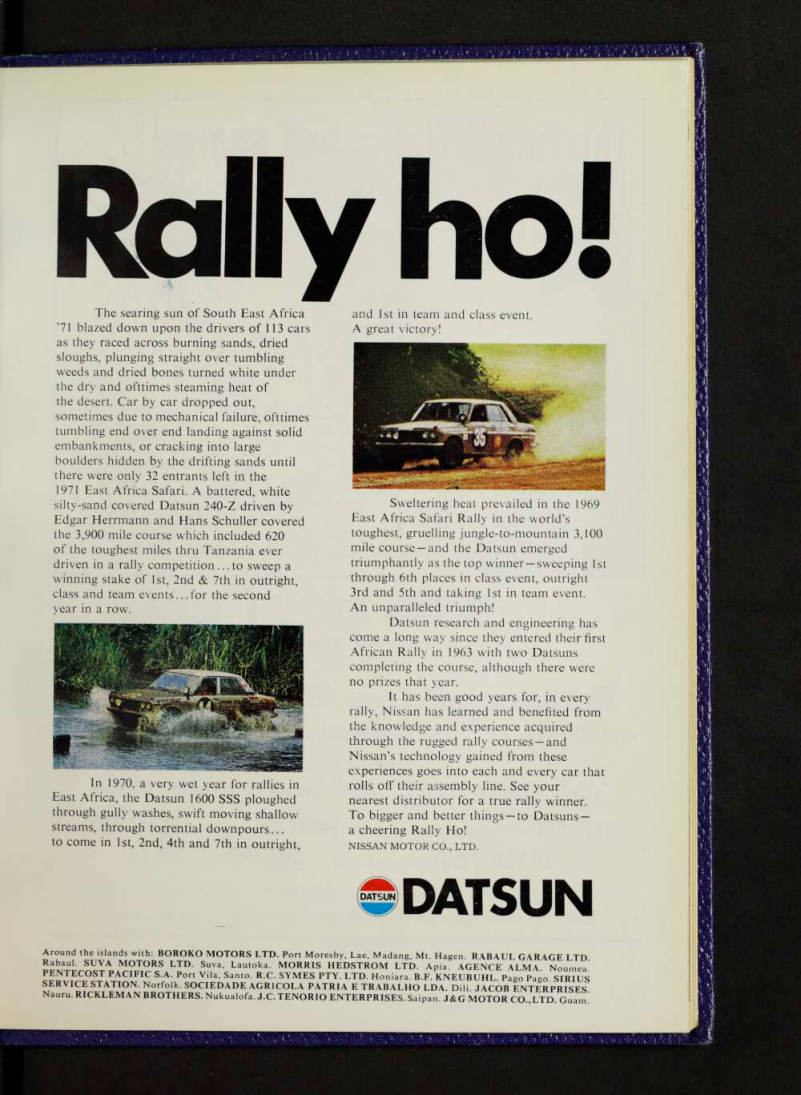 69
69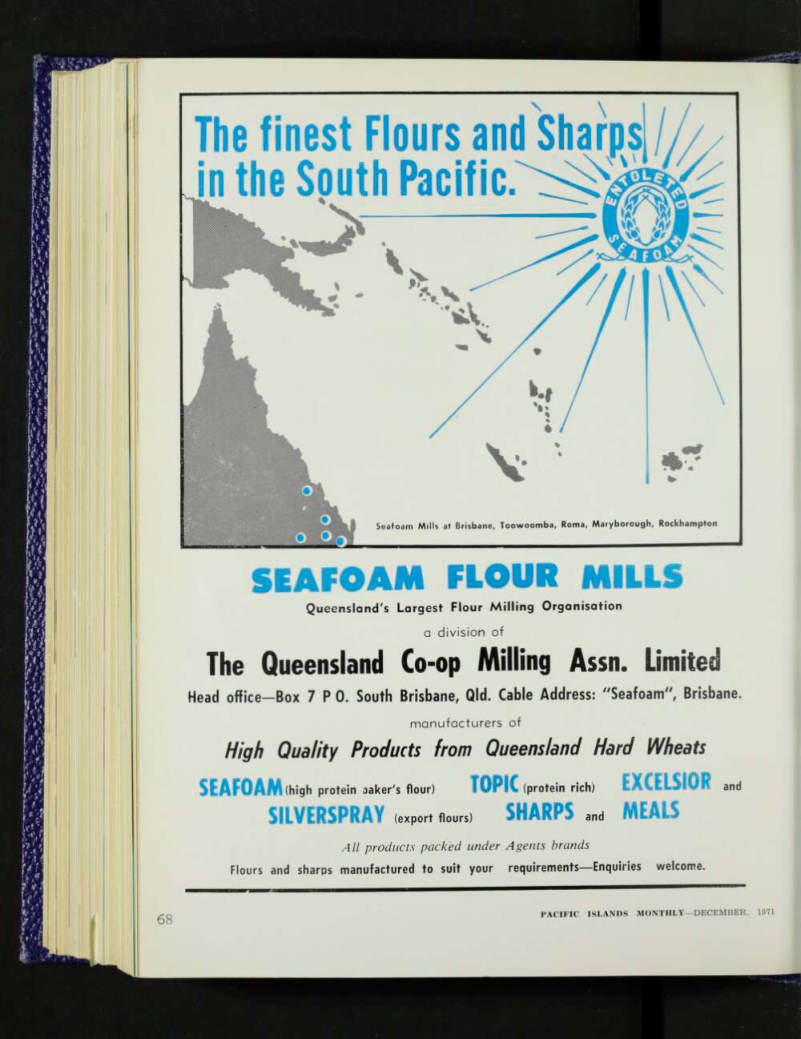 70
70 71
71 72
72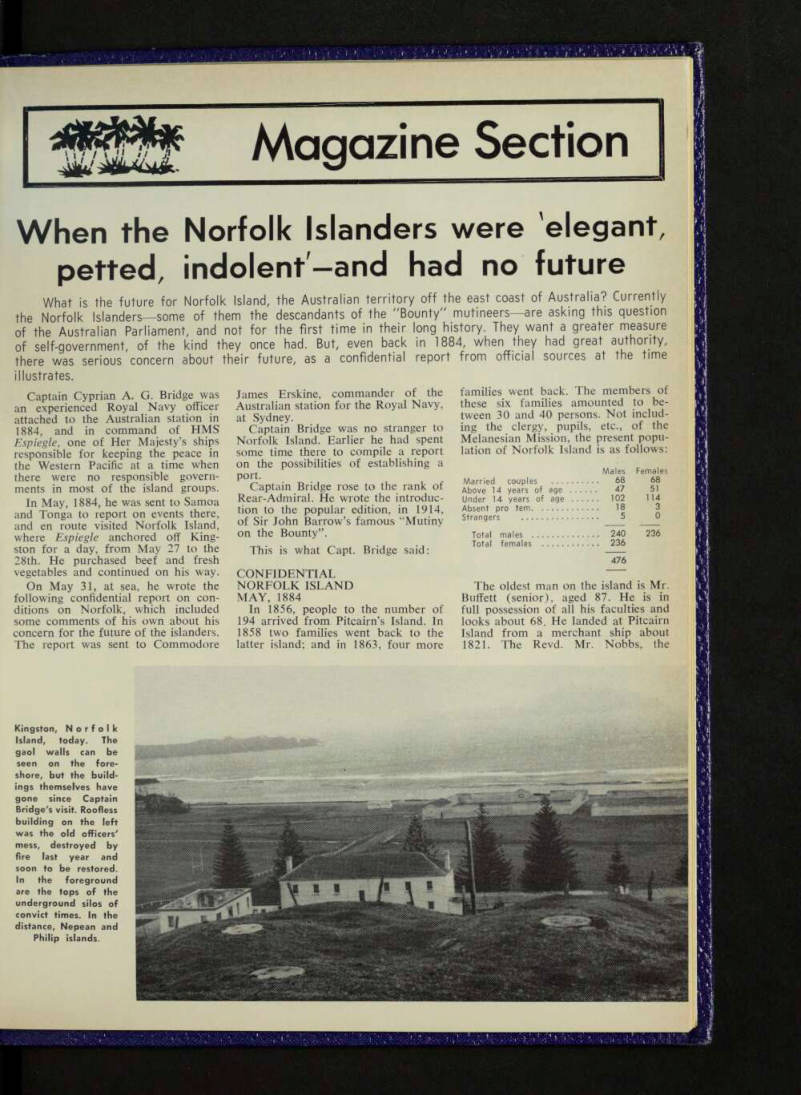 73
73 74
74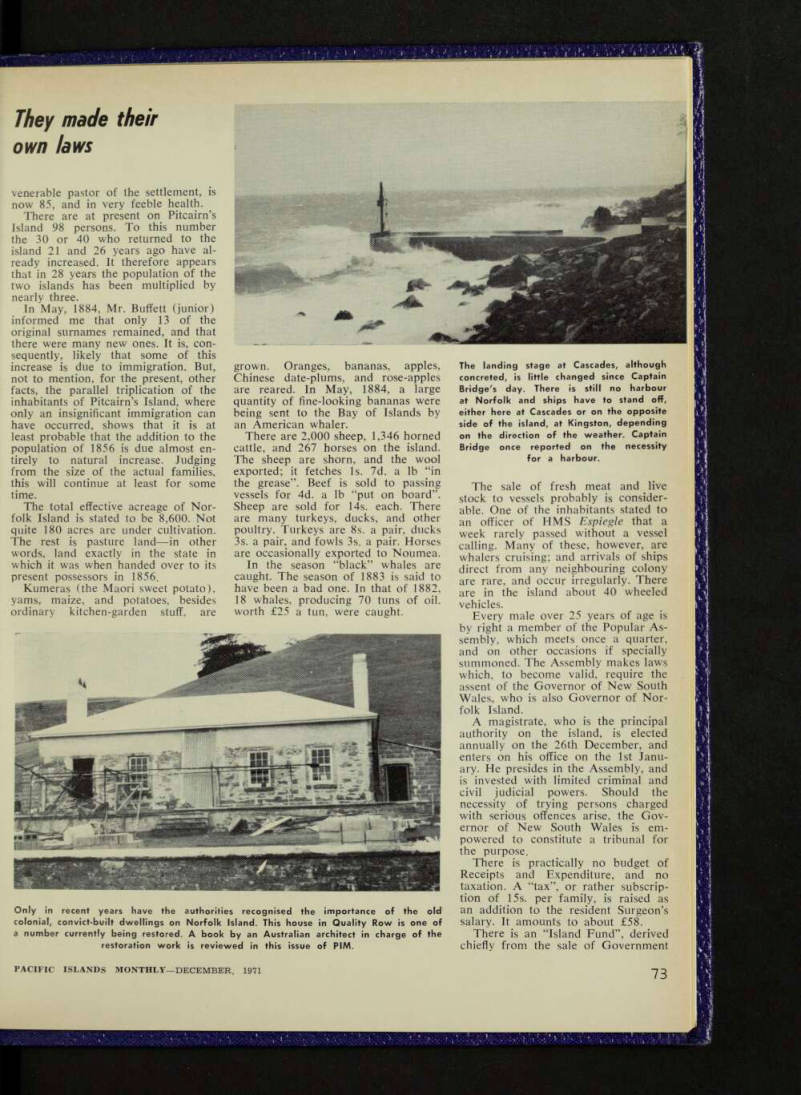 75
75 76
76 77
77 78
78 79
79 80
80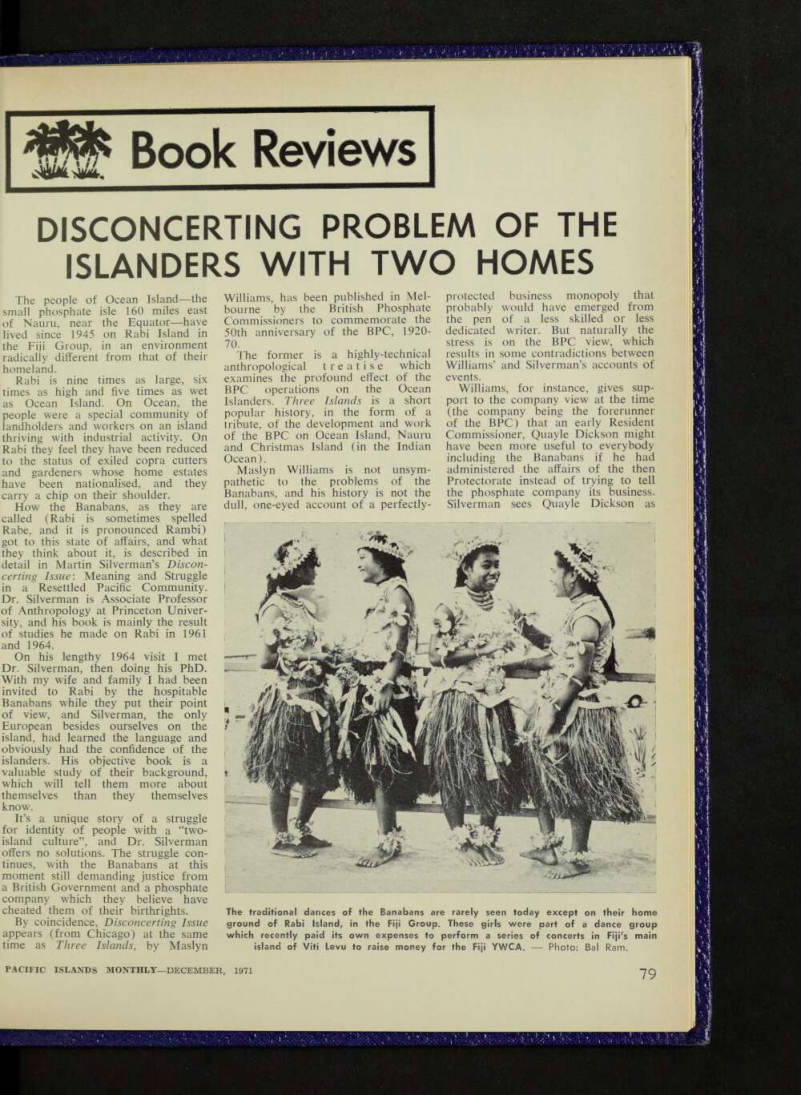 81
81 82
82 83
83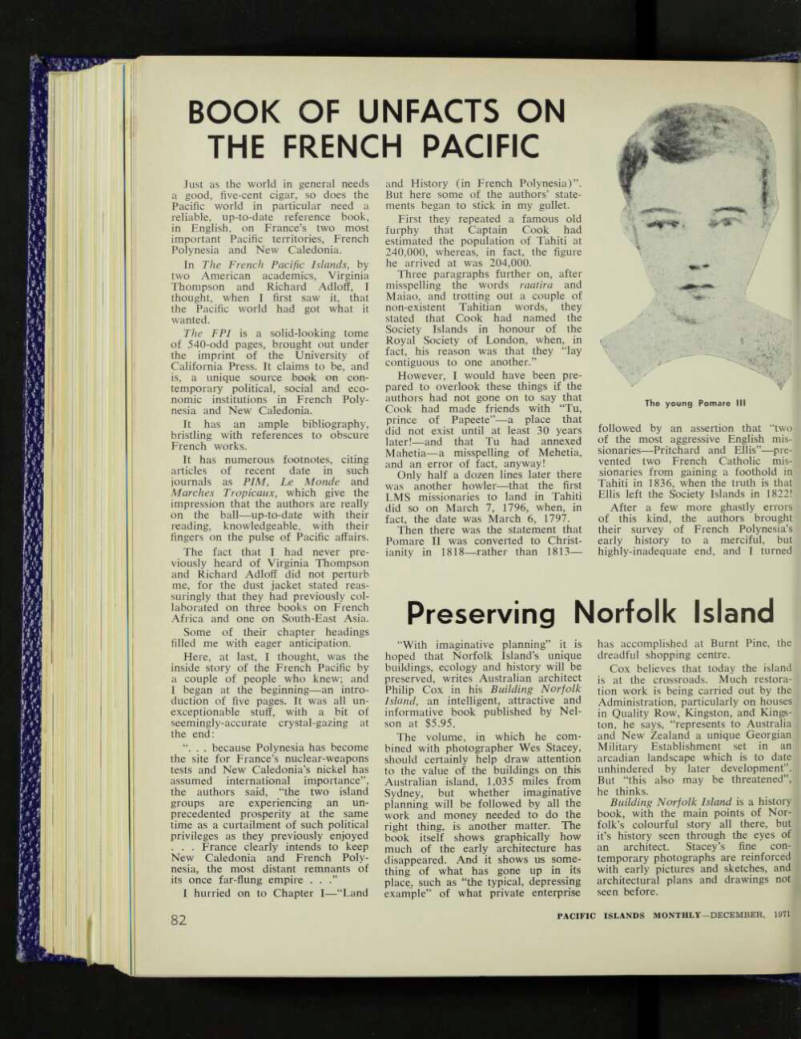 84
84 85
85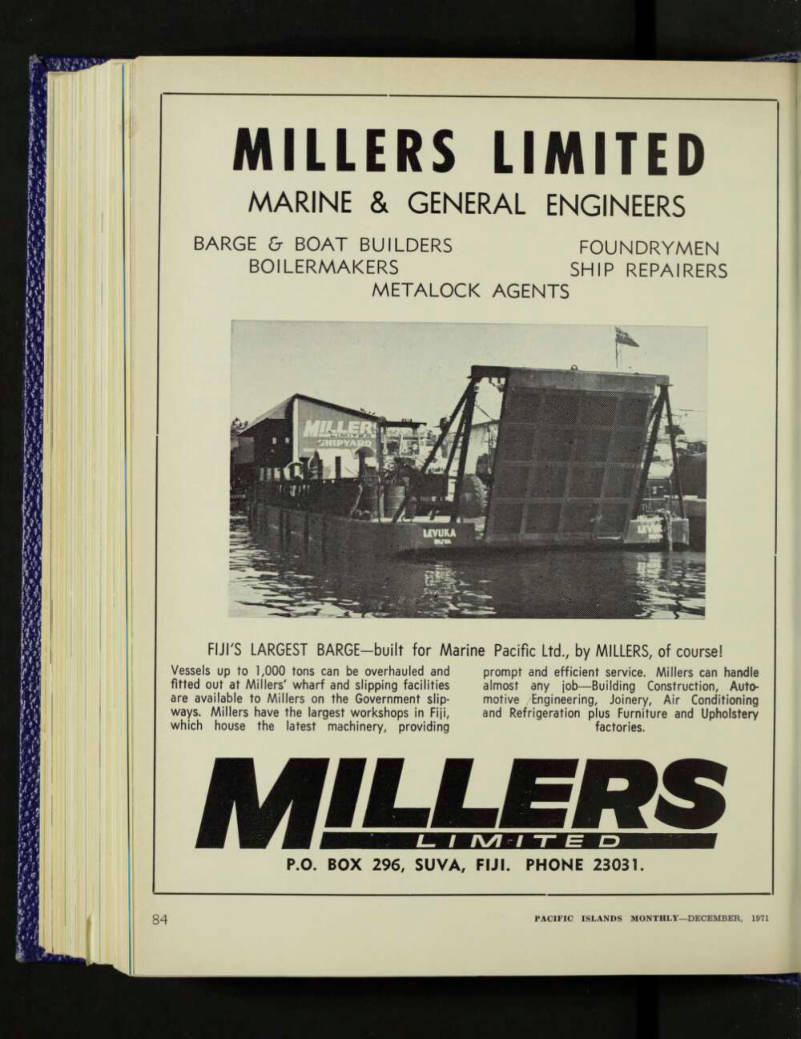 86
86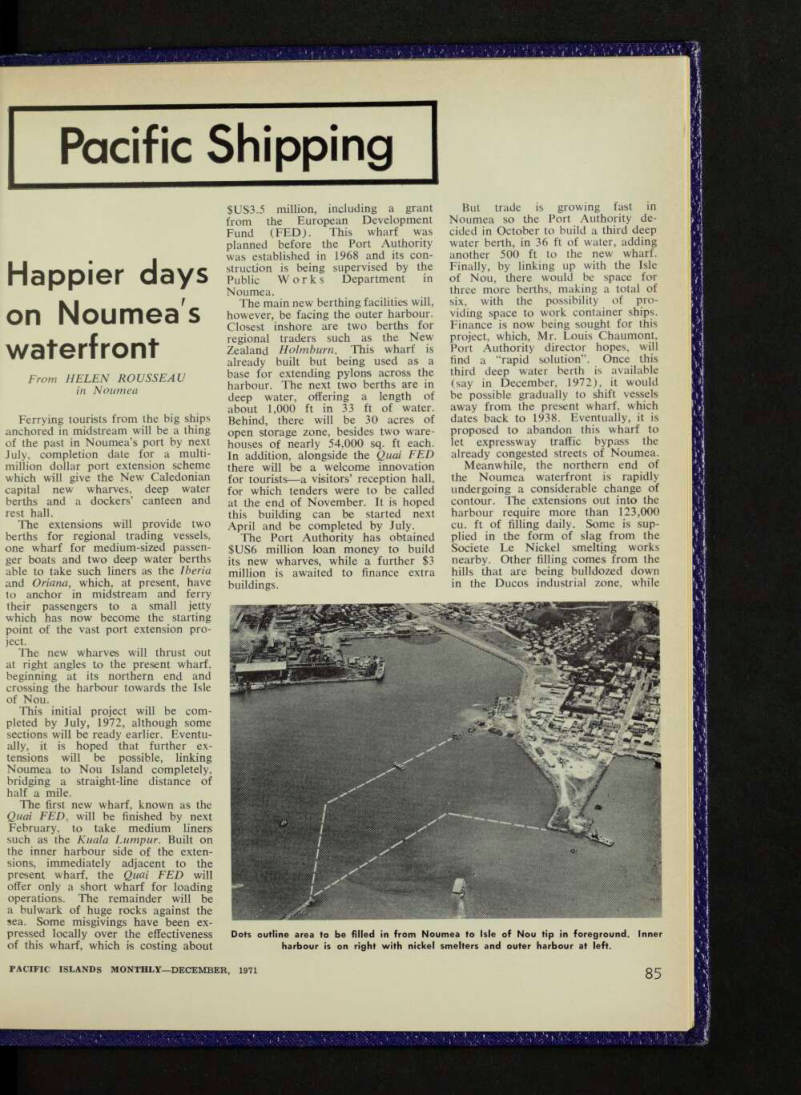 87
87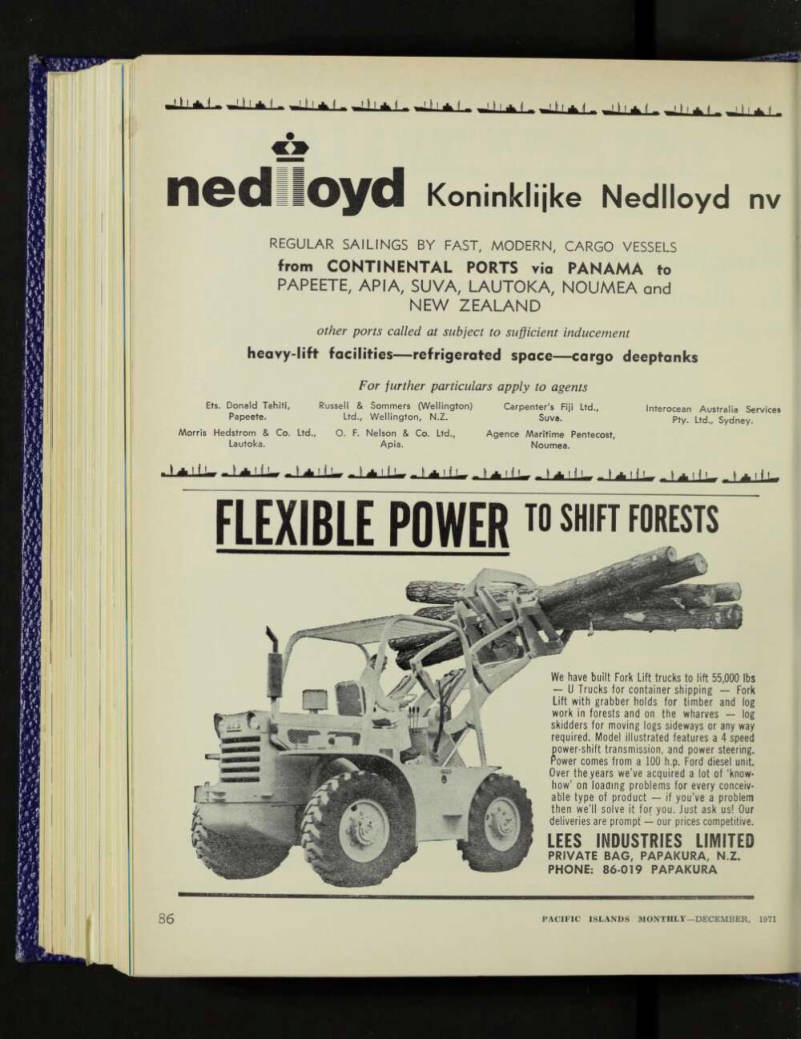 88
88 89
89 90
90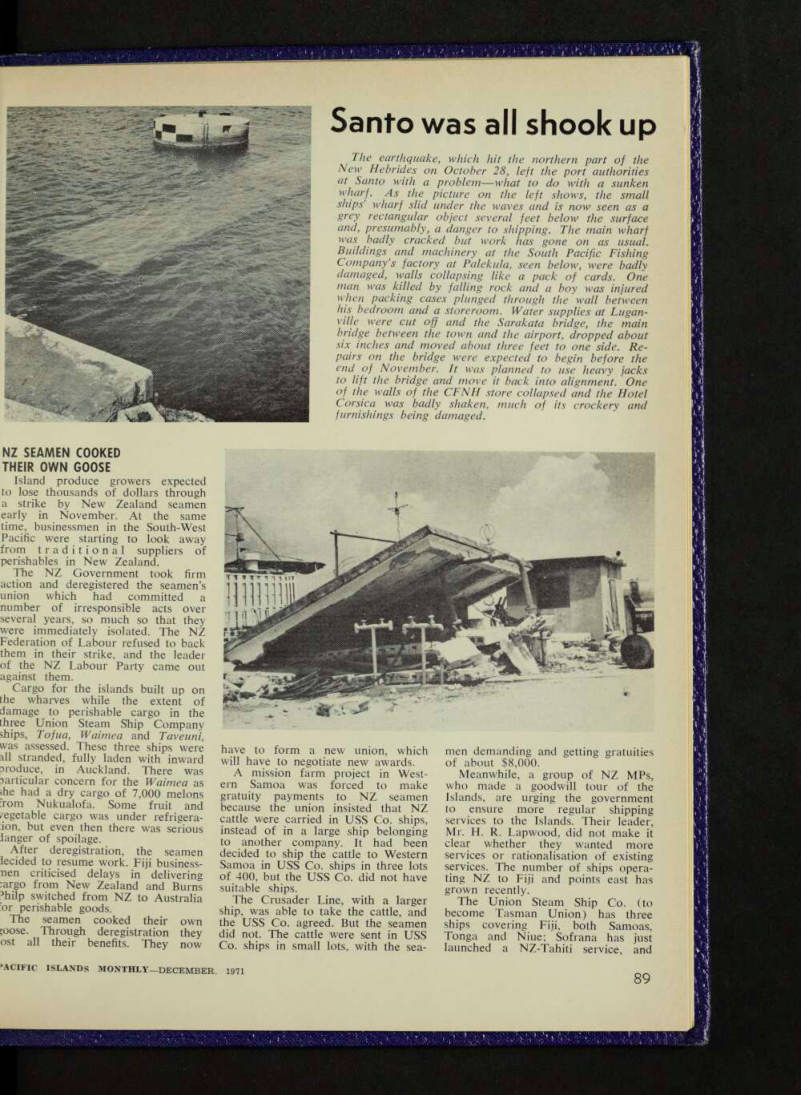 91
91 92
92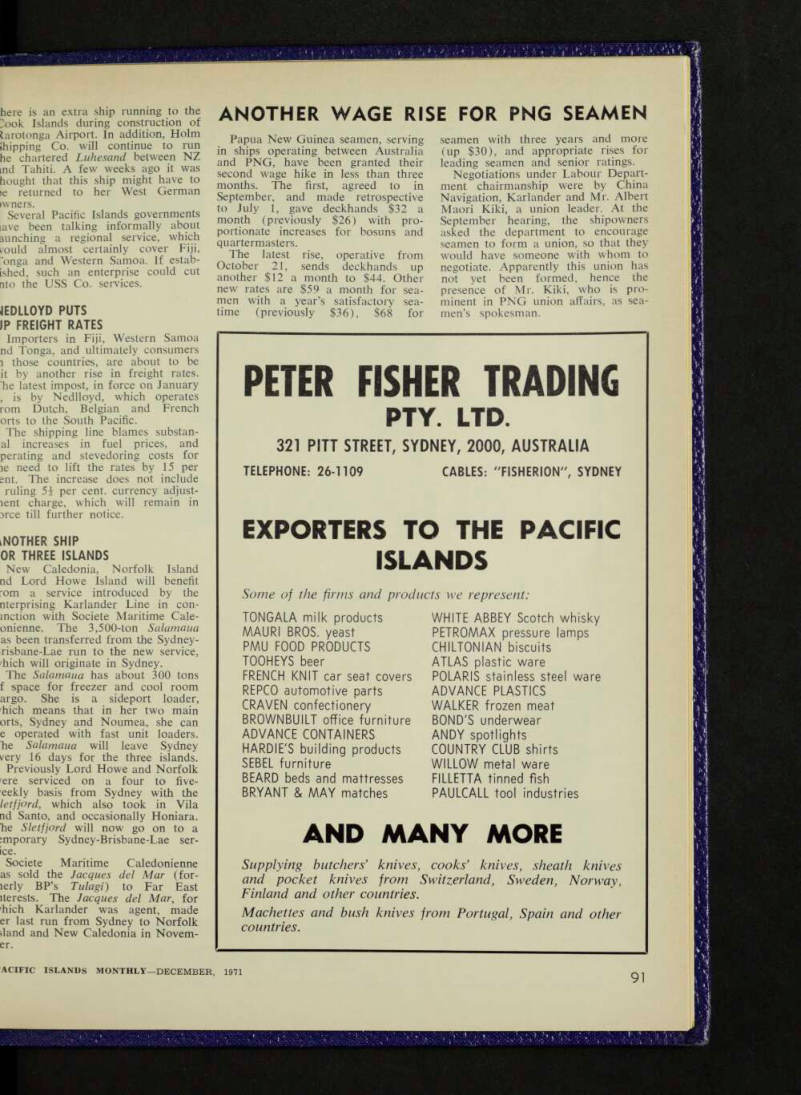 93
93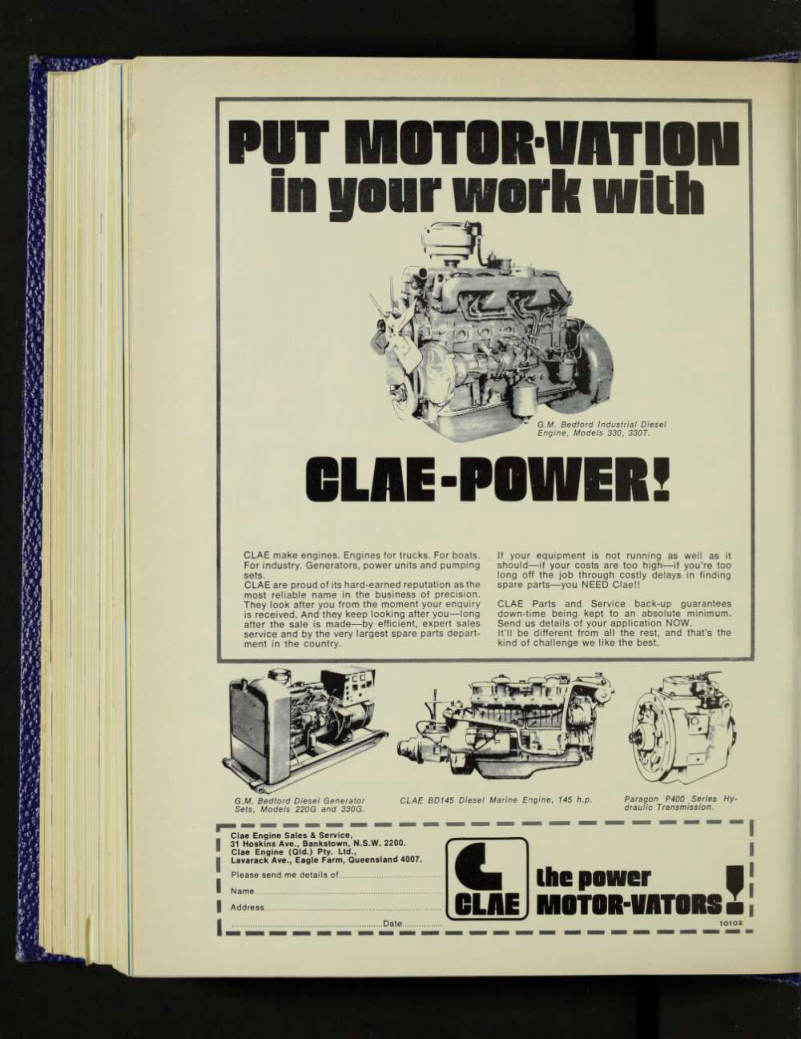 94
94 95
95 96
96 97
97 98
98 99
99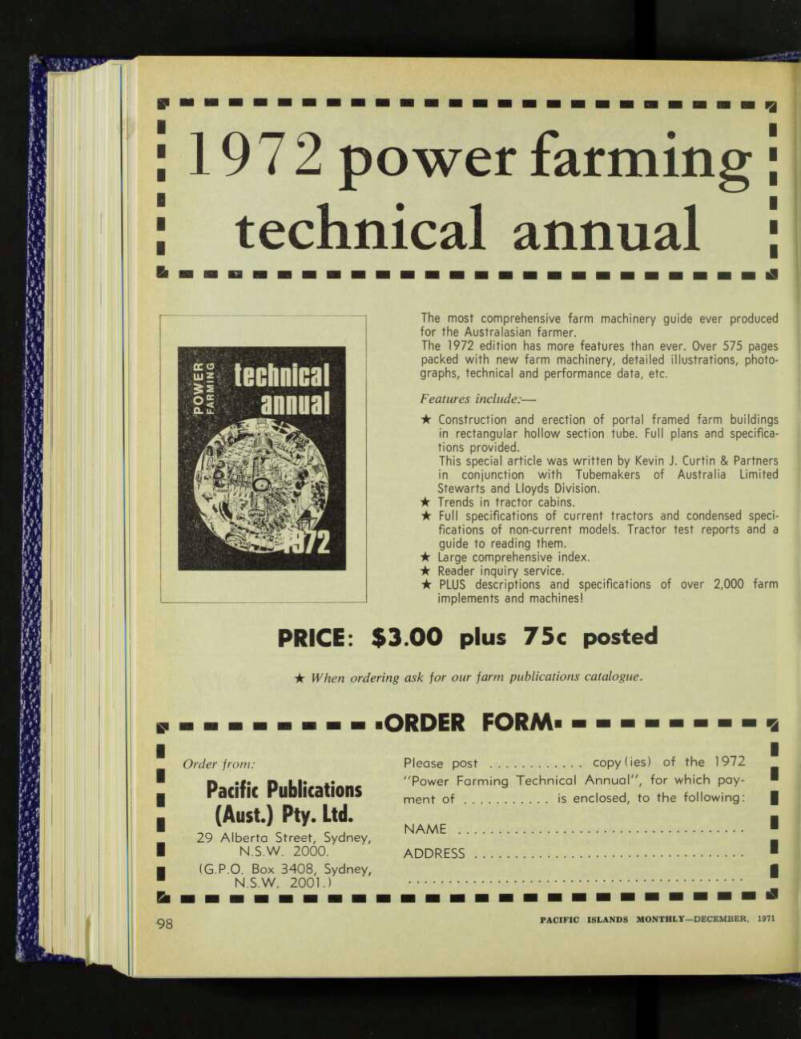 100
100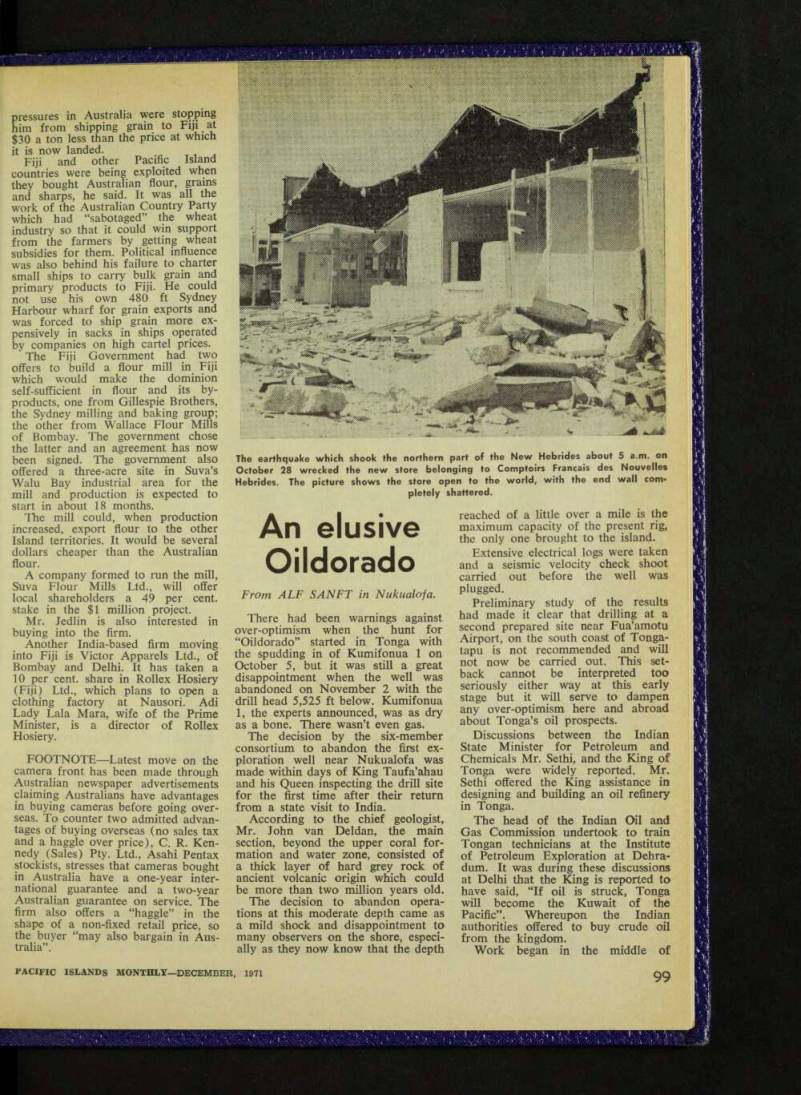 101
101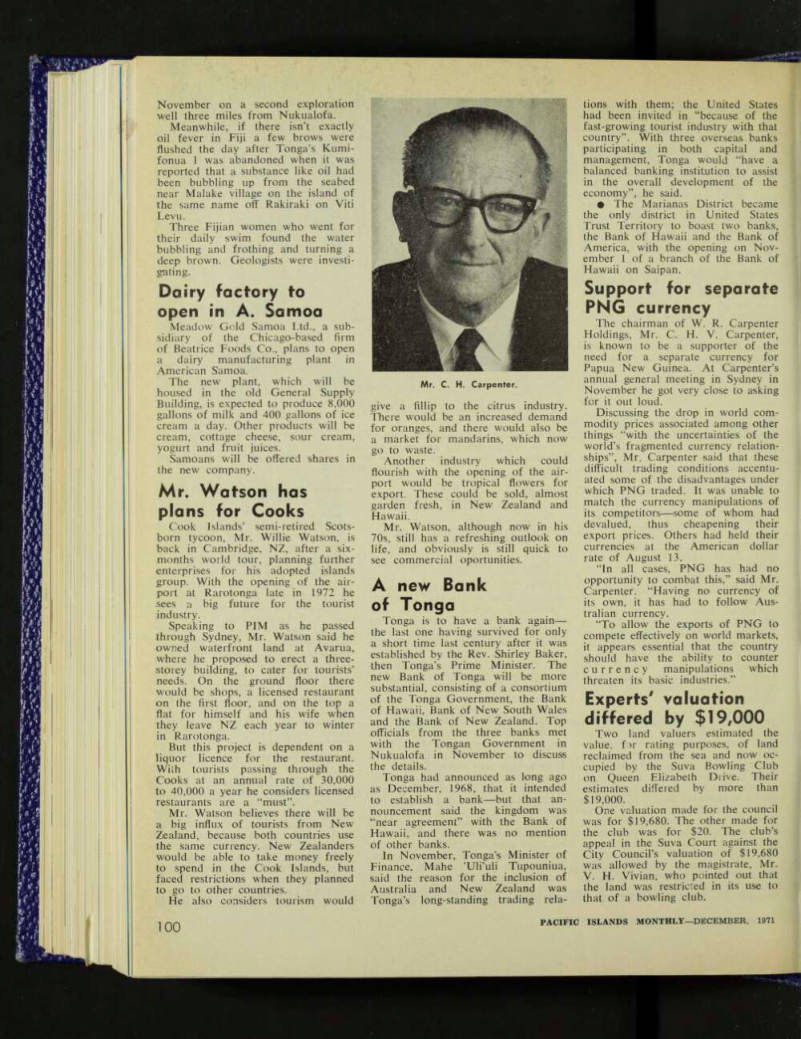 102
102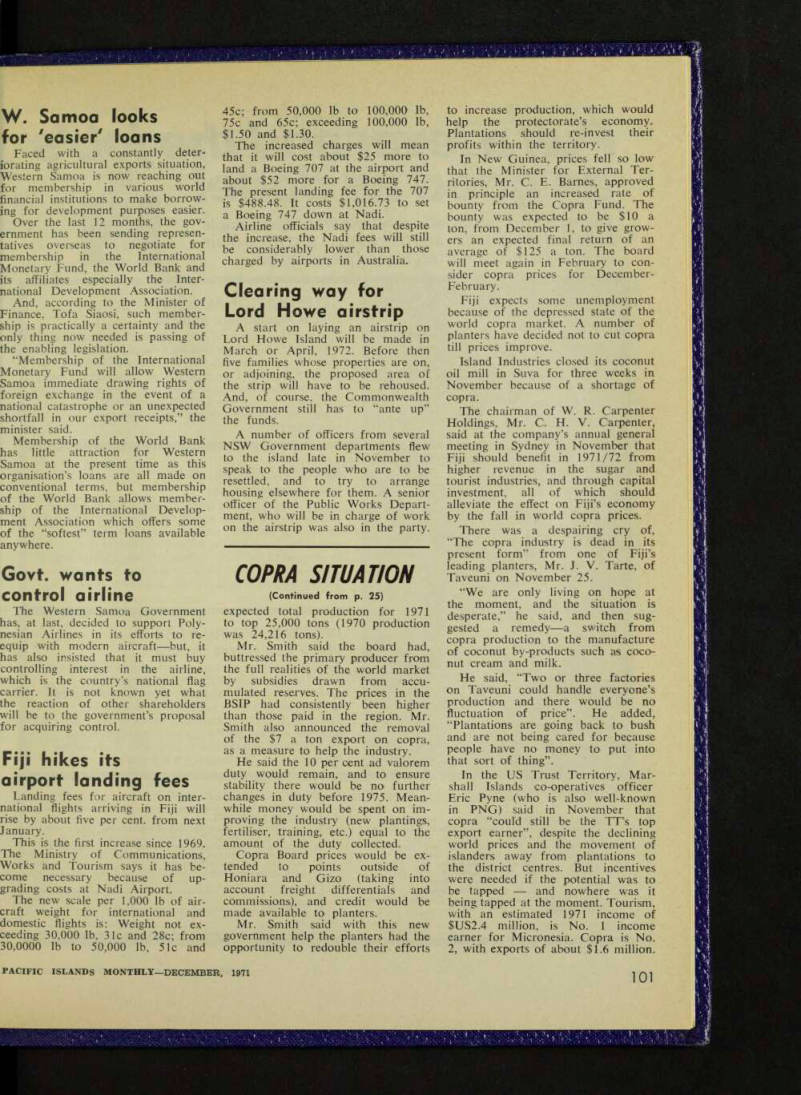 103
103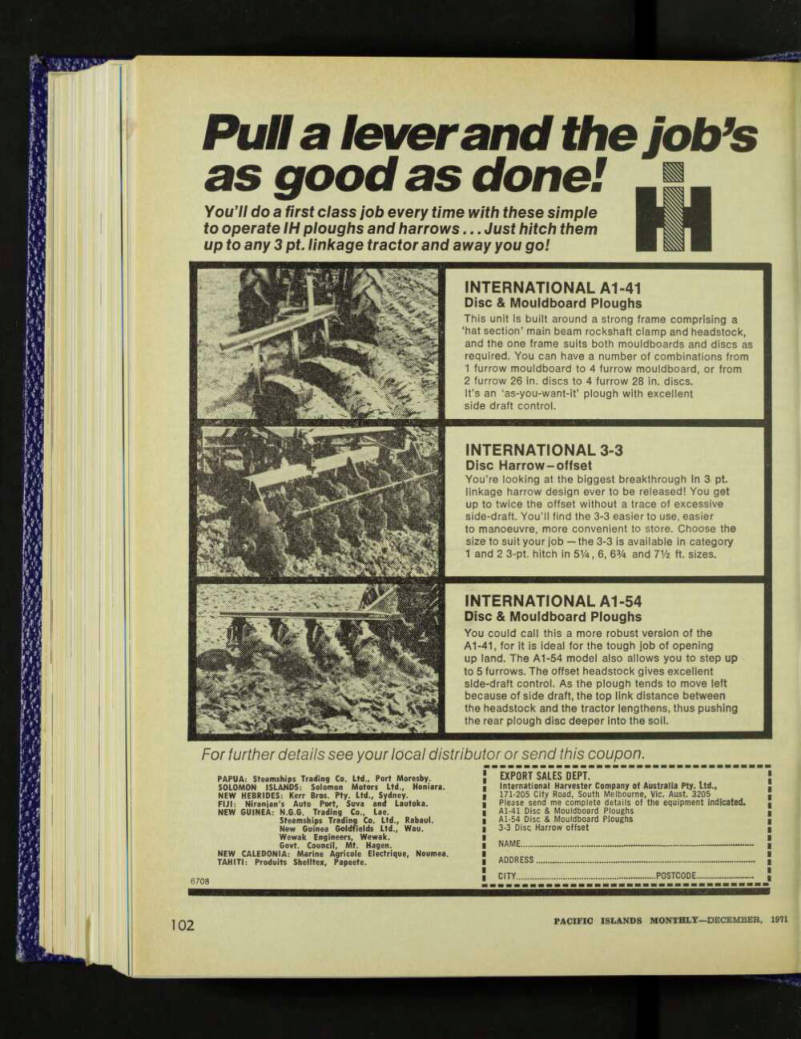 104
104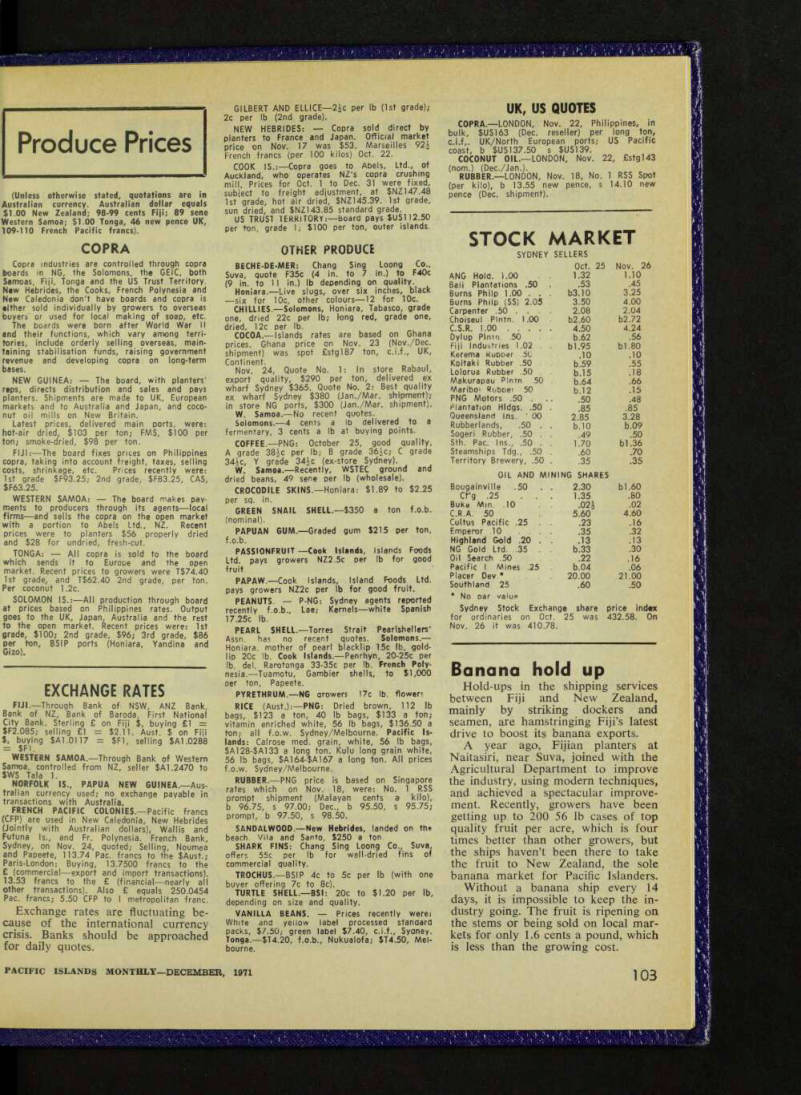 105
105 106
106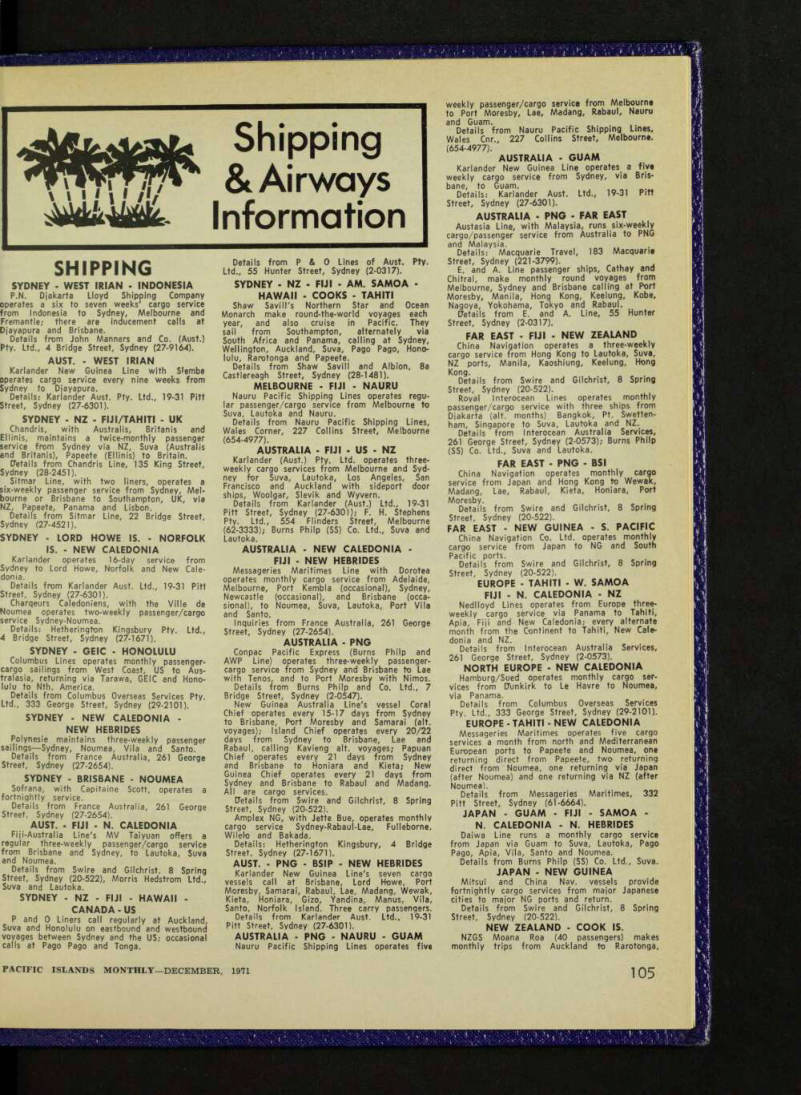 107
107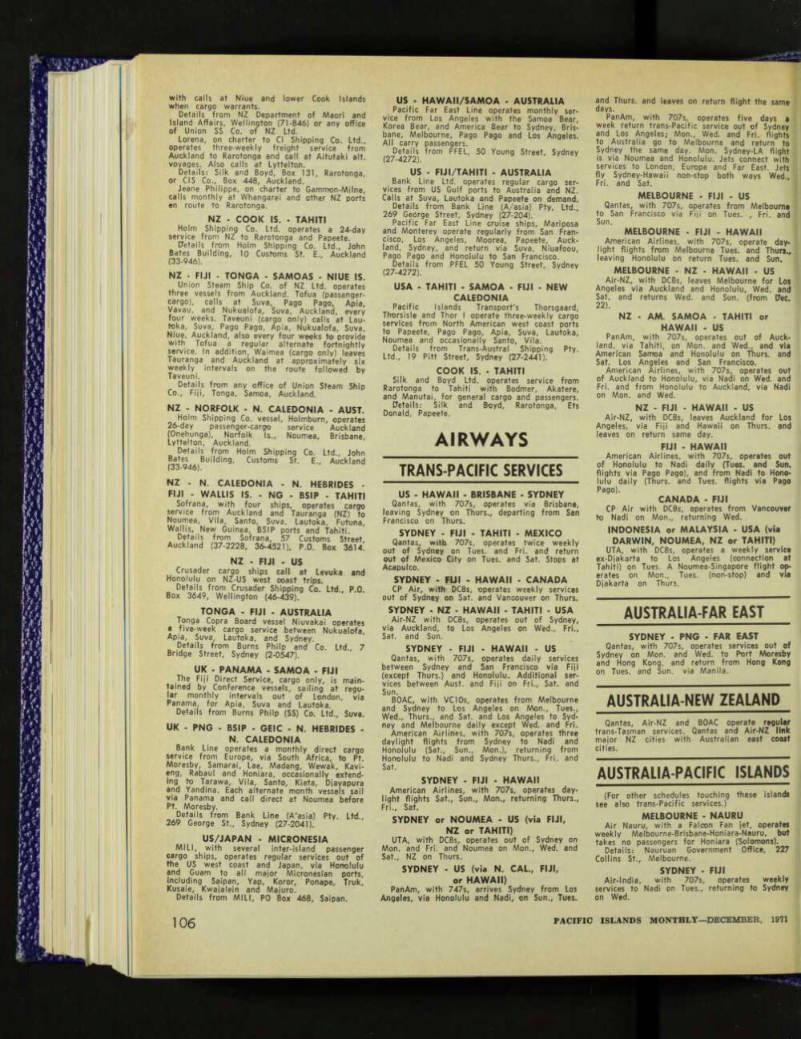 108
108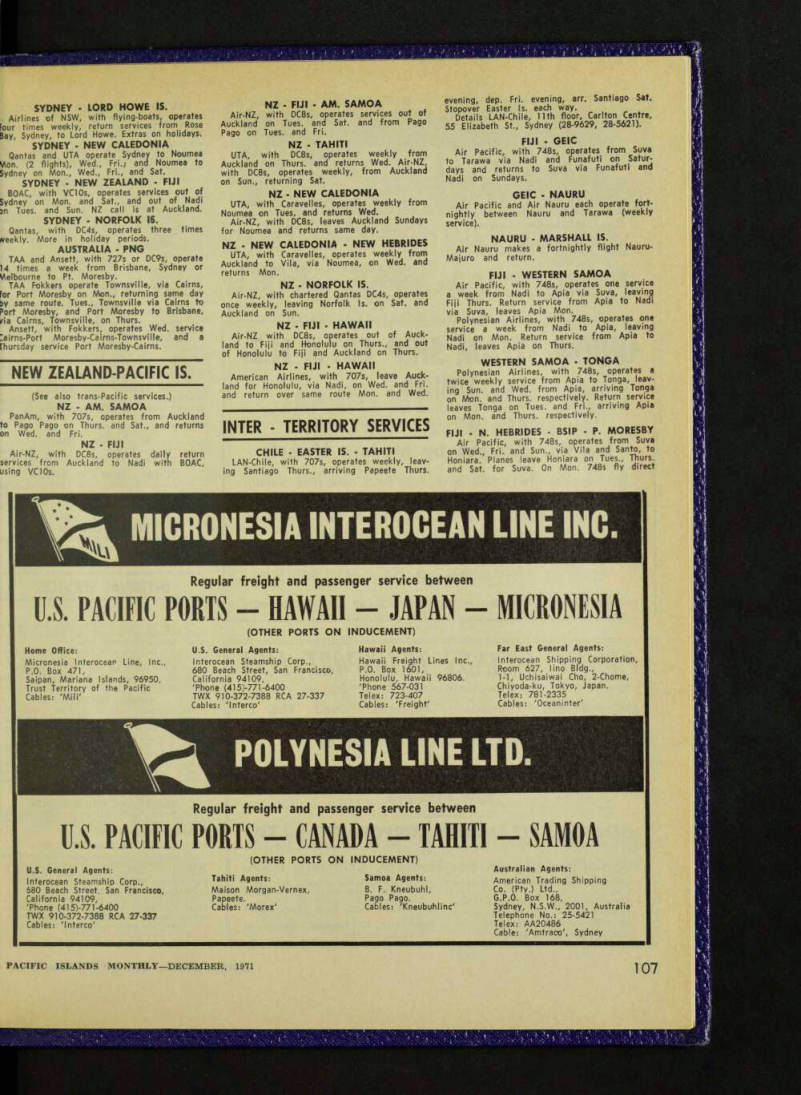 109
109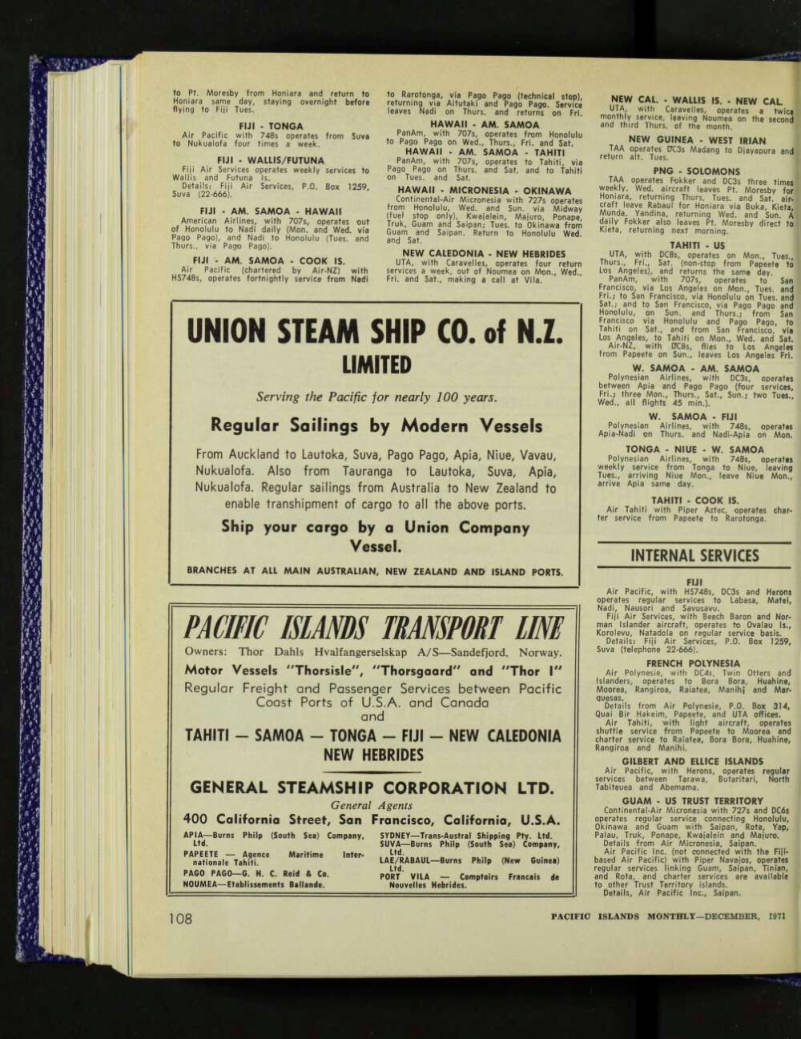 110
110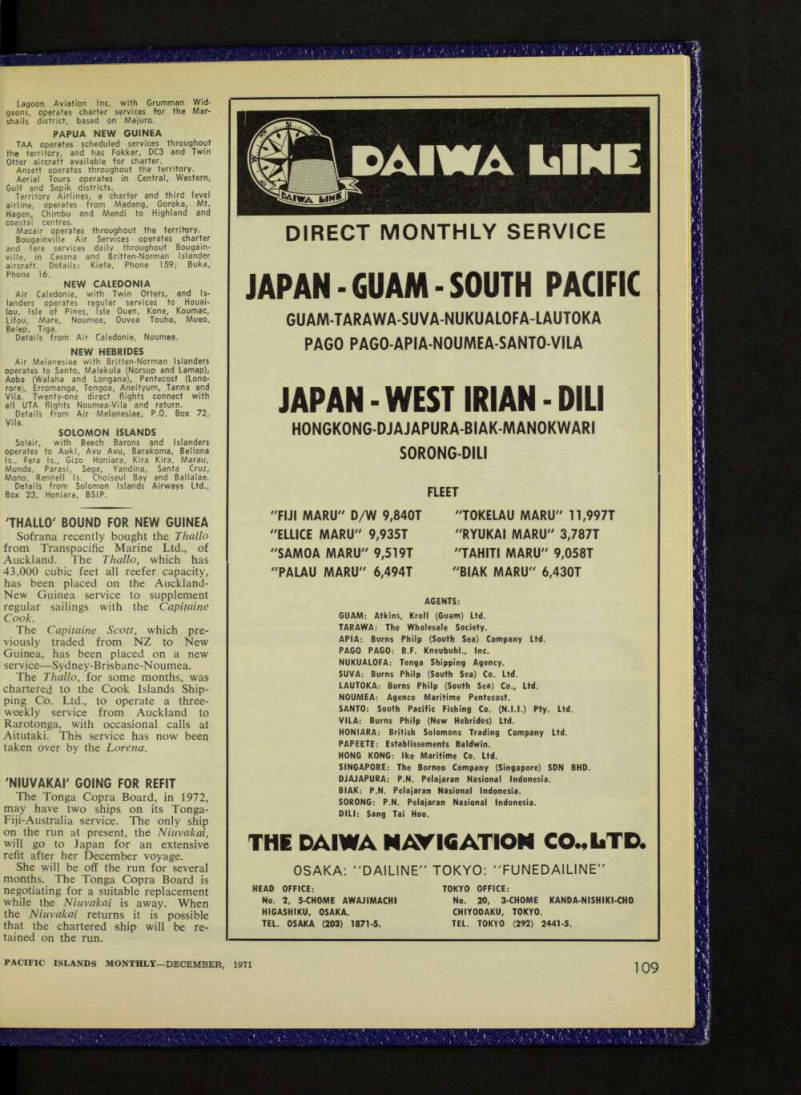 111
111 112
112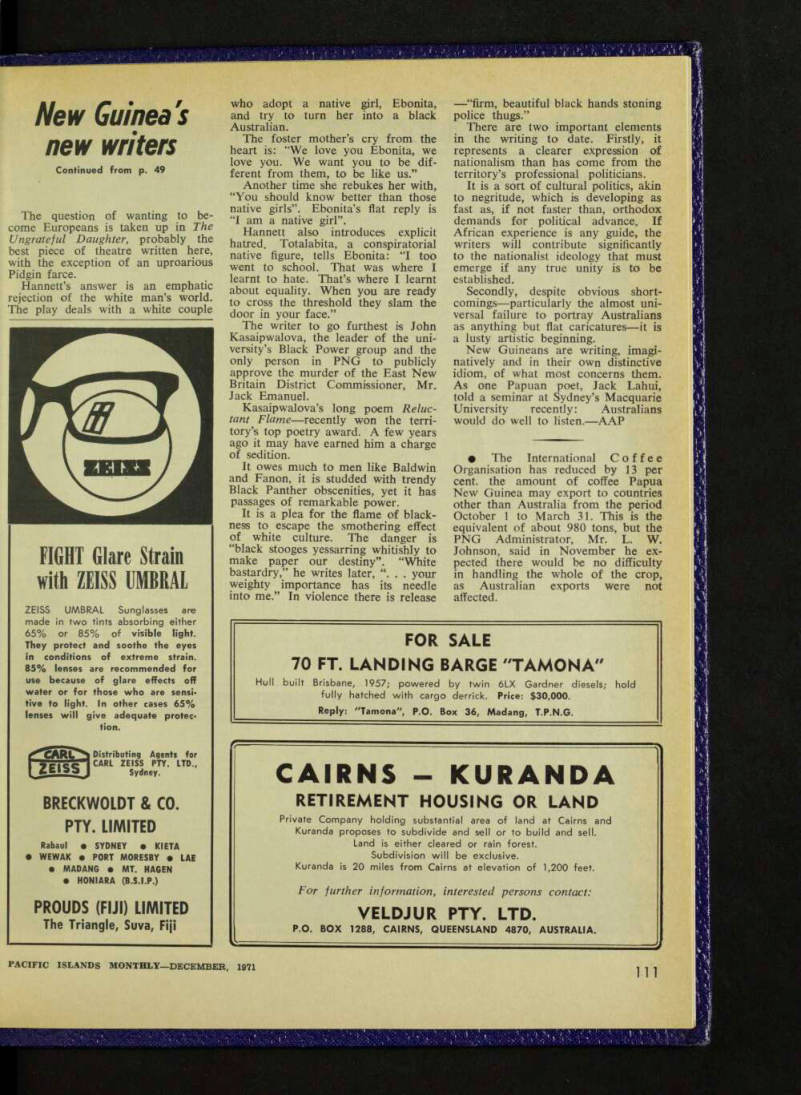 113
113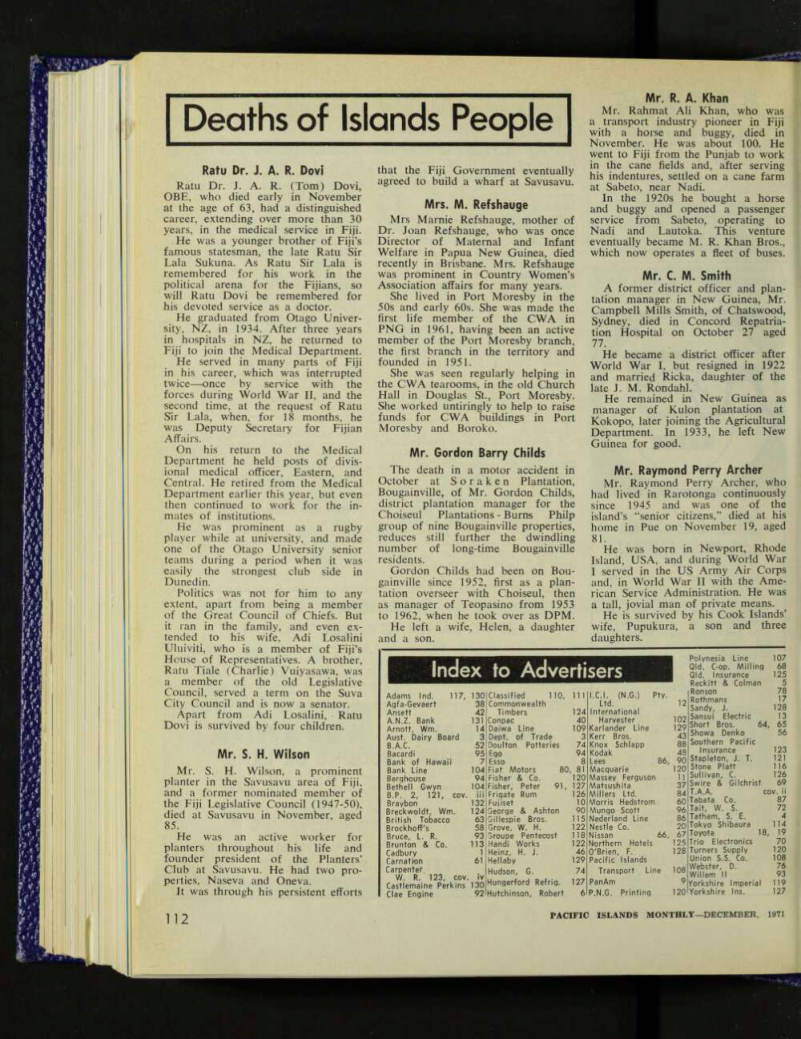 114
114 115
115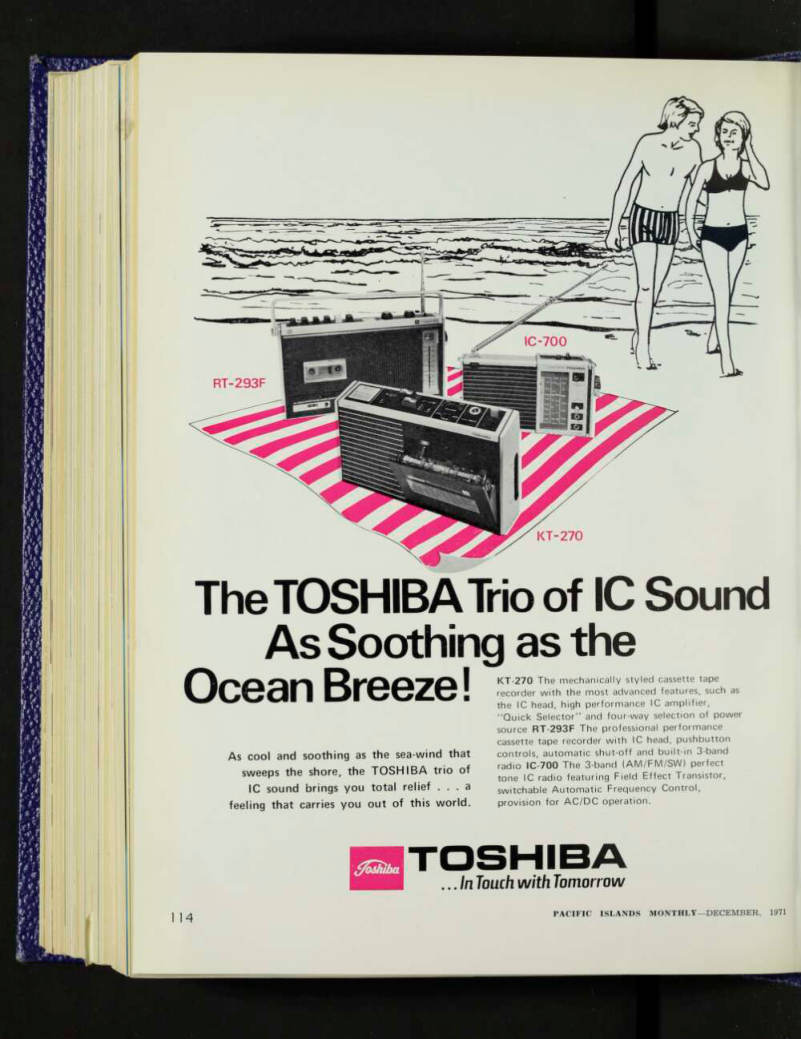 116
116 117
117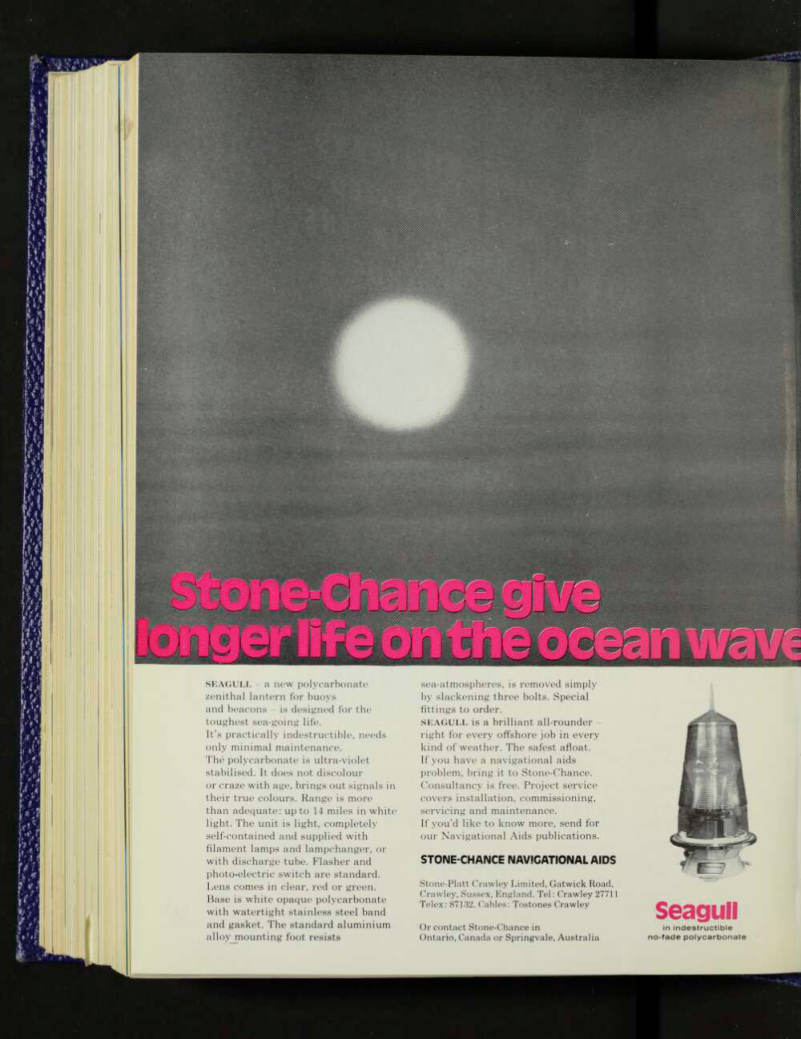 118
118 119
119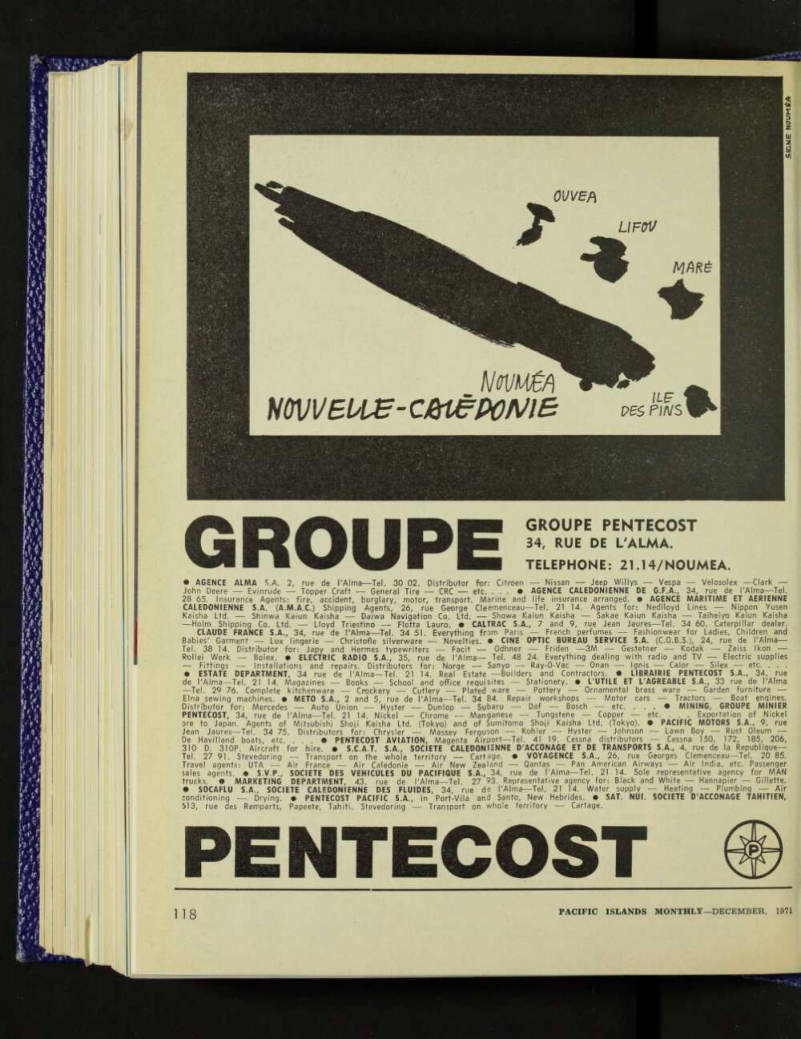 120
120 121
121 122
122 123
123 124
124 125
125 126
126 127
127 128
128 129
129 130
130 131
131 132
132 133
133 134
134 135
135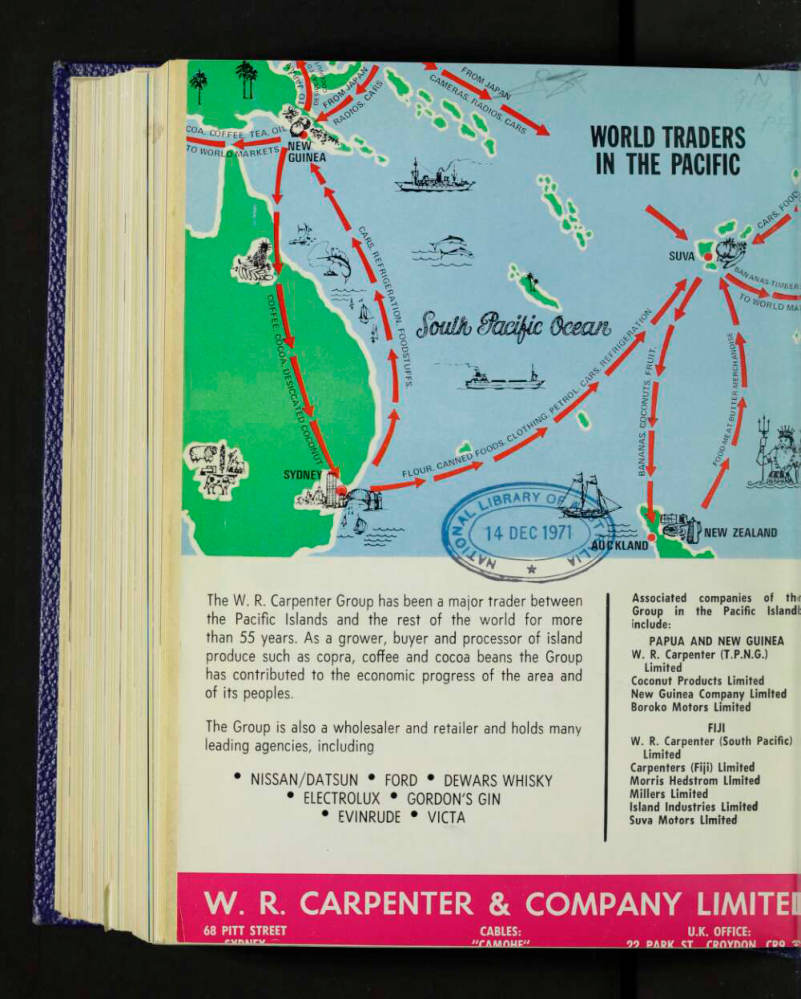 136
136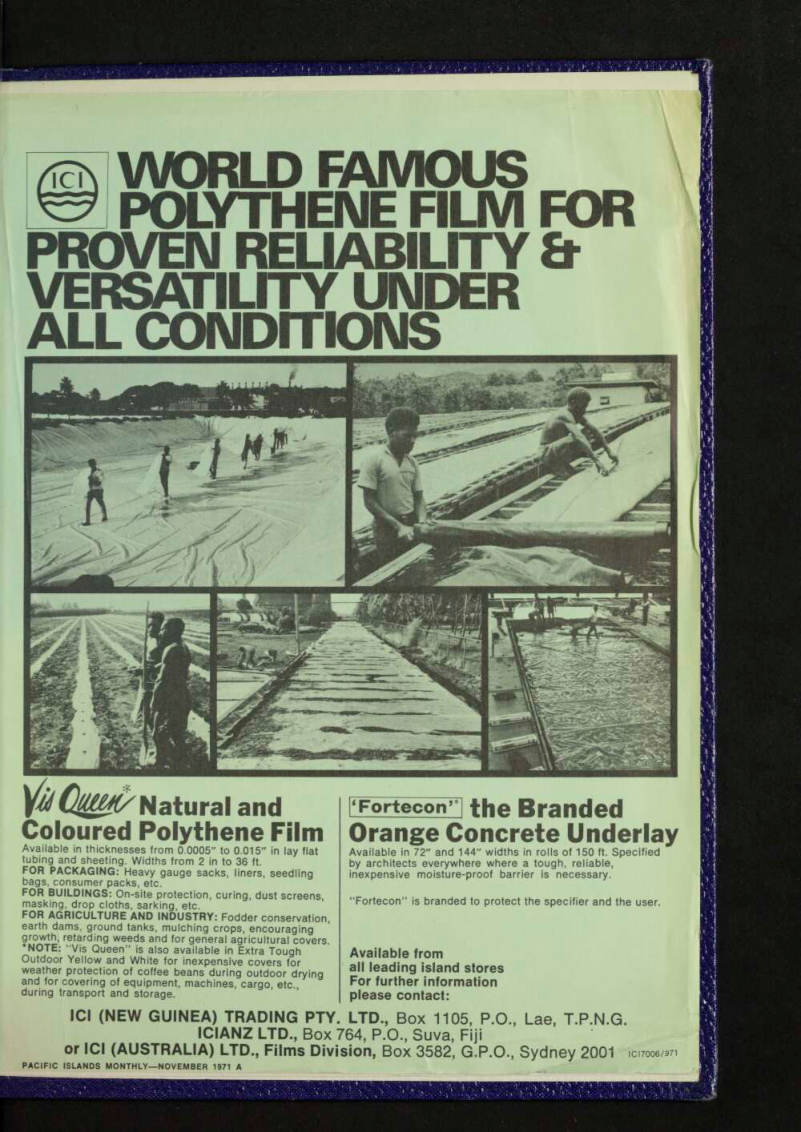 137
137