Pacific Islands Monthly
News Magazine Of The South Pacific
Australia, Nz, Geic, Bsip 50C
PNG, FIJI, COOKS, TONGA, W. SAMOA, N. HEBRIDES 45c
Nauru, Norfolk, Niue 45C
AMERICAN SAMOA 70c HAWAII 80c MICRONESIA 90c NEW CALEDONIA 65 CFP FRENCH POLYNESIA 90 CFP
November, 1971
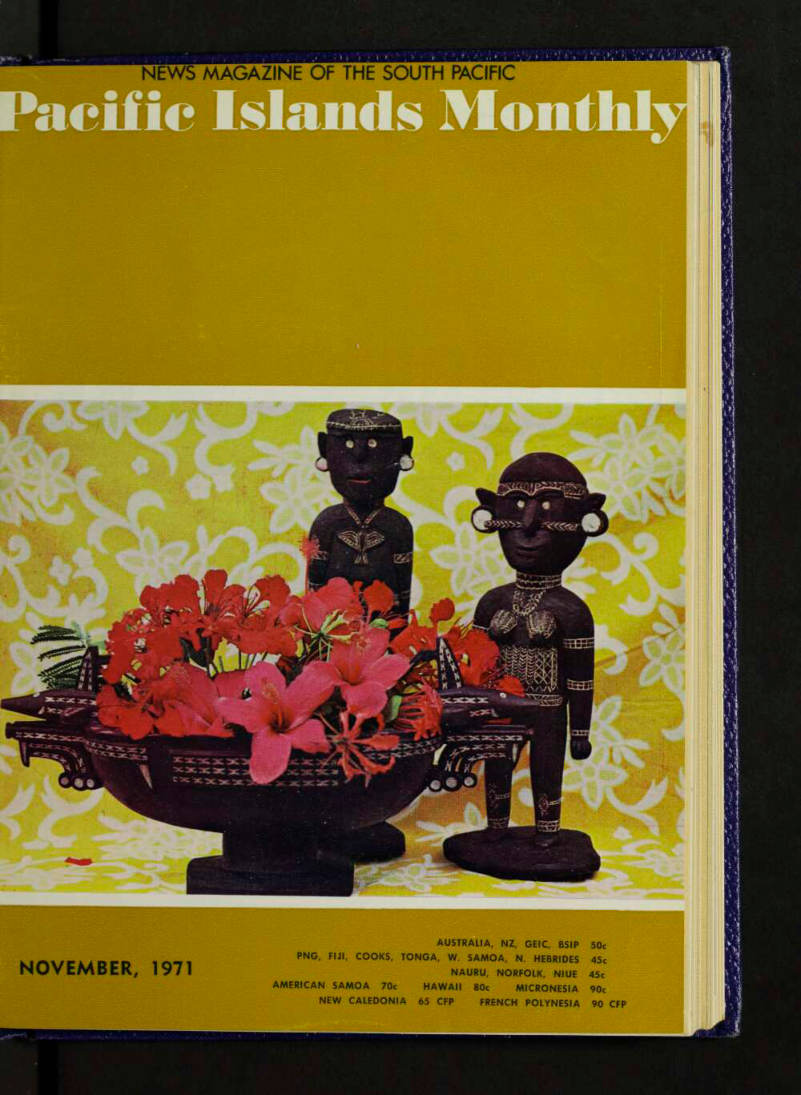
Our Cover
This attractive picture shows a col lection of traditional sculptures from Santa Ana, British Solomon Islands, carved from ebony. They are in the possession of Mr. and Mrs. Bayard K. Fox, of Honiara, and were photo graphed by Jacques Gourguechon.
There is growing interest in South Pacific art, which is likely to receive even more attention following the staging of the South Pacific Arts Festival in Suva next May. There is, however, current controversy about the cost of staging the festival (see the comments at the recent SPC meeting, beginning on p. 53).
Advertisements & other items, pp. 2-3 (1 item)
No. 1-the friendly one
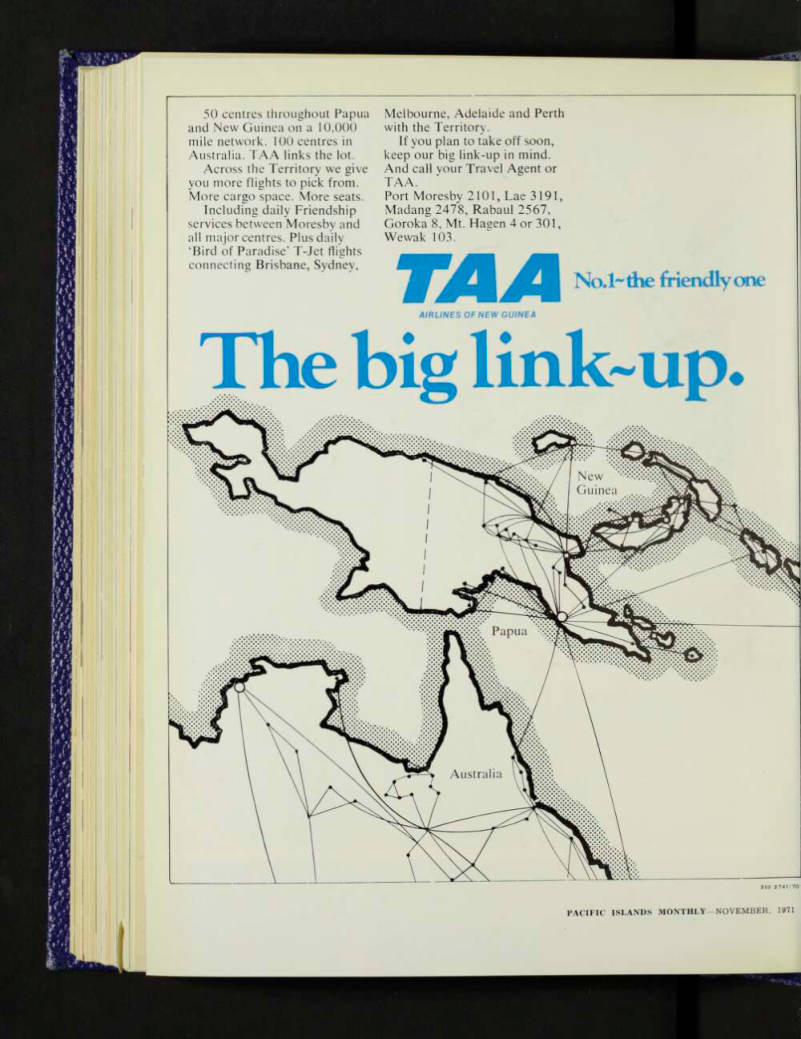
50 centres throughout Papua and New Guinea on a 10,000 mile network. 100 centres in Australia. TAA links the lot.
Across the Territory we give you more flights to pick from.
More cargo space. More seats.
Including daily Friendship
services between Moresby and all major centres. Plus daily ‘Bird of Paradise’ T-Jet flights connecting Brisbane, Sydney, Melbourne, Adelaide and Perth with the Territory.
If you plan to take off soon, keep our big link-up in mind.
And call your Travel Agent or
TAA.
Port Moresby 2101, Lae 3191, Madang 2478, Rabaul 2567, Goroka 8, Mt. Hasen 4 or 301, Wewak 103.
TAA
AIRLINES OF NEW GUINEA
No. 1-the friendly one
❖ ♦ New Guinea Australia 319 2741/70
M r* m mSSm V; rv S* *lw
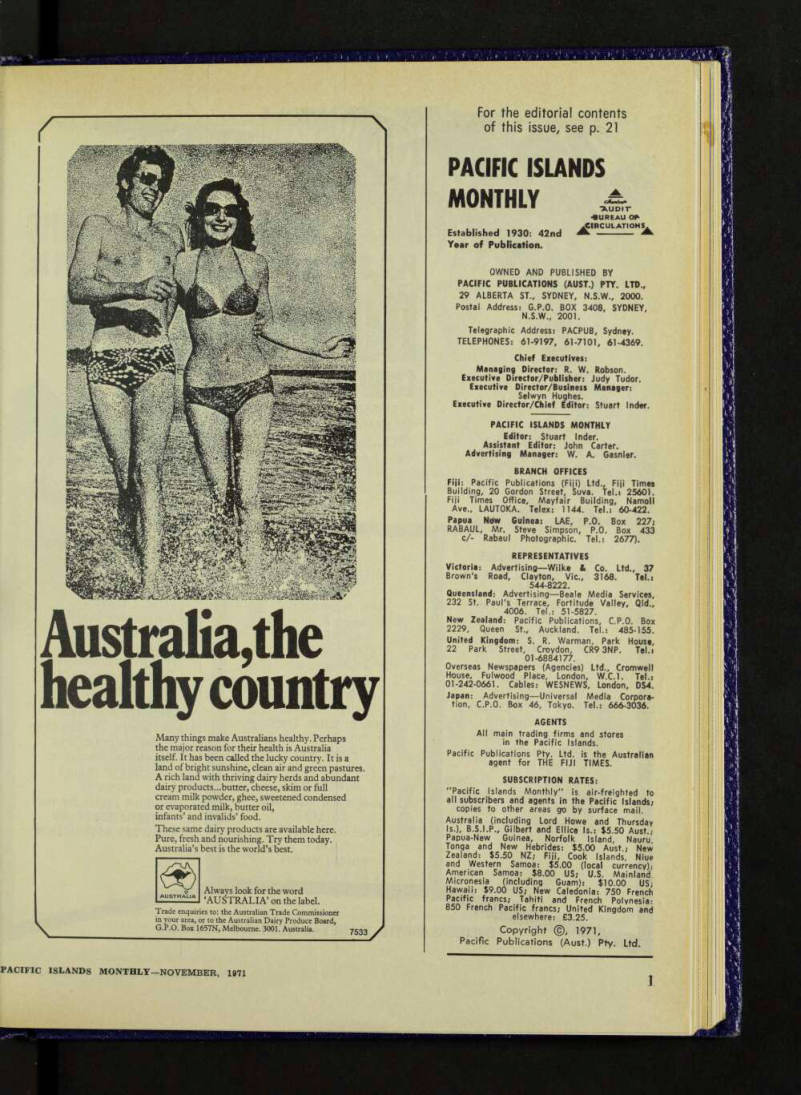
Australia,the
healthy country
\ Many things make Australians healthy. Perhaps the major reason for their health is Australia itself. It has been called the lucky country. It is a land of bright sunshine, clean air and green pastures.
A rich land with thriving dairy herds and abundant dairy products...butter, cheese, skim or full cream milk powder, ghee, sweetened condensed or evaporated milk, butter oil, infants’ and invalids’ food.
These same dairy products are available here.
Pure, fresh and nourishing. Try them today.
Australia’s best is the world’s best. & Always look for the word ‘AUSTRALIA’ on the label.
Trade enquiries to: the Australian Trade Commissioner in your area, or to the Australian Dairy Produce Board, G.P.O. Box 1657 N, Melbourne. 3001. Australia. 7533
Pacific Islands
Monthly
For the editorial contents of this issue, see p. 21
Established 1930: 42nd Year of Publication.
Owned And Published By
Pacific Publications (Aust.) Pty, Ltd.,
29 Alberta St., Sydney, N.S.W., 2000.
Postal Address: G.P.O. BOX 3408, SYDNEY,
N.S.W., 2001.
Telegraphic Address: PACPUB, Sydney.
Telephones: 61-9197, 61-7101, 61-4369.
Chief Executives: Managing Director: R. W. Robson.
Executive Director/Publisher: Judy Tudor.
Executive Director/Business Manager: Selwyn Hughes.
Executive Director/Chief Editor: Stuart Inder.
Pacific Islands Monthly
Editor: Stuart Inder.
Assistant Editor: John Carter.
Advertising Manager: W. A. Gasnler.
Branch Offices
Fiji: Pacific Publications (Fiji) Ltd., Fiji Times Building, 20 Gordon Street, Suva. Tel.: 25601.
Fiji Times Office, Mayfair Building, Namoll Ave., LAUTOKA. Telex: 1144. Tel.: 60-422.
Papua Ndw Guinea: LAE, P.O. Box 227> RABAUL, Mr. Steve Simpson, P.O. Box 433 c/- Rabaul Photographic. Tel.: 2677).
Representatives
Victoria: Advertising—Wilke & Co. Ltd., 37 Brown's Road, Clayton, Vic., 3168. Tel.: 544-8222.
Queensland: Advertising—Beale Media Services, 232 St. Paul's Terrace, Fortitude Valley, Old., 4006. Tel.: 51-5827.
New Zealand; Pacific Publications, C.P.O. Box 2229, Queen St., Auckland. Tel.: 485-155.
United Kingdom; S. R. Warman, Park House, 22 Park Street, Croydon, CR9 3NP. Tel.: 01-6884177.
Overseas Newspapers (Agencies) Ltd., Cromwell House, Fulwood Place. London, W.C.I. Tel.: 01-242-0661. Cables: WESNEWS, London, DS4.
Japan: Advertising—Universal Media Corpora tion, C.P.O. Box 46, Tokyo. Tel.: 666-3036.
Agents
All main trading firms and stores in the Pacific Islands.
Pacific Publications Pty. Ltd. is the Australian agent for THE FIJI TIMES.
Subscription Rates:
"Pacific Islands Monthly" is air-freighted to all subscribers and agents in the Pacific Islands; copies to other areas go by surface mail.
Australia (including Lord Howe and Thursday Is.), 8.5.1. P., Gilbert and Ellice Is.; $5.50 Aust.; Papua-New Guinea, Norfolk Island, Nauru Tonga and New Hebrides; $5.00 Aust.; New Zealand: $5.50 NZ; Fiji, Cook Islands, Niue and Western Samoa: $5.00 (local currency); American Samoa: $B.OO US; U.S. Mainland Micronesia (including Guam); $lO 00 US' Hawaii: $9.00 US; New Caledonia: 750 French Pacific francs; Tahiti and French Polynesia: 850 French Pacific francs; United Kingdom and elsewhere: £3.25.
Copyright ©, 1971,
Pacific Publications (Aust.) Pty. Ltd.
Advertisements & other items, pp. 4-16 (1 item)
Burnsp
THROUGHOUT THE PACIFIC
TUI,SAMOA, TONGA, NIUE Is,NORFOLK Is.
/i [ L/\
[SOUTH SEA] CO. LTD.
REGISTERED OFFICE: SUVA, FIJI.
TELEPHONE NO: 22661
TELEX NO: FJ1127
Code Address: "BURNSOUTH' 111
SHIPPING AGENCIES
The New Zealand Shipping Co. Ltd.
Shaw Savill & Albion Co. Ltd.
Blue Star Port Line (Management) Ltd.
Bank Line Ltd.
General Steamship Corporation Ltd.
Compagnie des Messageries Maritimes Royal Interocean Lines Daiwa Navigation Company Ltd.
Sitmar Line Flotta Lauro (Lauro Lines) Australasia Pty. Ltd.
Tonga Shipping Agency.
EXCLUSIVE
DISTRIBUTORSHIPS
INCLUDE
Akai Taperecorders Sunbeam Appliances Dunlop Products Hitachi Electronics Holden Motor Vehicles Rolex Watches Revlon Cosmetics Pentax Cameras Massey-Ferguson Tractors Olympic Tyres Penfold Wines
AGENTS FOR
Queensland Insurance Co. Ltd.
Shell Company (P. 1.) Ltd.
Bureau Veritas
ASSOCIATED COMPANIES
Burns Philp (New Hebrides) Ltd.
Burns Philp Trustee Co. Ltd.
Automotive Supplies Co. Ltd.
Corrie & Co. Ltd.
Wrought Iron and Steel Construction Co. Ltd.
Bish Ltd.
SPECIALISED SERVICES
Expert advice on Shipping,- Forwarding; Customs formalities; Insurance.
COMPLETE TRAVEL
SERVICE
accredited agents for the
INTERNATIONAL AIR
TRANSPORT ASSOCIATION
OVERSEAS AGENTS: SYDNEY • LONDON • SAN FRANCISCO
world
quality
■-A m ¥ * v i 'O vt> **si &
one
Only the world’s finest Virginia tobaccos are blended to produce ...
PLAYER’S
GOLD
LEAF
ofthe great cigarettes
8593/2/70
great bunch
of flours.
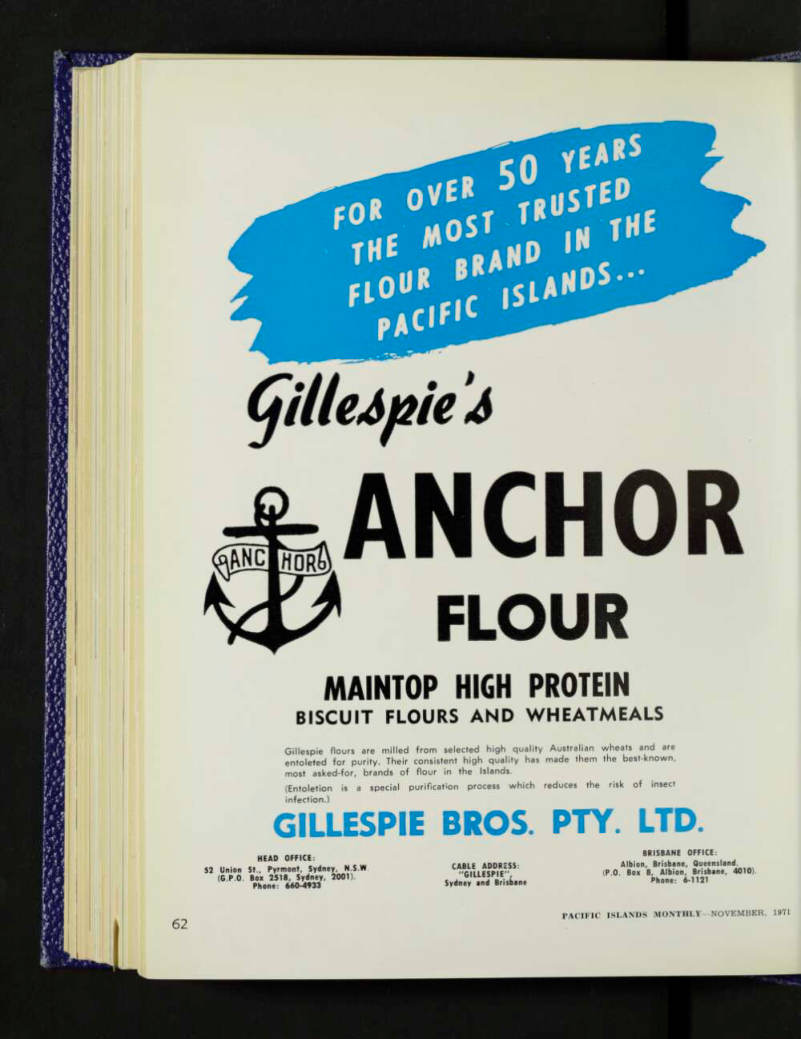
Robert Hutchinson makes the greatest bunch of flours in the Pacific. Bakers’ flour *** Superlite cake and sponge flours.
Biscuit flour and cracker flour.
Wheaten sharps and wheaten meal.
We’re particularly proud of our bunch of flours. So we have a technical advisory service to help you use them properly.
So next time you see a Robert Hutchinson flour (or even one of our Hutmill stock feeds), remember it’s just one of the bunch.
M j m m
ROBERT
HUTCHINSON
LIMITED
tiie flour people
Hartington Street, Glenroy, Victoria, Australia. 3046. Telephone Melbourne 306 7261 rhioz
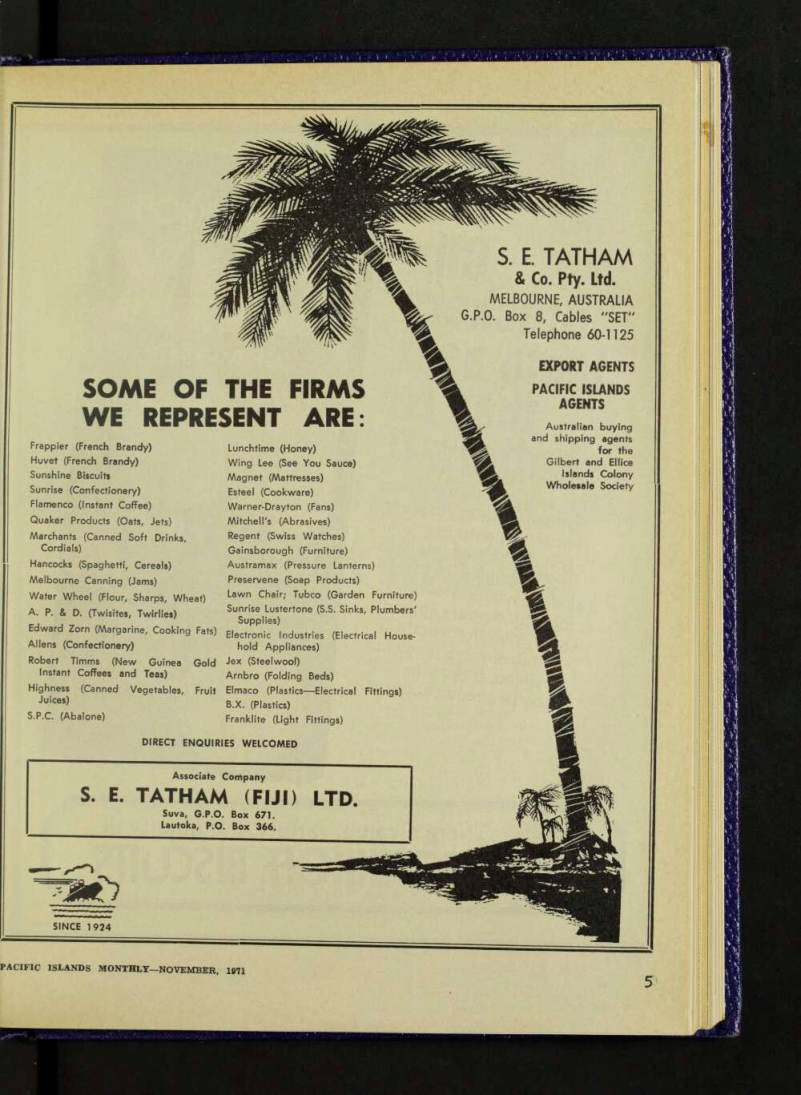
SOME OF THE FIRMS
WE REPRESENT ARE;
Frappier (French Brandy) Huvet (French Brandy) Sunshine Biscuits Sunrise (Confectionery) Flamenco (Instant Coffee) Quaker Products (Oats, Jets) Merchants (Canned Soft Drinks, Cordials) Hancocks (Spaghetti, Cereals) Melbourne Canning (Jams) Water Wheel (Flour, Sharps, Wheat) A. P. & D. (Twisites, Twirlies) Edward Zorn (Margarine, Cooking Fats) Allens (Confectionery) Robert Timms (New Guinea Gold Instant Coffees and Teas) Highness (Canned Vegetables, Fruit Juices) S.P.C. (Abalone) Lunchtime (Honey) Wing Lee (See You Sauce) Magnet (Mattresses) Esteel (Cookware) Warner-Drayton (Fans) Mitchell's (Abrasives) Regent (Swiss Watches) Gainsborough (Furniture) Austramax (Pressure Lanterns) Preservene (Soap Products) Lawn Chair; Tubco (Garden Furniture) Sunrise Lustertone (S.S. Sinks, Plumbers' Supplies) Electronic Industries (Electrical Household Appliances) Jex (Steelwool) Arnbro (Folding Beds) Elmaco (Plastics —Electrical Fittings) B.X. (Plastics) Franklite (Light Fittings)
DIRECT ENQUIRIES WELCOMED
Associate Company
S. E. TATHAM (FIJI) LTD
Suva, G.P.O. Box 671.
Lautoka, P.O. Box 366.
SINCE 1924
Gift
Crackers
taste as «
they re
buttered'.
Brockhoff CIK ate cpsp, golden etaokets just asi tn«y fresh fr ° m h n 6 ib P bie with drinks into PS ’th savoury spreads. or tQ P w ' th Brockhotf CHx Oven-cnsp »r {or
SSsa
KDft X There’s value, variety and quality in
BROCKHOFF BISCUITS
6441/8 x 6V4
SHHH
M & m E S&S ><*
We got it there.
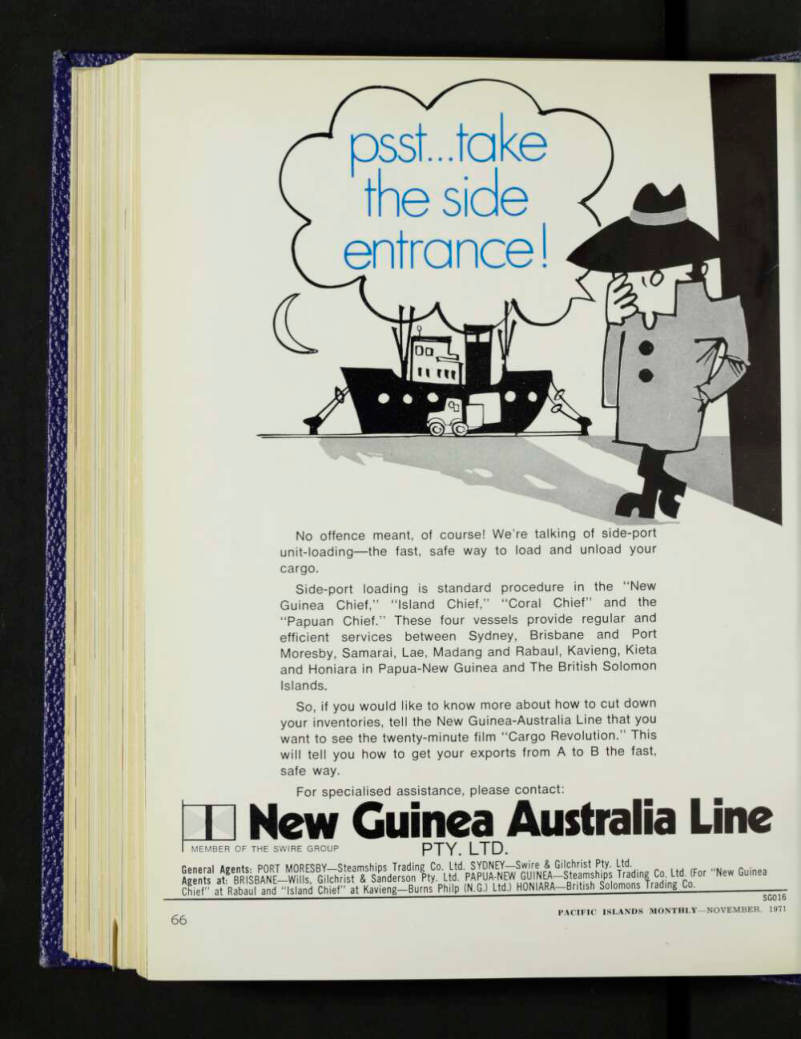
A lot of things in the Territory wouldn't be happening if it wasn't for Conpac. Because Conpac will carry any kind of cargo. From a king-sized bulldozer to sheet steel, steel girders, a radio-active Cobalt unit, meat. You name it.
We II carry it. Its just part of the service we offer. Conpac's contribution to the Territory's development. Conpac also serves you better with: Direct services to Port Moresby and Lae.
When you ship with Conpac your goods arrive the fast way. Conpac specialises with separate direct services from Sydney/Brisbane to Port Moresby and to Lae. MV ''Nimos'' offers a 17 day turnabout to Port Moresby. MV "Tenos" hps a 19 day turnabout to Lae.
Exclusive "Cargo Advisory Service".
Conpac has its own fully-staffed offices at Port Moresby and Lae. If you have a problem cargo or a cargo problem ask the expert cargo advisory team at either Conpac office to assist you. This service is one of the many ways Conpac is assisting in the development of the Territory.
Exclusive. Simple shipping documentation.
Only Conpac offers simplified standard import/ export documentation. Large shippers will find it saves valuable time and money. Small to large shippers can still use the highly suitable existing documentation. Only Conpac offers you a choice.
Ship your cargo the fast, efficient way through Conpac. Offices are located at Musgrave St. Port Moresby. Telephone 2369. And at Macdhui St.
Lae. Telephone; 2269.
caNmc
CONTRINERS PRC/FIC EXPRESS LINE
25836 SYDNEY: 7 Bridge Street. Phone: 2 0547. BRISBANE: 133 Mary Street Phone: 31 0391. C0N28.87
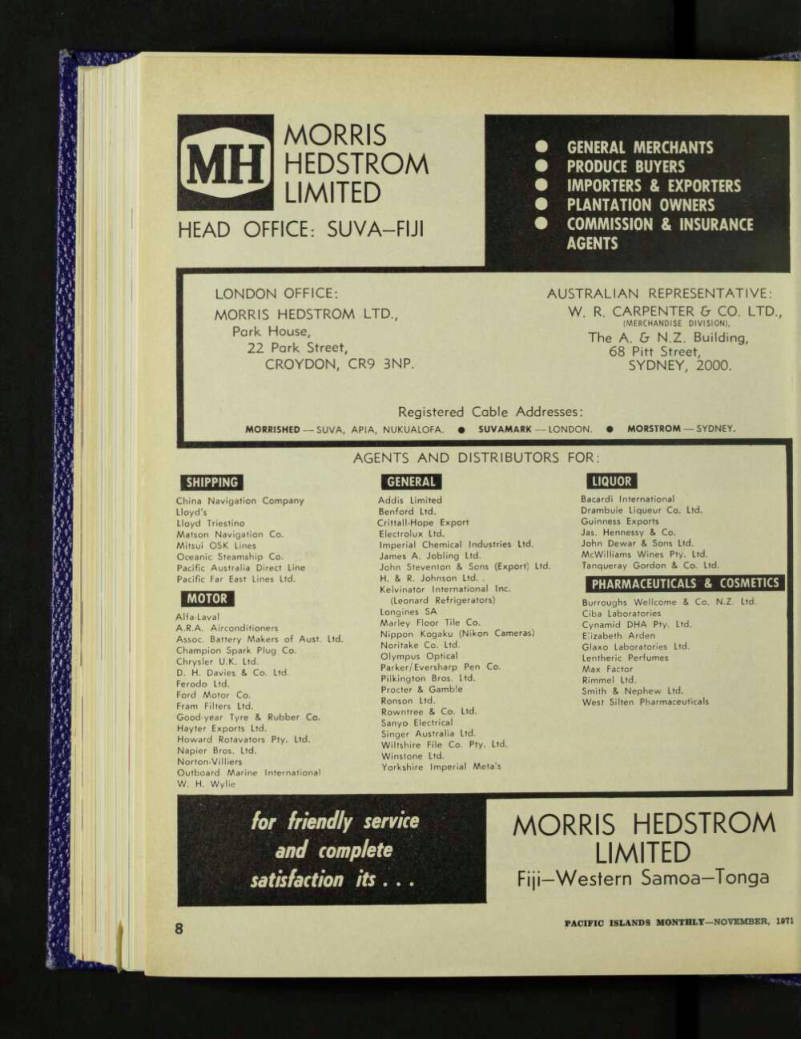
MORRIS
HEDSTROM
LIMITED
HEAD OFFICE: SUVA-FIJI
(J[}3
LONDON OFFICE:
MORRIS HEDSTROM LTD.,
Park House,
22 Park Street,
CROYDON, CR9 BNP.
AUSTRALIAN REPRESENTATIVE:
W. R. CARPENTER & CO. LTD.,
(MERCHANDISE DIVISION),
The A. & N.Z. Building,
68 Pitt Street,
SYDNEY, 2000.
Registered Cable Addresses:
MORRISHED SUVA, APIA, NUKUALOFA. • SUVAMARK LONDON.
MORSTROM —SYDNEY.
AGENTS AND DISTRIBUTORS FOR:
SHIPPING
China Navigation Company Lloyd's Lloyd Triestino Matson Navigation Co.
Mitsui OSK Lines Oceanic Steamship Co.
Pacific Australia Direct Line Pacific Far East Lines Ltd.
MOTOR
Alfa-Laval A.R.A. Airconditioners Assoc. Battery Makers of Aust. Ltd.
Champion Spark Plug Co.
Chrysler U.K. Ltd.
D. H. Davies & Co. Ltd.
Ferodo Ltd.
Ford Motor Co.
Fram Filters Ltd.
Good-year Tyre & Rubber Co.
Hayter Exports Ltd.
Howard Rotavators Pty. Ltd.
Napier Bros. Ltd.
Norton-Villiers Outboard Marine International W. H. Wylie
GENERAL
Addis Limited Benford Ltd.
Crittall-Hope Export Electrolux Ltd.
Imperial Chemical Industries Ltd.
James A. Jobling Ltd.
John Steventon & Sons (Export) Ltd.
H. & R. Johnson Ltd. .
KelvinatOr International Inc. (Leonard Refrigerators) Longines SA Marley Floor Tile Co.
Nippon Kogaku (Nikon Cameras) Noritake Co. Ltd.
Olympus Optical Parker/Eversharp Pen Co.
Pilkington Bros. ltd.
Procter & Gamble Ronson Ltd.
Rowntree & Co. Ltd.
Sanyo Electrical Singer Australia Ltd.
Wiltshire File Co. Pty. Ltd.
Winstone Ltd.
Yorkshire Imperial Metals
LIQUOR
Bacardi International Drambuie Liqueur Co. Ltd.
Guinness Exports Jas. Hennessy & Co.
John Dewar & Sons Ltd.
McWilliams Wines Pty. Ltd.
Tanqueray Gordon & Co. Ltd.
PHARMACEUTICALS & COSMETICS
Burroughs Wellcome & Co. N.Z. Ltd.
Ciba Laboratories Cynamid DHA Pty. Ltd.
Elizabeth Arden Glaxo Laboratories Ltd.
Lentheric Perfumes Max Factor Rimmel Ltd.
Smith & Nephew Ltd.
West Silten Pharmaceuticals
for friendly service
and complete
satisfaction its ...
MORRIS HEDSTROM
LIMITED
Fiji-Western Samoa-Tonga
The Rempioy range.
Made wel in Britain to sd
wel in your county
- The Remploy range—craftsmanship at low prices. Couple this with a prompt service and you'll know why our products sell so well all over the world.
A look at a few items from our range will show you what we mean.
There are Spring Interior Mattresses and Divan Sets in a wide range of sizes and qualities—all made to specifications that ensure comfort and durability.
There are leather goods—everything from slim folio cases and school satchels to prestige executive briefcases and the luxury Skai range of travel goods.
There's tough industrial clothing which offers complete protection and comfort for the wearer.
And there's metal furniture, immersion heaters, electric soldering irons, walking aids and rehabilitation equipment.
All made well in Britain to sell well in your country.
For full details write to our Sales Promotional Representatives, Demka (PTY) Ltd., 2/12 Carrington St., Sydney, New South Wales, Australia 2000, or contact us direct.
Remploy
Remploy Limited, Export Department, 415 Edgware Road, Cricklewood, London NW2 6LR, England.
COLEMAN
ALSO MAKES THESE
WORLD FAMOUS PRODUCTS:
The Coleman
Cold Makers
Coleman Air Conditioners have special "Tropical capacity" coils, Tecumseh compressors, (5 year warranty) for reliable heavy duty performance. They dehumidify, filter out dust, dirt and pollen. Coleman Air Conditioners will keep you cooler and more comfortable than you've ever been.
They operate safely, efficiently and quietly year after year. m
EXPORT DIVISION
The Canadian Coleman Company Limited, 9 Davies Avenue, Toronto, Ontario, Canada-
Highly competitive Low priced Wide range
ROYAL DOULTON
BATHROOMWARE.
f Concorde "150” Suite Concorde "Pedigree” Suite "Flair” 20” x 16” Wall Basm TameoTT Vanity Basin 26/1/7 full details send coupon now to : Export Manager, Doulton Potteries Pty. Limited, P.O.
Box 1 81, Chatswood. N.S.W. 2067. Australia. Please mail your "Bathroom Scene” sanitaryware leaflet.
Name Company Add ' esS( . in ! U '! ) . • - Country .''. . \V.\ •
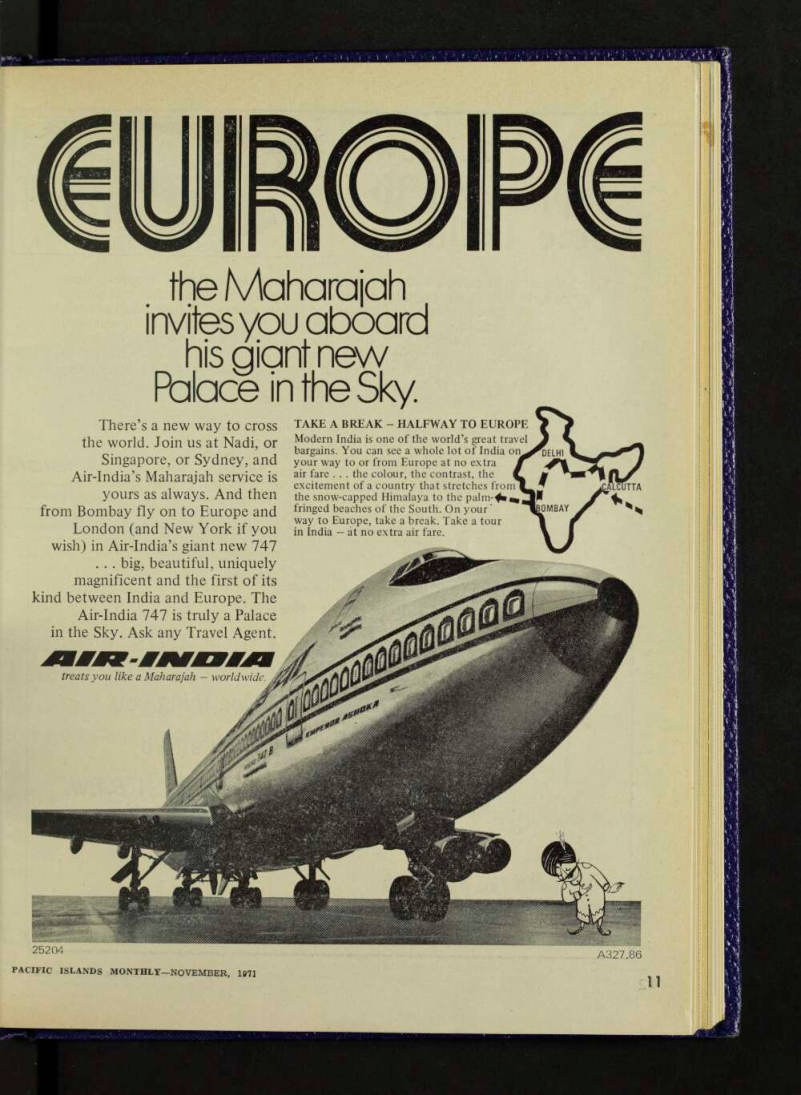
the Maharajah
invtes you aboard
his giant new
Palace in the Sky.
There’s a new way to cross the world. Join us at Nadi, or Singapore, or Sydney, and Air-India’s Maharajah service is yours as always. And then from Bombay fly on to Europe and London (and New York if you wish) in Air-India’s giant new 747 . . . big, beautiful, uniquely magnificent and the first of its kind between India and Europe. The Air-India 747 is truly a Palace in the Sky. Ask any Travel Agent. treats you like a Maharajah - worldwide.
TAKE A BREAK - HALFWAY TO EUROPE Modern India is one of the world’s great travel bargains. You can see a whole lot of India on your way to or from Europe at no extra air fare . . . the colour, the contrast, the excitement of a country that stretches from the snow-capped Himalaya to the fringed beaches of the South. On your' way to Europe, take a break. Take a tour in India - at no extra air fare. m
DELHI
TTA
DMBAY
0 m m m Hr* r ■M A 327.86
A new
approach to
home building
A You have only to compare the advantages to see why “Panel” Housing from George Hudson is the building construction system for you. Quick and simple to erect because it works on an easy-to-follow planned construction system.
“Panel” employs a minimum of parts, is fully insulated and pleasingly modern. The design is flexible. Packed in a practical fashion, it’s easily transportable and ideal for export (and keep in mind that when supplied in quantity, the services of a trained supervisor are provided free of charge.) Besides, it is the latest concept in home building, and backed by the experience of George Hudson; so you can’t go wrong. ft
GEORGE HUDSON HOMES
DIVISION (PTY. LTD.)
MAX RUTTER,
Development Manager, 186 Hume Highway, Cabramatta, Sydney, Australia, 2166.
Phone: 727-9066.
Please forward me further literature on “Panel”
Housing by George Hudson. PIM.O
NAME:
ADDRESS:
POST CODE
Get with the Strength * a/ m m M One thing you CAN afford is the BEST BANK Get with the Strength
BANK GOMMONWIAITH
A new audio product
From Japan's audio-oily specialist
■ % 1 3) mMM rnmmmm
Sansui's 210 A solid-state
2-band SW/MW tuner with stereo amplifier
You seldom find a high-class receiver and stereo amplifier in one compact package. But here it is.
The 210 A offers flawless reception in both MW and SW bands and boasts such big-receiver characteristics as extralarge tuning meter, direct tape monitor switch, and high-sensitivity ferrite bar antenna.
Silicon circuitry throughout guarantees exceptional signal-to-noise ratio and very wide dynamic range for fine-grained, high-linearity sound.
All of this is housed in one luxurious walnut cabinet with silver-gold aluminum panel. Uncompromising quality from the inside out. From Sansui, Japan's audioonly specialist.
ScLttSTil.
Tel SERVONNiATP Street ' CreY L y nn Auckland 2, New Zealand. Tel: 763064 / PRABHU BROTHERS LTD. P.O. Box 183, Nadi, Fiji Islands Tel- 56406 Jlu. MOW * rn a®"! T ? hitL ° 3 ' 29 1 OCEAN,A ,NDENT AGENCY p O. Box 5518, Boroko, Port Moresby, Papua & New Guinea.
Box 224Td rHnwl°rn 1 & S ° NS B °* 11 ° 6 ' Boroko - Te,: 5 6546/Kamarere Street, P.O.
Tel- 56445 PINGS Mp n R T*' P °' B ° X 11 ° 6 ' B ° r ° k °- Te,: 563381 SEET ° K ° NG & S ° NS P / L Taurama Road ' PO - B °* 1218 ' Boroko.
Lr , n. J c l° X \ t D Hagen - Tel; 385 I BOUGAINVILLE COPPER Canteen, Panguna / PHOTOSONIC P.O. Box 519, Madang. Tel: 2503 / Alma-Sebastopol B.P. 1123 Noumea. Nouveue-Caledonia. Tel: 59-11 et 40-78 / SANSUI ELECTRIC CO., LTD. 14-1. 2-chome, Izumi!
/C> O Cs 'V o -V N?
Lunch size, snack size
SAO biscuits
are the right size!
Crisp, fresh Arnott’s Sao biscuits ... right size to satisfy, right size for snack foods, too! Cheese for lunch? A big slice fits just right on Sao. So does a slice of ham or salami.
Prefer jam or spread? Or how about tomato? Simply serve with Sao —the right-size biscuit that makes all the crisp difference to lunches at home and at school or outof-doors. The triple-wrapped pack keeps the biscuits crisp and fresh.
Qrnott's/a" Biscuits
There is no Substitute for Quality
Up Front
with the Editor
I suppose it is what lawyers would call “a notorious fact” that prices are high in Tahiti. But you can’t make that statement and simply leave it at that, because the paradox is that not all prices are high some things in Tahiti are good value indeed but why the variations?
For instance, a couple of miles in a taxi will cost the visitor about S 3 Australian, and almost double after 11 o’clock at night, when there is a heavy and inexplicable surcharge. But for less than $5 you can fly the 10 or 11 miles between Tahiti and her sister island of Moorea. For $3 you can take a long and pleasant boat trip to Moorea.
And for a flat 20 cents you can travel just about anywhere you want on Tahiti in one of the many clean and fast buses—the famous trues.
Again inexplicably, the buses dis appear from dusk to dawn, leaving the visitor in the hands of the avarici ous taxi drivers.
Good French wine is not expensive by the bottle in Tahiti’s shops (it is considerably more costly in the hotel dining rooms). Less than $2 will buy you an excellent vintage at the corner store. For a mere 80 cents, with something back on the bottle, you can buy a litre of drinkable rough red.
Yet you’ll pay anything from 45c to 60c for a meagre 10 oz bottle of locally-brewed beer considerably more in the bar, of course. They usu ally ask for $1 there. Why should Tahiti beer be so expensive?
In view of Tahiti’s reputation for high costs, you might be surprised to learn that Tahiti’s hotel tariffs are comparable with those anywhere else, and might even be a shade better than the tariffs of some horrible hostelries in Melanesia.
It’s not the room rate that makes the Tahiti visitor look with horror at his final bill, but the “little extras”, such as laundry and room service, and his continental breakfasts. (There is nothing little about his lunch, dinner and bar bills).
The extras are the reason for Tahiti having gained a reputation for high prices (not excluding the $4 tax per
person extracted from the traveller as he departs from that fine airport terminal). Anybody who plans his trip to Tahiti merely on the basis of basic hotel tariffs is in for a rude shock.
In issuing this warning I am not— and please note it—attempting to turn visitors away from Tahiti. On the con trary, Tahiti is now more lovely than it was, which makes it beautiful in deed, and the people are perhaps even more friendly than they were, which makes them warm indeed, and Tahiti is an island to be visited. Nobody could claim he had seen the South Seas unless he included a visit to the New Cythera.
But it seems to me there is a lesson here for those territories which seek to make their money out of the tourist. Reputations travel with the speed of a jet, and travellers like to compare notes on where their dollars got the best value.
There is not much point in his hotel playing fair and square if much of the rest of the local business community takes the visitor for a sucker as soon as his sunglasses and camera are seen to emerge from the hotel foyer.
The average visitor, wondering in retrospect just how his money dissi pated so swiftly and so soundlessly, is inclined to tar everybody with the same brush. He doesn’t say, “Wine was cheap, but cab prices are a shocker!” He says, “Hell, Tahiti is expensive!”
It’s true that if he took his eye from his camera viewfinder long enough he might perhaps find out about le true, or the corner foodstand where he can eat, from a paper plate, half a tender roast chicken and enough french fries to last him till breakfast, all for a dollar.
But most tourists are busy people, on a tight schedule, and they haven’t
the time to search for the economies.
They rely on local goodwill for pro tection against overcharging, and the local community must take collective blame if the visitor goes away feeling he hasn’t got value for money. He wifi tell everybody about his unhappy ex perience, and he will return again only to those places where he gets value.
I don’t preclude the hotels from these comments. They take the blame too if they follow a policy of inflating bar prices to gain on the swings what they missed on the tariff roundabout.
Or if they keep tariffs higher than they need to be because they think it’s what the traffic will bear.
Take the unhappy case of Papeete’s Hotel Taaone, which closed at a moment’s notice in September (PIM, Oct., p. 41). As we said then, there were a number of reasons for the closing of that once-famous hotel, and most of them are the subject of con troversy anyhow. But those with ex perience in the travel business say that the Taaone failed to recognise that it had slipped as a first-class hotel, but it continued to charge first-class prices. It would have done better to have reduced tariffs and sought to at tract those wanting a good hotel with out the high-priced extras.
In other words, value for money.
You can say what you like, but value for money will get us customers in, whether they are selling us Tahiti or a mouse-trap. Any businessman who flies in the face of that fact does so at his own peril, and all the experts on tourism won’t convince me that when it comes to value the tour ist business is any different in prin ciple from any other.
Stuart Inder
Advertisements & other items, pp. 17-22 (2 items)
Tahiti:
The only book telling the vivid history of Tahiti from its discovery by Europeans to the present day.
Island
of
Love
276 pages, illustrated; soft cover.
Price: Australia and P.N.G., $1.95 Aust., plus 16c posted; Pacific Islands and overseas countries, $1.95 Aust., plus 25c posted; U.S.A., $2.75 U.S. posted.
Available from: —
ROBERT LANGDON
Pacific Publications (Aust.) Pty. Ltd.
Box 3408, G.P.0., Sydney, N.S.W.
Aust., 2001.
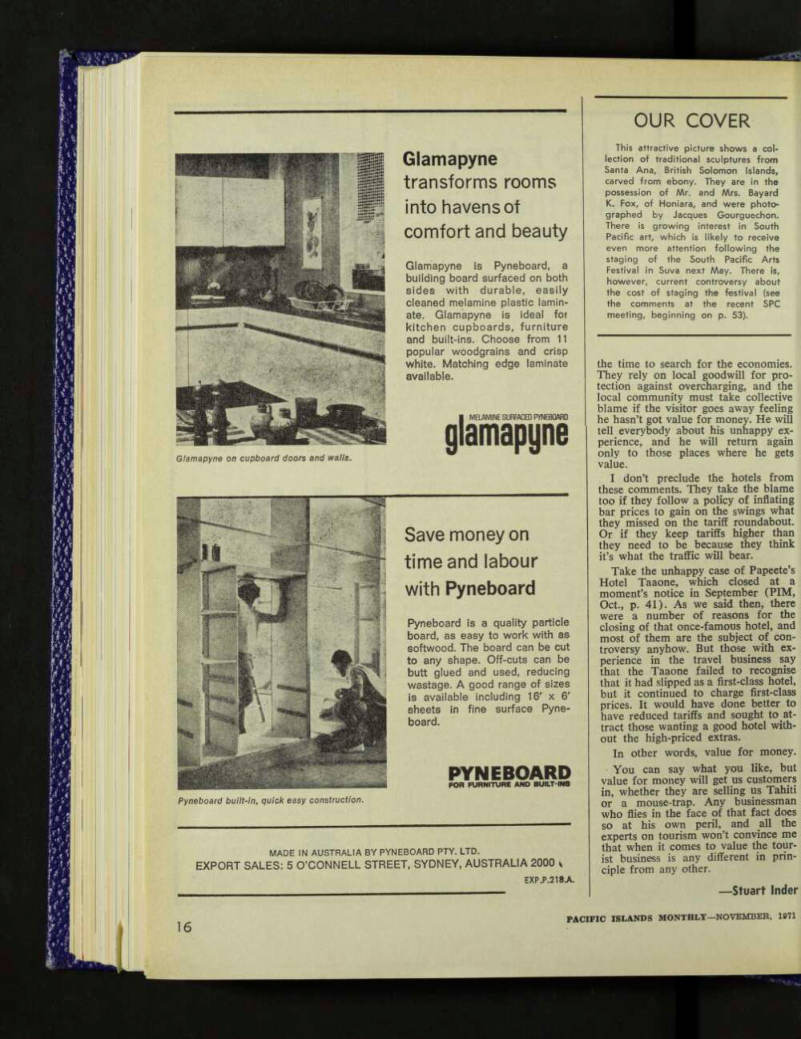
Glamapyne on cupboard doors and walls.
Glamapyne
transforms rooms
into havens of
comfort and beauty
Glamapyne is Pyneboard, a building board surfaced on both sides with durable, easily cleaned melamine plastic laminate. Glamapyne is ideal for kitchen cupboards, furniture and built-ins. Choose from 11 popular woodgrains and crisp white. Matching edge laminate available.
■ MELAMINE SURFACED PYNEBOARD
glamapyne
■ ■ m m m Pyneboard built-in, quick easy construction
Save money on
time and labour
with Pyneboard
Pyneboard is a quality particle board, as easy to work with as softwood. The board can be cut to any shape. Off-cuts can be butt glued and used, reducing wastage. A good range of sizes is available including 16' x 6' sheets in fine surface Pyneboard.
PYNEBOARD
FOR FURNITURE AND BUILT-INS
MADE IN AUSTRALIA BY PYNEBOARD PTY. LTD.
EXPORT SALES: 5 O’CONNELL STREET, SYDNEY, AUSTRALIA 2000 v
EXP.P.2IB.A.
Consulate
II f m -■ * /
Come over to Consulate, enjoy the rich inviting flavour of choice Virginia tobaccos enhanced : V- by a touch of refreshing menthol.
People who Know the best insist 3* on Consulate—the world’s first Virginia menthol cigarette.
COOL CLEAN CONSULATE
For that surprising extra it gives you Men//ic£ (Jua/i
FtLfgß TIPPED CIGARETTES
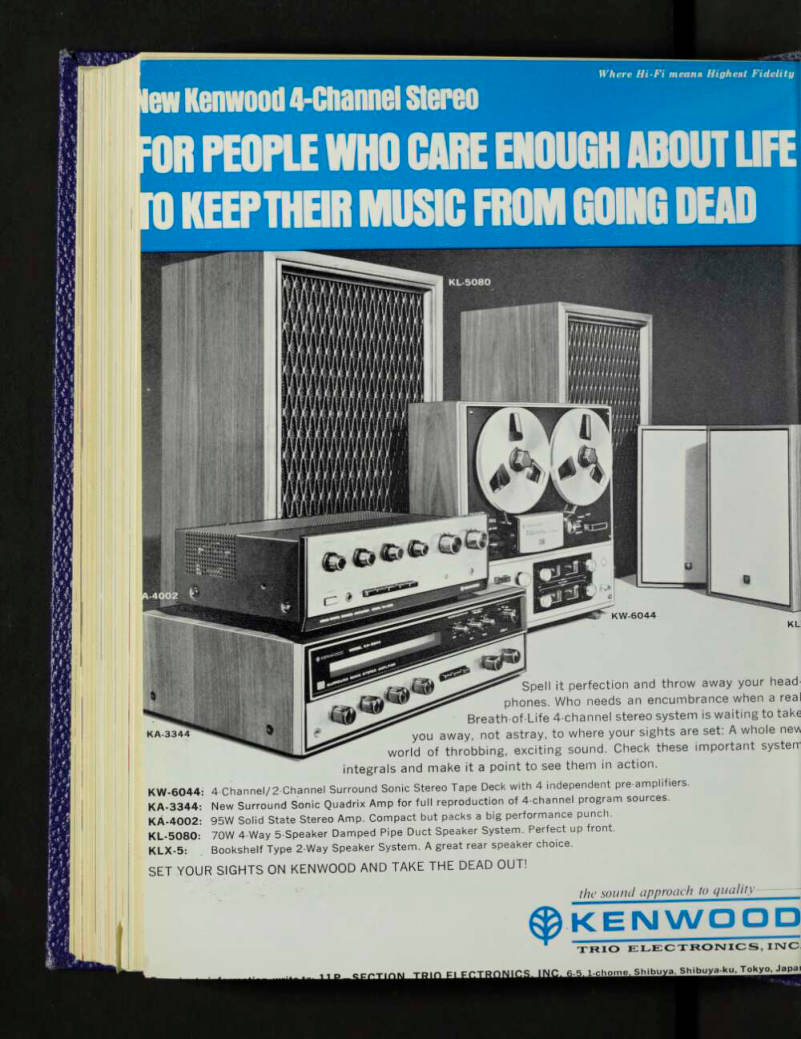
Where Hi-Fi means Highest Fidelity
ew Kenwood 4-Channel Stereo
OR PEOfU WHO CUE HOUGH ABOUT IK
KEEPTHBR MUSIC FROM OOHIG DEM)
mmi
-6044 KW -3344 Spell it perfection and throw away your headphones. Who needs an encumbrance when a real Breath-of-Life 4-channel stereo system is waiting to take you away, not astray, to where your sights are set: A whole new world of throbbing, exciting sound. Check these important system ntegrals and make it a point to see them in action. 4-Channel/2-Channel Surround Sonic Stereo Tape Deck with 4 independent pre amplifiers.
New Surround Sonic Quadrix Amp for full reproduction of 4-channel program sources. 95W Solid State Stereo Amp. Compact but packs a big performance punch. 70W 4-Way 5-Speaker Damped Pipe Duct Speaker System. Perfect up front.
Bookshelf Type 2-Way Speaker System. A great rear speaker choice. iET YOUR SIGHTS ON KENWOOD AND TAKE THE DEAD OUT! <W-6044; <A-3344: KA-4002: KL-5080:
KLX-5:
the sound approach to quality
® KENWOOD
TRIO ELECTRONICS, lIMO
'_ _I V" ' 7 % « a 1 M m Wk m • .fM -W S • Brat •' II ao
IRS
« : 'V
PRODUCERS OF BRUNTONS
’^M C js »»bL® ol*v1 * v ' I *»* ■!-‘
FAMOUS
BAKERS' FIOURS
CUIT AND NOOI
BISCUIT AND NOODLE
URS, SHARPS, ETC.
-■■•v' < •; v>& m ®p
i "SSJU
*' r ■*7 LB)
MEDIU
IHQLEM
Ws
BR»*2 gS
slßssi « M MakK
IUINTONt
is*** *6»S* steel m m Ft
SIOIEY
o*
COHPMVP
SVOH
EV Of
"KSS 1
BWKUWS
what’s
the
freshest
milk
in the
islands?
NESTLE
sunshine
ET Nestle s SUNSHINE 16 pints of fresh, full cream milk in every 3 lb. can!
Sunshine the freshest milk keeps fresh for months, in any climate, without refrigeration. Keeps its added vitamins at full-strength !
Takes only seconds to whisk up creamy fresh milk for drinking, for cooking.
Every spoonful of Sunshine adds double richness and creaminess. Baking a cake?
Sift Sunshine in with the flour. So easy !
Save money ! Save time ! Buy Nestle's Sunshine and you'll never be fresh out out of milk again !
Nestle s SUNSHINE
In This Issue
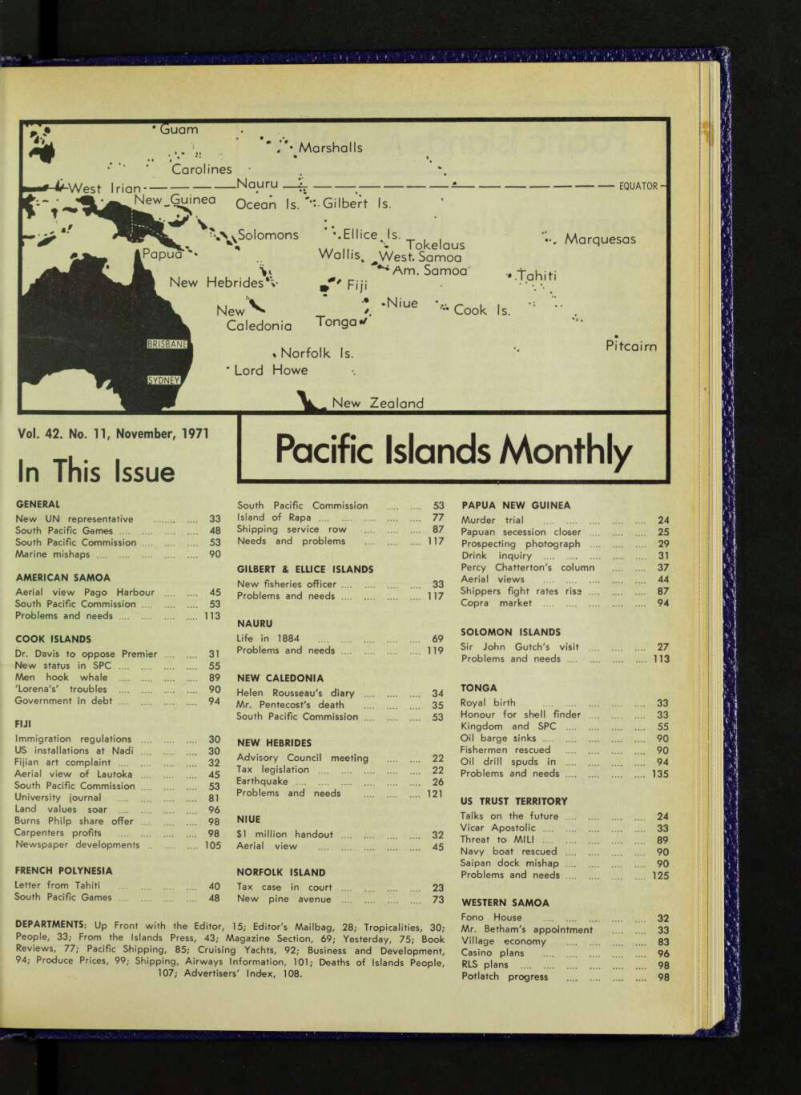
General
New UN representative 33 South Pacific Games 48 South Pacific Commission 53 Marine mishaps ... 90
American Samoa
Aerial view Pago Harbour 45 South Pacific Commission 53 Problems and needs 113
Cook Islands
Dr. Davis to oppose Premier 31 New status in SPC 55 Men hook whale 89 'Lorena's' troubles 90 Government in debt 94
Fiji
Immigration regulations 30 US installations at Nadi 30 Fijian art complaint 32 Aerial view of Lautoka 45 South Pacific Commission 53 University journal 81 Land values soar 96 Burns Philp share offer 98 Carpenters profits 98 Newspaper developments 105
French Polynesia
Letter from Tahiti 40 South Pacific Games 48
South Pacific Commission 53 Island of Rapa 77 Shipping service row 87 Needs and problems 117
Gilbert & Ellice Islands
New fisheries officer 33 Problems and needs 117
Nauru
Life in 1884 69 Problems and needs 119
New Caledonia
Helen Rousseau's diary 34 Mr. Pentecost's death 35 South Pacific Commission 53
New Hebrides
Advisory Council meeting 22
Tax legislation 22
Earthquake 26
Problems and needs 121
Niue
$1 million handout 32 Aerial view 45
Norfolk Island
Tax case in court 23 New pine avenue 73
DEPARTMENTS: Up Front with the Editor, 15; Editor's Mailbag, 28; Tropicalities, 30; People, 33; From the Islands Press, 43; Magazine Section, 69; Yesterday, 75; Book Reviews, 77; Pacific Shipping, 85; Cruising Yachts, 92; Business and Development, 94; Produce Prices, 99; Shipping, Airways Information, 101; Deaths of Islands People, 107; Advertisers' Index, 108.
Papua New Guinea
Murder trial 24 Papuan secession closer 25 Prospecting photograph 29 Drink inquiry 31 Percy Chatterton's column 37 Aerial views 44 Shippers fight rates rise 87 Copra market 94
Solomon Islands
Sir John Gutch's visit 27 Problems and needs 113
Tonga
Royal birth 33 Honour for shell finder 33 Kingdom and SPC 55 Oil barge sinks 90 Fishermen rescued 90 Oil drill spuds in 94 Problems and needs 135
Us Trust Territory
Talks on the future 24 Vicar Apostolic 33 Threat to Mill 89 Navy boat rescued 90 Saipan dock mishap 90 Problems and needs 125
Western Samoa
Fono House 32 Mr. Betham's appointment 33 Village economy 83 Casino plans 96 RLS plans 98 Potlatch progress 98
Pacific Islands Monthly
Booming Vila (where the action is) won't back down on land speculation
The problems caused by Vila’s boom growth rate and the future of the cattle and beef industry were the main concern of members of the New Hebrides Advisory Council when they met in Vila in October. But high light of the session was a debate on a petition to the UN prepared by the Fiji law firm of Ramrakhas on behalf of the Na-Griamel land move ment, which was roundly condemned.
The 24-man council (the Resident Commissioners, as joint presidents, and four ex-officio members who also attend, have no vote) was able to meet at all thanks only to a reprieve which extended its life for another year. Indeed, for a short time it ceased to exist because its two-year life ended on September 3 and the decision extending its life was not published until September 23.
The British and French Resident Commissioners gave the reason for the extension of life in their opening speech. Apparently the London and Paris governments are currently put ting their heads together to sort out a number of issues obstructing pro gress in the group.
One issue is the constitution of the Advisory Council itself and it seems likely that elections will be taking place next year for a new kind of council, perhaps with an enlarged franchise for both New Hebridean and European members. And per haps with more than simple advisory powers.
Thanks largely to the discovery of the New Hebrides as a tax haven, and the consequent inrush of solici tors, auditors, banks (Barclays, CBC and the Bank of NSW all declared within 10 days of each other in late September their intention to open branches) and even, in a few cases, the arrival of real businessmen, the demand for office space and housing in Vila is causing a major building boom.
On every side bulldozers are rip ping platforms out of the limestone and local builders are so busy trying to complete fat contracts as fast as
possible to make room for the next, that minor contracts are going un bidden for.
The result of this growth is a real problem in town management.
Council members were particularly concerned with the impossible de mand made on the police and on Vila’s narrow, bumpy streets by enormously increased traffic. They called on the Resident Commissioners to review completely current traffic regulations and increase the penalties for traffic offences, to establish a specialist joint traffic police unit, to review the insurance situation (at present the minimum required is only third party with $B,OOO cover) and to raise by a year the minimum ages for driving licences to cut down on skid-kid accidents.
The council also gave a sympa thetic hearing to Mr. d’Hautesserre, a young VAT (Volontaire Aide
New added value tax legislation was issued in Vila on October 8 to replace the controversial Joint Regulation No. 16 issued on August 2 (PIM, Sept., p. 25). Joint Regulation No. 22 of 1971 is a completely new text, re-written to include amendments suggested by the Advisory Council Standing Committee when it met in late August. Land speculators will find it no more pleasant than the original. The amendments are aimed primarily at softening the blow for local, long-term, landowners.
A rebate of tax, starting at 15 per cent, for over five years of ownership up to a maximum of 80 per cent, for over 50 years of ownership by the vendor, is allowed. In addition, although the tax applies on the sale of every plot of land subdivided after January 1, 1967, on hire purchase sales already in progress on August 2, it will only apply to instalments paid since then.
Payments made previous to August 2 escape.
Other amendments differentiate between the tax applicable on rural subdivisions (50 per cent, of added value maximum) and urban subdivisions (25 per cent.) and provide for appeal to “the appropriate court” in the event of dispute over the added value assessment.
Despite the changes, the legislation maintains rigidly the original intention to stop speculative land subdivision, and to encourage such subdivisions as do take place to be carried out properly. The original legislation has already brought a halt to New Hebrides land sales in Hawaii, while its implications are studied by authorities there.
It is difficult to see how any buyer of a subdivision can now hope for any return on his investment for many years to come. With the New Hebrides joint administration also imposing a virtual ban on all but the most necessary immigration, the price of land outside the town areas, already artificially high, is not likely to rise.
Most of the speculative subdivision operations are well away from the towns, some so remote as to be virtually inaccessible.
Technique) architect who had drawn up a plan for the use of the large area now being reclaimed from the sea along Vila’s waterfront. Included in the plan were six-storey office blocks (the highest in Vila at present is three storeys) and a four-lane boulevarde taking north-south traffic along the new seafront instead of congested Rue Higginson.
However, some members had reser vations, particularly about the large office blocks on the reclaimed land which it was originally intended should be maintained as a green area.
Mr. Chauveau raised the question of compensation for the Rue Higgin son businesses that had their view of Vila Bay—one of the loveliest in the Pacific—cut off by the new buildings but Mr. d’Hautesserre thrust this aside as a problem for the legal ex perts, as architects tend to do. How ever, the British Resident Commis
sioner, Mr. Allan, agreed that com pensation had to be considered.
The alarm caused among farmers by the discovery of brucellosis near Vila earlier this year showed itself in the serious concern expressed by the council for the protection of the beef and cattle industry. Beef is one of the main economic hopes for the future of the New Hebrides and so far, unlike most other Pacific territories, the group has taken few measures to protect itself properly against imported diseases. Strict quarantine and complex laboratory testing of all imported animals were called for, it was agreed.
The Resident Commissioners were asked to correct what was attacked as being false information supplied to the UN in a petition from the Na- Griamel movement. The petition had been prepared by Suva lawyers Messrs. Ramrakhas.
Quotations from the petition cited by the originator of the motion, Archdeacon D. A, Rawcliffe, in cluded these: “Natives are being im prisoned and in many cases they have been terrorised off the land. The Administrations have proved ex tremely callous and indifferent to the cries of the indigenous people and new and sophisticated methods of clearing us off our land have been devised, and the methods of using police dogs have struck a new terror in the hearts of the indigenous people.”
Talking of marriage, the petition said “customary marriage laws are not being recognised . . . the non recognition of the marriage laws is an attempt to break down the social and the moral order which prevails in the New Hebrides . .
Also, “No real attempt has been made to educate the indigenous people”.
To people in the New Hebrides such statements are so far from the truth as to be ludicrous.
Archdeacon Rawcliffe cited many more examples and proceeded to pour well-deserved scorn on most of them.
About the police dogs “striking new terror”, he commented that whoever wrote that must have “seen the Superintendent of Police walking his pet dog around Vila”.
Archdeacon Rawcliffe quoted other inaccuracies made by speakers in the UN when the petition was dis cussed, and said his complaint was that the Special Committee on Colonialism apparently believed the stuff. The New Hebrides was surely entitled to have the facts put cor rectly in the UN.
Mr. George Kalkoa said the council should take action against the UN committee “for giving false
impressions of the Government of the New Hebrides”.
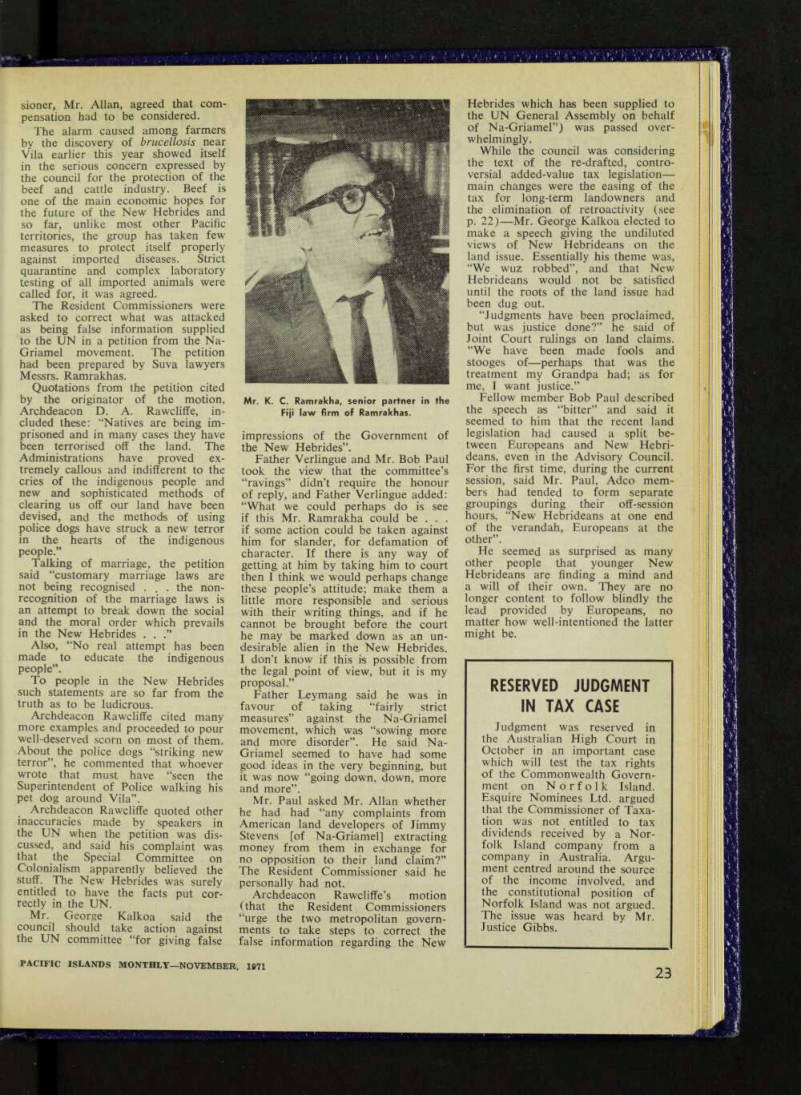
Father Verlingue and Mr. Bob Paul took the view that the committee’s “ravings” didn’t require the honour of reply, and Father Verlingue added: “What we could perhaps do is see if this Mr. Ramrakha could be . . . if some action could be taken against him for slander, for defamation of character. If there is any way of getting at him by taking him to court then I think we would perhaps change these people’s attitude; make them a little more responsible and serious with their writing things, and if he cannot be brought before the court he may be marked down as an un desirable alien in the New Hebrides.
I don’t know if this is possible from the legal point of view, but it is my proposal.”
Father Leymang said he was in favour of taking “fairly strict measures” against the Na-Griamel movement, which was “sowing more and more disorder”. He said Na- Griamel seemed to have had some good ideas in the very beginning, but it was now “going down, down, more and more”.
Mr. Paul asked Mr. Allan whether he had had “any complaints from American land developers of Jimmy Stevens [of Na-Griamel] extracting money from them in exchange for no opposition to their land claim?”
The Resident Commissioner said he personally had not.
Archdeacon Rawcliffe’s motion (that the Resident Commissioners “urge the two metropolitan govern ments to take steps to correct the false information regarding the New
Hebrides which has been supplied to the UN General Assembly on behalf of Na-Griamel”) was passed over whelmingly.
While the council was considering the text of the re-drafted, contro versial added-value tax legislation— main changes were the easing of the tax for long-term landowners and the elimination of retroactivity (see p. 22) —Mr. George Kalkoa elected to make a speech giving the undiluted views of New Hebrideans on the land issue. Essentially his theme was, “We wuz robbed”, and that New Hebrideans would not be satisfied until the roots of the land issue had been dug out.
“Judgments have been proclaimed, but was justice done?” he said of Joint Court rulings on land claims.
“We have been made fools and stooges of—perhaps that was the treatment my Grandpa had; as for me, I want justice.”
Fellow member Bob Paul described the speech as “bitter” and said it seemed to him that the recent land legislation had caused a split be tween Europeans and New Hebri deans, even in the Advisory Council.
For the first time, during the current session, said Mr. Paul, Adco mem bers had tended to form separate groupings during their off-session hours, “New Hebrideans at one end of the verandah, Europeans at the other”.
He seemed as surprised as many other people that younger New Hebrideans are finding a mind and a will of their own. They are no longer content to follow blindly the lead provided by Europeans, no matter how well-intentioned the latter might be.
Mr. K. C. Ramrakha, senior partner in the Fiji law firm of Ramrakhas.
Reserved Judgment
In Tax Case
Judgment was reserved in the Australian High Court in October in an important case which will test the tax rights of the Commonwealth Govern ment on Norfolk Island.
Esquire Nominees Ltd. argued that the Commissioner of Taxa tion was not entitled to tax dividends received by a Nor folk Island company from a company in Australia. Argu ment centred around the source of the income involved, and the constitutional position of Norfolk Island was not argued.
The issue was heard by Mr.
Justice Gibbs.
Progress Or Impasse? Micronesia's
Future Still In The Balance
From PIM correspondents in Honolulu
Depending on how you view it, the latest round in the two-year-old negotiations between the US and Micronesia on Micronesia’s political future ended in October with hopes for more progress—or just another impasse over basic points.
Nobody could call it a successful meeting. Both sides will have to alter their positions before talks are re sumed—and the meeting broke up without anybody fixing a date.
It was a complex session, held over eight days at the rambling Hotel Hana Maui, in one of Hawaii’s most remote and undeveloped areas. The resort is one of the most expensive in the Hawaiian islands, and the Americans paid.
The American delegation was headed by Ambassador Franklin Haydn Williams, and the Micro nesians by Senator Lazarus Salii, and it’s probably true to say that both sides stopped talking when it was obvious there was going to be no further unanimity. But the Micro nesians invited the American Gov ernment to another round, in Micro nesia, before the January session of the Micronesian Congress.
Neither side negotiated effectively; both were aware that they could have done better.
The US made what appeared to be some major concessions. The Micro nesians will be able to vote to choose their own political future (which is required by the UN anyway); they will write their own constitution and laws (so long as rights of American citizens and businesses are protected); they will control their own land (al though questions remain on leases for military bases required by the US in the Marshalls, the Marianas and Palau, and it was not stated whether the US would need further land, and whether it would be entitled to store nuclear weapons in Micronesia).
This all added up to an offer of a Micronesian association with the US having many of the characteristics of the “free association” the Micro nesians asked for. Commonwealth status is dead, but this new relation ship would have an important draw back. Micronesians asked that free association be terminated at any time should either side want it that way. The US insisted that termina tion should only be by mutual con sent—which would give the US
power of veto, and the free association would not be free at all.
As Senator Tosiwo Nakayama, one of the three members of the Micronesian Independence Coalition in the Micronesian delegation, saw it; “Mutual consent is a kiss of death!”
Thus the big question is just how much either side is disposed to compromise on this vital point.
The US argument was that even in offering termination on a mutual basis the US was making a significant concession on its past stand; that in any case it was doubtful if the US Congress would want to pour money into Micronesia for development programmes and American bases if the Micronesians could pull out at any point. Certainly the US tended to moderate its security interests during the discussions. In doing this it was showing a clearer perception of Micronesian attitudes (as it did in many other ways during the talks).
But stripped down to essentials, the US position was that it still believed in its right to use Micronesia for defence, and it still hoped to retain US sovereignty in Micronesia.
Not at any time during the talks did the Americans say the Micronesians could have sovereignty; what
the US was really offering was terri torial status dressed in a fine new set of clothes, Its delegation avoided answering probing questions, and it talked around crucial points.
An example was when the Micro nesians attempted to find just what the procedure would be when they had to write their own constitution.
The US didn’t have the details, or if it did, wouldn’t come clean. A sample of American gobbledegook, from Ambassador Williams: “Precipitate change or termination against the will of the United States would have to be weighed against the continuing need for political stability in the Pacific Ocean area. Termina tion could adversely affect our ability to fulfil our responsibilities to our selves, to Micronesia, and to the world community for the mainten ance of international peace and security, and could diminish your capacity to fulfil your own future role in this regard.”
Salii pointed out that the ability of Micronesia to unilaterally termi nate its relationship with the US was “an essential protection for a small nation that wishes to maintain its identity while in a relationship
with a large and strong nation,” irrespective of the US attitude to maintaining peace and security in the Pacific. In any case, said Salii in Honolulu later, long-term bases could be leased irrespective of any US- Micronesia association, as the US already did in Cuba.
The basic difference between American and Micronesian ap proaches at the talks was that the Micronesians believe they should have all the power and lease some of it to the US; the US believes it should retain power and lease most of it to the Micronesians.
Nowhere was this more obvious than in the matter of eminent domain (or final control) over land. Micro nesia wanted the US to renounce the power for ever; America was not prepared to make a clear statement on land jurisdiction.
The usually soft-spoken Salii has suggested that if the Americans aren’t more forthcoming on practical matters, such as the termination ques tion, when the next round of talks is held, the Micronesians will switch to their second alternative—indepen dence.
One key question hardly came up —the future of the Marianas District (above the separate US territory of Guam). Of this, Salii said as talks opened: “We recognise the aspiration of the people of the Marianas to share in the benefits that indepen dence bestows on your great country by becoming more closely affiliated with the United States.”
The US didn’t bring the question up because it did not want to compli cate the picture or seem divisive.
But both sides said privately it was recognised that it was likely that the Marianas would separate from the other five districts and become a separate US territory.
So the talks ended. As the final communique said, “Areas of pre liminary agreement as well as dis agreements were more clearly de fined”. In terms of past sessions, that is progress.
It will take several months and some hard thinking and tough de cisions in Washington and Micro nesia to show whether it’s progress toward a breakoff, or agreement.
FIREPROOFED?—The next regu lar session of the Congress of Micro nesia will be in Palau, beginning on January 10 next year. The last regu lar session was cut short on February 20 when arsonists destroyed the meet ing chambers in Saipan (PIM, March, p. 22), and it has now been decided to make Palau the new permanent site.
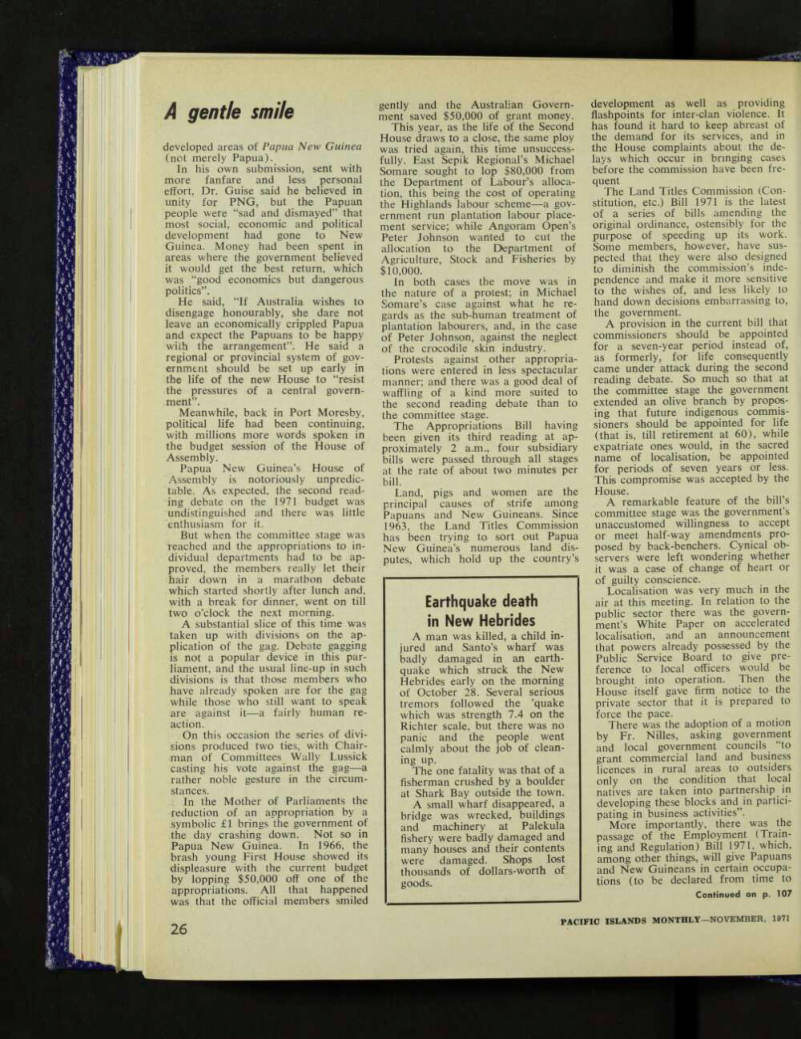
The PNG Assembly delegation to Canberra in October to discuss the future of Papua with the Minister for Territories, Mr. C. E. Barnes (centre). From left they are, Lepani Watson, Tore Lokoloko, Toua Kapena, Andagari Wabiria and Oala Oala-Rarua (leader).
Photo: External Territories Dept.
"Village Plot " T Kill Emanuel
East New Britain District Commissioner Jack Emanuel, 52, was murdered on August 19 as a result of a plot hatched at secret village meetings several days beforehand, Rabaul District Court was told in October when evidence was heard against 21 Tolai men charged with Emanuel’s murder. At the end of the 10-day hearing 14 went for trial with seven discharged.
The court was told Emanuel was stabbed to death with a wartime Japanese bayonet as he walked along a path at Kabaira Plantation with a village man, William Taupa, who acted as decoy. The killing was allegedly done by Anton Tovaliria, 24, who in a pre-arranged plan ran up behind the District Commissioner and plunged the bayonet into the right side of his chest. Other villagers were hidden in the bush, some allegedly to assist in the actual killing if Tovaliria wasn’t up to it, and others to prevent possible in terference from nearby police. The police were stoned by the villagers when the body was discovered.
There was a long-standing dispute over the Kabaira land, which is owned by Plantation Holdings Ltd. One defendant allegedly said villagers had decided the killing of a European would draw attention to their case for ownership. Other names had been on the death list besides Emanuel’s. It was also claimed during the hearing that instructions for the killing had come from the Mataungan Association.
Those committed are Toviliria, Taupa, Alois Titi, Tolucas Toguna, Francis Tokarat, Tomano Tovolo Tovurie, Aron Toliplip, Toleklius Topait, Joseph Tovuvu, Clement Vavaula, Thomas Topainuk, Joseph Tomarum, Otto Kaliop and Thomas Togogol.
Papuans want more
The possibility of Papuan secession came closer in October as a re sult of disagreement over a visit to Canberra of a PNG parliamentary delegation.
The five-man delegation met the Minister for Territories, Mr. C. E.
Barnes, to press for a better deal for PNG’S 750,000 Papuans. The House of Assembly sent them after the Aus tralian Government refused to appoint an all-party Australian parliamentary committee to tour Papua to find out the wishes of the people. There has been increasing dissidence among Papuan members of the PNG As sembly, who fear their territory is in danger of being overwhelmed by the wealthier and numerically larger New Guinea. Australia probably re jected the request because it doesn’t want to encourage a breakaway move ment.
The Canberra delegation had in tended to press for a regional parlia ment for Papua among other things, but it became obvious before the delegation’s departure that Canberra was not sympathetic. As a result, Speaker of the House, Dr. John Guise, at the last minute withdrew from the delegation and made direct submissions on his own behalf. He explained that the delegation was “ill prepared” for such a vital task.
His defection caused bitterness in the delegation. Leader Gala Oala- Rarua, who the previous month had won some international popularity as
chairman of the South Pacific Con ference in Noumea (see p. 53), re torted that it was not the delegation, but Dr. Guise, who was ill-prepared.
Guise, said his fellow Papuan Oala- Rarua, with more than a grain of truth, was making sure that he was not associated with a possible image shattering failure in Canberra.
As it happened, the Canberra talks were not a failure, but as the wily Dr.
Guise had at least suspected, they didn’t gain much either. The delega tion members did rather look as if they were “going like schoolboys to be lectured”.
Mr. Barnes said the matter of con stitutional safeguards for Papua was one for a select committee in the next House of Assembly (due in March following general elections).
He said future visiting UN missions would be asked to report on PNG as a whole and not merely on New Guinea. The matter of “regional authorities” for PNG, to give Papua a greater say, would also be a matter for a select committee.
After listening to a long list of development needs the delegation said were required by Papua (hydro-elec tric development of the Purari River, copper mining in the Western District, an air service from Australia to Daru, development of forestry , fish and cattle industries, a road link between Papua and New Guinea), Mr. Barnes agreed to send a special consultant to study the problems of the less-
A gentle smile
developed areas of Papua New Guinea (not merely Papua).
In his own submission, sent with more fanfare and less personal effort, Dr. Guise said he believed in unity for PNG, but the Papuan people were “sad and dismayed” that most social, economic and political development had gone to New Guinea. Money had been spent in areas where the government believed it would get the best return, which was “good economics but dangerous politics”.
He said, “If Australia wishes to disengage honourably, she dare not leave an economically crippled Papua and expect the Papuans to be happy with the arrangement”. He said a regional or provincial system of gov ernment should be set up early in the life of the new House to “resist the pressures of a central govern ment”.
Meanwhile, back in Port Moresby, political life had been continuing, with millions more words spoken in the budget session of the House of Assembly.
Papua New Guinea’s House of Assembly is notoriously unpredic table. As expected, the second read ing debate on the 1971 budget was undistinguished and there was little enthusiasm for it.
But when the committee stage was reached and the appropriations to in dividual departments had to be ap proved, the members really let their hair down in a marathon debate which started shortly after lunch and, with a break for dinner, went on till two o’clock the next morning.
A substantial slice of this time was taken up with divisions on the ap plication of the gag. Debate gagging is not a popular device in this par liament, and the usual line-up in such divisions is that those members who have already spoken are for the gag while those who still want to speak are against it—a fairly human re action.
On this occasion the series of divi sions produced two ties, with Chair man of Committees Wally Lussick casting his vote against the gag—a rather noble gesture in the circum stances.
In the Mother of Parliaments the reduction of an appropriation by a symbolic £1 brings the government of the day crashing down. Not so in Papua New Guinea. In 1966, the brash young First House showed its displeasure with the current budget by lopping $50,000 off one of the appropriations. All that happened was that the official members smiled
gently and the Australian Govern ment saved $50,000 of grant money.
This year, as the life of the Second House draws to a close, the same ploy was tried again, this time unsuccess fully. East Sepik Regional’s Michael Somare sought to lop $BO,OOO from the Department of Labour’s alloca tion, this being the cost of operating the Highlands labour scheme —a gov ernment run plantation labour place ment service; while Angoram Open’s Peter Johnson wanted to cut the allocation to the Department of Agriculture, Stock and Fisheries by
$Lo,Ooo.
In both cases the move was in the nature of a protest; in Michael Somare’s case against what he re gards as the sub-human treatment of plantation labourers, and, in the case of Peter Johnson, against the neglect of the crocodile skin industry.
Protests against other appropria tions were entered in less spectacular manner; and there was a good deal of waffling of a kind more suited to the second reading debate than to the committee stage.
The Appropriations Bill having been given its third reading at ap proximately 2 a.m., four subsidiary bills were passed through all stages at the rate of about two minutes per bill.
Land, pigs and women are the principal causes of strife among Papuans and New Guineans. Since 1963, the Land Titles Commission has been trying to sort out Papua New Guinea’s numerous land dis putes, which hold up the country’s
development as well as providing flashpoints for inter-clan violence. It has found it hard to keep abreast of the demand for its services, and in the House complaints about the de lays which occur in bringing cases before the commission have been fre quent The Land Titles Commission (Con stitution, etc.) Bill 1971 is the latest of a series of bills amending the original ordinance, ostensibly for the purpose of speeding up its work.
Some members, however, have sus pected that they were also designed to diminish the commission’s inde pendence and make it more sensitive to the wishes of, and less likely to hand down decisions embarrassing to, the government.
A provision in the current bill that commissioners should be appointed for a seven-year period instead of, as formerly, for life consequently came under attack during the second reading debate. So much so that at the committee stage the government extended an olive branch by propos ing that future indigenous commis sioners should be appointed for life (that is, till retirement at 60), while expatriate ones would, in the sacred name of localisation, be appointed for periods of seven years or less.
This compromise was accepted by the House.
A remarkable feature of the bill’s committee stage was the government’s unaccustomed willingness to accept or meet half-way amendments pro posed by back-benchers. Cynical ob servers were left wondering whether it was a case of change of heart or of guilty conscience.
Localisation was very much in the air at this meeting. In relation to the public sector there was the govern ment’s White Paper on accelerated localisation, and an announcement that powers already possessed by the Public Service Board to give pre ference to local officers would be brought into operation. Then the House itself gave firm notice to the private sector that it is prepared to force the pace.
There was the adoption of a motion by Fr. Nilles, asking government and local government councils “to grant commercial land and business licences in rural areas to outsiders only on the condition that local natives are taken into partnership in developing these blocks and in partici pating in business activities”.
More importantly, there was the passage of the Employment (Train ing and Regulation) Bill 1971, which, among other things, will give Papuans and New Guineans in certain occupa tions (to be declared from time to
Continued on p. 107
time) a measure of protection from expatriate competition.
Expatriates already in Papua New Guinea and engaged in their declared occupation will be allowed to con tinue in it, but no new immigrants will be allowed into the country to add their competition to that already existing. The House has travelled a long way since 1968, when a tenta tive suggestion for something of this kind got very rough treatment, being denounced by white and brown mem bers alike.
One step forward taken at this meeting may turn out to be the most important of all. This was a bill to create a Local Government Service— a kind of mini-Public Service to pro vide an administrative arm for local government. More and more people are coming round to the view that decentralisation is an important part of the answer to the problem of
creating unity out of diversity. The Local Government Service, by secur ing effective implementation of de cisions taken at local levels, may play a key part in the task of nation building.
Other bills passed included one providing for the tabling in parlia ment of the reports of commissions of inquiry, and a long overdue one which will enable the victim of an accident caused by an unregistered and uninsured vehicle or a hit-and run driver to sue a “nominal defen dant” for compensation.
In motions approved by the House the member for Rigo-Abau Open, Scotty Uroe, put in a strong plea for the advancement of women in public life, while the member for Moresby Open, Percy Chatterton, asked for consideration to be given to the creation of a National Capital District on the lines of Australia’s Capital Territory.
Finally, in one of those not-too frequent gestures in which PNG’s parliament turns its attention from internal problems to those of the outside world, unanimous support was given to a motion sponsored by Fr.
Nilles (Chimbu Regional) which declared that the House “is disturbed by reports of the French Govern ment’s insistence on carrying out atomic bomb tests in the Pacific area and calls upon the government to re quest other governments likely to be affected by these activities to join with us in making a strong protest to the French Government with a view to having these tests stopped permanently”.
Earthquake death
in New Hebrides
A man was killed, a child in jured and Santo’s wharf was badly damaged in an earth quake which struck the New Hebrides early on the morning of October 28. Several serious tremors followed the ’quake which was strength 7.4 on the Richter scale, but there was no panic and the people went calmly about the job of clean ing up. .
The one fatality was that of a fisherman crushed by a boulder at Shark Bay outside the town.
A small wharf disappeared, a bridge was wrecked, buildings and machinery at Palekula fishery were badly damaged and many houses and their contents were damaged. Shops lost thousands of dollars-worth of goods.
Islands
Return
To The
By Sir John Gutch
My wife and I have just returned from a visit to the New Hebrides and British Solomon Islands after an absence of 10J years. When we left Honiara in January, 1961, at the end of my five-year term as High Commissioner for the Western Paci fic, the possibility of such a return visit seemed remote: indeed, we won dered whether, even if it became possible, it would be wise. In the event it has been an unforgettable ex perience.
Our visit was timed to enable us to take part in the concluding cele brations in the centenary com memoration of Bishop Patteson. We attended the Thanksgiving Service on September 26, in the beautiful new cathedral of St. Barnabas in Honiara, where the Archbishop of Melbourne, the Primate of Australia, preached a most impelling sermon and there were over 2,000 communicants—a moving tribute to the work started by Patteson in Melanesia a century ago.
During our visit we were frequently asked what changes we saw from the Solomons of our day. The changes have been staggering in their extent and variety.
The material development which one sees in and around Honiara is impressive. New buildings have sprung up on all sides. Mendana Avenue has been transformed from a dusty street with a preponderance of old Quonset huts into a busy, tar sealed thoroughfare, still lined with shady trees, but flanked by new shops and offices.
Government departments, many of which had been housed in war-time hutments, now have modern, air conditioned offices. The palm-thatched Government House, where I lived as High Commissioner, has disappeared.
The High Commissioner’s residence, spacious and well designed, stands back from the old site with park like laws running down to the sea.
Housing development, too, is impres sive. The ridges above Honiara are dotted with new houses and housing estates are creeping into the valleys and onto the hills farther back.
Communications are vastly im proved. In our day the only exter nal air service from New Guinea operated only three times in the month and internal air services were non-existent. Now there are fre quent services from Fiji and New Guinea, whilst there are few parts in the protectorate which cannot be visited by air.
Road development has been im pressive, particularly on Malaita, and is continuing. We ourselves were able to make flying visits to Gizo and to Auki as well and an enjoyable tour by ship around the island of Ysabel with the High Commissioner.
On the economic front we were able to see rice development on the Guadalcanal Plains, the new herd of Brahman cattle recently arrived from Australia, and the CDC’s oil palm trials, which are showing great promise. Timber extraction and re generation are going well. Bauxite extraction on Rennell Island is im minent and other mining possibilities are in the wind.
Altogether one gets the impression that the protectorate now has a real chance of attaining the economic viability for which it has been striving for so long.
After a long absence, all this material progress hits one in the eye, so to speak. Development on the human side has also been striking, but is more difficult to assess.
We met many old friends in all sections of the community: this was one of the objects of our visit. Many Solomon Islanders are holding more responsible positions than in our day.
An increasing number are going over seas for further education and train
ing. The new universities in New Guinea and Fiji are beginning to plav their part.
Some of our most encouraging visits were those to educational in stitutions—amongst them the King George VI School and Selwyn Col lege Secretary School, the Govern ment Training College, the new Tech nical Institute, and the Patteson Theo logical Centre.
There is no doubt as to the en thusiasm of the staffs and the eager ness of the Solomon Islanders to grasp the new opportunities of equipping themselves for the future.
The effect of all this can already be seen and made a deep impression on us. Some of the Solomon Islanders whom we met were more self-assured and confident, much easier to dis cuss problems with and readier to ex press their views.
And what does the future hold for them?
We have, of course, been frequently asked our view on the likely timing of self-government and eventual in dependence.
There has been steady progress on the constitutional front since I pre sided at the first meeting of the new Legislative Council shortly before my departure, and the High Commis sioner has recently announced further possible changes in the present Gov erning Council and Committees.
These are matters which a Select Committee of the existing council will discuss so that firm prospects can be put to the new council after the elections due in 1973. One hopes that this steady process of constitutional advance in consultation with the Solo mon Islanders themselves will con tinue.
I remember expressing the view to PIM in 1961 that events in New Guinea might have a profound effect on the Solomons. That may well still be so.
No doubt rapid constitutional changes in New Guinea would excite impatience in some quarters in the Solomons—one or two impatient voices are already being heard. My feeling is, however, that in general Solomon Islanders will look shrewdly and critically at events in New Guinea and make up their own minds as to what would be best for themselves.
One further point—l think it is im portant for their future that the pro cess of breaking down island pre judices, which still exist, should con tinue so that the Solomons can be welded into a nation which will hold together. The mingling of the younger generation from the different islands in secondary schools and in further edu cation should help greatly in this pro cess.
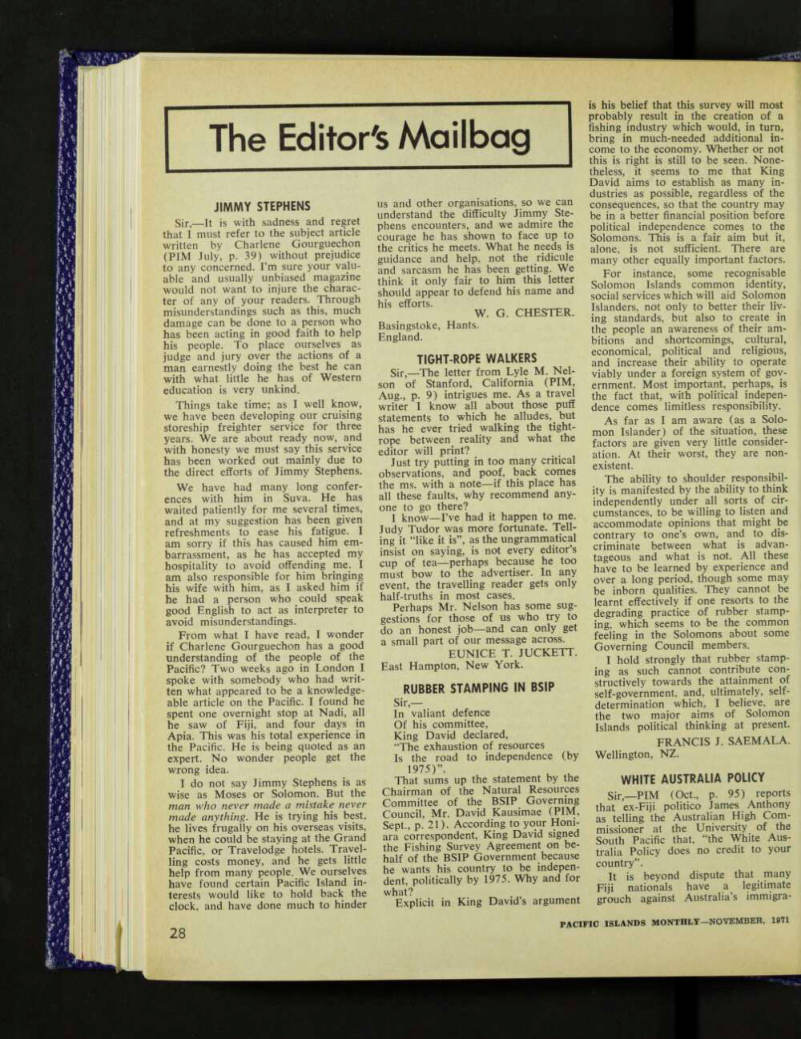
Sir John and Lady Gutch, on their return to Honiara. In this article for PIM, the former Western Pacific High Commissioner comments on changes. —BSIP Information Service
The Editor's Mailbag
Jimmy Stephens
Sir, —It is with sadness and regret that I must refer to the subject article written by Charlene Gourguechon (PIM July, p. 39) without prejudice to any concerned. I’m sure your valu able and usually unbiased magazine would not want to injure the charac ter of any of your readers. Through misunderstandings such as this, much damage can be done to a person who has been acting in good faith to help his people. To place ourselves as judge and jury over the actions of a man earnestly doing the best he can with what little he has of Western education is very unkind.
Things take time; as I well know, we have been developing our cruising storeship freighter service for three years. We are about ready now, and with honesty we must say this service has been worked out mainly due to the direct efforts of Jimmy Stephens.
We have had many long confer ences with him in Suva. He has waited patiently for me several times, and at my suggestion has been given refreshments to ease his fatigue. I am sorry if this has caused him em barrassment, as he has accepted my hospitality to avoid offending me. I am also responsible for him bringing his wife with him, as I asked him if he had a person who could speak good English to act as interpreter to avoid misunderstandings.
From what I have read, I wonder if Charlene Gourguechon has a good understanding of the people of the Pacific? Two weeks ago in London I spoke with somebody who had writ ten what appeared to be a knowledge able article on the Pacific. I found he spent one overnight stop at Nadi, all he saw of Fiji, and four days in Apia. This was his total experience in the Pacific. He is being quoted as an expert. No wonder people get the wrong idea.
I do not say Jimmy Stephens is as wise as Moses or Solomon. But the man who never made a mistake never made anything. He is trying his best, he lives frugally on his overseas visits, when he could be staying at the Grand Pacific, or Travelodge hotels. Travel ling costs money, and he gets little help from many people. We ourselves have found certain Pacific Island in terests would like to hold back the clock, and have done much to hinder
us and other organisations, so we can understand the difficulty Jimmy Ste phens encounters, and we admire the courage he has shown to face up to the critics he meets. What he needs is guidance and help, not the ridicule and sarcasm he has been getting. We think it only fair to him this letter should appear to defend his name and his efforts.
W. G. Chester.
Basingstoke, Hants.
England.
Tight-Rope Walkers
Sir,—The letter from Lyle M. Nel son of Stanford, California (PIM, Aug., p. 9) intrigues me. As a travel writer I know all about those puff statements to which he alludes, but has he ever tried walking the tight rope between reality and what the editor will print?
Just try putting in too many critical observations, and poof, back comes the ms. with a note—if this place has all these faults, why recommend any one to go there?
I know —I’ve had it happen to me.
Judy Tudor was more fortunate. Tell ing it “like it is”, as the ungrammatical insist on saying, is not every editor’s cup of tea —perhaps because he too must bow to the advertiser. In any event, the travelling reader gets only half-truths in most cases.
Perhaps Mr. Nelson has some sug gestions for those of us who try to do an honest job—and can only get a small part of our message across.
Eunice T. Juckett.
East Hampton, New York.
Rubber Stamping In Bsip
Sir, — In valiant defence Of his committee, King David declared, “The exhaustion of resources Is the road to independence (by 1975)”. u That sums up the statement by the Chairman of the Natural Resources Committee of the BSIP Governing Council, Mr. David Kausimae (PIM, Sept., p. 21). According to your Honi ara correspondent, King David signed the Fishing Survey Agreement on be half of the BSIP Government because he wants his country to be indepen dent, politically by 1975. Why and for what?
Explicit in King David’s argument
is his belief that this survey will most probably result in the creation of a fishing industry which would, in turn, bring in much-needed additional in come to the economy. Whether or not this is right is still to be seen. None theless, it seems to me that King David aims to establish as many in dustries as possible, regardless of the consequences, so that the country may be in a better financial position before political independence comes to the Solomons. This is a fair aim but it, alone, is not sufficient. There are many other equally important factors.
For instance, some recognisable Solomon Islands common identity, social services which will aid Solomon Islanders, not only to better their liv ing standards, but also to create in the people an awareness of their am bitions and shortcomings, cultural, economical, political and religious, and increase their ability to operate viably under a foreign system of gov ernment. Most important, perhaps, is the fact that, with political indepen dence comes limitless responsibility.
As far as I am aware (as a Solo mon Islander) of the situation, these factors are given very little consider ation. At their worst, they are non existent.
The ability to shoulder responsibil ity is manifested by the ability to think independently under all sorts of cir cumstances, to be willing to listen and accommodate opinions that might be contrary to one’s own, and to dis criminate between what is advan tageous and what is not. All these have to be learned by experience and over a long period, though some may be inborn qualities. They cannot be learnt effectively if one resorts to the degrading practice of rubber stamp ing, which seems to be the common feeling in the Solomons about some Governing Council members.
I hold strongly that rubber stamp ing as such cannot contribute con structively towards the attainment of self-government, and, ultimately, self determination which, I believe, are the two major aims of Solomon Islands political thinking at present.
Francis J. Saemala.
Wellington, NZ.
White Australia Policy
Sir,—PlM (Oct., p. 95) reports that ex-Fiji politico James Anthony as telling the Australian High Com missioner at the University of the South Pacific that, “the White Aus tralia Policy does no credit to your country”.
It is beyond dispute that many Fiji nationals have a legitimate u Anctrulip’si immiera
tion formula. Particularly affected are those non-European civil servants in Fiji who apply for a six-month permit to stay in Australia while on leave.
However, strange as it may seem to most Fiji people and some Aus tralians, James Anthony, his sister, brother and family and the elder Mrs.
Anthony have all received better treatment from the Australian authorities than their fellow countrymen.
James, himself, was given a sub stantial scholarship from the Aus tralian National University to write for his doctorate in political science.
One of the younger Anthony girls was given permission to come to Australia and she left the country only when she decided to marry in Canada. James’ brother Patrick was given a visa in 1969 to attend a trade union congress in Canberra and in the following year was given a 12-month student’s visa to study at a college in Sydney. His wife and three children followed. After completing two months of his 12month course, Patrick left the col lege and is now working in Sydney, having been given an extension of his entry permit.
What many are asking is, why is it that the Anthonys and others can obtain these concessions while other potential migrants with no connec tions are, if they are non-Europeans, either forced to leave or cannot come to Australia at all?
Alan Hamilton
Randwick, Sydney.
Death Of Usa
Sir, —It may interest your readers to learn of the passing of my daughter lisa Therese Gooderham, who died on Monday, September 27.
Ilsa was bora at the Prince Ngu Hospital in Neiafu, Vavau, Tonga, on July 18, 1968, while I was the Chair man of the Methodist District there.
Later we moved to Nukualofa when I became President of the Methodist Conference until February this year.
Our daughter was diagnosed as having an inoperable tumour (glioma) on the brain stem and X-Ray therapy was begun immediately. This was under the supervision of Dr. Minty, whose father was a resident doctor in Nukua lofa in the 1920 s and who himself was bora in Nukualofa.
This sickness forced my resignation from the presidency of the church in Tonga and our continued residence in Australia, Ilsa passed away after six months illness. She has always had a very special place in the hearts of the Tongan people. The Tongan com
munity of Melbourne gathered at the graveside and sang hymns to pay their final respects.
Although she was only a little child of three years, I thought you might be able to find a place in PIM for a little friend who was known and loved by many of the people at Vavau, Haapai and Tongatapu.
(Rev.) Justin J. Gooderham.
South Springvale, Victoria.
Sechstroh River
Sir, —Quite some time ago I wrote asking for information regarding the identification today of the Sechstroh River named by a German expedition in the 19th century, but I received no replies.
However, inquiries were pressed in Europe, and the Museum Fur Volker kunde in Berlin has informed me that according to some documentation they possess, the former Sechstroh River is known today as the Tami River.
Can this be confirmed, I wonder, by any residents of the Territory of Papua New Guinea today?
(Rev.) A. H. Voyce.
Postal History of NZ Inc., Milford, Auckland.
That Racist Cover
Sir, —Not having had Mr. Saun ana’s advantage of a university educa tion no doubt leaves me at a disad vantage in many ways.
And I feel rather awed by his per spicacity and educational proficiency, especially in the field of English, when I note that (PIM, Sept., p. ii), it has taken him only 618 words to say . . .
“I Hate Expatriates”.
K. O. Worcester.
Wewak.
Mr. G. F. W. Zimmer
Sir, —Regarding the report of the death of my husband Mr, George F.
W. Zimmer (PIM, June, p. 127), he did not receive the French Croix de Guerre but was made a Chevalier de Legion d’Honneur de France, which is the highest honour France can give to a serving officer. Among his many “dog-fights” in the air and successes was the shooting down of Max von Muller, who was one of the well known von Richthofen’s ace pilots.
Incidentally, my husband was one of the six pilots to be awarded the Distinguished Flying Cross when it was struck in 1918.
Nan Zimmer.
Wishaw, Lanarkshire, Scotland.
What are they doing? They are prospecting on New Guinea's Tarua River, in the New Guinea Highlands, in 1930. Who are they? The two central figures are Reg Beazley and Ernie Shepherd, members of the now famous Akmana team which we believe was first to contact the Highlands wigmen and bring back wigs. Their exploits were reported in RIM in April and March this year. The pictures we published included this one, when we wrongly named the fellow under the hat as being Sam Freeman. For posterity and for Ernie Shepherd, now 73 and living in Sydney, we happily put the record straight.
Tropicalities
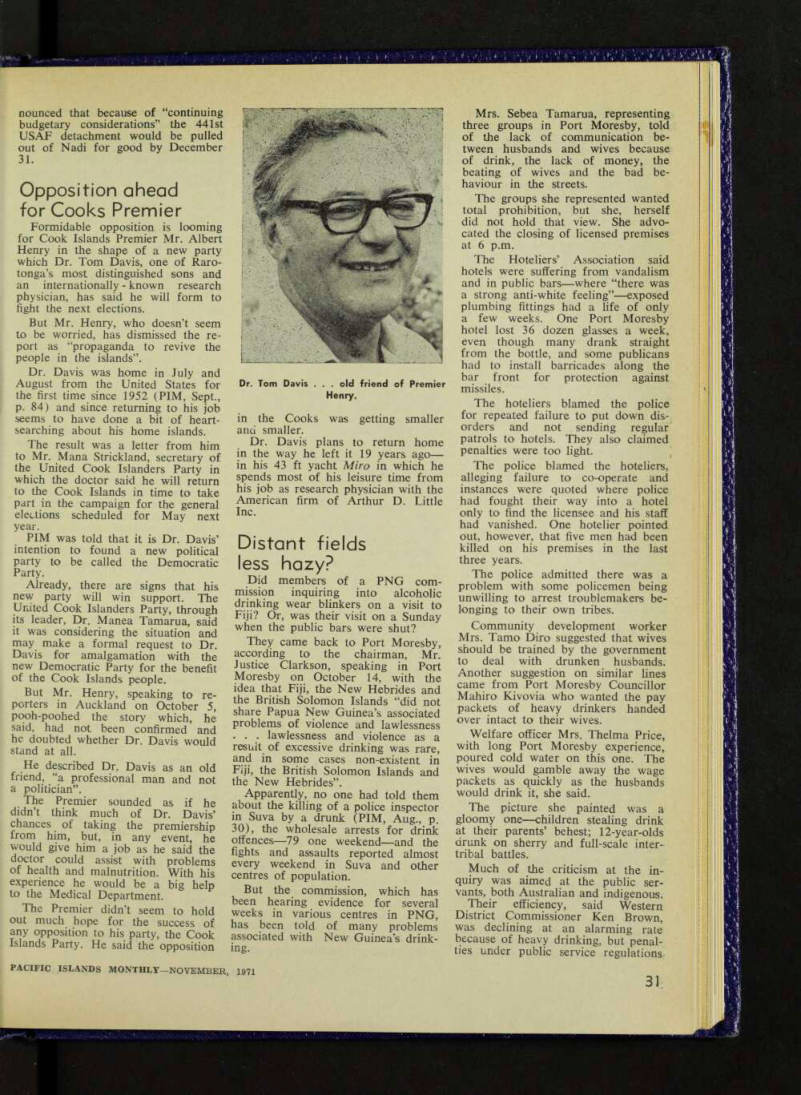
Slamming
Fiji's Door
Fiji’s immigration regulations are giving massive headaches to com panies and tourist agencies. To companies driven nearly frantic by the increasing pressure of “localisa tion” demands, and to tourist agencies inundated with complaints about the unreasonable visa regulations.
One of Fiji’s oldest companies, Burns Philp (South Sea) Co., Ltd., has sold a subsidiary, Burns Philp (New Hebrides) Ltd. One reason given for the reluctant sale was the “increasing difficulty the South Sea Company is experiencing in managing its affairs because of the effects of localisation in Fiji”.
“This policy”, chairman Sir Maurice Scott said in October in the annual report, “is now being administered with increasing severity and has no apparent regard for the serious effect it is having on the company’s ability to control and manage diverse opera tions, not only in Fiji, but in the overseas territories”.
Dozens of companies can echo the same complaint. Many employers are developing ulcers over their struggles to clear the hurdles put in the way of engaging qualified staff from over seas. One of the worst is the require ment of an employer to put a period to the time he will need his expatri ate employee, to the time taken to train a “local” for the job and, even, to give the “local’s” name.
In positions where qualities and at tributes recognised as making for efficiency are abstract ones, fulfilling such a requirement is almost im possible.
But the noisiest uproar is coming from the tourist agencies and the air lines over the visa regulations. These were changed recently and the effect of the change was immediate. Scores of tourists from countries which had no visa abolition agreement with Fiji found themselves barred.
Ten Mexicans who wanted to spend two days in “Friendly Fiji” were turned away, virtually on the door step, in September and two more from the same country recently spent 25 hours in the transit lounge at Nadi
Airport until their aircraft took off.
A woman with a Spanish passport, who had a visa problem, spent all night at the airport terminal before anyone with enough authority could be located to sort out the problem.
Incensed at the lack of consider ation by the immigration authorities, who did not wait until news of the regulations change could be made known in other countries, the travel industry recently protested to the Minister of Labour.
The Fiji Visitors Bureau board met on October 19 and one member, Mr.
Dick Warner, managing director of travel agents Hunts of the de scribed the visa position as serious and deplored the lack of consultation between the government and the tour ist industry.
The bureau suggested that, as an interim measure, tourists arriving without visas should be supplied with them at the airports.
The immigration laws may also take the gilt off the gingerbread for those people overseas who are buying home-sites in places like Deuba’s Paci fic Harbour.
The possession of such a home will not guarantee the owner a place in Fiji’s sun for all time.
According to the Prime Minister, Ratu Sir Kamisese Mara, those people with an assured income who want to retire to Fiji would be wel come to come, but they wouldn’t be allowed to work, and those with homes who wished to pay only periodic visits to their property would have to be satisfied with the present regulations which allow them a permit to reside for up to six months in any year.
Fairies or
big brother?
The fairy ring of little white mushroom domes and long, white, windowless caravans tucked fairly unobtrusively away in a corner of Nadi Airport has always been a matter for wondering locals to natter about (PIM, June, p. 24).
Like mushroom rings do, it popped up overnight in November, 1966, occupied by men with dis tinctly American voices and definite military manners.
What excited curiosity was that although they never seemed to be
seen in uniform, some occasionally appeared to be toting guns. For the next three years neither the US Con sulate in Suva nor the Fiji Govern ment would acknowledge that the fairy ring was there.
After a year or two the listing “US Air Force Detachment 441” sidled into the pages of the public telephone directory. That may have been a security slip. Intrigued local journalists who instantly rang the number to ask: “Who are you, what are you doing there and why?”, met with an earful of secretive, heavy breathing and then a mumbled reference to the Suva consulate.
But the consulate was not at all helpful. And it would get terribly embarrassed when one of the long white caravans was spotted from time to time on Suva Wharf while being shipped in or out of Fiji.
Told that a newspaper wanted some caption details to go with a photo of the caravans the consulate wailed: “Don’t do that. Need anyone know they’re there?”
Despite their civilian disguise, the Americans at Nadi, never numbering more than about 40, behaved as US servicemen abroad usually do. They successfully muscled in on all the single available girls, monopolised the local bars, and moaned about the time they had to suffer in Fiji before getting home to the good old USA.
Prodded again, the consulate re ferred queries to the Fiji Govern ment. This responded by acting as if it had never received them. Two years ago, prodded once more, the consulate hummed and hawed and after a day or two said that Washing ton, DC, had decided to satisfy local curiosity.
One Fiji Times reporter would be allowed to walk through the mush room ring just once. The mass of electronic dials and wires he saw didn’t mean much.
“Just meteorological research,” he was assured. “Electronic equipment housed at the installation has been used to measure and record data on electrical disturbances and baro metric changes in the upper atmos phere.” „ What kind of disturbances? Ones caused by missiles and bombers and satellites whizzing through space?
“Er, no. This data assists in deter mining the size and intensity of storm centres and in tracking their move ment.” , , So why all the secrecy about the weather? How about storm centres of, say, nuclear intensity, hovering around Mururoa?
Those questions weren’t answered and now probably never will be.
In October the US Consulate an
nounced that because of “continuing budgetary considerations” the 441st USAF detachment would be pulled out of Nadi for good by December 31.
Opposition ahead
for Cooks Premier
Formidable opposition is looming for Cook Islands Premier Mr. Albert Henry in the shape of a new party which Dr. Tom Davis, one of Raro tonga’s most distinguished sons and an internationally - known research physician, has said he will form to fight the next elections.
But Mr. Henry, who doesn’t seem to be worried, has dismissed the re port as “propaganda to revive the people in the islands”.
Dr. Davis was home in July and August from the United States for the first time since 1952 (PIM, Sept., p. 84) and since returning to his job seems to have done a bit of heart searching about his home islands.
The result was a letter from him to Mr, Mana Strickland, secretary of the United Cook Islanders Party in which the doctor said he will return to the Cook Islands in time to take part in the campaign for the general elections scheduled for May next year.
PIM was told that it is Dr. Davis’ intention to found a new political party to be called the Democratic Party.
Already, there are signs that his new party will win support. The United Cook Islanders Party, through its leader, Dr. Manea Tamarua, said it was considering the situation and may make a formal request to Dr.
Davis for amalgamation with the new Democratic Party for the benefit of the Cook Islands people.
But Mr. Henry, speaking to re porters in Auckland on October 5, pooh-poohed the story which, he said, had not been confirmed and he doubted whether Dr. Davis would stand at all.
He described Dr. Davis as an old friend, “a professional man and not a politician”.
The Premier sounded as if he didn’t think much of Dr. Davis’ chances of taking the premiership from him, but, in any event, he would give him a job as he said the doctor could assist with problems of health and malnutrition. With his experience he would be a big help to the Medical Department.
The Premier didn’t seem to hold out much hope for the success of any opposition to his party, the Cook Islands Party. He said the opposition
in the Cooks was getting smaller ana smaller.
Dr. Davis plans to return home in the way he left it 19 years ago— in his 43 ft yacht Miro in which he spends most of his leisure time from his job as research physician with the American firm of Arthur D. Little Inc.
Distant fields
less hazy?
Did members of a PNG com mission inquiring into alcoholic drinking wear blinkers on a visit to Fiji? Or, was their visit on a Sunday when the public bars were shut?
They came back to Port Moresby, according to the chairman, Mr.
Justice Clarkson, speaking in Port Moresby on October 14, with the idea that Fiji, the New Hebrides and the British Solomon Islands “did not share Papua New Guinea’s associated problems of violence and lawlessness . . . lawlessness and violence as a result of excessive drinking was rare, and in some cases non-existent in Fiji, the British Solomon Islands and the New Hebrides”.
Apparently, no one had told them about the killing of a police inspector in Suva by a drunk (PIM, Aug., p. 30), the wholesale arrests for drink offences—79 one weekend—and the fights and assaults reported almost every weekend in Suva and other centres of population.
But the commission, which has been hearing evidence for several weeks in various centres in PNG, has been told of many problems associated with New Guinea’s drink ing.
Mrs. Sebea Tamarua, representing three groups in Port Moresby, told of the lack of communication be tween husbands and wives because of drink, the lack of money, the beating of wives and the bad be haviour in the streets.
The groups she represented wanted total prohibition, but she, herself did not hold that view. She advo cated the closing of licensed premises at 6 p.m.
The Hoteliers’ Association said hotels were suffering from vandalism and in public bars—where “there was a strong anti-white feeling”—exposed plumbing fittings had a life of only a few weeks. One Port Moresby hotel lost 36 dozen glasses a week, even though many drank straight from the bottle, and some publicans had to install barricades along the bar front for protection against missiles.
The hoteliers blamed the police for repeated failure to put down dis orders and not sending regular patrols to hotels. They also claimed penalties were too light.
The police blamed the hoteliers, alleging failure to co-operate and instances were quoted where police had fought their way into a hotel only to find the licensee and his staff had vanished. One hotelier pointed out, however, that five men had been killed on his premises in the last three years.
The police admitted there was a problem with some policemen being unwilling to arrest troublemakers be longing to their own tribes.
Community development worker Mrs. Tamo Diro suggested that wives should be trained by the government to deal with drunken husbands.
Another suggestion on similar lines came from Port Moresby Councillor Mahiro Kivovia who wanted the pay packets of heavy drinkers handed over intact to their wives.
Welfare officer Mrs. Thelma Price, with long Port Moresby experience, poured cold water on this one. The wives would gamble away the wage packets as quickly as the husbands would drink it, she said.
The picture she painted was a gloomy one—children stealing drink at their parents’ behest; 12-year-olds drunk on sherry and full-scale inter tribal battles.
Much of the criticism at the in quiry was aimed at the public ser vants, both Australian and indigenous.
Their efficiency, said Western District Commissioner Ken Brown, was declining at an alarming rate because of heavy drinking, but penal ties under public service regulations
Dr. Tom Davis . . . old friend of Premier Henry.
were so light that punishment was a laughing matter.
Mr. Brown also alleged that — • At Dam, the people on a regular wage lived from pay-day to pay day for a fortnightly bender; • At least $6,000, nearly half Dam’s fortnightly pay cheque, went each pay weekend on liquor; and • Last Christmas 4,000 bottles of dry sherry were sold at Daru.
Another aspect of the problem was touched on by Percy Chatterton, MHA, who attacked the drinking cult.
“Every effort should be made to avoid the situation in Papua New Guinea in which beer is sentimental ised as in Australia,” he said.
The commission has received many prescriptions to cure the problems.
These include, reducing the liquor trading hours, teaching children about the effects of heavy drinking, heavier penalties for drink offences, the policing of hotels by village and community elders, “beer only” licences, weaker beer with a tax re duction on it and a bigger tax on spirits and sherry.
The view that drinking hours should be cut led to the submission by the Police Commissioner, Briga dier N. A. M. Nicholls, that this should also apply to the clubs.
They were almost wholly patron ised by expatriates, he said, and it had been claimed that this was a source of “racial discomfort” to indigenes who saw expatriates drink ing in clubs when hotels and taverns were closed.
The horror of a
$1 million handout
The whys and wherefores of New Zealand’s financial obligations to its protectorates—Niue in particular— arose during a Suva news conference for the touring NZ parliamentary delegation in September.
Mr. R. E. B. Peren, head of the South Pacific division of NZ’s Minis try of Foreign Affairs, remarked on one reaction he’d met in Fiji.
A respected Suva citizen, he said, had expressed “horror” that 5,000 Niueans received a $1 million-a-year handout between them.
“The suggestion was that this was immoral, that it was too much . . . that chaps ought to look after them selves”, he said. Mr. Peren added that New Zealand’s own attitude was that it did indeed have a responsibility to Niue.
He conceded that there were some inequalities in the pattern of New Zealand aid to the South Pacific, but said, “Over the next 10 years there
will be a change in the pattern of our aid and relationships, which will re flect the new constitutional situation in the region. We will tend to deal more equally with various territories”.
Leader of the delegation, Mr. H.
R. Lapwood, said he did not al together agree with suggestions that New Zealand should give more aid to the South Pacific because there were always people to think up ways and means of how the country should be spending money.
W. Samoa's Fono
is really modern
Western Samoa’s ultra - modern Fono House is now completed but it will not be officially used until the Independence Day celebrations in June next year.
Built at a cost of $185,000, it contains the latest furniture and equipment including the most modern simultaneous translating equipment from New Zealand.
Foundations of the new legislative department building nearby have been laid but further work has been stopped because materials have not arrived.
On the airport project, more than 50 per cent, of the dredging is done.
Half of the new terminal buildings and the runway are also completed.
Director of Works Mr. Leslie McQuitty indicated that the first 5,000 ft of runway suitable for the opera tion of Air Pacific jets would be ready by next April and the rest of the airport and road projects by the end of next year.
The new Fono House was financed with a loan from New Zealand and the airport project with a SUS 2.4 million loan from the Asian Develop ment Bank.
Church council
quizzed
The Melanesian Council of Churches has had a lively annual meeting at Baiyer River Baptist mission in the Western Highlands of New Guinea. The council began by welcoming the Roman Catholic Church into full membership, thus making the MCC one of the rela tively few national councils of churches which include the Catholics.
This has given rise to a certain amount of tension in some quarters, but on the whole the meetings went off cordially.
MCC delegates showed some dis enchantment both with the World Council of Churches and with the proliferating consultations and semi
nars held under the auspices of the World Council or other bodies.
They passed a resolution express ing concern that the World Council was inviting people from PNG to attend its commissions as advisers, without first consulting either the MCC or those territory churches which are members of the council.
The resolution was prompted by recent invitations to Tolai John Kaputin and trade unionist Albert Maori Kiki, both of whom are con troversial figures locally.
On the subject of consultations and seminars, everyone seemed to be ask ing in effect, are they really worth while? In particular, they wanted to know why experts had to be brought expensive distances from overseas, when in the opinion of many dele gates there were already people in the area who could be used just as effectively.
Delegates also felt that far too often participants in seminars and consultations failed to pass on what they had learnt, so that the church, country and people derived little benefit from the programmes.
In its new assertive mood of aggres sive questioning, the MCC fired off a resolution asking the World Council to clarify the aims, objects and bene fits of a proposed consultation on social and political maturity in the South Pacific.
'Down with shorts'
cries festival director
“Take off your shorts and throw away your paper ribbons,” was the cry from the heart of South Pacific Festival of Arts director Victor Carell to the Fijians in October. But he wasn’t advocating nudity. He was condemning the use in Fijian arts of anything but traditional materials.
Lamenting the preponderance of khaki shorts, plastics, crepe paper, wrist watches and the like in Fijian mekes and the use of kerosene tins for drums, Mr. Carell appealed to “every leader in the South Pacific to make a concentrated drive for the resurrection and preservation of traditional customs and good taste in art”. . .
He wanted the “elimination of tasteless early European contact resi dues and of stop-gap puritanical fashions such as putting certain island women into men’s singlets for public ceremonies”.
One suggestion he made was the return of the original loincloth or brief athletic underpants dyed brown and not “European shorts glaringly out of keeping with gracious voivoi skirts”.
People
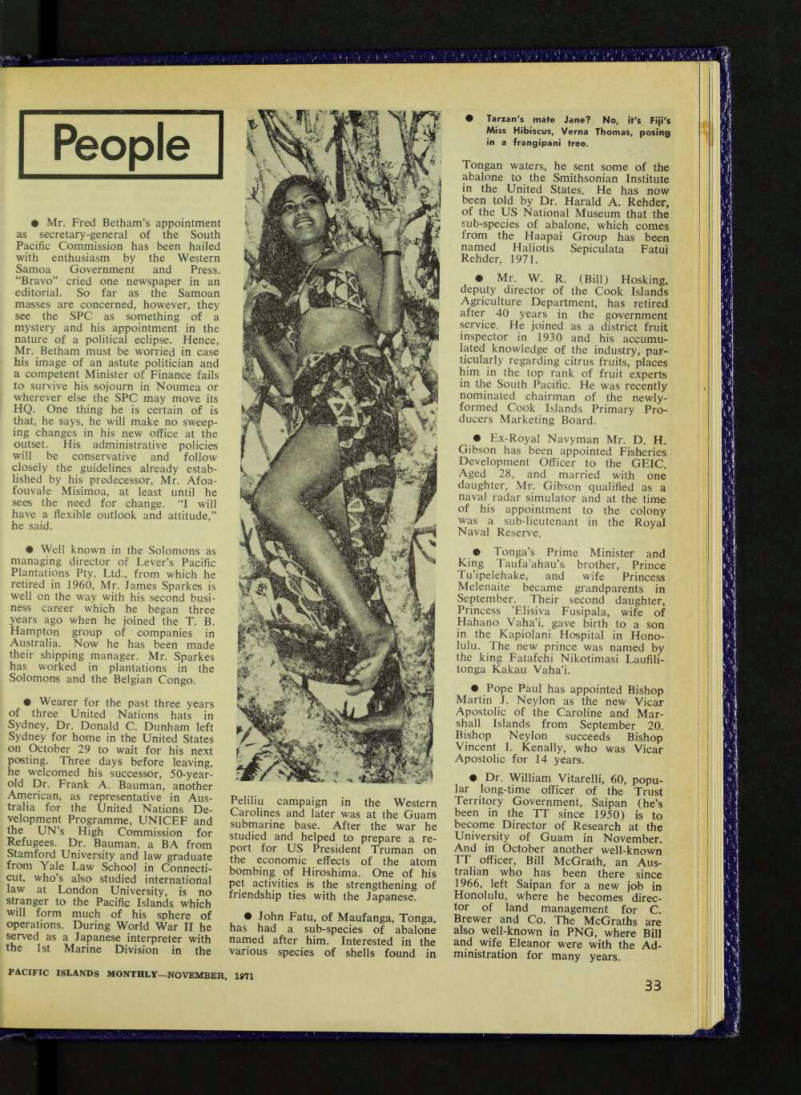
• Mr. Fred Betham’s appointment as secretary-general of the South Pacific Commission has been hailed with enthusiasm by the Western Samoa Government and Press.
“Bravo” cried one newspaper in an editorial. So far as the Samoan masses are concerned, however, they see the SPC as something of a mystery and his appointment in the nature of a political eclipse. Hence, Mr. Betham must be worried in case his image of an astute politician and a competent Minister of Finance fails to survive his sojourn in Noumea or wherever else the SPC may move its HQ. One thing he is certain of is tiiat, he says, he will make no sweep ing changes in his new office at the outset. His administrative policies will be conservative and follow closely the guidelines already estab lished by his predecessor, Mr. Afoa fouvale Misimoa, at least until he sees the need for change. “I will have a flexible outlook and attitude,” he said. • Well known in the Solomons as managing director of Lever’s Pacific Plantations Pty. Ltd., from which he retired in 1960, Mr. James Sparkes is well on the way with his second busi ness career which he began three years ago when he joined the T. B.
Hampton group of companies in Australia. Now he has been made their shipping manager. Mr. Sparkes has worked in plantations in the Solomons and the Belgian Congo. • Wearer for the past three years of three United Nations hats in Sydney, Dr. Donald C. Dunham left Sydney for home in the United States on October 29 to wait for his next posting. Three days before leaving, he welcomed his successor, 50-year old Dr. Frank A. Bauman, another American, as representative in Aus tralia for the United Nations De velopment Programme, UNICEF and the UN’s High Commission for Refugees. Dr. Bauman, a BA from Stamford University and law graduate from Yale Law School in Connecti cut, who’s also studied international law at London University, is no stranger to the Pacific Islands which will form much of his sphere of operations. During World War II he served as a Japanese interpreter with the Ist Marine Division in the
Peliliu campaign in the Western Carolines and later was at the Guam submarine base. After the war he studied and helped to prepare a re port for US President Truman on the economic effects of the atom bombing of Hiroshima. One of his pet activities is the strengthening of friendship ties with the Japanese. • John Fatu, of Maufanga, Tonga, has had a sub-species of abalone named after him. Interested in the various species of shells found in
Tongan waters, he sent some of the abalone to the Smithsonian Institute in the United States. He has now been told by Dr. Harald A. Rehder, of the US National Museum that the sub-species of abalone, which comes from the Haapai Group has been named Haliotis Sepiculata Fatui Rehder, 1971. • Mr. W. R. (Bill) Hosking, deputy director of the Cook Islands Agriculture Department, has retired after 40 years in the government service. He joined as a district fruit inspector in 1930 and his accumu lated knowledge of the industry, par ticularly regarding citrus fruits, places him in the top rank of fruit experts in the South Pacific. He was recently nominated chairman of the newly formed Cook Islands Primary Pro ducers Marketing Board. • Ex-Royal Navyman Mr. D. H.
Gibson has been appointed Fisheries Development Officer to the GEIC.
Aged 28, and married with one daughter, Mr. Gibson qualified as a naval radar simulator and at the time of his appointment to the colony was a sub-lieutenant in the Royal Naval Reserve. • Tonga’s Prime Minister and King Taufa’ahau’s brother, Prince Tu’ipelehake, and wife Princess Melenaite became grandparents in September. Their second daughter.
Princess ’Elisiva Fusipala, wife of Hahano Vaha’i, gave birth to a son in the Kapiolani Hospital in Hono lulu. The new prince was named by the king Fatafehi Nikotimasi Laufili tonga Kakau Vaha’i. • Pope Paul has appointed Bishop Martin J. Neylon as the new Vicar Apostolic of the Caroline and Mar shall Islands from September 20.
Bishop Neylon succeeds Bishop Vincent I. Kenally, who was Vicar Apostolic for 14 years. • Dr. William Vitarelli, 60, popu lar long-time officer of the Trust Territory Government, Saipan (he’s been in the TT since 1950) is to become Director of Research at the University of Guam in November.
And in October another well-known TT officer, Bill McGrath, an Aus tralian who has been there since 1966, left Saipan for a new job in Honolulu, where he becomes direc tor of land management for C.
Brewer and Co. The McGraths are also well-known in PNG, where Bill and wife Eleanor were with the Ad ministration for many years.
Tarzan's mate Jane? No, it's Fiji's Miss Hibiscus, Verna Thomas, posing in a frangipani tree.
Cabbage
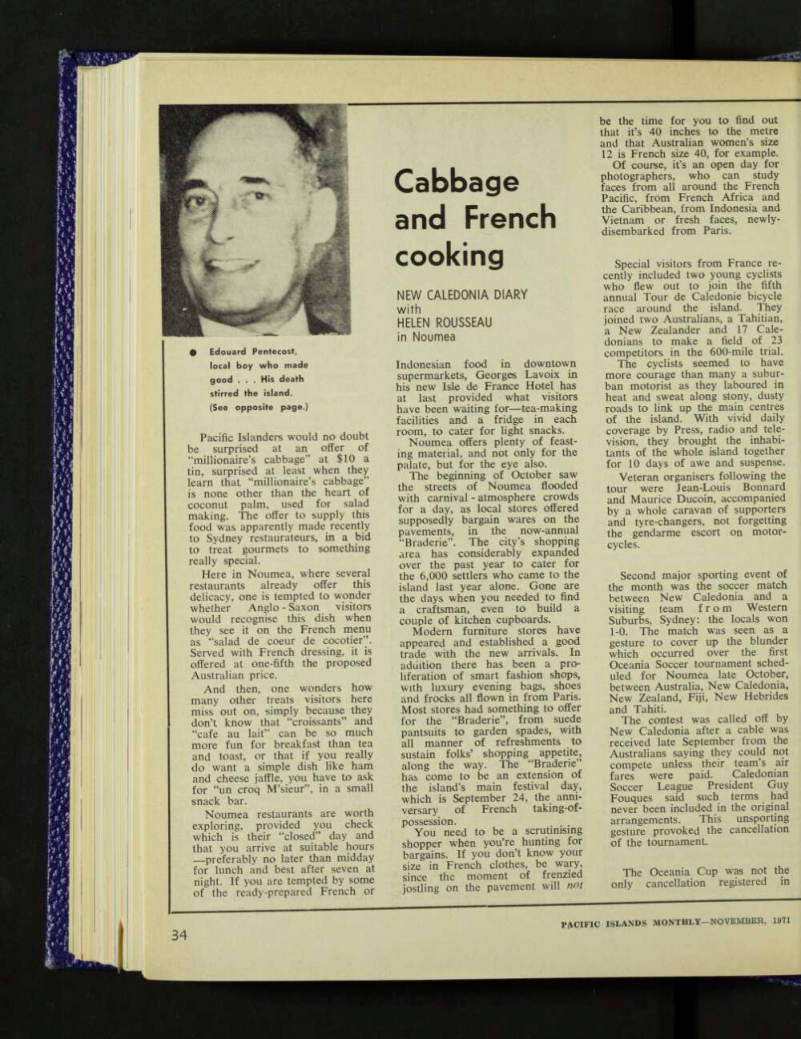
and French cooking
New Caledonia Diary
with
Helen Rousseau
in Noumea
Pacific Islanders would no doubt be surprised at an offer of “millionaire’s cabbage” at $lO a tin, surprised at least when they learn that “millionaire’s cabbage” is none other than the heart of coconut palm, used for salad making. The offer to supply this food was apparently made recently to Sydney restaurateurs, in a bid to treat gourmets to something really special.
Here in Noumea, where several restaurants already offer this delicacy, one is tempted to wonder whether Anglo - Saxon visitors would recognise this dish when they see it on the French menu as “salad de coeur de cocotier”.
Served with French dressing, it is offered at one-fifth the proposed Australian price.
And then, one wonders how many other treats visitors here miss out on, simply because they don’t know that “croissants” and “cafe au lait” can be so much more fun for breakfast than tea and toast, or that if you really do want a simple dish like ham and cheese jaffle, you have to ask for “un croq M’sieur”, in a small snack bar.
Noumea restaurants are worth exploring, provided you check which is their “closed” day and that you arrive at suitable hours —preferably no later than midday for lunch and best after seven at night. If you are tempted by some of the ready-prepared French or
Indonesian food in downtown supermarkets, Georges Lavoix in his new Isle de France Hotel has at last provided what visitors have been waiting for—tea-making facilities and a fridge in each room, to cater for light snacks.
Noumea offers plenty of feast ing material, and not only for the palate, but for the eye also.
The beginning of October saw the streets of Noumea flooded with carnival - atmosphere crowds for a day, as local stores offered supposedly bargain wares on the pavements, in the now-annual “Braderie”. The city’s shopping area has considerably expanded over the past year to cater for the 6,000 settlers who came to the island last year alone. Gone are the days when you needed to find a craftsman, even to build a couple of kitchen cupboards.
Modern furniture stores have appeared and established a good trade with the new arrivals. In addition there has been a pro liferation of smart fashion shops, with luxury evening bags, shoes and frocks all flown in from Paris.
Most stores had something to offer for the “Braderie”, from suede pantsuits to garden spades, with all manner of refreshments to sustain folks’ shopping appetite, along the way. The “Braderie” has come to be an extension of the island’s main festival day, which is September 24, the anni versary of French taking-of possession.
You need to be a scrutinising shopper when you’re hunting for bargains. If you don’t know your size in French clothes, be wary, since the moment of frenzied jostling on the pavement will not
be the time for you to find out that it’s 40 inches to the metre and that Australian women’s size 12 is French size 40, for example.
Of course, it’s an open day for photographers, who can study faces from all around the French Pacific, from French Africa and the Caribbean, from Indonesia and Vietnam or fresh faces, newly disembarked from Paris.
Special visitors from France re cently included two young cyclists who flew out to join the fifth annual Tour de Caledonie bicycle race around the island. They joined two Australians, a Tahitian, a New Zealander and 17 Cale donians to make a field of 23 competitors in the 600-mile trial.
The cyclists seemed to have more courage than many a subur ban motorist as they laboured in heat and sweat along stony, dusty roads to link up the main centres of the island. With vivid daily coverage by Press, radio and tele vision, they brought the inhabi tants of the whole island together for 10 days of awe and suspense.
Veteran organisers following the tour were Jean-Louis Bonnard and Maurice Ducoin, accompanied by a whole caravan of supporters and tyre-changers, not forgetting the gendarme escort on motor cycles.
Second major sporting event of the month was the soccer match between New Caledonia and a visiting team from Western Suburbs, Sydney: the locals won 1-0. The match was seen as a gesture to cover up the blunder which occurred over the first Oceania Soccer tournament sched uled for Noumea late October, between Australia, New Caledonia, New Zealand, Fiji, New Hebrides and Tahiti.
The contest was called off by New Caledonia after a cable was received late September from the Australians saying they could not compete unless their team’s air fares were paid. Caledonian Soccer League President Guy Fouques said such terms had never been included in the original arrangements. This unsporting gesture provoked the cancellation of the tournament.
The Oceania Cup was not the only cancellation registered in
Edouard Pentecost, local boy who made
good . . . His death
stirred the island. (See opposite page.)
Noumea recently. Much more alarming was the news from Japanese nickel buyers here that they were slowing down, almost stopping, their ore shipments from New Caledonia, The quota system piaced a 4.3 million ton limit on Caledonian exports in the Japanese financial year ending March 31, 1971. It is now feared that this year ore exports may not exceed much more than 3 million tons.
As panic spread among the “petits mmeurs” independent mine operators, various Caledonians flew off to Tokyo in a bid to remedy the situation. At the same time, as trucking contractors lost their jobs on inland mines, concern mounted over their ability to pay back truck loan payments, which can amount to $l,OOO per month.
There are now about 25 Cale donian mine operating groups. As they began closing down their mines, dipnissing workers and put ting millions of dollars of heavy earth - moving equipment into “mothballs”, the government was faced with a serious problem.
The miners’ first reaction was to blame not only the current re cession on the world nickel market, but the fact that Japan is now seeking to buy her ore more from other sources, since the Paris government placed snap quotas on the Caledonian ex porters in May, 1970.
The quotas were imposed to help big French companies to establish smelters here, but to date none of the promised three new companies has been able to get off the planning table and begin construction of their factories.
In the face of rising local un easiness, the authorities suddenly produced a series of TV inter views and an on-location movie showing a new prospecting ven ture involving Swedish and Cale donian interests, on the East Coast, between Thio and Yate.
As helicopters whirled overhead transporting mobile drilling equip ment over a dramatic mountainous terrain, Caledonians were told that the new exploration venture has embarked on a two-year research programme to try to prove the existence of 25 million tons of garnieritic ore at 2 per cent, nickel content. The exploration involves Granges of Sweden and Rene de Rouvray of Noumea, forming the
Societe Mini e r e Caledonienne
(Sominec).
Caledonian mining circles were wondering why Swedish pros pectors were admitted to the territory when certain American, Australian and Japanese interests have not been accepted. It was whispered that the French com pany Pechiney could eventually be involved in the project. In the meantime, the Caledonians pointed out that much further-advanced projects such as Canadian INCO, SOMECAL and PEN AM AX were still awaiting either French finance or government approval to pro ceed.
Amid the local deception and uneasiness, it was expected that the Territorial Assembly, resuming late October to debate next year’s lABO million budget, would be having an exceptionally “hot” summer session, especially in view of the general elections looming up next year. The Assembly met only a couple of weeks after the death of one of its most esteemed members, Vice-President Edouard Pentecost (see next column).
Meanwhile, somewhat on the periphery of all this local debate, the South Pacific Commission was expecting Mr, Fred Betham to take up his post as Secretary- General from November 1.
In other parts of town, on the business and political plane, a New Zealand parliamentary dele gation succeeded a business mission from the Wellington Manufacturers’ Association. On the artistic scene, French painter Frank Fay, from Tahiti, held an exhibition at the Chateau Royal Hotel, offering canvases from $lBO to $5BO, which raised some interesting comment as to how comfortably an artist should ex pect to live.
Finally, among the social activi ties during October, Richard Johnston, only son of Louis and Verna Johnston, married Mademoiselle Maryline Boyer, in a ceremony which brought to gether numerous members of two old Noumea trading families, the Johnstons and Hagens.
In ail there is plenty of activity in Noumea these days, and the Caledonians have a busy time sandwiching it all in, between the coconut palm salad and the “croq M’sieur”.
made good
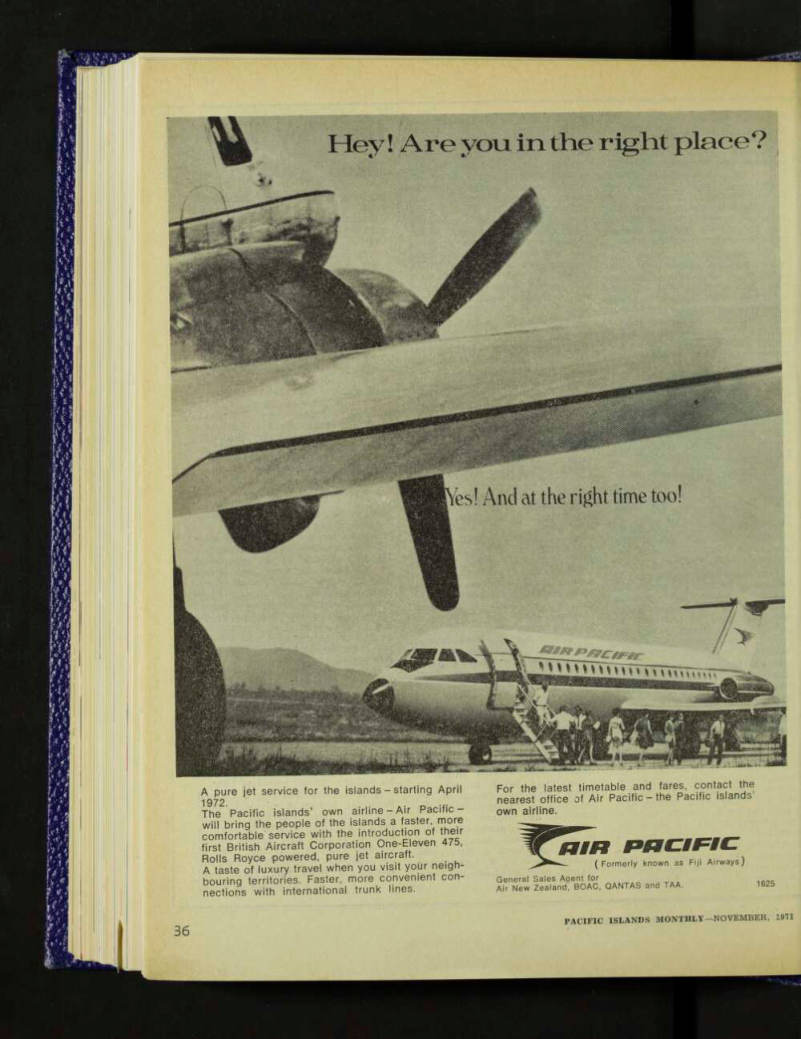

Local boy who made good
Edouard Pentecost had become al most a legendary figure in New Caledonia, even before the island was stirred with the news of his death on October 4.
The man who died as president of a $5O million-a-year industrial empire, as master of the immense villa on Rocher a la Voile headland and as a Caledonian mourned throughout the territory, was born 62 years ago in the village of Ro, on Mare in the offshore Loyalty Islands.
Those who have swum at Noumea’s Anse Vata beach and looked up at the huge mansion on the “Sailing-ship- Rock headland to the north may well wonder: how could a man born on a tiny offshore island of 3,000 inhabitants become New Caledonia’s wealthiest millionaire and best-known unofficial ambassador in world capi tals from Paris to Tokyo. To those who knew his broad smile and confi dent handshake, the answer lay in his dynamic and engaging personality, in his vision of the territory’s ever developing possibilities and in his drive to work hard and see affairs concluded.
Mr. Pentecost had been ill for seve ral months with circulatory problems.
He died of heart failure surrounded by household members and several doctors. Only a couple of hours earlier he had been signing docu ments concerning Noumea’s second brewery, due to be operating by the end of this year. The previous day he had driven out to a new housing site being developed at Noumea’s 7th Kilometer.
He is survived by his wife, Madame Henriette Pentecost, two married sons Michel and Philippe, both living in Noumea and his daughter Claude, Madame Guy Francois, who lives in Brussels.
At the time of his father’s death, Michel was flying to Tokyo for im portant talks on the nickel ore crisis, but was able to fly back in time for his father’s funeral two days later.
If one of his forefathers, Captain Pentecost, had an island named after him in the New Hebrides, Edouard Pentecost gave his name to a whole business empire, now known as the Groupe Pentecost. At the news of his death, half Noumea’s business life seemed to stand still. There were
Continued on p. 108
whole blocks of closed doors along the Rue de I’Alma, Noumea’s main street, as Pentecost shops and busi ness houses mourned the passing of their directing spirit. From one end of the street to the other and nearby, the Pentecost group offers the latest $lO,OOO Citroen car, Caterpillar bull dozers, Italian tableware and trans istor radios, shipping, travel and in surance services, besides holding a share in the new Paribas NC Bank, now under construction.
In a ceremony honoured by the biggest gathering ever seen about a tomb in Noumea, Edouard Pentecost was buried at the 4th Kilometer cemetery, after a service in Noumea’s Protestant Church. His body was laid to rest in the family vault shared by his mother and his elder brother Rich ard, who died as a young man in the New Hebrides, after a horse-riding ac cident.
The two boys had come to Noumea for their secondary education at the La Perouse High School. They later worked for the trading firm Hagen Brothers. Young Edouard then sailed around the islands as supercargo in boats trading especially with the New Hebrides. In 1932 he married Hen riette Leyraud and about that time entered business on his own account, his first venture being a book store on the Rue de I’Alma, opposite the present large Librairie Pentecost book store.
His first manager was Paul Demene, a man who spent many intervening years outside the territory, but who, today, sits high in the Pentecost Pyra mid. They were friends back in the early days, playing soccer together.
Pentecost was in the Caledonian side to play the first Australian soccer team that came to the island in 1933. He was also captain of the water polo team that played in Australia about the same time. In a moving tribute to his support for sport, only a few days before his death, Pentecost was presented with the Caledonian soccer team’s highly-prized trophy, brought back after their recent win at the Tahiti Games.
Back in the early days on the Rue de I’Alma, Pentecost joined with the Ventrillon family to build Noumea’s first modern building on the Rue Georges Clemenceau corner, with “Claude France” fashion goods now on the ground floor. Pentecost later acquired the Hagen Brothers’ Citroen agency, originally next door. This was at the beginning of a chain of activities which were eventually to revolve especially around nickel ope
rations. After becoming agent for Caterpillar heavy mining equipment in 1947, it was from the ’fifties that Pentecost pioneered the sale of nickel ore to Japan, thus developing what became a very lucrative business for Caledonian mine operators.
Not all his projects followed an untroubled trail to success, however.
The dreams of the son of Mare did not always coincide with the schemes of the Paris bureaucrats. Many Cale donians believe that it was too irritat ing and envy-provoking for certain Metropolitan French to admit so much power and success in an islander. Whatever the reason, Pente cost did not succeed in gaining ap proval to operate his own commercial air service. His group nevertheless owns six Cessna aircraft and two heli copters. In addition, Pentecost’s plan to construct a nickel smelting factory on the West Coast never received Paris blessing, nor did his project to build a conveyor belt for ore delivery to the seaside.
No doubt the biggest frustration were the snap quotas Paris introduced in May 1970 on Caledonian nickel ore shipments to Japan. Pentecost was stunned and protested strongly when Paris imposed a 853,000 tons quota on his operations, after he had received contracts to export almost twice that amount last year. As a result, he had to ship $600,000 worth of prospecting equipment back to Japan. The Japanese subsequently de cided to rely less heavily on New Caledonian supplies and their latest announcement to cut purchases from the island was what had sent Michel Pentecost flying to Tokyo on the eve of his father’s death.
Pentecost’s other primary pioneer ing work had been in contacts, since 1958, to have Canadian INCO enter
the territory and build a smelter near his mines in the south of the island.
However, like General de Gaulle who had promised Caledonians this “second company” (apart from the French SLN), Pentecost was not to see the realisation of this project.
Grieved though he was at what seemed to be obstacles placed in the way of the territory’s development, Pentecost rose above frustrations posed by certain authorities. A repre sentative of his enterprise said recently that the group now has 2,000 em ployees; pays some SUSSOO,OOO in monthly salaries; contributes $60,000 monthly in payroll tax for workers social service benefits and in 1970 paid $5 million as customs duty into the territory’s coffers.
He had few overseas investments, but a couple of apartments in Paris.
While generating all this local activity, Edouard Pentecost built the > most luxurious residence on the island, where the family took up residence four years ago. Here, with balconies and terraces overlooking the sea on both sides, and with glittering salons to receive his guests, Edouard Pente cost would host a dinner party of 50 friends, who would include a visiting Canadian ambassador, a vice president of the US Caterpillar group, Japanese nickel buyers, some of his local mana gers and colleagues from the Terri torial Assembly.
He had a vision of building other beautiful homes in Noumea: on a waterfront estate behind Ouen Toro mountain, and a project for some 400 home sites with marina and business premises. The new suburb is being planned with an Australian construc tion company, Edouard Pentecost was hoping to call it the Domain of Wanatchore which, in the language of Mare Island, means “Beloved .
Advertisements & other items, p. 38 (1 item)
A pure jet service for the islands - starting April
1972. ...
The Pacific islands’ own airline-Air Pacific will bring the people of the islands a faster, more comfortable service with the introduction of their first British Aircraft Corporation One-Eleven 475, Rolls Royce powered, pure jet aircraft.
A taste of luxury travel when you visit your neighbouring territories. Faster, more convenient connections with international trunk lines.
For the latest timetable and fares, contact the nearest office of Air Pacific-the Pacific islands own airline.
am a
(Formerly known as Fiji Airways) eneral Sales Agent for ir New Zealand, BOAC, QANTAS and TAA. 1625
* Footnotes
Growing Old
Isn't What It
Used To Be
T'HE small Papuan girl who, with two brothers A and a grandmother, appeared on my doorstep one morning recently to wish me a happy birth day, proffered a plate of cakes and a birthday card featuring two red roses, a key and the words “Happy 21st Birthday”.
If only it were true! Actually it was my 73rd, and my 48th in Papua.
Among Papuans birthdays are rarely remem bered, except in the case of small children. Of late years a party for baby’s first birthday is a common feature of urban family life. Before the advent of infant and maternal welfare clinics it was quite an achievement for a Papuan baby to survive the rigours of its first year of life, even with the help of the little wood charm attached to a string tied round his or her neck. Thus the modem first birthday party may well be an adaptation of an older ceremony which celebrated the child’s safe
passage through the initial perils of babyhood, rather than a bor rowing from the white folk.
Not only are birthdays little celebrated, but birth dates are little remembered. Literate parents often write down their children’s birth dates in an exercise book or on the fly leaf of their vern acular Bible. The latter is the more likely to survive, and the Bible Society might do worse than to take a leaf out of the practice of Victorian England and bind a few
spare leaves into the Bibles they publish for us ® .* n a P ua New Guinea to provide for the writing in of a record of family births, marriages and deaths.
For many years, as a minister of religion, I used to make a practice of writing the birth date as well as the date of baptism on the certificates I gave to the parents who presented their babies for baptism and who, at that early date, could generally still remember the date on which their children were born.
Generally, but not always.
I once visited, on a Monday, a Papuan home m which there was a new-born babe. The happy but placid mother had to call her husband to help establish on which day of the previous week the
With Percy Chatterton
in Port Moresby
latest addition to her already numerous brood had arrived!
Unfortunately those small pieces of card— the baptism certificates—proved themselves to be eminently losable, and rarely survived for produc tion at a time when they would have been of use.
It is only within the last few years that Paguineans have begun to realise that, in a world of forms, birth dates matter. Tertiary education, medical benefits, life assurance and other blessings of the
Western way of life bring with them more and more forms to be filled in. Many of them have a space for “date of birth”, and some even demand the production of a birth certificate.
Some years ago an ordinance was enacted which had as one of its objects the provision of readily accessible facilities for the registration of births throughout Papua New Guinea. Unfortu nately the part of the ordinance which made this provision has
never been brought into force.
Quite often young Paguineans are faced with the need for establishing their birth date, and, if they happen to have been bom in one or other of the areas in which I have spent my working life, they not infrequently end up on my doorstep with the plaintive plea, “Can you tell me when I was born?” Here is a situation which could have been foreseen and should have been provided for in the immediate post war years, but instead it has been dropped into the “too hard” tray and left there.
This problem is one which mainly affects those on the threshold of their working lives.
There is another which has crept up on us, and which was perhaps less predictable, which is cur-
Advertisements & other items, p. 40 (1 item)
Massey-Ferguson
0 * - '
MFE7ISS
To keep cultivating costs down you need
to buy products that stand up
Like our MFI3S tractor and 1V1F34 harrow All over the world, farmers buy more MFl3s’s than any other tractor in its class. And, the reason is quite simple. On any size farm, the
MFI3S does more work, more economically
because it has the best power-to-weight ratio in its class a powerful high-torque engine that delivers plenty of power with economy
and the advanced
Ferguson System, that
puts thefinest implement
control plus tremendous
power at your fingertips (more than enough to lift 2,850 lbs.). Hitch up the MF34 Disc Harrow on the linkage and you make up a most
versatile, hard-working combination that is un-
beatable in any field. Choose the MF34 in 12, 16, 20 disc sizes with 20" or 22" plain or scalloped discs. You can offset this disc harrow to
the right or left of the
tractor and extend the
rear gang an additional
201" left or right.
MASSEY-FERGUSON
WORLD’S LARGEST MANUFACTURER OF TRACTORS
ASK YOUR MASSEY-FERGUSON DISTRIBUTOR FOR COMPLETE DETAILS ... THE MAN TO SEE IS HERE
PAPUA AND NEW GUINEA
Ela Motors Limited, P.O. Box 75,
PORT MORESBY
Branches and Dealers throughout Papua and New Guinea
FIJI, TONGA. WESTERN
SAMOA AND OTHER SOUTH
PACIFIC TERRITORIES
Motor Division, Burns Philp (South Sea) Co. Ltd., P.O. Box 355,
SUVA, FIJI
Branches throughout the region
NEW CALEDONIA
Pacific Motors, S.A.,
B.P. 41, NOUMEA
BRITISH SOLOMON ISLANDS
R. C. Symes Pty. Ltd.,
HONIARA, GUADALCANAL
TAHITI
Ets, Donald,
P.O. Box 131, PAPEETE
NEW HEBRIDES
CONDOMINIUM
Pentecost Pacific S.A., Santo and Port Vila
Why not a fund
for the elderly?
rently affecting those who are reaching the end of their working lives.
From the 1920 s onward a rapidly increasing number of young Paguineans have been abandon ing the life of the village for wage earning jobs.
Some, after a period of wage earning, reverted to village life, but more and more became perman ent wage earners.
Many who took this step in the pre-war years have now reached, or are approaching, the time when they can no longer continue in their employ ment. Few of them have had a chance of con tributing to a pension scheme during their work ing years, and some face a grim old age.
“Oh, they’ll be all right”, say some expatri ates cheerfully. “Their people will look after them.”
Underlying this facile optimism is a mis conception about how Paguinean social security worked. It is true that the old were well cared for in most Paguinean communities. But the motive force was not compassion, though I do not suggest that compassion was not frequently pre sent—l am sure that it was.
The motive force was reciprocation. Those who had made their contribution to the welfare of the community in the days of their strength were entitled to, and received, care and support in their old age.
At the death of one exceptionally cantan kerous old lady I knew, a relative said, “It was high time she died”; and I have never known a coffin made so quickly. But, as trying as she was, she had been well cared for while she lived; she had had a wonderful way with the yams in her prime.
Back in the 1950 s I knew a charming old man from eastern Papua—a gentleman if ever there was one. He had worked in Port Moresby for many years at a wage from which he could save little, and most of his near relatives were dead. As old age approached he looked forward with increasing dread to the day when he would have to return to his village. Largely due to the position of respect he held in the Church, he was, I believe, well received when he did go back.
Death came to him soon, and I suspect that he welcomed it.
The problem is compounded by the fact that.
during the years in which some of these now elderly men have been working away in offices and workshops, the communities from which they came have been moving out of a subsistence into a cash economy. It’s one thing to provide for grandad from the harvest of garden, bush and sea, but another kettle of fish to support him on store-bought food.
True, some employers, including the govern ment, are providing ex-gratia pensions or lump sum gratuities for retiring employees of long standing. But some are not. Moreover, many of those now growing old suffered, through no fault of their own, a break in the continuity of their employment during the years of war.
In a case which recently came to my notice the employee had been doing virtually the same job since he left my school about 1930. But he has done it under four employers—first the pre war Papua Administration, then a private Aus tralian communications organisation, then, during the war, the Army, and finally a Commonwealth Government-sponsored commission.
The last of his four employers is bucking at taking responsibility for him, and he looks like missing out. And he, poor chap, is one of those who come from a community which has now moved over almost completely into a cash economy.
It is satisfactory to note that local officers in the Public Service are now to have their own superannuation scheme, and that moves are afoot to establish a national provident fund for Papua New Guinea on the lines of one already estab lished in Fiji. But these will only help those who are just beginning, or have not advanced very far in, their wage earning life.
In the meantime there will be cases of hard ship. They will not be so numerous that they could not be met by compassionate allowances from a fund set up for the purpose. The capital sum needed to set up such a fund need not be unduly great in proportion to the sort of money we are spending in other ways.
Tahiti
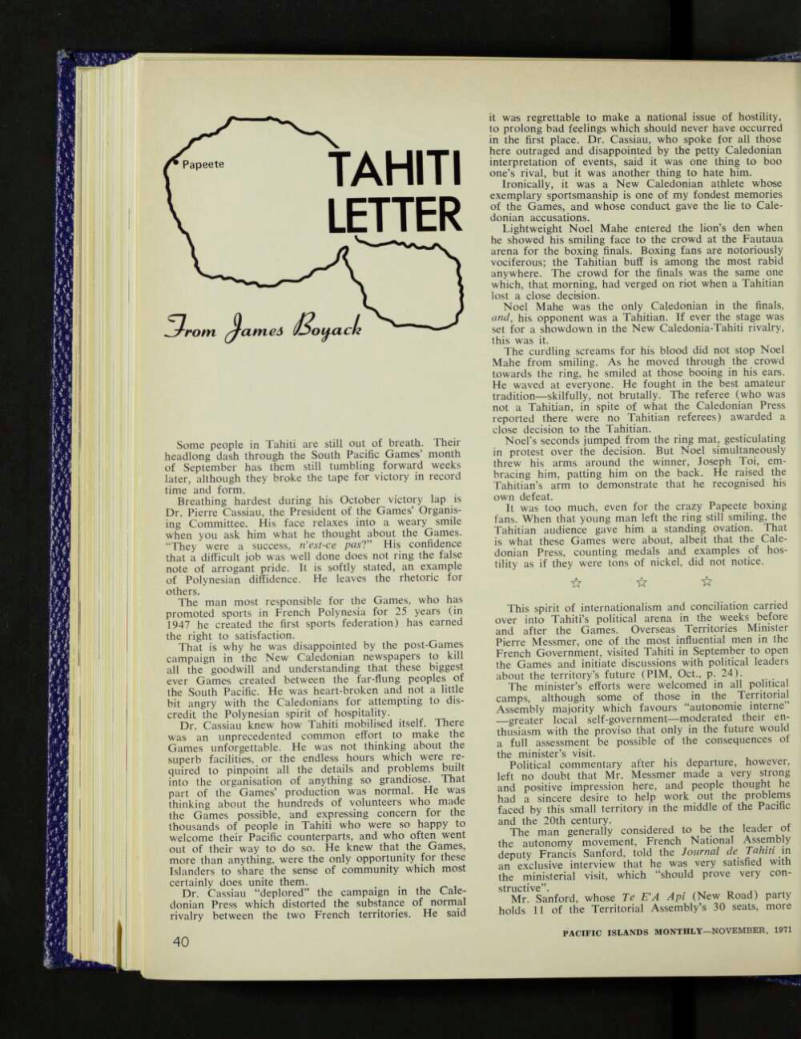
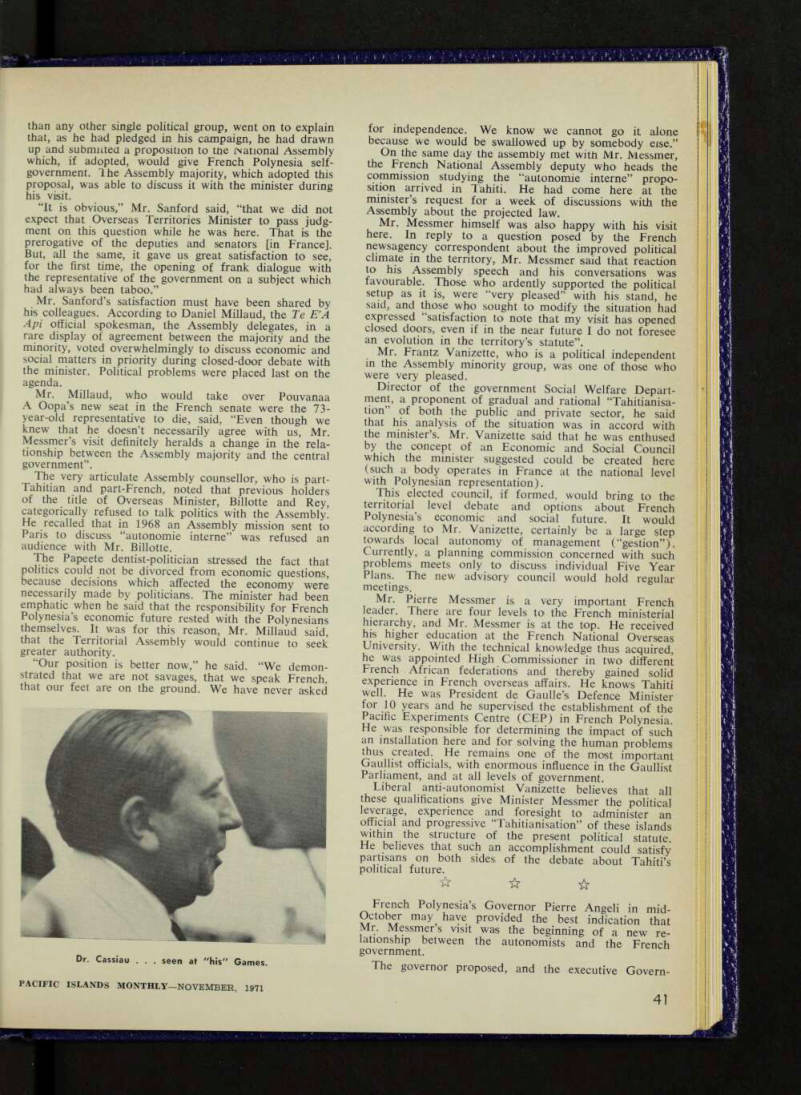

Letter
From James Boyach
Some people in Tahiti are still out of breath. Their headlong dash through the South Pacific Games’ month of September has them still tumbling forward weeks later, although they broke the tape for victory in record time and form.
Breathing hardest during his October victory lap is Dr. Pierre Cassiau, the President of the Games’ Organis ing Committee. His face relaxes into a weary smile when you ask him what he thought about the Games.
“They were a success, n’est-ce pasT His confidence that a difficult job was well done does not ring the false note of arrogant pride. It is softly stated, an example of Polynesian diffidence. He leaves the rhetoric for others.
The man most responsible for the Games, who has promoted sports in French Polynesia for 25 years (in 1947 he created the first sports federation) has earned the right to satisfaction.
That is why he was disappointed by the post-Games campaign in the New Caledonian newspapers to kill all the goodwill and understanding that these biggest ever Games created between the far-flung peoples of the South Pacific. He was heart-broken and not a little bit angry with the Caledonians for attempting to dis credit the Polynesian spirit of hospitality.
Dr. Cassiau knew how Tahiti mobilised itself. There was an unprecedented common effort to make the Games unforgettable. He was not thinking about the superb facilities, or the endless hours which were re quired to pinpoint all the details and problems built into the organisation of anything so grandiose. That part of the Games’ production was normal. He was thinking about the hundreds of volunteers who made the Games possible, and expressing concern for the thousands of people in Tahiti who were so happy to welcome their Pacific counterparts, and who often went out of their way to do so. He knew that the Games, more than anything, were the only opportunity for these Islanders to share the sense of community which most certainly does unite them.
Dr. Cassiau “deplored” the campaign in the Cale donian Press which distorted the substance of normal rivalry between the two French territories. He said
it was regrettable to make a national issue of hostility, to prolong bad feelings which should never have occurred in the first place. Dr. Cassiau, who spoke for all those here outraged and disappointed by the petty Caledonian interpretation of events, said it was one thing to boo one’s rival, but it was another thing to hate him.
Ironically, it was a New Caledonian athlete whose exemplary sportsmanship is one of my fondest memories of the Games, and whose conduct gave the lie to Cale donian accusations.
Lightweight Noel Mahe entered the lion’s den when he showed his smiling face to the crowd at the Fautaua arena for the boxing finals. Boxing fans are notoriously vociferous; the Tahitian buff is among the most rabid anywhere. The crowd for the finals was the same one which, that morning, had verged on riot when a Tahitian lost a close decision.
Noel Mahe was the only Caledonian in the finals, and , his opponent was a Tahitian. If ever the stage was set for a showdown in the New Caledonia-Tahiti rivalry, this was it.
The curdling screams for his blood did not stop Noel Mahe from smiling. As he moved through the crowd towards the ring, he smiled at those booing in his ears.
He waved at everyone. He fought in the best amateur tradition—skilfully, not brutally. The referee (who was not a Tahitian, in spite of what the Caledonian Press reported there were no Tahitian referees) awarded a close decision to the Tahitian.
Noel’s seconds jumped from the ring mat, gesticulating in protest over the decision. But Noel simultaneously threw his arms around the winner, Joseph Toi, em bracing him, patting him on the back. He raised the Tahitian’s arm to demonstrate that he recognised his own defeat.
It was too much, even for the crazy Papeete boxing fans. When that young man left the ring still smiling, the Tahitian audience gave him a standing ovation. That is what these Games were about, albeit that the Cale donian Press, counting medals and examples of hos tility as if they were tons of nickel, did not notice. ☆ ☆ ☆ This spirit of internationalism and conciliation carried over into Tahiti’s political arena in the weeks before and after the Games. Overseas Territories Minister Pierre Messmer, one of the most influential men in the French Government, visited Tahiti in September to open the Games and initiate discussions with political leaders about the territory’s future (PIM, Oct., p. 24).
The minister’s efforts were welcomed in all political camps, although some of those in the Territorial Assembly majority which favours “autonomic interne —greater local self-government—moderated their en thusiasm with the proviso that only in the future would a full assessment be possible of the consequences of the minister’s visit.
Political commentary after his departure, however, left no doubt that Mr. Messmer made a very strong and positive impression here, and people thought he had a sincere desire to help work out the problems faced by this small territory in the middle of the Pacific and the 20th century. , , , , The man generally considered to be the leader ot the autonomy movement, French National Assembly deputy Francis Sanford, told the Journal de Tahiti m an exclusive interview that he was very satisfied with the ministerial visit, which “should prove very con structive”. J Mr. Sanford, whose Te E’A Apt (New Road) party holds 11 of the Territorial Assembly’s 30 seats, more
than any other single political group, went on to explain that, as he had pledged in his campaign, he had drawn up and submitted a proposition to the iNationai Assembly which, if adopted, would give French Polynesia self government. Ihe Assembly majority, which adopted this proposal, was able to discuss it with the minister during his visit.
“It is obvious,” Mr. Sanford said, “that we did not expect that Overseas Territories Minister to pass judg ment on this question while he was here. That is the prerogative of the deputies and senators [in France].
But, all the same, it gave us great satisfaction to see, for the first time, the opening of frank dialogue with the representative of the government on a subject which had always been taboo.”
Mr. Sanford’s satisfaction must have been shared by his colleagues. According to Daniel Millaud, the Te E’A Api official spokesman, the Assembly delegates, in a rare display of agreement between the majority and the minority, voted overwhelmingly to discuss economic and social matters in priority during closed-door debate with the minister. Political problems were placed last on the agenda.
Mr. Millaud, who would take over Pouvanaa A Oopa’s new seat in the French senate were the 73year-old representative to die, said, “Even though we knew that he doesn’t necessarily agree with us, Mr.
Messmer’s visit definitely heralds a change in the rela tionship between the Assembly majority and the central government”.
The very articulate Assembly counsellor, who is part- Tahitian and part-French, noted that previous holders of the title of Overseas Minister, Billotte and Rey, categorically refused to talk politics with the Assembly.
He recalled that in 1968 an Assembly mission sent to Paris to discuss “autonomie interne” was refused an audience with Mr. Billotte.
The Papeete dentisripolitician stressed the fact that politics could not be divorced from economic questions, because decisions which affected the economy were necessarily made by politicians. The minister had been emphatic when he said that the responsibility for French Polynesia’s economic future rested with the Polynesians themselves. It was for this reason, Mr. Millaud said, that the Territorial Assembly would continue to seek greater authority.
“Our position is better now,” he said. “We demon strated that we are not savages, that we speak French, that our feet are on the ground. We have never asked
for independence. We know we cannot go it alone because we would be swallowed up by somebody else.”
On the same day the assembly met with Mr. Messmer, the French National Assembly deputy who heads the commission studying the “autonomie interne” propo sition arrived in Tahiti. He had come here at the minister’s request for a week of discussions with the Assembly about the projected law.
Mr. Messmer himself was also happy with his visit here. In reply to a question posed by the French newsagency correspondent about the improved political climate in the territory, Mr. Messmer said that reaction to his Assembly speech and his conversations was favourable. Those who ardently supported the political setup as it is, were “very pleased” with his stand, he said, and those who sought to modify the situation had expressed “satisfaction to note that my visit has opened closed doors, even if in the near future I do not foresee an evolution in the territory’s statute”.
Mr. Frantz Vanizette, who is a political independent in the Assembly minority group, was one of those who were very pleased.
Director of the government Social Welfare Depart ment, a proponent of gradual and rational “Tahitianisa tion” of both the public and private sector, he said that his analysis of the situation was in accord with the minister’s. Mr. Vanizette said that he was enthused by the concept of an Economic and Social Council which the minister suggested could be created here (such a body operates in France at the national level with Polynesian representation).
This elected council, if formed, would bring to the territorial level debate and options about French Polynesia’s economic and social future. It would according to Mr. Vanizette, certainly be a large step towards local autonomy of management (“gestion”).
Currently, a planning commission concerned with such problems meets only to discuss individual Five Year Plans. The new advisory council would hold regular meetings.
Mr. Pierre Messmer is a very important French leader. There are four levels to the French ministerial hierarchy, and Mr. Messmer is at the top. He received his higher education at the French National Overseas University. With the technical knowledge thus acquired, he was appointed High Commissioner in two different French African federations and thereby gained solid experience in French overseas affairs. He knows Tahiti well. He was President de Gaulle’s Defence Minister for 10 years and he supervised the establishment of the Pacific Experiments Centre (CEP) in French Polynesia.
He was responsible for determining the impact of such an installation here and for solving the human problems thus created. He remains one of the most important Gaullist officials, with enormous influence in the Gaullist Parliament, and at all levels of government.
Liberal anti-autonomist Vanizette believes that all these qualifications give Minister Messmer the political leverage, experience and foresight to administer an official and progressive “Tahitianisation” of these islands within the structure of the present political statute.
He believes that such an accomplishment could satisfy partisans on both sides of the debate about Tahiti’s political future. & ☆ French Polynesia’s Governor Pierre Angeli in mid- October may have provided the best indication that Mr. Messmer s visit was the beginning of a new re lationship between the autonomists and the French government.
The governor proposed, and the executive Govern
Dr. Cassiau . . . seen at "his" Games.
ment Council adopted, the cancella tion of a September 8, 1970, decree which banned controversial French notary public Marcel Lejeune from the major islands in French Poly nesia.
“Maitre” Lejeune was, in effect, ex pelled from the territory because his political activities at the time had led the French Government to believe that his continued presence here posed a threat to “public order”.
The then Overseas Territories Minis ter, Henri Rey, was about to make an official visit to Tahiti. The “Maitre” had been involved in a fierce administrative battle during the month of August, 1970, to win concessions for his Air Moorea-Air Tahiti air taxi service. When Mr. Le jeune concluded, and publicly an nounced, that a government plot was preventing his successful competition (he wanted import licences to import new aircraft) with the UTA-French Airlines’ subsidiary RAI, the scheduled inter-island airline, he moved his fight from an economic and administrative level to the poli tical war zone The government came to the con clusion that he intended to help organise perhaps violent demonstra tions during the minister’s visit a few days later. It justified the “Maitre’s” expulsion on these grounds* The Government Council’s com munique announcing that “Maitre”
Lejeune could return here said, in part, “It now appears, in effect, that there is no longer reason to prolong the application of this exceptional measure [the expulsion], motivated at the time by considerations of public order, now that a relaxed climate is evident in the territory and of which the recent visit of the State Minister was an indication . . .”
In a completely separate decision, however, the Government Council decreed that “Maitre” Lejeune will not be allowed to resume his func tion as a notary public for five years.
The communique said “Maitre”
Lejeune had broken the rules of his
profession.
The decision to suspend his notariat for five years was based on a lengthy investigation of his acti vities here by the Superior Notariat Council, and demands made by the state prosecutor and advice offered to the government by Superior Court of Appeals in Papeete. “Maitre” Le jeune had pleaded his case here late last month through a Paris lawyer.
Advertisements & other items, pp. 44-45 (2 items)
End the problem
m rv *
of dry skin
Unless you take particular care harsh weather can easily rob your complexion of the precious moist oils quicker than the oil ducts of the skin can replace it, thus resulting in dry skin and the foundation of wrinkles.
A little extra attention should be taken at this time of the year by smoothing oil of Ulan over the face and neck daily before applying makeup. Oil of Ulan is recommended because of its special isotonic properties that help nature to maintain the natural oil and moisture balance of the skin.
Beauty, the glow of a healthy complexion and protection of your skin from dryness are yours when you use this unique tropical oil regularly.
Beauty skin specialists are also recommending that the oil of Ulan should be smoothed over the face last thing at night before retiring to give your skin the added benefit of night-time nourishment.
From the
Islands Press
Notice in the American Samoa 'News Bulletin': A correction appearing in yesterday's 'News Bulletin' was incorrect. It should have said that the Bank of Western Samoa has set an exchange rate for the US dollar at 69 cents. US money is being accepted now in Western Samoa. If this is incorrect it will be corrected in Monday's 'News Bulletin'.
From the 'A/licronitor', Majuro: Modern civilisation has brought us many good things treatment for syphilis, tuberculosis, radiation exposure.
Extract from a report in the 'Samoa Times' on the invitation from Pope Paul to a choir from Western Samoa to sing the papal mass at St. Paul's Basilica in Rome on Mission Sunday, October 24: His Lordship Bishop Pio Taoflnuu, the first Polynesian bishop said ... all members of the choir will be wearing Samoan clothing right throughout the trip. The girls, he said, will be wearing 'puletasi'. We want to tell the world, he commented, that they can hike their minis up, but the Samoan girls, these girls anyway, will keep to the traditional methods of dress.
News item from the GEIC Information Notes: The Colony Central Hospital reports that a record of 18 deliveries was made for the month of September.
This was not due to the failure of family planning, but the people now realise that it is much safer to have their babies in hospital rather than to be attended by untrained midwives.
Report of an interview with the Platters, the famous American Negro singing group, in the 'Samoa Times': "The colour problem is less in America than anywhere else in the world.' This was the answer given by the leader of the Platters, Mr. Howard Guyton, in an interview yesterday morning . . . "The Maoris in New Zealand, the West Indians in England, the New Caledonians in Noumea, the Aborigines in Australia, the New Hebrideans in New Hebrides have more colour problems than the Negroes in America" . . . There are poor Negroes, he went on, but there are also more black millionaires than anywhere else.
Extracts from an editorial in the 'Fiji Times': Because of the three-headed monster which passes for government in the New Hebrides, there is little u any. prospect of the indigenous people there enjoying the sort of political advancement that other
South Pacific island people have gained, or are in the process of gaining. The British and French administrations in the condominium, plus the joint administration, present a picture of inefficiency and inertia which would surely be hard to match any where on earth. The country they administer in such a way is thus left wide open to economic exploiters of the worst type . . . Obviously the New Hebrides is in need of some constructive attention from the United Nations, perhaps under the influence of those Pacific countries, including Fiji, which have a voice in the world forum. Otherwise, thousands of people —and their children—will be denied participation in the progress of the South Pacific.
Extract from an article by J. Bani in the 'New
Hebridean Viewpoints' a cyclostyled magazine first
published in August by the New Hebrides
Culture Association:
... It is now clear to us New Hebrideans that we really have two different people here with totally different perspectives of running the New Hebrides. The British being the first group who look at themselves as missionaries, whose aims are to educate and prepare the indigenous people until the time when the natives will be fully prepared to run their own country , . . The second group is the French who perhaps are more friendly people than the British but as far as their policy is concerned are here to make the New Hebrides become part of France . . .
I am compelled to ask France and Britain, what is the future of the New Hebrides? Are we to be deprived of our freedom? Please give us our freedom to be a people and a nation as others in this world.
From 'This and That' in the 'Tonga Chronicle 7 : Women’s brown wigs are the “in thing” for men in Nukualofa. They were being sold at a stall near the Talamahu Market last Saturday for prices from Tsl to 50 seniti, depending on the time of day you bought one.
Mini-taxi and bus drivers seem to find them
especially attractive.
Extracts from a letter by 'Another Islander' in the
'Norfolk Islander':
I refer to the letter from Kathleen A. Bowell, published in week before last paper in reply to 'lslander' . . . Maybe you work harder than I know how, but I doubt it.
I have never seen you in the tough times with your head down and backside up harvesting beans, in the blazing heat of the sun, for very little compensation too.
Not many rushed in here then to work hard. I think all Islanders have done it the hard way so you don't impress me with your ability to work, particularly with the advantages of electricity and mod. cons we did not have until recently.
Extract from an editorial in the 'Fiji Times' on the
'First birthday of independent Fiji':
Independence has brought new costs to Fiji and these will grow as the years go by. To a disquieting extent, the dominion is relying more and more heavily on tourism for its income. There is nothing wrong in the expansion of this or any other industry but there is danger in relying too heavily on an income source that can be greatly and perhaps suddenly affected by outside influences and in neglecting, as Fiji is increasingly doing, the use of her own resources to produce food for her people.
Pilot's-eye view of the South
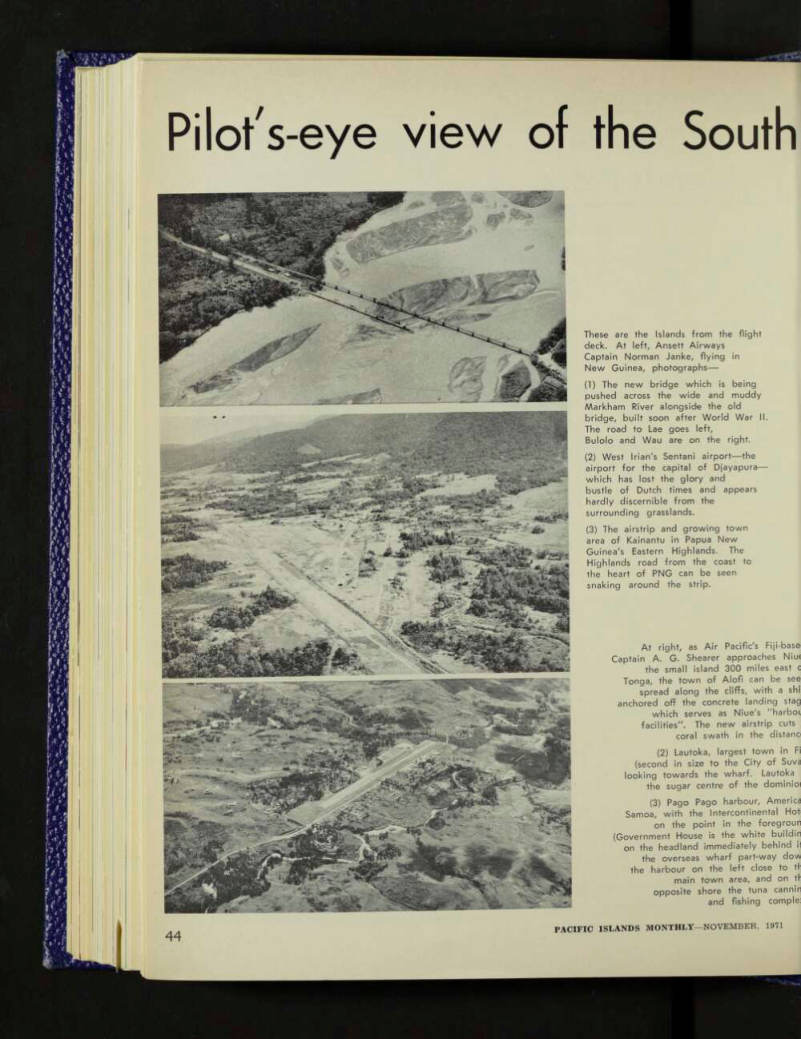
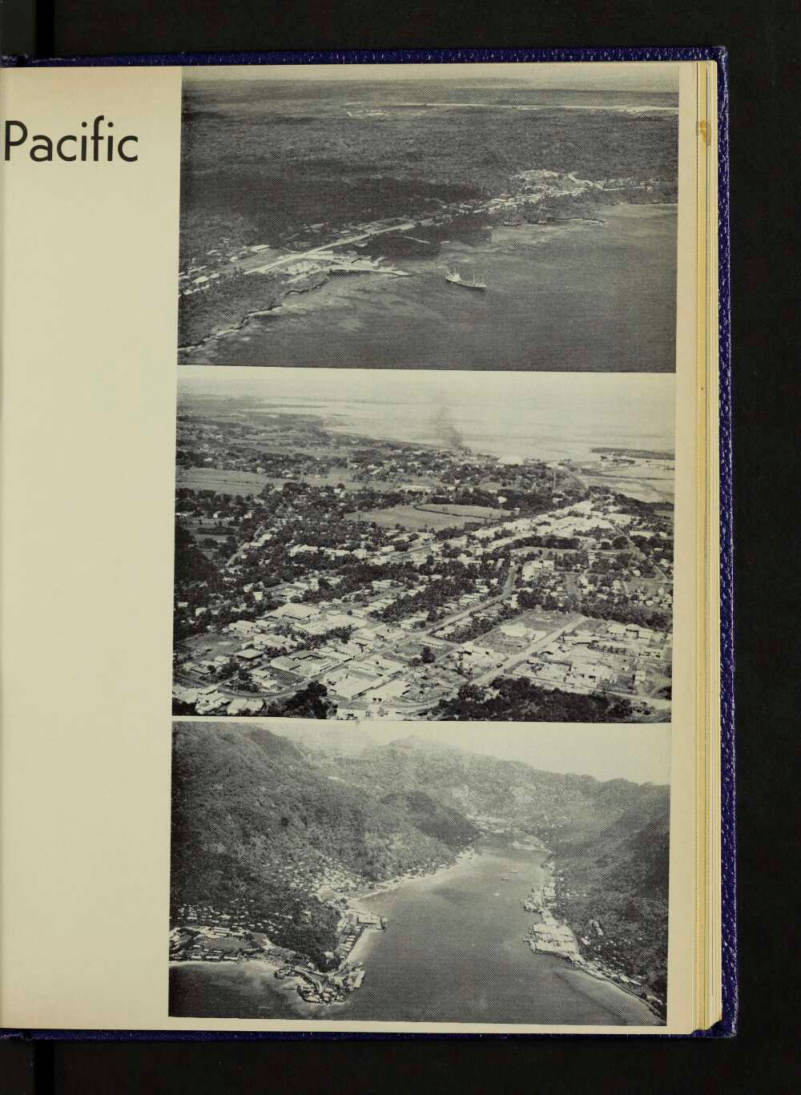
These are the Islands from the flight deck. At left, Ansett Airways Captain Norman Janke, flying in New Guinea, photographs— (1) The new bridge which is being pushed across the wide and muddy Markham River alongside the old bridge, built soon after World War II.
The road to Lae goes left, Bulolo and Wau are on the right. (2) West Irian's Sentani airport—the airport for the capital of Djayapura — which has lost the glory and bustle of Dutch times and appears hardly discernible from the
surrounding grasslands.
(3) The airstrip and growing town area of Kainantu in Papua New Guinea's Eastern Highlands. The Highlands road from the coast to the heart of PNG can be seen snaking around the strip.
At right, as Air Pacific's Fiji-bases Captain A. G. Shearer approaches Niue[?] the small island 300 miles east [?] Tonga, the town of Alofi can be see spread along the cliffs, with a shi[?] anchored off the concrete landing stag[?] which serves as Niue's "harbo[?] facilities". The new airstrip cuts coral swath in the distano[?] (2) Lautoka, largest town in Fi[?] (second in size to the City of Suva[?] looking towards the wharf. Lautoka the sugar centre of the dominioi[?] (3) Pago Pago harbour, America[?] Samoa, with the Intercontinental Hotel on the point in the foregroun[?] (Government House is the white building on the headland immediately behind it the overseas wharf part-way dow[?] the harbour on the left close to th[?] main town area, and on the opposite shore the tuna cannin[?] and fishing comple[?]
Advertisements & other items, pp. 47-49 (2 items)
Pacific
Whip
66
The fastest spud
NEW
Potato
Whip
Now prepare piping hot, creamy mashed potato in a flash.
New Potato Whip puts an end to the old “dull spud chores.
Good to Eat .With Potato Whip you get the full flavour and nourishment of selected, top quality potatoes mixed with rich full cream milk. All this goodness is sealed into an easy-to-store foil sachet. . . 4 Big Serves. To make up Edgell Potato Whip you simply pour a pack into boiling water. Then stir quickly.
And instantly you’ve enough piping hot mashed potato for four generous helpings.
Edgell Potato Whip true potato taste.
From an Edgell country garden.
in the Pacific”
Straight!
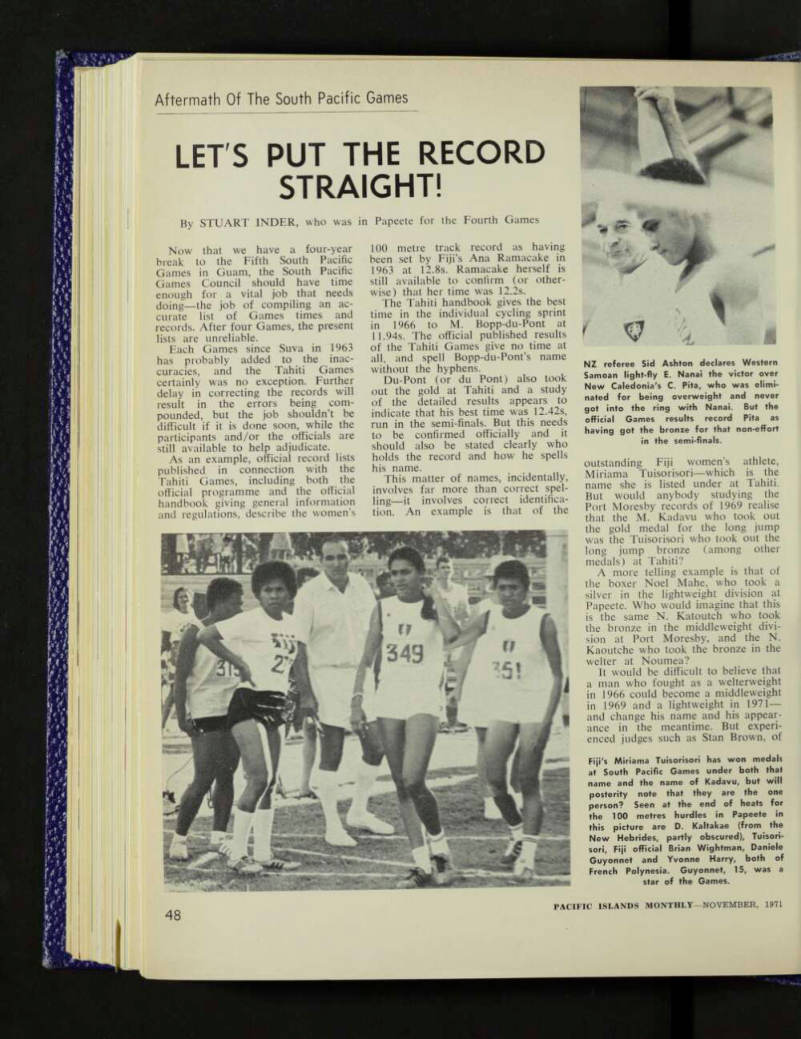
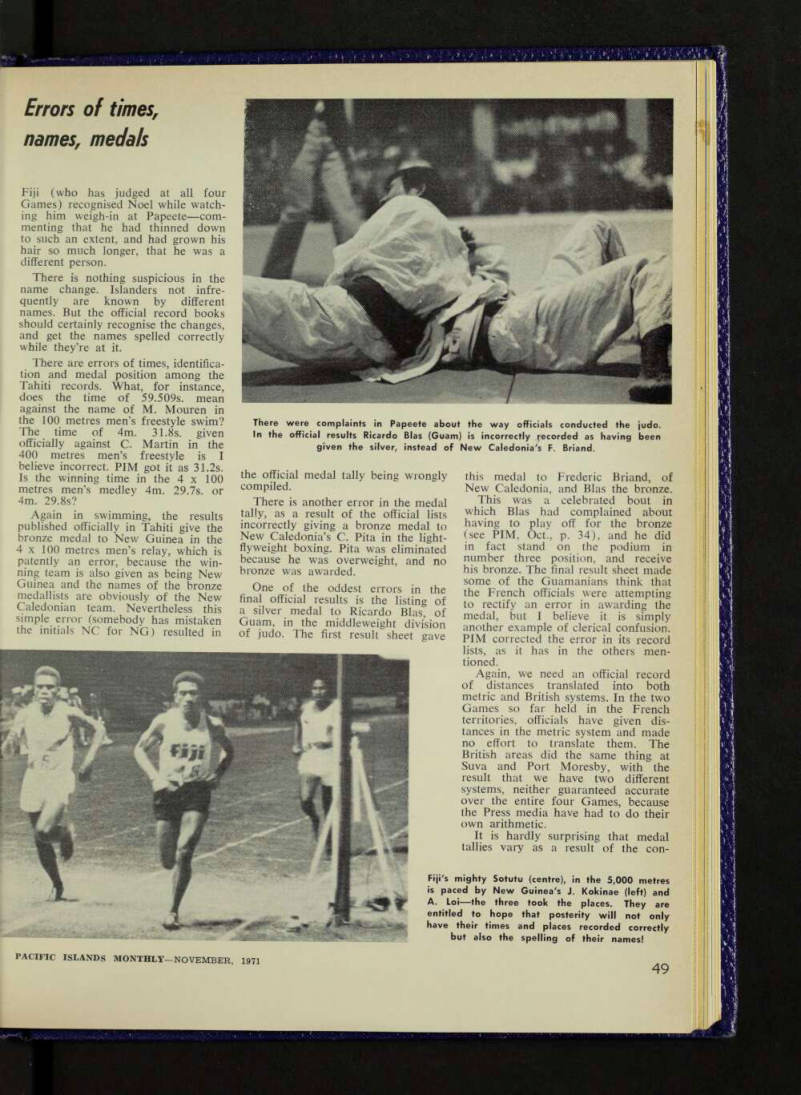
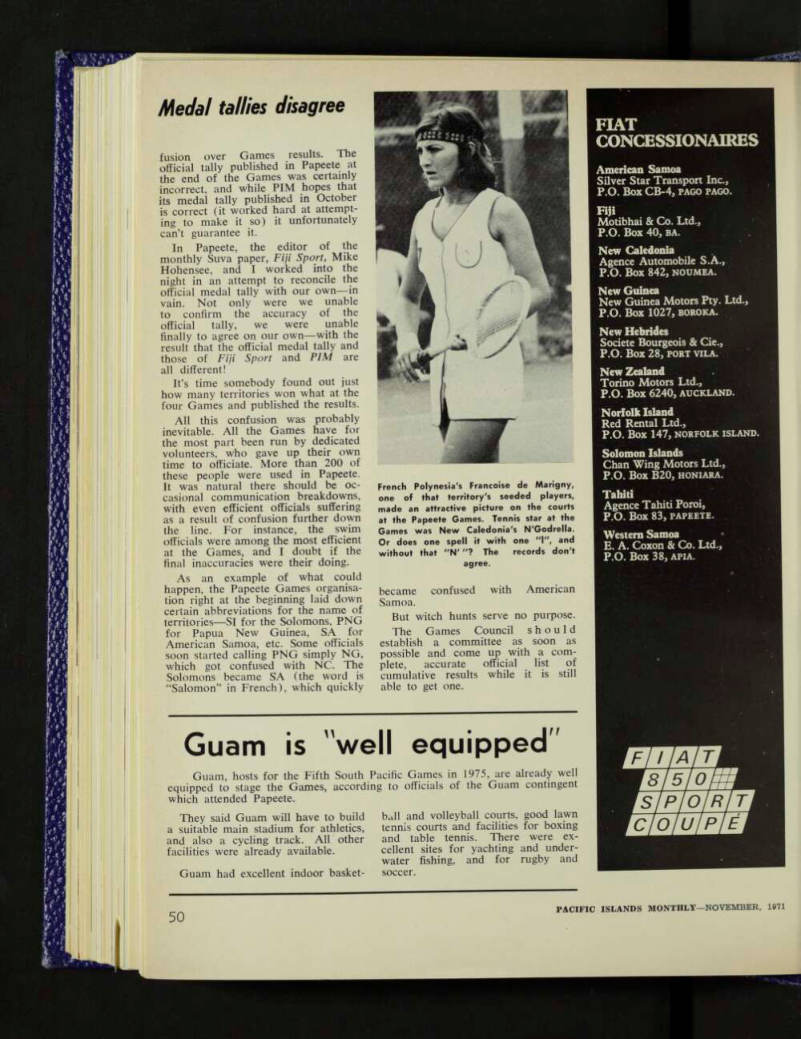
Aftermath Of The South Pacific Games
Let's Put The Record
By STUART INDER, who was in Papeete for the Fourth Games
Now that we have a four-year break to the Fifth South Pacific Games in Guam, the South Pacific Games Council should have time enough for a vital job that needs doing—the job of compiling an accurate list of Games times and records. After four Games, the present lists are unreliable.
Each Games since Suva in 1963 has probably added to the inaccuracies, and the Tahiti Games certainly was no exception. Further delay in correcting the records will result in the errors being compounded, but the job shouldn’t be difficult if it is done soon, while the participants and/or the officials are still available to help adjudicate.
As an example, official record lists published in connection with the Tahiti Games, including both the official programme and the official handbook giving general information and regulations, describe the women’s
100 metre track record as having been set by Fiji’s Ana Ramacake m 1963 at 12.85. Ramacake herself is still available to confirm (or other wise) that her time was 12.25.
The Tahiti handbook gives the best time in the individual cycling sprint in 1966 to M. Bopp-du-Pont at 11.945. The official published results of the Tahiti Games give no time at all, and spell Bopp-du-Pont’s name without the hyphens, Du-Pont (or du Pont) also took out the gold at Tahiti and a study of the detailed results appears to indicate that his best time was 12.425, run in the semi-finals. But this needs to be confirmed officially and it should also be stated clearly who holds the record and how he spells his name. . t 1 This matter of names, incidentally, involves far more than correct spel ling—it involves correct identifica tion. An example is that of the
outstanding Fiji women’s athlete, Miriama Tuisorisori —which is the name she is listed under at Tahiti.
But would anybody studying the Port Moresby records of 1969 realise that the M. Kadavu who took out the gold medal for the long jump was the Tuisorisori who took out the long jump bronze (among other medals) at Tahiti?
A more telling example is that of the boxer Noel Mahe, who took a silver in the lightweight division at Papeete. Who would imagine that this is the same N. Katoutch who took the bronze in the middleweight divi sion at Port Moresby, and the N.
Kaoutche who took the bronze in the welter at Noumea?
It would be difficult to believe that a man who fought as a welterweight in 1966 could become a middleweight in 1969 and a lightweight in 1971 and change his name and his appear ance in the meantime. But experi enced judges such as Stan Brown, of
NZ referee Sid Ashton declares Western Samoan light-fly E. Nanai the victor over New Caledonia's C. Pita, who was elimi nated for being overweight and never got into the ring with Nanai. But the official Games results record Pita as having got the bronze for that non-effort in the semi-finals.
Fiji's Miriama Tuisorisori has won medals at South Pacific Games under both that name and the name of Kadavu, but will posterity note that they are the one person? Seen at the end of heats for the 100 metres hurdles in Papeete in this picture are D. Kaltakae (from the New Hebrides, partly obscured), Tuisori sori, Fiji official Brian Wightman, Daniele Guyonnet and Yvonne Harry, both of French Polynesia. Guyonnet, 15, was a star of the Games.
Errors of times, names, medals
Fiji (who has judged at all four Games) recognised Noel while watch ing him weigh-in at Papeete—com menting that he had thinned down to such an extent, and had grown his hair so much longer, that he was a different person.
There is nothing suspicious in the name change. Islanders not infre quently are known by different names. But the official record books should certainly recognise the changes, and get the names spelled correctly while they’re at it.
There are errors of times, identifica tion and medal position among the Tahiti records. What, for instance, does the time of 59.5095. mean against the name of M. Mouren in the 100 metres men’s freestyle swim?
The time of 4m. 31.85. given officially against C. Martin in the 400 metres men’s freestyle is I believe incorrect. PIM got it as 31.25.
Is the winning time in the 4 x 100 metres men’s medley 4m. 29.75. or 4m. 29.85?
Again in swimming, the results published officially in Tahiti give the bronze medal to New Guinea in the 4 x 100 metres men’s relay, which is patently an error, because the win ning team is also given as being New Guinea and the names of the bronze medallists are obviously of the New Caledonian team. Nevertheless this simple error (somebody has mistaken the initials NC for NG) resulted in
the official medal tally being wrongly compiled.
There is another error in the medal tally, as a result of the official lists incorrectly giving a bronze medal to New Caledonia’s C. Pita in the light flyweight boxing. Pita was eliminated because he was overweight, and no bronze was awarded.
One of the oddest errors in the final official results is the listing of a silver medal to Ricardo Bias, of Guam, in the middleweight division of judo. The first result sheet gave
this medal to Frederic Briand, of New Caledonia, and Bias the bronze.
This was a celebrated bout in which Bias had complained about having to play off for the bronze (see PIM, Oct., p. 34), and he did in fact stand on the podium in number three position, and receive his bronze. The final result sheet made some of the Guamanians think that the French officials were attempting to rectify an error in awarding the medal, but I believe it is simply another example of clerical confusion.
PIM corrected the error in its record lists, as it has in the others men tioned.
Again, we need an official record of distances translated into both metric and British systems. In the two Games so far held in the French territories, officials have given dis tances in the metric system and made no effort to translate them. TTie British areas did the same thing at Suva and Port Moresby, with the result that we have two different systems, neither guaranteed accurate over the entire four Games, because the Press media have had to do their own arithmetic.
It is hardly surprising that medal tallies vary as a result of the con-
There were complaints in Papeete about the way officials conducted the judo.
In the official results Ricardo Bias (Guam) is incorrectly recorded as having been given the silver, instead of New Caledonia's F. Briand.
Fiji's mighty Sotutu (centre), in the 5,000 metres is paced by New Guinea's J. Kokinae (left) and A. Loi —the three took the places. They are entitled to hope that posterity will not only have their times and places recorded correctly but also the spelling of their names!
Medal tallies disagree
fusion over Games results. The official tally published in Papeete at the end of the Games was certainly incorrect, and while PIM hopes that its medal tally published in October is correct (it worked hard at attempt ing to make it so) it unfortunately can’t guarantee it.
In Papeete, the editor of the monthly Suva paper, Fiji Sport, Mike Hohensee, and I worked into the night in an attempt to reconcile the official medal tally with our own —in vain. Not only were we unable to confirm the accuracy of the official tally, we were unable finally to agree on our own —with the result that the official medal tally and those of Fiji Sport and PIM are all different!
It’s time somebody found out just how many territories won what at the four Games and published the results.
All this confusion was probably inevitable. All the Games have for the most part been run by dedicated volunteers, who gave up their own time to officiate. More than 200 of these people were used in Papeete.
It was natural there should be oc casional communication breakdowns, with even efficient officials suffering as a result of confusion further down the line. For instance, the swim officials were among the most efficient at the Games, and I doubt if the final inaccuracies were their doing.
As an example of what could happen, the Papeete Games organisa tion right at the beginning laid down certain abbreviations for the name of territories —SI for the Solomons, PNG for Papua New Guinea, SA for American Samoa, etc. Some officials soon started calling PNG simply NG, which got confused with NC. The Solomons became SA (the word is “Salomon” in French), which quickly
became confused with American Samoa.
But witch hunts serve no purpose.
The Games Council should establish a committee as soon as possible and come up with a com plete, accurate official list of cumulative results while it is still able to get one.
French Polynesia's Francoise de Marigny, one of that territory's seeded players, made an attractive picture on the courts at the Papeete Games. Tennis star at the Games was New Caledonia's N'Godrella.
Or does one spell it with one "I", and without that "N"'? The records don't agree.
Advertisements & other items, pp. 52-54 (2 items)
Guam is "well equipped'
FIAT
CONCESSIONAIRES
American Samoa Silver Star Transport Inc.,
P.O. Box CB-4, PAGO PAGO.
Fiji Motibhai & Co. Ltd., P.O. Box 40, ba.
New Caledonia Agence Automobile S.A.,
P.O. BOX 842, NOUMEA.
New Guinea New Guinea Motors Pty. Ltd., P.O. Box 1027, boroka.
New Hebrides Societe Bourgeois & Cie.,
P.O. Box 28, PORT VILA.
New Zealand Torino Motors Ltd.,
P.O. BOX 6240, AUCKLAND.
Norfolk Island Red Rental Ltd.,
P.O. Box 147, NORFOLK ISLAND.
Solomon Islands Chan Wing Motors Ltd.,
P.O. BOX 820, HONIARA.
Tahiti Agence Tahiti Poroi,
P.O. BOX 83, PAPEETE.
Western Samoa E. A. Coxon & Co. Ltd.,
P.O. Box 38, APIA.
Guam is "well equipped'
Guam, hosts for the Fifth South Pacific Games in 1975, are already well equipped to stage the Games, according to officials of the Guam contingent which attended Papeete.
They said Guam will have to build a suitable main stadium for athletics, and also a cycling track. All other facilities were already available.
Guam had excellent indoor basketball and volleyball courts, good lawn tennis courts and facilities for boxing and table tennis. There were excellent sites for yachting and underwater fishing, and for rugby and soccer.
Everyone should have at least
one Italian love affair.
(With a Fiat.)
Of all the cars in your life you will always remember your Fiat.
Made in Italy for people who love cars.
Fast, beautiful and responsive.
When will your Italian love affair begin?
Fiat 850 Sport Coupe: 52 bhp, twin choke carb., 4 speed floor mounted all synchro gearshift, over 90 mph, front disc brakes, heater/demister. anna mnunv.
Banina
BBWBB
FLEXIBLE POWER to shir forests
W v >• /' m 2* m W We have built Fork Lift trucks to lift 55,000 lbs U Trucks for container shipping Fork Lift with grabber holds for timber and log work in forests and on the wharves log skidders for moving logs sideways or any way required. Model illustrated features a 4 speed power-shift transmission, and power steering.
Power comes from a 100 h.p. Ford diesel unit.
Over the.years we've acquired a lot of 'knowhow' on loading problems for every conceivable type of product if you’ve a problem then we’ll solve it for you. Just ask us! Our deliveries are prompt our prices competitive.
LEES INDUSTRIES LIMITED
PRIVATE BAG, PAPAKURA, N.Z.
PHONE: 86-019 PAPAKURA
WANTED! QUALITY FLOOR SANDERS
George Hudson (Pty. Ltd.), respected name in the parquetry flooring and building industries of 130 years standing, are looking for floor sanders and polishers that share their established high quality standards, who would be interested in the marketing and installation of the top name George Hudson parquetry flooring range. Interested? Then contact George Hudson Pty. Ltd., Flooring Division, 1 Bridge Road, Glebe, 2037, Sydney, Australia.
Phone: 660 4144.
Pacific Islands. Monthjlx—November, 197 X
Problem Of The South Pacific
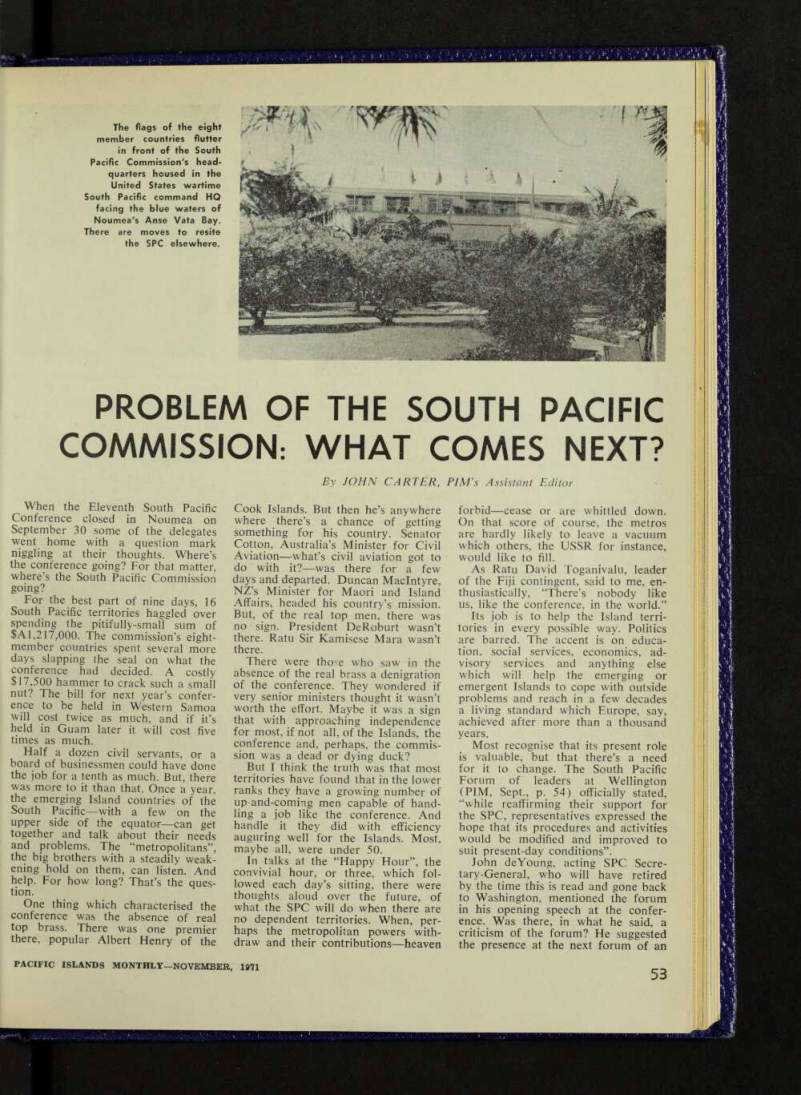
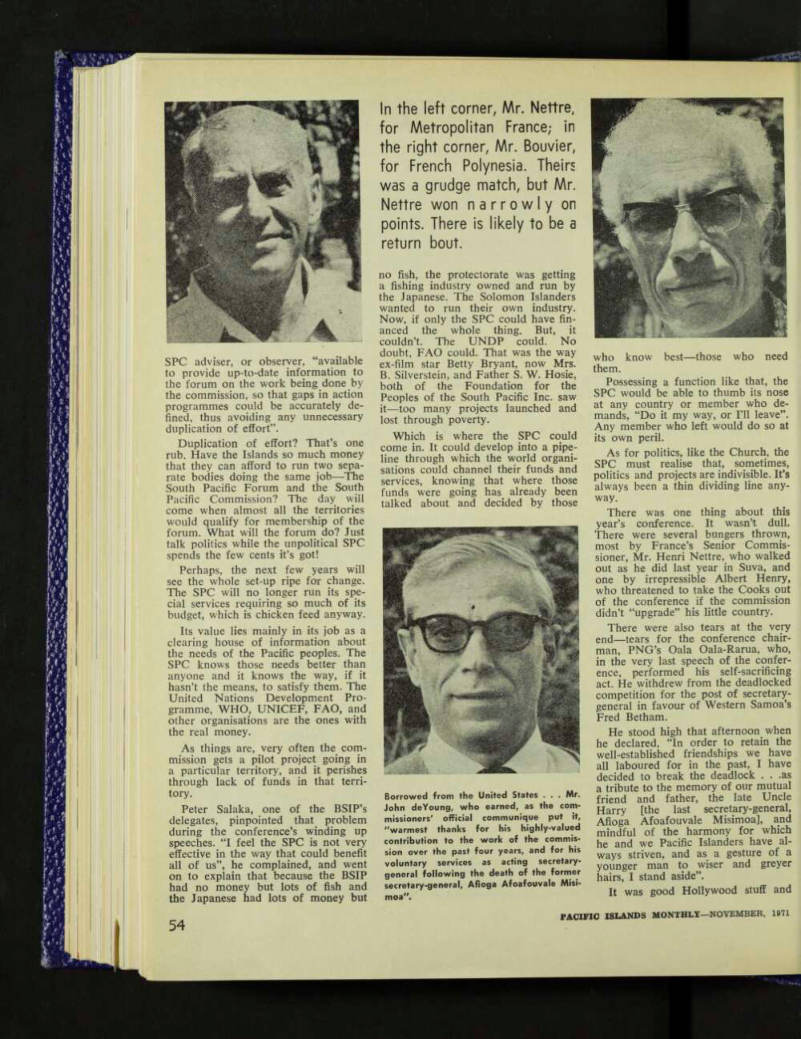

Commission: What Comes Next?
By JOHN CARTER, PI M’s Assistant Editor
When the Eleventh South Pacific Conference closed in Noumea on September 30 some of the delegates went home with a question mark niggling at their thoughts. Where’s the conference going? For that matter, where s the South Pacific Commission gomg. c n e -i )est ar * . nme days, 16 boutn Pacific territories haggled over spending the pitifully-small sum of ql»Al’Zl7,000. The commission’s eightmember countries spent several more aays slapping the seal on what the tn S 6 hac * d ecl ded. A costly * tV u nw 1 t 0 sucb a nut. lhe bill tor next year’s conference to be held in Western Samoa win cost twice as much, and if it’s held in Guam later it will cost five tunes as much. u A. . zen CIVI I servants, or a ?i? a • u°f * :,usmess / nen could have done e job tor a tenth as much. But, there was more to it than that. Once a year.
A Island countries of the J>outn Pacmc—with a few on the SldC a* n quator can B et together and talk about their needs fi? e 5? S ’ metr oP olltans ”> the big brothers with a steadily weak- £ T?° V, on 1 em o , lst s n * And tinn h ° r h ° W lonB ’ Thats the ques " n ‘ • , , . , , Une thing which characterised the r tC K renCe the absence of real IhLA™ 1 Aiu W f u° ne premier there, popular Albert Henry of the
Cook Islands. But then he’s anywhere where there’s a chance of getting something for his country. Senator Cotton, Australia’s Minister for Civil Aviation—what’s civil aviation got to do with it?—was there for a few days and departed. Duncan Maclntyre, NZ’s Minister for Maori and Island Affairs, headed his country’s mission.
But, of the real top men, there was no sign. President Deßoburt wasn’t there. Ratu Sir Kamisese Mara wasn’t there.
There were those who saw in the absence of the real brass a denigration °f the conference. They wondered if very senior ministers thought it wasn’t worth the effort. Maybe it was a sign that with approaching independence for most, if not all, of the Islands, the conference and, perhaps, the commis sion was a dead or dying duck?
But I think the truth was that most territories have found that in the lower ranks they have a growing number of up and-coming men capable of hand ling a job like the conference. And handle it they did with efficiency auguring well for the Islands. Most, maybe all, were under 50.
In talks at the “Happy Hour”, the convivial hour, or three, which fol lowed each day’s sitting, there were thoughts aloud over the future, of what the SPC will do when there are no dependent territories. When, per haps the metropolitan powers with draw and their contributions—heaven
forbid—cease or are whittled down.
On that score of course, the metros are hardly likely to leave a vacuum which others, the USSR for instance, would like to fill, As Ratu David Toganivalu, leader of the Fiji contingent, said to me, en thusiastically, “There’s nobody like us, like the conference, in the world,”
Its job is to help the Island terri tones in every possible way. Politics are barred. The accent is on educa tion, social services, economics, ad visory services and anything else which will help the emerging or emergent Islands to cope with outside problems and reach in a few decades a living standard which Europe, say, achieved after more than a thousand years.
Most recognise that its present role is valuable, but that there’s a need for it to change. The South Pacific Forum of leaders at Wellington (PIM, Sept., p. 54) officially stated, “while reaffirming their support for the SPC, representatives expressed the hope that its procedures and activities would be modified and improved to suit present-day conditions”, John deYoung, acting SPC Secre tary-General, who will have retired by the time this is read and gone back to Washington, mentioned the forum in his opening speech at the confer ence. Was there, in what he said, a criticism of the forum? He suggested the presence at the next forum of an
The flags of the eight member countries flutter in front of the South Pacific Commission's head quarters housed in the United States wartime South Pacific command HQ facing the blue waters of Noumea's Anse Vata Bay.
There are moves to resite the SPC elsewhere.
SPC adviser, or observer, “available to provide up-to-date information to the forum on the work being done by the commission, so that gaps in action programmes could be accurately de fined, thus avoiding any unnecessary duplication of effort”.
Duplication of effort? That’s one rub. Have the Islands so much money that they can afford to run two sepa rate bodies doing the same job—The South Pacific Forum and the South Pacific Commission? The day will come when almost all the territories would qualify for membership of the forum. What will the forum do? Just talk politics while the unpolitical SPC spends the few cents it’s got!
Perhaps, the next few years will see the whole set-up ripe for change.
The SPC will no longer run its spe cial services requiring so much of its budget, which is chicken feed anyway.
Its value lies mainly in its job as a clearing house of information about the needs of the Pacific peoples. The SPC knows those needs better than anyone and it knows the way, if it hasn’t the means, to satisfy them. The United Nations Development Pro gramme, WHO, UNICEF, FAO, and other organisations are the ones with the real money.
As things are, very often com mission gets a pilot project going in a particular territory, and it perishes through lack of funds in that terri tory.
Peter Salaka, one of the BSIP’s delegates, pinpointed that problem during the conference’s winding up speeches. “I feel the SPC is not very effective in the way that could benefit all of us”, he complained, and went on to explain that because the BSIP had no money but lots of fish and the Japanese had lots of money but
no fish, the protectorate was getting a fishing industry owned and run by the Japanese. The Solomon Islanders wanted to run their own industry.
Now, if only the SPC could have fin anced the whole thing. But, it couldn’t. The UNDP could. No doubt, FAO could. That was the way ex-film star Betty Bryant, now Mrs.
B. Silverstein, and Father S. W. Hosie, both of the Foundation for the Peoples of the South Pacific Inc. saw it—too many projects launched and lost through poverty.
Which is where the SPC could come in. It could develop into a pipe line through which the world organi sations could channel their funds and services, knowing that where those funds were going has already been talked about and decided by those
who know best—those who need them.
Possessing a function like that, the SPC would be able to thumb its nose at any country or member who de mands, “Do it my way, or I’ll leave”.
Any member who left would do so at its own peril.
As for politics, like the Church, the SPC must realise that, sometimes, politics and projects are indivisible. It’s always been a thin dividing line any way.
There was one thing about this year’s conference. It wasn’t dull.
There were several hungers thrown, most by France’s Senior Commis sioner, Mr. Henri Nettre, who walked out as he did last year in Suva, and one by irrepressible Albert Henry, who threatened to take the Cooks out of the conference if the commission didn’t “upgrade” his little country.
There were also tears at the very end—tears for the conference chair man, PNG’s Gala Oala-Rarua, who, in the very last speech of the confer ence, performed his self-sacrificing act. He withdrew from the deadlocked competition for the post of secretary general in favour of Western Samoa’s Fred Betham.
He stood high that afternoon when he declared, “In order to retain the well-established friendships we have all laboured for in the past, I have decided to break the deadlock . . .as a tribute to the memory of our mutual friend and father, the late Uncle Harry [the last secretary-general, Afioga Afoafouvale Misimoa], and mindful of the harmony for which he and we Pacific Islanders have al ways striven, and as a gesture of a younger man to wiser and greyer hairs, I stand aside”.
It was good Hollywood stuff and
In the left corner, Mr. Nettre, for Metropolitan France; in the right corner, Mr. Bouvier, for French Polynesia. Theirs was a grudge match, but Mr.
Nettre won narrowly on points. There is likely to be a return bout.
Borrowed from the United States . . . Mr.
John deYoung, who earned, as the com missioners' official communique put it, "warmest thanks for his highly-valued contribution to the work of the commis sion over the past four years, and for his voluntary services as acting secretary general following the death of the former
secretary-general, Afioga Afoafouvale Misi
moa".
Oala, who’d been an admirable chair man, got a standing ovation. Some of the girls cried. It was a big surprise —to most. It wasn’t to those who knew that, in true Islands fashion, there’d been talks and offers made in an attempt to get a compromise. Mr.
Betham could work out the late Uncle Harry’s term, maybe do another one, and then retire and let Oala in. Time will tell, although Oala may well think the job’s small beer by then.
However, in his farewell speech, when referring to the fact that there was “only one pair of secretary’s sandals”, he cautioned his erstwhile rival, “Don’t wear out those sandals”.
Mr. Betham was overwhelmed. He told me that Oala’s gesture was a com plete surprise and “the manner in which he did it really gripped me”. It gripped everyone.
The reverberations from the other bangs were more griping than grip ping. There’d been civil war through out between Mr. Nettre and the French Polynesia delegate, Mr. Henri Bouvier, France-born, but a hard core autonomist, committee member of the Pupu Here Ai’a (Party of the Patriots) and vice-president of French Polynesia’s Territorial Assembly. It was obvious he wasn’t enamoured of the offer made by France’s Mr. Mess mer at the Games in Tahiti (PIM Oct., p, 24).
Nettre and Bouvier sat together seating was in alphabetical order— but it was obvious from the outset that Bouvier saw in Nettre the per sonification of a France intransigent m her negative attitude towards any demands for autonomy by her pos sessions. The same thing happened last year in Suva when Allain needled Nettre to the point of a walk-out. , Bouvier lost no opportunity to put the sabot m, but Nettre, the most ex perienced of the senior commissioners and a top State counsellor at home, kept his cool until the day before the close. Even when Bouvier went poli tical and referred indirectly to the French nuclear test—“ French Poly nesia is a centre of world pollution” xt V^ ere was little reaction from Nettre. . Almost every time Nettre took one view, Bouvier took the other, but as most of the time, Nettre was odd man out m the conference, there was little he could do about it. Until Bouvier managed to get a motion in “Any other business”. It was loaded.
He had earlier complained that the Canberra Agreement had asked that terntonal delegates to the conference should be chosen from the people as representatives of the people. “Alas
it is not always the case”, lamented Bouvier. “Delegates of two of three French-speaking territories were appointed only by the governor or the administrator representing the central government”.
There was more in the same vein and mention of “dictatorial methods which are contrary to the spirit of the Canberra Agreement”. Mr. Nettre protested that as the representative of France he could not admit anything that threw doubt on the institutions of France. It was an internal matter, and there should be no discussion within an international conference on the relations between a metropolitan government and its constitutional institutions.
He had a case of course. The SPC has barred politics and this was politics. Mr. Oala-Rarua put the stopper on and said it should be referred to an ad hoc committee. The delegates passed to the next business with Nettre and Bouvier still arguing, the latter telling him, “I don’t like dietatorship”.
The big explosion came days later when the delegates were tackling a boring but seemingly harmless chore —approving the official report of the conference to the commissioners’ ses sion. Mr. Nettre wanted the item deal resolution on the appoint -5 of delegates to include a footnote trom j im tba * was an mte mal mat and not . the conference’s business, “ e . was Setting nowhere with this, the chairman telling him that if he had a footnote others would want one.
Mr. Bouvier was in there once again, saying that he thought Mr. Nettre was “slightly confused”. That did it.
Banging the table angrily, Mr. Nettre turned to his compatriot and berated him. Oala protested that when some one wa s tak ing the floor he should be respected and be allowed to finish his S?! 6016111 ; The ? Mr - Nettre re P lied: 1 ? a Y e alwa V s bee n courteous and try t 0 follow procedure, and I don’t think an y° ne can contradict me on this”.
Somebody could and did—the chair man, who told him: “I am sorry. I must contradict you on this one be-
Resounding victory
cause you have been rude to the chair”. The suave diplomat gave place to an angry man as Nettre jumped from his seat and stalked out.
That night delegates and commis sioners went round with the olive branch looking for Mr. Nettre, who appeared next morning with an ulti matum—change the offending para graph or else, the or else being, “The conference must know that, depend ing on the outcome, the French Gov ernment will have to draw its own conclusions”.
That was the language of diplo macy, but it meant that France might withdraw from the conference. Before the sitting started I asked Mr. Nettre if failure to get satisfaction could mean just that. Mr. Nettre replied, “It could mean that”. That was the way all the commissioners and dele gates obviously thought as well, be cause they leaned over backwards to meet the Frenchman’s wishes.
But Mr Bouvier wasn’t doing any backward leaning. He persisted in his opposition. There were various solu tions posed, but either Mr. Nettre or Mr. Bouvier didn’t like them. Then UK Senior Commissioner, Mr. D. A.
Scott, suggested dropping the whole item, recording a harmless substitute that the French Polynesia delegate drew attention to the principle of selecting delegates as contained in the Canberra Agreement and slapping on an even more harmless heading “Composition of the Council”, which is the heading in the agreement.
Mr. Nettre was mollified, but Mr.
Bouvier wasn’t, and continued asking for more. It was plain that everyone by now was getting fed up with the whole thing and especially of the tenacious Mr. Bouvier. He got the message in the end, did a smart about-turn and agreed to this emascu lated item—“ The conference took note and referred to the ad hoc com mittee the principle contained in para graph 35 of the Canberra Agree ment”, 21 words. The original had 288 words. It was a resounding vic tory for La Belle France.
Altogether, it was an interesting conference, which managed to agree on how the budget of $1,217,000 should be spent. A fifth of it went on keeping the commission going; $310,075 on programme direction; $291,617 on programme personnel; $237,673 on programme activities, which includes education, health and social welfare, agriculture, livestock
and fisheries and economic affairs, and $81,600 on the publications bureau.
As was reported in last month’s PIM, all the member governments raised the ante by 15 per cent., but France made conditions, one being that the “level of contribution would depend on certain conditions relating to the recommended Work Pro gramme”.
France’s 15 per cent, could have been at stake because on one particu lar item in the Work Programme, Mr.
Nettre dug his heels in when the con ference wanted to approve it. It was a contribution of $6,250 to a new rhinoceros beetle project which the UNDP has planned. Everyone was in favour except Mr. Nettre. His “Non” was persistent as the Russian’s “Niet” in the United Nations. Come to think of it, in the discussion which followed Mr. Nettre’s walk-out, the American Samoa delegate, Mr. Pal auni M. Tuiasosopo, who talked more than most, bracketed Mr. Nettre’s angry outburst and walk-out with Mr.
Khrushchev’s display at the United Nations when he hammered the table with his shoe.
It was hard to see why France was so adamant in its opposition to the spending of SPC money on a new UNDP project unless it is that France wants as little contact as possible be tween the SPC and the UN.
He was entitled to object. Under the rules, any of the member coun tries can veto any new project and
it looked as if Mr. Nettre was set on doing so. He didn’t want to. He wanted it the easy way—rejection of the item by the conference. But the conference wanted it in. It wasn’t a large sum, but the SPC would be able to keep in touch with the UN over it and be entitled to any bene fits the projects will bring.
The conference wrangled over this one for hours, on one day and then on the following day. “I have instruc tions from my government not to agree to this”, said Mr. Nettre, and started the ball rolling. He suggested they should let the UN do the job on its own and hope for the benefits.
Some of the territories worried by the rhinoceros beetle would have been willing to go along with him except that they found out that if they be came signatories with the UNDP over the project it would cost them a packet.
UK’s Mr. Scott and Western Samoa’s Senior Commissioner Tofa Lauofo Meti gave strong support to the SPC’s sharing in the project. Mr.
Bouvier was agin Mr. Nettre. So far as French Polynesia was concerned it couldn’t care less, he said, about coconuts and copra. It had tourism, but it didn’t want the beetle. Coconut trees made good ornaments.
Fiji, through Deputy Director for Agriculture Winston Thompson, moved deletion of the $6,250 contri bution from the programme, but Cook Islands Premier Mr. Albert Henry said he wasn’t very happy. All the motion was trying to do was to avoid
Mr. Justin Toke, at 25, the youngest dele gate at the conference. A student at a French university, he was Wallis and Futuna's sole delegate. He was at home for the university holidays when he was chosen.
"Join me in the cold" invited Tonga
someone exercising a veto. A few minutes later Fiji withdrew its motion and the delegates went home to chew over it.
Next day, Mr. Nettre again ap pealed for a compromise and said those who wanted a say in the UNDP programme were only wanting it as a matter of pride. “You are not defend ing a principle”, he said. “You are defending a susceptibility which costs $6,000”.
He again said he was acting on orders from his government in oppos ing the item, but by this time no one had any patience left. The item was confirmed.
On the second day Cook Islands Albert Henry threw the cat among the island doves. He threatened to take the Cooks out of the conference if something wasn’t done with the Can berra Agreement laying down rules for the attendance of delegates. The Premier was very hurt. Since 1950 when the first conference was held he had warm feeling in his heart knowing that he belonged. Now par ticipation by the Cook Islands was only possible by invitation.
Apparently, the only territories with a right to sit in the conference were those that were dependent territories or independent. The in-betweeners which had self-government have no specific right to attend.
“It is an appalling experience to come to the petrifying realisation that since 1965 I have had none but a sham legal right to be here: that my seat in this conference is made of clay; that my speeches to date were no more than privileged soliloquies, and my votes illegal”, he cried. Then he made his threat. “I am here to tell you my problems and I ask this con ference to do something about them.
Failing this—we say goodbye. I can not allow the Cook Islands to be a part of this organisation as an invited guest”.
After sleeping on it the conference tackled the question the following morning and Ratu David Toganivalu, leader of the Fiji delegation, tried to cut the Gordian Knot with a resolu tion asking the senior commissioner to make permanent provision for self governing territories to be accorded full status as members of the South Pacific Conference.
Mr. Nettre was against this. He
thought the Canberra Agreement al ready implied what Mr. Henry was asking for. Mr. Henry was having nothing of this. Assumption was no good. It must be in writing.
Tonga’s Mr. Dan Tufui said the only thing to do was to amend the agreement because a friendly gesture such as Mr. Nettre’s could be with drawn by any government. Tonga her self feels out in the cold and Mr.
Tufui implied this when he invited Mr. Henry, in the event of the agree ment not being changed, “to join me in the ranks of the unwanted and with me go out into the cold”.
Like the Cooks, Tonga takes the view that her position in the confer ence is not defined and she has re fused, though she is independent, to become a member government. So far as the Canberra Agreement is con sidered, Tonga neither fish nor fowl, nor even an in-between like the Cooks. She was never a dependency of any other power in the way all the member territories have been.
The delegates passed Fiji’s motion, but the subject cropped up again in the second week when American Samoa’s Mr. Palauni Tuiasosopo piloted through a motion calling for the appointment of an ad hoc com mittee to formulate concrete amend ing proposals to the Canberra Agree ment for submission to next year’s conference.
His intention was to pave the way for Tonga to become a member of the commission. Killing two birds with one stone, the delegates agreed that the committee should be the Planning Committee, which should also con
sider the Review Committee’s repc for 1970 recognising that there were “special problems” where Tonga and the Cooks were concerned. This com mittee will also examine Mr. Bouvier’s grievances.
Once again, Mr. Nettre’s “No”. He thought these committees a waste of time and money, especially when they were not able to decide anything which the commissioners couldn’t quash. But, he was on his own once again and the Planning Committee will prepare at least two hot potatoes for next year’s conference.
Tuesday, September 28, was Fiji’s black day and a black day for next year’s Festival of Arts as Fiji is plan ning it. The dominion came to the conference armed with an account listing spending for the festival of $35,000 for this year and $165,000 for next year, a total of $200,000.
Ratu David Toganivalu handed in the bill and asked for help to pay it, reminding the conference that the festival had been conceived at the 1968 conference and the baby placed in Fiji’s lap.
He said the Fiji Government would contribute $lOO,OOO and was hoping the member governments in the SPC would provide $BO,OOO in proportion to their percentage contributions to the regular budget. He suggested that the revenue from the festival could go to the member governments or into a fund to provide the nucleus for the next festival. He didn’t think it was right that Fiji should bear the cost burden and the responsibility for staging the festival. The SPC had already earmarked $5,000 from the 1972 budget for the festival.
Delegates didn’t think that Fiji should bear the whole cost either but almost to a man, and that in cluded the metropolitan commis sioners, they refused, or at least didn’t offer, to foot half the bill.
One reason for their decision—and again they were almost unanimous— was that the whole concept of the festival was too grandiose. Some thought too much money was being spent on such things as advertising.
The commissioners all said their governments could not contribute as their spendings for next year had already been budgeted for. Some of the territories criticised the festival programme. They said it was sup posed to be a festival of traditional culture in the islands but they found there would be other cultures repre sented and even ballet which wasn’t in the tradition of any of the islands.
Most of them made a big thing of this and one group continued its discussions and arguments outside.
Ratu David Toganivalu, leader of the Fiji delegation. He handed in the bill for $200,000 for the Fiji Arts Festival and asked for help in paying it.
jo much cold water on Fiji's contingent
During that discussion one PNG delegate, who didn’t agree that the festival should be confined entirely to traditional Island culture, said with heavy sarcasm, “I suppose it would be all right, seeing that it has to be traditional, for me to bring a naked man and eat him on the stage”.
It wasn’t too far out as a debating point. Fiji agreed that it used to be within the Fijian culture. The PNG man, no doubt with memories of the cannibal feast at Daru a few months ago, replied that it was still part of PNG’s culture.
There seemed to be grounds for criticising the estimates. There was $lO,OOO for travelling expenses inside Fiji for the Fiji performers—outside performers will be paying their own to Fiji—s3o,ooo for feeding overseas performers and $20,000 for decorat ing the City of Suva park.
Delegates seized on those, saying performers were expected to pay for their own food as they had done at the South Pacific Games and Suva city could decorate its own park, using its own money. Even little Niue thought the expenses could be cut and the festival brought down to a smaller scale.
Advertising in Fiji was another thing which delegates criticised, most speakers saying that by the time the festival started, no one in Fiji would
need an advert to tell him about it.
All this was so much cold water on the Fiji contingent, and the only ray of sunshine came from a suggestion by George Kalkoa of the New Hebrides, next year’s conference deputy chairman. He suggested that maybe UNESCO might find some money for the festival.
Mr. C. Craw, New Zealand Com missioner, thought Fiji should do its best to pare expenses and added, “I think the concept is a little too grand”. There were more of these comments to make Fiji unhappy until Mr. Tuiasosopo, of American Spioa, who usually thought up something to end debates, moved a resolution that the Fiji Government should examine its festival programme and expenses, make economies by “minimising un necessary expenditure” and confine the festival items to “those of indi genous derivation”. This was carried and together with it the idea of establishing an Arts Festival Revolv ing Fund, to be managed by the SPC, through voluntary contributions.
There was a speedy come-back by Ratu David Toganivalu. He said that because of the sentiments expressed and the resolution that had been passed, the Fiji Government might also have to limit its financial com mitment. Optimistically, he added that UNESCO might help and there might be help from voluntary con tributors.
One got the impression, in the first week at any rate, that some of the delegates were a little less than luke warm over many of Fiji’s ideas. Was it envy, Fiji being so far advanced and obviously enjoying independence?
Or was it just that Fiji’s ideas are the ideas of a country which, one delegate said outside the building, was 50 years ahead of all the rest.
At any rate some of Fiji’s suggestions fell by the wayside. There was no support at all for a regional body on tourism but it managed to get sup port for a suggested study of the need for tackling problems of double taxation when people and companies with interests in the islands and metropolitan countries had to pay tax in both places.
Another success for Fiji was that it managed to rid itself of the burden
(Continued on p. 113)
Mr. Albert Henry, Premier of the Cook Islands, managed to get his way and achieved member status for his country.
The two Samoas were represented at the conference by, left, Palauni M. Tuiasosopo, otherwise known as Brownie, of American Samoa, and Western Samoa's Health Minister, Vaai Kolone, on the right.
Reuben K. Uatioa, GEIC's Leader of Gov ernment Business and the colony's dele gate.
of the South Pacific Health Services which for years has been a chore for Fiji’s Medical Department. The SPC will take over the job, get a new medical officer for that work and other duties and cut out some of the duties which modern days and methods have made obsolete.
The SPC’s Health Programme Director, Dr. Guy Loison, took a dim view at the outset of the likeli hood of getting that baby pushed nto his lap because he said in his •eport to the conference that there tvas more work than they could landle even without Fiji wanting to iass the health services over to them.
He was also short of typists be cause he told the delegates on one xxasion, tongue in cheek perhaps, hat he had only six typists and of hose one was always pregnant and mother sick.
Fiji also got the conference’s ear vith a proposal that a school xamination board covering the whole if the region should be set up as 7 iji felt the present system in most erritories was out of context and inrealistic.
Mr. Raj Singh, who put Fiji’s ase, commented; “We find students mowing more about sheep and wool /hen they should be knowing more bout coconuts and sugar cane”. He acked up his argument with figures bowing that of 2,779 students taking tie NZ School Certificate examina ions only 144 passed in all five sub sets.
The secretariat was asked to can ass the territories on this with the lea of getting the education direc ts together.
Apart from papers like this and ther resolutions, speeches by com lissioners and reports from pro ramme directors, the conference got irough 91 items in the Work Study rogramme and was still able to nish its business a day and a half tiead of schedule.
One item which occupies an im ortant position on the agenda is le addresses by territorial delega tes on their “Special needs and roblems”. Judging by the tenor of le speeches, optimistically limited to ve minutes each, few territories had iy special needs and problems. If ley had—and of course they have— ley weren’t talking about them.
The Cook Islands and Western Samoa are not included in the resume given below for the simple reason that they declined to talk about their problems. The Cook Islands’ Dr. J.
Williams, merely said; “We shall not require the five minutes and propose that you allocate it to Niue. We prefer not to make any comment relating to special needs and prob lems.”
Western Samoa’s Minister for Health, Vaai Kolone, went one better.
He proposed the deletion of the whole exercise from next year’s agenda and the introduction of some thing more suitable, on the grounds that there were so many problems which were so difficult that the SPC couldn’t do anything about them any way. He reminded them that last year Mr. Oala-Rarua said Papua New Guinea’s problems were so numerous that the commission with its small resources couldn’t tackle even 1 per cent, of them, and that for umpteen years Nauru had been telling the conference about the same problems year after year.
Well, Nauru recited them again this year, its delegate producing a script which had the conference laughing. Once again Fiji beat the big drum of inter-regional co operation but I got the impression
countries weren’t terribly interested in inter-regional co-operation beyond PIPA and the Forum. A summary of views collected from the territories on tourism revealed that most of them wanted to paddle their own canoes. There were even some flat refusals, but that’s another story.
What the delegates said about the needs of their peoples is outlined here:
• American Samoa —Wanted
encouragement of inter-regional trade through the exchange of statistics and the possible exchange of raw materials, and the improvement of indigenous food plants and the methods of preparation of food using indigenous food plants. There was also a need for a keener awareness of the value of the sea’s resources and a need for more active project work with less academic discussion.
The commission should become more involved and assume a more positive role in environmental control. They also needed to know more about sod conservation. • BSIP —The protectorate now had a new constitution and had had a general election, and as it lacked the party system it might be possible to involve elected members and make them more active in day-to-day
Solomons not afraid
government. The government had also prepared and approved the Sixth Development Plan. It had high hopes for the plan and believed it was soundly constructed. One of the problems was that political develop ment and aspirations were running ahead of the development of the economy and the speed at which educated Solomon Islanders were taking their place in the Civil Service.
Nevertheless, 76 per cent, of the recurrent budget was being met from the BSIP’s own resources. It had no doubts about the economic future of the BSIP if people were not afraid of hard work and they were not. • FlJl —With more than 50 per cent, of the population under the age of 19, there was an urgent need for rapidly creating job opportunities.
This was receiving a great deal of government attention. The need for skilled and supervisory manpower, together with the need for various categories of professional people was rising very rapidly in the face of accelerated growth in certain sectors of the Fiji economy. The need could only be satisfied quickly if substantial private and public resources were allocated to education and training within established industries.
Sugar and copra were Fiji’s most important cash crops and some under standing would have to be reached with the enlarged European Economic Community if those industries were to avoid serious dislocation. In the long run both the economic base and their markets would have to be diversified to cushion the economy from the vagaries of international market forces.
Fiji also wanted a lowering of trade barriers by the industrialised countries against Fiji goods and was concerned about the lack of know ledge of marine resources. That was ao area where the nations of the South Pacific region could mutually benefit through joint prospecting and co-ordinated research.
It was also important to redress the income gap between the urban and rural population by stimulating economic growth in the rural areas.
Accordingly, the rural development programme was directed towards assisting the rural community to im prove living standards, mainly through self-help schemes. Declaring that Fiji “did not fully subscribe to :he popular belief that opportunities
for increasing future intra-regional
trade were severely limited by the
Galloping inflation
ick of complementarity within our arious economies”, Fiji stressed that numerous opportunities existed for o-operation in areas of trade, ship iug, taxation, concessions to indus ies, research, mineral prospecting, larketing and finance.
• French Polynesia—Had
great deal to do to solve its prob ims. French Polynesia might appear ) be in a good position as compared ith other territories. In the last few ears an atomic centre had been stablished in the territory and xmomic development had been jectacular. But it was an illusion l many ways and had sparked off development of tertiary activities, alloping inflation was in force and ie territory’s production was barely per cent, of the value of its im- Drts. To remedy that disastrous tuation the Assembly was attempt ig to reorganise the economy so that ie territory could produce more for » own consumption, in particular agriculture, fisheries, building and aftsmanship, and it wanted the SPC 1 send them technicians and advisers those fields so that the Polynesians >uld defend their economic interests id social structure against intrusion om outside.
The French Polynesians were going for tourism in a big way but its welopment would change the dural environment so they had to epare measures for nature conser ition. Any help in that direction 3uld be welcomed.
French Polynesians also wanted to -operate with other territories’ easures for protection in matters hygiene and health. The ex rience of other territories in setting ► labour training centres for young hool-leavers would be of great value French Polynesia. Although they sre not affected by the rhinoceros ■etle, they wished to continue to ke part in the financing of the anti etle campaign. Relations with the itside world, especially with the ands affected by the beetle, led pm to believe that they might be ected later so they would like to J more action in the preventive Id, especially in the protection of rbour areas. • GElC —Although in the centre the islands of the populated estern Pacific they were not a acting place for trade routes or ber communications, commerce or Iture. Nevertheless, because of sir central position they wanted to
Strain on budget
develop their interests in the modern world in step with the countries around them. They, therefore, placed much importance on their connec tion with the other countries through ;he SPC and the conference. They vere now beginning to mature con stitutionally and had a legislative council and executive council with dected members.
Fisheries surveys were about to >egin and plans for the development )f the copra industry were being tried Hit on various islands. Many other :fforts to provide employment and to nake goods locally to replace im lorts were in hand. The results of he family planning programme were ;ood and showed the people were )eginning to realise the need for such , programme. They looked for and welcomed outside help and increasing o-operation from the other terri ories. • GUAM —The territory was ex icriencing economic growth and a ising living standard and these ilaced a strain on their budget. Their ifra-structure was inadequate to andje the increase in population and lany schools would have to be built, dl their problems were but a few ears from being solved, but with lore capital they could shorten the me. Although they had a booming conomy, a large portion of their udget was earmarked for exports, ut they were a long way from apply sources. Something must be one to produce more for their own eeds. Administrative measures had een introduced to sell the telephone astern to private enterprise. • NAURU —Being a small island had few of the problems of the ther territories but it had unique roblems of its own. Nauru had to nport water from Australia and nother problem was that their island, [ready small, was dwindling. That as a real problem. Four-fifths of le island was declared to be phos hate bearing and by the time the eposits were worked out, four-fifths f the island would have disappeared, ftien that happened, and with their apulation growth, they would have ardly room to move.
The problem of developing the orked-out area was very complex id would cost millions of dollars i solve. Another problem was that hen the deposits were worked out ieir only source of income would iddenly cease and they would have a more money. They were trying
No pigeon-holing
;o find substitutes but what they vould be was the burning question of he time. They were airing their >roblems in the hope that technical idvice and other advice would be >ffered because at the present time hey had no solution.
• New Caledonia—G Ave An
issurance to the SPC of full co operation in any projects and pro ;rammes common to them all. They /ere an industrialised country with ich resources but they could not emain indifferent to the problems >f other territories in the same region, "hey would be interested in a num er of projects designed to meet the pedal needs of territories requiring ic help of specialists. They appealed 3r the implementation of projects nd not have them pigeon-holed and icn brought out later as new pro mts. • NEW HEBRlDES —Principal eeds were economic and agricultural evelopment and the development of lucational and health services, lajor expenses of education and ealth were met by the United King am and France, but that was a tuation which could not be expected
► continue indefinitely.
A plan covering the five years ?71 to 1975 was recently intro iced. It provided for the expendi re of $8 million and embraced ans for a co-ordinated programme ! development in the sectors of the ;onomy for which the joint adminis ation was responsible.
Agriculture continued to be the ainstay of the economy and in that here their principal needs arose, apra was the main crop but a fall g world price and an acute short ly of labour combined to depress oduction. There had been an in ease in cocoa production which is on a small scale.
One bright feature was the in case in beef production. The lue of chilled and frozen meat pro iced in 1970 was more than double s 1969 value. Fishing was also veloping rapidly and fish exports 1970 worth $4,666,000 was only ghtly below that of copra. Timber ojects on Erromanga, which were tried in 1969, had earned $664,000 1970. Their islands had made re irkable progress in their last few ars but they were still in need of tter roads and increased shipping ■vices. Tourism was growing and developed on the right lines could
Messing problem
ecome a valuable contributor to the entry’s viability. • NlUE —Continued immigration E the people to New Zealand was E great concern. They would be irprised if the present population ased on the 1966 census had in •eased to 5,000. Whether improved ammunications would conserve their emulation or accelerate its departure jmained to be seen. The more jople were educated and the more ►phisticated they became, the easier was for them to leave the island.
Hopes expressed last year that there ould be improvements in copra pro iction had been prematurely opti istic. Important factors affecting ie copra industry were the migration •oblem and the attitude of the sople remaining on the island to ards the industry.
The most pressing problem arose scause the people went overseas and arned overseas to accept the r estem concept of material pros >rity. They no longer accepted the ea of being small subsistence rmers. The problem was how to ovide the people with their needs hen the island’s limited resources d not allow them to provide each an with a job.
The government had to strike a ilance between the need to help ople cope with the modern world, id the need to conserve their true ilture and heritage. It was their >pe that the conference and the suits achieved would help to pre rve for each territory its own Iture.
Niue would like a share of the Iden eggs but not at the sacrifice their traditional way of life. It is their aim to encourage tourism t on a moderate basis. They hoped .have their guesthouse open by mid -73, so they would be interested in y help they could get through the mmission in the training of hotel iff.
• Papua New Guinea— This
ar $2O million had been provided acquire teaching staff exceeding )00 but they would still reach only little more than half the children alified for primary education. At 5 same time there was a problem th the secondary school leavers, spite of having 40 post-secondary lining institutions they would shortly ich full capacity of intake.
Employers have been asked to train are apprentices and reduce the num r of job seekers. Health service penditure was $l4 million. There
Tonga's budget
was criticism that their health ser vices were too sophisticated. Whether it was justified or not, costs were certainly soaring. The House of Assembly was revising the five-year economic programme implemented in 1968 to provide $l,OOO million. The second five-year programme to begin in 1974 would again commit them to more than $l,OOO million.
The programme was designed to bring about diversification of industry but, because of the climate, agricul ture would remain the economic mainstay. The 1970-71 balance of payment deficit was $l5O million.
Bougainville copper would be in pro luction next year and would repre sent about half the gross national jroduct. They hoped that small in iustries being set up would help to bridge the economic gap. Australia continued to provide half the total mdget. • TONGA —Like other territories, fonga’s problems were associated vith a lack of natural resources and in increasing population confined to l small area of land. With the prob ems went hand-in-hand the need to reate labour-intensive industries and >ther facilities to cater for the needs nd aspirations of those leaving the chools every year to swell the labour □rce.
They had tried for many years to stablish a fishing industry on a big :ale but like everything else in onga it was proceeding slowly. They ad six small vessels in the shipping ade totally manned by Tongans ained in their own school, except 3r senior officers and masters who Dmpleted their training in New ealand. They also had a controlled Jurist industry and were keeping ieir fingers crossed as the first ex ioratory oil well was about to be ink. This year Tonga had passed le biggest budget in its history, ther territories talked in hundreds : millions. Their top budget was a tie more than $4 million. Tonga ight not be able to keep abreast : requirements but, as the Americans id, they were used to doing their vn thing, in their own way, at eir own pace and, almost but not lite, within their own means.
• Us Trust Territory—
icy were entering a more tran xonal stage in the development of eir economy and the improvement their social services. They had the tential to build a great future for
Pollution worries
heir citizens but there was a great md pressing need for more instruc ion, more direction and more people o show them the way to do things, fhey could not reap the rewards vhich existed in the area of marine esources without training and de elopment of a fishery programme, nd they were looking forward to aking advantage of the valuable ervices which the SPC fisheries gency was developing.
There was enough arable land to upport the population and leave pro uce for export but very little land 'as put to use because they had not ot people with the necessary ex ertise. The transport of produce r as a continuing problem.
They were anxious to develop the Jurist industry but they did not link it was worth losing amenities irough unplanned tourism. They more lines of communication tid more transport to meet the needs f the tourists so they looked for elp in that direction and, at the ime time, help to preserve the Rural beauty of Micronesia.
Pollution was a real problem. ;veral lagoons had been placed out de limits because of pollution. To :ther with neighbours in the GEIC ey could form a regional copra de dopment programme and could look r help from the United Nations ewelopment Programme and the
• Wallis And Futuna—The
ands’ needs were in agriculture, henes and building. They needed Ip to protect and conserve their vironment and develop their 500ns.
That was a crucial problem be use the marine fauna had been Jre or less destroyed by dynamite, allis and Futuna people used namite for fishing.
Another project could be the de lopment of tapa cloth production uch could be an interesting occupa n. They were also worried about vn planning and would like to kC part in town planning activities, )ecially those which would improve litation in their villages. Many of :ir people still lived among the :s and poultry, and sanitation was t perfect. They would also like a Jject which would adapt modern
-hitecture and building techniques
their social and economic con ions. The people had modern tenals but did not know how to : them.
Cooks, Tonga now honest women
Premier Albert Henry of the Cook Islands will not, as he threatened, take his country out of the conference. The South Pacific Commission’s eight memoer countries, at their private session which followed the conference, gave Mr. Henry all he wanted—the legal right to be a member of the conference an f~. r }°^ us^, a Buest. At the same time, they gave the key of the door to Tonga, whwh has held aloof from membership because the kingdom’s position was not defined by the Canberra Agreement. The commissioners’ formal com mumque released on October 8, the day after the session ended, declared, “The question of participation in the South Pacific Conference of territories which ave obtained self-government, notably the Cook Islands, was resolved with the formal amendment of the conference rules and procedures to the effect u i ri §hts of attendance and participation were extended to them .. .
With the formal adoption of this amendment, not only will the Cook Islands be able to participate fully in future South Pacific Conferences, but also the Kingdom of Tonga, which up till now has participated by invitation only, will be able to take its place in the conference as of right”.
Within minutes of meeting, the commissioners had ratified the appoint ment of Mr. Fred Betham as secretary-general, and also appointed a social programme director in place of Mr. deYoung. The new man is Dr. F. Mahony, of the United States, who comes from the University of Hawaii.
During the conference, Mr. Nettre threatened to veto the spending of $6,250 on a contribution to the UNDP’s new rhinoceros beetle control project.
He didn’t. The commissioners adopted the conference’s recommendation and left the French a face-saver by deciding to take the money from the contribution made by Western Samoa, which is just like Johnny going to the shop with 10c for one purchase for his mother and 10c for a neighbour’s purchase and running back home without either because he’s forgotten which 10c was for what purpose.
Mr. Aaron Marcus, of the United States, raised the question of new headquarters for the commission. The present one is nearly 30 years old, having been erected by the United States Army Command as a temporary HQ. Some delegates would like to see the commission HQ shift from Noumea to some where more central, like Fiji. The session asked Mr. Marcus to draw up terms of reference for a future study group. What will be the outcome of that? A new block of buildings, big enough to house both the SPC and the SP Forum?
Advertisements & other items, p. 58 (1 item)
May holidays-
' I >/M H
x-w-xiWfc
take the family away
in a VW Camper
mobile motel
rom A*T
ACAR
Discover Australia this new exciting econorn/ca way.
Holiday anywhere anytime, cruise in comfort with no accommodation worries. In a VW Camper you II find all the facilities of a first class motel powered by Volkswagens famous 1600 cc. motor.
For further details phone Mr. John Ross at 5 0161 q R LTD., 132 Breakfast Creek Rd., Newstead 4006 POST Please send me details of renting a VW Camper
THIS NAME
Ii coupon ; address
TODAY ...Phone k ——J
Two votes less
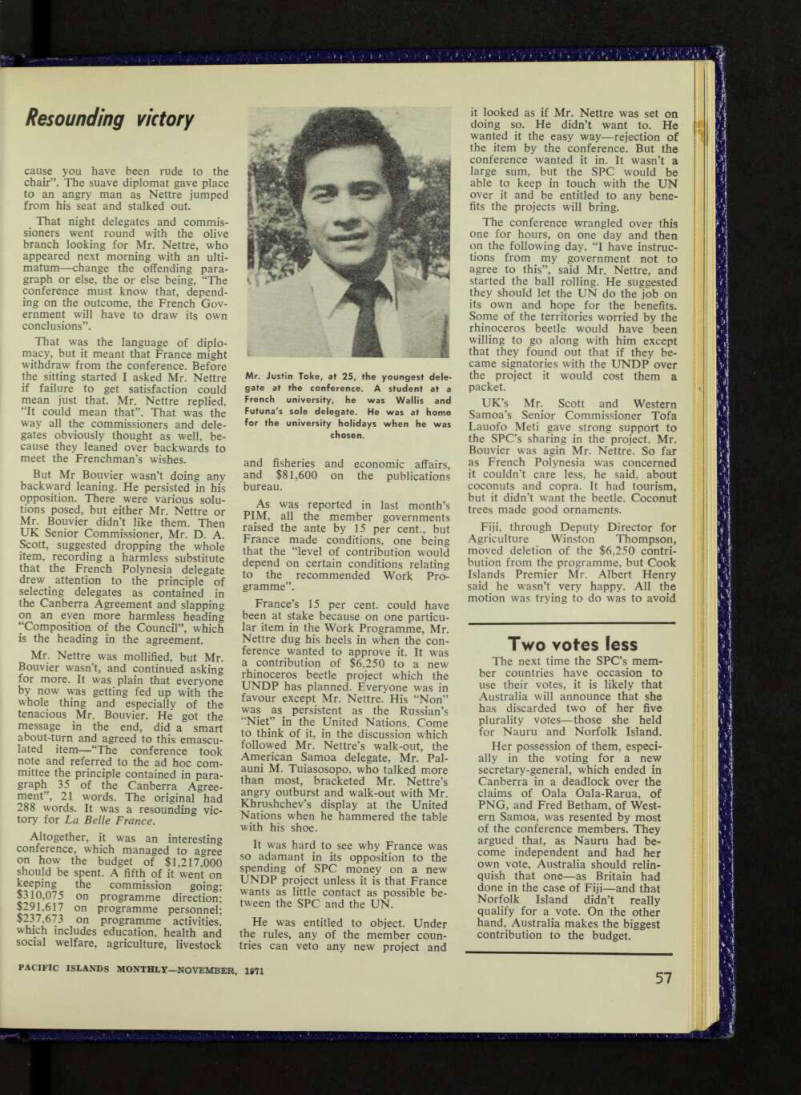
The next time the SPC’s mem ber countries have occasion to use their votes, it is likely that Australia will announce that she has discarded two of her five plurality votes —those she held for Nauru and Norfolk Island.
Her possession of them, especi ally in the voting for a new secretary-general, which ended in Canberra in a deadlock over the claims of Oala Oala-Rarua, of PNG, and Fred Betham, of West ern Samoa, was resented by most of the conference members. They argued that, as Nauru had be come independent and had her own vote, Australia should relin quish that one—as Britain had done in the case of Fiji—and that Norfolk Island didn’t really qualify for a vote. On the other hand, Australia makes the biggest contribution to the budget.
Advertisements & other items, pp. 60-70 (2 items)
Somebody
I’ve got one lighter made out of two Victorian pennies.
It’s never worked.
I’ve got another that I bought as a holiday souvenir. That went for a week, I’ve got three other jobs that only need a new little ratchet thingummy.
I’ve got a lighter with a wick like a pyjama cord that lights in a gale and nowhere else.
Lighters ?
I’ve got a drawer full of them.
And a sore thumb.
Somebody
please give me
a Ronson
One of these will do nicely
Adonis slim gas lighter Premier top-selling gas lighter
\ V| ; - e J
Windmaster gas lighter Comet gas lighter To givers of Ronson gas lighters. A filling can last for months. Re-fuelling lasts 5 seconds. The lighter - with its adjustable flame could easily last forever.
RONSON
iat’s
the Stout got that the
Land Cruiser and
these other Toyotas
got?
Quality and guts.
The TOYOTA LAND CRUISER has got it. 4-wheel drive, 6-cylinder 155 HP engine.
Fantastic gear combinations of six forward speeds and two reverse. It doubles as a versatile family fun car, too.
Then there’s the big horse pickup, TOYOTA STOUT. The front and rear axles, suspension and powerful brakes feature the stoutness of those used in heavier duty trucks. Plus it packs a 1 06HP engine. Big cab and cargo box.
Plenty of legroom in front and space in back.
And the split bench seat has cushion comfort.
You get power, safety, economy and stoutness, too. r. ’"SS/ss P I f Z n
TOiOIA TRUCK
TOOACVNA
But you may like the dual rear wheel TOYOTA DYNA. You can choose a heavy duty pickup. Or a bigger payload platform truck.
Even a double cab and delivery van. With either a husky 106 HP gasoline engine or an economical 70HPdiesel job.
Or you may want the big one.
The TOYOTA TRUCK. Six big models built to take the rough and tough.
With 130 HP diesel or 155 HP regular fuel engines under an alligator bonnet.
Got room for a Toyota?
STRIBUTQRS: TERRITORY OF PAPUA & NEW GUINEA ELA MOTORS LIMITED: Burns Ph.lp House. Musgrave Street, Port Moresby, ipua / US. TRUST TERRITORY MICROL CORPORATION: P O Bo« 234, Saipan. Mariano Islands. T rust Territory o( the Pacific Islands / II ISLAND AUTOMOTIVE SUPPLIES CO .LTD , P O Box 355, Suva / AMERICAN SAMOA BURNS PHILP (SOUTH SEA) CO., LTD., Pago go / WESTERN SAMOA BURNS PHILP (SOUTH SEA) LTD., Apia / GUAM RICKY’S AUTO CO„ P O Box 1458. Agano / NEW HEBRi iS BURNS PHILP (N.H.) LTD., Vila / SOLOMON ISLANDS ZEPHYR SERVICE STATION PTY LTD., Honiara / NEW CALEDONIA SOCI- E D IMPORTATION AUTOMOBILE DU PACIFIC, Noumea / Tahiti ETABLISSEmENTS £mILE A MARTIN & FILS, 6 p 61 Papeete
TOYOTA
\ 50 T* r
CQK
(jilie A pie
m
HOR
ANCHOR
FLOUR
MAINTOP HIGH PROTEIN
BISCUIT FLOURS AND WHEATMEALS
Gillespie Hours are milled from selected high quality Australian wheats and are entoleted for purity. Their consistent high quality has made them the best-known, most asked-for, brands of flour in the Islands. (Entoletion is a special purification process which reduces the risk of insect infection.)
GILLESPIE BROS. PTY. LTD
HEAD OFFICE:
Union St., Pyrmont, Sydney, N.S.W (G.P.O, Box 2518, Sydney, 2001).
Phone: 660-4933
CABLE ADDRESS;
"GILLESPIE',
Sydney and Brisbane
BRISBANE OFFICE:
Albion, Brisbane, Queensland. (P.O. Box 8, Albion, Brisbane, 4010) Phone: 6-1121
Get the PHILADELPHIA idea
PHILADELPHIA
BRAND
CREAM CHEESE
mUURiUD
KRA
> i i 4 m IV2 cups evaporated milk, well chilled
8 oz. PHILADELPHIA BRAND Cream
Cheese, softened at room temperature 1 cup castor sugar 1 teaspoon vanilla essence essence and beaten evaporated milk.
Fold in the warm jelly mixture. Pour into prepared crumb crust and chill for several hours or overnight. Decorate with strawberries if liked. 10 to 12 servings.
PHILADELPHIA, BRAND* Cream
Cheese gives you a new idea on cheese cakes, savouries, dips, desserts, snacks and main course dishes.
And because it’s made from rich farm cream, PHILADELPHIA is a sheer delight to mix or spread. Always so marvellously smooth. Try our luscious No-Bake Lemon Cheese Cake and get the PHILADELPHIA idea.
NO-BAKE LEMON CHEESE CAKE
Crumb Crust: 2 cups sweet biscuit crumbs 4 oz. butter, melted Crumb Crust: Combine biscuit crumbs and melted butter. Press onto bottom and sides of a buttered 9 inch cake tin with removable base. Bake in a moderate oven (350°F Gas, 375°F Electric) for 10 minutes. Cool and chill.
FREE colour recipe booklet
'44 ways with PHILLY”
For more ideas with PHILADELPHIA BRAND Cream Cheese, just write to us: Dept. P., Kraft Foods Limited, Box 5065, G.P.0., Melbourne, 3001.
Filling: 1 packet lemon jelly crystals % cup boiling water 1 dessertspoon grated lemon rind V* cup lemon juice Filling: Dissolve jelly crystals in boiling water, add lemon rind and lemon juice; cool slightly. Beat evaporated milk until thick. Beat the PHILA- DELPHIA BRAND Cream Cheese until smooth, blend in sugar, vanilla More good food ideas from
KRAFT
reg’d TRADE MAPK 059-P-353
m¥ 4 % z m* j k * 3® n - JN *
jfcr^
. 1 4C
Rally ho!
The searing sun of South East Africa ’7l blazed down upon the drivers of 113 cars as they raced across burning sands, dried sloughs, plunging straight over tumbling weeds and dried bones turned white under the dry and ofttimes steaming heat of the desert. Car by car dropped out, sometimes due to mechanical failure, ofttimes tumbling end over end landing against solid embankments, or cracking into large boulders hidden by the drifting sands until there were only 32 entrants left in the 1971 East Africa Safari. A battered, white silty-sand covered Datsun 240-Z driven by Edgar Herrmann and Hans Schuller covered the 3,900 mile course which included 620 of the toughest miles thru Tanzania ever driven in a rally competition... to sweep a winning stake of Ist, 2nd & 7th in outright, class and team events...for the second year in a row.
In 1970, a very wet year for rallies in East Africa, the Datsun 1600 SSS ploughed through gully washes, swift moving shallow streams, through torrential downpours... to come in Ist, 2nd, 4th and 7th in outright. and Ist in team and class event.
A great victory! a.
Sweltering heat prevailed in the 1969 East Africa Safari Rally in the world’s toughest, gruelling jungle-to-mountain 3,100 mile course—and the Datsun emerged triumphantly as the top winner—sweeping Ist through 6th places in class event, outright 3rd and sth and taking Ist in team event.
An unparalleled triumph!
Datsun research and engineering has come a long way since they entered their first African Rally in 1963 with two Datsuns completing the course, although there were no prizes that year.
It has been good years for, in every rally, Nissan has learned and benefited from the knowledge and experience acquired through the rugged rally courses —and Nissan’s technology gained from these experiences goes into each and every car that rolls off their assembly line. See your nearest distributor for a true rally winner.
To bigger and better things —to Datsuns a cheering Rally Ho!
NISSAN MOTOR CO., LTD.
DATSUN
DATSUN
t SnvA n Moioo? o . R^ KO e MOT ° RS LTD ‘ P ° n Moresby ’ Lae ’ Madang, Mt. Hagen. RABAUL GARAGE LTD.
SUVA MOTORS LTD. Suva, Lautoka. MORRIS HEDSTROM LTD. Apia AGENCE ALMA Noumea SA - P ° rt VHa - Sant ° R C SYMES PTY LTD Honiara. B.F. KNEUBUHL SlrTus SERVICE STATION. Norfolk SOCIEDADE AGRICOLA PATRIA E TRABALHO LDA. Dili JACOB ENTERPRISES Nauru. RICKLEMAN BROTHERS. Nukualofa. J.C. TENORIO ENTERPRISES. Saipan. J&G MOTOR CO.,LTD. Guam.
pssLtake
the side
entrance!
□□ M 111 $3 No offence meant, of course! We’re talking of side-port unit-loading—the fast, safe way to load and unload your cargo.
Side-port loading is standard procedure in the “New Guinea Chief,” “Island Chief,” “Coral Chief” and the “Papuan Chief.” These four vessels provide regular and efficient services between Sydney, Brisbane and Port Moresby, Samarai, Lae, Madang and Rabaul, Kavieng, Kieta and Honiara in Papua-New Guinea and The British Solomon Islands.
So, if you would like to know more about how to cut down your inventories, tell the New Guinea-Australia Line that you want to see the twenty-minute film “Cargo Revolution.” This will tell you how to get your exports from A to B the fast, safe way.
For specialised assistance, please contact ror SpcUldllotJU dbololdl lOC7, picaoc
□H New Guinea Australia line
PTY. LTD.
MEMBER OF THE SWIRE GROUP
S' Trading Co ; Ltd (For "New Guinea fef at Rabaul and "Island ng nt Kaviene-Burn/ Philp (N.G.I Ltd.) HONIARA British Solomons Trading Co.
a
?TTT
Some people know us as a passenger ship, and some as a cargo ship. We like to think of ourselves as a cargo ship that carries passengers.
Whichever way you look at it, you can be sure of one thing: Cargo Care. The Taiyuan provides a fast, reliable and safe cargo service.
Every 21 days the Taiyuan leaves Brisbane for Sydney,
The MS Taiyuan
takes as
much care
of her cargo
as she does
other
passengers
Lautoka, Suva and Noumea then returns to Brisbane. On board is every kind of cargo: frozen and chilled foods, heavy machinery and vehicles.
The M.S. Taiyuan provides you with a transport deal over this route that is not bettered by any other carrier. All you have to do is contact one of our local agents for more details. And leave the rest to us. i
MEMBER OF THE SWIRE GROUP
!=□ A O U(^J
LTD.
General Agents: SUVA-Morris Hedstrom Ltd. SYDNEY-Swire & Gilchrist Pty. Ltd. Agents in : MELBOURNE-P & 0. Lines of Australia Pty Ltd. BRISBANE—WiIIs, Gilchrist & Sanderson Pty. Ltd. NOUMEA-Etablissements Ballande, Service Maritime. LAUTOKA—Morris Hedstrom Ltd. 920/86
There are no
short cuts to Heinz
dor quality.
jjjjjftjj $
hioh
iff fs I h h > A -- ►' if Ml w. sc fS IN2
JUNIOH
E
HEINZ
er
JUNIOR
BECi
n»» ! /■ W 8
HEIN
*Thain£° uuio^
HlCKtf
tilffuTh
W.
We believe that food should be as pure, as fresh and as tasty as possible. And at Heinz we strive for this kind of quality everytime.
Take our unique Baby Food Peak-Nutrition cooking Process.
By this method we capture all the goodness, proteins, vitamins and minerals that are lost in other ordinary cooking methods.
And the care we take in preparing Baby Food we take in all our products.
So when you buy Heinz you know you are getting a product that for taste, freshness, quality and price has absolutely no equal,
Pacific Islands Monthlt-November, 1071
Magazine Section
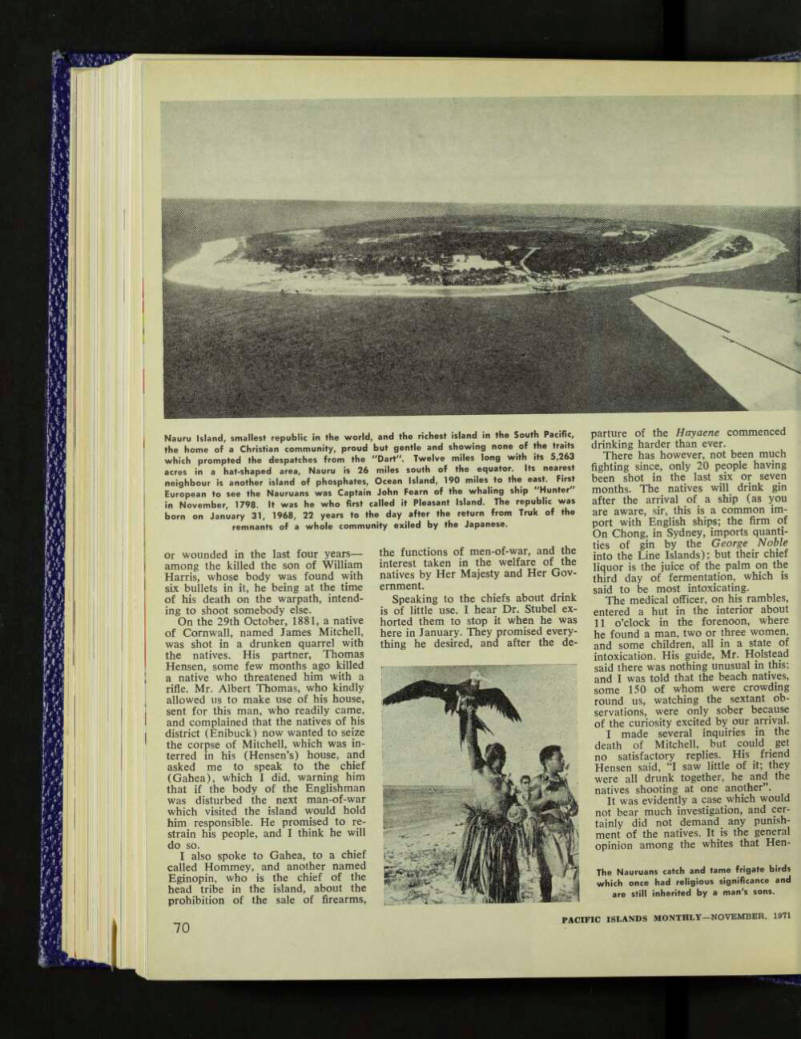
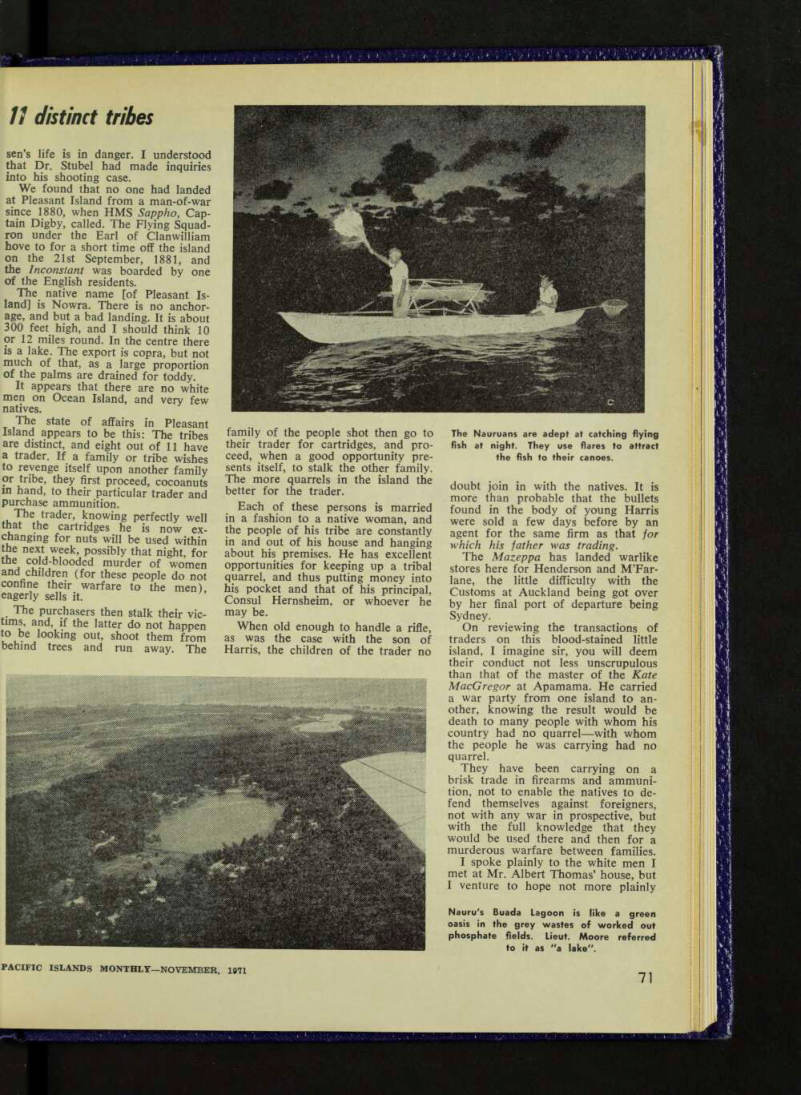
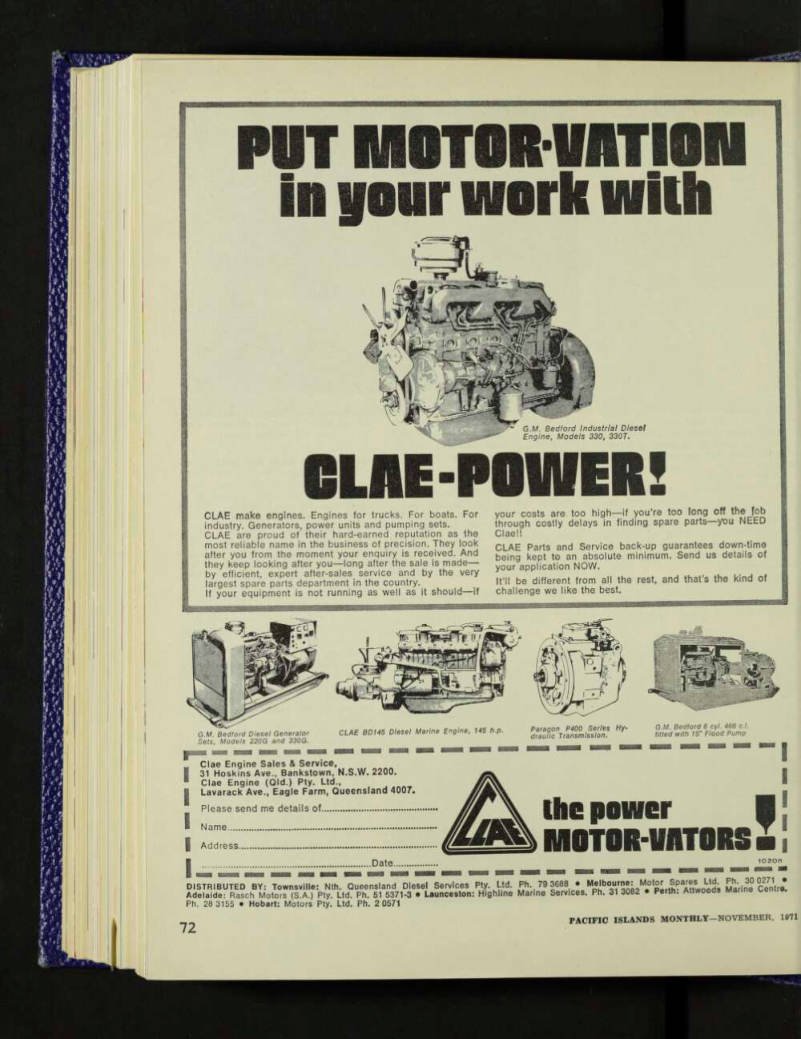
When gun-running traders turned Nauru into "a blood-stained little island”
From May to September, 1884, HMS Dart, under the command of Lieutenant W. U. Moore, was on patrol among the islands of the West ern Pacific to help keep the peace.
Her job was to investigate any com plaints by white men against natives and by natives against white men, and issue punishment where her com mander thought this necessary. To make his position stronger, Lieut.
Moore had been commissioned to act as a Deputy British Commissioner for the Western Pacific.
While the Dart was on station the High Commissioner issued regulations forbidding the sale of arms to the natives by British subjects, and one of the Dart's jobs was to see that this regulation became known around the islands. Lieut. Moore issued a general proclamation in August (see box) while his ship was at Arno atoll, east of Majuro, in the Marshall Islands of Micronesia, and later the same month the Dart visited Nauru Island (then called Pleasant Island) to spread the news.
What life was like on Nauru in August, 1884, is given in the follow ing report, quoted verbatim, which Lieut. Moore made to the officer commanding the Australian station, Commodore James Erskine, in Syd ney.
Here is Lieut. Moore’s official report: Arrived at Pleasant Island at 8.30 a.m., August 20, and at once landed for observations and to see the British subjects. This island contrasts un favourably with Ebon [in the Marshall Islands]. It is inhabited by about 1,200 people, none of whom have any re ligion, who for the most part drink to excess of sour palm toddy, who are well armed, and who are ever fight ing amongst each other, being freely supplied as occasion requires with firearms and ammunition by the eight white men on the island, five of whom are agents, for Mr. Hemsheim, the Imperial German Consul, one for
Messrs. Henderson & Macfarlane, and two for Mr. Pfeffer (Jaluit agency).
Their names are as follows:
For Consul Hernsheim:
William Harris, Thomas Jack (British subjects); Thomas Hensen, Albert Thomas (Norwegian); Van Vein (Dutch).
For The Jaluit Agency
(Mr Pfeffer): John Smith (British subject); Robert Rash (German).
For Messrs. Henderson &
MACFARLANE: Samuel Holstead (born on Sunday Island).
William Harris has been 42 years on the island without leaving it for more than a fortnight. He is prob ably one of those earlier residents spoken of in Findlay’s South Pacific Directory.
He and John Smith expressed satis faction at the communication I had to make to them on the part of the
High Commissioner respecting the sale of firearms, etc., but Thomas Jack, who seems to have a large stock of ammunition on hand, was hurt, and asked “how a fellow was to get a living now?”
I explained to the traders that the High Commissioner did not prohibit the sale of those rifles already given to the natives on credit; but I de clined to authorise Mr. Jack to issue his ammunition.
I have stated that the natives are ever fighting; by this I mean that the members of one small tribe, of which there are 11 on the island, are every now and then laying in wait for mem bers of another tribe and shooting them from behind an ambush. It is a vendetta warfare on a large scale.
In this way about 250 men, women, and children, that is about one-fifth of the population, have been killed
or wounded in the last four years— among the killed the son of William Harris, whose body was found with six bullets in it, he being at the time of his death on the warpath, intend ing to shoot somebody else.
On the 29th October, 1881, a native of Cornwall, named James Mitchell, was shot in a drunken quarrel with the natives. His partner, Thomas Hensen, some few months ago killed a native who threatened him with a rifle. Mr. Albert Thomas, who kindly allowed us to make use of his house, sent for this man, who readily came, and complained that the natives of his district (Enibuck) now wanted to seize the corpse of Mitchell, which was in terred in his (Hensen’s) house, and asked me to speak to the chief (Gahea), which I did, warning him that if the body of the Englishman was disturbed the next man-of-war which visited the island would hold him responsible. He promised to re strain his people, and I think he will do so.
I also spoke to Gahea, to a chief called Hommey, and another named Eginopin, who is the chief of the head tribe in the island, about the prohibition of the sale of firearms,
the functions of men-of-war, and the interest taken in the welfare of the natives by Her Majesty and Her Gov ernment.
Speaking to the chiefs about drink is of little use. I hear Dr. Stubel ex horted them to stop it when he was here in January. They promised every thing he desired, and after the de-
parture of the Hayaene commenced drinking harder than ever.
There has however, not been much fighting since, only 20 people having been shot in the last six or seven months. The natives will drink gin after the arrival of a ship (as you are aware, sir, this is a common im port with English ships; the firm of On Chong, in Sydney, imports quanti ties of gin by the George Noble into the Line Islands); but their chief liquor is the juice of the palm on the third day of fermentation, which is said to be most intoxicating.
The medical officer, on his rambles, entered a hut in the interior about 11 o’clock in the forenoon, where he found a man, two or three women, and some children, all in a state of intoxication. His guide, Mr. Holstead said there was nothing unusual in this; and I was told that the beach natives, some 150 of whom were crowding round us, watching the sextant ob servations, were only sober because of the curiosity excited by our arrival.
I made several inquiries in the death of Mitchell, but could get no satisfactory replies. His friend Hensen said, “I saw little of it; they were all drunk together, he and the natives shooting at one another”.
It was evidently a case which would not bear much investigation, and cer tainly did not demand any punish ment of the natives. It is the general opinion among the whites that Hen
Nauru Island, smallest republic in the world, and the richest island in the South Pacific, the home of a Christian community, proud but gentle and showing none of the traits which prompted the despatches from the "Dart". Twelve miles long with its 5,263 acres in a hat-shaped area, Nauru is 26 miles south of the equator. Its nearest neighbour is another island of phosphates, Ocean Island, 190 miles to the east. First European to see the Nauruans was Captain John Fearn of the whaling ship "Hunter" in November, 1798. It was he who first called it Pleasant Island. The republic was born on January 31, 1968, 22 years to the day after the return from Truk of the remnants of a whole community exiled by the Japanese.
The Nauruans catch and tame frigate birds which once had religious significance and are still inherited by a man's sons.
// distinct tribes
sen’s life is in danger. I understood that Dr. Stubel had made inquiries into his shooting case.
We found that no one had landed at Pleasant Island from a man-of-war since 1880, when HMS Sappho, Cap tain Digby, called. The Flying Squad ron under the Earl of Clanwilliam hove to for a short time off the island on the 21st September, 1881, and the Inconstant was boarded by one of the English residents.
The native name [of Pleasant Is land] is Nowra. There is no anchor age, and but a bad landing. It is about 300 feet high, and I should think 10 or 12 miles round. In the centre there is a lake. The export is copra, but not much of that, as a large proportion of the palms are drained for toddy.
It appears that there are no white men on Ocean Island, and very few natives.
The state of affairs in Pleasant Island appears to be this; The tribes are distinct, and eight out of 11 have a trader. If a family or tribe wishes to revenge itself upon another family or tribe, they first proceed, cocoanuts in hand, to their particular trader and purchase ammunition. .The trader, knowing perfectly well that the cartridges he is now ex changing for nuts will be used within the next week, possibly that night, for the cold-blooded murder of women and children (for these people do not confine their warfare to the men) eagerly sells it.
The purchasers then stalk their vic tims, and, if the latter do not happen to be looking out, shoot them from behind trees and run away. The
family of the people shot then go to their trader for cartridges, and pro ceed, when a good opportunity pre sents itself, to stalk the other family.
The more quarrels in the island the better for the trader.
Each of these persons is married in a fashion to a native woman, and the people of his tribe are constantly in and out of his house and hanging about his premises. He has excellent opportunities for keeping up a tribal quarrel, and thus putting money into his pocket and that of his principal, Consul Hernsheim, or whoever he may be.
When old enough to handle a rifle, as was the case with the son of Harris, the children of the trader no
doubt join in with the natives. It is more than probable that the bullets found in the body of young Harris were sold a few days before by an agent for the same firm as that for which his father was trading.
The Mazeppa has landed warlike stores here for Henderson and M’Far lane, the little difficulty with the Customs at Auckland being got over by her final port of departure being Sydney.
On reviewing the transactions of traders on this blood-stained little island, I imagine sir, you will deem their conduct not less unscrupulous than that of the master of the Kate MacGregor at Apamama. He carried a war party from one island to an other, knowing the result would be death to many people with whom his country had no quarrel—with whom the people he was carrying had no quarrel.
They have been carrying on a brisk trade in firearms and ammuni tion, not to enable the natives to de fend themselves against foreigners, not with any war in prospective, but with the full knowledge that they would be used there and then for a murderous warfare between families.
I spoke plainly to the white men I met at Mr. Albert Thomas’ house, but I venture to hope not more plainly
The Nauruans are adept at catching flying fish at night. They use flares to attract the fish to their canoes.
Nauru's Buada Lagoon is like a green oasis in the grey wastes of worked out phosphate fields. Lieut. Moore referred to it as "a lake".
Children with pistols
than you will consider it my duty to have done. I said, “By forfeiting pro tection I mean this: If next year an English man-of-war comes to this island and finds your children shot, your house burnt, or your property destroyed and the Captain of her discovers that you have, in disobedi ence to the High Commissioner’s Arms Regulation of which I now in form you, given or sold either your own stores of firearms and ammuni tion, or another person’s firearms and ammunition, to the natives, I be lieve he will do nothing for you. If your own life is taken I believe he will adopt no steps to punish the people who shot you”.
It appears that some of the white men—Thomas Jack, the Scotchman, notably—have many rifles sold on credit, and are afraid, now that the views of HM Government are made known, that the natives will not pay.
To this grievance I did not attempt to offer any consolation.
Every adult I believe has a weapon of some sort, and many of the chil dren can be seen going about with pistols.
Altogether the natives have a wild and disorderly appearance. None of them wear clothes. With eight white men distributed over the island, allow ing them to purchase the means wherewithal to kill each other, and thus stimulating their savage natures, it would be surprising if they were other than what they are, naked, ig norant and quarrelsome.
William Harris, who ought to know, stated that when he first came to Pleasant Island the natives did not know the art of extracting spirit from the juice of the palm, and that it was introduced by a white man.
Equal altitude observations by Lieut. Messum and myself place Pleasant Island 12 miles west of the position it occupies in chart 780, xi 81. We left at 4 pm, 20th August, and after an uneventful passage an chored at Matupi [New Britain] at 11 am, 28th August. [Three years after Lieut. Moore’s visit, Nauru was visited by a member of New Zealand’s parliament, Fre derick J. Moss, and his account of what he saw there (in his book, Through Atolls and Islands in the Great South Seas, London, 1889) showed there had been little change in conditions over the three years.
The British trader William Harris, whom Lieut. Moore mentions as hav ing had his son killed in a feud, had lost another son—shot dead in at tempting to revenge his brother. See PIM June, 1970 (p. 87).]
Advertisements & other items, pp. 71-80 (1 item)
To Any British Subject
Sale of Firearms to Natives
I have to inform you that the Arms Regulations issued by Her Britannic Majesty's High Commissioner, and put in force July 1, 1884, forbids you to sell or give any firearms, ammunition, powder, dynamite, or explosives of any description to any natives of any island in the Western Pacific under a penalty of £lO fine or a month's imprisonment.
I should also warn you that by disobeying this regulation you will in all probability forfeit that protection for your person and property from aggression on the part of the natives of the island on which you reside, which is now accorded by HM vessels to British subjects who lead orderly lives and obey the laws of their country.
The Arms Regulations make no exception in favour of British subjects acting as agents of foreign firms.
You are at liberty to complete the sale of any firearms in your possession at this date upon which a deposit has been paid to you by a native purchaser.
W. U. MOORE,
Lieutenant, RN (one of HBM Deputy Commissioners for the Western Pacific).
HMS "Dart", Arnho, August 5, 1884.
NT MSTORHATIOIH
in m work with
\ ** '.-V 1 w m 0 G.M. Bedford Industrial Diesel Engine, Models 330, 330 T.
CLAE make engines. Engines for trucks. For boats. For industry. Generators, power units and pumping sets.
CLAE are proud of their hard-earned reputation as the most reliable name in the business of precision. They look after you from the moment your enquiry is received. And they keep looking after you—long after the sale is made— by efficient, expert after-sales service and by the very largest spare parts department in the country.
If your equipment is not running as well as it should —if your costs are too high—if you’re too long off the fob through costly delays in finding spare parts—you NEED Clael!
CLAE Parts and Service back-up guarantees down-time being kept to an absolute minimum. Send us details of your application NOW.
It’ll be different from all the rest, and that’s the kind of challenge we like the best. 9 a j- -1 t o 8 TS G.M. Bedford Diesel Generator Sets, Models 220 G and 330 G.
CLAE BDUS Diesel Marine Engine, 145 h.p Paragon P4OO Series Hydraulic Transmission.
G.M. Bedford 6 cyl. 466 c.l. fitted with 15" Flood Pump Clae Engine Sales & Service, 31 Hoskins Ave., Bankstown, N.S.W. 2200.
Clae Engine (Old.) Pty. Ltd., Lavarack Ave., Eagle Farm, Queensland 4007.
Please send me details of Name Address I
the power 11
MfITOR-URTORS ■ I
.Date. • Diesel Services Pty. Ltd. Ph. 79 3688 . Slrine c/ntr* lotors (S.A.) Pty. Ltd. Ph. 51 5371-3 • Launceston: Highlme Marine Services, Ph. 31 3082 • Perth. Attwoods Man
DISTRIBUTED BY
Adelaide: Rasch Motors (S.A.) Pty, Ph. 28 3155 • Hobart: Motors Pty. Ltd. Ph. 2 0571
Little things from Holbrooks
mean a lot.
I © SyioiiimioKS . pickles i r i white vtneg3f |.E.
I Danish
HOLBBOf
&White ■ It’s the little things that really make a meal.
That’s why it’s important that the little
things you buy HOLBROOKS
come with a big name.
Trade Enquiries: Reckitt & Colman Pty. Limited, 44-96 Wharf Road,
WEST RYDE. 2114. N.S.W.
Cables; Reckitts Sydney.
Territory travel
is a cup of
k T m M m * <r a I i m / 9 4 m u 111 , Sl# It's that easy when you fly in the comfort of an airconditioned pressurised *Ansett Airlines of Papua New Guinea prop jet. Up and over the Owen Stanleys, back and forth throughout the Territory. Ansett Airlines of Papua New Guinea have a generation of experience flying the Territory . . . experience any airline would be glad to tuck under its wing. In the air or on the ground our service is friendly, courteous and very helpful. Keep us in mind next time you plan a flight. .’. you’ll agree that with Ansett Airlines of Papua New Guinea Territory travel is a cup of tea! * (Also operating the services of Papuan Airlines Pty. Ltd.) jassii^
ANSETT airlines of papua new guinea
In conjunction with ANSETT AIRLINES OF AUSTRA
Marine Shells
of the Pacific
Revised edition
Walter 0. Cernohorsky
The first edition of Marine Shells of the Pacific was enthusiastically received by shell collectors throughout the world but it has been out of print for some time. The second edition, now available, has been completely revised by the author in the light of new information that has come to hand since the first edition was published in 1968. The whole text has been checked and brought up to date where necessary.
ANOTHER SHELL BOOK COMING
A new volume on shells not so far covered is now in preparation by Walter O. Cernohorsky. y It will be in larger format than the present volume and will have a number of colour plates.
Available early 1972.
248 pages; cloth bound; illustrated.
Use the form overleaf when ordering.
mmmmmmmmm* ORIPFRFORM
"MARINE SHELLS OF THE PACIFIC" sells in Australia and P.N.G. for $7.00 Aust., plus 20c posted; Pacific Islands and overseas countries $7.00 Aust., plus 70c posted; U.S.A., $B.BO U.S., posted.
Please send copy(ies) “MARINE SHELLS OF
THE PACIFIC ' to
NAME -
ADDRESS
(BLOCK LETTERS, PLEASE)
for which payment of is enclosed.
Pacific Publications (Australia) Pty. Ltd,
* 29 Alberta Street, Sydney, N.S.W. 2000. (Postal address: Box 3408, G.P.0., Sydney, N.S.W. 2001) When ordering ask for our Pacific book catalogue
NOVEMBER, 1971—PACIFIC ISLANDS MONTHLY
Norfolk's new pine avenue
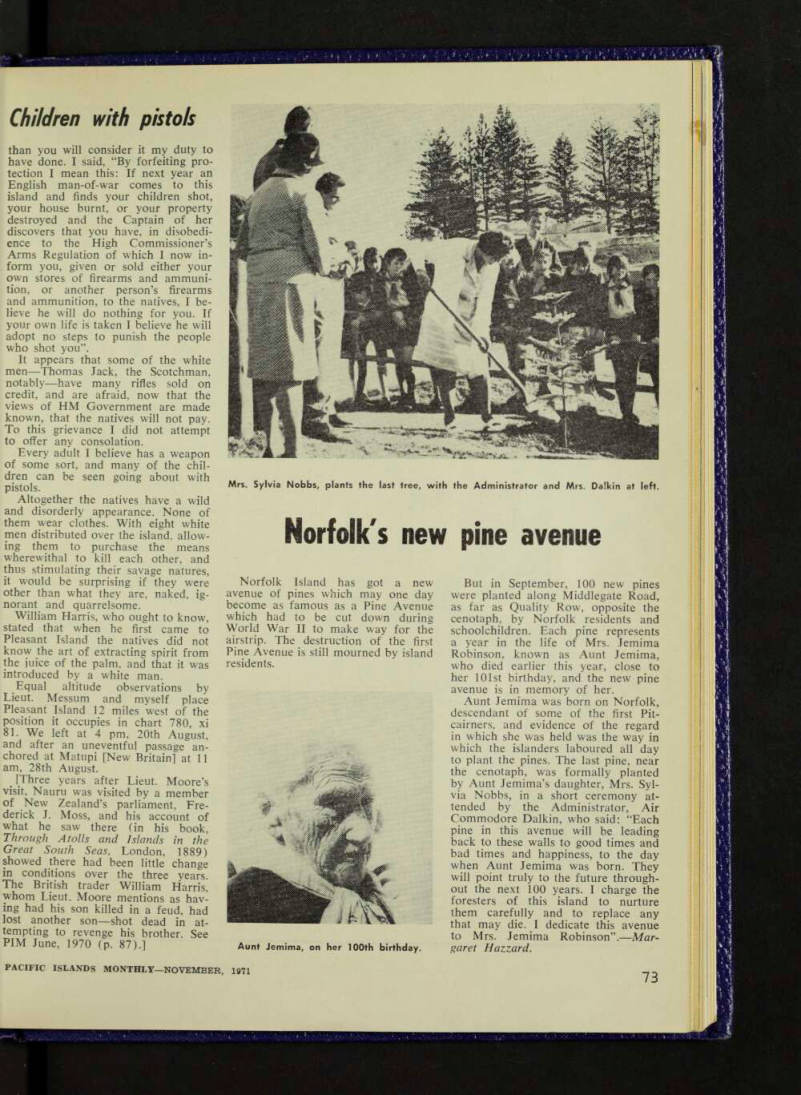
Norfolk Island has got a new avenue of pines which may one day become as famous as a Pine Avenue which had to be cut down during World War II to make way for the airstrip. The destruction of the first Pine Avenue is still mourned by island residents.
But in September, 100 new pines were planted along Middlegate Road, as far as Quality Row, opposite the cenotaph, by Norfolk residents and schoolchildren. Each pine represents a year in the life of Mrs. Jemima Robinson, known as Aunt Jemima, who died earlier this year, close to her 101st birthday, and the new pine avenue is in memory of her.
Aunt Jemima was born on Norfolk, descendant of some of the first Pit cairners, and evidence of the regard in which she was held was the way in which the islanders laboured all day to plant the pines. The last pine, near the cenotaph, was formally planted by Aunt Jemima’s daughter, Mrs. Syl via Nobbs, in a short ceremony at tended by the Administrator, Air Commodore Dalkin, who said: “Each pine in this avenue will be leading back to these walls to good times and bad times and happiness, to the day when Aunt Jemima was born. They will point truly to the future through out the next 100 years. I charge the foresters of this island to nurture them carefully and to replace any that may die. I dedicate this avenue to Mrs. Jemima Robinson”.—Mar garet Hazzard.
Aunt Jemima, on her 100th birthday.
Mrs. Sylvia Nobbs, plants the last tree, with the Administrator and Mrs. Dalkin at left.
Yesterday
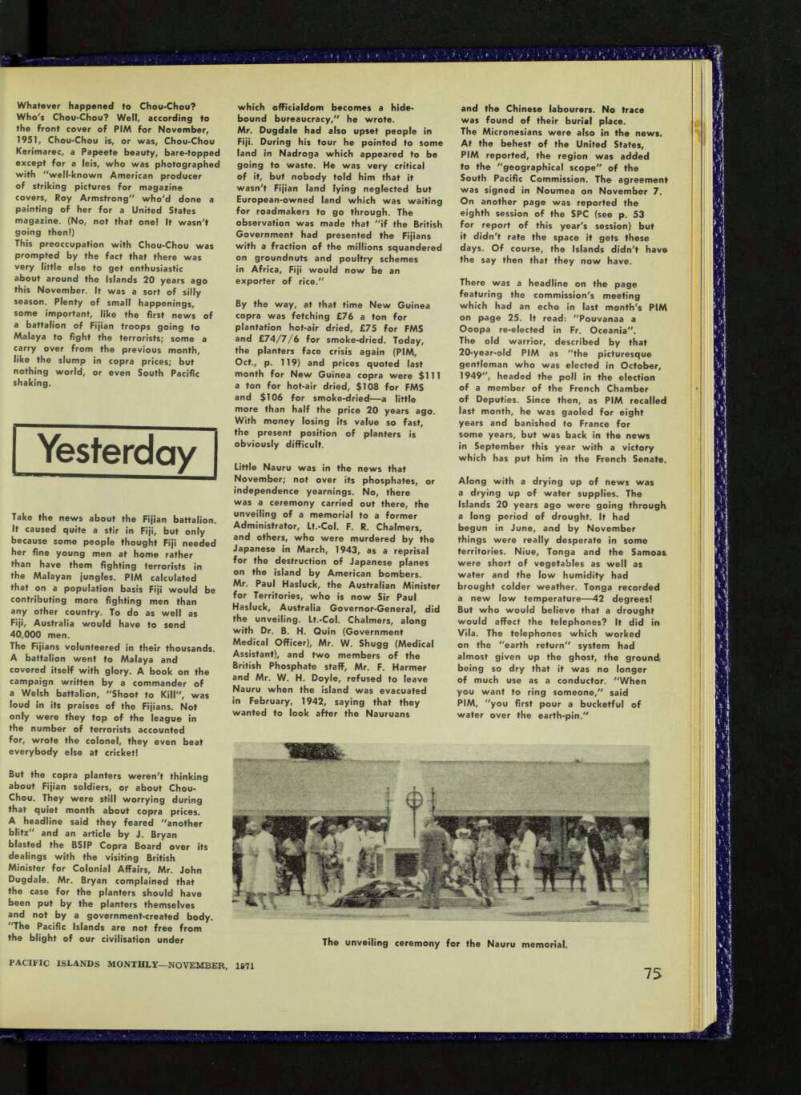
Whatever happened to Chou-Chou?
Who's Chou-Chou? Well, according to the front cover of PIM for November, 1951, Chou-Chou is, or was, Chou-Chou Kerimarec, a Papeete beauty, bare-topped except for a leis, who was photographed with "well-known American producer of striking pictures for magazine covers, Roy Armstrong" who'd done a painting of her for a United States magazine. (No, not that one! It wasn't going then!) This preoccupation with Chou-Chou was prompted by the fact that there was very little else to get enthusiastic about around the Islands 20 years ago this November. It was a sort of silly season. Plenty of small happenings, some important, like the first news of a battalion of Fijian troops going to Malaya to fight the terrorists; some a carry over from the previous month, like the slump in copra prices; but nothing world, or even South Pacific shaking.
Take the news about the Fijian battalion.
It caused quite a stir in Fiji, but only because some people thought Fiji needed her fine young men at home rather than have them fighting terrorists in the Malayan jungles. PIM calculated that on a population basis Fiji would be contributing more fighting men than any other country. To do as well as Fiji, Australia would have to send 40,000 men.
The Fijians volunteered in their thousands.
A battalion went to Malaya and covered itself with glory. A book on the campaign written by a commander of a Welsh battalion, "Shoot to Kill", was loud in its praises of the Fijians. Not only were they top of the league in the number of terrorists accounted for, wrote the colonel, they even beat everybody else at cricket!
But the copra planters weren't thinking about Fijian soldiers, or about Chou- Chou. They were still worrying during that quiet month about copra prices.
A headline said they feared "another blitz" and an article by J. Bryan blasted the BSIP Copra Board over its dealings with the visiting British Minister for Colonial Affairs, Mr. John Dugdale. Mr, Bryan complained that the case for the planters should have been put by the planters themselves and not by a government-created body.
"The Pacific Islands are not free from the blight of our civilisation under
which officialdom becomes a hide bound bureaucracy," he wrote.
Mr. Dugdale had also upset people in Fiji. During his tour he pointed to some land in Nadroga which appeared to be going to waste. He was very critical of it, but nobody told him that it wasn't Fijian land lying neglected but European-owned land which was waiting for roadmakers to go through. The observation was made that "if the British Government had presented the Fijians with a fraction of the millions squandered on groundnuts and poultry schemes in Africa, Fiji would now be an exporter of rice."
By the way, at that time New Guinea copra was fetching £76 a ton for plantation hot-air dried, £75 for FMS and £74/7/6 for smoke-dried. Today, the planters face crisis again (PIM, Oct., p. 119) and prices quoted last month for New Guinea copra were $lll a ton for hot-air dried, $lOB for FMS and $lO6 for smoke-dried—a little more than half the price 20 years ago.
With money losing its value so fast, the present position of planters is
obviously difficult.
Little Nauru was in the news that November; not over its phosphates, or independence yearnings. No, there was a ceremony carried out there, the unveiling of a memorial to a former Administrator, Lt.-Col. F. R. Chalmers, and others, who were murdered by the Japanese in March, 1943, as a reprisal for the destruction of Japanese planes on the island by American bombers.
Mr. Paul Hasluck, the Australian Minister for Territories, who is now Sir Paul Hasluck, Australia Governor-General, did the unveiling. Lt.-Col. Chalmers, along with Dr. B. H. Quin (Government Medical Officer), Mr. W. Shugg (Medical Assistant), and two members of the British Phosphate staff, Mr. F. Harmer and Mr, W. H. Doyle, refused to leave Nauru when the island was evacuated in February, 1942, saying that they wanted to look after the Nauruans
and the Chinese labourers. No trace was found of their burial place.
The Micronesians were also in the news.
At the behest of the United States, PIM reported, the region was added to the "geographical scope" of the South Pacific Commission. The agreement was signed in Noumea on November 7.
On another page was reported the eighth session of the SPC (see p. 53 for report of this year's session) but it didn't rate the space it gets these days. Of course, the Islands didn't have the say then that they now have.
There was a headline on the page featuring the commission's meeting which had an echo in last month's PIM on page 25. It read: "Pouvanaa a Ooopa re-elected in Fr. Oceania".
The old warrior, described by that 20-year-old PIM as "the picturesque gentleman who was elected in October, 1949", headed the poll in the election of a member of the French Chamber of Deputies. Since then, as PIM recalled last month, he was gaoled for eight years and banished to France for some years, but was back in the news in September this year with a victory which has put him in the French Senate.
Along with a drying up of news was a drying up of water supplies. The Islands 20 years ago were going through a long period of drought. It had begun in June, and by November things were really desperate in some territories. Niue, Tonga and the Samoa* were short of vegetables as well as water and the low humidity had brought colder weather. Tonga recorded a new low temperature—42 degrees!
But who would believe that a drought would affect the telephones? It did in Vila. The telephones which worked on the "earth return" system had almost given up the ghost, the ground being so dry that it was no longer of much use as a conductor. "When you want to ring someone," said PIM, "you first pour a bucketful of water over the earth-pin."
The unveiling ceremony for the Nauru memorial.
Book Reviews
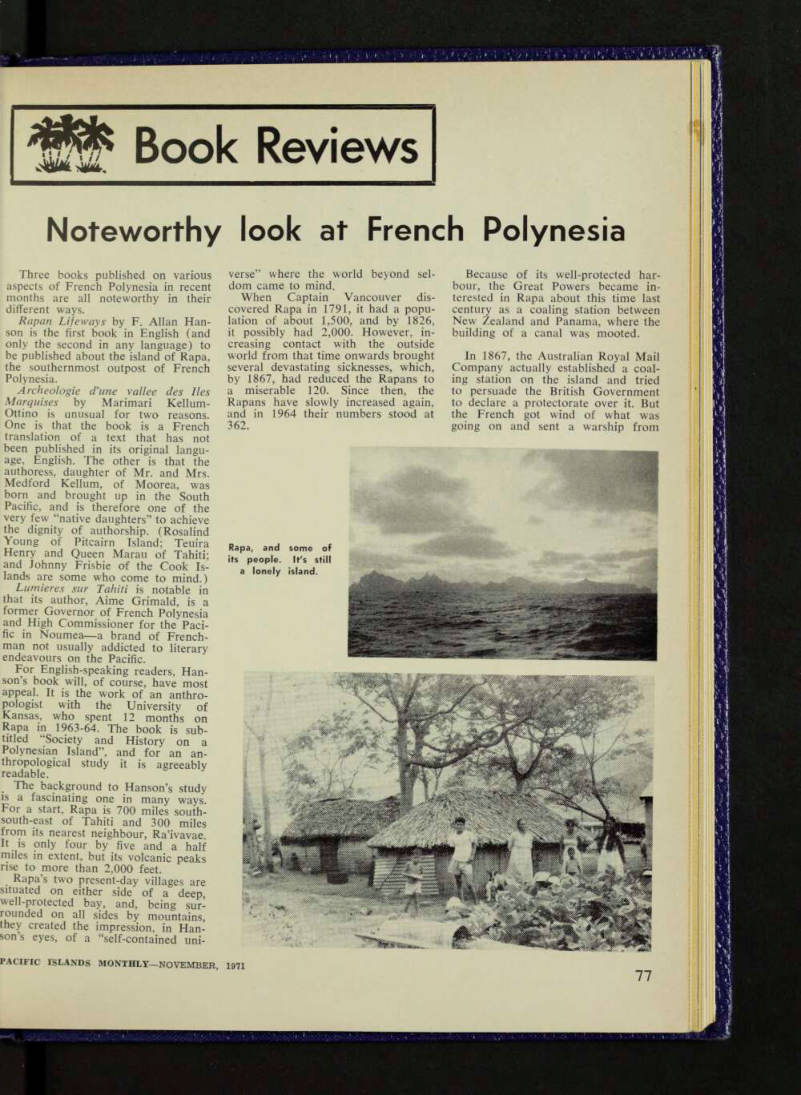

Noteworthy look at French Polynesia
Three books published on various aspects of French Polynesia in recent months are all noteworthy in their different ways.
Rapan Lifeways by F. Allan Han son is the first book in English (and only the second in any language) to be published about the island of Rapa, the southernmost outpost of French Polynesia.
Archeologie d’une vallee des lies Marquises by Marimari Kellum- Ottino is unusual for two reasons.
One is that the book is a French translation of a text that has not been published in its original langu age, English. The other is that the authoress, daughter of Mr. and Mrs.
Medford Kellum, of Moorea, was born and brought up in the South Pacific, and is therefore one of the very few “native daughters” to achieve the dignity of authorship. (Rosalind Young of Pitcairn Island; Teuira Henry and Queen Marau of Tahiti; and Johnny Frisbie of the Cook Is lands are some who come to mind.) Lumieres sur Tahiti is notable in that its author, Aime Grimald, is a former Governor of French Polynesia and High Commissioner for the Paci fic in Noumea—a brand of French man not usually addicted to literary endeavours on the Pacific.
For English-speaking readers, Han son’s book will, of course, have most appeal. It is the work of an anthro pologist with the University of Kansas, who spent 12 months on Rapa in 1963-64. The book is sub titled “Society and History on a Polynesian Island”, and for an an thropological study it is agreeably readable.
The background to Hanson’s study is a fascinating one in many ways.
For a start, Rapa is 700 miles south south-east of Tahiti and 300 miles from its nearest neighbour, Ra’ivavae It is only four by five and a half miles in extent, but its volcanic peaks rise to more than 2,000 feet.
Rapa’s two present-day villages are situated on either side of a deep, well-protected bay, and, being sur rounded on all sides by mountains, they created the impression, in Han son s eyes, of a “self-contained uni
verse” where the world beyond sel dom came to mind.
When Captain Vancouver dis covered Rapa in 1791, it had a popu lation of about 1,500, and by 1826, it possibly had 2,000. However, in creasing contact with the outside world from that time onwards brought several devastating sicknesses, which, by 1867, had reduced the Rapans to a miserable 120. Since then, the Rapans have slowly increased again, and in 1964 their numbers stood at 362.
Because of its well-protected har bour, the Great Powers became in terested in Rapa about this time last century as a coaling station between New Zealand and Panama, where the building of a canal was mooted.
In 1867, the Australian Royal Mail Company actually established a coal ing station on the island and tried to persuade the British Government to declare a protectorate over it. But the French got wind of what was going on and sent a warship from
Rapa, and some of its people. It's still a lonely island.
Tahiti to establish a French protec torate.
About 20 years later when the pros pect of a Panama Canal was revived, the British Government nearly agreed to the French annexation of the New Hebrides in exchange for Rapa, but was dissuaded from doing so by the Australians and New Zealanders. Sub sequently, France decided to turn Rapa into an outright possession, and Governor Chesse sailed down from Tahiti to raise the French flag. How ever, the king and chiefs told him bluntly that they didn’t want either the protectorate flag or the Tricolor, and it was only after a threat of force that they gave in. But not for 10ng...
When another French Governor went to Rapa from Tahiti about seven years later, he found the islanders, as he himself expressed it, “in open revolt against the government of France”, and more threats were needed to bring the recalcitrant islanders to heel. The Rapan mon archy was thereupon abolished and native laws were superseded by the French civil code.
Despite all this, the French never had needed to use Rapa because the opening of the Panama Canal did not turn it into the strategic stopping place that was envisaged. As a result, it has, as Hanson puts it, “remained a lonely island, commercially and politically of little importance; an island from which one can see passing ocean liners, but where as late as 1964 three months might elapse with out a visit from the outside world”.
Islands such as Rapa are becoming pretty hard to find these days; and probably even Rapa won’t remain as it is for too much longer.
If it does change, though, the world —thanks to Hanson—will still have an excellent portrait of what it was like in the good old days of 1964.
Life, then, was divided into two simple sides —the food side and the belief side, and all human activities revolved around one or the other.
Marquesas
Towards the end of 1924, the then Director of the Bishop Museum in Honolulu, Dr. Harold Gregory, pulled aff an agreeable, money-saving coup.
He persuaded the American owner of a magnificent 180 ft yacht called Kaimiloa, which had just arrived in Honolulu en route to Samoa on a
pleasure cruise, to provide free ac commodation and transport for five members of his staff who wanted to carry out scientific work in the South Seas.
Dr. Gregory’s coup had several in teresting and far-reaching conse quences:— 1. The Bishop Museum scientists, who included the now well-known Dr.
Kenneth Emory, were able to visit Polynesian maraes on several of the Line Islands that might otherwise have remained unvisited for years. 2. The owner of the Kaimiloa, Mr.
Medford Kellum, Sr., and his son, Medford Kellum, Jr., acquired an interest in Polynesian archaeology.
3. Dr. Emory was later able to make a study of the Polynesian stone remains in the Society Islands. 4. The Kaimiloa never reached Samoa. Instead, Mr. Kellum, Sr., be came interested in a vast agricultural property at the head of Papetoai Bay, Moorea, which happened to be on the market at the time, and in an ex pansive moment he bought it and gave it to his son. 5. Mr. Kellum, Jr., and his wife installed themselves on Moorea as tropical agriculturists, living in a pre fabricated house imported from Cali fornia, and raising a family consist ing of a boy and a girl. 6. The girl, Marimari, who was
born in Tahiti, grew up speaking Eng lish, French and Tahitian; and she acquired an interest in the same sub ject that had indirectly brought the Kaimiloa to Moorea Polynesian archaeology.
Now, 47 years after Dr. Gregory’s noney-saving coup, Marimari, who is Harried to a French anthropologist, Paul Ottino, has published her first najor work on her subject—a detailed study of the archaeological remains af the Hane Valley of Uahuka, Mar juesas Islands.
The study was done in 1962-64 and earned the authoress a Master of Arts iegree at the University of Hawaii.
Its English title is Sites and Settle nents in Hane Valley, Marquesas.
Governor’S Book
At first sight, Governor Grimald’s look, Lumieres sur Tahiti (Tahiti Brought to Light) seems not much lifferent from the many other coffee able books on the Pacific Islands hat have made their appearance dur ng the last two or three years. And, n fact, it isn’t. It is an attractively >ound volume, of 180 pages, contain ing 100 pages of text and 129 illus rations in colour and black and vhite.
The text is divided into six sec ions dealing with history, the various slands and archipelagoes of French tolynesia, their people, political de elopments in the 20th century, eco tomic and social development, and he development of air service and aurism.
What differentiates Governor Grim- Id’s book from others of the same ind is that his occasionally contains iformation that is not readily access es elsewhere. For example, he says hat when the nuclear tests are on at lururoa, 15,000 people are in French 'olynesia for the purpose, of whom 0,000 are Servicemen.— Robert ,angdon. (RAPAN LIFEWAYS. Little, Brown and ompany. Boston. SUS4.I6; ARCHEO OGIE d’UNE VALLEE des IL E S LARQUISES. Societe des Oceanistes [usee de I’Homme, Paris. 65 Prs ;
Umieres Sur Tahiti. A. Grimald, 28
venue Carnot, Paris 17. 55 Prs.). • A new journal is expected to lake its appearance on the Pacific slands scene next March under the tie of Pacific Perspective.
Its birthplace will be the Univer ty of the South Pacific and assist
ing at its birth will be Professor R.
G. Crocombe.
According to its editor, senior student Sione K. Tupouniua—it is “now in labour under the general guidance and leadership of Professor Crocombe’, and is aimed primarily at school teachers, church leaders, politicians and other leaders of opinion as well as academicians in the Pacific.
It will publish articles on matters of social, economic, political, historical, geographical and other current interests in the area. It will also publish summaries and reviews of books relevant to the Pacific.
Pacific Perspective, which will be published twice yearly, in March and September, is not formally linked Wlth the university but most °f those concerned with it are faculty members and senior students.
Articles in the first issue will in elude, “Preserving with Tradition?
The Future of Pacific Cultures”, by r. g. Crocombe; “Economic Plan ning—Tonga Style”, by I. Fairbairn; “Labour Trade in the Solomon Islands 1870-1911”, by P. Corns; “The Island State and the Interna tional Community”, by S. K. Tupou niua, and “Investment for Tourism in Fijian Land”, by R. Nayacakalou.
Advertisements & other items, pp. 82-86 (2 items)
Qantas Gives You
4 GREAT JET WAYS
AROUND THE WORLD
Qantas offers you four jetways to London, Europe and around the world. Choose between the Singapore-Bangkok way or the Hong Kong-Orient way when you fly West. Or if you’re travelling East you have a choice of the Tahiti-Mexico way or the Honolulu-U.S.A. way.
Any way you want it. Qantas will take you there. Check your Qantas Travel Agent.
anntas
Australia’s round the world Airline. a M m > 3 ANT AS, with AIR INDIA. AIR NEW 2EALAND. BOAC and MSA.
PRESBYTERIAN
LADIES' COLLEGE
GOULBURN, N.S.W., AUSTRALIA
Provides not only a high standard of academic tuition in small classes to Higher School Certificate Standard, but also encourages cultural, religious, recreational and sporting activities designed to give the students a complete education.
Set in spacious and attractive grounds on the Western side of Goulburn, a City of 21,000 people, in the Southern Tablelands of New South Wales.
Only 130 miles from Sydney; serviced by a first rate three hour rail service,- 60 miles from Canberra, the Australian Capital.
Boarding accommodation is modern and comfortable.
Extensive sporting facilities and many extracurricular activities (Music, Life-saving, Duke of Edinburgh Awards, Golf, Horse-riding and a variety of others) provide every encouragement for allround development.
ENROLMENTS FOR 1972 ARE NOW BEING ACCEPTED.
Inquiries are invited for further information.
Address all correspondence to the Principal;
MISS MARY PARSONS, M.Sc., B.Ed., M.A.C.E.
Presbyterian Ladies' College
GOULBURN, 2580. N.S.W., AUSTRALIA.
9 Wt X r. & j m X T k\ . \ You’re Sitting on Top of the World...
With the Fuiiset IOOOW Executive Chair!
\nyone confined behind a desk knows his productivity, efficiency and work output greatly de Dends on personal comfort. That's why smart managers in 52 countries choose the Fujiset 1000 W Executive Chair.
Fhe extremely comfortable, durable Fujiset Executive Chair features 3 stylish, rugged fabric upholstered seat top with tough vinyl seat 3dges and backrest, attractively constructed on a beautifully finished base with 2 inch hooded casters.
Every outstanding Fujiset product is designed for comfort and functional convenience,and the Fujiset Executive Chair is available in a wide selection of colors and metal finishes to enhance the decor of any office.
Besides the above, 30 different chairs and desks for office use are available from us. * w
DISTRIBUTORS WANTED
Fujiset Trading Co., Ltd.
21,2-CHOME YOYOGI.SHIBUYA-KU,TOKYO 151, JAPAN
Phone- Tokyo 379-3210 Cable Address: CHAIRFUJISET
A SCHOOL IN AUSTRALIA?
BK r
THE ARMIDALE SCHOOL
is the third largest Protestant boarding school in New South Wales. Features include; • High University success rate (82%). • Audio-Visual Aids. • Four new Science Laboratories. • Three modern boarding houses. * Extensive Extra-curricular activities. % Spacious grounds (70 acres), q Teacher-Pupil Ratio 1 : 16. * Only country member of G.P.S.
COURSES: UPPER PRIMARY TO MATRICULATION
FEES: $460 per term.
Enquiries to The Headmaster,
THE ARMIDALE SCHOOL
ARMIDALE, N.S.W. 2350.
w r \ 0 P B r i'
For changing face... or sun control.
Wunderlich Octalinear Grilles.
Decorative screens for solar control and building refacing Wunderlich give you Octalinear Grilles, the decorative screen that allows for custom designing to meet a particular sun control problem.
The grille design and placement can be varied to screen out the sun's direct rays and glare. This reduces undesirable heat gain, and allows a free flow of air, while preserving maximum visual contact. In fact, depending upon functional requirements, up to 90% horizontal visibility can be obtained.
The Wunderlich Octalinear Grille is a highly versatile medium that meets both the design and functional requirements of refacing old buildings, and the addition of solar and decorative screens to new constructions.
The grilles can be adapted to any design concept. And they may be varied in module, slope and depth to achieve the desired wall.
Their design flexibility and the wide variation provides the opportunity to design to a budget consideration. Combined with their permanence and light weight, Octalinear Grilles are particularly economical in a variety of uses, including space dividers, fascias, free air intakes, sign and display backgrounds, vision barriers, decorative ceilings, decorative grilles, solar canopies, solar screens, solar fins, cooling tower screens, and building refacings. , ..
Interested? Make a constructive move. For free colour literature and full technical details phone or write to Wunderlich.
OCTALINEAR GRILLES
Wunderlich Limited, Head office and showroom; 393 Cleveland Street, Redfern, 2016, Australia. Telephone 69 0366 139712/2
81
ACIFIC ISLANDS MONTHLY— NOVEMBER, 1971
Samoan village
Economic life in the Samoan village
A major problem in the South-West Pacific which political independence and plans for social and economic de velopment do little to solve, is that of encouraging the rural sector to in volve itself more actively in the pro duction of cash crops for the domestic and export markets.
While Pacific countries have had some success in developing local in dustries, in building roads, airfields, hospitals and schools, they have been far less successful in encouraging the rural population to grow more pro duce for sale.
Surprisingly, little research has been carried out in this field and so Brian Lockwood’s Samoan Village Eco nomy is a welcome addition to the field.
Dr. Lockwood’s book is yet another from the stable of the ANU’s Re search School of Pacific Studies, where he was a research scholar in the mid-sixties. Based upon a year’s residence in Western Samoa, the book examines the four villages of Utuali’l, Uafata and Poutasi on the island of Upolu, and Taga on the island of Savai’i. The villages are chosen to represent different economic locations in that they are varying distances from the main town and market centre of Apia.
By gathering very detailed infor mation relating to subsistence produc tion, cash incomes, cash spending patterns and retail prices from a sample of households, Dr. Lockwood seeks to examine the effect of foreign institutions, such as the exchange of goods for cash, upon the lives of Samoans in the rural scene. He also compares the impact of these foreign institutions upon the main Samoan institutions of the family and of vil lage government.
Each of the four villages is exam ined in turn with its location, pro ductive resources, etc., all being listed.
For each household surveyed a com plete list of household possessions was made, which included such varied essentials as sugar bowls, knives and forks, tin snips, cows and hammers.
From this and from a great deal of other information, Lockwood is able to draw some very interesting conclu sions, the main one of which can best be summarised by quoting one of Lockwood’s concluding paragraphs: “Although the villagers respond to
market incentives in a predictable way, they rarely respond as fully as they could given their resource situation. They want a cash income because it allows them to have certain goods and services which otherwise would be denied them. It helps them U .P social ladder, and to gam polltical influence and authority—the real objectives Money is only one of many means of achieving them and, once achieved, money adds little to the enjoyment of the fa a Samoa, the Samoan way of life. Hence their interest m the outside world m general. ? the market sector m particular. is limited .
The book is well written with a pleasing absence of that gobbledygook which tends to make the work of so wnicn icnus 10 maxe me wonc or so many economists incomprehensible to others.
Thf> tPYt is illustrate hu a rmmLpr me text IS Illustrated by a number of very attractively-produced maps.
While the book will hardly appeal to the popular reader i n search of escapism, it will be of considerable interest to those having a general interest in Samoa or to those con . cerned with rural or village life in the Pacific , and in the processes of eco nomic and social change occurring there A ' useful supplement to the book is a s jj m volume entitled Economic Statistics of Samoan Village House holds, which is put out by the Depart ment of Economics, Research School of Pacific studies, ANU supple rnent is priced at $3.00 and comprises all t h e s t a tistical tables not included in Samoan Village Economy. — EW. (Samoan village economy. Oxford university Press, Melbourne. $7.50). (economic statistics of samoan village households. Dept, of Eco nomics, Research School of Pacific Studies, Australian National University, Canberra, $3.00).
Background To Australia
Pick Of The Paper-Backs
Maybe Australia’s Foreign Minister, Mr. Bowen, should read a modest looking Pan paper-back which has just reached the bookstalls. While in the United States early in October, Mr. Bowen set Australia, and in particular the Australian Labour Party, by the ears with an attack on the ALP, but it wasn’t that which upset most people. It was his description of Australia— “at present small and relatively insignificant” he said.
Was he right? Obviously not, according to Sydney-born Kyle Tennant, author of eight novels, a biography, a play and “Australia: Her Story”, the history of the continent capsulated into just under 300 pages.
When it was first published in 1953, it was immediately successful but, as a hard-back, it came hard on some purses. In paper-back, Kyle Tennant has added more pages to bring her very lucid history up to the 19705.
For the newly-arrived New Australian and for the descendants of the First Fleeters, as well as the in-betweens and, for that matter, the people of the Pacific Islands who should know and understand the background of their nearest and biggest neighbour, “Australia: Her Story” contains some thing of everything that has happened to and in Australia in her rise to greatness —yes “greatness” whatever Mr. Bowen thinks. It sells for $1.25.
Patrick Turnbull’s “One Bullet for the General” (Pan 80c ) is described by top thriller writer Alistair Mac Lean as “the finest war book I have ever read”. One critic, writing of this very satisfying story of war against the Japanese across the Chindwin, said: “Patrick Turnbull knows his jungle from the leeches to the smell of the enemy”. But he doesn’t know his history. He has the Americans transferring their successful aerial ambush of Admiral Yamamoto over Bougainville to a destroyer between Guam and Mindanao.
Other Pan Books just out include Virginia McKenna’s excellent story of some of the animals she met in her film career, “Some of My Friends Have Tails” (80c); “The Broad Highway” (95c), Regency romance by Jeffrey Farnol; and a spy thriller “The Sad Variety” (80c) from the prolific pen of Nicholas Blake.
Advertisements & other items, p. 88 (1 item)
Millers Limited
MARINE & GENERAL ENGINEERS
BARGE & BOAT BUILDERS FOUNDRYMEN
BOILERMAKERS SHIP REPAIRERS
METALOCK AGENTS
FIJI'S LARGEST BARGE—built for Marine Pacific Ltd., by MILLERS, of course!
Vessels up to 1,000 tons can be overhauled and fitted out at Millers' wharf and slipping facilities are available to Millers on the Government slipways. Millers have the largest workshops in Fiji, which house the latest machinery, providing prompt and efficient service. Millers can h almost any job—Building Construction, motive Engineering, Joinery, Air Condit and Refrigeration plus Furniture and Upho factories.
L_ I I\SI I
FIJI
BOX
296, SUVA,
PHONE 23031.
Pacific Shipping
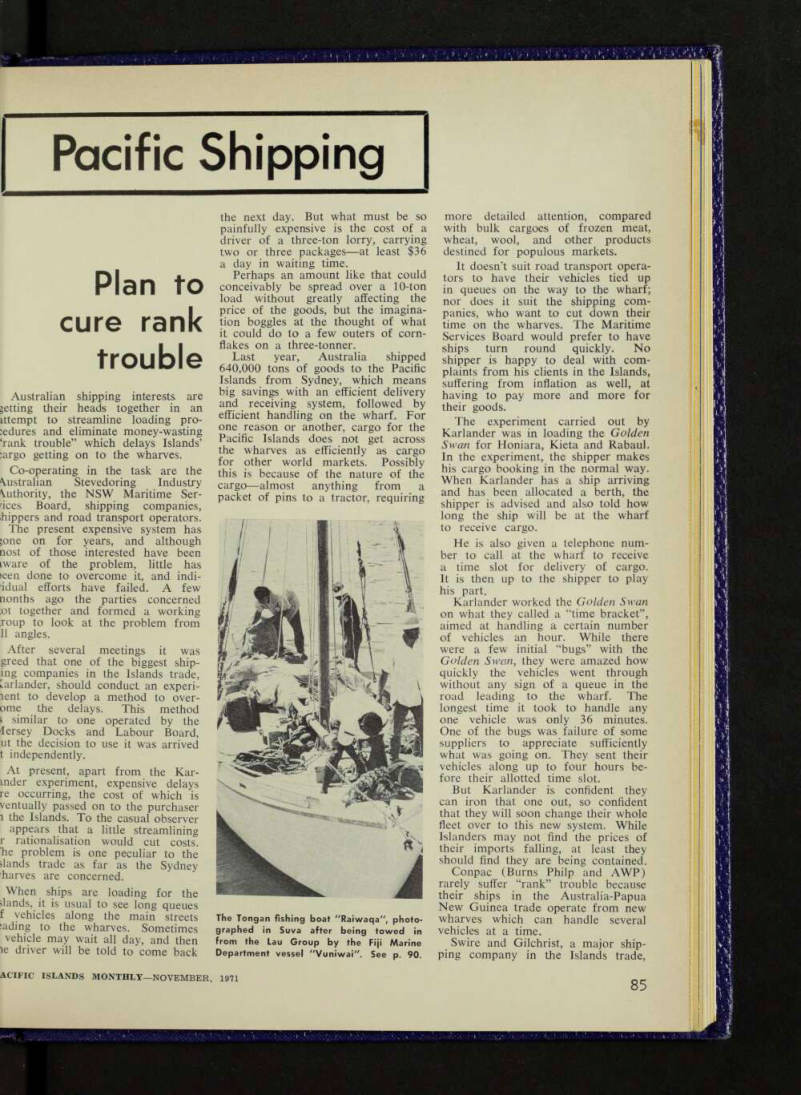

Plan to cure rank trouble
Australian shipping interests are jetting their heads together in an ittempt to streamline loading pro cedures and eliminate money-wasting ‘rank trouble” which delays Islands’ cargo getting on to the wharves.
Co-operating in the task are the \ustralian Stevedoring Industry Authority, the NSW Maritime Ser vices Board, shipping companies, hippers and road transport operators.
The present expensive system has ;one on for years, and although nost of those interested have been iware of the problem, little has »een done to overcome it, and indi idual efforts have failed. A few nonths ago the parties concerned ;ot together and formed a working roup to look at the problem from 11 angles.
After several meetings it was greed that one of the biggest ship jng companies in the Islands trade, karlander, should conduct an exped ient to develop a method to over ome the delays. This method J similar to one operated by the lersey Docks and Labour Board, ut the decision to use it was arrived
t independently.
At present, apart from the Kar mder experiment, expensive delays re occurring, the cost of which is ventually passed on to the purchaser i the Islands. To the casual observer appears that a little streamlining r rationalisation would cut costs, he problem is one peculiar to the dands trade as far as the Sydney harves are concerned.
When ships are loading for the dands, it is usual to see long queues f vehicles along the main streets cading to the wharves. Sometimes vehicle may wait all day, and then ie driver will be told to come back
the next day. But what must be so painfully expensive is the cost of a driver of a three-ton lorry, carrying two or three packages—at least $36 a day in waiting time.
Perhaps an amount like that could conceivably be spread over a 10-ton load without greatly affecting the price of the goods, but the imagina tion boggles at the thought of what it could do to a few outers of corn flakes on a three-tonner.
Last year, Australia shipped 640,000 tons of goods to the Pacific Islands from Sydney, which means big savings with an efficient delivery and receiving system, followed by efficient handling on the wharf. For one reason or another, cargo for the Pacific Islands does not get across the wharves as efficiently as cargo for other world markets. Possibly this is because of the nature of the cargo—almost anything from a packet of pins to a tractor, requiring
more detailed attention, compared with bulk cargoes of frozen meat, wheat, wool, and other products destined for populous markets.
It doesn’t suit road transport opera tors to have their vehicles tied up in queues on the way to the wharf; nor does it suit the shipping com panies, who want to cut down their time on the wharves. The Maritime Services Board would prefer to have ships turn round quickly. No shipper is happy to deal with com plaints from his clients in the Islands, suffering from inflation as well, at having to pay more and more for their goods.
The experiment carried out by Karlander was in loading the Golden Swan for Honiara, Kieta and Rabaul.
In the experiment, the shipper makes his cargo booking in the normal way.
When Karlander has a ship arriving and has been allocated a berth, the shipper is advised and also told how long the ship will be at the wharf to receive cargo.
He is also given a telephone num ber to call at the wharf to receive a time slot for delivery of cargo.
It is then up to the shipper to play his part.
Karlander worked the Golden Swan on what they called a “time bracket”, aimed at handling a certain number of vehicles an hour. While there were a few initial “bugs” with the Golden Swan, they were amazed how quickly the vehicles went through without any sign of a queue in the road leading to the wharf. The longest time it took to handle any one vehicle was only 36 minutes.
One of the bugs was failure of some suppliers to appreciate sufficiently what was going on. They sent their vehicles along up to four hours be fore their allotted time slot.
But Karlander is confident they can iron that one out, so confident that they will soon change their whole fleet over to this new system. While Islanders may not find the prices of their imports falling, at least they should find they are being contained.
Conpac (Burns Philp and AWP) rarely suffer “rank” trouble because their ships in the Australia-Papua New Guinea trade operate from new wharves which can handle several vehicles at a time.
Swire and Gilchrist, a major ship ping company in the Islands trade,
The Tongan fishing boat "Raiwaqa", photo graphed in Suva after being towed in from the Lau Group by the Fiji Marine Department vessel "Vuniwai". See p. 90.
have also introduced a system aimed at eliminating the “rank”. They ask shippers to watch their daily adver tisements in a shipping newspaper.
This advertisement gives full instruc tions about delivery of cargo. Ship pers are asked to advise the shipping clerk at the wharf the day they pre fer to deliver cargo, allowing steve dores to regulate delivery and to estimate the labour force required.
Png Shippers To
Fight Rising Rates
A shippers’ council is being formed in Papua New Guinea to try to com bat rapidly-rising freight rates be tween Australia and the Territory.
According to a Port Moresby report, a similar move is being made by Sydney exporters.
However, PIM inquiries among major exporters failed to reveal any such move in Sydney, although one shipper said, “It is high time shippers got together to form such an asso ciation”.
Freight rates between Australia and PNG have risen twice in 1971 by 15 per cent, in March and a further 9 per cent, in June. These have added to the already high cost of most consumer goods in PNG.
They have also added to the prob lems of producers of the Territory’s main export crops which are already in difficulties because of depressed world markets. For example, the price of shipping copra from Port Moresby to Australia has risen from 117 a ton in January, 1970, to $27.60 in July, 1971.
Both the Territory Administration and the Australian Government have oeen worried that increases would affect massive trade between the two countries.
In the year ended June 30, 1970, Papua New Guinea’s import bill was &211.7 million—sll2.6 million of which went to Australia.
In the same period the Territory >old $41.3 million worth of goods, 14 per cent, of its total exports, to Australia.
Decision to set up the council was nade at a meeting of Government ind businessmen in Lae in October.
Nauru Line
Puts Up Rates
Nauru Pacific Shipping Line, from November 15, will increase freight rates from Australia to the Pacific [slands by amounts ranging from 10 per cent, to 22.5 per cent, to meet ises caused by a “world-wide in lationary trend, further aggravated )y a rise in local costs of labour md materials”. Ports in New 3uinea, Guam and Fiji had all be come more expensive to work over
the last six months, said the company. The Nauru company left most of its rates unchanged when other lines raised theirs in July and August but the latest increase on rates to Fiji is the second since August.
The new rates are: Melbourne- Guam, up 10 to 15 per cent, on present JUS3B.BO; Melboume-Port Moresby, up to 124 per cent, on SA3O, ($33.75); Melbourne-Lae, Madang, Rabaul, up 124 per cent. on $31.20 (about $35.10); Melbourne-Kieta, up 12i per cent. on $36 (about $40,50); Melbourne- Fiji, up 22i per cent, on $29.30 (about $35.90); Sydney-Fiji, up 15 per cent, on $29.30 (about $33.69).
Trouble Looms Over
New Nz-Tahiti Service
, ... ... , , H v , u ?* ave a , shl PP ln ?, P el 7 lce t . wl * N « w Zealand, provided by the French °*ned S ° £rana Lme - Hol “ sh 'PP>»g c °- runs a charter vessel ° n th ® r °T Auckland and Pap f ete A the German-owned Luhe “nd- Holm had some doubts about continuing its service unless the NZ Government backed it against loss.
Not that the Luhesand operated at a loss. Captain J. F. Holm, managing director of the Holm Ship ping Co., said the Luhesand had been making a profit lately. Although it
was unlikely it would need any gov ernment money, a safeguard up to a ceiling of SNZSO,OOO over nine monies would be needed to keep the service running.
However, it appears that Holm has no intention of abandoning the ser vice. Holm is negotiating with the German owners for a renewal of the charter.
But New Zealand seamen are threatening trouble. They feared that the Luhesand might be taken off if Sofrana moved in with New Cale donian seamen, who would be paid at lower rates. They threatened to picket any Sofrana ship which started to service the route, and asked the government to take action.
Sofrana plans to start the service in November, using the Capitaine Cook.
A Whale Of A Tale
Two men trolling off Rarotonga recently in their 14 ft launch accidentally hooked a whale and almost got towed under the surface.
Dick kuddell and a friend were fishing off the north-west coast at Nikao when they sighted two whales splashing in the ocean a short dis tance away. Then their fishing reel screamed and something began to tow the launch astern.
Dick cut the line and cleared the propeller of tangled line. They lost 100 yards of line and two lures and one of their big hooks was straightened by the mammal.
“It must have been another whale,” he said later. “If I hadn’t managed to cut the line when I did it would’ve dragged us under.”
Three Of The
Best From The Captain
The Suva waterfront has never seen anything like it—a mass spank ing for a crew by the captain.
Going on board his Korean fishing ship Nam Hae 256 one morning in September, the captain found his 22man crew fast asleep after an ex hausting night ashore. Rousing them, he made them all lie, face down, on the deck.
Then, with a piece of six by two, he went down the line and gave each man three belts on the backside.
One man laughed and got a bonus of three more strokes.
Strike Echoes
The Fiji dockworkers’ strike in May is still creating echoes in the GEIC. The colony is suffering from a shortage of paper and building materials, cargoes of which have been strike-bound in Suva or have been off-loaded at other ports and have not yet found their way to the colony. One cargo, which was over carried, finished up in the Queensland city of Townsville.
Advertisements & other items, pp. 89-92 (2 items)
85
ACIFIC ISLANDS MONTHLY—NOVEMBER, 1971
Fiji Nuts
f FG ‘ 200 echosounder FRA* 10 radar
Picking your way among
islands,reefs,and sea traffic?
B FG 200
FRA 10
For further information please contact: Don't leave it to chance. Leave it to Furuno marine radars and echo sounders. Whether you pilot a fishing boat,pleasure boat.tug.or ferry, you need not leave navigation to chance. The precision Furuno Radar model FRA-lOand the portable Furuno Echosounder model FG-200are the ideal navigational aids for you !!
Why not take your chance with Furuno ?
Other main products: Radiotelephones, Loran Receivers, Fish Finders, Facsimile Receivers, Automatic Direction Finders. Sonars, etc.
B FURUNO ELECTRIC 9-52,Ashihara-cho,Nishinomiya City. Japan.
CO., LTD. Cable: FURUNO NISHINOMIYA
tropic or temperate climate —Fibreglass Refrigerated
units by George & Ashton exceed requirements George and Ashton moulded fibreglass refrigerated units are unaffected by rust, rot, fatigue, weathering or corrosion. No joints to harbour vermin, so cleaning is easy. Used for any type of vehicle or as static storage units. Any size units can be supplied assembled or in prefabricated sections for easy shipping and erection on site.
Approved by N.Z. Depts of Health and Agriculture.
GEORGE &
ASHTON
P.O. Box 2056.
South Dunedin, New Zealand.
Phones 54-108, 54-109 George & Ashton (P. 1.) Ltd.
Box 296, Suva, Fiji.
Phone 26-249.
FIJI NUTS
The Fiji Meats unit illustrated is the second supplied to this Company
BENEFIT FROM 86 YEARS
OF INSURANCE EXPERIENCE
QUEENSLAND
INSURANCE
Company Limited
(INCORPORATED 1886 IN AUSTRALIA)
HEAD OFFICE; 82 Pitt Street, Sydney FIJI ■ —Branch Office, Suva, Manager for Fiji: K. Galloway.
LAUTOKA, BA, LEVUKA, LAB ASA—Burns Philp (South Sea) Co. Limited. District Manager at Lautoka: U. Singh.
PAPUA-NEW GUlNEA—Branch Office, Port Moresby: Manager for Papua & New Guinea: D. J. Granter.
SAMARAI, LAE, MADANG, RABAUL, KAVIENG,
MT. HAGEN—Bums Philp (New Guinea) Limited.
District Manager at Rabaul: C. D. Dickings. Acting District Manager at Lae: B. Wain. District Manager at Mt. Hagen: G. F. Donnelly.
HONIARA (b.s.i.p.)— Breckwoldt & Company (s.i.) Pty. Limited.
NOUMEA—W. Johnston.
VlLA—Burns Philp (New Hebrides) Limited.
SANTO—Burns Philp (New Hebrides) Limited.
NORFOLK ISLAND—Bums Philp (South Sea) Co. Limited.
TAHlTl—Arthur Chung; Immeuble 8.1., Front deMer, Papeete.
OTHER SOUTH SEA ISLANDS—Bums Philp (South Sea) Co. Limited.
Assets exceed $A65,000,000
RELIABILITY
IN ANY WEATHER IN ANY CRAFT
if m 111. Lees 4-75 & 150-180.
Never a moment's worry when your craft is powered by a Lees Marine Engine. Economical too 1 Backed by an efficient service throughout Australia and the Pacific, covering instant replacement of spare parts ... and expert advice free. .
Send for Brochure with details of Marine Engines, orbitrol power steering, casale V-drive, jets, gearboxes, cooling systems, etc. . . . it’s FREE.
PRIVATE BAG, PAPAKURA, N.Z.
PHONE: 86-019 PAPAKURA
VUIIVC, ]CIO, I UU/U-J, wvw .. —, -' -
LEES MARINE LIMITED
FOR ALL YOUR SHIP REPAIRS
% P o -*** m
CABLES:
"BISHLIMITED"
G.P.O. BOX 172,
SUVA. FIJI ISLANDS.
BISH LIMITEI
H29BL
(ESTABLISHED 1906)
Works phone: 23021, 2‘, 22668, 22669, 22660.
A/H Workshop: 21 Manager: 2‘.
Asst. Man : 2
threat to end contract
Mill escapes TT Govt, threat to end contract
From a Saipan correspondent
Blasted by the United States Trust Territory Deputy High Commissioner Peter T. Coleman for alleged breaches of its shipping services con tract with the government, Micro nesian Interocean Line Inc, (MILI) almost lost its contract.
The threat came at the end of September when MILI, facing a financial crisis through the long strike by longshoremen on the US west coast, which was costing the company losses of $4,000 a day, was told by Mr. Coleman that the govern ment was taking steps to cancel the contract.
Coupled with MILI’s unhappy situation was the resignation of two members of the board—Mr. Gilbert Hofling, president and general manager, and Mr. Tage Blytmann, vice-president, traffic. Neither man would comment much, although Mr. Hofling did say it was the re sult of “a difference with the board over policy”.
MILI chairman, Mr. George C.
Kiskaddon wrote to the Interior De partment in Washington early in September about MILI troubles. He sought a number of assurances, in cluding normal security protection for civilian goods at ports, amenities for longshoremen, the provision of offices, guards’ quarters, etc.
He also asked the US Government for a loan of $500,000 (or guarantee to private sources). Another request was for the government to buy all MILI port developments at book value and sell to bona fide local enterprise. There were also requests for freight adjustments and compen sation for cargo competitors were allowed to carry to Kwajalein.
The next development was a state ment by Mr. Coleman, alleging that MILI had breached the shipping ser vices contract between it and the TT Government. Because of the alleged breach, the government was taking steps to cancel the contract. He said the government was exercising its claim against a $500,000 performance bond placed with a San Francisco bank by MILI. This was to assure faithful performance of the transport service agreement by MILI.
Mr. Coleman said that if the con tract was cancelled, the TT Govern ment would make every effort to pro tect the interests of the many hun
dreds of Micronesian stockholders and employees of the firm.
This contract, signed on August 1. 1968, is for 10 years and gives MILI exclusive rights to provide shipping services to the TT from the Far East and the US west coast as well as from any other international port.
The government alleged that MILI: • Failed to provide the govern ment with an annual schedule—the basic document of marine service in tentions and capability; • Failed to adhere to a 30-day trans-Pacific schedule, or to an 18day schedule of service to the Wes tern Districts of the TT, according to Mr. Coleman, almost “a wilful disregard of . . , contractual obliga tion”; • Gave notice to Barclays Bank, of San Francisco, that it did not in tend to renew its performance bond, which was in the form of a letter of credit from the bank to the TT government.
It was the last allegation which forced the government’s threat to exercise its claim against the bond.
Failure by MILI to provide an ade quate service bond was looked on by the TT Government as MILI’s most serious breach of contract.
Mr. Coleman in a letter to Mr.
Hofling late in September, said MILI’s “deteriorating financial situa tion” was a matter of grave concern to the government, A consolidated cash forecast indicated a deficit posi tion of about $900,000. After de ducting the possible capital worth of the company, he considered MILI had too big a deficit from which to re cover, unless immediate drastic ac tion was taken.
MILI officials reacted by saying the allegations of Mr. Coleman had not been proved. They considered they were not in breach of contract in anything alleged, except in relation to renewal of the performance bond.
The reprieve came on October 20 when the TT Government and MILI officials announced that they had reached agreement on reorganisation.
This will enable the reorganised ship ping line to continue service to Micro nesia under the general terms of the contract. As a result of the agree ment, the government withdrew notice of intention to cancel the contract, and MILI agreed to take steps to im prove its finances and resolve diffi
culties which led to the government action.
These steps included: Change of control, both operationally and finan cially, to Micronesian stockholders and MILI officials; transfer of stock with shares placed in trust; and re placement of four San Francisco members of the board by four Micro nesians. Under this agreement chair man George Kiskaddon drops out.
The 12-member board is now com posed entirely of Micronesians.
Anewa Bay
Gets Its Pilot
Captain lan de Baird, formerly of the Fiji Marine Department, arrived at Bougainville on October 14 to take up his duties as pilot and harbour master when Anewa Bay becomes a private port administered by the Bougainville Copper Co. Date for the takeover is sometime in November.
At present, pilot work is done by a government pilot from Kieta. An other ex-Fiji Marine Department pilot, Captain Jack Dalby, is port superintendent at Anewa Bay. Cap tain dc Baird was at Singapore before going to Fiji two years ago.
Lorena Had
Teething Troubles
The Norwegian-owned Lorena has made her first cargo voyage from Auckland to Rarotonga, but only atfer teething troubles. She had to leave 35 tons of refrigerated cargo behind because hold temperatures could not be lowered to below freez ing point. This was caused by a mechanical fault, and poor stowage of cargo.
There was also trouble with the NZ Cooks and Stewards’ Union over a requirement by the owners. All ships sailing under the Norwegian flag require all crew to have medical examinations and chest X-rays. The NZ Seamen’s Union agreed to this condition, but the Cooks and Stewards’ Union held off. There was an arrangement to sail the ship with Norwegian cooks and stewards and NZ seamen, pending negotiations be tween the Cook Islands Shipping Co., which chartered the Lorena, and the union.
When the ship was about to leave Auckland for Whangarei to load cement for the Cooks, a representa tive of the Cooks and Stewards Union went on board and said the ship was “black”. The seamen ignored this and took the ship to Whangarei.
At Whangarei, the Cooks and Stewards’ Union mounted a picket line which halted loading for about an hour. When loading was com pleted the Lorena sailed for Raro tonga.
And Rescues
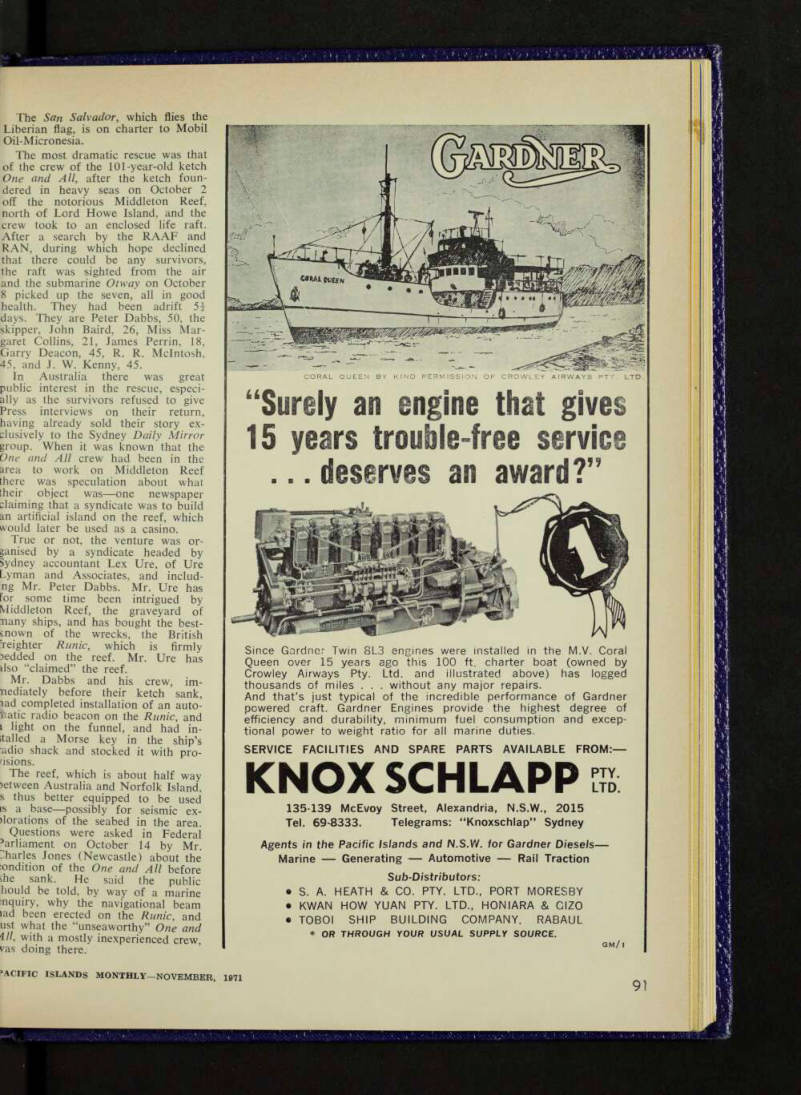
Marine Mishaps
Several mishaps were reported last month and late September but there was no loss of life. However, a ketch and barge were lost. Two ships, which became disabled and had to drift, were rescued. Their stories follow: A Tonga oil barge, the Lolo manaia, sank near Vatoa Island in southern Lau early in October. She was on her way from Suva to Tonga, towed by the Hifofua, when she cap sized 19 miles east of Vatoa.
The Hifofua picked up the crew and the tow continued, for a short time, with the barge’s stern about 10 feet out of the water. The cargo of 500 tons of motor fuel for British Petroleum was lost when the Lolo manaia sank.
Later, Tonga’s Deputy Prime Minister, Mr. M. U. Tupouniua, called an emergency meeting with fuel suppliers to discuss the situation following the sinking of the Lolo manaia. Because of uncertainty about future fuel supplies, he appealed for co-operation in conserving fuel.
The LCU-1495, a US Navy boat on loan to the Marianas District, broke down and drifted helplessly for three days in September before she was rescued by a Japanese ship.
She was on her way from Saipan to Pagan Island in the northern Marianas with heavy equipment for use in dismantling and shifting a damaged US Navy aircraft which had crashed on the Pagan airstrip.
The Japanese ship, the Shichiyo Maru, found the LCU-1495 about 200 miles north - east of Saipan.
Several Navy and Air Force planes, and three ships took part in the search. A US Navy minesweeper, the Pluck, was detailed to rendezvous with the LCU-1495 and tow it back to Saipan.
Eleven Tongan fishermen arrived hungry and exhausted in Suva in late September after a chance rescue by the Fiji Marine Department vessel Vuniwai.
Their fishing boat Raiwaqa, was towed to Suva by Vuniwai after being spotted hundreds of miles off course, near the island of Ono-i-Lau in Fiji s Lau Group. Out of food, and with only a few bottles of rainwater, the Tongans were in an exhausted state after battling against stormy weather for six days.
The fishing boat left Nukualofa on September 14 on a three-day fishing trip.
She started to drift to the north east when a storm struck at 3 a.m. the following day. The crew spent the next three days trying to beat back to Tonga against 30-knot winds, patching ripped mainsails with fish sacks in the meantime.
By Monday, supplies had shrunk to two loaves of bread and two half bottles of water. By Monday night, the bread had gone. The following day the weather cleared and the wind dropped. During a rainfall, the men were able to catch enough water to fill bottles and cans.
On the Wednesday morning, the relieved Tongans spotted the Vuniwai anchored at harbour at Ono-i-Lau.
They were taken in tow, arriving in Suva on September 25.
The 26,000-ton oil tanker San Salvador drove its bows 7 ft into the pier on Saipan’s Charlie dock on October 10 while attempting to berth with a load of bulk fuel and oil.
As the tanker crunched its way into the pier, oil, enough to fill several hundred barrels, poured through a gash in the San Salvador’s bows into the harbour.
Public Works officials encircled the 450 ft long tanker with a boom of floating lumber and managed to con tain the oil spill. It was then “mopped up” with “tangen-tangen” branches and buckets.
Divers, who inspected the pier, said the gash went down for more than 20 ft and appeared to be extensive.
No estimate of the amount of damage has been made.
The San Salvador, which flies the Liberian flag, is on charter to Mobil Oil-Micronesia.
The most dramatic rescue was that of the crew of the 101-year-old ketch One and All, after the ketch foun dered in heavy seas on October 2 off the notorious Middleton Reef, north of Lord Howe Island, and the crew took to an enclosed life raft.
After a search by the RAAF and RAN, during which hope declined that there could be any survivors, the raft was sighted from the air and the submarine Otway on October 8 picked up the seven, all in good health. They had been adrift 5i days. They are Peter Dabbs, 50, the skipper, John Baird, 26, Miss Mar garet Collins, 21, James Perrin, 18, Garry Deacon, 45, R. R. Mclntosh, 45, and J. W, Kenny, 45.
In Australia there was great public interest in the rescue, especi ally as the survivors refused to give Press interviews on their return, having already sold their story ex clusively to the Sydney Daily Mirror group. When it was known that the One and All crew had been in the area to work on Middleton Reef there was speculation about what their object was—one newspaper claiming that a syndicate was to build an artificial island on the reef, which would later be used as a casino.
True or not, the venture was or ganised by a syndicate headed by Sydney accountant Lex Ure, of Ure Lyman and Associates, and includ ng Mr. Peter Dabbs. Mr. Ure has For some time been intrigued by Middleton Reef, the graveyard of nany ships, and has bought the best mown of the wrecks, the British Teighter Runic, which is firmly aedded on the reef. Mr. Ure has ilso “claimed” the reef.
Mr. Dabbs and his crew, im nediately before their ketch sank, lad completed installation of an auto matic radio beacon on the Runic, and i light on the funnel, and had in •talled a Morse key in the ship’s adio shack and stocked it with pro visions.
The reef, which is about half way jetween Australia and Norfolk Island, s thus better equipped to be used is a base—possibly for seismic ex ecrations of the seabed in the area.
Questions were asked in Federal parliament on October 14 by Mr.
Charles Jones (Newcastle) about the :ondition of the One and All before she sank. He said the public hould be told, by way of a marine inquiry, why the navigational beam lad been erected on the Runic, and ust what the “unseaworthy” One and ill, with a mostly inexperienced crew, vas doing there.
Gone fishing!
Saipan stevedores have got it made —at least 20 of them have.
A big problem has been a time lag between ships, giving spas modic employment only. It could be that the manager of the Saipan Stevedoring Co., Mr.
Alf Santos, has hit on a solu tion.
Recently, between ships, he rounded up 20 of his employees, lent them two boats and sug gested they go fishing. He offered to buy whatever they caught. In their first two days the men caught 900 lb of reef fish.
What they did not take home they sold to Mr. Santos.
Mr. Santos is not being a philanthropist. He intends to freeze the fish, and use it for meals when full gangs are work ing a ship.
Advertisements & other items, p. 95 (2 items)
91
*ACIFIC ISLANDS MONTHLY—NOVEMBER, 1971
Knox Schlapp
lIBK
W*Al WISH
CORAL QUEEN BY KIND PERMISSION OF CROWLEY AIRWAYS PTY. LTD.
“Surely an engine that gives
15 years troulile-free service
... deserves an award?”
m m Since Gardner Twin BL3 engines were installed in the M.V. Coral Queen over 15 years ago this 100 ft. charter boat (owned by Crowley Airways Pty. Ltd. and illustrated above) has logged thousands of miles . . . without any major repairs.
And that's just typical of the incredible performance of Gardner powered craft. Gardner Engines provide the highest degree of efficiency and durability, minimum fuel consumption and exceptional power to weight ratio for all marine duties.
SERVICE FACILITIES AND SPARE PARTS AVAILABLE FROM:—
KNOX SCHLAPP
135-139 McEvoy Street, Alexandria, N.S.W., 2015 Tel. 69-8333. Telegrams: “Knoxschlap” Sydney Agents in the Pacific Islands and N.S.W. for Gardner Diesels- Marine Generating Automotive Rail Traction Sub-Distributors: • S. A. HEATH & CO. PTY. LTD., PORT MORESBY • KWAN HOW YUAN PTY. LTD., HONIARA & GIZO
• TOBOI SHIP BUILDING COMPANY, RABAUL
* OR THROUGH YOUR USUAL SUPPLY SOURCE.
PTY.
LTD.
gm/i
Cruising
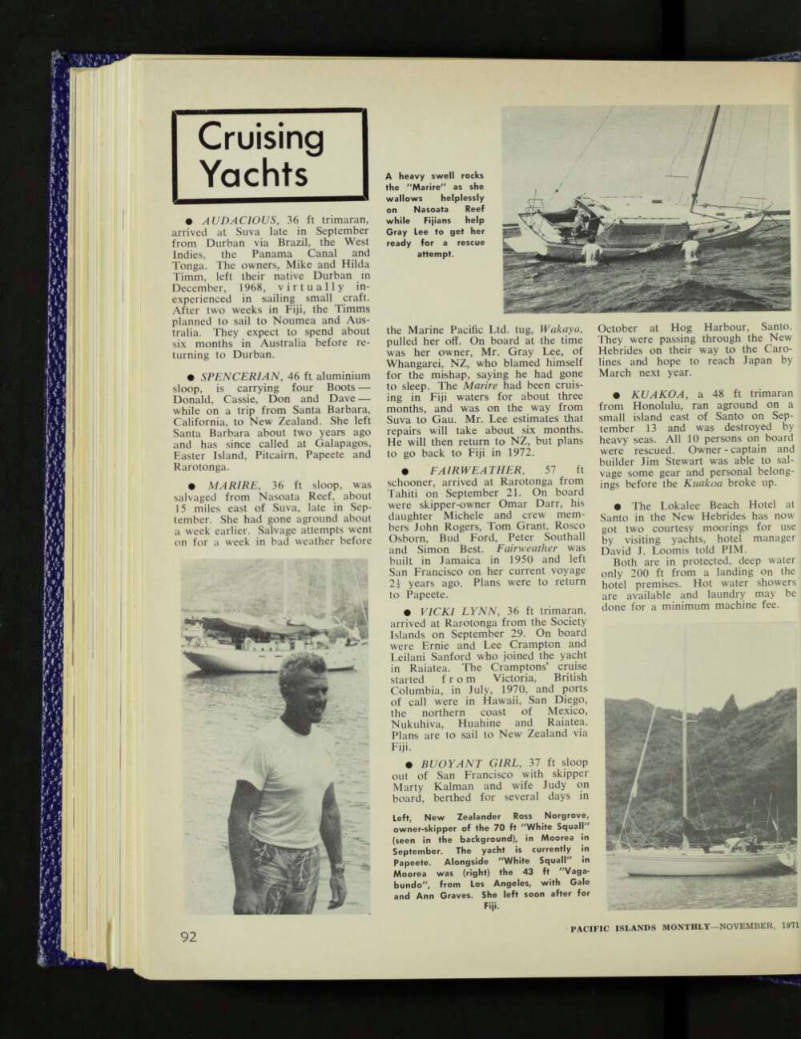
Yachts
• AUDACIOUS, 36 ft trimaran, arrived at Suva late in September from Durban via Brazil, the West Indies, the Panama Canal and Tonga. The owners, Mike and Hilda Timm, left their native Durban in December, 1968, virtually in experienced in sailing small craft.
After two weeks in Fiji, the Timms planned to sail to Noumea and Aus tralia. They expect to spend about six months in Australia before re turning to Durban. • SPENCERIAN, 46 ft aluminium sloop, is carrying four Boots Donald, Cassie, Don and Dave while on a trip from Santa Barbara, California, to New Zealand. She left Santa Barbara about two years ago and has since called at Galapagos, Easter Island, Pitcairn, Papeete and Rarotonga. • MARIRE , 36 ft sloop, was salvaged from Nasoata Reef, about 15 miles east of Suva, late in Sep tember. She had gone aground about a week earlier. Salvage attempts went on for a week in bad weather before
the Marine Pacific Ltd. tug, Wakaya, pulled her off. On board at the time was her owner, Mr. Gray Lee, of Whangarei, NZ, who blamed himself for the mishap, saying he had gone to sleep. The Marire had been cruis ing in Fiji waters for about three months, and was on the way from Suva to Gau. Mr. Lee estimates that repairs will take about six months.
He will then return to NZ, but plans to go back to Fiji in 1972.
• Fairweather, 57 Ft
schooner, arrived at Rarotonga from Tahiti on September 21. On board were skipper-owner Omar Darr, his daughter Michele and crew mem bers John Rogers, Tom Grant, Rosco Osborn, Bud Ford, Peter Southall and Simon Best. Fairweather was built in Jamaica in 1950 and left San Francisco on her current voyage 21 years ago. Plans were to return to Papeete. • VICKI LYNN, 36 ft trimaran, arrived at Rarotonga from the Society Islands on September 29. On board were Ernie and Lee Crampton and Leilani Sanford who joined the yacht in Raiatea. The Cramptons’ cruise started from Victoria, British Columbia, in July, 1970, and ports of call were in Hawaii, San Diego, the northern coast of Mexico, Nukuhiva, Huahine and Raiatea.
Plans are to sail to New Zealand via Fiji. • BUOYANT GIRL, 37 ft sloop out of San Francisco with skipper Marty Kalman and wife Judy on board, berthed for several days in
October at Hog Harbour, Santo.
They were passing through the New Hebrides on their way to the Caro lines and hope to reach Japan by March next year. • KUAKOA, a 48 ft trimaran from Honolulu, ran aground on a small island east of Santo on Sep tember 13 and was destroyed by heavy seas. All 10 persons on board were rescued. Owner - captain and builder Jim Stewart was able to sal vage some gear and personal belong ings before the Kuakoa broke up. • The Lokalee Beach Hotel at Santo in the New Hebrides has now got two courtesy moorings for use by visiting yachts, hotel manager David J. Loomis told PIM.
Both are in protected, deep water only 200 ft from a landing on the hotel premises. Hot water showers are available and laundry may be done for a minimum machine fee.
A heavy swell rocks the "Marire" as she wallows helplessly on Nasoata Reef while Fijians help Gray Lee to get her ready for a rescue attempt.
Left, New Zealander Ross Norgrove, owner-skipper of the 70 ft "White Squall" (seen in the background), in Moorea in September. The yacht is currently in Papeete. Alongside "White Squall" in Moorea was (right) the 43 ft "Vaga bundo", from Los Angeles, with Gale and Ann Graves. She left soon after for Fiji.
Advertisements & other items, p. 97 (1 item)
International Trucks
Proved best by test
on one of the world’s
toughest truck
testing courses!
■ f a a Proved best of all by thousands of owners!
INTERNATIONAL TRUCKS
EXPORT SALES DEPT.
International Harvester Company of Australia Pty. Ltd. 171-205 City Road, South Melbourne, Vic. Aust. 3205.
Please send me complete details of the ACCO Series Trucks
NAME,
ADDRESS
ACCO Series trucks (with GVW ratings from 15,000 lb. to 35,000 lb.) have been testedand proved-under the worst conditions you could ever imagine ... conditions far worse than any you are likely to meet!
A top seller in Australia, the top truck in the carrying field, ACCO Series trucks are the ones to buy if you want the best!
Get full details today from your local distributor or send coupon. . C^! DC ifl l^.: .. A9ence Marine Agricole Electique, Boite SOLOMON ISLANDS: Solomon Motors Limited, P.O. Box Cl 6, Postals 473, NOUMEA, NEW CALEDONIA HONIARA. GUADALCANAL BSIP. "SOLMOT"
Limited, G.P.O. Box 450, SUVA. TAHITI: Tahiti Produits Shelltex Boite Postale 350, PAPEETE,
FIJI ISLANDS "NIRANJAN" TAHITI
NEW HEBRIDES: Kerr Bros. Pty. Limited, G.P.O. Box 3838,
SYDNEY, N.S.W.
POSTCODE,
6710/E/FP
Business and Development
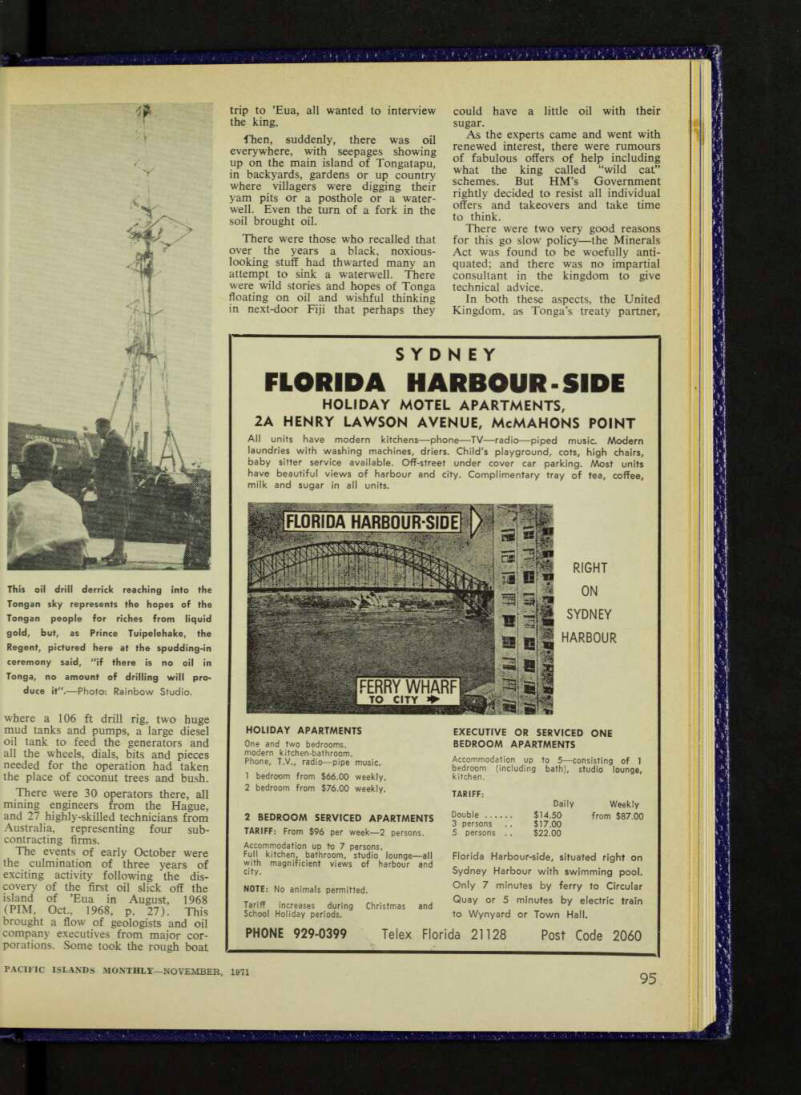
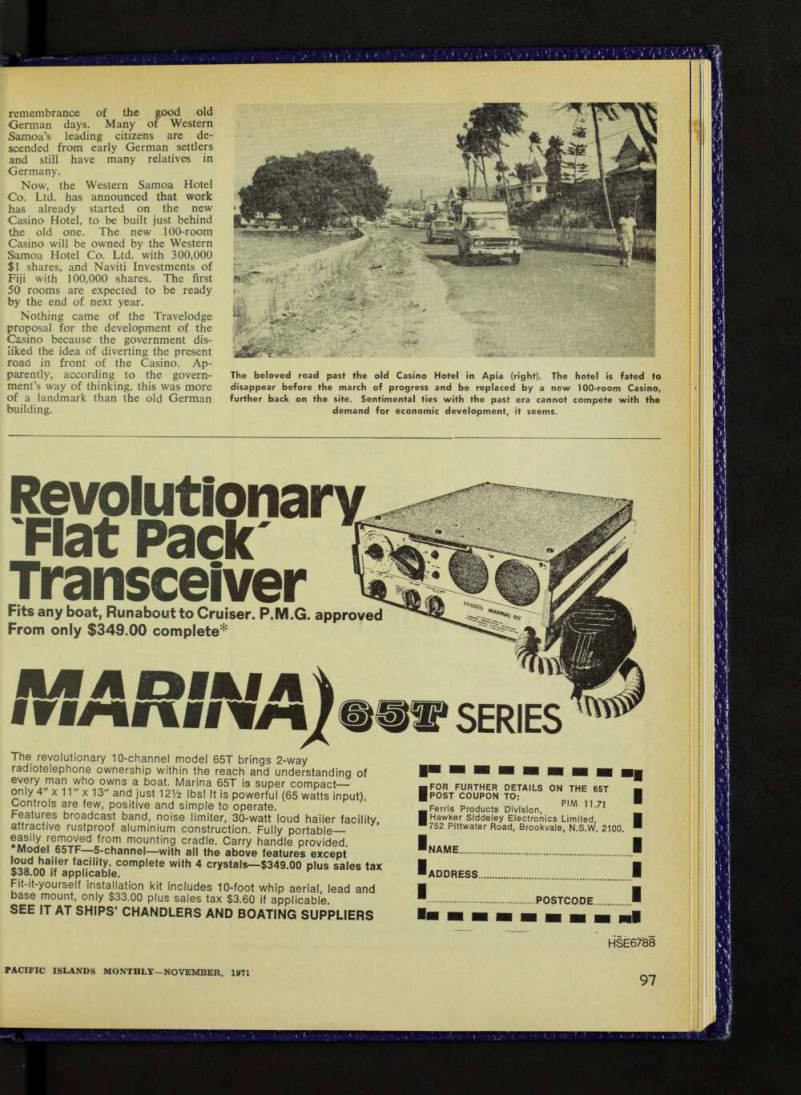
Things are
tough in the
Cook Islands
The Cook Islands Government is in hock to Rarotonga firms to the tune of $350,000. Or so the story goes in Rarotonga where there is confirmation offered in the shape of a refusal by some of the firms to supply any more goods on credit to government stores.
Other stores still accept orders but are charging 1 per cent, per month on overdue accounts. Govern ment penury is also reflected in private sectors which have been affected by a severe curtailment in government spending.
This has also reduced citrus pro duction. Island Foods Ltd.’s factory has reported a drop of more than 40,000 cases of fruit for processing this year, which represents a loss to growers of about $62,000. The future of the citrus industry looks glum with grower interests declining and many orchards showing neglect.
Shippers report a general slowing down of cargo between the islands in the group but this time of the year usually sees a drop in freight move ments with the citrus season at an end and pineapple production not due to start until late November.
Large numbers of government workers have been laid off, almost 100 in Rarotonga alone, and trading firms report big reductions in cash sales with consequent increases in applications for credit.
One major sales and service firm complained that business was all “to hell and gone” over the past two months with sales in August and September down to less than half the June volume.
The islanders were hoping that New Zealand would come to the rescue at the behest of Premier Albert Henry who went there look ing for an extra $1.2 million to tide his country over the crisis, but hopes were somewhat dashed when Mr.
Henry, on the eve of returning home
on October 20, wailed that he had asked for a loaf of bread and got only half a loaf.
But that half loaf is worth $500,000, which the NZ Government had fixed as the most it would hand out on this occasion. Mr. Henry was downcast. He doesn’t expect that even his persuasive pleading will be able to loosen New Zealand’s purse-strings further.
The NZ Government’s financial re view team headed by Mr. B. D. A.
Crieg, recently retired comptroller and auditor-general of the NZ Gov ernment, has been in the Cooks assessing the situation.
The team was expected to follow up rumours of serious overspending by some government departments with suspected inefficient administra tive machinery. It’s not clear what the team found but, if the amount the NZ Government has agreed to hand out is any criterion, the team has found that things are only about half as bad as has been reported.
This won’t cheer the Premier how ever. He was decidedly despondent when he left for home.
“I am an unhappy man returning to the islands not knowing what will happen,” he said.
Tonga digs the
modern dream
From BETTY SANFT in Nukualofa King Taufa’ahau of Tonga calls his first exploratory oil well now being drilled at Maafanga, two miles out of Nukualofa, Kumifonua, which means exploring or prospecting. But Fonua, often used in Tongan poetry, means a place of rest, where dreams can come true, which is probably what his Majesty had in mind when he named it.
He was on his state visit to India with his Queen Mata’aho when the well was spudded in on October 5 with Prime Minister Prince Tuipele hake setting off the drill rig which could make dreams come true of a Kuwait in the South Pacific.
The king’s brother didn’t mention dreams. He was down to earth with a warning that “if there is no oil in Tonga then no amount of drilling will produce it”, and then on a much higher plane with, “But, if God is with us in this project, then we shall strike oil”.
A crowd of several hundreds flocked to the site, a flat, open acre
where a 106 ft drill rig, two huge mud tanks and pumps, a large diesel oil tank to feed the generators and all the wheels, dials, bits and pieces needed for the operation had taken the place of coconut trees and bush.
There were 30 operators there, all mining engineers from the Hague, and 27 highly-skilled technicians from Australia, representing four sub contracting firms.
The events of early October were the culmination of three years of exciting activity following the dis covery of the first oil slick off the island of ’Eua in August, 1968 (PIM, Oct., 1968, p. 27). This brought a flow of geologists and oil company executives from major cor porations. Some took the rough boat
trip to ’Eua, all wanted to interview the king. fhen, suddenly, there was oil everywhere, with seepages showing up on the main island of Tongatapu in backyards, gardens or up country where villagers were digging their yam pits or a posthole or a waterwell. Even the turn of a fork in the soil brought oil.
There were those who recalled that over the years a black, noxiouslooking stuff had thwarted many an attempt to sink a waterwell. There were wild stories and hopes of Tonga floating on oil and wishful thinking in next-door Fiji that perhaps they
could have a little oil with their sugar.
As the experts came and went with renewed_ interest, there were rumours of . f f b “J. ous . 9 ffers help including w !* at the ,~ wld ca i, s^if, l T es j ? u i s Government r, J htly d “ lded to resist all individual ? ffe , r k s . and takeovers and take time to i? in * 4 , .
There were two very good reasons for this go slow policy—the Minerals Act was found to be woefully anti quated; and there was no impartial consultant in the kingdom to give technical advice, In both these aspects, the United Kingdom, as Tonga’s treaty partner,
This oil drill derrick reaching into the Tongan sky represents the hopes of the Tongan people for riches from liquid gold, but, as Prince Tuipelehake, the Regent, pictured here at the spudding-in ceremony said, "if there is no oil in Tonga, no amount of drilling will pro duce it".— Photo: Rainbow Studio.
came to her aid with the provision of an oil expert for close consultation. „„ . , , , , When the act was upgraded and government moved with more confidence, oil talks were held m London between the British, the Tongan Government and major oil companies, The outcome was a six-member consortium signed up to carry out invest!gallons over an area that takes in the mam island groups and much of the ocean floor m between, A subsidiary of the Shell Group, the first in Tonga as suppliers of
fuel oil, was set up to head the search. Tonga Shell NV established headquarters in Nukualofa in mid -1970 and moved reasonably fast s i nce then with geological and mag netometer surveys on land and off .
They have now reached the significant point of drilling the first exploration well. the time of writ ing, Kumifonua No j has reached a depth of 1?800 working around the clock, seven days a wee bringing a touch of drama and a sense of anticipation to the lives of the people of this quiet corner of the Pacific.
Suva land
values soar
A revaluation of land within the boundaries of Fiji’s capital, Suva, has ballooned the total value to $51,725,270 compared with the original figure of $13,512,407 set six years ago.
The increase means a much bigger rate bill for Suva landowners al though the City Council is expected to cut its present rate of 5c in the dollar to something like 1.13 c.
Shopkeepers and people living in the recently-developed areas will feel the draught more than dwellers in the older parts of the city. Muanikau ward, one of the more “exclusive” areas, has had its land values raised from $1,915,000 to $7,558,000. Suva ward’s figure is $29,999,000 compared with $7,776,000 and Samabula’s rises from $3,829,000 to $14,167,000.
Among the shopowners, Morris Hedstrom Ltd. have had their site, which covers more than an acre, in creased from $159,488 to $657,800, while Gumming Street shop sites most occupied by Gujerati shop keepers, have jumped from around $B,OOO to more than $50,000.
The increases, according to Lands Department senior valuer, reflect the heavy demand for sites which have sent land prices zooming since 1969.
Ratepayers have until the year-end to appeal against the new valuations, which could create an interesting situ ation if some of the valuations were upset. The City Council will fix its 1972 rate in November, using the new valuation figures. Should these be greatly reduced on appeal, the council would find itself a long way from balancing its 1972 budget.
Work starts on
the new Casino
Although the Western Samoa parliament had already approved the removal of the old German Casino Hotel on the Apia waterfront, nothing can hide the fact that the decision is controversial.
Built during the German colonial era (1900-1914) as a kind of rest centre for aged and sick servants of the Kaiser, the Casino—-until the emergence of Aggie Grey’s hotel— had always enjoyed eminence as Western Samoa’s leading hotel.
It had become an historic land mark in the capital of the first inde pendent Polynesian nation and a
remembrance of the good old German days. Many of Western Samoa’s leading citizens are de scended from early German settlers and still have many relatives in Germany.
Now, the Western Samoa Hotel Co. Ltd. has announced that work has already started on the new Casino Hotel, to be built just behind the old one. The new 100-room Casino will be owned by the Western Samoa Hotel Co. Ltd. with 300,000 $1 shares, and Naviti Investments of Fiji with 100,000 shares. The first 50 rooms are expected to be ready by the end of next year.
Nothing came of the Travelodge proposal for the development of the Casino because the government dis liked the idea of diverting the present road in front of the Casino. Ap parently, according to the govern ment’s way of thinking, this was more of a landmark than the old German building.
The beloved road past the old Casino Hotel in Apia (right). The hotel is fated to disappear before the march of progress and be replaced by a new 100-room Casino, further back on the site. Sentimental ties with the past era cannot compete with the demand for economic development, it seems.
Share gift offer
boomerangs on BP
The Fiji Government has rejected an offer by Burns Philp (South Sea) Co. Ltd. of 200,000 shares at an “advantageous price” as an indepen dence gift.
The shares, which were offered at $2.50, 50c above par, are around $3.15 on the Sydney Stock Exchange.
If the government had accepted the offer, it would have received about the middle of October a final divi dend of 5 per cent, plus a special dividend of 2i per cent., a total of $30,000 on the 200,000 shares.
In a written address delivered at the annual meeting in Suva on October 16, which he was unable to attend having broken a rib in a fall, chairman Sir Maurice Scott said the share offer was in recognition of the government’s wish to take an in terest in local enterprise.
The government’s reaction was to suggest that the shares be sold to Fiji citizens at the same price, but Burns Philp is not expected to agree to this as it would leave the situation wide open to speculators. Burns Philp (SS) is now on the horns of a dilemma The company’s net profit for the year was $683,894.
Carpenter profit
a record
The Fiji dock strike in April and May caused some loss of profit to the Carpenter companies there, but the amount was impossible to assess.
This was stated in the preliminary re port to June 30, 1971, of Carpenter Holdings Ltd., released in October.
There were also substantial losses in earnings in the group’s stevedoring division because of the strike. Island Transport Ltd., the Carpenter local shipping operator, had a net loss of $51,007 in the latest financial year, as its three ships were tied up for the duration of the strike.
In spite of all that overall turn over and profits of the group in Fiji were at record levels. Total mer chandise sales increased by 11.5 per cent, over the previous year. The industrial activities of Millers Ltd. maintained a high level of output, while building construction also made an important contribution to profits.
The Carpenter group in Papua New Guinea lifted total merchandise sales by 10.7 per cent., but sub stantial cost increases cut profits to be low last year’s level.
The group’s automotive division, following management changes and an internal reorganisation, returned to a satisfactory level of profitability.
Progress in the tea industry continued to be good, with production up; coffee production was up, so was copra and cocoa (but prices dropped).
The company’s net profit was a record $6,747,896, compared with $6,035,809 in 1969-70. The net earning rate on the issued capital was 37.5 per cent. The final dividend is 10 per cent., making a steady 20 per cent, payout for the year. • ANG Holdings Ltd., investment and development company, has de clared its first dividend—s per cent, on a net profit of $380,537 for the year ended June 30. In 1969-70, the company’s net profit was $149,706, while in 1968-69 it was $6,000. • Reports of a plan to build a cable car to Robert Louis Steven son’s tomb atop Mt. Vaea, above Apia in Western Samoa, and also of a Canadian Government offer to build a hotel on Mt. Vaea, have been termed “rumours” by the Western Samoa Department of Economic De velopment. • Potlatch timber operations in Asau, Western Samoa, are reportedly in full swing, although there is still some trouble with the Asau wharf for larger ships.
Copra Market Still Depressed
But Recovery Possibly On Way
Conditions in the copra markets of the world continued in their de pressed state throughout most of October, although there was evidence of some price recovery during the week ended on October 16, general manager of the PNG Copra Marketing Board reported in Port Moresby in late October. He added: “The main factors influencing world prices continue to be the un settled currency conditions, the dock strikes in the United States, and a general surplus in supplies available in UK/Europe , ... .
“President Nixon using the Taft/Hartley law ordered the West Coast strikers back to work for a cooling-off period, but the present unsettled conditions will probably continue until some satisfactory negotiations are concluded and the strikes end.
“The decline in world prices forced a further reduction of $B.OO a ton in tentative prices currently being paid by the PNG Copra Market ing Board and with effect from October 1, these were reduced to.
Hotair 5103.00 per ton, FMS $lOO.OO, Smoke $98.00.
“All prices were inclusive of the bounty payment of $3.00 per ton paid on behalf of the Copra Industry Stabilisation Board.’
Advertisements & other items, pp. 99-102 (1 item)
Florida Harbour-Side
SYDNEY
HOLIDAY MOTEL APARTMENTS,
2A HENRY LAWSON AVENUE, McMAHONS POINT
All units have modern kitchens—phone—TV—radio—piped music Modern laundries with washing machines, driers. Child's playground, cots, high chairs, baby sitter service available. Off-street under cover car parking. Most units have beautiful views of harbour and city. Complimentary tray of tea, coffee, milk and sugar in all units.
FLORIDA HARBOUR-SIDE
5 B H H E
FERRY WHARF
TO CITY
RIGHT
ON
SYDNEY
HARBOUR
HOLIDAY APARTMENTS
One and two bedrooms, modern kitchen-bathroom.
Phone, T.V., radio—pipe music. 1 bedroom from $66.00 weekly. 2 bedroom from $76.00 weekly.
2 BEDROOM SERVICED APARTMENTS
TARIFF: From $96 per week—2 persons.
Accommodation up to 7 persons.
Full kitchen, bathroom, studio lounge—all with magnificient views of harbour and city.
NOTE: No animals permitted.
Tariff increases during Christmas and School Holiday periods.
EXECUTIVE OR SERVICED ONE
BEDROOM APARTMENTS
Accommodation up to s—consisting of 1 bedroom (including bath), studio lounge, kitchen.
TARIFF:
Daily Weekly Double $14.50 from $87.00 3 persons .. $17.00 5 persons .. $22.00 Florida Harbour-side, situated right on Sydney Harbour with swimming pool.
Only 7 minutes by ferry to Circular Quay or 5 minutes by electric train to Wynyard or Town Hall.
PHONE 929-0399 Telex Florida 21128 Post Code 2060
A TOTAL JOB
BY HUNGERFORD REFRIGERATION PTY. LTD.
BRISBANE
HEAD OFFICE: PORT MORESBY 56033. LAE 3472, KIETA. • Refrigeration and air conditioning engineers and contractors. • Rudnev pre-fabricated freezers and cold rooms. • Westinghouse air conditioning. • "Bitzer" refrigeration plant. • Hussman self-service cases. • Refrigerated cabinets for all applications.
DESIGN • INSTALLATION • MAINTENANCE • SERVICE
WILLEM II
THE CIGARS
WHICH MADE
DUTCH CIGARS
FAMOUS
w mi.
NV. WILLEM lISIGARENFABRIEKEN
VALKENSWAARD HOLLAND
Revolutionary
Flat Pack'
Transceiver
Fits any boat, Runabout to Cruiser. P.M.G. approved
From only $349.00 complete*
mrtn/iVA) © ©3? series
4* IV The revolutionary 10-channel model 65T brings 2-way radiotelephone ownership within the reach and understanding of every man who owns a boat. Marina 65T is super compact— only 4" x 11" x 13" and just 12Vfe lbs! It is powerful (65 watts input).
Controls are few, positive and simple to operate.
Features broadcast band, noise limiter, 30-watt loud hailer facility, attractive rustproof aluminium construction. Fully portable— [™ d J rom moun ting cradle. Carry handle provided.
Model 65TF—5-channel—with all the above features except R u . d *l a !! er faci,it y> complete with 4 crystals—s349.oo plus sales tax $38.00 if applicable.
Fit-it-yourself installation kit includes 10-foot whip aerial, lead and base mount, only $33.00 plus sales tax $3.60 if applicable.
SEE IT AT SHIPS’ CHANDLERS AND BOATING SUPPLIERS
IFOR FURTHER DETAILS ON THE 65T
POST COUPON TO:
PIM 11.71
POST COUPON TO:
.Ferris Products Division, I* imo nuuuuia LMViaioii, Hawker Siddeley Electronics Limited. 752 Pittwater Road, Brookvale, N.S.W. 2100.
'NAME.
'ADDRESS.
POSTCODE
HSE67BB
76 Years' Experience
Selling
"SERVICE"
to the Pacific Islands
NELSON & ROBERTSON
PTY. LIMITED
(Established 1895 )
PLANTATION HOUSE, 197 CLARENCE STREET, SYDNEY
CABLES; "IVAN", SYDNEY, BRISBANE. TELEX; AA22381, SYDNEY.
ISLAND MERCHANTS
SHIPPING AGENTS
TRAVEL AGENTS
INSURANCE AGENTS
REAL ESTATE AGENTS
Branch Office; Nelson S Robertson Pty. ltd., 303 Adelaide St., Brisbane, Old, New Guinea Representatives; Rabaol Trading Co. Pty. Ltd., Rabaul Lae Madang Kieta.
Produce Prices
(Unless otherwise stated, quotations are in Australian currency. Australian dollar equals SI.OO New Zealand; 98-99 cents Fiji; 89 sene Western Samoa; $l.OO Tonga, 46 new pence UK, 109-110 French Pacific francs).
Copra
Copra industries are controlled through copra boards in NG, the Solomons, the GEIC, both Samoas, Fiji, Tonga and the US Trust Territory.
New Hebrides, the Cooks, French Polynesia and New Caledonia don't have boards and copra is either sold individually by growers to overseas buyers or used for local making of soap, etc.
The boards were born after World War II and their functions, which vary among terri tories, include orderly selling overseas, main taining stabilisation funds, raising government revenue and developing copra on long-term bases.
NEW GUINEA: The board, with planters' reps, directs distribution and sales and pays planters. Shipments are made to UK, European markets and to Australia and Japan, and coco nut oil mills on New Britain.
Latest prices, delivered main ports, were: hot-air dried, $lO3 per ton; FMS, $lOO per ton; smoke-dried, $9B per ton.
FIJI:—The board fixes prices on Philippines copra, taking into account freight, taxes, selling costs, shrinkage, etc. Prices recently were: Ist grade, $F96.50; 2nd grade, $F86.50, CAS, SF66.
WESTERN SAMOA: The board makes pay ments to producers through its agents—local firms—and sells the copra on the open market with a portion to Abels Ltd., NZ. Recent prices were SWSIOS for Ist grade, and SWS92 for 2nd grade.
TONGA: All copra is sold to the board which sends it to Europe and the open market. Recent prices to growers were $T95.80 ist grade, and $T83.80 2nd grade, per ton.
Per coconut 1.2 c.
SOLOMON IS.: —All production through board at prices based on Philippines rates. Output goes to the UK, Japan, Australia and the rest to the open market. Recent prices were; Ist grade, $100; 2nd grade, $96; 3rd grade, $B6 per ton, BSIP ports (Honiara, Yandina and Gizo).
GILBERT AND ELLICE—per lb (Ist grade); 2c per lb (2nd grade).
NEW HEBRIDES: Copra sold direct by planters to France and Japan. Official market price on Aug. 23 was $56. Marseilles 917 French francs, Oct. 15.
COOK IS.: —Copra goes to Abels, Ltd., of Auckland, who operates NZ's copra crushing mill. Prices for Oct. 1 to Dec. 31 were fixed, subject to freight adjustment, at $NZ147.48 Ist grade, hot air dried, $NZ145.39. Ist grade, sun dried, and $NZ143.85 standard grade.
US TRUST TERRITORY:—Board pays $U5112.50 per ton, grade 1; $lOO per ton, outer islands.
Other Produce
BECHE-DE-MER: Chang Sing Loong Co., Suva, quote F3sc (4 in. to 7 in.) to F4oc (9 in. to 11 in.) lb depending on quality.
Honiara.—Live slugs, over six inches, black —six for 10c, other colours—l2 for 10c.
CHILLIES. — SoIomons, Honiara, Tabasco, grade one, dried 22c per lb; long red, grade one, dried, 12c per lb.
COCOA. —lslands rates are based on Ghana prices. Ghana price on Oct. 22 (Oct./Dec. shipment) was spot £stg2ol.so ton, c.i.f., UK, Continent.
Oct. 25, Quote No. 1: In store Rabaul, export quality, $320 per ton, delivered ex wharf Syd ney $385. Quote No. 2: Best quality ex wharf Sydney $405 (Nov. shipment); in store NG ports, $330 (Nov. shipment).
W. Samoa. —No offerings for early shipment.
Solomons.—4 cents a lb delivered to a fermentary, 3 cents a lb at buying points.
COFFEE. —PNG: October 25, good quality, A grade per lb; B grade 36£c; C grade 34£c, Y grade 34£c (ex-store Sydney).
W. Samoa. —Recently, WSTEC ground and dried beans, 49 sene per lb (wholesale).
CROCODILE SKlNS.— Honiara; $1.89 to $2.25 per sq. in.
Green Snail Shell.—S3So A Ton F.O.B.
(nominal).
PAPUAN GUM.—Graded gum $215 per ton, f.o.b.
PASSIONFRUIT. — Cook Islands, Islands Foods Ltd. pays growers NZ2.5c per lb for good fruit PAPAW. —Cook Islands, Island Foods Ltd. pays growers NZ2c per lb for good fruit.
PEANUTS. P-NG: Sydney agents reported recently f.0.b., Lae; Kernels—white Spanish 17.25 c lb.
PEARL SHELL. —Torres Strait Pearlshellers' Assn, has no recent quotes. Solomons.— Honiara, mother of pearl blacklip 15c lb, gold lip 20c lb. Cook Islands.—Penrhyn, 20-25 c per lb, del. Rarotonga 33-35 c per lb. French Poly nesia.—Tuamotu, Gambier shells, to $ 1,000 oer ton, Papeete.
PYRETHRUM. — NG growers 17c lb, flowers RICE (Aust.):— PNG: Dried brown, 112 lb bags, $123 a ton, 40 lb bags, $133 a ton; vitamin enriched white, 56 lb bags, $136.50 a ton; all f.o.w. Sydney/Melbourne. Pacific Is lands: Calrose med. grain, white, 56 lb bags, SAI2B-SAI33 a long ton. Kulu long grain white, 56 lb bags, SAI64-SAI67 a long ton. All prices f.o.w. Sydney/Melbourne.
RUBBER. —PNG price is based on Singapore rates which, on Oct. 25, were: No. 1 RSS prompt shipment (Malayan cents a kilo), Nov. b 95, s 95.25; Dec., b 95.50, s 95.75; prompt, b 91.75, s 92.75.
SANDALWOOD. —New Hebrides, landed on the beach, Vila and Santo, $250 a ton.
SHARK FINS: Chang Sing Loong Co., Suva, offers 55c per lb for well-dried fins of commercial quality.
TROCHUS. —BSIP 4c to 5c per lb (with one buyer offering 7c to 8c).
TURTLE SHELL— BSI: 20c to $1.20 per lb, depending on size and quality.
VANILLA BEANS. Prices recently were: White and yellow label processed standard packs, $7.50; green label $7.40, c.i.f., Sydney.
Tonga.— sT4.2o, f.0.b., Nukualofa; $T4.50, Mel bourne.
Uk, Us Quotes
COPRA.— LONDON, Oct. 21, Philippines, in bulk, SUSI7B (Nov. reseller) per long ton, c.i.f., UK/North European ports; US Pacific coast, b
Susiso, S Susis2.
Coconut Oil.— London, Oct. 21, £Stgl39
(Dec./Jan.).
RUBBER.— LONDON, Oct. 25, No. 1 RSS Spot (per kilo), b 13.50 new pence, s 14.20 new pence (Nov. shipment).
Exchange Rates
FlJl.— Through Bank of NSW, ANZ Bank Bank of NZ, Bank of Baroda, First National City Bank. Sterling £ on Fiji $, buying £1 = $F2.085; selling £1 = $2.11. Aust. $ on Fiji $, buying $A1.0117 = SFI, selling $A1.0288 WESTERN SAMOA. —Through Bank of Western Samoa, controlled from NZ, seller $A1.2470 to SWS Tala 1.
Norfolk Is., Papua New Gulnea.—Aus
tralian currency used; no exchange payable in transactions with Australia.
FRENCH PACIFIC COLONIES.— Pacific francs (CFP) are used in New Caledonia, New Hebrides (Jointly with Australian dollars), Wallis and Futuna Is., and Fr. Polynesia. French Bank, Sydney, on Oct. 25, quoted: Selling, Noumea and Papeete, 113.36 Pac. francs to the sAust.; Paris-London: Buying, 13.7525 francs to the £ (commercial —export and import transactions). 13.4750 francs to the £ (financial—nearly all other transactions). Also £ equals 250.1818 Pac. francs.
Exchange rates are fluctuating be cause of the international currency crisis. Banks should be approached for daily quotes.
Stock Market
Sydney Stock Exchange share price index for ordinaries on September 24 was 445.74.
On Oct. 25 it was 432.58.
Sydney
Sellers
Sept. 24 Oct. 25 ANG Hold. 1.00 . . 1.10 1.32 Bali Plantations .50 .53 .53 Jurns Philp 1.00 . . 3.08 b3.10 Burns Philp (SS) 2.05 3.15 3.50 Carpenter 50 . . . 1.96 2.08 Choiseul Plntn. 1.00 2.25 b2.60
C.S.R. 1.00
4.75 4.50 Dylup Plntn. .50 . . .65 b.62 Fiji Industries 1.02 . bl .90 bl.95 Kerema Rubber .50 . b.08 .10 Koitaki Rubber .50 . .65 b.59 Lolorua Rubber .50 . b.15 b.15 Makurapau Plntn. .50 .65 b.64 Mariboi Rubber .50 . .18 b.12 PNG Motors .50 . .50 .50 Plantation Hldqs. .50 .80 .85 Queensland Ins. 1.00 3.00 2.85 Rubberlands .50 . . .10 b.10 Sogeri Rubber .50 b.48 .49 Sth. Pac Ins. .50 bl .30 1.70 Steamships Tdg. .50 .60 .60 Territory Brewery .50 .37 .35
Oil And Mining Shares
Bougainville .50 2.64 2.30 Ct'g .25 . . bl .85 1.35 Buka Min. .10 . . .02 i .02 i
C.R.A. .50 ... .
6.36 5.60 Cultus Pacific .25 b.28 .23 Emperor .10 ... , b.40 .35 Highland Gold .20 . b.10 .13 NG Gold Ltd. .35 . b.33 b.33 Oil Search .50 . . . .30 .22 Pacific 1. Mines .25 .05 b.04 Placer Dev.* . . . 30.00 20.00 Southland .25 . . * No par value .64 .60
Flour is
now in kilos
Australian exporters of flour to the Pacific Islands “went metric” on October 1. These millers, from Victoria, New South Wales and Queensland, were first to go over to the new system.
To make matters easier for the importers, the bags carry both metric and imperial weights.
The old 150 lb jute sack has been abolished and replaced by a 50 kilo sack (equal to about 110 lb). A 25 kilo calico bag (about 55 lb), re places the 50 lb calico bag; and a 10 kilo bag (about 22 lb) replaces the 25 lb pack.
Other packages for the Pacific Islands are the 17 kilo drum (about 35 lb), and the 5 kilo calico bag, packed 10 to the outer, to give a total weight of about 110 lb.
Advertisements & other items, p. 104 (1 item)
nedlloyd Koninklijke Nedlloyd nv
THE BANK LINE
MONTHLY SERVICES
U.K., CONTINENT to PAPUA-NEW GUINEA & SOLOMON ISLANDS PAPUA, NEW GUINEA to NORTH AMERICA fir U.K., CONTINENT SOLOMON ISLANDS, FIJI, TONGA, SAMOA AND TARAWA to U.K.,
CONTINENT
☆ U.S. GULF/AUSTRALASIA VESSELS CALL AT FIJI WHEN REQUIRED .1 T A &
FOR PARTICULARS APPLY:
THE BANK LINE (AUSTRALASIA) PTY. LTD., SYDNEY, N.S.W.
nedlloyd Koninklijke Nedlloyd nv
REGULAR SAILINGS BY FAST, MODERN, CARGO VESSELS
from CONTINENTAL PORTS via PANAMA to
PAPEETE, APIA, SUVA, LAUTOKA, NOUMEA and
NEW ZEALAND
other ports called at subject to sufficient inducement
heavy-lift facilities —refrigerated space—cargo deeptanks
For further particulars apply to agents
Ets. Donald Tahiti, Russell & Sommers (Wellington) Papeete. Ltd-/ Wellington, N.Z.
Morris Hedstrom & Co. Ltd., O. F. Nelson & Co. Ltd., Lautoka. Apia.
Carpenter's Fiji Ltd., Suva.
Agence Maritime Pentecost, Noumea.
Interocean Australia Services Pty. Ltd., Sydney. -laill _lai 1-1— - t A I Li—
Shipping
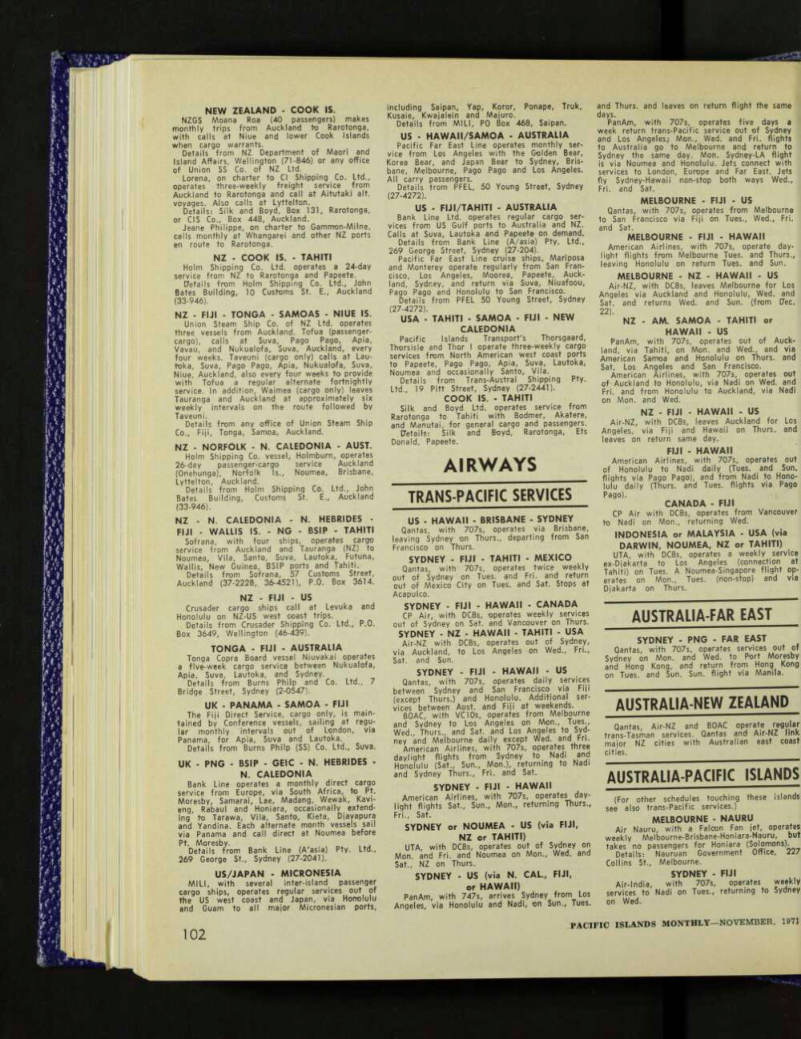
& Airways Information
Sydney - West Irian - Indonesia
P.N. Djakarta Lloyd Shipping Company operates a six to seven weeks' cargo service from Indonesia to Sydney, Melbourne and Fremantle; there are inducement calls at Djayapura and Brisbane.
Details from John Manners and Co. (Aust.) Pty. Ltd., 4 Bridge Street, Sydney (27-9164).
Aust. - West Irian
Karlander New Guinea Line with Slembe operates cargo service every nine weeks from Sydney to Djayapura.
Details: Karlander Aust. Pty, Ltd., 19-31 Pitt Street, Sydney (27-6301).
SYDNEY • NZ - FIJI/TAHITI ■ UK Chandris, with Australis, Britanis and Ellinis, maintains a twice-monthly passenger service from Sydney via NZ, Suva (Australis and Britanis), Papeete (Ellinis) to Britain.
Details from Chandris Line, 135 King Street, Sydney (28-2451).
Sitmar Line, with two liners, operates a six-weekly passenger service from Sydney, Mel bourne or Brisbane to Southampton, UK, via NZ, Papeete, Panama and Lisbon.
Details from Sitmar Line, 22 Bridge Street, Sydney (27-4521).
SYDNEY ■ LORD HOWE ■ NORFOLK IS.
A Karlander cargo vessel calls every month at Lord Howe and Norfolk Is. from Sydney.
Details from Karlander Aust. Ltd., 19-31 Pitt Street, Sydney (27-6301).
Sydney - Norfolk Island -
New Caledonia
Jacques del Mar (owned by Societe Maritime Caledonienne, Noumea) operates a three-weekly passenger-cargo voyage from Sydney to Norfolk and Noumea.
Details from Karlander Aust. Ltd., 19-31 Pitt Street, Sydney (27-6301).
Charqeurs Caledoniens, with the Vide de Noumea operates two-weekly passenger/cargo service Sydney-Noumea.
Details: Hetherington Kingsbury Pty. Ltd 4 Bridge Street, Sydney (27-1671).
Sydney - Geic ■ Honolulu
Columbus Lines operates monthly passenger cargo sailings from West Coast, US to Aus tralasia, returning via Tarawa, GEIC and Hono lulu to Nth. America.
Details from Columbus Overseas Services Pty.
Ltd., 333 George Street, Sydney (29-2101).
Sydney - New Caledonia -
New Hebrides
Polynesia maintains three-weekly passenger sailings—Sydney, Noumea, Vila and Santo.
Details from France Australia, 261 George Street, Sydney (27-2654).
Aust. - Fiji - N. Caledonia
Fiji-Australia Line's MV Taiyuan offers a regular three-weekly passenger/cargo service from Brisbane and Sydney, to Lautoka, Suva and Noumea.
Details from Swire and Gilchrist, 8 Spring Street, Sydney (20-522), Morris Hedstrom Ltd!
Suva and Lautoka.
SYDNEY - NZ ■ FIJI - HAWAII -
Canada - Us
P and 0 Liners call regularly at Auckland, Suva and Honolulu on eastbound and westbound
voyages between Sydney and the US; occasional calls at Pago Pago and Tonga.
Details from P & 0 Lines of Aust. Pty.
Ltd., 55 Hunter Street, Sydney (2-0317).
SYDNEY - NZ - FIJI - AM. SAMOA -
Hawaii - Cooks - Tahiti
Shaw Savill's Northern Star and Ocean Monarch make round-the-world voyages each year, and also cruise in Pacific. They sail from Southampton, alternately via South Africa and Panama, calling at Sydney, Wellington, Auckland, Suva, Pago Pago, Hono lulu, Rarotonga and Papeete.
Details from Shaw Savill and Albion, 8a Castlereagh Street, Sydney (28-1481).
Melbourne - Fiji - Nauru
Nauru Pacific Shipping Lines operates regu lar passenger/cargo service from Melbourne to Suva, Lautoka and Nauru.
Details from Nauru Pacific Shipping Lines, Wales Corner, 227 Collins Street, Melbourne (654-4977).
AUSTRALIA - FIJI - US - NZ Karlander (Aust.) Pty. Ltd. operates three weekly cargo services from Melbourne and Syd ney for Suva, Lautoka, Los Angeles, San Francisco and Auckland with sideport door ships, Woolgar, Slevik and Wyvern.
Details from Karlander (Aust.) Ltd., 19-31 Pitt Street, Sydney (27-6301); F. H. Stephens Pty. Ltd., 554 Flinders Street, Melbourne (62-3333); Burns Philp (SS) Co. Ltd., Suva and Lautoka.
Australia - New Caledonia •
Fiji • New Hebrides
Messageries Maritimes Line with Dorotea operates monthly cargo service from Adelaide, Melbourne, Port Kembla (occasional), Sydney, Newcastle (occasional), and Brisbane (occa sional), to Noumea, Suva, Lautoka, Port Vila and Santo.
Inquiries from France Australia, 261 George Street, Sydney (27-2654).
Australia - Png
Conpac Pacific Express (Burns Philp and AWP Line) operates three-weekly passenger cargo service from Sydney and Brisbane to Lae with Tenos, and to Port Moresby with Nimos.
Details from Burns Philp and Co. Ltd., 7 Bridge Street, Sydney (2-0547).
New Guinea Australia Line's vessel Coral Chief operates every 15-17 days from Sydney to Brisbane, Port Moresby and Samarai (alt. voyages); Island Chief operates every 20/22 days from Sydney to Brisbane, Lae and Rabaul, calling Kavieng alt. voyages; Papuan Chief operates every 21 days from Sydney and Brisbane to Honiara and Kieta; New Guinea Chief operates every 21 days from Sydney and Brisbane to Rabaul and Madang.
All are cargo services. details from Swire and Gilchrist, 8 Spring Street, Sydney (20-522).
Amplex NG, with Jette Bue, operates monthly cargo service Sydney-Rabaul-Lae, Fulleborne, Wilelo and Bakada.
Details: Hetherington Kingsbury, 4 Bridge Street, Sydney (27-1671).
AUST. - PNG - BSIP - NEW HEBRIDES Karlander New Guinea Line's seven cargo vessels call at Brisbane, Lord Howe, Port Moresby, Samarai, Rabaul, Lae, Madang, Wewak, Kieta, Honiara, Gizo, Yandina, Manus, Vila, Santo, Norfolk Island. Three carry passengers.
Details from Karlander Aust. Ltd., 19-31 Pitt Street, Sydney (27-6301).
AUSTRALIA - PNG - NAURU - GUAM Nauru Pacific Shipping Lines operates five weekly passenger/cargo service from Melbourne to Port Moresby, Lae, Madang, Rabaul, Nauru and Guam.
Details from Nauru Pacific Shipping Lines, Wales Cnr., 227 Collins Street, Melbourne. (654-4977).
Australia - Guam
Karlander New Guinea Line operates a five weekly cargo service from Sydney, via Bris bane, to Guam, Details: Karlander Aust. Ltd., 19-31 Pitt Street, Sydney (27-6301).
Australia - Png - Far East
Austasia Line, with Malaysia, runs six-weekly cargo/passenger service from Australia to PNG and Far East.
Details: Macquarie Travel, 183 Macquarie Street, Sydney (221-3799).
E. and A. Line passenger ships, Cathay and Chitral, make monthly round voyages from Melbourne, Sydney and Brisbane calling at Port Moresby, Manila, Hong Kong, Keelung, Kobe, Nagoya, Yokohama, Tokyo and Rabaul. details from E. and A. Line, 55 Hunter Street, Sydney (2-0317).
FAR EAST - FIJI - NEW ZEALAND China Navigation operates a three-weekly cargo service from Hong Kong to Lautoka, Suva, NZ ports, Manila, Kaoshiung, Keelung, Hong Kong.
Details from Swire and Gilchrist, 8 Spring Street, Sydney (20-522).
Royal Interocean Lines operates three-weekly passenger/cargo service with four ships from Manila, Pt, Swettenham, Singapore, Bangkok, Hong Kong to Suva, Lautoka and NZ.
Details from Interocean Australia Services, 261 George Street, Sydney (2-0573); Burns Philp (SS) Co. Ltd., Suva and Lautoka.
Far East - Png - Bsi
China Navigation operates monthly cargo service from Japan and Hong Kong to Wewalc, Madang, Lae, Rabaul, Kieta, Honiara, Port Moresby.
Details from Swire and Gilchrist, 8 Spring Street, Sydney (20-522).
FAR EAST ■ NEW GUINEA - S. PACIFIC China Navigation Co. Ltd. operates monthly cargo service from Japan to NG and South Pacific ports.
Details from Swire and Gilchrist, 8 Spring Street, Sydney (20-522).
Europe - Tahiti - W. Samoa
Fiji - N. Caledonia - Nz
Nedlloyd Lines operates from Europe three weekly cargo service via Panama to Tahiti, Apia, Fiji and New Caledonia; every alternate month from the Continent to Tahiti, New Cale donia and NZ.
Details from Interocean Australia Services, 261 George Street, Sydney (2-0573).
North Europe - New Caledonia
Hamburg/Sued operates monthly cargo ser vices from dunkirk to Le Havre to Noumea, via Panama.
Details from Columbus Overseas Services Pty. Ltd., 333 George Street, Sydney (29-2101).
Europe-Tahiti-New Caledonia
Messageries Maritimes operates four cargo services a month from north and Mediterranean European ports to Papeete and Noumea, one returning direct from Papeete, one returning direct from Noumea, one returning via Japan (after Noumea) and one returning via NZ (after Noumea).
Details from Messageries Maritimes, 332 Pitt Street, Sydney (61-6664).
JAPAN - GUAM - FIJI - SAMOA -
N. Caledonia - N. Hebrides
Daiwa Line runs a monthly cargo service from Japan via Guam to Suva, Lautoka, Pago Pago, Apia, Vila, Santo and Noumea.
Details from Burns Philp (SS) Co. Ltd., Suva.
Japan - New Guinea
Mitsui and China Nav. vessels provide fortnightly cargo services from major Japanese cities to major NG ports and return.
Details from Swire and Gilchrist, 8 Spring Street, Sydney (20-522).
New Zealand - Cook Is.
NZGS Moana Roa (40 passengers) makes monthly trips from Auckland to Rarotonga, with calls at Niue and lower Cook Islands when cargo warrants.
Details from NZ Department of Maori and Island Affairs, Wellington (71-846) or any office of Union SS Co. of NZ Ltd.
Lorena, on charter to Cl Shipping Co. Ltd., operates three-weekly freight service from Auckland to Rarotonga and call at Aitutaki alt. voyages. Also calls at Lyttelton.
Details: Silk and Boyd, Box 131, Rarotonga, or CIS Co., Box 448, Auckland.
Jeane Philippe, on charter to Gamrrron-Milne, calls monthly at Whangarei and other NZ ports en route to Rarotonga.
Nz - Cook Is. - Tahiti
Holm Shipping Co. Ltd. operates a 24-day service from NZ to Rarotonga and Papeete.
Details from Holm Shipping Co. Ltd., John Bates Building, 10 Customs St. E., Auckland (33-946).
NZ - FIJI - TONGA - SAMOAS - NIUE IS.
Union Steam Ship Co. of NZ Ltd. operates three vessels from Auckland. Tofua (passenger cargo), calls at Suva, Pago Pago, Apia, Vavau, and Nukualofa, Suva, Auckland, every four weeks. Taveuni (cargo only) calls at Lau toka, Suva, Pago Pago, Apia, Nukualofa, Suya, Niue, Auckland, also every four weeks to provide with Tofua a regular alternate fortnightly service. In addition, Waimea (cargo only) leaves Tauranga and Auckland at approximately six weekly intervals on the route followed by Taveuni.
Details from any office of Union Steam Ship Co., Fiji, Tonga, Samoa, Auckland.
NZ - NORFOLK - N. CALEDONIA - AUST.
Holm Shipping Co. vessel, Holmburn, operates 26-day passenger-cargo service Auckland (Onehunga), Norfolk Is., Noumea, Brisbane, Lyttelton, Auckland.
Details from Holm Shipping Co. Ltd., John Bates Building, Customs St. E., Auckland (33-946).
NZ - N. CALEDONIA - N. HEBRIDES - FIJI - WALLIS IS. - NG - BSIP - TAHITI Sofrana, with four ships, operates cargo service from Auckland and Tauranga (NZ) to Noumea, Vila, Santo, Suva, Lautoka, Futuna, Wallis, New Guinea, BSIP ports and Tahiti.
Details from Sofrana, 57 Customs Street, Auckland (37-2228, 36-4521), P.O. Box 3614.
Nz - Fiji - Us
Crusader cargo ships call at Levuka and Honolulu on NZ-US west coast trips.
Details from Crusader Shipping Co. Ltd., P.O.
Box 3649, Wellington (46-439).
Tonga - Fiji - Australia
Tonga Copra Board vessel Niuvakai operates a five-week cargo service between Nukualofa, Apia, Suva, Lautoka, and Sydney.
Details from Burns Philp and Co. Ltd., 7 Bridge Street, Sydney (2-0547).
UK - PANAMA - SAMOA - FIJI The Fiji Direct Service, cargo only, is main tained by Conference vessels, sailing at regu lar monthly intervals out of London, via Panama, for Apia, Suva and Lautoka.
Details from Burns Philp (SS) Co. Ltd., Suva.
UK - PNG ■ BSIP - GEIC - N. HEBRIDES -
N. Caledonia
Bank Line operates a monthly direct cargo service from Europe, via South Africa, to Pt.
Moresby, Samarai, Lae, Madang, Wewak, Kavi eng, Rabaul and Honiara, occasionally extend ing to Tarawa, Vila, Santo, Kieta, Djayapura and Yandina. Each alternate month vessels sail via Panama and call direct at Noumea before Pt. Moresby. . „ ...
Details from Bank Line (A'asia) Pty. Ltd., 269 George St., Sydney (27-2041).
Us/Japan - Micronesia
MILI, with several inter-island passenger cargo ships, operates regular services out of the US west coast and Japan, via Honolulu and Guam to all major Micronesian ports,
including Saipan, Yap, Koror, Ponape, Truk, Kusaie, Kwajalein and Majuro.
Details from MILI, PO Box 468, Saipan.
Us - Hawaii/Samoa - Australia
Pacific Far East Line operates monthly ser vice from Los Angeles with the Golden Bear, Korea Bear, and Japan Bear to Sydney, Bris bane, Melbourne, Pago Pago and Los Angeles.
All carry passengers.
Details from PFEL, 50 Young Street, Sydney (27-4272).
Us - Fiji/Tahiti - Australia
Bank Line Ltd. operates regular cargo ser vices from US Gulf ports to Australia and NZ.
Calls at Suva, Lautoka and Papeete on demand.
Details from Bank Line (A/asia) Pty. Ltd., 269 George Street, Sydney (27-204).
Pacific Far East Line cruise ships, Mariposa and Monterey operate regularly from San Fran cisco, Los Angeles, Moorea, Papeete, Auck land, Sydney, and return via Suva, Niuafoou, Pago Pago and Honolulu to San Francisco.
Details from PFEL 50 Young Street, Sydney (27-4272).
USA - TAHITI - SAMOA - FIJI - NEW
Caledonia
Pacific Islands Transport's . Thorsgaard, Thorsisle and Thor I operate three-weekly cargo services from North American west coast ports to Papeete, Pago Pago, Apia, Suva, Lautoka, Noumea and occasionally Santo, Vila.
Details from Trans-Austral Shipping Pty.
Ltd., 19 Pitt Street, Sydney (27-2441).
Cook Is. - Tahiti
Silk and Boyd Ltd. operates service from Rarotonga to Tahiti with Bodmer, Akatere, and Manutai, for general cargo and passengers. details; Silk and Boyd, Rarotonga, Ets Donald, Papeete.
Airways
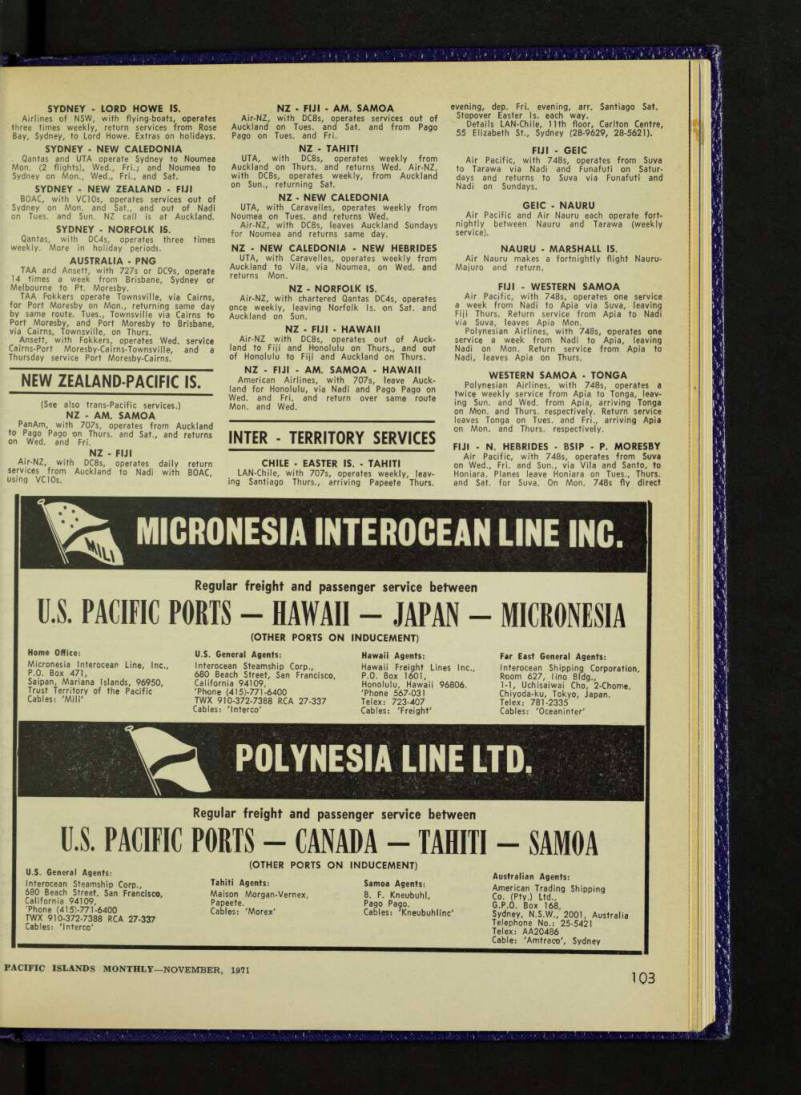
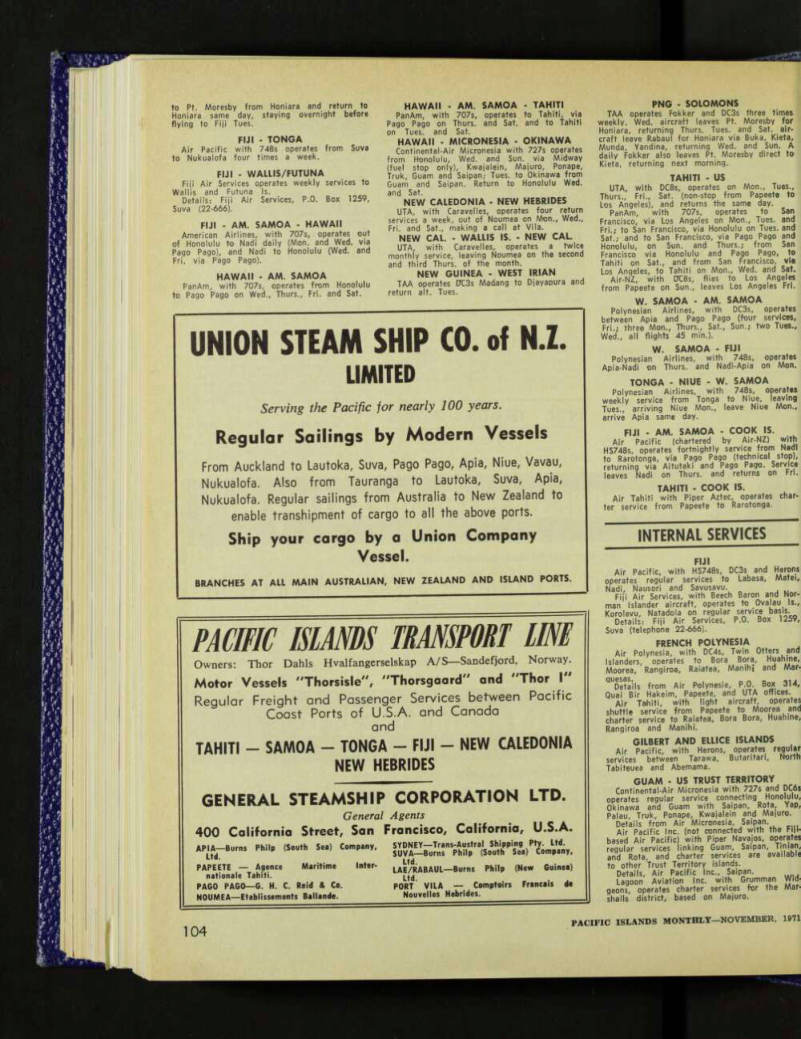
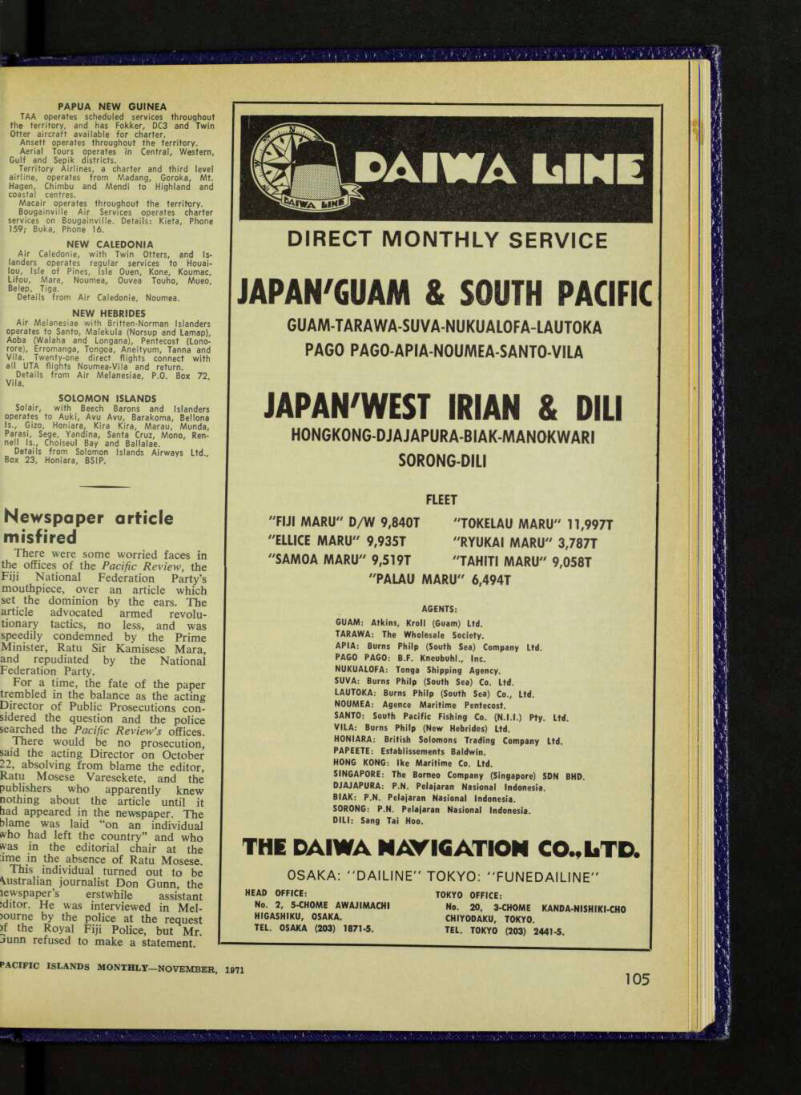
Trans Pacific Services
US - HAWAII - BRISBANE - SYDNEY Qantas, with 7075, operates via Brisbane, leaving Sydney on Thurs., departing from San Francisco on Thurs.
SYDNEY - FIJI - TAHITI - MEXICO Qantas, with 7075, operates twice weekly out of Sydney on Tues. and Fri. and return out of Mexico City on Tues. and Sat. Stops at Acapulco.
SYDNEY - FIJI - HAWAII - CANADA CP Air, with DCBs, operates weekly services out of Sydney on Sat. and Vancouver on Thurs.
SYDNEY - NZ - HAWAII - TAHITI - USA Air-NZ with DCBs, operates out of Sydney, via Auckland, to Los Angeles on Wed., Fri., Sat. and Sun.
SYDNEY - FIJI - HAWAII - US Qantas, with 7075, operates daily services between Sydney and San Francisco via Fiji (except Thurs.) and Honolulu. Additional ser vices between Aust. and Fiji at weekends.
BOAC, with VC 10s, operates from Melbourne and Sydney to Los Angeles on Mon., Tues., Wed., Thurs., and Sat. and Los Angeles to Syd ney and Melbourne daily except Wed. and Fri.
American Airlines, with 7075, operates three daylight flights from Sydney to Nadi and Honolulu (Sat., Sun., Mon.), returning to Nadi and Sydney Thurs., Fri. and Sat.
Sydney - Fiji - Hawaii
American Airlines, with 7075, operates day light flights Sat., Sun., Mon., returning Thurs., Fri., Sat.
SYDNEY or NOUMEA - US (via FIJI,
Nz Or Tahiti)
UTA, with DCBs, operates out of Sydney on Mon. and Fri. and Noumea oh Mon., Wed, and Sat., NZ on Thurs.
SYDNEY - US (via N. CAL., FIJI,
Or Hawaii)
PanAm, with 7475, arrives Sydney from Los Angeles, via Honolulu and Nadi, on Sun., Tues.
and Thurs. and leaves on return flight the same days.
PanAm, with 7075, operates five days a week return trans-Pacific service out of Sydney and Los Angeles; Mon., Wed. and Fri. flights to Australia go to Melbourne and return to Sydney the same day. Mon. Sydney-LA flight is via Noumea and Honolulu. Jets connect with services to London, Europe and Far East. Jets fly Sydney-Hawaii non-stop both ways Wed., Fri. and Sat.
Melbourne - Fiji - Us
Qantas, with 7075, operates from Melbourne to San Francisco via Fiji on Tues., Wed., Fri. and Sat.
Melbourne - Fiji - Hawaii
American Airlines, with 7075, operate day light flights from Melbourne Tues. and Thurs., leaving Honolulu on return Tues. and Sun.
MELBOURNE - NZ - HAWAII ■ US Air-NZ, with DCBs, leaves Melbourne for Los Angeles via Auckland and Honolulu, Wed. and Sat. and returns Wed. and Sun. (from Dec. 22).
NZ - AM. SAMOA - TAHITI or
Hawaii - Us
PanAm, with 7075, operates out of Auck land, via Tahiti, on Mon. and Wed., and via American Samoa and Honolulu on Thurs. and Sat. Los Angeles and San Francisco.
American Airlines, with 7075, operates out of Auckland to Honolulu, via Nadi on Wed. and Fri. and from Honolulu to Auckland, via Nadi on Mon. and Wed.
NZ - FIJI - HAWAII - US Air-NZ, with DCBs, leaves Auckland for Los Angeles, via Fiji and Hawaii on Thurs. and leaves on return same day.
Fiji - Hawaii
American Airlines, with 7075, operates out of Honolulu to Nadi daily (Tues. and Sun. flights via Pago Pago), and from Nadi to Hono lulu daily (Thurs. and Tues. flights via Pago Pago).
Canada - Fiji
CP Air with DCBs, operates from Vancouver to Nadi on Mon., returning Wed.
Indonesia Or Malaysia - Usa (Via
Darwin, Noumea, Nz Or Tahiti)
UTA, with DCBs, operates a weekly service ex-Djakarta to Los Angeles (connection at Tahiti) on Tues. A Noumea-Singapore flight op erates on Mon., Tues. (non-stop) and via Djakarta on Thurs.
Australia-Far East
Sydney - Png - Far East
Qantas, with 7075, operates services out of Sydney on Mon. and Wed. to Port Moresby and Hong Kong, and return from Hong Kong on Tues. and Sun. Sun. flight via Manila.
Australia-New Zealand
Qantas, Air-NZ and BOAC operate regular trans-Tasman services. Qantas and Air-NZ link major NZ cities with Australian east coast cities.
Australia-Pacific Islands
(For other schedules touching these islands see also trans-Pacific services.)
Melbourne - Nauru
Air Nauru, with a Falcon Fan jet, operates weekly Melbourne-Brisbane-Honiara-NaurU/ but takes no passengers for Honiara (Solomons).
Details: Nauruan Government Office, 227 Collins St., Melbourne.
Sydney - Fiji
Air-lndia, with 7075, operates weekly services to Nadi on Tues., returning to Sydney on Wed.
Sydney ■ Lord Howe Is.
Airlines of NSW, with flying-boats, operates three times weekly, return services from Rose Bay, Sydney, to Lord Howe. Extras on holidays.
Sydney ■ New Caledonia
Qantas and UTA operate Sydney to Noumea Mon. (2 flights). Wed., Fri.; and Noumea to Sydney on Mon., Wed., Fri., and Sat.
Sydney - New Zealand - Fiji
BOAC, with VCTOs, operates services out of Sydney on Mon. and Sat., and out of Nadi on Tues. and Sun. NZ call is at Auckland.
Sydney - Norfolk Is.
Qantas, with DC4s, operates three times weekly. More in holiday periods.
Australia - Png
TAA and Ansett, with 727 s or DC9s, operate 14 times a week from Brisbane, Sydney or Melbourne to Pt. Moresby.
TAA Fokkers operate Townsville, via Cairns, for Port Moresby on Mon., returning same day by same route. Tues., Townsville via Cairns to Port Moresby, and Port Moresby to Brisbane, via Cairns, Townsville, on Thurs.
Ansett, with Fokkers, operates Wed. service Cairns-Port Moresby-Cairns-Townsville, and a Thursday service Port Moresby-Cairns.
New Zealand-Pacific Is.
(See also trans-Pacific services.)
Nz - Am. Samoa
PanAm, with 7075, operates from Auckland to Pago Pago on Thurs. and Sat., and returns on Wed. and Fri.
Nz - Fiji
Air-NZ, with DCBs, operates daily return services from Auckland to Nadi with BOAC, using VC 10s.
Nz - Fiji • Am. Samoa
Air-NZ, with DCBs, operates services out of Auckland on Tues. and Sat. and from Pago Pago on Tues. and Fri.
Nz - Tahiti
UTA, with DCBs, operates weekly from Auckland on Thurs. and returns Wed. Air-NZ, with DCBs, operates weekly, from Auckland on Sun., returning Sat,
Nz - New Caledonia
UTA, with Caravelles, operates weekly from Noumea on Tues. and returns Wed.
Air-NZ, with DCBs, leaves Auckland Sundays for Noumea and returns same day.
NZ - NEW CALEDONIA • NEW HEBRIDES UTA, with Caravelles, operates weekly from Auckland to Vila, via Noumea, on Wed. and returns Mon.
Nz - Norfolk Is.
Air-NZ, with chartered Qantas DC4s, operates once weekly, leaving Norfolk Is. on Sat. and Auckland on Sun.
Nz • Fiji - Hawaii
Air-NZ with DCBs, operates out of Auck land to Fiji and Honolulu on Thurs., and out of Honolulu to Fiji and Auckland on Thurs.
NZ - FIJI ■ AM. SAMOA - HAWAII American Airlines, with 7075, leave Auck land for Honolulu, via Nadi and Pago Pago on Wed. and Fri. and return over same route Mon. and Wed.
Inter - Territory Services
Chile ■ Easter Is. - Tahiti
LAN-Chile, with 7075, operates weekly, leav ing Santiago Thurs., arriving Papeete Thurs.
evening, dep. Fri. evening, arr. Santiago Sat.
Stopover Easter Is. each way.
Details LAN-Chile, 11th floor, Carlton Centre, 55 Elizabeth St., Sydney (28-9629, 28-5621).
Fiji - Geic
Air Pacific, with 7485, operates from Suva to Tarawa via Nadi and Funafuti on Satur days and returns to Suva via Funafuti and Nadi on Sundays.
Geic • Nauru
Air Pacific and Air Nauru each operate fort nightly between Nauru and Tarawa (weekly service).
Nauru - Marshall Is.
Air Nauru makes a fortnightly flight Nauru- Majuro and return.
Fiji - Western Samoa
Air Pacific, with 7485, operates one service a week from Nadi to Apia via Suva, leaving Fiji Thurs. Return service from Apia to Nadi via Suva, leaves Apia Mon.
Polynesian Airlines, with 7485, operates one service a week from Nadi to Apia, leaving Nadi on Mon. Return service from Apia to Nadi, leaves Apia on Thurs.
Western Samoa - Tonga
Polynesian Airlines, with 7485, operates a twice weekly service from Apia to Tonga, leav ing Sun. and Wed. from Apia, arriving Tonga on Mon. and Thurs. respectively. Return service leaves Tonga on Tues. and Fri., arriving Apia on Mon. and Thurs. respectively.
FIJI - N. HEBRIDES - BSIP - P. MORESBY Air Pacific, with 7485, operates from Suva on Wed., Fri. and Sun., via Vila and Santo, to Honiara. Planes leave Honiara on Tues., Thurs. and Sat. for Suva. On Mon. 748 s fly direct
to Pt. Moresby from Honiara and return to Honiara same day, staying overnight before flying to Fiji Tues.
Fiji - Tonga
Air Pacific with 748 s operates from Suva to Nukualofa four times a week. , c /ci iti im a
Fiji - Wallis/Futuna
Fiji Air Services operates weekly services to Wallis and Futuna Is.
Details: Fiji Air Services, P.O. Box 1259, Suva (22-666). „ ... CAUrtA u * \a/ aii
Fiji - Am. Samoa - Hawaii
American Airlines, with 7075, operates out of Honolulu to Nadi daily (Mon. and Wed. via Pago Pago), and Nadi to Honolulu (Wed. and Fn. via Pago Pago).
Hawaii - Am. Samoa
PanAm, with 7075, operates from Honolulu to Pago Pago on Wed., Thurs., Fri. and Sat.
Hawaii - Am. Samoa • Tahiti
PanAm, with 7075, operates to Tahiti, via Pago Pago on Thurs. and Sat, and to Tahiti on Tues. and Sat.
Hawaii ■ Micronesia - Okinawa
Continental-Air Micronesia with 727 s operates f rom Honolulu, Wed. and Sun. via Midway (fuel st °P on| y)' Kwajalein, Majuro, Ponape, Truk, Q uam anc j Saipan; Tues. to Okinawa from Guam anc ] Saipan. Return to Honolulu Wed. and Sat.
New Caledonia - New Hebrides
UTA, with Caravelles, operates four return services a week, out of Noumea on Mon., Wed,, Fri . gnd sgt; making a ca) at Vila.
N w xa/ALLIS IS - NEW CAL NEW CAL. - WALLIS is. incyv v. wu th f y service , leaving Noumea on the second and th rd Thurs of t he month.
New Guinea - West Irian
TAA operates DCSs Madang to Djayapura and return alt. Tues.
Png • Solomons
TAA operates Fokker and DC3s three times weekly. Wed. aircraft leaves Pt. Moresby for Honiara, returning Thurs. Tues. and Sat. air craft leave Rabaul for Honiara via Buka, Kieta, Munda, Yandina, returning Wed. and Sun. A daily Fokker also leaves Pt. Moresby direct to Kieta, returning next morning.
Tahiti - Us
UTA, with DCBs, operates on Mon., Tues., Thurs., Fri., Sat. (non-stop from Papeete to Los Angeles), and returns the same day.
PanAm, with 7075, operates to San Francisco, via Los Angeles on Mon., Tues. and Fri,; to San Francisco, via Honolulu on Tues. and Sat.; and to San Francisco, via Pago Pago and Honolulu, on Sun. and Thurs.; from San Francisco via Honolulu and Pago Pago, to Tahiti on Sat., and from San Francisco, via Los Angeles, to Tahiti on Mon., Wed. and Sat.
Air-NZ, with DCBs, flies to Los Angeles from Papeete on Sun., leaves Los Angeles Fri.
W. Samoa - Am. Samoa
Polynesian Airlines, with DC3s, operates between Apia and Pago Pago (four services, Fri.; three Mon., Thurs., Sat., Sun.; two Tues., Wed., all flights 45 min.).
W. Samoa - Fiji
Polynesian Airlines, with 7485, operates Apia-Nadi on Thurs. and Nadi-Apia on Mon.
Tonga - Niue - W. Samoa
Polynesian Airlines, with 7485, operates weekly service from Tonga to Niue, leaving Tues., arriving Niue Mon., leave Niue Mon., arrive Apia same day.
FIJI - AM. SAMOA - COOK IS.
Air Pacific (chartered by Air-NZ) with HS74Bs, operates fortnightly service from Nadi to Rarotonga, via Pago Pago (technical stop), returning via Aitutaki and Pago Pago. Service leaves Nadi on Thurs. and returns on Fri.
Tahiti - Cook Is.
Air Tahiti with Piper Aztec, operates char ter service from Papeete to Rarotonga.
Internal Services
Fiji
Air Pacific, with HS74Bs, DC3s and Herons operates regular services to Labasa, Matei, Nadi, Nausori and Savusavu.
Fiji Air Services, with Beech Baron and Nor man Islander aircraft, operates to Ovalau Is., Korolevu, Natadola on regular service basis.
Details: Fiji Air Services, P.O. Box 1259, Suva (telephone 22-666).
French Polynesia
Air Polynesia, with DC4s, Twin Otters and Islanders, operates to Bora Bora, Huahme, Moorea, Rangiroa, Raiatea, Manihi and Marfrom Air Polynesia, P.O. Box 314, Quai Bir Hakeim, Papeete, and UTA offices.
Air Tahiti, with light aircraft, operates shuttle service from Papeete to Moorea and charter service to Raiatea, Bora Bora, Huahme, Rangiroa and Manihi.
Gilbert And Ellice Islands
Air Pacific, with Herons, operates regular services between Tarawa, Butaritari, North Tabiteuea and Abemama.
Guam - Us Trust Territory
Continental-Air Micronesia with 727 s and DC6s operates regular service connecting Honolulu, Okinawa and Guam with Saipan, Rota, Yap, Palau, Truk, Ponape, Kwajalein and Maiuro.
Details from Air Micronesia, Saipan.
Air Pacific Inc. (not connected with the Fni based Air Pacific) with Piper Navajos, operates regular services linking Guam, Saipan, Tinian, and Rota, and charter services are available to other Trust Territory islands.
Details, Air Pacific Inc., Saipan.
Lagoon Aviation Inc. with Grumman Wid geons, operates charter services for the Mar shalls district, based on Majuro.
Papua New Guinea
TAA operates scheduled services throughout the territory, and has Fokker, DC3 and Twin Otter aircraft available for charter.
Ansett operates throughout the territory.
Aerial Tours operates in Central, Western, Gulf and Sepik districts.
Territory Airlines, a charter and third level airline, operates from Madang, Goroka, Mt.
Hagen, Chimbu and Mendi to Highland and coastal centres.
Macair operates throughout the territory.
Bougainville Air Services operates charter services on Bougainville. Details: Kieta, Phone 159; Buka, Phone 16.
New Caledonia
Air Caledonie, with Twin Otters, and Is landers operates regular services to Houai lou. Isle of Pines, Isle Ouen, Kone, Koumac, Lifou, Mare, Noumea, Ouvea Touho, Mueo, Belep, Tiga.
Details from Air Caledonie, Noumea.
New Hebrides
Air Melanesiae with Britten-Norman Islanders operates to Santo, Malekula (Norsup and Lamap), Aoba (Walaha and Longana), Pentecost (Lono rqre), Erromanga, Tongoa, Aneityum, Tanna and Vila. Twenty-one direct flights connect with all UTA flights Noumea-Vila and return.
Details from Air Melanesiae, P.O. Box 72, Vila.
Solomon Islands
Solair, with Beech Barons and Islanders operates to Auki, Avu Avu, Barakoma, Bellona Is., Gizo, Honiara, Kira Kira, Marau, Munda, Parasi, Sege, Yandina, Santa Cruz, Mono, Ren nell Is., Choiseul Bay and Ballalae.
Details from Solomon Islands Airways Ltd., Box 23, Honiara, BSIP.
Advertisements & other items, pp. 107-108 (1 item)
Micronesia Interocean Line Inc
Regular freight and passenger service between
U.S. PACIFIC PORTS - HAWAII - JAPAN - MICRONESIA
(OTHER PORTS ON INDUCEMENT)
Home Office: Micronesia Interocean Line, Inc., P.O. Box 471, Saipan, Mariana Islands, 96950, Trust Territory of the Pacific Cables: 'Mili' U.S. General Agents: Interocean Steamship Corp., 680 Beach Street, San Francisco, California 94109, 'Phone (415)-771 -6400
TWX 910-372-7388 RCA 27-337
Cables: 'lnterco' Hawaii Agents: Hawaii Freight Lines P.O. Box 1601, Honolulu, Hawaii 96806 'Phone 567-031 Telex: 723-407 Cables: 'Freight' Inc.
Far East General Agents: Interocean Shipping Corporation Room 627, lino Bldg., 1-1, Uchisaiwai Cho, 2-Chome, Chiyoda-ku, Tokyo, Japan.
Telex: 781-2335 Cables: 'Oceaninter'
POLYNESIA LINE LTD.
Regular freight and passenger service between
U.S. PACIFIC PORTS - CANADA - TAHITI - SAMOA U.S. General Agents: Interocean Steamship Corp., 680 Beach Street, San Francisco, California 94109, 'Phone (415)-771-6400
TWX 910-372-7388 RCA 27-337
Cables: 'lnterco'
(OTHER PORTS ON INDUCEMENT)
Tahiti Agents: Maison Morgan-Vernex, Papeete.
Cables: 'Morex' Samoa Agents: B. F. Kneubuhl, Pago Pago.
Cables: 'Kneubuhlinc' Australian Agents: American Trading Shipping Co. (Pty.) Ltd., G.P.O. Box 168, Sydney, N.S.W., 2001, Australia Telephone No.: 25-5421 Telex: AA20486 Cable: 'Amtraco', Sydney
UNION STEAM SHIP CO. of N.Z.
LIMITED
Serving the Pacific for nearly 100 years.
Regular Sailings by Modern Vessels
From Auckland to Lautoka, Suva, Pago Pago, Apia, Niue, Vavau, Nukualofa. Also from Tauranga to Lautoka, Suva, Apia, Nukualofa. Regular sailings from Australia to New Zealand to enable transhipment of cargo to all the above ports.
Ship your cargo by a Union Company Vessel.
BRANCHES AT ALL MAIN AUSTRALIAN, NEW ZEALAND AND ISLAND PORTS.
PACIFIC ISLANDS TRANSPORT LINE
Owners: Thor Dahls Hvalfangerselskap A/S—Sandefjord, Norway.
Motor Vessels "Thorsisle", "Thorsgaard" and "Thor I"
Regular Freight and Passenger Services between Pacific Coast Ports of U.S.A. and Canada and
TAHITI SAMOA TONGA FIJI NEW CALEDONIA
NEW HEBRIDES
GENERAL STEAMSHIP CORPORATION LTD.
General Agents 400 California Street, San Francisco, California, U.S.A.
APiA-B.r„s Philp (South So.) Company, UJ PAPEETE Agence Maritime Inter- LAE/RABAUL —Burns Philp (New Guinea) nationale Tahiti. Ltd PAGO PAGO—G. H. C. Reid & Co. PORT VILA Comptoirs Francais de NOUMEA—Etablissements Ballande. Nouvelles Hebrides.
Newspaper article
misfired
There were some worried faces in the offices of the Pacific Review, the Fiji National Federation Party’s mouthpiece, over an article which set the dominion by the ears. The article advocated armed revolu tionary tactics, no less, and was speedily condemned by the Prime Minister, Ratu Sir Kamisese Mara, and repudiated by the National Federation Party.
For a time, the fate of the paper trembled in the balance as the acting Director of Public Prosecutions con sidered the question and the police searched the Pacific Review’s offices.
There would be no prosecution, said the acting Director on October 22, absolving from blame the editor, Ratu Mosese Varesekete, and the publishers who apparently knew nothing about the article until it bad appeared in the newspaper. The blame was laid “on an individual who had left the country” and who was in the editorial chair at the ime in the absence of Ratu Mosese.
This individual turned out to be Australian journalist Don Gunn, the lewspaper s erstwhile assistant Jditor. He was interviewed in Mel )ourne by the police at the request >f the Royal Fiji Police, but Mr. junn refused to make a statement.
Advertisements & other items, pp. 109-111 (1 item)
Japan'west Irian & Dili
DIRECT MONTHLY SERVICE
JAPAN'GUAM & SOUTH PACIFIC
GUAM-TARAWA-SUVA-NUKUALOFA-LAUTOKA
PAGO PAGO-APIA-NOUMEA-SANTO-VILA
JAPAN'WEST IRIAN & DILI
HONGKONG-DJAJAPURA-BIAK-MANOKWARI
SORONG-DILI
FLEET
'FIJI MARU" D/W 9,8401 "TOKELAU MARU" 11,997 T 'ELLICE MARU" 9,935 T "RYUKAI MARU" 3,787 T 'SAMOA MARU" 9,519 T "TAHITI MARU" 9,058 T
"PALAU MARU" 6,494 T
AGENTS:
GUAM: Atkins, Kroll (Guam) Ltd.
TARAWA: The Wholesale Society.
APIA: Burns Philp (Sooth Sea) Company Ltd.
PAGO PAGO: B.F. Kneubuhl., Inc.
NUKUALOFA: Tonga Shipping Agency.
SUVA: Burns Philp (South Sea) Co. Ltd.
LAUTOKA: Burns Philp (South Sea) Co., Ltd.
NOUMEA: Agence Maritime Pentecost.
SANTO: South Pacific Fishing Co. (N. 1.1.) Pty. Ltd.
VILA: Burns Philp (New Hebrides) Ltd.
HONIARA: British Solomons Trading Company Ltd.
PAPEETE: Establissements Baldwin.
HONG KONG: Ike Maritime Co. Ltd.
SINGAPORE; The Borneo Company (Singapore) SDN BHD.
DJAJAPURA: P.N, Pelajaran Nasional Indonesia.
BIAK; P.N. Pelajaran Nasional Indonesia.
SORONG; P.N. Pelajaran Nasional Indonesia.
DILI: Sang Tai Hoo.
THE DAIWA NAVIGATION CO., LTD.
OSAKA: "DAILINE" TOKYO: "FUNEDAILINE"
HEAD OFFICE:
No. 2, 5-CHOME AWAJIMACHI
HIGASHIKU, OSAKA.
TEL. OSAKA (203) 1871-5.
TOKYO OFFICE:
No. 20, 3-CHOME KANDA-NISHIKI-CHO
CHIYODAKU, TOKYO.
TEL. TOKYO (203) 2441-5.
ACCOMMODATION
SYDNEY, home for rent, Mosman, 2 minutes drive to beach, walk to ferry, 3 bedrooms. Approx, early Jan. to early March. $7O p.w. or part thereof. Johnson, 10 Somerset St., Mosman, NSW, 2088.
BOOKS, MAGAZINES, ETC.
ALL BOOKS AND JOURNALS ON AUS-
IRALASIA AND THE PACIFIC BOUGHT
AND SOLD. Catalogues issued and sent tree on application. Correspondence incited. Berkelouw, 114 King St., Sydney. 2000. Telephone: 28-7874.
BODEN’S BOAT DESIGNS PTT. LTD.,
695 George St., Sydney. 2000 Get your Bodens Boat Designs and Boat Building Book from newsagents everywhere. Posted direct $A2.20 surface mall.
WIDE RANGE OF BOOKS and magazines for the mature adult. Free catalogue sent upon request. Please enclose selfaddressed stamped envelope. Write to.
Venus Mail Boutique, Box 3759, G.P.0., Sydney, 2001.
EVERYTHING FOR BOATS. 24 page
catalogue airmailed for one dollar bill (A or U.S.) or equivalent. Thomas Fonlkes (PI), Lansdowne Rd., Leytonstone, London, E.ll.
AGENTS WANTED
LIVE-WIRE AGENT required for underwater photographic equipment. Retail or Wholesale agencies considered. A chance to get in on the ground floor for this fast increasing sales potential. Contact: “Aqua-Sea”, Box 169, P.O. Darlinghurst, N.S.W. 2010, Australia.
Classified Advertisements
Per line, 95c Aust.; Minimum rate. 4 lines.
PEN FRIENDS
IS THERE SOMEONE in Nauru, or any independent island, who is willing to entertain friendly correspondence with an Italian young man and, eventually, stamp exchange? If yes, write to; Giovanni de Santis, Casella Postale 97, 70100, Ban, Italy.
FOR SALE
LAND for sale at Kuranda and Cairns.
Various size blocks with or without houses. Ideal retirement situation. For further information contact landowners.
Veldjur Pty. Ltd., P.O. Box 1288, Cairns, 4870.
FLEETS. Heavily bit. 65 ft. prawn trawler, dry and refrig, cargo space, bit. 1964, 180 h.p. diesel, heavy winch, radio, sounder, etc., $70,000. Make exc. cargo boat. Fleets, Rowe’s Bldg., Edward St., Brisbane. Cable; Fleets, Brisbane.
M. V. TAFURA, 52 ft x 16 ft x 6 ft 6 in.
Built at Ballina, N.S.W., in 1964 of Australian Hardwood. Copper fastened throughout. Garboards coppered. Powered by 165 H.P. Caterpillar D 333 Engine.
Crammond radio. Furuno echo sounder.
Carries 15 tons deadweight or 400 bags of copra. Will tow 200 logs 5 ft x 16 ft at 2 knots. In survey until January, 1972. 4 berths forr’ed one in wheelhouse. Va ton deck winch. Now based at Gizo, 8.5.1. P.
Price, $30,000. A. E. Palmer, Gizo, 8.5.1. P.
FIJI, We have for sale large tract of freehold land, including 3 Copra Plantations. Pacific Real Estate Co., P.O. Box 933, Suva, Fiji.
CONCRETE BLOCK MACHINE. Makes
blocks, flags. edgings, screen-blocks, garden stools —up to 8 at once and »6 an hour. SAIO7 c.l.f. main ports. Send for leaflets. Forest Farm Research, Londonderry, N.8.W.. 2753 BEAUTIFUL SLIDES of Australian scenes you would not forget. Free catalogue.
P.O. BOX 617, Ballarat, Vic., Australia. 3350.
CINEMA FOR SALE. Located in the heart of the capital of the Solomon Islands — Honiara. For details please write to the Manager, Point Cruz Theatre, P.O. Box 17, Honiara.
VISITING BRISBANE?
Stay at TOWER MILL MOTEi. First class air-conditioned accommodation, T.V., private bathroom and verandah with a delightful view. Two restaurants.
From $lO.OO per day.
Book through your Travel Agent or Airline office or direct to 239, Wickham Terrace, Brisbane. Telephone 31-1421.
BRISBANE HOLIDAY HIRE
of $l2 per month TV Sets, portables, 12 in.-23 in.
RADIOS & STEREO 1 -
GRAMS
BED, MATTRESS, PILLOW
complete with linen ... $l2 per month from
ROBIN WHITE RENTS,
222 Old Cleveland Road, Coorparoo, Brisbane.
Telephone: 97-8883.
WANTED
FREEHOLD LAND
Am interested in buying a large tract of freehold land in the South Pacific. Might pay cash.
Please write: "PAM", c/- Box 3408, G.P.0., Sydney 2000, Australia.
GENERATING SETS
New and used sets up to 600 kVA.
STONE CRUSHERS
Jaw and Gyratory types.
MINING EQUIPMENT
Ball Mills. Hammer Mills.
Disintegrators.
WINCHES
Air, electric and diesel engine
powered.
AIR COMPRESSORS
Both electric and diesel engine driven from 80 cfm upwards.
D.H. BERGHOUSE
PTY. LTD.,
61-65 MACARTHUR STREET, ULTIMO,
SYDNEY, N.S.W. 2007, AUSTRALIA.
Cables: "Bergmachines", Sydney.
GEM CUTTING
We offer a comprehensive range of saws, grinders, polishers and tumblers for the hobbyist. Write for a free catalogue to— Rytime-Robilt Pty. Ltd., 218 Bay Road, Sandringham, Victoria, 3191.
CAIRNS - KURANDA
RETIREMENT HOUSING OR LAND
Private Company holding substantial area of land at Cairns and Kuranda proposes to subdivide and sell or to build and sell.
Land is either cleared or rain forest.
Subdivision will be exclusive.
Kuranda is 20 minutes from Cairns at elevation of 12,000 feet.
For further information, interested persons contact:
VELDJUR PTY. LTD.,
P.O. BOX 1288, CAIRNS, QUEENSLAND 4870, AUSTRALIA.
POSITION WANTED
ATTENTION MANAGEMENT
AUSTRALIAN aged 30 with young family member Institute of Chartered Accountants i-u Australla and with extensive good calibre professional and commercial experience, including some tropical, seeks employment in Pacific region, ideally as personal assistant to top Management.
High degree of responsibility and level remuneration is sought. Replies: Management”, Post Office, Old Bar Beach, N.S.W., 2430, Aust.
Australian Holidays . . .
Next time you are in Sydney for your leave let
C. V. HOLLAND'S USED CARS OF
ROCKDALE
solve your transport problems h n„M„ a " eXtenS i Ve T ge of at least 150 mod «>s to choose from, all thoroughly prepared and warranted vehicles which we will guarantee to buy back at the termination of your holidays.
For further information please contact: Jack Swiff, Used Car Manager.
C. V. HOLLAND PTY. LTD.
Authorised General Motors Dealers
601 Princes Highway, Rockdale, SYDNEY, 2216.
Phone: 59-37X1
Islands People
Deaths of Islands People
Mrs. Alice Frost Long-time Rabaul resident, Mrs.
Alice Frost, died in Brisbane on October 8, aged 84. After housekeep ing at Lae Hospital and Wau Hotel she opened a store in Wau, later mov ing to Rabaul.
After World War II Mrs, Frost was in Port Moresby, and then at the Cosmopolitan Hotel, Rabaul. She settled in Australia in 1963. Her son, Fred, and family live in Brisbane.
Boga Peri
Mr. Boga Peri, well-known district court interpreter in Port Moresby for the past 20 years, died in mid-Septem ber, at the age of 50.
Born at Lalaura village in the Abau area of the Central District, Mr. Peri was educated at the Yule Island school and joined the public service in June, 1938. He served in the Army from 1942 to 1945 and joined the Law Department as a court inter preter in 1950.
Leonard J. Brass Widely respected authority on the plants of New Guinea, Dr. Leonard J. Brass, died at Cairns, Queensland, on August 29, at the age of 71. He was most noted for the field botanical work which he did in New Guinea, particularly as leader of several Archbold Expeditions from the Museum of Natural History.
Dr. Brass was born and educated in Queensland, and had retired there, after completing 33 years’ service with the American Museum, in 1966.
He had been curator of the Archbold Collections of the Museum at that time, and was recognised as curator emeritus thereafter. In recent times he has been honorary curator of the Flecker Herbarium of the North Queensland Naturalists’ Club.
During World War 11, Dr. Brass served in the Canadian Army, and was consultant to the US Forces on matters related to the vegetation and ecology of the Islands. Information he supplied enabled the spectacular glider-rescue of three US airmen from the Baliem River Valley.
An honorary doctorate was con ferred on Dr. Brass by Florida State University in 1962. He was naturalised as a US citizen in 1947. His wife, Marie, died in 1954. His closest sur viving relative is his sister, Mrs. Edna Henderson, of Brisbane.
Advertisements & other items, p. 111 (1 item)
PNG development
107
ACIFIC ISLANDS MONTHLT-NOVEMBER, 1971
PNG development Continued from p. 26
Index to Advertisers
Adams Ind. 42, 115 Air India H Air Pacific 36 Ansett 76 A. Bank 117 A & T Rent-A-Car 56 Armidale School 81 Arnott, Wm. 14 Aust. Dairy Board 1 Bank Line 100 Bish Ltd. 88 B. 1, 121, cov. in Breckwoldt, Wm. 123 British Tobacco 3 Brockhoff's 6 Brunton & Co. 19
Cadbury I]9
Canadian Coleman 10 Carpenter, W, R. 125, cov. iv Castlemaine Perkins 122 Clae Engine 72 Commonwealth Timbers 114
Commonwealth Bank 12 Conpac 7 Crest Hotel HO
C.S.R. Co. 16
Oaiwa Line 103 Doulton Potteries 10 Edgell, Gordon 46, 47 Fiat Motors 50, 51 Fisher & Co. 126 Fisher, Peter 126 Frigate Rum 120 Fujiset 80 Furuno 86 George & Ashton 86 Gillespie Bros. 62 Grove, W. H. 122 Handi Works 114 Harris, Keith 128 Hawker Siddeley 97 Heinz, H. J. 68 Hellaby 127 Holland, C. V. 107 Hudson, G. 12, 52 Hungerford Refrig. 96
Hutchinson, Robert 4 Karlander Line 127 Kerr Bros. 120 Knox Schlapp 91 Kraft Foods 63 Lees 52, 88 Macquarie 126 Massey Ferguson 38 Master Builders 124 Matsushita 109 Mick Simmons 118 Millers Ltd. 84 Morris Hedstrom 8 Nederland Line 100 Nestle Co. 20 Nissan 64, 65 Northern Hotels 121 N. & R. Pty. Ltd. 98 Pacific Islands Transport Line 104 Pauls Foods 112 P.L.C. Goulburn 79 P.N.G. Printing 118 Polynesia Line 103
Qantas Qld. Insurance 8/ Reckitt & Colman 7^ Remploy Ltd. ■
Ronson ft
Rothmans 1'
Sandy, J. . 1?;
Sansui Electric : Solomons Wholesale Southern Pacific
Insurance ]2<
Stapleton, J. T, |1 Sullivan, C. 121 Swire & Gilchrist 66, 6, T.A.A. cov. i Tait, W. S. 11' Tatham, S. E.
Tokyo Shibaura m Toyota 6 Trio Electronics 1 Turners Supply 12 Union S.S. Co. 10 Willem II 9 Wunderlich J* Yorkshire Ins. 12 Zeiss, Carl H
Advertisements & other items, pp. 112-134 (12 items)
Pentecost death
108
PACIFIC ISLANDS MONTHLY—NOVEMBER, 197
Pentecost death Continued from p. 35
the life of the party
Now you can have a ball when you want it...and where you want it.
With these National pleasure makers. 1 Portable radio (Model R-357D). Three bands (MW/SWI/SW2), 12 transistors, two deluxe speakers, linear scale indicators for volume and fine tuning. Two purpose Magic Meter for signal strength and battery check. Weighs 2-5/8 pounds. 2 Portable stereo phonograph (Model SG-207). AC/battery operation.
Four speeds, automatic record changer. 11 transistors, solid state engineered, two detachable speakers, ceramic cartridge, dual stylus. Weighs 11-1/2 pounds. 3 Portable stereo cassette tape recorder (Model RS-2555). 4-track. 2-channel.
Five watts of music power output. AC/battery operation. Two precise, easy-to-read VU meters. Comes with two high sensitivity remote-controlled microphones. Weighs 11 pounds.
Hi NATIONAL
Complete after sales service available throughout Australia
now Queensland is
than just Surfers
or the Barrier Reef.
fx. *4 w :i Now Brisbane has a beautif ul,big International Crest Hotel.
Gone are the days when a stopover in Brisbane was an effort. Because now you can revel in exciting luxury at Brisbane’s only international standard hotel.
The Crest International.
Right in the City centre overlooking King George Square the Crest International offers discriminating travellers all the prestige, service and excitement of a truly international hotel.
Explore the complex of intimate bars, restaurants and exotic lounges, shops. Or relax with a drink beside the rooftop pool and barbecue. Get away from it all in the tropical garden or sauna room!
You’ll love it.
Complete 24 hour room service seven days a week (for anything from a drink or snack to a six course meal).
CH9I6A/K&B
Unsurpassed convention facilities catering from 7 to 700 and a formal ballroom for 400 seated guests.
Complete underground carpark and credit facilities to holders of Crest credit cards and all other recognised card holders.
All this is yours from only $12.50 a night. (As a special opening offer, families of up to three can share the same room at the Crest International for the price of one! Up to September 30th 1971.) The atmosphere of the Crest International is elegant while still retaining the friendly, relaxed charm of this Sunshine City. And it’s all ready, waiting for you. So now there is much more to sunny Queensland than you imagined.
Experience this new way of life soon!
Cr&l
INTERNATIONAL HOTEL, BRISBANE
(where it's summer all year around) King George Square, Brisbane Phone 21 7788 Cables “Crestel” Telex 41320
CREST HOTEL, SYDNEY
111 Darlinghurst Road, Kings Cross, Sydney.
Phone 35 2755 Cables “Crestel” Telex 21352 Local phone bookings: Melbourne: 634511,636295. Adelaide: 86721. Perth; 21 7681
1C 700 Li)* 293 F RT 270 iliiP
The TOSHIBA Trio of 1C Sound
As Soothing as the
Ocean Breeze!
As cool and soothing as the sea-wind that sweeps the shore, the TOSHIBA trio of 1C sound brings you total relief ... a feeling that carries you out of this world.
KT-270 The mechanically styled cassette tape recorder with the most advanced features, such as the 1C head, high performance 1C amplifier, "Quick Selector" and four-way selection of power source RT-293F The professional performance cassette tape recorder with 1C head, pushbutton controls, automatic shut-off and built-in 3-band radio IC-700 The 3-band (AM/FM/SW) perfect tone 1C radio featuring Field Effect Transistor, switchable Automatic Frequency Control, provision for AC/DC operation.
tfoSuba
TOSHIBA
...In Touch with Tomorrow
it’s cool, creamy mid delicious ...and Pauls made it just for you
\ PAULS ]
ice cream i
SOLOMONS WHOLESALE UNION LIMITED
WHOLESALERS FOR THE SOLOMON ISLANDS
The Directors of the Solomons Wholesale Union Limited, a newly formed enterprise, wish to advise Manufacturers and Agents that their warehouse in Honiara will commence trading early in 1972.
Enquiries are invited for Agencies and Distributorships Address—P.O. Box 447, Honiara, 8.5.1. P.
Telephone—o6s4.
Cable—Wholesale, Honiara.
OTHER HANOI PRODUCTS!
rlandi' range of quality products also includes: a portable Twin-Burner Slovene and 'Handi' Pumpless Petrol Iron.
Keep a
handy!
No need to fumble and fume! Throw light on the subject with a 'Handi'. It's twice as bright as electric light. Completely stormproof. Simple and safe to use.
PRESSURE OPERATED
One filling gives 12 hours of brilliant 300 candle-power lighting. Built to last, with chromed, rust-proofed finish. Petrol or Kerosene models.
Ask for Handi! Everywhere!
HANOI WORKS PTY. LTD.
Compo Rd., Salisbury North - Ph. 472122
BRISBANE, QUEENSLAND, AUSTRALIA
Looking for an
exterior plywood
that resists
WEATHER &
INSECTS?
Made by Commonwealth New Guinea Timbers Ltd, Bidolo, New Guinea Available Srom plywood suppliers in the Territory Pacific area
Only Pea-Beu Insecticide
guarantees to kill aj|
insect pests... FAST!
Pea-Beu is the strongest insecticide
available today
A recent survey, which included laboratory testing, conclusively proved that Pea-Beu aerosol insecticide contained the highest concentration of the world’s most powerful insect-killing ingredients.
Flies, mosquitoes, in fact no insect can survive its powerful fume action. Powerful Pea-Beu penetrates to all comers with devastating effect to all flying and crawling insect pests, even seeking out and destroying those hiding in inaccessible places. Because of its strong concentration, Pea-Beu aerosol insecticide is very economical. You need only short bursts in a room to ensure complete protection from all disease-carrying insect pests.
The dangers of diseases spread by insect pests cannot be stressed enough, especially to mothers of young children. Pea-Beu is the only insecticide that will kill all insect pests, even the hardy cockroach. Regular spraying with powerful Pea-Beu aerosol insecticide will eradicate insect pests such as flies, mosquitoes, cockroaches, fleas, ants, moths and silverfish and all insect pests that bring the dangers of disease into your home.
Always remember the health of your family depends on your choice of insecticide. Powerful Pea-Beu is guaranteed to kill all diseasecarrying insect pests before they have a chance to bring illness into your home.
Powerful Pea-Beu—guaranteed the strongest, most
powerful insecticide available today.
Pea-Beu kills ail insects
W. S. TAIT (N.Z.) CO.
EXPANDS OUR NETWORK
OFFERING A NEW ZEALAND EXPORT SERVICE
Established 1890 offering merchants in the Pacific, buying service giving prompt, careful and expert attention to all requirements.
For that service with a difference, cable "Success", Sydney. ► <T> Representing Manufacturers of: Tilley Lamps, Success Footwear, Del Monte Products, Murray Valley Drinks, etc., Lingman Italian Gas Ranges, Success Petrol Washing Machines, E. W. Pipe Fittings, Sharp Calculators, Success Canned Fish, and other leading Brands. r s P
31 Macquarie Place, Sydney, N.S.W. 2000
G.P.O. BOX 5315, SYDNEY, 2001.
CABLES: "TAITCO", SYDNEY.
Seatrans House, Gore St., Auckland, N.Z,
P.o. BOX 2044, AUCKLAND, N.Z.
CABLES: "TAITCO”, AUCKLAND.
Buy and sell the world
with one phone call
Overseas trips to secure new markets or to investigate new trends may be beyond the financial resources of some companies ... yet the price of a local phone call can put you in touch with the world.
ANZ Banking Group will give you general or specific information about any country ... it’s yours for the asking.
Get the facts on trade. Currency. Credit. Regulations and Legal Matters. Business transactions. Introductions.
Get through to the world through ANZ.
All enquiries to ANZ Bank, Administrative Headquarters, 351 Collins Street, Melbourne, Australia, 3000, telephone 61 2011, or to any ANZ branch in Fiji, Papua and New Guinea, British Solomon Islands and New Hebrides.
A M fJM AUSTRALIA AND NEW ZEALAND
« BANKING GROUP LIMITED
WCORKWATINO ANZ BANK AND ES*A BANK
ANZB64
B .
nan
FIGHT Glare Strain
with ZEISS UMBRAE
ZEISS UAABRAL Sunglasses are made in two tints absorbing either 65% or 85% of visible light.
They protect and soothe the eyes in conditions of extreme strain. 85% lenses are recommended for use because of glare effects off water or for those who are sensitive to light. In other cases 65% lenses will give adequate protection.
I ZEISSI
Distributing Agents for
CARL ZEISS PTY. LTD.,
Sydney.
BRECKWOLDT & CO.
PTY. LIMITED
Rabaul • SYDNEY • KIEYA
• WEWAK • PORT MORESBY • LAE
• MADANG • MT. HAGEN
• HONIARA (8.5.1. P.)
PROUDS (FIJI) LIMITED
The Triangle, Suva, Fiji
M
MICK SIMMONS LTD.
THE MODERN HOME OF SPORT
adidas ROME
& i A strong very good looking shoe and for a long time our best seller.
Oxhide white upper, adidas Arch support, toe cap and reinforced heel counter. Now fitted with our newest patent, the "Achilles Protector".
Padded tongue and white non-slip Olympia sole. Excellent for outdoor training and competition.
PRICE $12.95
SPECIAL ATTENTION GIVEN ALL MAIL ORDERS
ORDERS AND ENQUIRIES TO MICK SIMMONS,
720 GEORGE STREET, HAYMARKET, N.S.W. 2000, AUSTRALIA
D
lapua new guinea
printing co. pty. ltd.
Supplying the Territory with:
• COMMERCIAL JOB PRINTING
• PAPER RULING
• STATIONERY REQUIREMENTS
• RUBBER STAMPS
Mail Orders Invited p.O. Box 633, Port Moresby Cables & Telegram*: P.O. Box 759, Lae Printer Port Moresby P.O. Box 30, Mount Hagen and Lae
YOUR NEXT LEAVE
Modern up to the minute homes at Palm Beach, Avalon, Newport, Church Point, Mona Vale, etc., available to Island Residents for Holidays. Write for information
J. T. STAPLETON PTY. LTD.
ESTATE AGENTS,
133 PITT STREET, SYDNEY, 2000. 25-5305, 25-1737 also Box 32, P. 0., Avalon Beach, Sydney 2107. 918-2221.
RAMBLER'S
GUIDE TO
NORFOLK
ISLAND
$l.OO at bookstalls or from Pacific Publications (Aust.) Pty. Ltd., Box 3408, G.P.0., Sydney (plus 18c postage).
&want CaMu/ufJL
sw<mt Cadia/iifJi
s'wtmt CkdimcfJi
&'want CadSmcfA
o It’s worth saying over and over again because there’s a glass and a hall of pure, fresh, full-cream milk in every half-pound of Cadbury Dairy Milk Chocolate. No other chocolate can possibly give you that creamy, creamy Cadbury taste. Look for the famous purple wrapper.
CADBURY
DAIRY MILK CHOCOLATE
the biggest selling block chocolate in Australia - M 04/32/0
Kerr Bros., the Parker Furniture people
FOR PACIFIC
ISLANDS
Parker Furniture undoubted leader in Australia's domestic furniture industry Manufacturers of modern dining, lounge, occasional and bedroom furniture.
KERR BROTHERS PTY.UD
Island Merchants,
65 York Street, Sydney.
CABLES: CAREFULNESS, SYDNEY.
r I' For
RUM
at its best... say
OVERPROOF AND UNDERPROOF
in 5 oz. and 13 oz. flasks and 26 oz. and 40 oz. bottles, BLENDED AND BOTTLED BY JOHN WALKER & SONS LIMITED.
ZZZ222Z.
WrM V
Don't let your
family down
You've worked hard to give them a home, schooling and security. Don't let that hard-won security erode away because you continued to overlook making out a Will. With a properly planned Will, you can be certain in the knowledge that your property will eventually pass to the people you specify, and also that your Estate will be as large as possible after probate and duties. In this regard, we invite you to take advantage of the advisory service we provide, entirely free of obligation. Our specialists in Estate Planning will be delighted to help you plan your Will most efficiently, or to discuss it fully with your solicitor or accountant. .that
THE
BURNS PHILP TRUSTEE
COMPANY LIMITED
Fiji Office: Mr. A. W. Cooper, Resident Manager. . Rodwell Road, Suva Telephone: 2 4661 Also Registered Offices at Port Morseby (Papua) and Vila (New Hebrides) Head Office: 51 Pitt Street, SYDNEY 2000 Telephone: 241 1021. Telegrams: "BURNSTRUST," Sydney BPI 3
A holiday In Fiji is not complete without a stay at
KOROLEVU b EACH HOTEL
Korolevu, the South Pacific's most famous resort is a must for all visitors to Fiji. Situated on the beautiful Coral Coast of Viti Levu, Korolevu is a holiday-maker's dream. The beautiful curving white sand beaches and the shimmering palm fronds make a stay at Korolevu a truly memorable occasion.
Other Northern Hotels at Suva, Sigatoka, Nadi, Lautoka, Ba and Tavua.
KOROLEVU BEACH HOTEL,
KOROLEVU-I-WAI, NADROGA, FIJI.
Sales Representative; Shaul International, Hotel Representatives, 34th Floor, Australia Square Sydney, N.S.W., 2000, Australia.
Telephone: 27-4601. Cable; "Rephotel", Sydney.
UaHtn lnt 5SS! ,O S!!i 6th . F,oor ' 330 CollinS Stuff, Melbourne, 3000, Victoria, Australia.
W. H. GROVE & SONS LTD
Established 1896
EXPORTERS
P.O. Box 490, Auckland, New Zealand.
Telegraphic and Cable Address: 'Grove' Auckland. • Entrust your requirements to the firm with more than 70 years' practical experience in exporting to the Pacific Islands.
Accredited Agents for The New Zealand Dairy Board, The New Zealand Apple and Pear Marketing Board and exporters of all classes of New Zealand manufactured goods and produce. • IN FIJI as W. H. GROVE & SONS (FIJI) LTD.
Ask for FOUREX— the dear sparkling amber beer...
available in BOTTLES, CANS and STUBBIES
KZy
‘lts Quality Never Varies’
Wholesale Distributors:
C. SULLIVAN
(NEW GUINEA) PTY. LTD.,
Port Moresby, Lae, Mt. Hagen, Rabaul, Kieta, Lautoka and Suva, Fiji.
AGENCIES:
R. Bensley—Madang. Ping Shee & Co. —Wewak. E. V. Lawson Pty. Ltd. — Honiara, British Solomon Islands. fcTUNAri mm Brewed from the finest Ingredients by Castlemaine Perkins Limited.
EXPORTERS
to the Pacific Islands!
BRECKWOLDT & CO.
PTY. LTD.
276 Pitt Street, Sydney 2000
Box 5027, G.P.0., Sydney. Cable Address: "BREWO", Sydney.
Pacific-Islands Branches:
P.O. Box 222, RABAUL.
P.O. Box 1549, Boroko, PORT MORESBY.
P.O. Box 185, MADANG.
P.O. Box 557, LAE.
P.O. Box 72, KIETA.
P.O. Box 237, MT. HAGEN.
P.O. Box 178, WEWAK.
BRECKWOLDT & CO.
P.O. Box 47, APIA.
BRECKWOLDT & CO. (5.1.) LTD.
P.O. Box C 5, HONIARA.
Head Office:
BRECKWOLDT Cr CO., HAMBURG/GERMANY.
Offices at: Milan, London, Antwerp, Kuala Lumpur, Bangkok, Hong Kong.
Enquiries from Australian Manufacturers invited.
BRECKWOLDT & CO.
(N.G.) PTY. LTD.
V.V i £
mMii
THE
YORKSHIRE INSURANCE
CO. LTD.
(Incorporated in England)
A MEMBER OF THE GENERAL ACCIDENT GROUP OF COMPANIES
ALL CLASSES OF INSURANCE
AUSTRALIAN HEAD OFFICE: 10-12 Spring Street, Sydney.
Group Manager for Australia: R. M. Trotter.
PAPUA AND NEW GUINEA BRANCH: Douglas Street, Port Moresby.
Manager: H. M. Harvey.
CHIEF ISLAND REPRESENTATIVES
Port Moresby, James Services Pty. Ltd.; Rabaul, A.S.P. (N.G.) Ltd.; Lae, Radio Cabs (Lae) Pty.
Ltd.; Madang, W. Stokes; Manus, Edgell & Whiteley Ltd.; Honiara, 8.5.1. P., E. V. Lawson Ltd.; Suva, Williams & Gosling Ltd.; Noumea, R. Laubreaux; Norfolk Island, Martin's Agencies; Apia, E. A. Coxon & Co.
SECURE INVESTMENT
in the Queensland
building industry
INVEST NOW!
Master Builders Permanent
Building and Bowkett Society
This recently acquired Building Society is backed by the solidity of the Qld. Master Builders Association established in 1882. if you are saving for a home what better choice than to invest with on organisation that is the heart and strength of the Qld. Building Industry.
Your money earns up to 7 1 /4% per annum with absolute security. No investment too large or too small. Operate your deposits and withdrawals with PASS BOOK convenience.. Withdrawals can be arranged at short notice.
Put your money in the hands of the Masters! invest with Master Builders Permanent.
Master Builders permanent
BUILDING AND BOWKETT SOCIETY
City Office: Master Builders House, 417 Wickham Terrace.
Ph. 21 7033 Branches at: TOOWOOMBA. ROCKHAMPTON,
TOWNSVILLE, BUNDABERG.
Jk I Please send me details of investment in the M.B.P. Building Society.
5 NAME -
■ ADDRESS
I POSTCODE I
m PIM ' m
SANDYS
EXTRUDED ALUMINIUM
ADJUSTABLE LOUVRES
FITTED WITH ALUMINIUM OR GLASS BLADES
FOR SUN AND VENTILATION CONTROL
ALSO SANDYS EXTRUDED ALUMINIUM GLAZING BAR FOR
ECONOMICAL SAWTOOTH ROOF AND SIDEWALL GLAZING
AVAILABLE FROM :
JAMES SANDY PTY. ITD.
637 GARDENERS ROAD, MASCOT,
N.S.W., 2020, AUSTRALIA.
• GLASS MERCHANTS
• ALUMINIUM STOREFRONTS
• ALUMINIUM WINDOWS AND DOORS
• SHOWER SCREENS
• MIRRORS
o A l&l
TIME TO TURN
GRASS
INTO LAWN!
A model available to suit all conditions and every purpose.
Obtainable from:
SUVA MOTORS LTD.
Suva, Lautoka.
ISLAND PRODUCTS LTD.
Port Moresby.
NEW GUINEA CO. LTD.
Rabaul, Madang, Lae, Mount Hagen, Minj, Goroka.
m
SOUTHERN PACIFIC INSURANCE
COMPANY LIMITED
Head Office: Equitable Life Building, 80 Alfred Street, Milsons Point, N.S.W., 2061.
Specialising in Pacific Island Insurance requirements for over 30 years. • FIRE • FIRE AND VOLCANIC ERUPTION • HOUSEHOLD COMPREHENSIVE • MOTOR VEHICLE • COMPULSORY THIRD PARTY • COMPULSORY WORKERS' COMPENSATION
• PUBLIC LIABILITY • MARINE
Enquiries invited for all classes of insurance from special representatives ati
o^9's U 'buildi Central” /Wen to
SPECIALIST EXPORTERS
POTATOES ONIONS
GARLIC BLUEPEAS
FRESH FRUIT AND VEGETABLES
N.Z. DAIRY BOARD GHEE
GERRARD WIRE TYING EQUIPMENT
GENERAL MERCHANDISE COOLER
FREEZER
Current Quotations from:
Turners Supply Company Limited
P.O. Box 1370, AUCKLAND. Cables "TUSCO" Auckland.
PACIFIC EXPORT DIVISION of TURNERS & GROWERS LTD. Wholesale Fruit and Produce Merchants, Auckland, New Zealand.
I need rest-
baby's exhausted,
too —
What would
you do?
I've tried to be an attentive mother but so many times I've felt at a loss to know just how to comfort my little one.
Baby, having arrived so much later than Tim and Jen, I'd really forgotten the distressing symptoms that come with teething troubles.
Then, in desperation I remembered Fisher's Teething Powder.
You'd be amazed what an effective and soothing aid they are to baby's sore gums, digestive disturbances and intestinal upsets which are natural teething disorders.
Another great virtue of Fisher's Teething Powders is their safety.
They do not contain Calomel, Opiates, Bromides or any harmful substances. Even if the baby by mischance should eat several, they could do no harm.
By giving your baby a Fisher's Teething Powder as needed, you not only keep the little one happy and well, but save yourself all those upsets and nervous tensions that beset a mother when her baby suffers distress. Be sure to get a supply of Fisher's Teething Powders from your chemist or store. Only 30 cents for 20 powders, write direct to Fisher & Co., Manufacturing Chemists, 17 May St., St. Peters, N.S.W. Postcode 2044.
smso
THE NEW LONGER-LIFE
KNIVES THAT HAVETHE EDGE
OVER ALL OTHERS
Swiss design and manufacture
OBTAINABLE
FROM THE
LEADING
BUTCHER
SUPPLIERS
Sole Importers:
PETER FISHER
TRADING PTY.LTD.
321 Pitt Street
SYDNEY
Telephone 26 1109
swtso
FORESTMII PORTABLE SAWMILL
The Forestmil is portable and completely self-contained. Two sawblades cut at right-angles removing a complete section of timber in one timber up to 12 inches by 6 inches including boards can be cut from logs any diameter. • The Forestmil is operated by only two men. • Weight of the complete machine is 1,560 lbs. • The heaviest section can be lifted by three men. • It is erected ready for operation in one hour.
Manufactured by
MACQUARRIE INDUSTRIES PTY. LTD.
133 BAKERS ROAD, NORTH COBURG, VICTORIA.
Continually growing
popularity
HELLABY’S CANNED MEATS
‘CROWN’
‘PACIFIC’
‘ARROW’
m
HELLABY
p/s,C
MORE SERVICE/MORE
MORE OFTEN
CARGOES WITH
3€A nLJUVD
Services to and from: Sydney • Brisbane • Port Moresby • Rabaul • Lae • Samarai • Madang • Wewak • Vanimo • Manus Is. • Buka • Kieta • Kavieng • Honiara • Vila • Santo • Norfolk Island • Lord Howe Island.
KARLANDER NEW GUINEA LINE LTD.
MANAGING AGENTS: KARLANDER (AUSTRALIA) PTY. LTD.
19-31 Pitt St. (3rd Floor), Sydney, N.S.W., Australia. Tel.: 27 6301.
Brisbane: F. H. Stephens Pty. Ltd., 30 Albert St. Tel.: 31 1476.
Agents: Port Moresby—New Guinea Co. Ltd.
Samarai—Burns Philp (N.G.) Ltd.
Kieta—Breckwoldt & Co. (N.G.) Pty. Ltd.
Wewak—Burns Philp (N.G.) Ltd.
Rabaul—Rabaul Trading Co. Pty. Ltd.
Madang—B. J. Back Pty. Ltd.
Lae — N.G.G. Trading Company.
Honiara—E. V. Lawson Pty. Ltd.
* SULLIVAN EXPORT SERVICE *
C. SULLIVAN (EXPORT) PTY. LTD.
4th Floor, Kemblo Building,
60 MARGARET STREET, SYDNEY, 2000, N.S.W,
Telephone: 29-8144 (6 lines).
MELBOURNE
C. SULLIVAN (EXPORT)
PTY. LTD.
59 William Street, Melbourne, 3000, Vie.
Telephone: 62-6600.
Cables and Telegrams: CHASULL, Melbourne.
Telegrams and Cables: CHASULL, Sydney.
BRISBANE
C. SULLIVAN (Q'LAND)
PTY. LTD.
Empire House, cnr. Queen & Whart Sts., Brisbane. 4000 (G.P.O. Box 1697 V, Brisbane, 4001.) Telephone: 24958.
Cables and Telegrams: CHASULL, Brisbane.
Also •»: PORT MORESBY • LAE • RABAUI • SUVA • LAUTOKA •
OFFERING A COMPREHENSIVE BUYING
TO ISLANDS CLIENTS
NEW ZEALAND
C. SULLIVAN (N.Z.)
LTD.
Leveln Building, cnr. Paul & Alrdale Sts., Auckland, 1 Telephone; 36-0472.
Cables and Telegrams: CHASULL, Auckland.
LONDON • SAN FRANCISCO
SERVICE
• To Islands Cordial-makers . . . Pastrycooks . . . Confectioners . . .Canners . . ;
FOLLOW THE EXAMPLE OF
AUSTRALIA'S LEADING FOOD PROCESSORS
WHO FOR 30 YEARS HAVE CONSISTENTLY USED
GOLD BADGE
FINE QUALITY
BRAND
AND
CO.LT
ESSENCES and EDIBLE COLOURS
Samples are available for manufacturers We are Flavouring Specialists producing highly concentrated soluble es . s ® nce ® f °' |t . foo< industries and invite your enquiries, either direct or through your usual buy.ng channels.
KEITH HARRIS &. CO. LTD.
Sefton Road, Thornleigh, N.S.W.
Cables: Kehar, Sydney 1015 Ann Street, Valley N.l, Qld Cables: Keharbris, Brisbane
BURNS PHILP (NEW GUINEA) LIMITED
GENERAL MERCHANTS
SHIPPING AND CUSTOMS AGENTS
Head Office: Champion Parade, Port- Moresby.
PHONE: 2202. TELEX: PAAII6. CABLE ADDRESS: BURPHIL, m
BRANCHES:
Subsidiary Companies Hotel Moresby Ltd.
Ela Motors Ltd.
Local Laundries Ltd.
Moresby Hire Services Ltd.
Papua Hotel Ltd.
The B.N.G. Trading Co. Ltd.
The Port Moresby Freezing Co. Ltd.
Overseas Agents Burns, Philp & Co. Ltd. All Aust. States.
Burns, Philp & Co. Ltd., London.
Burns-Philp Co. of San Francisco.
Burns Philp (South Sea) Co. Ltd.
Burns Philp (New Hebrides) Ltd.
Agents for Burns Philp Trustee Co. Ltd.
Queensland Insurance Co. Ltd.
Lloyds of London.
Stewarts & Lloyds (Australia) Pty. Ltd.
Shell Company (Pacific Islands) Ltd.
Distributorships include British Paints Buckingham & Carnatic Textiles Byford Products Citizen Watches "CeCoCo" Machinery Conditionaire Air Curtain Doors Hardie's Building Products Heuga Tile Floor Coverings Jean Patou Parfums "John" Valves Johnson Ceramic Tiles Kienzle Clocks Marcel Rochas Parfums Mikimoto Pearls National Radios & Appliances Noritake Chinaware Rolex Watches Ronson Products Rover Power Mowers Sunbeam Appliances, Mowers & Rural Products Exporters of Coffee & Cocoa Beans, Peanuts, Rubber Shipping Agents for Bank Line Ltd.
Campagnie Des Messageries Maritimes Chandris Line Cogedar Line Containers Pacific Express Line Cunard Steamships Co. Ltd.
Eastern & Australian Steamship Co. Ltd.
P & O Lines of Australia Pty. Ltd.
Nederland Line Royal Dutch Mail Societe Francaise de Navigation The French Line Union Steam Ship Co. of N.Z. Ltd.
Airline Agents for Ansett Airlines Qantas Airways Ltd.
Trans-Australia Airlines International Air Transport Association Representatives Travel Department For World Wide Travel
I ML
BURNS PHILP (New Guinea) Ltd.
L for service and real value
WORLD TRADERS
IN THE PACIFIC
♦I % f s \ » EW
GUINEA
\ SZ.
M Zy V .
SUVA
WARM
It % - V
SYDNEY
C<«3 to V vf X>fcVi - 17 o <
NEW ZEALAND
'-V AU The W. R. Carpenter Group has been a major trader between the Pacific Islands and the rest of the world for more than 55 years. As a grower, buyer and processor of island produce such as copra, coffee and cocoa beans the Group has contributed to the economic progress of the area and of its peoples.
Associated companies of the Group in the Pacific Islands include:
PAPUA AND NEW GUINEA
W. R. Carpenter (T.P.N.G.) Limited Coconut Products Limited New Guinea Company Limited Boroko Motors Limited The Group is also a wholesaler and retailer and holds many
leading agencies, including
• NISSAN/DATSUN • FORD • DEWARS WHISKY
• ELECTROLUX • GORDON'S GIN
• EVINRUDE • VICTA
FIJI
W. R. Carpenter (South Pacific) Limited Carpenters (Fiji) Limited Morris Hedstrom Limited Millers Limited Island Industries Limited Suva Motors Limited
W. R. CARPENTER & COMPANY LIMITED
68 PITT STREET
SYDNEY
CABLES:
"CAM ONE"
U.K. OFFICE:
22 PARK ST., CROYDON, CR9 3N
. X / . . ,
Ific Islands Monthly—November, 1971
Acific Islands Monthly—November, 1871
117
CIFIC ISLANDS MONTHLY—NOVEMBER, 1871
119
\CIFIC ISLANDS MONTHLY—NOVEMBER, 1971
121
CIFIC ISLANDS MONTHLY—NOVEMBER, 1971
123
CIFIC ISLANDS MONTHLY—NOVEMBER, 1971
125
LCIFIC ISLANDS MONTHLY—NOVEMBER, 1871
127
CIFIC ISLANDS MONTHLY—NOVEMBER, 1971
Published by PACIFIC PUBLICATIONS (ADST.) PTY. S Mbetta°Street. Sydney, 2000.
MTIS' &TSSSS? FOR M —“ n B 8 Y "TOST 7 'AS A NEWSPAPER - CATEGORY B.