Niue tries
pp. 61-63 · Read in the full issue
a new way
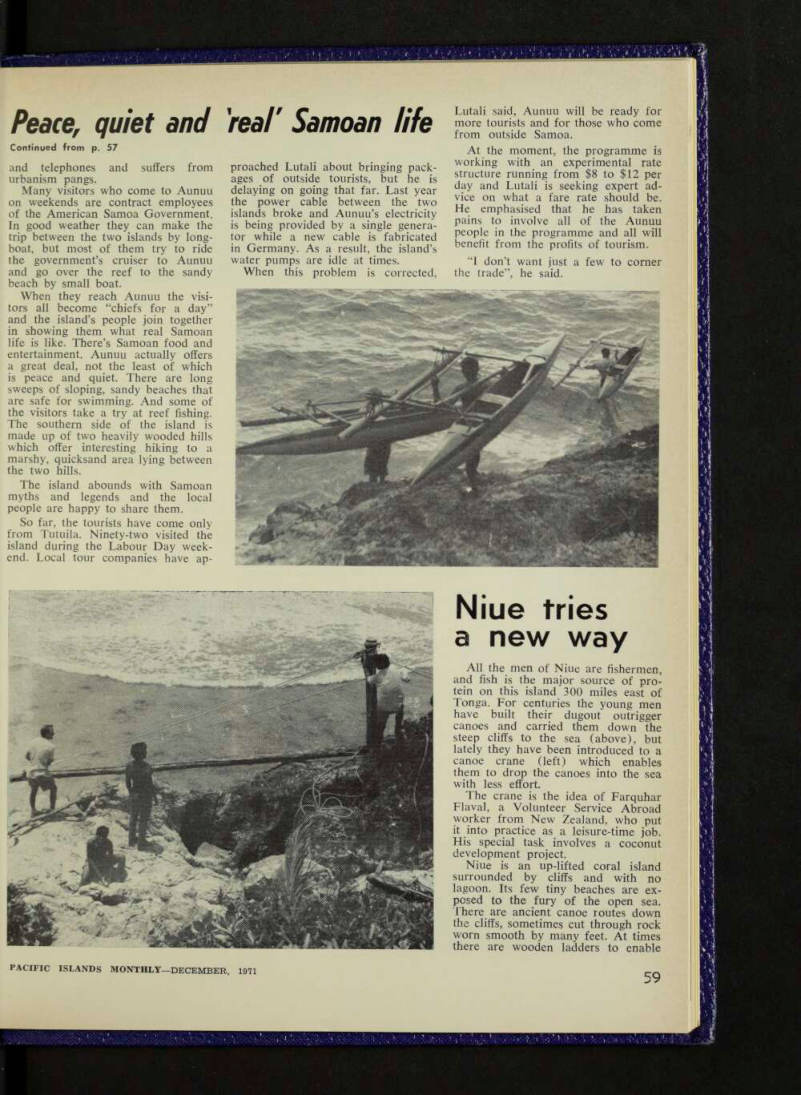
All the men of Niue are fishermen, and fish is the major source of pro tein on this island 300 miles east of Tonga. For centuries the young men have built their dugout outrigger canoes and carried them down the steep cliffs to the sea (above), but lately they have been introduced to a canoe crane (left) which enables them to drop the canoes into the sea with less effort.
The crane is the idea of Farquhar Flaval, a Volunteer Service Abroad worker from New Zealand, who put it into practice as a leisure-time job.
His special task involves a coconut development project.
Niue is an up-lifted coral island surrounded by cliffs and with no lagoon. Its few tiny beaches are ex posed to the fury of the open sea.
There are ancient canoe routes down the cliffs, sometimes cut through rock worn smooth by many feet. At times there are wooden ladders to enable
the men to get their canoes to the sea.
They “park” them on the cliffs, with coconut palm fronds to protect them from the sun.
Village people at Lakepa, where Flaval has been living, were doubtful about the crane idea when Flaval started on it, but—Niue fashion — they were helpful when the time came to build it and test it. They then ac cepted the crane as being quicker, safer and easier than clambering down a ladder.
Flaval plans to build another one.
The canoe, as important to the peoples of the Pacific Islands as the wheel to the peoples of the land masses, figures in Niuean legend as the bringer of the coconut.
Writing in the government-spon sored Tohi Tala Niue, T, Moresi snr., of Alofi North recalls that the “coconut was brought here by two people, Levei-Matangi and Leveifua lolo. They travelled on a two-man canoe on their voyage to an island called Manua. On arriving at the island they were given some coconuts to drink, and on drinking they felt the sweetness of the milk and the delicacy of the meat of the green nuts. They were very thankful and praised that new thing.
“Before returning to their island, Moa, the King of Manua, gave them the coconut and said, ‘This coconut is for you, take back and plant, and it will provide you with delicious food’.
“That is the meaning of the word ‘Niue’. It was originally ‘Niue Faikai’ but later changed to ‘Niue Fekai’ which means a gift. That is also the reason why our island is always hospitable up till today.”
Another legend links the island’s coconuts with Tonga, relating how a young man from the island of Motu Sefua married a Tongan princess and brought his bride and the coconuts from Tonga to Niue.
Legends are usually founded on fact and Niue’s beginnings are be lieved to date back more than 1,000 years to two main migrations, the first from Samoa and then one from Tonga.
The Cook Islands are also thought to have helped to people the island and, even today, the population is divided into two groups, those in the northern villages and those in the southern villages.
The legend related by T. Moresi, snr., however, appears to link Niue with Samoa and the Cooks. The tradition of the Cooks is that they were invaded about 800 years ago by two warriors, Karika, of Manu’a in Samoa, and Tangiia, of Tahiti.