Tahiti
pp. 30-31 · Read in the full issue
Letter
A man who lives in Tahiti had his third book published in November, and as I thought about the significance of this event during the past few weeks, and mulled over other things that have happened in Tahiti worthy of mention in my December letter, I became more and more sure that this book, The Long Way (Arthaud, Paris) by Bernard Moitessier, was the only subject worth writing about at length.
I have no intention of doing a book review.
The Long Way is so beautiful and natural, grandiose and simple, delicate and daringly profound, only a paid critic or a profit-minded publisher would have reason to contemplate it with other than the sea-swelling, heart-breaking-with-joy gratitude I felt when I read it.
My only desire is to introduce the book and the French yachtsman-author to those in the Pacific who are better prepared than, say, city-bound folk, to rejoice with me that such a man, and such a book, can exist in today’s lousy world.
My hope is that we in the Pacific can give this book a ground-swell of appreciation which, like a tidal wave, will rise up and sweep across the polluted continents give them a bath, so to speak. Those who really need this book, with our help, will be able then to use its graceful humanity and hopefulness as a demonstration of the wonderful common self their workaday lives tend to sell short.
Bernard Moitessier, 46, is one of the nine single handed yachtsmen who set out from Plymouth in 1968 to make a nonstop circumnavigation. The nine men were “participants” in a “race” organised by the London Sunday Times. The first man to reach Plymouth after rounding three capes was to receive a golden globe.
The man who made the best time won the £5,000 prize money. The remarkable English yachtsman, Robin Knox-Johnston, was the only one to finish the race.
He collected all the marbles. Nigel Tetley made it around the world, but he lost his mast in the Atlantic.
Donald Crowhurst never left the Atlantic. He sailed here and there writing a phoney log about an imaginary voyage. He disappeared at sea and was presumed dead. (Knox-Johnston gave the £5,000 he won to Crowhurst’s family).
Bernard Moitessier got past the Horn going east, and then decided the money and glory were not worth the hassle of life in Europe. He decided to continue in his own wake to the peaceful Pacific where he could leisurely savour his newly-discovered happiness.
The Long Way recounts Bernard’s voyage, what it was like to be alone at sea. It shows, and therefore very subtly tells, why he decided not to head north back to Plymouth. It is a perfect book, because it’s an agonisingly-jewelled and true one. It shows the growth and change of a man who was prepared, physically and spiritually, to go anywhere to find himself, to find a tenable meaning for life.
By giving up the excellent position he was in to win the prize money, Bernard made himself one of the noteworthy Pacific refugees from the suffocating machine-tooled life of contemporary “civilisation”. His 37,455-mile voyage in 303 days from Plymouth to Tahiti by way of five capes remains the longest non stop trip in planetary history (Robin made it back to Plymouth, a 30,000-mile voyage, in 312 days, nine more than it took Bernard to circle the globe one and a half times).
By writing The Long Way, an effort which took him almost 2i years, Bernard shares his gut-raw ex perience with us, and makes it clear, for even the most cynical of sceptics, why he abandoned the Sunday Times race.
The book, however, was definitely not written as a defence of his decision. The word “abandon” implies the reverse of what actually happened. Bernard, in fact, refused to give up. He had no choice but to follow the magnificent dictates of the ocean and his heart. To have acted in any other way, to have re lented in favour of the acknowledged temptations of Plymouth, would have been an abandonment of everything he had seen and felt and learned at sea.
The Long Way is great because it is at once un flinchingly precise narrative description, and symbolic throughout. It is unadulterated narrative of an extremely perceptive, experienced seaman (He had taken Joshua from Tahiti to Alicante, 14,216 miles, in 1966, on what then was the longest nonstop voyage. His wife, Francoise incidentally, during that trip became the first woman to round Cape Horn). Bernard’s observations are abundant and acute. They come after 25 years at sea in small boats. Not even Herman Melville has told me more about what the ocean is like (the long appendix is a handbook of technical detail for cruising yachtsmen). If the book were nothing more than ex cellent narrative, I think it would be worth reading.
Its grandeur and intelligence make it much, much more than an ocean voyage well-told. It is the true story (a parable?) of one relatively ordinary man pitting his confusion and weakness, and strength, against the entire mute universe, against the groaning colossus of the ocean, Bernard’s meticulous re-creations of sight and sound and senses always achieve a symbolic force.
His brute acknowledgement of the physical world re creates the mystery of life itself. Bernard and Joshua (named after Slocum), sail inches up and down, speed and balance, ocean creatures of which man and boat are no more or less, wind force and spiritual force,
everything is real and symbolic at the same time. The real elements become symbols for a different voyage Bernard is making towards the most exhilarating and dangerous far-reaches of his own humanity. As he says, the real log is written on the sea itself.
Just before the Horn, wind force 8, gusts 9, monster swells miraculously regular, Bernard takes off his mask and gloves to better feel part of the 56 degree latitude end-of-the-earth. He clings to Joshua which is surfing 60 to 75 feet at a time from wave crest to trough. Boat and man are at their breaking point.
Bernard waits before, ears burning, he lowers sail and goes below to resume his hypnotised but not at all crazy watch from the relative safety of his closed hatch viewpoint.
I must warn readers this book is crafted. I do not believe there is an extraneous detail. Like a sym phony, or a good poem, or any naturally and indis putably alive thing, it has a harmonious, invisible life.
Bernard lived his voyage with uncompromising honesty and he knew how to present, and let be presented, his experience in The Long Way. His book is almost written by the deft, silent understatement of life itself.
A two-lane highway was built along the Papeete waterfront while Bernard was writing. All the lovely old trees were cut down to make room for it. Bernard and his yachtsmen neighbours were distraught. A garden they themselves planted, in which every evening they sat around and talked, was bull-dozed away. They wrote a letter of protest to the governor. Soon their garden was partially returned, with the promise that trees and grass would soon line the whole waterfront boulevard.
The yachtsmen imposed their will on the bureaucrats of progress.
That is the hope proposed by this book. Every man has a choice, and one man does make a difference.
Bernard is giving his share of the money this book will make to “The Friends of the Earth”, a group
trying to return nature to man. Bernard’s unashamed message, conceived at sea and written in Tahiti, is the soft voice of the Pacific speaking to the world. If the Pacific, with articulate spokesmen like Bernard Moit essier, cannot make itself heard . . . but that’s a crazy thought. It has to make itself heard. ☆ ☆ ☆ Albeit, Bernard Moitessier’s radiant book has gal vanised my thoughts of recent weeks, life continues here at its slow but always interesting pace.
French Overseas Territories Minister Pierre Mes smer (PIM, Oct. p. 24 & Nov. p. 40) was called back to centre-stage by the Territorial Assembly at the end of October, but he was not being asked for an encore.
Assembly President John Teariki, speaking on the first day of the 1972 budget session, took offence at two remarks attributed to the minister by a French news agency dispatch. The minister had allegedly slighted the importance and authority of the local autonomist Ass embly majority during debate at the Paris National Assembly on a project to decentralise power in French Polynesia (I will write at length on this relatively com plex “communities project” in a future letter).
Prior to reading his traditional speech to the opening session, Governor Pierre Angeli jumped to the minister’s defence before what President Teariki called “a bad quarrel” developed any further. Later in the day, the governor’s office produced an official trans cript of the Paris debate. It turned out that the news paper report had considerably oversimplified the min ister’s exact words and dramatised its paraphrases with quotation marks. The assemblymen remained suspicious of a government intention to nibble away some of their prerogatives, but no further public remonstrations occurred.
The governor announced the 1972 budget of approx imately U.S. $32.6 million, a 4 per cent, increase over fiscal 1971. He gave a comprehensive review of areas in which the money would best be spent. Tourism headed his list. Agriculture and animal and fish breeding, would be encouraged to improve the disastrous balance of payments situation. A battle against rising prices and the start of oceanographic research and exploitation were also stated as priorities for ’72. ☆ ☆ ☆ Other news from Tahiti includes a narrowly averted strike by employees at the privately-owned Martin Electric Company. A one-day walkout and total blackout were avoided when the 11th hour nego tiations established a temporary truce. To get the union to push back its strike deadline to December 31, the Martin bosses had to agree to immediately and per manently link salaries to the government-calculated cost-of-living index. Martin became the first private enterprise in French Polynesia to take this step. It is a precedent which may become standard procedure for the private sector. Civil service and military people have had this advantage for some time.
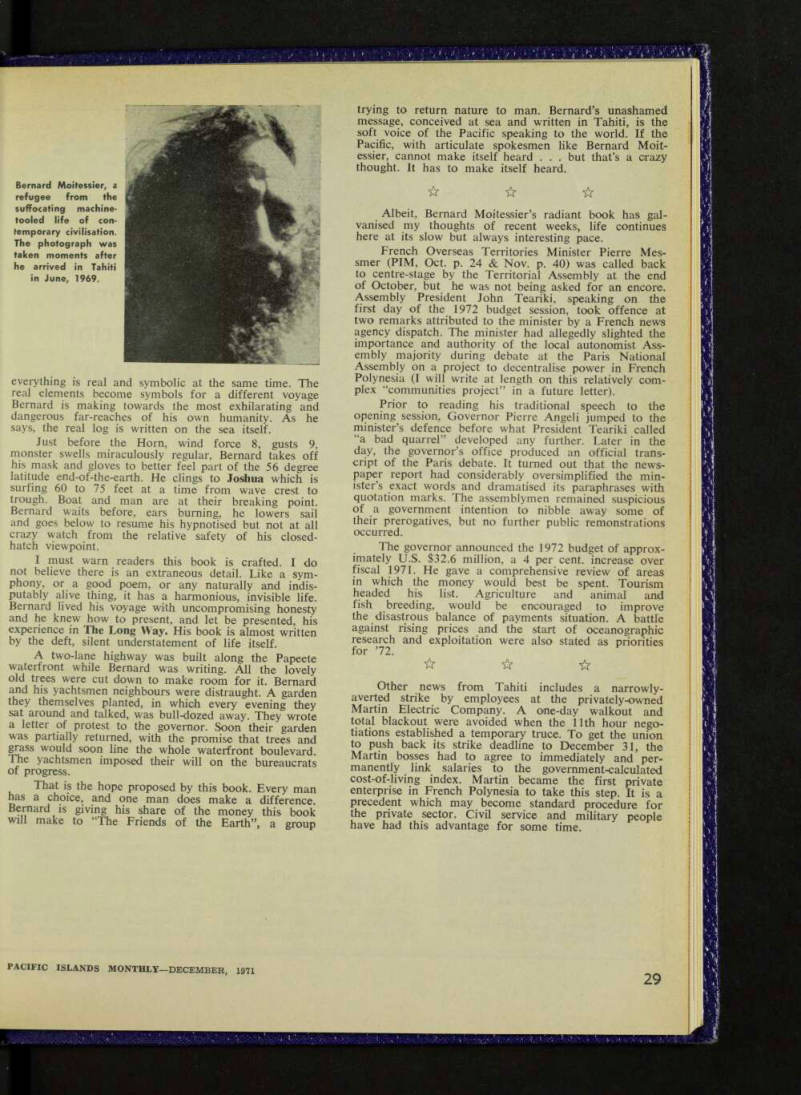
Bernard Moitessier, a refugee from the suffocating machine tooled life of con temporary civilisation.
The photograph was taken moments after he arrived in Tahiti in June, 1969.