Tropicalities
pp. 28-29 · Read in the full issue
Tonga's treasure trail
A Japanese called Charlie and a Tongan called Joe are the principal players in the latest episode of the continuing story of the Mysterious Tongan Treasure.
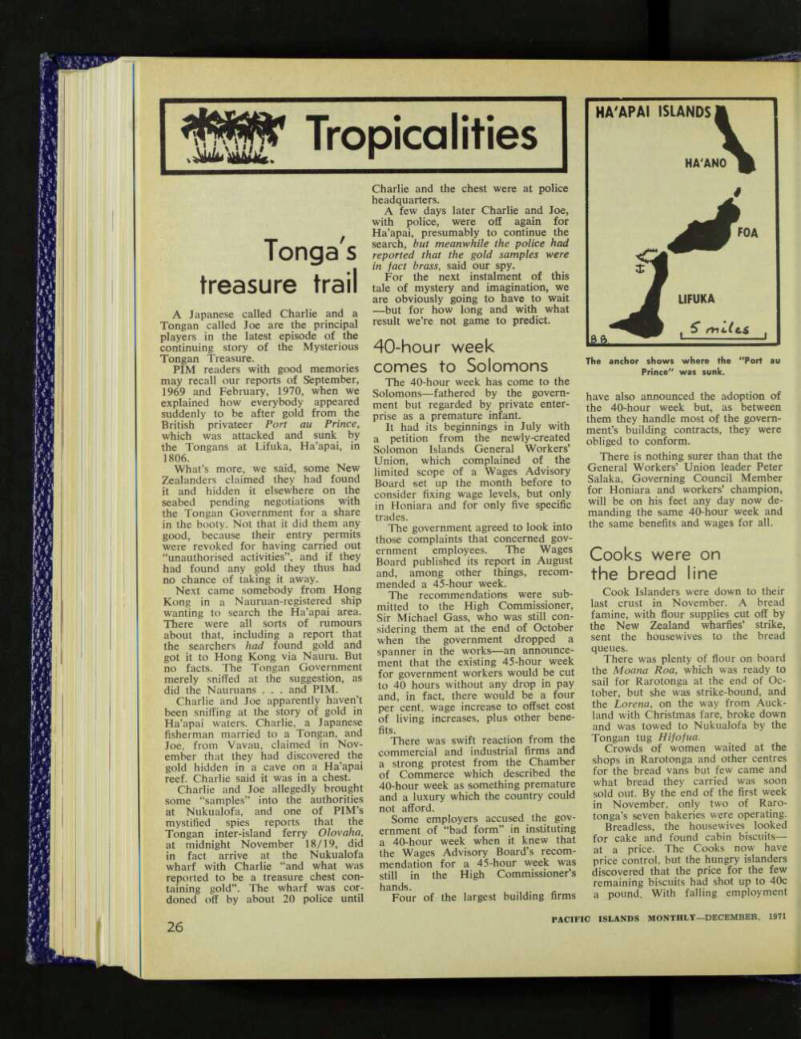
PIM readers with good memories may recall our reports of September, 1969 and February, 1970, when we explained how everybody appeared suddenly to be after gold from the British privateer Port au Prince, which was attacked and sunk by the Tongans at Lifuka, Ha’apai, in 1806.
What’s more, we said, some New Zealanders claimed they had found it and hidden it elsewhere on the seabed pending negotiations with the Tongan Government for a share in the booty. Not that it did them any good, because their entry permits were revoked for having carried out “unauthorised activities”, and if they had found any gold they thus had no chance of taking it away.
Next came somebody from Hong Kong in a Nauruan-registered ship wanting to search the Ha’apai area.
There were all sorts of rumours about that, including a report that the searchers had found gold and got it to Hong Kong via Nauru. But no facts. The Tongan Government merely sniffed at the suggestion, as did the Nauruans . . . and PIM.
Charlie and Joe apparently haven’t been sniffing at the story of gold in Ha’apai waters. Charlie, a Japanese fisherman married to a Tongan, and Joe, from Vavau, claimed in Nov ember that they had discovered the gold hidden in a cave on a Ha’apai reef. Charlie said it was in a chest.
Charlie and Joe allegedly brought some “samples” into the authorities at Nukualofa, and one of PlM’s mystified spies reports that the Tongan inter-island ferry Olovaha, at midnight November 18/19, did in fact arrive at the Nukualofa wharf with Charlie “and what was reported to be a treasure chest con taining gold”. The wharf was cor doned off by about 20 police until
Charlie and the chest were at police headquarters.
A few days later Charlie and Joe, with police, were off again for Ha’apai, presumably to continue the search, but meanwhile the police had reported that the gold samples were in fact brass, said our spy.
For the next instalment of this tale of mystery and imagination, we are obviously going to have to wait —but for how long and with what result we’re not game to predict.
40-hour week
comes to Solomons
The 40-hour week has come to the Solomons —fathered by the govern ment but regarded by private enter prise as a premature infant.
It had its beginnings in July with a petition from the newly-created Solomon Islands General Workers’
Union, which complained of the limited scope of a Wages Advisory Board set up the month before to consider fixing wage levels, but only in Honiara and for only five specific trades.
The government agreed to look into those complaints that concerned gov ernment employees. The Wages Board published its report in August and, among other things, recom mended a 45-hour week.
The recommendations were sub mitted to the High Commissioner, Sir Michael Gass, who was still con sidering them at the end of October when the government dropped a spanner in the works—an announce ment that the existing 45-hour week for government workers would be cut to 40 hours without any drop in pay and, in fact, there would be a four per cent, wage increase to offset cost of living increases, plus other bene fits.
There was swift reaction from the commercial and industrial firms and a strong protest from the Chamber of Commerce which described the 40-hour week as something premature and a luxury which the country could not afford.
Some employers accused the gov ernment of “bad form” in instituting a 40-hour week when it knew that the Wages Advisory Board’s recom mendation for a 45-hour week was still in the High Commissioner’s hands.
Four of the largest building firms
have also announced the adoption of the 40-hour week but, as between them they handle most of the govern ment’s building contracts, they were obliged to conform.
There is nothing surer than that the General Workers’ Union leader Peter Salaka, Governing Council Member for Honiara and workers’ champion, will be on his feet any day now de manding the same 40-hour week and the same benefits and wages for all.
Cooks were on
the bread line
Cook Islanders were down to their last crust in November. A bread famine, with flour supplies cut off by the New Zealand wharfies’ strike, sent the housewives to the bread queues.
There was plenty of flour on board the Moana Roa, which was ready to sail for Rarotonga at the end of Oc tober, but she was strike-bound, and the Lorena, on the way from Auck land with Christmas fare, broke down and was towed to Nukualofa by the Tongan tug Hifofua.
Crowds of women waited at the shops in Rarotonga and other centres for the bread vans but few came and what bread they carried was soon sold out. By the end of the first week in November, only two of Raro tonga’s seven bakeries were operating.
Breadless, the housewives looked for cake and found cabin biscuits— at a price. The Cooks now have price control, but the hungry islanders discovered that the price for the few remaining biscuits had shot up to 40c a pound. With falling employment
The anchor shows where the "Port au Prince" was sunk.
and a money shortage, few could afford to buy.
Falling back on the traditional staple food, taro, they were again foiled. There was little taro. An out break of Pythium, a fungus disease which turns the root into a rotten, evil-smelling mass, had hit the gar dens. And, in the last few years, with plenty of jobs going, the Rarotongans, particularly, have neglected the gardens which assured them a subsi stence diet.
There were few other foods either.
Tinned meats, the usual takeaway meals, even ice cream had vanished.
But there were bananas! The NZ sea men’s strike had marooned all banana cargoes in the Islands.
The islanders were in no real dan ger of starving, but they had to pull their belts in and were only able to let them out again after November 17 when the Moana Roa finally docked at Rarotonga.
The Lorena, which had a seized main thrust bearing, was expected to reach Rarotonga early December.
Then there’ll be turkeys, ducks, hams, lamb, pork and butter for sale.
The Cooks live almost hand to mouth where flour is concerned. Be cause, the bakers claim, NZ flour tends to become weevil-infested if left for long periods, and French flour from Tahiti, although superior, costs $2.50 more for a 160 lb sack, reserves are not kept. The bakers rely on the Moana Roa’s monthly visit.
The island bakeries normally im port about 66 tons a month, and another 25 tons goes to the outer islands, mainly to Aitutaki. The bill for flour came to $94,000 last year.
More and more, the Cooks people rely on overseas suppliers for their food. Last year food imports cost $1,362,000, of which tinned corned beef claimed 21 per cent. Imported fish cost $103,000 and cabin biscuits $58,000.
In Port Moresby, Papua New Guinea, the price of a loaf of bread went up 2c in November, to 20c retail unwrapped, and 21c wrapped, after the government agreed there had been a 12 per cent, increase in manufacturing costs since the last review, in 1963. The government will also extend price control on bread to more territory towns.
Sentimental
return to Samoa
When Dr. Margaret Mead made a sentimental five-day visit to Ame rican Samoa in November, the scene of her first research 46 years ago,
she termed her return the most pleasant period of her life.
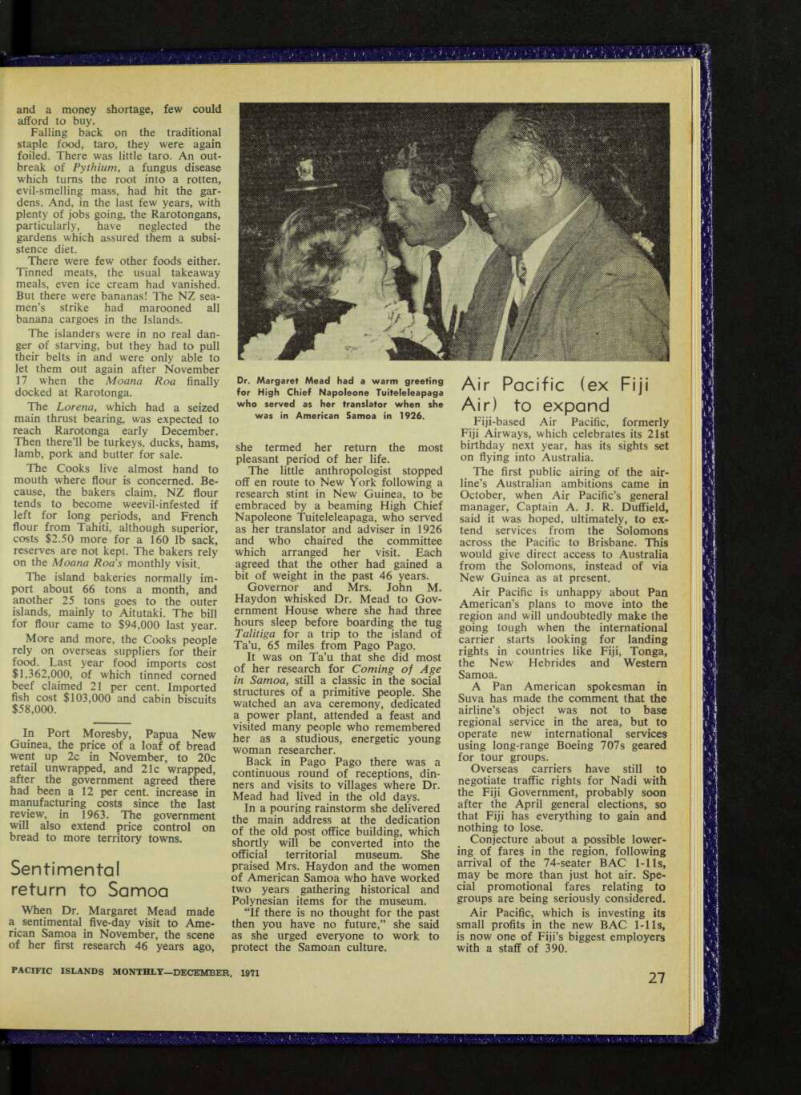
The little anthropologist stopped off en route to New York following a research stint in New Guinea, to be embraced by a beaming High Chief Napoleone Tuiteleleapaga, who served as her translator and adviser in 1926 and who chaired the committee which arranged her visit. Each agreed that the other had gained a bit of weight in the past 46 years.
Governor and Mrs. John M.
Haydon whisked Dr. Mead to Gov ernment House where she had three hours sleep before boarding the tug Talitiga for a trip to the island of Ta’u, 65 miles from Pago Pago.
It was on Ta’u that she did most of her research for Coming of Age in Samoa, still a classic in the social structures of a primitive people. She watched an ava ceremony, dedicated a power plant, attended a feast and visited many people who remembered her as a studious, energetic young woman researcher.
Back in Pago Pago there was a continuous round of receptions, din ners and visits to villages where Dr.
Mead had lived in the old days.
In a pouring rainstorm she delivered the main address at the dedication of the old post office building, which shortly will be converted into the official territorial museum. She praised Mrs. Haydon and the women of American Samoa who have worked two years gathering historical and Polynesian items for the museum.
“If there is no thought for the past then you have no future,” she said as she urged everyone to work to protect the Samoan culture.
Air Pacific (ex Fiji
Air) to expand
Fiji-based Air Pacific, formerly Fiji Airways, which celebrates its 21st birthday next year, has its sights set on flying into Australia.
The first public airing of the air line’s Australian ambitions came in October, when Air Pacific’s general manager, Captain A. J. R. Duffield, said it was hoped, ultimately, to ex tend services from the Solomons across the Pacific to Brisbane. This would give direct access to Australia from the Solomons, instead of via New Guinea as at present.
Air Pacific is unhappy about Pan American’s plans to move into the region and will undoubtedly make the going tough when the international carrier starts looking for landing rights in countries like Fiji, Tonga, the New Hebrides and Western Samoa.
A Pan American spokesman in Suva has made the comment that the airline’s object was not to base regional service in the area, but to operate new international services using long-range Boeing 707 s geared for tour groups.
Overseas carriers have still to negotiate traffic rights for Nadi with the Fiji Government, probably soon after the April general elections, so that Fiji has everything to gain and nothing to lose.
Conjecture about a possible lower ing of fares in the region, following arrival of the 74-seater BAC 1-1 Is, may be more than just hot air. Spe cial promotional fares relating to groups are being seriously considered.
Air Pacific, which is investing its small profits in the new BAC 1-1 Is, is now one of Fiji’s biggest employers with a staff of 390.
Dr. Margaret Mead had a warm greeting for High Chief Napoleone Tuiteleleapaga who served as her translator when she was in American Samoa in 1926.