baptisms'
pp. 32-33 · Read in the full issue
Memories of 'aerial baptisms'
Caledonians in November were happy to cast aside problems of the nickel market and of political leadership as they paused joyously to re-live some adventures of 40 years ago. In November they invited back to Noumea the man who, in 1931, was the first to land a plane on New Caledonian soil —Victor Roffey of Rockhampton, Australia, at the time a newly-fledged pilot of 23 years.
He was also the first to make a flight linking New Caledonia with another country, Australia.
Wherever you mentioned the name Roffey in Noumea recently, you were bound to elicit some response about this young pioneer and his single-engined de Havil- '3 nd , G T, sy n lo . th ’ th ,!, Eagle. Mr. Patrice Wright, a Noumea company sales manager, well remembers his awesome expenence of those days: I was a boy of 10 and Roffey took me up together with a woman from the New Hebrides and we both trembled with fright. We put on flying helmet and goggles since our heads were poking out the top, of course”. At the local Shell agency, Tom Hagen recalls that Shell, who supplied Roffey’s fuel, put out a special ink blotter in those days with Roffey’s head and plane printed on it.
Retail store director, Numa Daly, is the Noumea Rotarian who flew to Rockhampton to meet Roffey and arrange his memorial trip back to Noumea as guest of local Rotary. Numa Daly recalls that Roffey took many Caledonians up for their first joy rides and for what the French call “aerial baptisms”. He also undertook special charter flights, including one trip to Thio to fetch an especially-strong player to join in a soccer match agamst Numa Daly’s own team. Roffey flew the fellow down to Noumea, “but we won just the same” Mr.
Daly recalls with a chuckle, of course there were no air (ri in New Caledonia in those d but Mr . Da ly does not Golden remember Roffey ever having a mis hap, even as he put the locals through the the loop and other 6 acrobatics. Mr. Marcel L ' H uillier particularly remembers a moc j c battle carried out by Roffey as he flew his plane over an .. my .. car a nd flour bag .. bombs ” were dropped down on . * . . , t f „ After entertaining the locals for nine months, Roffey decided to fly his plane home. (He had originally brought it to Noumea by boat). Extra fuel tanks had to be attached for the 1,000 mile
New Caledonia Diary
with
Helen Rousseau
in Noumea flight and some of the mechanics who helped in the task are still in Noumea. Captain Charles Legras, a retired sea captain now living in Noumea, gave Roffey some offshore landmarks to look out for and, with a pumped-up tyre tube fitted around his waist in case of emergency, young Roffey made off for home. He was in a hurry to attend the wedding of his sister, who was to become the mother of Rod Laver, the Austra lian tennis champion.
As all New Caledonia seemed to wait with bated breath, Roffey’s flight took 11 hours. When the all-safe message came through from Brisbane, the Caledonians hastened to hoist the French and Australian flags on top of the Semaphore (Signal) hill, as a mark of triumph.
From accounts reaching Noumea, it seems that Roffey’s exploit did not raise the same enthusiasm in Australia, where the young pilot became the special object of customs and quarantine officials, because of the bunches of flowers and bottles of champagne offered to him by Caledonian well-wishers.
If Roffey forged the first air link between New Caledonia and its neighbours in 1931, other ad
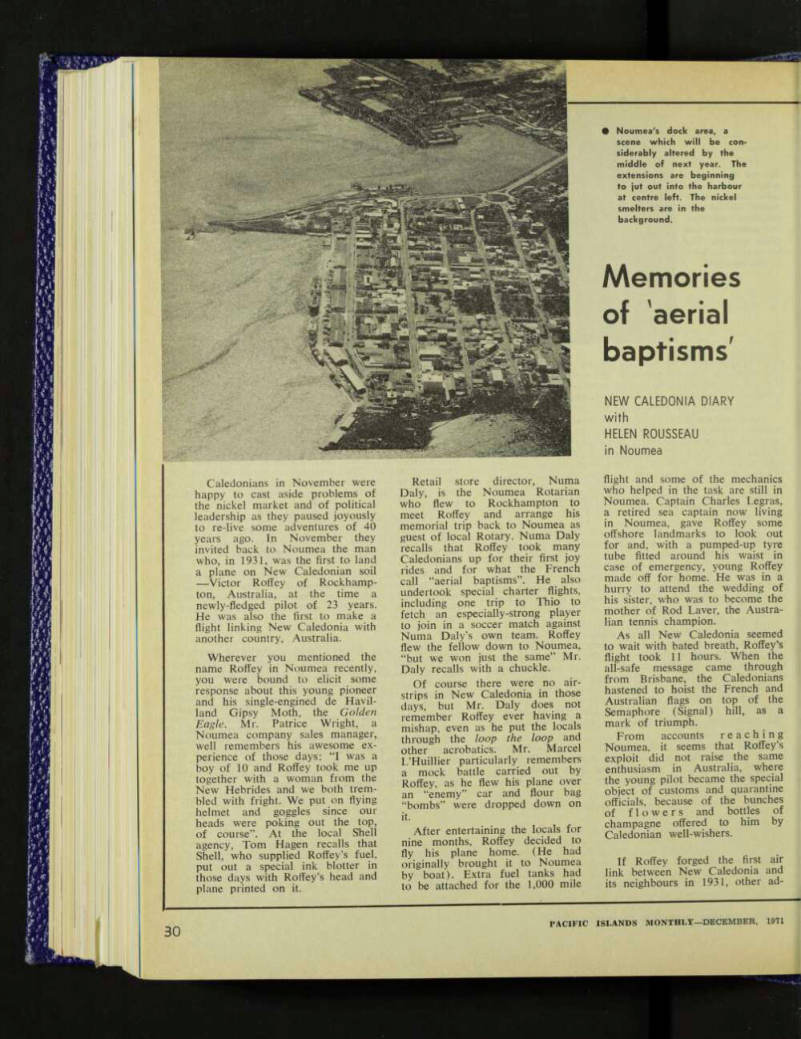
Noumea's dock area, a scene which will be con siderably altered by the middle of next year. The extensions are beginning to jut out into the harbour at centre left. The nickel smelters are in the background.
venturers come these days to drive on Caledonian roads. Six over seas drivers were expected to participate in the island’s sth Safari Caledonien, scheduled for the first weekend in December.
Three teams from metropolitan France were entered in the trial, together with one Tahitian driver, two Australian teams and 40 Caledonian pairs.
Coinciding with preparations for the Safari, the island’s first significant car tyre retread plant was opened in Noumea. It is a joint venture between the Austra lian company Mac Nicol Invest ments Pty. Ltd. of Brisbane and the W.A. Johnston group in Noumea, using the American Bandag process. The factory is especially equipped to handle tyres from heavy trucks such as those used in transporting nickel ore.
Among other recent overseas interests entering the territory, two new types of precut homes from Australia were on display in Noumea in November. The Californian Home promoted by local American Vernon Dapper in collaboration with Guy Chausy is a Blunt home, from Colwel Pty. Ltd. of Adelaide. The second house was presented by a local company set up to assemble homes from Brownbuilt in Melbourne.
The two homes on display from these Australian manufacturers are offered at $A42,000 and $28,000 respectively.
Other Australian housing com panies represented in the territory include O’Neill Industries of Queensland and George Hudson of Sydney. In addition there are about nine New Zealand pre fabricated home companies selling their dwellings in New Cale donia. Noumea’s building industry has been stretched to the limits to provide adequate housing since more than 10,000 new arrivals were registered in New Caledonia in the 20 months to the end of August.
These new arrivals have, of course, been attracted by the pro mised large expansion of the ter ritory’s nickel industry. In view of the current nickel market slump and the failure of the three pro posed new nickel companies to implement their projects, there has been considerable uncertainty over the prospects in view.
Through its current summer session, the Territorial Assembly has to debate the island’s budget for 1972. While revenue cannot be estimated precisely for the next 12 months, the budget proposed by the Administration has been designed to maintain confidence and envisages an expenditure of some SABO million.
In opening the budget session late October, Governor Louis Verger told the Territorial Council lors: “1971 will have been a year of deceptions for the territory”.
After noting that none of the new nickel-treating companies was yet installed and that the nickel market was in an unfavourable position, the governor said this state of affairs had a taste of “hopes that have been disap pointed. And this taste is all the more bitter as the hopes placed in the future and development of New Caledonia are immense”. He continued “It is in this atmosphere of disenchantment, of uneasiness even, that your session is opening”.
The governor had no significant new developments to report on new nickel smelting projects for the island. He claimed, however, that the world’s large non-ferrous metal companies could not regard New Caledonia’s immense nickel wealth with disinterest. Yet he pointed out that inflation on the island is a problem for such companies, since the Canadian INCO project which was originally estimated to require an invest ment of $3OO million had since grown to double that figure.
On the positive side, the gov ernor claimed that the territory’s sole existing nickel smelting com pany, the SLN, expects to produce around 58,000 tons next year, which would be 11,000 tons more than this year. The SLN had an nounced it would produce over 60,000 tons this year, but that was before the slump or the two-month strike were taken into account.
Meanwhile, on the nickel ore front, after Paris had imposed a 4.3 million ton limit on exports in the last Japanese financial year, the quota for this year, ending March 31, 1972, is 4.7 million tons. But the Japanese have indicated they may not buy quite 3.5 million tons now, while in the next Japanese-year beginning April 1, 1972 sales of Caledonian nickel ore to Japan may not rise
far above the 2 million ton level.
In the meantime, preparations for the boom have considerably livened up many aspects of life in Noumea. Art shows, local ballet performances, imported stage artists and nightclub musicians all received popular support during the month. One of the most recent art exhibitors was a Caledonian, Mr. Patrice Nielly, who displayed some 130 paintings in Noumea, souvenirs of his voyages around the French Pacific.
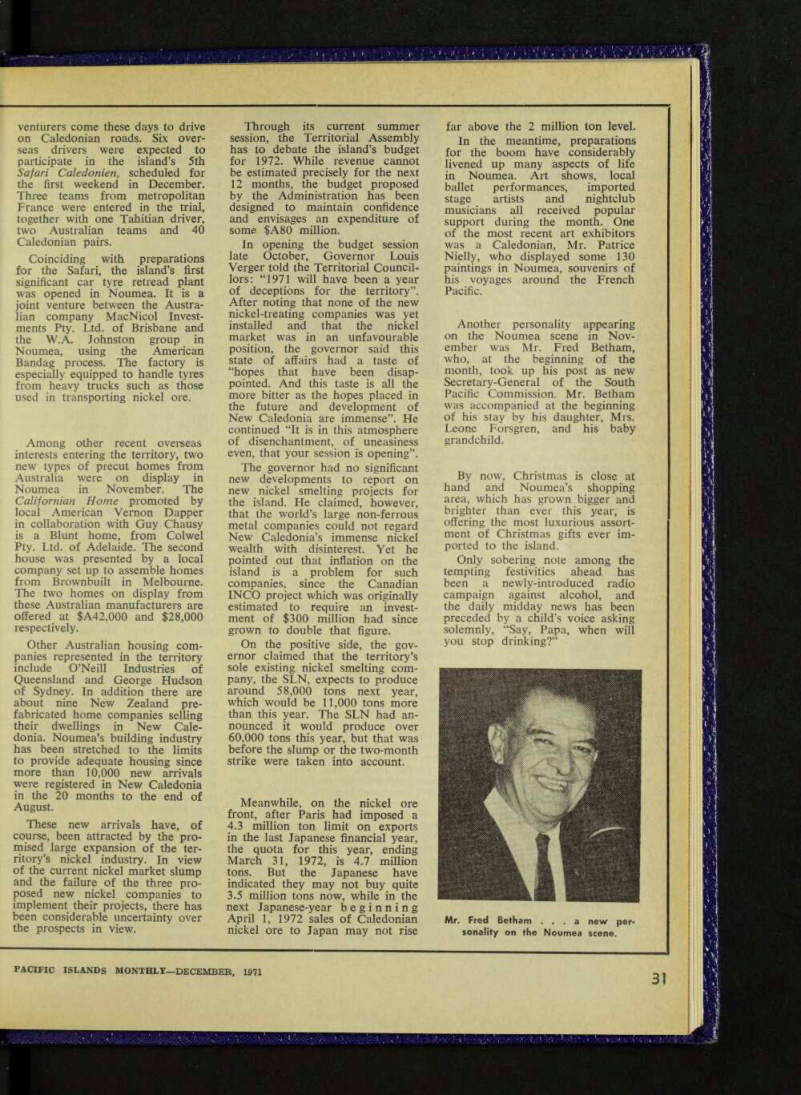
Another personality appearing on the Noumea scene in Nov ember was Mr. Fred Betham, who, at the beginning of the month, took up his post as new Secretary-General of the South Pacific Commission. Mr. Betham was accompanied at the beginning of his stay by his daughter, Mrs.
Leone Forsgren, and his baby grandchild.
By now, Christmas is close at hand and Noumea’s shopping area, which has grown bigger and brighter than ever this year, is offering the most luxurious assort ment of Christmas gifts ever im ported to the island.
Only sobering note among the tempting festivities ahead has been a newly-introduced radio campaign against alcohol, and the daily midday news has been preceded by a child’s voice asking solemnly, “Say, Papa, when will you stop drinking?”
Mr. Fred Betham ... a new per sonality on the Noumea scene.