Straight!
pp. 50-52 · Read in the full issue
Aftermath Of The South Pacific Games
Let's Put The Record
By STUART INDER, who was in Papeete for the Fourth Games
Now that we have a four-year break to the Fifth South Pacific Games in Guam, the South Pacific Games Council should have time enough for a vital job that needs doing—the job of compiling an accurate list of Games times and records. After four Games, the present lists are unreliable.
Each Games since Suva in 1963 has probably added to the inaccuracies, and the Tahiti Games certainly was no exception. Further delay in correcting the records will result in the errors being compounded, but the job shouldn’t be difficult if it is done soon, while the participants and/or the officials are still available to help adjudicate.
As an example, official record lists published in connection with the Tahiti Games, including both the official programme and the official handbook giving general information and regulations, describe the women’s
100 metre track record as having been set by Fiji’s Ana Ramacake m 1963 at 12.85. Ramacake herself is still available to confirm (or other wise) that her time was 12.25.
The Tahiti handbook gives the best time in the individual cycling sprint in 1966 to M. Bopp-du-Pont at 11.945. The official published results of the Tahiti Games give no time at all, and spell Bopp-du-Pont’s name without the hyphens, Du-Pont (or du Pont) also took out the gold at Tahiti and a study of the detailed results appears to indicate that his best time was 12.425, run in the semi-finals. But this needs to be confirmed officially and it should also be stated clearly who holds the record and how he spells his name. . t 1 This matter of names, incidentally, involves far more than correct spel ling—it involves correct identifica tion. An example is that of the
outstanding Fiji women’s athlete, Miriama Tuisorisori —which is the name she is listed under at Tahiti.
But would anybody studying the Port Moresby records of 1969 realise that the M. Kadavu who took out the gold medal for the long jump was the Tuisorisori who took out the long jump bronze (among other medals) at Tahiti?
A more telling example is that of the boxer Noel Mahe, who took a silver in the lightweight division at Papeete. Who would imagine that this is the same N. Katoutch who took the bronze in the middleweight divi sion at Port Moresby, and the N.
Kaoutche who took the bronze in the welter at Noumea?
It would be difficult to believe that a man who fought as a welterweight in 1966 could become a middleweight in 1969 and a lightweight in 1971 and change his name and his appear ance in the meantime. But experi enced judges such as Stan Brown, of
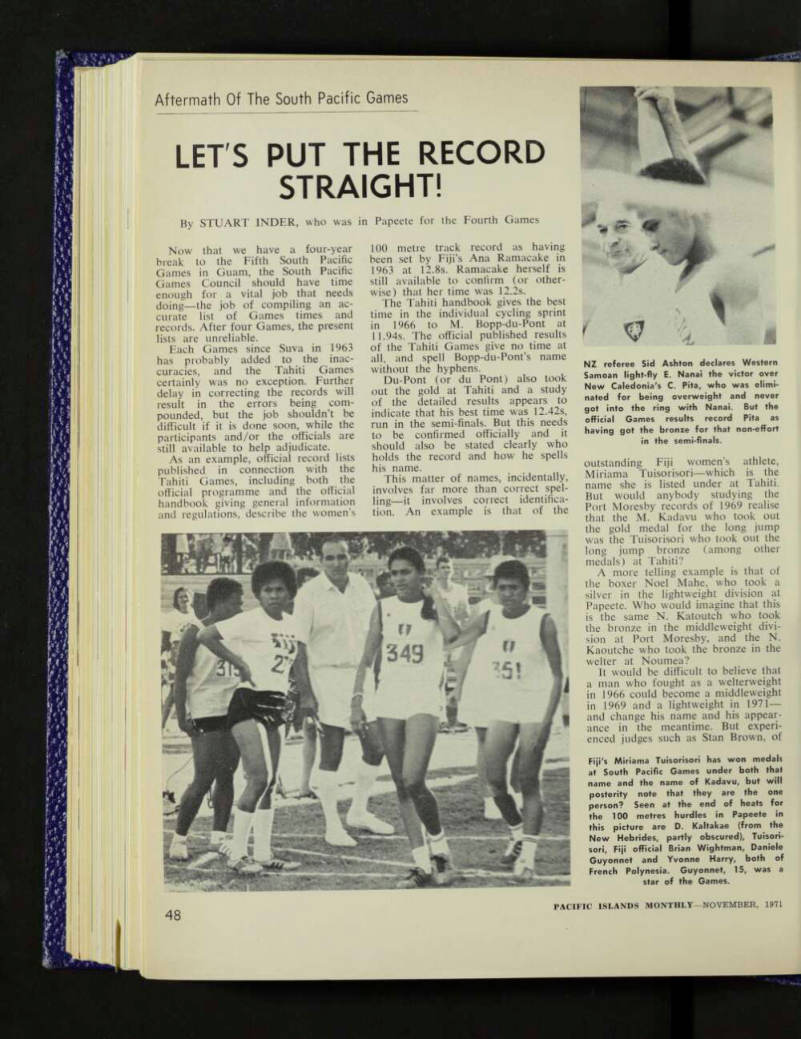
NZ referee Sid Ashton declares Western Samoan light-fly E. Nanai the victor over New Caledonia's C. Pita, who was elimi nated for being overweight and never got into the ring with Nanai. But the official Games results record Pita as having got the bronze for that non-effort in the semi-finals.
Fiji's Miriama Tuisorisori has won medals at South Pacific Games under both that name and the name of Kadavu, but will posterity note that they are the one person? Seen at the end of heats for the 100 metres hurdles in Papeete in this picture are D. Kaltakae (from the New Hebrides, partly obscured), Tuisori sori, Fiji official Brian Wightman, Daniele Guyonnet and Yvonne Harry, both of French Polynesia. Guyonnet, 15, was a star of the Games.
Errors of times, names, medals
Fiji (who has judged at all four Games) recognised Noel while watch ing him weigh-in at Papeete—com menting that he had thinned down to such an extent, and had grown his hair so much longer, that he was a different person.
There is nothing suspicious in the name change. Islanders not infre quently are known by different names. But the official record books should certainly recognise the changes, and get the names spelled correctly while they’re at it.
There are errors of times, identifica tion and medal position among the Tahiti records. What, for instance, does the time of 59.5095. mean against the name of M. Mouren in the 100 metres men’s freestyle swim?
The time of 4m. 31.85. given officially against C. Martin in the 400 metres men’s freestyle is I believe incorrect. PIM got it as 31.25.
Is the winning time in the 4 x 100 metres men’s medley 4m. 29.75. or 4m. 29.85?
Again in swimming, the results published officially in Tahiti give the bronze medal to New Guinea in the 4 x 100 metres men’s relay, which is patently an error, because the win ning team is also given as being New Guinea and the names of the bronze medallists are obviously of the New Caledonian team. Nevertheless this simple error (somebody has mistaken the initials NC for NG) resulted in
the official medal tally being wrongly compiled.
There is another error in the medal tally, as a result of the official lists incorrectly giving a bronze medal to New Caledonia’s C. Pita in the light flyweight boxing. Pita was eliminated because he was overweight, and no bronze was awarded.
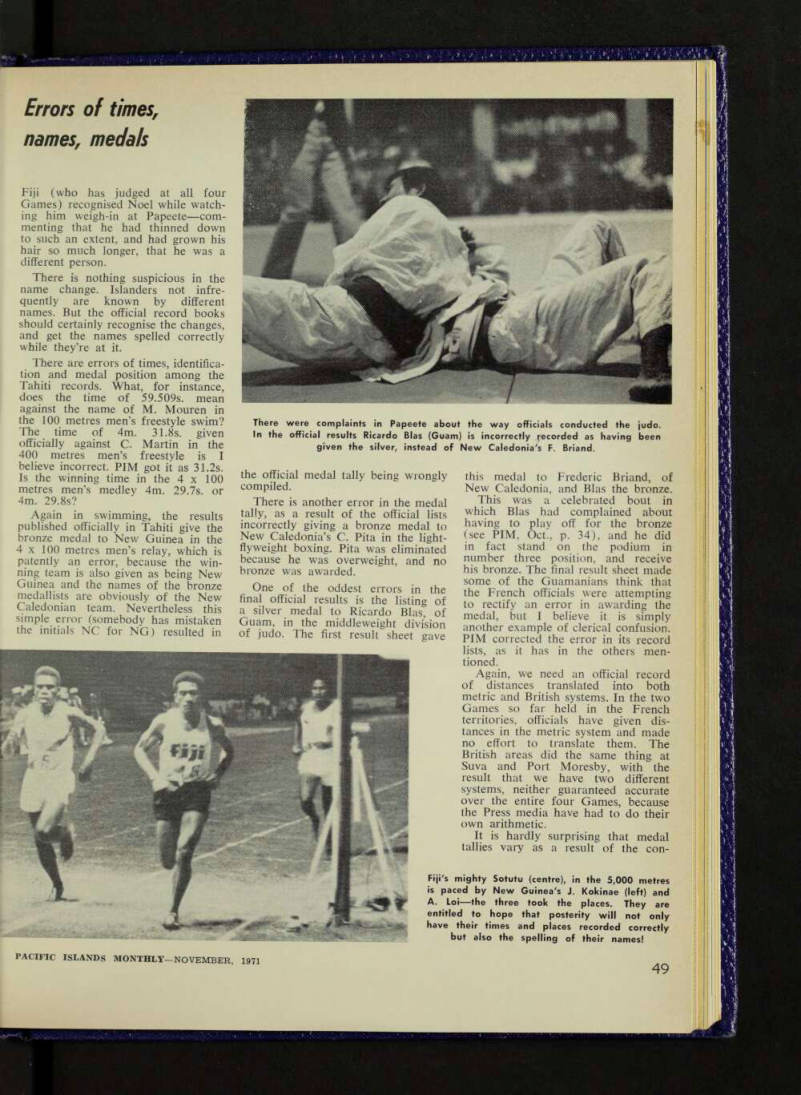
One of the oddest errors in the final official results is the listing of a silver medal to Ricardo Bias, of Guam, in the middleweight division of judo. The first result sheet gave
this medal to Frederic Briand, of New Caledonia, and Bias the bronze.
This was a celebrated bout in which Bias had complained about having to play off for the bronze (see PIM, Oct., p. 34), and he did in fact stand on the podium in number three position, and receive his bronze. The final result sheet made some of the Guamanians think that the French officials were attempting to rectify an error in awarding the medal, but I believe it is simply another example of clerical confusion.
PIM corrected the error in its record lists, as it has in the others men tioned.
Again, we need an official record of distances translated into both metric and British systems. In the two Games so far held in the French territories, officials have given dis tances in the metric system and made no effort to translate them. TTie British areas did the same thing at Suva and Port Moresby, with the result that we have two different systems, neither guaranteed accurate over the entire four Games, because the Press media have had to do their own arithmetic.
It is hardly surprising that medal tallies vary as a result of the con-
There were complaints in Papeete about the way officials conducted the judo.
In the official results Ricardo Bias (Guam) is incorrectly recorded as having been given the silver, instead of New Caledonia's F. Briand.
Fiji's mighty Sotutu (centre), in the 5,000 metres is paced by New Guinea's J. Kokinae (left) and A. Loi —the three took the places. They are entitled to hope that posterity will not only have their times and places recorded correctly but also the spelling of their names!
Medal tallies disagree
fusion over Games results. The official tally published in Papeete at the end of the Games was certainly incorrect, and while PIM hopes that its medal tally published in October is correct (it worked hard at attempt ing to make it so) it unfortunately can’t guarantee it.
In Papeete, the editor of the monthly Suva paper, Fiji Sport, Mike Hohensee, and I worked into the night in an attempt to reconcile the official medal tally with our own —in vain. Not only were we unable to confirm the accuracy of the official tally, we were unable finally to agree on our own —with the result that the official medal tally and those of Fiji Sport and PIM are all different!
It’s time somebody found out just how many territories won what at the four Games and published the results.
All this confusion was probably inevitable. All the Games have for the most part been run by dedicated volunteers, who gave up their own time to officiate. More than 200 of these people were used in Papeete.
It was natural there should be oc casional communication breakdowns, with even efficient officials suffering as a result of confusion further down the line. For instance, the swim officials were among the most efficient at the Games, and I doubt if the final inaccuracies were their doing.
As an example of what could happen, the Papeete Games organisa tion right at the beginning laid down certain abbreviations for the name of territories —SI for the Solomons, PNG for Papua New Guinea, SA for American Samoa, etc. Some officials soon started calling PNG simply NG, which got confused with NC. The Solomons became SA (the word is “Salomon” in French), which quickly
became confused with American Samoa.
But witch hunts serve no purpose.
The Games Council should establish a committee as soon as possible and come up with a com plete, accurate official list of cumulative results while it is still able to get one.
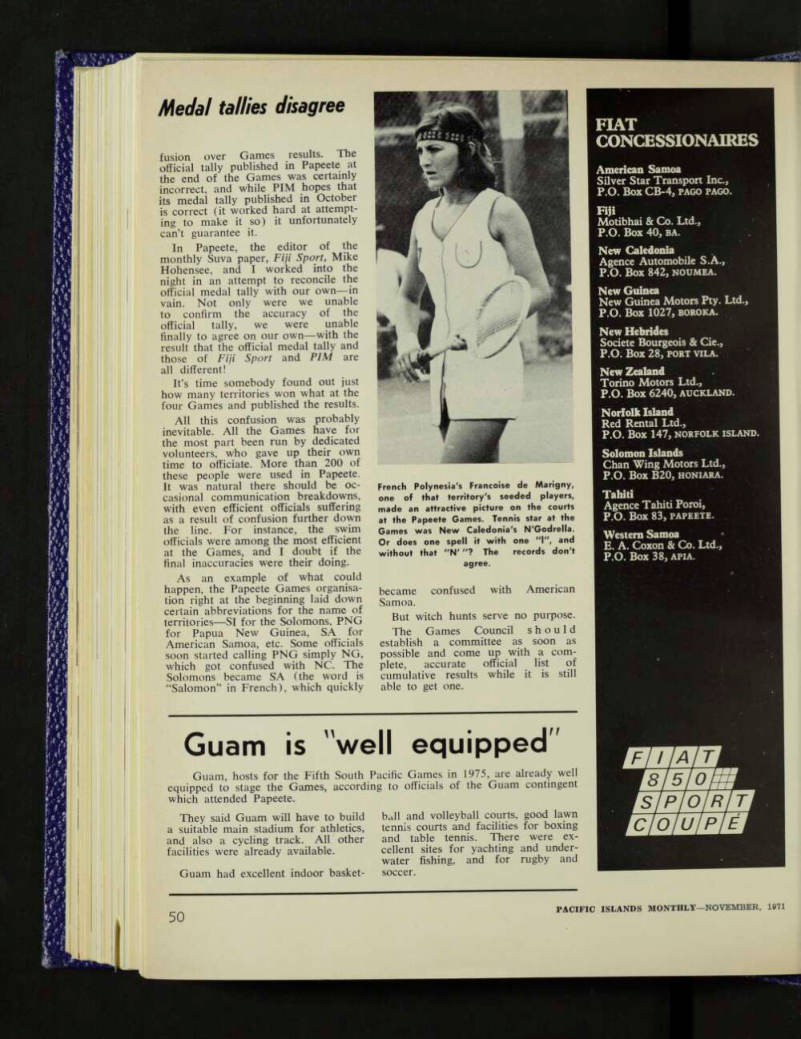
French Polynesia's Francoise de Marigny, one of that territory's seeded players, made an attractive picture on the courts at the Papeete Games. Tennis star at the Games was New Caledonia's N'Godrella.
Or does one spell it with one "I", and without that "N"'? The records don't agree.