Problem Of The South Pacific
pp. 55-131 · Read in the full issue

Commission: What Comes Next?
By JOHN CARTER, PI M’s Assistant Editor
When the Eleventh South Pacific Conference closed in Noumea on September 30 some of the delegates went home with a question mark niggling at their thoughts. Where’s the conference going? For that matter, where s the South Pacific Commission gomg. c n e -i )est ar * . nme days, 16 boutn Pacific territories haggled over spending the pitifully-small sum of ql»Al’Zl7,000. The commission’s eightmember countries spent several more aays slapping the seal on what the tn S 6 hac * d ecl ded. A costly * tV u nw 1 t 0 sucb a nut. lhe bill tor next year’s conference to be held in Western Samoa win cost twice as much, and if it’s held in Guam later it will cost five tunes as much. u A. . zen CIVI I servants, or a ?i? a • u°f * :,usmess / nen could have done e job tor a tenth as much. But, there was more to it than that. Once a year.
A Island countries of the J>outn Pacmc—with a few on the SldC a* n quator can B et together and talk about their needs fi? e 5? S ’ metr oP olltans ”> the big brothers with a steadily weak- £ T?° V, on 1 em o , lst s n * And tinn h ° r h ° W lonB ’ Thats the ques " n ‘ • , , . , , Une thing which characterised the r tC K renCe the absence of real IhLA™ 1 Aiu W f u° ne premier there, popular Albert Henry of the
Cook Islands. But then he’s anywhere where there’s a chance of getting something for his country. Senator Cotton, Australia’s Minister for Civil Aviation—what’s civil aviation got to do with it?—was there for a few days and departed. Duncan Maclntyre, NZ’s Minister for Maori and Island Affairs, headed his country’s mission.
But, of the real top men, there was no sign. President Deßoburt wasn’t there. Ratu Sir Kamisese Mara wasn’t there.
There were those who saw in the absence of the real brass a denigration °f the conference. They wondered if very senior ministers thought it wasn’t worth the effort. Maybe it was a sign that with approaching independence for most, if not all, of the Islands, the conference and, perhaps, the commis sion was a dead or dying duck?
But I think the truth was that most territories have found that in the lower ranks they have a growing number of up and-coming men capable of hand ling a job like the conference. And handle it they did with efficiency auguring well for the Islands. Most, maybe all, were under 50.
In talks at the “Happy Hour”, the convivial hour, or three, which fol lowed each day’s sitting, there were thoughts aloud over the future, of what the SPC will do when there are no dependent territories. When, per haps the metropolitan powers with draw and their contributions—heaven
forbid—cease or are whittled down.
On that score of course, the metros are hardly likely to leave a vacuum which others, the USSR for instance, would like to fill, As Ratu David Toganivalu, leader of the Fiji contingent, said to me, en thusiastically, “There’s nobody like us, like the conference, in the world,”
Its job is to help the Island terri tones in every possible way. Politics are barred. The accent is on educa tion, social services, economics, ad visory services and anything else which will help the emerging or emergent Islands to cope with outside problems and reach in a few decades a living standard which Europe, say, achieved after more than a thousand years.
Most recognise that its present role is valuable, but that there’s a need for it to change. The South Pacific Forum of leaders at Wellington (PIM, Sept., p. 54) officially stated, “while reaffirming their support for the SPC, representatives expressed the hope that its procedures and activities would be modified and improved to suit present-day conditions”, John deYoung, acting SPC Secre tary-General, who will have retired by the time this is read and gone back to Washington, mentioned the forum in his opening speech at the confer ence. Was there, in what he said, a criticism of the forum? He suggested the presence at the next forum of an
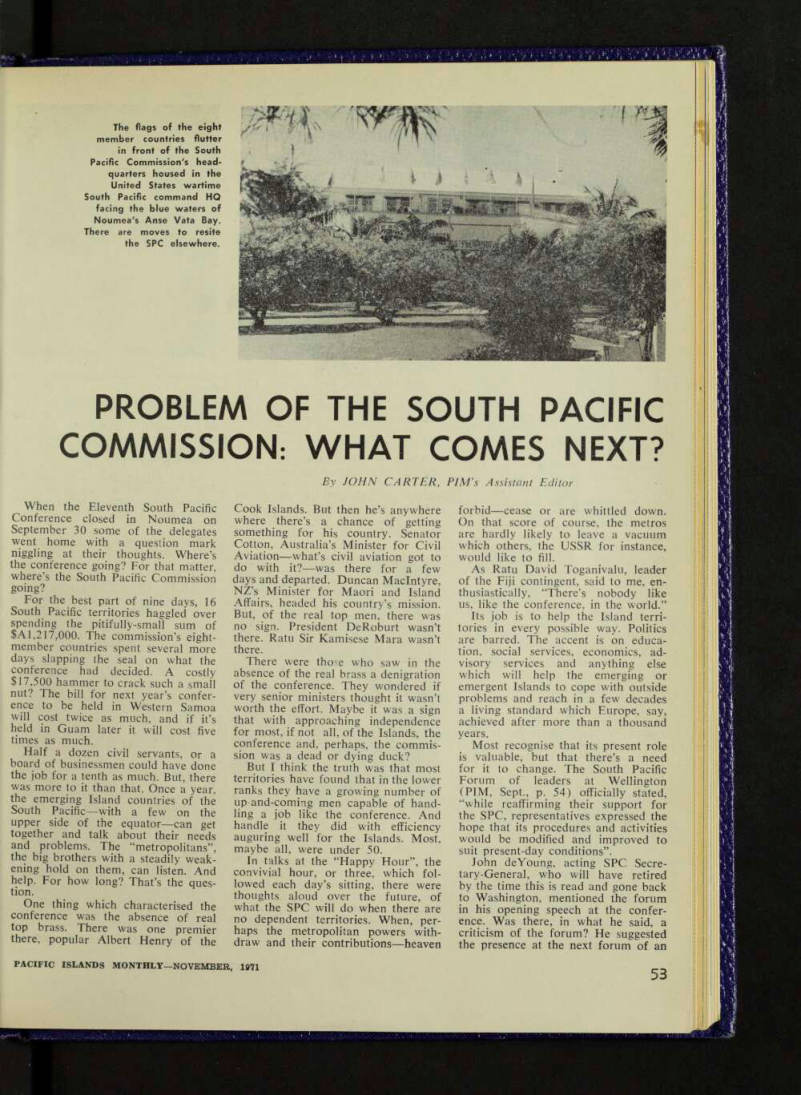
The flags of the eight member countries flutter in front of the South Pacific Commission's head quarters housed in the United States wartime South Pacific command HQ facing the blue waters of Noumea's Anse Vata Bay.
There are moves to resite the SPC elsewhere.
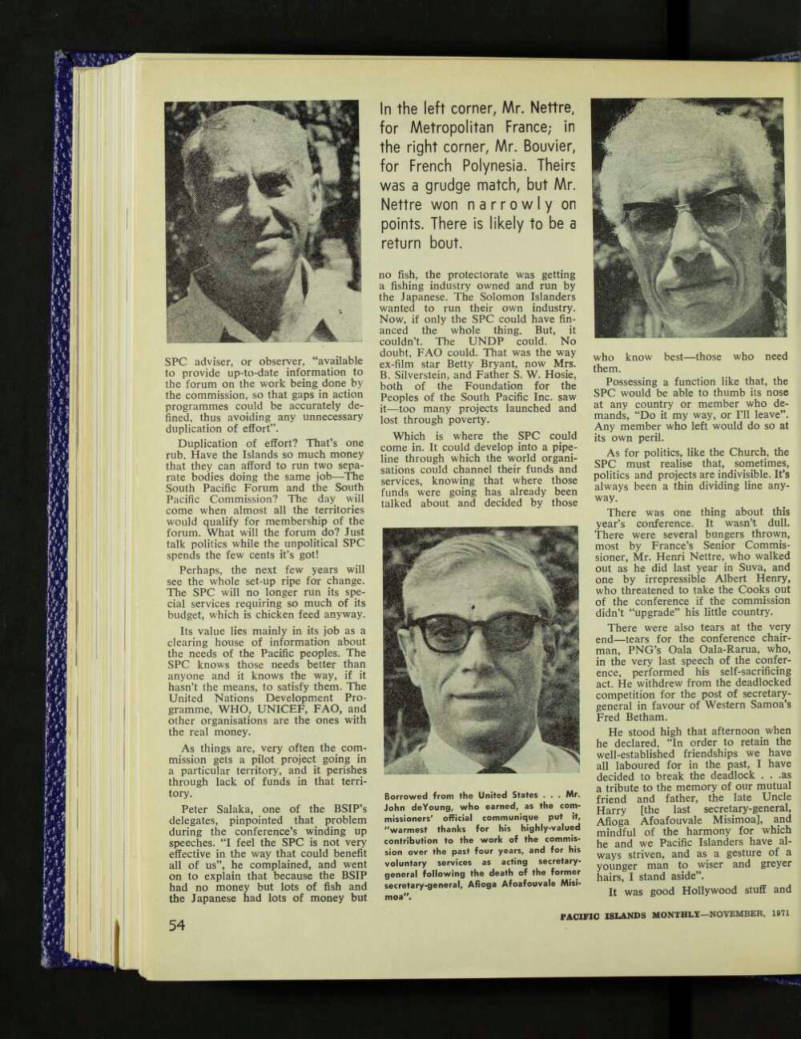
SPC adviser, or observer, “available to provide up-to-date information to the forum on the work being done by the commission, so that gaps in action programmes could be accurately de fined, thus avoiding any unnecessary duplication of effort”.
Duplication of effort? That’s one rub. Have the Islands so much money that they can afford to run two sepa rate bodies doing the same job—The South Pacific Forum and the South Pacific Commission? The day will come when almost all the territories would qualify for membership of the forum. What will the forum do? Just talk politics while the unpolitical SPC spends the few cents it’s got!
Perhaps, the next few years will see the whole set-up ripe for change.
The SPC will no longer run its spe cial services requiring so much of its budget, which is chicken feed anyway.
Its value lies mainly in its job as a clearing house of information about the needs of the Pacific peoples. The SPC knows those needs better than anyone and it knows the way, if it hasn’t the means, to satisfy them. The United Nations Development Pro gramme, WHO, UNICEF, FAO, and other organisations are the ones with the real money.
As things are, very often com mission gets a pilot project going in a particular territory, and it perishes through lack of funds in that terri tory.
Peter Salaka, one of the BSIP’s delegates, pinpointed that problem during the conference’s winding up speeches. “I feel the SPC is not very effective in the way that could benefit all of us”, he complained, and went on to explain that because the BSIP had no money but lots of fish and the Japanese had lots of money but
no fish, the protectorate was getting a fishing industry owned and run by the Japanese. The Solomon Islanders wanted to run their own industry.
Now, if only the SPC could have fin anced the whole thing. But, it couldn’t. The UNDP could. No doubt, FAO could. That was the way ex-film star Betty Bryant, now Mrs.
B. Silverstein, and Father S. W. Hosie, both of the Foundation for the Peoples of the South Pacific Inc. saw it—too many projects launched and lost through poverty.
Which is where the SPC could come in. It could develop into a pipe line through which the world organi sations could channel their funds and services, knowing that where those funds were going has already been talked about and decided by those
who know best—those who need them.
Possessing a function like that, the SPC would be able to thumb its nose at any country or member who de mands, “Do it my way, or I’ll leave”.
Any member who left would do so at its own peril.
As for politics, like the Church, the SPC must realise that, sometimes, politics and projects are indivisible. It’s always been a thin dividing line any way.
There was one thing about this year’s conference. It wasn’t dull.
There were several hungers thrown, most by France’s Senior Commis sioner, Mr. Henri Nettre, who walked out as he did last year in Suva, and one by irrepressible Albert Henry, who threatened to take the Cooks out of the conference if the commission didn’t “upgrade” his little country.
There were also tears at the very end—tears for the conference chair man, PNG’s Gala Oala-Rarua, who, in the very last speech of the confer ence, performed his self-sacrificing act. He withdrew from the deadlocked competition for the post of secretary general in favour of Western Samoa’s Fred Betham.
He stood high that afternoon when he declared, “In order to retain the well-established friendships we have all laboured for in the past, I have decided to break the deadlock . . .as a tribute to the memory of our mutual friend and father, the late Uncle Harry [the last secretary-general, Afioga Afoafouvale Misimoa], and mindful of the harmony for which he and we Pacific Islanders have al ways striven, and as a gesture of a younger man to wiser and greyer hairs, I stand aside”.
It was good Hollywood stuff and
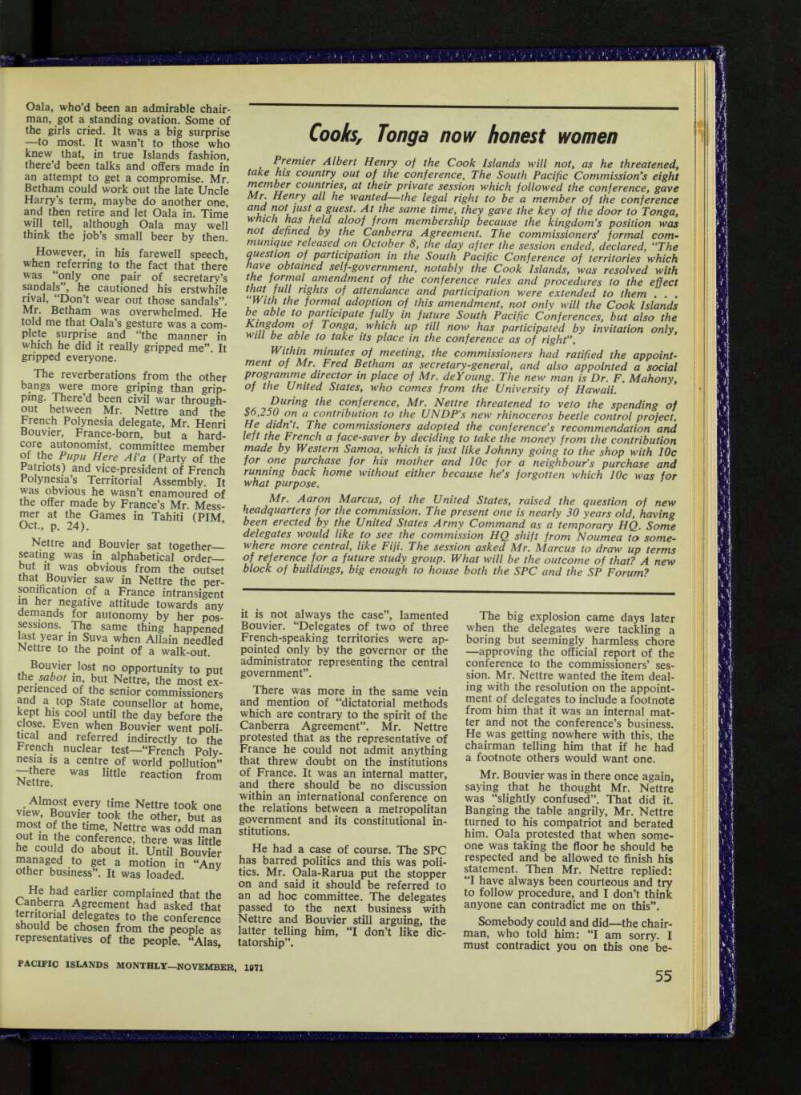
In the left corner, Mr. Nettre, for Metropolitan France; in the right corner, Mr. Bouvier, for French Polynesia. Theirs was a grudge match, but Mr.
Nettre won narrowly on points. There is likely to be a return bout.
Borrowed from the United States . . . Mr.
John deYoung, who earned, as the com missioners' official communique put it, "warmest thanks for his highly-valued contribution to the work of the commis sion over the past four years, and for his voluntary services as acting secretary general following the death of the former
secretary-general, Afioga Afoafouvale Misi
moa".
Oala, who’d been an admirable chair man, got a standing ovation. Some of the girls cried. It was a big surprise —to most. It wasn’t to those who knew that, in true Islands fashion, there’d been talks and offers made in an attempt to get a compromise. Mr.
Betham could work out the late Uncle Harry’s term, maybe do another one, and then retire and let Oala in. Time will tell, although Oala may well think the job’s small beer by then.
However, in his farewell speech, when referring to the fact that there was “only one pair of secretary’s sandals”, he cautioned his erstwhile rival, “Don’t wear out those sandals”.
Mr. Betham was overwhelmed. He told me that Oala’s gesture was a com plete surprise and “the manner in which he did it really gripped me”. It gripped everyone.
The reverberations from the other bangs were more griping than grip ping. There’d been civil war through out between Mr. Nettre and the French Polynesia delegate, Mr. Henri Bouvier, France-born, but a hard core autonomist, committee member of the Pupu Here Ai’a (Party of the Patriots) and vice-president of French Polynesia’s Territorial Assembly. It was obvious he wasn’t enamoured of the offer made by France’s Mr. Mess mer at the Games in Tahiti (PIM Oct., p, 24).
Nettre and Bouvier sat together seating was in alphabetical order— but it was obvious from the outset that Bouvier saw in Nettre the per sonification of a France intransigent m her negative attitude towards any demands for autonomy by her pos sessions. The same thing happened last year in Suva when Allain needled Nettre to the point of a walk-out. , Bouvier lost no opportunity to put the sabot m, but Nettre, the most ex perienced of the senior commissioners and a top State counsellor at home, kept his cool until the day before the close. Even when Bouvier went poli tical and referred indirectly to the French nuclear test—“ French Poly nesia is a centre of world pollution” xt V^ ere was little reaction from Nettre. . Almost every time Nettre took one view, Bouvier took the other, but as most of the time, Nettre was odd man out m the conference, there was little he could do about it. Until Bouvier managed to get a motion in “Any other business”. It was loaded.
He had earlier complained that the Canberra Agreement had asked that terntonal delegates to the conference should be chosen from the people as representatives of the people. “Alas
it is not always the case”, lamented Bouvier. “Delegates of two of three French-speaking territories were appointed only by the governor or the administrator representing the central government”.
There was more in the same vein and mention of “dictatorial methods which are contrary to the spirit of the Canberra Agreement”. Mr. Nettre protested that as the representative of France he could not admit anything that threw doubt on the institutions of France. It was an internal matter, and there should be no discussion within an international conference on the relations between a metropolitan government and its constitutional institutions.
He had a case of course. The SPC has barred politics and this was politics. Mr. Oala-Rarua put the stopper on and said it should be referred to an ad hoc committee. The delegates passed to the next business with Nettre and Bouvier still arguing, the latter telling him, “I don’t like dietatorship”.
The big explosion came days later when the delegates were tackling a boring but seemingly harmless chore —approving the official report of the conference to the commissioners’ ses sion. Mr. Nettre wanted the item deal resolution on the appoint -5 of delegates to include a footnote trom j im tba * was an mte mal mat and not . the conference’s business, “ e . was Setting nowhere with this, the chairman telling him that if he had a footnote others would want one.
Mr. Bouvier was in there once again, saying that he thought Mr. Nettre was “slightly confused”. That did it.
Banging the table angrily, Mr. Nettre turned to his compatriot and berated him. Oala protested that when some one wa s tak ing the floor he should be respected and be allowed to finish his S?! 6016111 ; The ? Mr - Nettre re P lied: 1 ? a Y e alwa V s bee n courteous and try t 0 follow procedure, and I don’t think an y° ne can contradict me on this”.
Somebody could and did—the chair man, who told him: “I am sorry. I must contradict you on this one be-
Resounding victory
cause you have been rude to the chair”. The suave diplomat gave place to an angry man as Nettre jumped from his seat and stalked out.
That night delegates and commis sioners went round with the olive branch looking for Mr. Nettre, who appeared next morning with an ulti matum—change the offending para graph or else, the or else being, “The conference must know that, depend ing on the outcome, the French Gov ernment will have to draw its own conclusions”.
That was the language of diplo macy, but it meant that France might withdraw from the conference. Before the sitting started I asked Mr. Nettre if failure to get satisfaction could mean just that. Mr. Nettre replied, “It could mean that”. That was the way all the commissioners and dele gates obviously thought as well, be cause they leaned over backwards to meet the Frenchman’s wishes.
But Mr Bouvier wasn’t doing any backward leaning. He persisted in his opposition. There were various solu tions posed, but either Mr. Nettre or Mr. Bouvier didn’t like them. Then UK Senior Commissioner, Mr. D. A.
Scott, suggested dropping the whole item, recording a harmless substitute that the French Polynesia delegate drew attention to the principle of selecting delegates as contained in the Canberra Agreement and slapping on an even more harmless heading “Composition of the Council”, which is the heading in the agreement.
Mr. Nettre was mollified, but Mr.
Bouvier wasn’t, and continued asking for more. It was plain that everyone by now was getting fed up with the whole thing and especially of the tenacious Mr. Bouvier. He got the message in the end, did a smart about-turn and agreed to this emascu lated item—“ The conference took note and referred to the ad hoc com mittee the principle contained in para graph 35 of the Canberra Agree ment”, 21 words. The original had 288 words. It was a resounding vic tory for La Belle France.
Altogether, it was an interesting conference, which managed to agree on how the budget of $1,217,000 should be spent. A fifth of it went on keeping the commission going; $310,075 on programme direction; $291,617 on programme personnel; $237,673 on programme activities, which includes education, health and social welfare, agriculture, livestock
and fisheries and economic affairs, and $81,600 on the publications bureau.
As was reported in last month’s PIM, all the member governments raised the ante by 15 per cent., but France made conditions, one being that the “level of contribution would depend on certain conditions relating to the recommended Work Pro gramme”.
France’s 15 per cent, could have been at stake because on one particu lar item in the Work Programme, Mr.
Nettre dug his heels in when the con ference wanted to approve it. It was a contribution of $6,250 to a new rhinoceros beetle project which the UNDP has planned. Everyone was in favour except Mr. Nettre. His “Non” was persistent as the Russian’s “Niet” in the United Nations. Come to think of it, in the discussion which followed Mr. Nettre’s walk-out, the American Samoa delegate, Mr. Pal auni M. Tuiasosopo, who talked more than most, bracketed Mr. Nettre’s angry outburst and walk-out with Mr.
Khrushchev’s display at the United Nations when he hammered the table with his shoe.
It was hard to see why France was so adamant in its opposition to the spending of SPC money on a new UNDP project unless it is that France wants as little contact as possible be tween the SPC and the UN.
He was entitled to object. Under the rules, any of the member coun tries can veto any new project and
it looked as if Mr. Nettre was set on doing so. He didn’t want to. He wanted it the easy way—rejection of the item by the conference. But the conference wanted it in. It wasn’t a large sum, but the SPC would be able to keep in touch with the UN over it and be entitled to any bene fits the projects will bring.
The conference wrangled over this one for hours, on one day and then on the following day. “I have instruc tions from my government not to agree to this”, said Mr. Nettre, and started the ball rolling. He suggested they should let the UN do the job on its own and hope for the benefits.
Some of the territories worried by the rhinoceros beetle would have been willing to go along with him except that they found out that if they be came signatories with the UNDP over the project it would cost them a packet.
UK’s Mr. Scott and Western Samoa’s Senior Commissioner Tofa Lauofo Meti gave strong support to the SPC’s sharing in the project. Mr.
Bouvier was agin Mr. Nettre. So far as French Polynesia was concerned it couldn’t care less, he said, about coconuts and copra. It had tourism, but it didn’t want the beetle. Coconut trees made good ornaments.
Fiji, through Deputy Director for Agriculture Winston Thompson, moved deletion of the $6,250 contri bution from the programme, but Cook Islands Premier Mr. Albert Henry said he wasn’t very happy. All the motion was trying to do was to avoid
Mr. Justin Toke, at 25, the youngest dele gate at the conference. A student at a French university, he was Wallis and Futuna's sole delegate. He was at home for the university holidays when he was chosen.
"Join me in the cold" invited Tonga
someone exercising a veto. A few minutes later Fiji withdrew its motion and the delegates went home to chew over it.
Next day, Mr. Nettre again ap pealed for a compromise and said those who wanted a say in the UNDP programme were only wanting it as a matter of pride. “You are not defend ing a principle”, he said. “You are defending a susceptibility which costs $6,000”.
He again said he was acting on orders from his government in oppos ing the item, but by this time no one had any patience left. The item was confirmed.
On the second day Cook Islands Albert Henry threw the cat among the island doves. He threatened to take the Cooks out of the conference if something wasn’t done with the Can berra Agreement laying down rules for the attendance of delegates. The Premier was very hurt. Since 1950 when the first conference was held he had warm feeling in his heart knowing that he belonged. Now par ticipation by the Cook Islands was only possible by invitation.
Apparently, the only territories with a right to sit in the conference were those that were dependent territories or independent. The in-betweeners which had self-government have no specific right to attend.
“It is an appalling experience to come to the petrifying realisation that since 1965 I have had none but a sham legal right to be here: that my seat in this conference is made of clay; that my speeches to date were no more than privileged soliloquies, and my votes illegal”, he cried. Then he made his threat. “I am here to tell you my problems and I ask this con ference to do something about them.
Failing this—we say goodbye. I can not allow the Cook Islands to be a part of this organisation as an invited guest”.
After sleeping on it the conference tackled the question the following morning and Ratu David Toganivalu, leader of the Fiji delegation, tried to cut the Gordian Knot with a resolu tion asking the senior commissioner to make permanent provision for self governing territories to be accorded full status as members of the South Pacific Conference.
Mr. Nettre was against this. He
thought the Canberra Agreement al ready implied what Mr. Henry was asking for. Mr. Henry was having nothing of this. Assumption was no good. It must be in writing.
Tonga’s Mr. Dan Tufui said the only thing to do was to amend the agreement because a friendly gesture such as Mr. Nettre’s could be with drawn by any government. Tonga her self feels out in the cold and Mr.
Tufui implied this when he invited Mr. Henry, in the event of the agree ment not being changed, “to join me in the ranks of the unwanted and with me go out into the cold”.
Like the Cooks, Tonga takes the view that her position in the confer ence is not defined and she has re fused, though she is independent, to become a member government. So far as the Canberra Agreement is con sidered, Tonga neither fish nor fowl, nor even an in-between like the Cooks. She was never a dependency of any other power in the way all the member territories have been.
The delegates passed Fiji’s motion, but the subject cropped up again in the second week when American Samoa’s Mr. Palauni Tuiasosopo piloted through a motion calling for the appointment of an ad hoc com mittee to formulate concrete amend ing proposals to the Canberra Agree ment for submission to next year’s conference.
His intention was to pave the way for Tonga to become a member of the commission. Killing two birds with one stone, the delegates agreed that the committee should be the Planning Committee, which should also con
sider the Review Committee’s repc for 1970 recognising that there were “special problems” where Tonga and the Cooks were concerned. This com mittee will also examine Mr. Bouvier’s grievances.
Once again, Mr. Nettre’s “No”. He thought these committees a waste of time and money, especially when they were not able to decide anything which the commissioners couldn’t quash. But, he was on his own once again and the Planning Committee will prepare at least two hot potatoes for next year’s conference.
Tuesday, September 28, was Fiji’s black day and a black day for next year’s Festival of Arts as Fiji is plan ning it. The dominion came to the conference armed with an account listing spending for the festival of $35,000 for this year and $165,000 for next year, a total of $200,000.
Ratu David Toganivalu handed in the bill and asked for help to pay it, reminding the conference that the festival had been conceived at the 1968 conference and the baby placed in Fiji’s lap.
He said the Fiji Government would contribute $lOO,OOO and was hoping the member governments in the SPC would provide $BO,OOO in proportion to their percentage contributions to the regular budget. He suggested that the revenue from the festival could go to the member governments or into a fund to provide the nucleus for the next festival. He didn’t think it was right that Fiji should bear the cost burden and the responsibility for staging the festival. The SPC had already earmarked $5,000 from the 1972 budget for the festival.
Delegates didn’t think that Fiji should bear the whole cost either but almost to a man, and that in cluded the metropolitan commis sioners, they refused, or at least didn’t offer, to foot half the bill.
One reason for their decision—and again they were almost unanimous— was that the whole concept of the festival was too grandiose. Some thought too much money was being spent on such things as advertising.
The commissioners all said their governments could not contribute as their spendings for next year had already been budgeted for. Some of the territories criticised the festival programme. They said it was sup posed to be a festival of traditional culture in the islands but they found there would be other cultures repre sented and even ballet which wasn’t in the tradition of any of the islands.
Most of them made a big thing of this and one group continued its discussions and arguments outside.
Ratu David Toganivalu, leader of the Fiji delegation. He handed in the bill for $200,000 for the Fiji Arts Festival and asked for help in paying it.
jo much cold water on Fiji's contingent
During that discussion one PNG delegate, who didn’t agree that the festival should be confined entirely to traditional Island culture, said with heavy sarcasm, “I suppose it would be all right, seeing that it has to be traditional, for me to bring a naked man and eat him on the stage”.
It wasn’t too far out as a debating point. Fiji agreed that it used to be within the Fijian culture. The PNG man, no doubt with memories of the cannibal feast at Daru a few months ago, replied that it was still part of PNG’s culture.
There seemed to be grounds for criticising the estimates. There was $lO,OOO for travelling expenses inside Fiji for the Fiji performers—outside performers will be paying their own to Fiji—s3o,ooo for feeding overseas performers and $20,000 for decorat ing the City of Suva park.
Delegates seized on those, saying performers were expected to pay for their own food as they had done at the South Pacific Games and Suva city could decorate its own park, using its own money. Even little Niue thought the expenses could be cut and the festival brought down to a smaller scale.
Advertising in Fiji was another thing which delegates criticised, most speakers saying that by the time the festival started, no one in Fiji would
need an advert to tell him about it.
All this was so much cold water on the Fiji contingent, and the only ray of sunshine came from a suggestion by George Kalkoa of the New Hebrides, next year’s conference deputy chairman. He suggested that maybe UNESCO might find some money for the festival.
Mr. C. Craw, New Zealand Com missioner, thought Fiji should do its best to pare expenses and added, “I think the concept is a little too grand”. There were more of these comments to make Fiji unhappy until Mr. Tuiasosopo, of American Spioa, who usually thought up something to end debates, moved a resolution that the Fiji Government should examine its festival programme and expenses, make economies by “minimising un necessary expenditure” and confine the festival items to “those of indi genous derivation”. This was carried and together with it the idea of establishing an Arts Festival Revolv ing Fund, to be managed by the SPC, through voluntary contributions.
There was a speedy come-back by Ratu David Toganivalu. He said that because of the sentiments expressed and the resolution that had been passed, the Fiji Government might also have to limit its financial com mitment. Optimistically, he added that UNESCO might help and there might be help from voluntary con tributors.
One got the impression, in the first week at any rate, that some of the delegates were a little less than luke warm over many of Fiji’s ideas. Was it envy, Fiji being so far advanced and obviously enjoying independence?
Or was it just that Fiji’s ideas are the ideas of a country which, one delegate said outside the building, was 50 years ahead of all the rest.
At any rate some of Fiji’s suggestions fell by the wayside. There was no support at all for a regional body on tourism but it managed to get sup port for a suggested study of the need for tackling problems of double taxation when people and companies with interests in the islands and metropolitan countries had to pay tax in both places.
Another success for Fiji was that it managed to rid itself of the burden
(Continued on p. 113)
Mr. Albert Henry, Premier of the Cook Islands, managed to get his way and achieved member status for his country.
The two Samoas were represented at the conference by, left, Palauni M. Tuiasosopo, otherwise known as Brownie, of American Samoa, and Western Samoa's Health Minister, Vaai Kolone, on the right.
Reuben K. Uatioa, GEIC's Leader of Gov ernment Business and the colony's dele gate.
of the South Pacific Health Services which for years has been a chore for Fiji’s Medical Department. The SPC will take over the job, get a new medical officer for that work and other duties and cut out some of the duties which modern days and methods have made obsolete.
The SPC’s Health Programme Director, Dr. Guy Loison, took a dim view at the outset of the likeli hood of getting that baby pushed nto his lap because he said in his •eport to the conference that there tvas more work than they could landle even without Fiji wanting to iass the health services over to them.
He was also short of typists be cause he told the delegates on one xxasion, tongue in cheek perhaps, hat he had only six typists and of hose one was always pregnant and mother sick.
Fiji also got the conference’s ear vith a proposal that a school xamination board covering the whole if the region should be set up as 7 iji felt the present system in most erritories was out of context and inrealistic.
Mr. Raj Singh, who put Fiji’s ase, commented; “We find students mowing more about sheep and wool /hen they should be knowing more bout coconuts and sugar cane”. He acked up his argument with figures bowing that of 2,779 students taking tie NZ School Certificate examina ions only 144 passed in all five sub sets.
The secretariat was asked to can ass the territories on this with the lea of getting the education direc ts together.
Apart from papers like this and ther resolutions, speeches by com lissioners and reports from pro ramme directors, the conference got irough 91 items in the Work Study rogramme and was still able to nish its business a day and a half tiead of schedule.
One item which occupies an im ortant position on the agenda is le addresses by territorial delega tes on their “Special needs and roblems”. Judging by the tenor of le speeches, optimistically limited to ve minutes each, few territories had iy special needs and problems. If ley had—and of course they have— ley weren’t talking about them.
The Cook Islands and Western Samoa are not included in the resume given below for the simple reason that they declined to talk about their problems. The Cook Islands’ Dr. J.
Williams, merely said; “We shall not require the five minutes and propose that you allocate it to Niue. We prefer not to make any comment relating to special needs and prob lems.”
Western Samoa’s Minister for Health, Vaai Kolone, went one better.
He proposed the deletion of the whole exercise from next year’s agenda and the introduction of some thing more suitable, on the grounds that there were so many problems which were so difficult that the SPC couldn’t do anything about them any way. He reminded them that last year Mr. Oala-Rarua said Papua New Guinea’s problems were so numerous that the commission with its small resources couldn’t tackle even 1 per cent, of them, and that for umpteen years Nauru had been telling the conference about the same problems year after year.
Well, Nauru recited them again this year, its delegate producing a script which had the conference laughing. Once again Fiji beat the big drum of inter-regional co operation but I got the impression
countries weren’t terribly interested in inter-regional co-operation beyond PIPA and the Forum. A summary of views collected from the territories on tourism revealed that most of them wanted to paddle their own canoes. There were even some flat refusals, but that’s another story.
What the delegates said about the needs of their peoples is outlined here:
• American Samoa —Wanted
encouragement of inter-regional trade through the exchange of statistics and the possible exchange of raw materials, and the improvement of indigenous food plants and the methods of preparation of food using indigenous food plants. There was also a need for a keener awareness of the value of the sea’s resources and a need for more active project work with less academic discussion.
The commission should become more involved and assume a more positive role in environmental control. They also needed to know more about sod conservation. • BSIP —The protectorate now had a new constitution and had had a general election, and as it lacked the party system it might be possible to involve elected members and make them more active in day-to-day
Solomons not afraid
government. The government had also prepared and approved the Sixth Development Plan. It had high hopes for the plan and believed it was soundly constructed. One of the problems was that political develop ment and aspirations were running ahead of the development of the economy and the speed at which educated Solomon Islanders were taking their place in the Civil Service.
Nevertheless, 76 per cent, of the recurrent budget was being met from the BSIP’s own resources. It had no doubts about the economic future of the BSIP if people were not afraid of hard work and they were not. • FlJl —With more than 50 per cent, of the population under the age of 19, there was an urgent need for rapidly creating job opportunities.
This was receiving a great deal of government attention. The need for skilled and supervisory manpower, together with the need for various categories of professional people was rising very rapidly in the face of accelerated growth in certain sectors of the Fiji economy. The need could only be satisfied quickly if substantial private and public resources were allocated to education and training within established industries.
Sugar and copra were Fiji’s most important cash crops and some under standing would have to be reached with the enlarged European Economic Community if those industries were to avoid serious dislocation. In the long run both the economic base and their markets would have to be diversified to cushion the economy from the vagaries of international market forces.
Fiji also wanted a lowering of trade barriers by the industrialised countries against Fiji goods and was concerned about the lack of know ledge of marine resources. That was ao area where the nations of the South Pacific region could mutually benefit through joint prospecting and co-ordinated research.
It was also important to redress the income gap between the urban and rural population by stimulating economic growth in the rural areas.
Accordingly, the rural development programme was directed towards assisting the rural community to im prove living standards, mainly through self-help schemes. Declaring that Fiji “did not fully subscribe to :he popular belief that opportunities
for increasing future intra-regional
trade were severely limited by the
Galloping inflation
ick of complementarity within our arious economies”, Fiji stressed that numerous opportunities existed for o-operation in areas of trade, ship iug, taxation, concessions to indus ies, research, mineral prospecting, larketing and finance.
• French Polynesia—Had
great deal to do to solve its prob ims. French Polynesia might appear ) be in a good position as compared ith other territories. In the last few ears an atomic centre had been stablished in the territory and xmomic development had been jectacular. But it was an illusion l many ways and had sparked off development of tertiary activities, alloping inflation was in force and ie territory’s production was barely per cent, of the value of its im- Drts. To remedy that disastrous tuation the Assembly was attempt ig to reorganise the economy so that ie territory could produce more for » own consumption, in particular agriculture, fisheries, building and aftsmanship, and it wanted the SPC 1 send them technicians and advisers those fields so that the Polynesians >uld defend their economic interests id social structure against intrusion om outside.
The French Polynesians were going for tourism in a big way but its welopment would change the dural environment so they had to epare measures for nature conser ition. Any help in that direction 3uld be welcomed.
French Polynesians also wanted to -operate with other territories’ easures for protection in matters hygiene and health. The ex rience of other territories in setting ► labour training centres for young hool-leavers would be of great value French Polynesia. Although they sre not affected by the rhinoceros ■etle, they wished to continue to ke part in the financing of the anti etle campaign. Relations with the itside world, especially with the ands affected by the beetle, led pm to believe that they might be ected later so they would like to J more action in the preventive Id, especially in the protection of rbour areas. • GElC —Although in the centre the islands of the populated estern Pacific they were not a acting place for trade routes or ber communications, commerce or Iture. Nevertheless, because of sir central position they wanted to
Strain on budget
develop their interests in the modern world in step with the countries around them. They, therefore, placed much importance on their connec tion with the other countries through ;he SPC and the conference. They vere now beginning to mature con stitutionally and had a legislative council and executive council with dected members.
Fisheries surveys were about to >egin and plans for the development )f the copra industry were being tried Hit on various islands. Many other :fforts to provide employment and to nake goods locally to replace im lorts were in hand. The results of he family planning programme were ;ood and showed the people were )eginning to realise the need for such , programme. They looked for and welcomed outside help and increasing o-operation from the other terri ories. • GUAM —The territory was ex icriencing economic growth and a ising living standard and these ilaced a strain on their budget. Their ifra-structure was inadequate to andje the increase in population and lany schools would have to be built, dl their problems were but a few ears from being solved, but with lore capital they could shorten the me. Although they had a booming conomy, a large portion of their udget was earmarked for exports, ut they were a long way from apply sources. Something must be one to produce more for their own eeds. Administrative measures had een introduced to sell the telephone astern to private enterprise. • NAURU —Being a small island had few of the problems of the ther territories but it had unique roblems of its own. Nauru had to nport water from Australia and nother problem was that their island, [ready small, was dwindling. That as a real problem. Four-fifths of le island was declared to be phos hate bearing and by the time the eposits were worked out, four-fifths f the island would have disappeared, ftien that happened, and with their apulation growth, they would have ardly room to move.
The problem of developing the orked-out area was very complex id would cost millions of dollars i solve. Another problem was that hen the deposits were worked out ieir only source of income would iddenly cease and they would have a more money. They were trying
No pigeon-holing
;o find substitutes but what they vould be was the burning question of he time. They were airing their >roblems in the hope that technical idvice and other advice would be >ffered because at the present time hey had no solution.
• New Caledonia—G Ave An
issurance to the SPC of full co operation in any projects and pro ;rammes common to them all. They /ere an industrialised country with ich resources but they could not emain indifferent to the problems >f other territories in the same region, "hey would be interested in a num er of projects designed to meet the pedal needs of territories requiring ic help of specialists. They appealed 3r the implementation of projects nd not have them pigeon-holed and icn brought out later as new pro mts. • NEW HEBRlDES —Principal eeds were economic and agricultural evelopment and the development of lucational and health services, lajor expenses of education and ealth were met by the United King am and France, but that was a tuation which could not be expected
► continue indefinitely.
A plan covering the five years ?71 to 1975 was recently intro iced. It provided for the expendi re of $8 million and embraced ans for a co-ordinated programme ! development in the sectors of the ;onomy for which the joint adminis ation was responsible.
Agriculture continued to be the ainstay of the economy and in that here their principal needs arose, apra was the main crop but a fall g world price and an acute short ly of labour combined to depress oduction. There had been an in ease in cocoa production which is on a small scale.
One bright feature was the in case in beef production. The lue of chilled and frozen meat pro iced in 1970 was more than double s 1969 value. Fishing was also veloping rapidly and fish exports 1970 worth $4,666,000 was only ghtly below that of copra. Timber ojects on Erromanga, which were tried in 1969, had earned $664,000 1970. Their islands had made re irkable progress in their last few ars but they were still in need of tter roads and increased shipping ■vices. Tourism was growing and developed on the right lines could
Messing problem
ecome a valuable contributor to the entry’s viability. • NlUE —Continued immigration E the people to New Zealand was E great concern. They would be irprised if the present population ased on the 1966 census had in •eased to 5,000. Whether improved ammunications would conserve their emulation or accelerate its departure jmained to be seen. The more jople were educated and the more ►phisticated they became, the easier was for them to leave the island.
Hopes expressed last year that there ould be improvements in copra pro iction had been prematurely opti istic. Important factors affecting ie copra industry were the migration •oblem and the attitude of the sople remaining on the island to ards the industry.
The most pressing problem arose scause the people went overseas and arned overseas to accept the r estem concept of material pros >rity. They no longer accepted the ea of being small subsistence rmers. The problem was how to ovide the people with their needs hen the island’s limited resources d not allow them to provide each an with a job.
The government had to strike a ilance between the need to help ople cope with the modern world, id the need to conserve their true ilture and heritage. It was their >pe that the conference and the suits achieved would help to pre rve for each territory its own Iture.
Niue would like a share of the Iden eggs but not at the sacrifice their traditional way of life. It is their aim to encourage tourism t on a moderate basis. They hoped .have their guesthouse open by mid -73, so they would be interested in y help they could get through the mmission in the training of hotel iff.
• Papua New Guinea— This
ar $2O million had been provided acquire teaching staff exceeding )00 but they would still reach only little more than half the children alified for primary education. At 5 same time there was a problem th the secondary school leavers, spite of having 40 post-secondary lining institutions they would shortly ich full capacity of intake.
Employers have been asked to train are apprentices and reduce the num r of job seekers. Health service penditure was $l4 million. There
Tonga's budget
was criticism that their health ser vices were too sophisticated. Whether it was justified or not, costs were certainly soaring. The House of Assembly was revising the five-year economic programme implemented in 1968 to provide $l,OOO million. The second five-year programme to begin in 1974 would again commit them to more than $l,OOO million.
The programme was designed to bring about diversification of industry but, because of the climate, agricul ture would remain the economic mainstay. The 1970-71 balance of payment deficit was $l5O million.
Bougainville copper would be in pro luction next year and would repre sent about half the gross national jroduct. They hoped that small in iustries being set up would help to bridge the economic gap. Australia continued to provide half the total mdget. • TONGA —Like other territories, fonga’s problems were associated vith a lack of natural resources and in increasing population confined to l small area of land. With the prob ems went hand-in-hand the need to reate labour-intensive industries and >ther facilities to cater for the needs nd aspirations of those leaving the chools every year to swell the labour □rce.
They had tried for many years to stablish a fishing industry on a big :ale but like everything else in onga it was proceeding slowly. They ad six small vessels in the shipping ade totally manned by Tongans ained in their own school, except 3r senior officers and masters who Dmpleted their training in New ealand. They also had a controlled Jurist industry and were keeping ieir fingers crossed as the first ex ioratory oil well was about to be ink. This year Tonga had passed le biggest budget in its history, ther territories talked in hundreds : millions. Their top budget was a tie more than $4 million. Tonga ight not be able to keep abreast : requirements but, as the Americans id, they were used to doing their vn thing, in their own way, at eir own pace and, almost but not lite, within their own means.
• Us Trust Territory—
icy were entering a more tran xonal stage in the development of eir economy and the improvement their social services. They had the tential to build a great future for
Pollution worries
heir citizens but there was a great md pressing need for more instruc ion, more direction and more people o show them the way to do things, fhey could not reap the rewards vhich existed in the area of marine esources without training and de elopment of a fishery programme, nd they were looking forward to aking advantage of the valuable ervices which the SPC fisheries gency was developing.
There was enough arable land to upport the population and leave pro uce for export but very little land 'as put to use because they had not ot people with the necessary ex ertise. The transport of produce r as a continuing problem.
They were anxious to develop the Jurist industry but they did not link it was worth losing amenities irough unplanned tourism. They more lines of communication tid more transport to meet the needs f the tourists so they looked for elp in that direction and, at the ime time, help to preserve the Rural beauty of Micronesia.
Pollution was a real problem. ;veral lagoons had been placed out de limits because of pollution. To :ther with neighbours in the GEIC ey could form a regional copra de dopment programme and could look r help from the United Nations ewelopment Programme and the
• Wallis And Futuna—The
ands’ needs were in agriculture, henes and building. They needed Ip to protect and conserve their vironment and develop their 500ns.
That was a crucial problem be use the marine fauna had been Jre or less destroyed by dynamite, allis and Futuna people used namite for fishing.
Another project could be the de lopment of tapa cloth production uch could be an interesting occupa n. They were also worried about vn planning and would like to kC part in town planning activities, )ecially those which would improve litation in their villages. Many of :ir people still lived among the :s and poultry, and sanitation was t perfect. They would also like a Jject which would adapt modern
-hitecture and building techniques
their social and economic con ions. The people had modern tenals but did not know how to : them.