The Editor's Mailbag
pp. 30-31 · Read in the full issue
Jimmy Stephens
Sir, —It is with sadness and regret that I must refer to the subject article written by Charlene Gourguechon (PIM July, p. 39) without prejudice to any concerned. I’m sure your valu able and usually unbiased magazine would not want to injure the charac ter of any of your readers. Through misunderstandings such as this, much damage can be done to a person who has been acting in good faith to help his people. To place ourselves as judge and jury over the actions of a man earnestly doing the best he can with what little he has of Western education is very unkind.
Things take time; as I well know, we have been developing our cruising storeship freighter service for three years. We are about ready now, and with honesty we must say this service has been worked out mainly due to the direct efforts of Jimmy Stephens.
We have had many long confer ences with him in Suva. He has waited patiently for me several times, and at my suggestion has been given refreshments to ease his fatigue. I am sorry if this has caused him em barrassment, as he has accepted my hospitality to avoid offending me. I am also responsible for him bringing his wife with him, as I asked him if he had a person who could speak good English to act as interpreter to avoid misunderstandings.
From what I have read, I wonder if Charlene Gourguechon has a good understanding of the people of the Pacific? Two weeks ago in London I spoke with somebody who had writ ten what appeared to be a knowledge able article on the Pacific. I found he spent one overnight stop at Nadi, all he saw of Fiji, and four days in Apia. This was his total experience in the Pacific. He is being quoted as an expert. No wonder people get the wrong idea.
I do not say Jimmy Stephens is as wise as Moses or Solomon. But the man who never made a mistake never made anything. He is trying his best, he lives frugally on his overseas visits, when he could be staying at the Grand Pacific, or Travelodge hotels. Travel ling costs money, and he gets little help from many people. We ourselves have found certain Pacific Island in terests would like to hold back the clock, and have done much to hinder
us and other organisations, so we can understand the difficulty Jimmy Ste phens encounters, and we admire the courage he has shown to face up to the critics he meets. What he needs is guidance and help, not the ridicule and sarcasm he has been getting. We think it only fair to him this letter should appear to defend his name and his efforts.
W. G. Chester.
Basingstoke, Hants.
England.
Tight-Rope Walkers
Sir,—The letter from Lyle M. Nel son of Stanford, California (PIM, Aug., p. 9) intrigues me. As a travel writer I know all about those puff statements to which he alludes, but has he ever tried walking the tight rope between reality and what the editor will print?
Just try putting in too many critical observations, and poof, back comes the ms. with a note—if this place has all these faults, why recommend any one to go there?
I know —I’ve had it happen to me.
Judy Tudor was more fortunate. Tell ing it “like it is”, as the ungrammatical insist on saying, is not every editor’s cup of tea —perhaps because he too must bow to the advertiser. In any event, the travelling reader gets only half-truths in most cases.
Perhaps Mr. Nelson has some sug gestions for those of us who try to do an honest job—and can only get a small part of our message across.
Eunice T. Juckett.
East Hampton, New York.
Rubber Stamping In Bsip
Sir, — In valiant defence Of his committee, King David declared, “The exhaustion of resources Is the road to independence (by 1975)”. u That sums up the statement by the Chairman of the Natural Resources Committee of the BSIP Governing Council, Mr. David Kausimae (PIM, Sept., p. 21). According to your Honi ara correspondent, King David signed the Fishing Survey Agreement on be half of the BSIP Government because he wants his country to be indepen dent, politically by 1975. Why and for what?
Explicit in King David’s argument
is his belief that this survey will most probably result in the creation of a fishing industry which would, in turn, bring in much-needed additional in come to the economy. Whether or not this is right is still to be seen. None theless, it seems to me that King David aims to establish as many in dustries as possible, regardless of the consequences, so that the country may be in a better financial position before political independence comes to the Solomons. This is a fair aim but it, alone, is not sufficient. There are many other equally important factors.
For instance, some recognisable Solomon Islands common identity, social services which will aid Solomon Islanders, not only to better their liv ing standards, but also to create in the people an awareness of their am bitions and shortcomings, cultural, economical, political and religious, and increase their ability to operate viably under a foreign system of gov ernment. Most important, perhaps, is the fact that, with political indepen dence comes limitless responsibility.
As far as I am aware (as a Solo mon Islander) of the situation, these factors are given very little consider ation. At their worst, they are non existent.
The ability to shoulder responsibil ity is manifested by the ability to think independently under all sorts of cir cumstances, to be willing to listen and accommodate opinions that might be contrary to one’s own, and to dis criminate between what is advan tageous and what is not. All these have to be learned by experience and over a long period, though some may be inborn qualities. They cannot be learnt effectively if one resorts to the degrading practice of rubber stamp ing, which seems to be the common feeling in the Solomons about some Governing Council members.
I hold strongly that rubber stamp ing as such cannot contribute con structively towards the attainment of self-government, and, ultimately, self determination which, I believe, are the two major aims of Solomon Islands political thinking at present.
Francis J. Saemala.
Wellington, NZ.
White Australia Policy
Sir,—PlM (Oct., p. 95) reports that ex-Fiji politico James Anthony as telling the Australian High Com missioner at the University of the South Pacific that, “the White Aus tralia Policy does no credit to your country”.
It is beyond dispute that many Fiji nationals have a legitimate u Anctrulip’si immiera
tion formula. Particularly affected are those non-European civil servants in Fiji who apply for a six-month permit to stay in Australia while on leave.
However, strange as it may seem to most Fiji people and some Aus tralians, James Anthony, his sister, brother and family and the elder Mrs.
Anthony have all received better treatment from the Australian authorities than their fellow countrymen.
James, himself, was given a sub stantial scholarship from the Aus tralian National University to write for his doctorate in political science.
One of the younger Anthony girls was given permission to come to Australia and she left the country only when she decided to marry in Canada. James’ brother Patrick was given a visa in 1969 to attend a trade union congress in Canberra and in the following year was given a 12-month student’s visa to study at a college in Sydney. His wife and three children followed. After completing two months of his 12month course, Patrick left the col lege and is now working in Sydney, having been given an extension of his entry permit.
What many are asking is, why is it that the Anthonys and others can obtain these concessions while other potential migrants with no connec tions are, if they are non-Europeans, either forced to leave or cannot come to Australia at all?
Alan Hamilton
Randwick, Sydney.
Death Of Usa
Sir, —It may interest your readers to learn of the passing of my daughter lisa Therese Gooderham, who died on Monday, September 27.
Ilsa was bora at the Prince Ngu Hospital in Neiafu, Vavau, Tonga, on July 18, 1968, while I was the Chair man of the Methodist District there.
Later we moved to Nukualofa when I became President of the Methodist Conference until February this year.
Our daughter was diagnosed as having an inoperable tumour (glioma) on the brain stem and X-Ray therapy was begun immediately. This was under the supervision of Dr. Minty, whose father was a resident doctor in Nukua lofa in the 1920 s and who himself was bora in Nukualofa.
This sickness forced my resignation from the presidency of the church in Tonga and our continued residence in Australia, Ilsa passed away after six months illness. She has always had a very special place in the hearts of the Tongan people. The Tongan com
munity of Melbourne gathered at the graveside and sang hymns to pay their final respects.
Although she was only a little child of three years, I thought you might be able to find a place in PIM for a little friend who was known and loved by many of the people at Vavau, Haapai and Tongatapu.
(Rev.) Justin J. Gooderham.
South Springvale, Victoria.
Sechstroh River
Sir, —Quite some time ago I wrote asking for information regarding the identification today of the Sechstroh River named by a German expedition in the 19th century, but I received no replies.
However, inquiries were pressed in Europe, and the Museum Fur Volker kunde in Berlin has informed me that according to some documentation they possess, the former Sechstroh River is known today as the Tami River.
Can this be confirmed, I wonder, by any residents of the Territory of Papua New Guinea today?
(Rev.) A. H. Voyce.
Postal History of NZ Inc., Milford, Auckland.
That Racist Cover
Sir, —Not having had Mr. Saun ana’s advantage of a university educa tion no doubt leaves me at a disad vantage in many ways.
And I feel rather awed by his per spicacity and educational proficiency, especially in the field of English, when I note that (PIM, Sept., p. ii), it has taken him only 618 words to say . . .
“I Hate Expatriates”.
K. O. Worcester.
Wewak.
Mr. G. F. W. Zimmer
Sir, —Regarding the report of the death of my husband Mr, George F.
W. Zimmer (PIM, June, p. 127), he did not receive the French Croix de Guerre but was made a Chevalier de Legion d’Honneur de France, which is the highest honour France can give to a serving officer. Among his many “dog-fights” in the air and successes was the shooting down of Max von Muller, who was one of the well known von Richthofen’s ace pilots.
Incidentally, my husband was one of the six pilots to be awarded the Distinguished Flying Cross when it was struck in 1918.
Nan Zimmer.
Wishaw, Lanarkshire, Scotland.
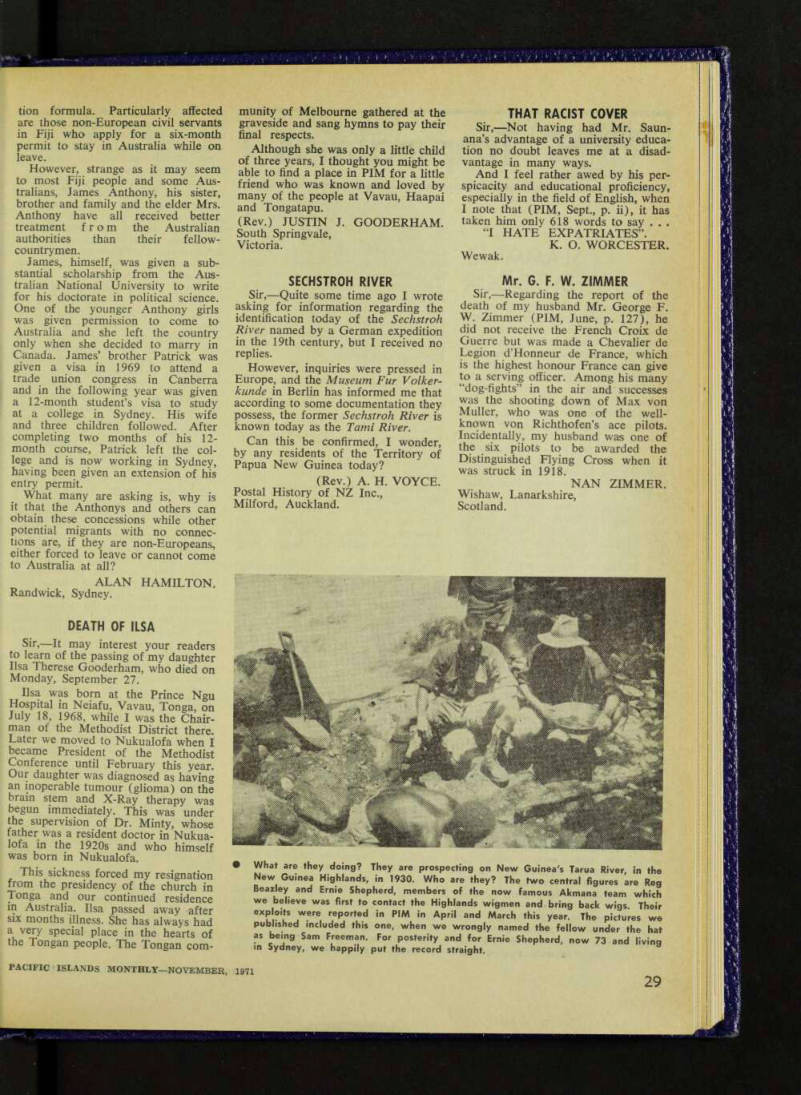
What are they doing? They are prospecting on New Guinea's Tarua River, in the New Guinea Highlands, in 1930. Who are they? The two central figures are Reg Beazley and Ernie Shepherd, members of the now famous Akmana team which we believe was first to contact the Highlands wigmen and bring back wigs. Their exploits were reported in RIM in April and March this year. The pictures we published included this one, when we wrongly named the fellow under the hat as being Sam Freeman. For posterity and for Ernie Shepherd, now 73 and living in Sydney, we happily put the record straight.