Tropicalities
pp. 32-34 · Read in the full issue
Slamming
Fiji's Door
Fiji’s immigration regulations are giving massive headaches to com panies and tourist agencies. To companies driven nearly frantic by the increasing pressure of “localisa tion” demands, and to tourist agencies inundated with complaints about the unreasonable visa regulations.
One of Fiji’s oldest companies, Burns Philp (South Sea) Co., Ltd., has sold a subsidiary, Burns Philp (New Hebrides) Ltd. One reason given for the reluctant sale was the “increasing difficulty the South Sea Company is experiencing in managing its affairs because of the effects of localisation in Fiji”.
“This policy”, chairman Sir Maurice Scott said in October in the annual report, “is now being administered with increasing severity and has no apparent regard for the serious effect it is having on the company’s ability to control and manage diverse opera tions, not only in Fiji, but in the overseas territories”.
Dozens of companies can echo the same complaint. Many employers are developing ulcers over their struggles to clear the hurdles put in the way of engaging qualified staff from over seas. One of the worst is the require ment of an employer to put a period to the time he will need his expatri ate employee, to the time taken to train a “local” for the job and, even, to give the “local’s” name.
In positions where qualities and at tributes recognised as making for efficiency are abstract ones, fulfilling such a requirement is almost im possible.
But the noisiest uproar is coming from the tourist agencies and the air lines over the visa regulations. These were changed recently and the effect of the change was immediate. Scores of tourists from countries which had no visa abolition agreement with Fiji found themselves barred.
Ten Mexicans who wanted to spend two days in “Friendly Fiji” were turned away, virtually on the door step, in September and two more from the same country recently spent 25 hours in the transit lounge at Nadi
Airport until their aircraft took off.
A woman with a Spanish passport, who had a visa problem, spent all night at the airport terminal before anyone with enough authority could be located to sort out the problem.
Incensed at the lack of consider ation by the immigration authorities, who did not wait until news of the regulations change could be made known in other countries, the travel industry recently protested to the Minister of Labour.
The Fiji Visitors Bureau board met on October 19 and one member, Mr.
Dick Warner, managing director of travel agents Hunts of the de scribed the visa position as serious and deplored the lack of consultation between the government and the tour ist industry.
The bureau suggested that, as an interim measure, tourists arriving without visas should be supplied with them at the airports.
The immigration laws may also take the gilt off the gingerbread for those people overseas who are buying home-sites in places like Deuba’s Paci fic Harbour.
The possession of such a home will not guarantee the owner a place in Fiji’s sun for all time.
According to the Prime Minister, Ratu Sir Kamisese Mara, those people with an assured income who want to retire to Fiji would be wel come to come, but they wouldn’t be allowed to work, and those with homes who wished to pay only periodic visits to their property would have to be satisfied with the present regulations which allow them a permit to reside for up to six months in any year.
Fairies or
big brother?
The fairy ring of little white mushroom domes and long, white, windowless caravans tucked fairly unobtrusively away in a corner of Nadi Airport has always been a matter for wondering locals to natter about (PIM, June, p. 24).
Like mushroom rings do, it popped up overnight in November, 1966, occupied by men with dis tinctly American voices and definite military manners.
What excited curiosity was that although they never seemed to be
seen in uniform, some occasionally appeared to be toting guns. For the next three years neither the US Con sulate in Suva nor the Fiji Govern ment would acknowledge that the fairy ring was there.
After a year or two the listing “US Air Force Detachment 441” sidled into the pages of the public telephone directory. That may have been a security slip. Intrigued local journalists who instantly rang the number to ask: “Who are you, what are you doing there and why?”, met with an earful of secretive, heavy breathing and then a mumbled reference to the Suva consulate.
But the consulate was not at all helpful. And it would get terribly embarrassed when one of the long white caravans was spotted from time to time on Suva Wharf while being shipped in or out of Fiji.
Told that a newspaper wanted some caption details to go with a photo of the caravans the consulate wailed: “Don’t do that. Need anyone know they’re there?”
Despite their civilian disguise, the Americans at Nadi, never numbering more than about 40, behaved as US servicemen abroad usually do. They successfully muscled in on all the single available girls, monopolised the local bars, and moaned about the time they had to suffer in Fiji before getting home to the good old USA.
Prodded again, the consulate re ferred queries to the Fiji Govern ment. This responded by acting as if it had never received them. Two years ago, prodded once more, the consulate hummed and hawed and after a day or two said that Washing ton, DC, had decided to satisfy local curiosity.
One Fiji Times reporter would be allowed to walk through the mush room ring just once. The mass of electronic dials and wires he saw didn’t mean much.
“Just meteorological research,” he was assured. “Electronic equipment housed at the installation has been used to measure and record data on electrical disturbances and baro metric changes in the upper atmos phere.” „ What kind of disturbances? Ones caused by missiles and bombers and satellites whizzing through space?
“Er, no. This data assists in deter mining the size and intensity of storm centres and in tracking their move ment.” , , So why all the secrecy about the weather? How about storm centres of, say, nuclear intensity, hovering around Mururoa?
Those questions weren’t answered and now probably never will be.
In October the US Consulate an
nounced that because of “continuing budgetary considerations” the 441st USAF detachment would be pulled out of Nadi for good by December 31.
Opposition ahead
for Cooks Premier
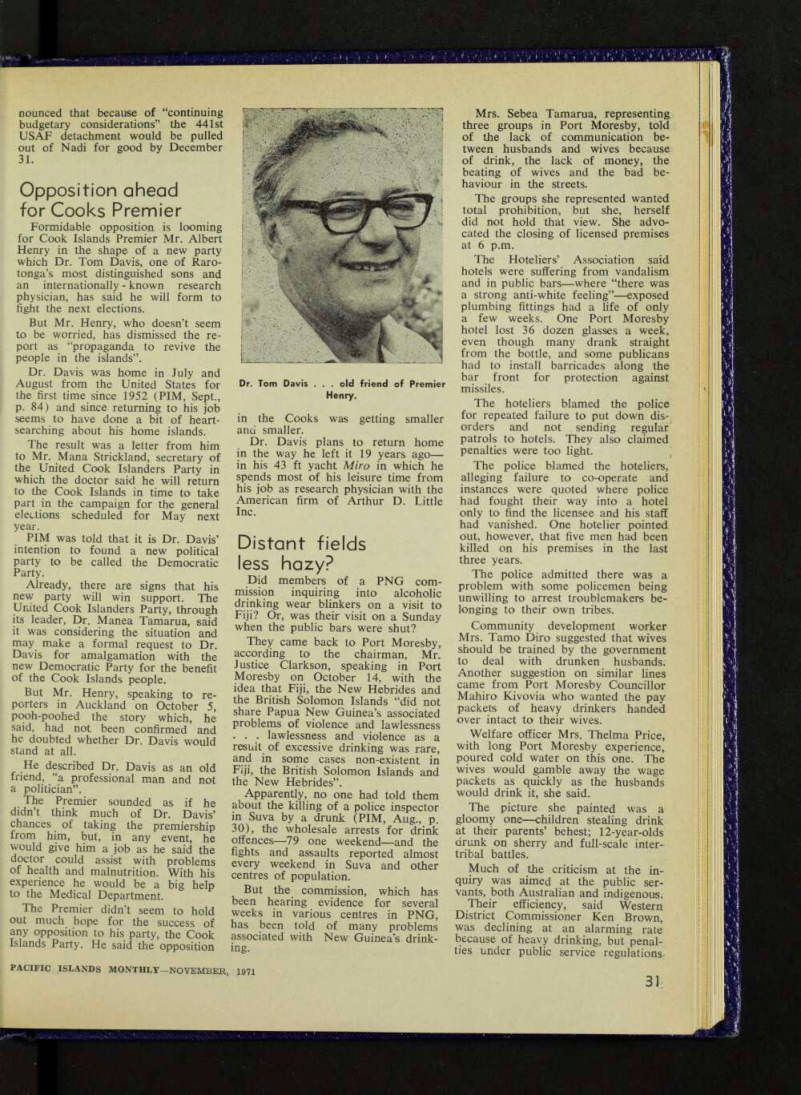
Formidable opposition is looming for Cook Islands Premier Mr. Albert Henry in the shape of a new party which Dr. Tom Davis, one of Raro tonga’s most distinguished sons and an internationally - known research physician, has said he will form to fight the next elections.
But Mr. Henry, who doesn’t seem to be worried, has dismissed the re port as “propaganda to revive the people in the islands”.
Dr. Davis was home in July and August from the United States for the first time since 1952 (PIM, Sept., p. 84) and since returning to his job seems to have done a bit of heart searching about his home islands.
The result was a letter from him to Mr, Mana Strickland, secretary of the United Cook Islanders Party in which the doctor said he will return to the Cook Islands in time to take part in the campaign for the general elections scheduled for May next year.
PIM was told that it is Dr. Davis’ intention to found a new political party to be called the Democratic Party.
Already, there are signs that his new party will win support. The United Cook Islanders Party, through its leader, Dr. Manea Tamarua, said it was considering the situation and may make a formal request to Dr.
Davis for amalgamation with the new Democratic Party for the benefit of the Cook Islands people.
But Mr. Henry, speaking to re porters in Auckland on October 5, pooh-poohed the story which, he said, had not been confirmed and he doubted whether Dr. Davis would stand at all.
He described Dr. Davis as an old friend, “a professional man and not a politician”.
The Premier sounded as if he didn’t think much of Dr. Davis’ chances of taking the premiership from him, but, in any event, he would give him a job as he said the doctor could assist with problems of health and malnutrition. With his experience he would be a big help to the Medical Department.
The Premier didn’t seem to hold out much hope for the success of any opposition to his party, the Cook Islands Party. He said the opposition
in the Cooks was getting smaller ana smaller.
Dr. Davis plans to return home in the way he left it 19 years ago— in his 43 ft yacht Miro in which he spends most of his leisure time from his job as research physician with the American firm of Arthur D. Little Inc.
Distant fields
less hazy?
Did members of a PNG com mission inquiring into alcoholic drinking wear blinkers on a visit to Fiji? Or, was their visit on a Sunday when the public bars were shut?
They came back to Port Moresby, according to the chairman, Mr.
Justice Clarkson, speaking in Port Moresby on October 14, with the idea that Fiji, the New Hebrides and the British Solomon Islands “did not share Papua New Guinea’s associated problems of violence and lawlessness . . . lawlessness and violence as a result of excessive drinking was rare, and in some cases non-existent in Fiji, the British Solomon Islands and the New Hebrides”.
Apparently, no one had told them about the killing of a police inspector in Suva by a drunk (PIM, Aug., p. 30), the wholesale arrests for drink offences—79 one weekend—and the fights and assaults reported almost every weekend in Suva and other centres of population.
But the commission, which has been hearing evidence for several weeks in various centres in PNG, has been told of many problems associated with New Guinea’s drink ing.
Mrs. Sebea Tamarua, representing three groups in Port Moresby, told of the lack of communication be tween husbands and wives because of drink, the lack of money, the beating of wives and the bad be haviour in the streets.
The groups she represented wanted total prohibition, but she, herself did not hold that view. She advo cated the closing of licensed premises at 6 p.m.
The Hoteliers’ Association said hotels were suffering from vandalism and in public bars—where “there was a strong anti-white feeling”—exposed plumbing fittings had a life of only a few weeks. One Port Moresby hotel lost 36 dozen glasses a week, even though many drank straight from the bottle, and some publicans had to install barricades along the bar front for protection against missiles.
The hoteliers blamed the police for repeated failure to put down dis orders and not sending regular patrols to hotels. They also claimed penalties were too light.
The police blamed the hoteliers, alleging failure to co-operate and instances were quoted where police had fought their way into a hotel only to find the licensee and his staff had vanished. One hotelier pointed out, however, that five men had been killed on his premises in the last three years.
The police admitted there was a problem with some policemen being unwilling to arrest troublemakers be longing to their own tribes.
Community development worker Mrs. Tamo Diro suggested that wives should be trained by the government to deal with drunken husbands.
Another suggestion on similar lines came from Port Moresby Councillor Mahiro Kivovia who wanted the pay packets of heavy drinkers handed over intact to their wives.
Welfare officer Mrs. Thelma Price, with long Port Moresby experience, poured cold water on this one. The wives would gamble away the wage packets as quickly as the husbands would drink it, she said.
The picture she painted was a gloomy one—children stealing drink at their parents’ behest; 12-year-olds drunk on sherry and full-scale inter tribal battles.
Much of the criticism at the in quiry was aimed at the public ser vants, both Australian and indigenous.
Their efficiency, said Western District Commissioner Ken Brown, was declining at an alarming rate because of heavy drinking, but penal ties under public service regulations
Dr. Tom Davis . . . old friend of Premier Henry.
were so light that punishment was a laughing matter.
Mr. Brown also alleged that — • At Dam, the people on a regular wage lived from pay-day to pay day for a fortnightly bender; • At least $6,000, nearly half Dam’s fortnightly pay cheque, went each pay weekend on liquor; and • Last Christmas 4,000 bottles of dry sherry were sold at Daru.
Another aspect of the problem was touched on by Percy Chatterton, MHA, who attacked the drinking cult.
“Every effort should be made to avoid the situation in Papua New Guinea in which beer is sentimental ised as in Australia,” he said.
The commission has received many prescriptions to cure the problems.
These include, reducing the liquor trading hours, teaching children about the effects of heavy drinking, heavier penalties for drink offences, the policing of hotels by village and community elders, “beer only” licences, weaker beer with a tax re duction on it and a bigger tax on spirits and sherry.
The view that drinking hours should be cut led to the submission by the Police Commissioner, Briga dier N. A. M. Nicholls, that this should also apply to the clubs.
They were almost wholly patron ised by expatriates, he said, and it had been claimed that this was a source of “racial discomfort” to indigenes who saw expatriates drink ing in clubs when hotels and taverns were closed.
The horror of a
$1 million handout
The whys and wherefores of New Zealand’s financial obligations to its protectorates—Niue in particular— arose during a Suva news conference for the touring NZ parliamentary delegation in September.
Mr. R. E. B. Peren, head of the South Pacific division of NZ’s Minis try of Foreign Affairs, remarked on one reaction he’d met in Fiji.
A respected Suva citizen, he said, had expressed “horror” that 5,000 Niueans received a $1 million-a-year handout between them.
“The suggestion was that this was immoral, that it was too much . . . that chaps ought to look after them selves”, he said. Mr. Peren added that New Zealand’s own attitude was that it did indeed have a responsibility to Niue.
He conceded that there were some inequalities in the pattern of New Zealand aid to the South Pacific, but said, “Over the next 10 years there
will be a change in the pattern of our aid and relationships, which will re flect the new constitutional situation in the region. We will tend to deal more equally with various territories”.
Leader of the delegation, Mr. H.
R. Lapwood, said he did not al together agree with suggestions that New Zealand should give more aid to the South Pacific because there were always people to think up ways and means of how the country should be spending money.
W. Samoa's Fono
is really modern
Western Samoa’s ultra - modern Fono House is now completed but it will not be officially used until the Independence Day celebrations in June next year.
Built at a cost of $185,000, it contains the latest furniture and equipment including the most modern simultaneous translating equipment from New Zealand.
Foundations of the new legislative department building nearby have been laid but further work has been stopped because materials have not arrived.
On the airport project, more than 50 per cent, of the dredging is done.
Half of the new terminal buildings and the runway are also completed.
Director of Works Mr. Leslie McQuitty indicated that the first 5,000 ft of runway suitable for the opera tion of Air Pacific jets would be ready by next April and the rest of the airport and road projects by the end of next year.
The new Fono House was financed with a loan from New Zealand and the airport project with a SUS 2.4 million loan from the Asian Develop ment Bank.
Church council
quizzed
The Melanesian Council of Churches has had a lively annual meeting at Baiyer River Baptist mission in the Western Highlands of New Guinea. The council began by welcoming the Roman Catholic Church into full membership, thus making the MCC one of the rela tively few national councils of churches which include the Catholics.
This has given rise to a certain amount of tension in some quarters, but on the whole the meetings went off cordially.
MCC delegates showed some dis enchantment both with the World Council of Churches and with the proliferating consultations and semi
nars held under the auspices of the World Council or other bodies.
They passed a resolution express ing concern that the World Council was inviting people from PNG to attend its commissions as advisers, without first consulting either the MCC or those territory churches which are members of the council.
The resolution was prompted by recent invitations to Tolai John Kaputin and trade unionist Albert Maori Kiki, both of whom are con troversial figures locally.
On the subject of consultations and seminars, everyone seemed to be ask ing in effect, are they really worth while? In particular, they wanted to know why experts had to be brought expensive distances from overseas, when in the opinion of many dele gates there were already people in the area who could be used just as effectively.
Delegates also felt that far too often participants in seminars and consultations failed to pass on what they had learnt, so that the church, country and people derived little benefit from the programmes.
In its new assertive mood of aggres sive questioning, the MCC fired off a resolution asking the World Council to clarify the aims, objects and bene fits of a proposed consultation on social and political maturity in the South Pacific.
'Down with shorts'
cries festival director
“Take off your shorts and throw away your paper ribbons,” was the cry from the heart of South Pacific Festival of Arts director Victor Carell to the Fijians in October. But he wasn’t advocating nudity. He was condemning the use in Fijian arts of anything but traditional materials.
Lamenting the preponderance of khaki shorts, plastics, crepe paper, wrist watches and the like in Fijian mekes and the use of kerosene tins for drums, Mr. Carell appealed to “every leader in the South Pacific to make a concentrated drive for the resurrection and preservation of traditional customs and good taste in art”. . .
He wanted the “elimination of tasteless early European contact resi dues and of stop-gap puritanical fashions such as putting certain island women into men’s singlets for public ceremonies”.
One suggestion he made was the return of the original loincloth or brief athletic underpants dyed brown and not “European shorts glaringly out of keeping with gracious voivoi skirts”.