Islands
p. 29 · Read in the full issue
Return
To The
By Sir John Gutch
My wife and I have just returned from a visit to the New Hebrides and British Solomon Islands after an absence of 10J years. When we left Honiara in January, 1961, at the end of my five-year term as High Commissioner for the Western Paci fic, the possibility of such a return visit seemed remote: indeed, we won dered whether, even if it became possible, it would be wise. In the event it has been an unforgettable ex perience.
Our visit was timed to enable us to take part in the concluding cele brations in the centenary com memoration of Bishop Patteson. We attended the Thanksgiving Service on September 26, in the beautiful new cathedral of St. Barnabas in Honiara, where the Archbishop of Melbourne, the Primate of Australia, preached a most impelling sermon and there were over 2,000 communicants—a moving tribute to the work started by Patteson in Melanesia a century ago.
During our visit we were frequently asked what changes we saw from the Solomons of our day. The changes have been staggering in their extent and variety.
The material development which one sees in and around Honiara is impressive. New buildings have sprung up on all sides. Mendana Avenue has been transformed from a dusty street with a preponderance of old Quonset huts into a busy, tar sealed thoroughfare, still lined with shady trees, but flanked by new shops and offices.
Government departments, many of which had been housed in war-time hutments, now have modern, air conditioned offices. The palm-thatched Government House, where I lived as High Commissioner, has disappeared.
The High Commissioner’s residence, spacious and well designed, stands back from the old site with park like laws running down to the sea.
Housing development, too, is impres sive. The ridges above Honiara are dotted with new houses and housing estates are creeping into the valleys and onto the hills farther back.
Communications are vastly im proved. In our day the only exter nal air service from New Guinea operated only three times in the month and internal air services were non-existent. Now there are fre quent services from Fiji and New Guinea, whilst there are few parts in the protectorate which cannot be visited by air.
Road development has been im pressive, particularly on Malaita, and is continuing. We ourselves were able to make flying visits to Gizo and to Auki as well and an enjoyable tour by ship around the island of Ysabel with the High Commissioner.
On the economic front we were able to see rice development on the Guadalcanal Plains, the new herd of Brahman cattle recently arrived from Australia, and the CDC’s oil palm trials, which are showing great promise. Timber extraction and re generation are going well. Bauxite extraction on Rennell Island is im minent and other mining possibilities are in the wind.
Altogether one gets the impression that the protectorate now has a real chance of attaining the economic viability for which it has been striving for so long.
After a long absence, all this material progress hits one in the eye, so to speak. Development on the human side has also been striking, but is more difficult to assess.
We met many old friends in all sections of the community: this was one of the objects of our visit. Many Solomon Islanders are holding more responsible positions than in our day.
An increasing number are going over seas for further education and train
ing. The new universities in New Guinea and Fiji are beginning to plav their part.
Some of our most encouraging visits were those to educational in stitutions—amongst them the King George VI School and Selwyn Col lege Secretary School, the Govern ment Training College, the new Tech nical Institute, and the Patteson Theo logical Centre.
There is no doubt as to the en thusiasm of the staffs and the eager ness of the Solomon Islanders to grasp the new opportunities of equipping themselves for the future.
The effect of all this can already be seen and made a deep impression on us. Some of the Solomon Islanders whom we met were more self-assured and confident, much easier to dis cuss problems with and readier to ex press their views.
And what does the future hold for them?
We have, of course, been frequently asked our view on the likely timing of self-government and eventual in dependence.
There has been steady progress on the constitutional front since I pre sided at the first meeting of the new Legislative Council shortly before my departure, and the High Commis sioner has recently announced further possible changes in the present Gov erning Council and Committees.
These are matters which a Select Committee of the existing council will discuss so that firm prospects can be put to the new council after the elections due in 1973. One hopes that this steady process of constitutional advance in consultation with the Solo mon Islanders themselves will con tinue.
I remember expressing the view to PIM in 1961 that events in New Guinea might have a profound effect on the Solomons. That may well still be so.
No doubt rapid constitutional changes in New Guinea would excite impatience in some quarters in the Solomons—one or two impatient voices are already being heard. My feeling is, however, that in general Solomon Islanders will look shrewdly and critically at events in New Guinea and make up their own minds as to what would be best for themselves.
One further point—l think it is im portant for their future that the pro cess of breaking down island pre judices, which still exist, should con tinue so that the Solomons can be welded into a nation which will hold together. The mingling of the younger generation from the different islands in secondary schools and in further edu cation should help greatly in this pro cess.
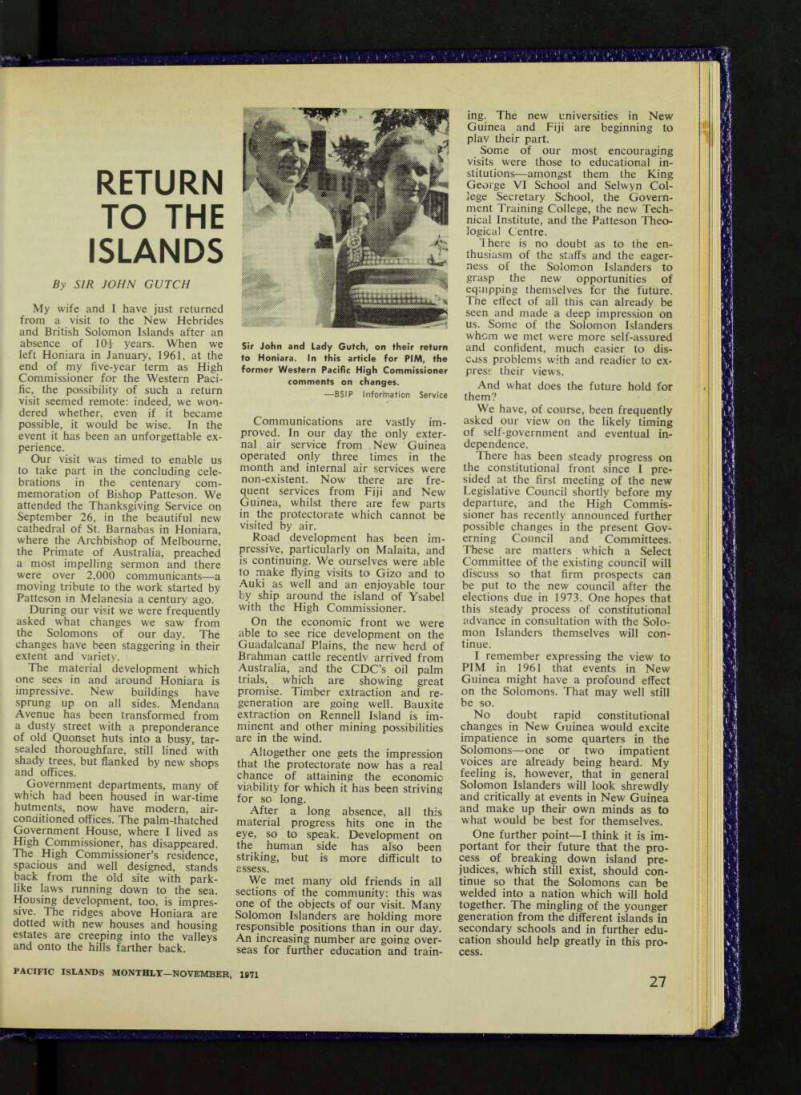
Sir John and Lady Gutch, on their return to Honiara. In this article for PIM, the former Western Pacific High Commissioner comments on changes. —BSIP Information Service