Book Reviews
pp. 89-91 · Read in the full issue
Academics Dissect Png To Make
A Piece For The Coffee Table
According to Peter Hastings, who edited Papua New Guinea—Pros peros's Other Island, it is a coffee table book for academics. That’s as maybe, but certainly a whole gaggle of the Top Cats of the academic world contributed to it.
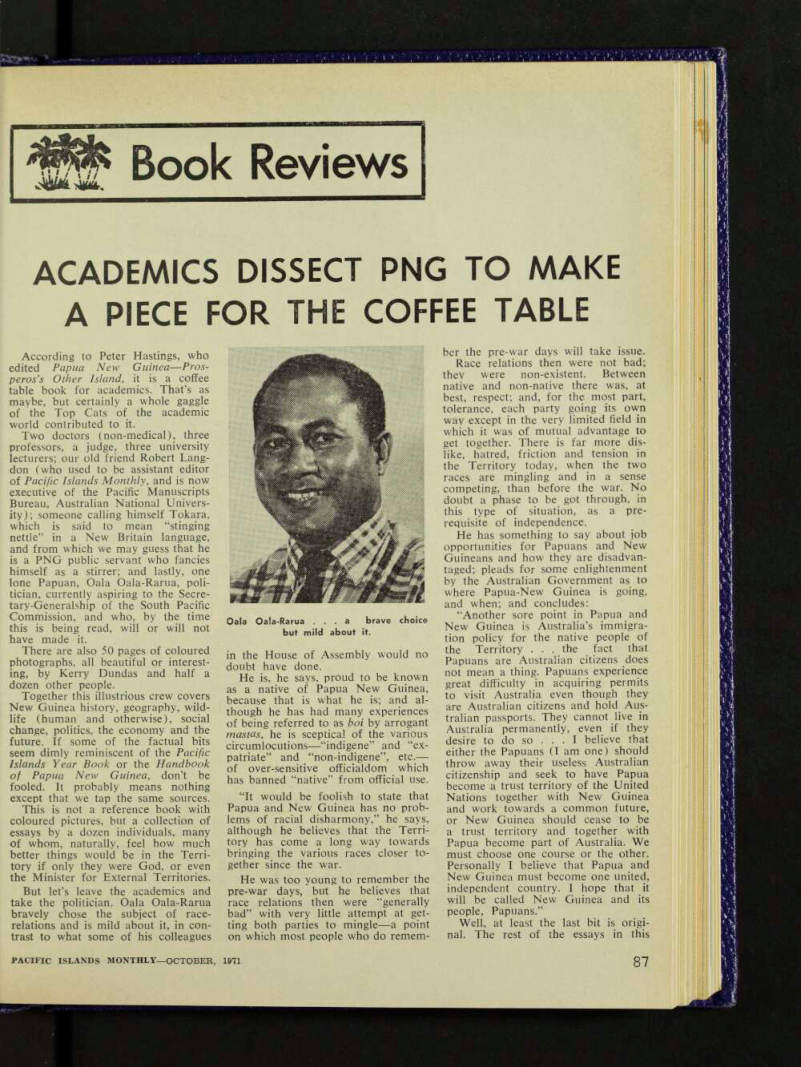
Two doctors (non-medical), three professors, a judge, three university lecturers; our old friend Robert Lang don (who used to be assistant editor of Pacific Islands Monthly, and is now executive of the Pacific Manuscripts Bureau, Australian National Univers ity); someone calling himself Tokara, which is said to mean “stinging nettle” in a New Britain language, and from which we may guess that he is a PNG public servant who fancies himself as a stirrer; and lastly, one lone Papuan, Gala Oala-Rarua, poli tician, currently aspiring to the Secre tary-Generalship of the South Pacific Commission, and who, by the time this is being read, will or will not have made it.
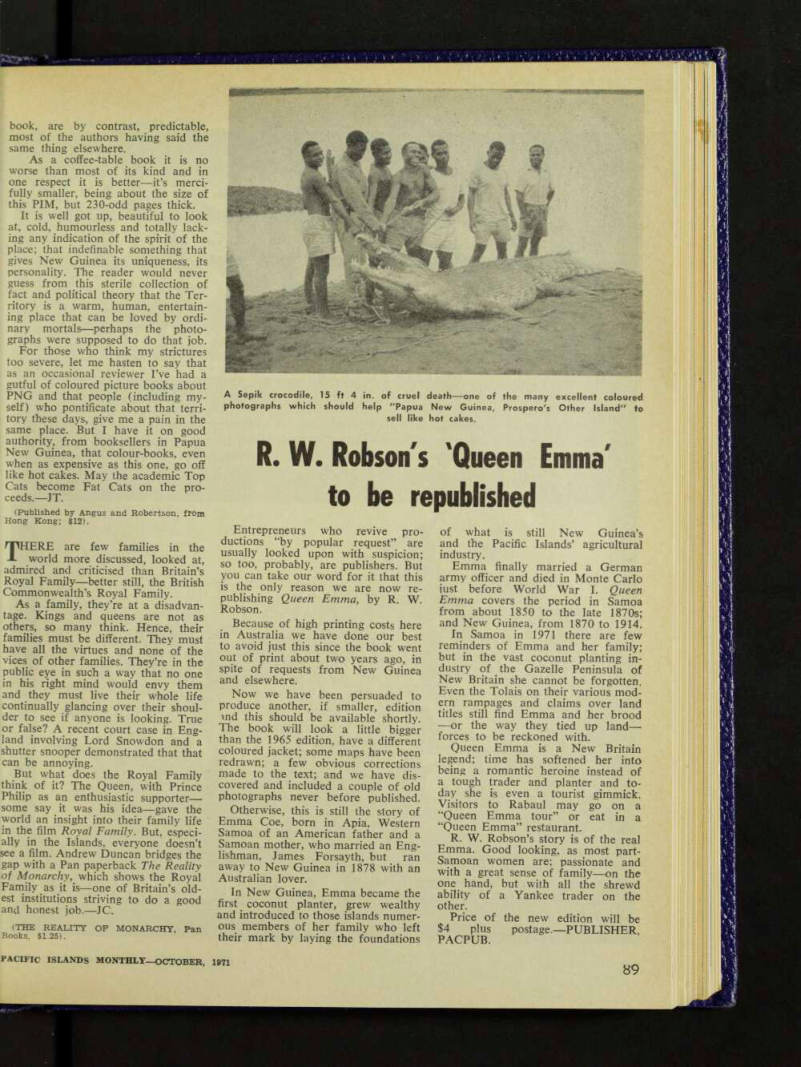
There are also 50 pages of coloured photographs, all beautiful or interest ing, by Kerry Dundas and half a dozen other people.
Together this illustrious crew covers New Guinea history, geography, wild life (human and otherwise), social change, politics, the economy and the future. If some of the factual bits seem dimly reminiscent of the Pacific Islands Year Book or the Handbook of Papua New Guinea, don’t be fooled. It probably means nothing except that we tap the same sources.
This is not a reference book with coloured pictures, but a collection of essays by a dozen individuals, many of whom, naturally, feel how much better things would be in the Terri tory if only they were God, or even the Minister for External Territories.
But let’s leave the academics and take the politician. Gala Oala-Rarua bravely chose the subject of race relations and is mild about it, in con trast to what some of his colleagues
in the House of Assembly would no doubt have done.
He is, he says, proud to be known as a native of Papua New Guinea, because that is what he is; and al though he has had many experiences of being referred to as boi by arrogant mastas, he is sceptical of the various circumlocutions—“indigene” and “ex patriate” and “non-indigene”, etc.— of over-sensitive officialdom which has banned “native” from official use.
“It would be foolish to state that Papua and New Guinea has no prob lems of racial disharmony,” he says, although he believes that the Terri tory has come a long way towards bringing the various races closer to gether since the war.
He was too young to remember the pre-war days, but he believes that race relations then were “generally bad” with very little attempt at get ting both parties to mingle—a point on which most people who do remem
ber the pre-war days will take issue.
Race relations then were not bad; they were non-existent. Between native and non-native there was, at best, respect; and, for the most part, tolerance, each party going its own way except in the very limited field in which it was of mutual advantage to get together. There is far more dis like, hatred, friction and tension in the Territory today, when the two races are mingling and in a sense competing, than before the war. No doubt a phase to be got through, in this type of situation, as a pre requisite of independence.
He has something to say about job opportunities for Papuans and New Guineans and how they are disadvan taged; pleads for some enlightenment by the Australian Government as to where Papua-New Guinea is going, and when; and concludes: “Another sore point in Papua and New Guinea is Australia’s immigra tion policy for the native people of the Territory . . . the fact that Papuans are Australian citizens does not mean a thing. Papuans experience great difficulty in acquiring permits to visit Australia even though they are Australian citizens and hold Aus tralian passports. They cannot live in Australia permanently, even if they desire to do so ... I believe that either the Papuans (I am one) should throw away their useless Australian citizenship and seek to have Papua become a trust territory of the United Nations together with New Guinea and work towards a common future, or New Guinea should cease to be a trust territory and together with Papua become part of Australia. We must choose one course or the other.
Personally I believe that Papua and New Guinea must become one united, independent country. I hope that it will be called New Guinea and its people, Papuans.”
Well, at least the last bit is origi nal. The rest of the essays in this
Oala Oa!a-Rarua ... a brave choice but mild about it.
book, are by contrast, predictable, most of the authors having said the same thing elsewhere.
As a coffee-table book it is no worse than most of its kind and in one respect it is better—it’s merci fully smaller, being about the size of this PIM, but 230-odd pages thick.
It is well got up, beautiful to look at, cold, humourless and totally lack ing any indication of the spirit of the place; that indefinable something that gives New Guinea its uniqueness, its personality. The reader would never guess from this sterile collection of fact and political theory that the Ter ritory is a warm, human, entertain ing place that can be loved by ordi nary mortals—perhaps the photo graphs were supposed to do that job.
For those who think my strictures too severe, let me hasten to say that as an occasional reviewer I’ve had a gutful of coloured picture books about PNG and that people (including my self) who pontificate about that terri tory these days, give me a pain in the same place. But I have it on good authority, from booksellers in Papua New Guinea, that colour-books, even when as expensive as this one, go off like hot cakes. May the academic Top Cats become Fat Cats on the pro
ceeds.-
JT.
(Published by Angus and Robertson, from Hong Kong; $l2).
THERE are few families in the world more discussed, looked at, admired and criticised than Britain’s Royal Family—better still, the British Commonwealth’s Royal Family.
As a family, they’re at a disadvan tage. Kings and queens are not as others, so many think. Hence, their families must be different. They must have all the virtues and none of the vices of other families. They’re in the public eye in such a way that no one in his right mind would envy them and they must live their whole life continually glancing over their shoul der to see if anyone is looking. True or false? A recent court case in Eng land involving Lord Snowdon and a shutter snooper demonstrated that that can be annoying.
But what does the Royal Family think of it? The Queen, with Prince Philip as an enthusiastic supporter— some say it was his idea—gave the world an insight into their family life in the film Royal Family. But, especi ally in the Islands, everyone doesn’t see a film. Andrew Duncan bridges the gap with a Pan paperback The Reality of Monarchy,' which shows the Royal Family as it is—one of Britain’s old est institutions striving to do a good
and honest job.-
JC.
I The Reality Op Monarchy, Pan
Books, $1.25).