There was
pp. 83-87 · Read in the full issue
a merry re-union at Lemakote
On July 31, 1971, at Lemakote, near Kavieng, an American priest and a German-born sister had a merry re union. After 27 years and 9,000 miles apart, they met under peaceful tropic skies, but one must go back to World War II for the background story.
During the early days of the war, the south-east sweep of Japanese power had captured New Ireland and New Hanover. Missionaries of the Sacred Heart ran a leper colony with more than 500 patients—one of the world’s largest, government-run with the religious order paid to staff it.
Soon after the war began, the European doctors and officials either escaped or were imprisoned. The Japanese had a deadly fear that to disturb the lepers would be to infect themselves with the dread disease.
Despite deep fears, Japanese officials felt it necessary to inspect the hospi tal.
Their strange behaviour amused the sisters no end. On the dock at Ane laua (New Hanover) stood Father Stamm and Brother Teutenberg to welcome the party. But the greetings had to wait until each Japanese was thoroughly sprayed with a strong dis infectant. Then several officers and a score of men under a Japanese flag marched up the hill to the first com pound.
Discussions were friendly. The visi tors were interested in operation of the colony—finances, food, medicine, etc. The Japanese said they could not continue the financing or providing medicines for the sisters who were acting as medics, but promised to try to help with the upkeep of lepers and staff. The mission ship Teresa would continue to get native foods.
The greetings over, the Japanese officers then spoke to the lepers. The talk was in the usual “all-conquering” tone—Great Nippon now ruled; all
must obey the missionaries who would represent the Japanese; disobedience would bring swift death by shooting.
Some months later, propaganda newspapers (in English) were distri buted with a prominent story of the native lepers weeping with happiness during the visit. The missionaries could not recall any tears that day.
With the Japanese ignorant of how leprosy is spread, their departure was almost more laughable than their ar rival. Standing on a burlap bag they were again sprayed and then leaped quickly to the deck of their boat.
The dreaded leprosy brought two years of peace to the colony. Calm was finally shattered with an Ameri can bombing of the colony on March 25, 1944. There are at least two ex planations of how it happened.
The first, an American version, said the bombers were aiming at what they thought were Japanese destroyers hid den at night in the shadows of the smaller islands. There was not too much “pinpointing accuracy” and some of the bombs hit the colony.
The other story as told by the mis sionaries, was that two native chiefs, deeply resenting the sale of the island to the Australian Government in the middle twenties, lied to Allied intelli gence that the island was jammed with Japanese. The chiefs thought that with the missionaries and lepers wiped out, the island would return to native ownership.
God seemed to have protected the colony fairly well—one leper killed, several wounded and little other damage. But when the dust settled only 25 lepers were left out of more than 500. Most had fled to New Ire land.
Tensions were mounting all over the islands. Japanese officers had hinted to imprisoned missionaries at Kokopo, near Rabaul, that they might
suffer greatly if the expected Ameri can landing took place.
Coastwatcher Stan Bell (brother of Lincoln) thought that the flight of the patients to New Ireland had removed the protection of leprosy for the mis sionaries. He strongly recommended quick evacuation.
Bell suggested moving to Lavongai to await a navy rescue vessel. His urg ent message warned of grave danger probably arising within two weeks.
At just about the same time, the Japanese authorities at Rabaul had permitted the transfer of hundreds of imprisoned missionaries from Vuna pope to a deep valley several miles further in the bush. Everywhere there were almost certain expectations of imminent American invasions. Fortu nately, General MacArthur leap frogged the area entirely.
The rescue was made from Emirau Island (St. Mathias Group) by PT boat. At the time, Emirau was the furthest military advance in the area.
Stan Bell, with his thorough know ledge of the region, was the logical guide for the PT-boat. The trip of several hours passed quickly between foolishly futile efforts to shoot flying fish with American .45 calibre pistols and intent listening to Stan Bell re count recent Coastwatcher exploits.
His listeners were shocked and dis gusted at his tale of stupidly-broken military intelligence that resulted in a native massacre.
Throughout the entire Pacific War, secrecy on the Coastwatchers was very tight and almost invariably well kept.
But, early in 1944 there had been a successful rescue of several American fliers with Coastwatcher help. LIFE magazine spilled the story along with a map carefully locating on a river the native village that had helped the fliers. Result? Within two weeks the
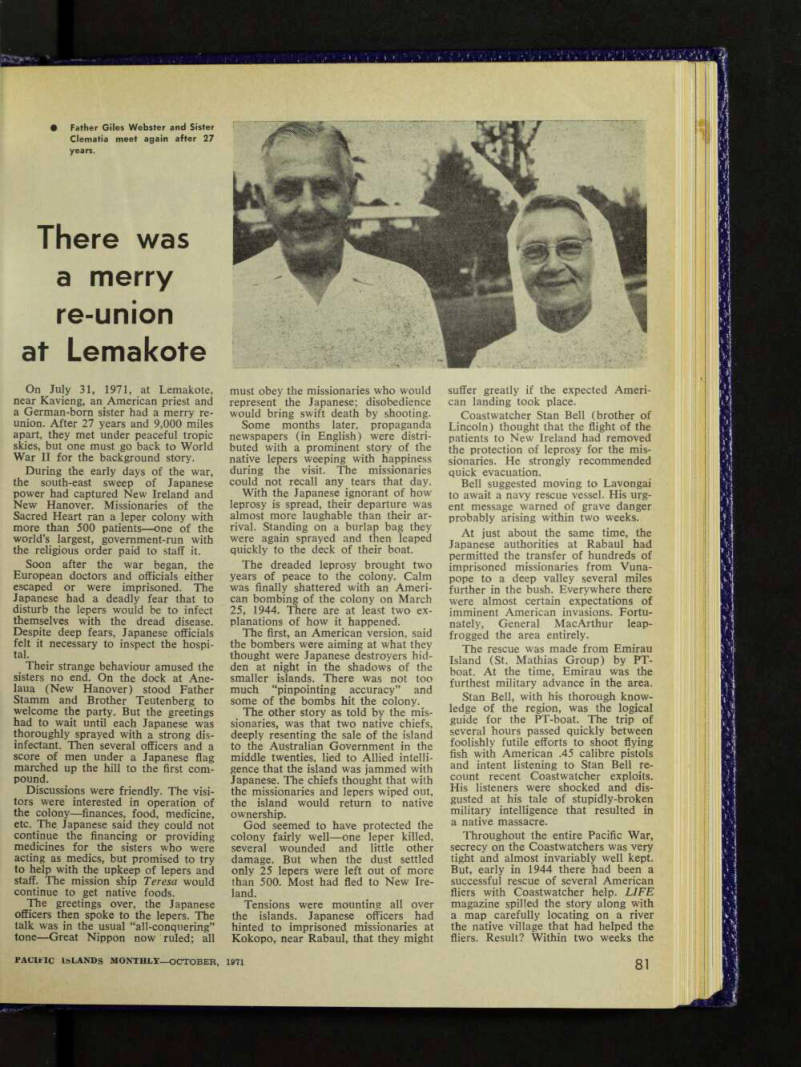
Father Giles Webster and Sister Clematia meet again after 27 years.
Japanese wiped out the entire village —every man, woman and child.
Navy Padre Giles A. Webster had been chosen to go ashore alone on an outrigger canoe to meet the mis sionaries at a nearby plantation at Lavongai. He later wrote to his mother that, “he had gone ashore in Nip-held territory armed to the teeth with an Abercrombie and Fitch pocket knife and two Hershey choco late bars.” This was a bit of fun, for the Geneva Agreement for Non- Combatants strictly forbids religious chaplains bearing arms of any kind.
At the small mission centre at Lavongai, the missionaries awaited father with their few small bags packed on the ready. The PT-boat had a bit of intelligence work to do further down the coast of New Ire land. As one of the enlisted men de scribed it, “a bit of dry cleaning and pressing to do on a party of Nips in a small cave,”
Lunch was mainly the last two ancient rubbery chickens who sacri ficed themselves to provide an almost inedible meal. The missionaries’ war reminiscences filled up the hours of waiting the return of the PT-boat.
After 12 years in the islands the missionaries were entitled to a trip to their homelands. In this case they were Germans and Poles. With war an obstacle, most of them were then in their 14th year away from home.
They were filled with questions of the outside world from which they had been so long cut off. And their greatest puzzle was not about the bombing of the lepers, but why American fighter planes had machine gunned their thatched native chapel.
Rows of bullet holes lined the walls.
The chaplain was able to explain this apparently blasphemous barbarism of the Americans.
He had been an unofficial padre to many US Marine Corps fliers back in the earlier days of the war and they had told him the whole story.
The fighter pilots had learned the hard way the Japanese ruse of mount ing a machine gun high up inside the roof of a chapel. In the thatched roof was a hinged section that could quickly be released. As the scouting planes would buzz low over a village, suddenly a flap in the roof would fall giving the Japanese gunner a fine, close shot at the plane. This was the reason for the seemingly-senseless order to strafe every chapel.
And now it can be told. The orders were frequently disobeyed. And on more than one occasion when they did damage a chapel, on returning to their base they took up a “rebuilding collection” and gave it to a local missionary.
In one case they collected $3,000.
A Marist missionary later told Father Webster he could build 10 chapels with that enormous gift.
It may seem large, but when one recalls the legendary, round-the-clock poker games of Major Carl and other great Marine fighter pilots, where stakes were large and local ways of spending money were almost nonexistent, the fat gift was not quite so large.
The rescue and the trip back were uneventful—no Japanese were seen or heard from in any way. Some six hours or so later the cheery American crew hoisted the grateful missionaries aboard. It was a difficult trip for some of the sisters (men had been trans-
ferred from rough destroyer duty and had to call it quits with the violently tossing PT-boats).
Sister Columbana, MSC, was very seasick and they seated her in a can vas deck chair in the boat’s centre where the motion was the least. With eyes closed she sat murmuring the rosary. The padre was heard to ob serve that “He had often heard God called upon at that very spot during night patrols, but in a slightly more blasphemous fashion.”
Those rescued included Father Josef Stamm, MSC; Brother John Teutenberg, MSC; Sisters Winfreda, Emelina, Clematia, Columbana (all MSC) and ancient Aussie Harry
Spanner (whose son is reported now living in Kavieng).
They were all flown from Emirau to Torokina to Brisbane, where they were prisoners of war for 18 months.
Where are they now?
Brother John died within less than a year from pernicious anaemia in a US hospital in Brisbane. Father Stamm returned to the islands for many more years of work and died a few years ago in Vunapope, near Rabaul. Mr. Spanner has been dead for many years. Sisters Winfreda and Emelina are retired at the Vunapope mother house. And the rest?
There is still another chapter.
Bishop Scharmach of Rabaul, and Father Webster met in a Franciscan church in New York City in the early 19505. Since a colourful story of the rescue written by a USMC correspon dent had been totally censored, the bishop had been trying unsuccessfully to learn the rescuing father’s identity.
In the 1960 s Sister Clematia had learned of father’s name through a visiting Irish missionary.
During the July of 1971, Father Webster was the guest of Father Hilary Fischer, MSC, at Kavieng and learned Sister Clematia was only a few miles away. On July 3, Father Webster walked up to Sister Clematia at the Lemakote Mission Hospital with these words—“lt’s been a long time, sister.” Sister looked blankly until father added—‘‘lt’s been 28 long years!” It was as if someone had thrown a switch. Sister’s face literally lit up and glowed with happiness.
“Father Webster!” she exclaimed de lightedly. If she had been nearer it looked as if she might have hugged him. They talked “nineteen to the dozen” for many hours, spanning the years with laughter-filled conversation.
Sister Clematia, with justice, has often been called “Mrs. Kavieng.” For her many welfare efforts in the mis sions she is an honorary OBE, and Konrad Adenauer gave her a German decoration.
On July 4, 1971 (“Independence Day” in the States) another happy rescue reunion took place at Puas- Anelaua, where Sister M. Colum bana and Father Webster met at the leper colony where today only 49 lepers remain of the 500-plus of the
war years.-
G. A.W.
• The Japanese Government has called off its search for the remains of soldiers killed in Asia and the Islands in World War 11. More than one million dead are still unaccounted for. A total of 2,300,000 are esti mated to have died in the Asian and Pacific war theatres and only 766,000 confirmed remains have been returned to Japan.