R. W. Robson's 'Queen Emma'
p. 91 · Read in the full issue
to be republished
Entrepreneurs who revive productions “by popular request” are usually looked upon with suspicion; so too, probably, are publishers. But you can take our word for it that this is the only reason we are now republishing Queen Emma, by R. W.
Robson - Because of high printing costs here in Australia we have done our best to avoid just this since the book went out of print about two years ago, in spite of requests from New Guinea and elsewhere.
Now we have been persuaded to produce another, if smaller, edition Hid this should be available shortly The book will look a little bigger than the 1965 edition, have a different coloured jacket; some maps have been redrawn; a few obvious corrections made to the text; and we have discovered and included a couple of old photographs never before published. a • • ... . r rL ’l h - Stl l he ) ? ry of |““"t S f b A rn ln A s'o, West f rn Australian lover.
In New Guinea, Emma became the first coconut planter, grew wealthy and introduced to those islands numerous members of her family who left their mark by laying the foundations
of what is still New Guinea’s and the Pacific Islands’ agricultural industry.
Emma finally married a German army officer and died in Monte Carlo lust before World War I. Queen Emma covers the period in Samoa from about 1850 to the late 1870 s; and New Guinea, from 1870 to 1914.
In Samoa in 1971 there are few reminders of Emma and her family; but in the vast coconut planting in dustry of the Gazelle Peninsula of New Britain she cannot be forgotten.
Even the Tolais on their various mod ern rampages and claims over land titles still find Emma and her brood —or the way they tied up land— forces to be reckoned with.
Queen Emma is a New Britain legend; time has softened her into being a romantic heroine instead of a tough trader and planter and to day she is even a tourist gimmick.
Visitors to Rabaul may go on a “Queen Emma tour” or eat in a “Queen Emma” restaurant.
R. W. Robson’s story is of the real Emma. Good looking, as most part- Samoan women are; passionate and with a great sense of family—on the one hand, but with all the shrewd ability of a Yankee trader on the other.
Price of the new edition will be
$4 plus postage.-
Publisher,
Pacpub.
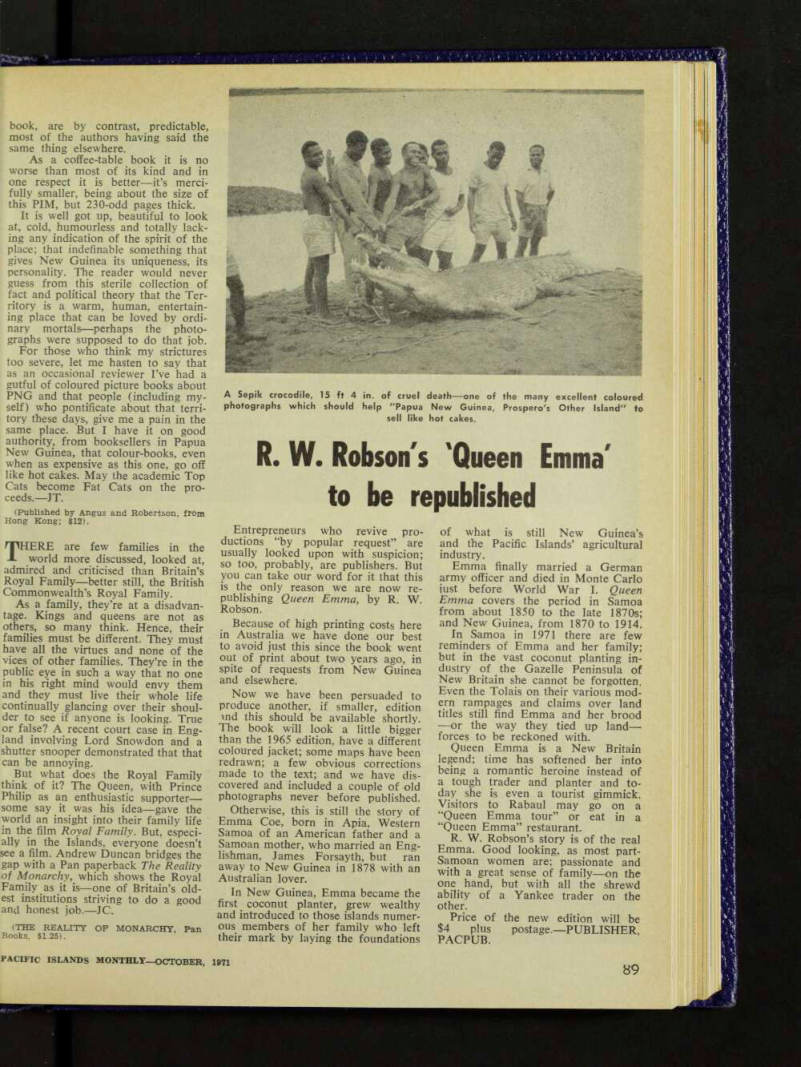
A Sepik crocodile, 15 ft 4 in. of cruel death—one of the many excellent coloured photographs which should help "Papua New Guinea, Prospero's Other Island" to sell like hot cakes.