Yesterday
p. 85 · Read in the full issue
Twenty years isn't a big slice out of history and to those approaching the last lap it's no time at all—which bit of philosophising comes from turning PlM's pages back to 1951. But, all the same, it's surprising how many people, places and things featured in PIM round that time are still cropping up.
Take Norfolk Island for instance. Just now there's a big ballyhoo about its role as a tax haven and signs that the islanders might be looking for independence, autonomy or something like that. Well, PIM in September, 1951, suggested in a headline, "Why not hand Norfolk Island to New Zealand". As we don't jump the gun by turning too many pages, any reaction to that suggestion may come later in YESTERDAY. What was bugging some folk was that while Aussie politicians had found in Nl "a pleasant and profitable refuge", Norfolk meant nothing to Australia In terms of tourism, fruit and vegetables. But NTs market for all three was New Zealand and traffic in them was developing to the advantage of Nl and NZ but not to Australia's advantage. "Why should the administration of Nl not be transferred from Australia to New Zealand?" folk asked. "NZ apparently is going to get all the benefits of traffic with Nl. Therefore, why should NZ not have the privilege of paying the costs of administering Norfolk Island?" Well, we know the privilege didn't get transferred.
Another bit of real estate transfer was mentioned on the same page. Apparently, planters in the Solomons were fed up of British rule and it had been mentioned by some people in London—not in the Colonial Office though— that the BSI planters would be better off under Australian rule. Nobody was optimistic about the chances of change, however, PIM observing that "Australia has all the headaches she wants in Papua-New Guinea without seeking more in the 'woeful Solomons'." She's still got the headaches, only more so.
Planters' woes took up a few pages in that 1951 PIM.
Fhey were still grousing about the "iniquity of the MOF arice" of copra and the perfidy of the British Government n refusing to increase the contract price after devaluation :>f sterling. They had it out in several places, in New guinea, Fiji and Tonga, with no less a person than the *t. Hon. John Dugdale, British Minister for Colonial \ffairs, who was doing a tour of red patches on the map. *y all accounts, Mr. Dugdale—he later became Sir John nanaged to dodge the issue, the faithful civil servants vhisking him away to other engagements when the planters >ecame too pressing. He made one comment, however, vhich didn't endear him to the planters in Fiji's Savusavu. le told them that a contract price was a contract price md if the price had fallen (when the contract was made) nstead of going up he couldn't see them coming along nd offering to take less. Incidentally, it was the first isit made by a British minister to Fiji for 25 years. )uite a few Ministers for Colonial Affairs came later, istensibly to get to know their subject better. The funny hing was that invariably, after a minister had visited he South Pacific colonies, he was switched to another job. he tours began to look like a perk. kS Sa l d ? the be 9 ,nn ‘ n 9/ lots of things keep cropping p. One of these is the forum which independent Island overnment leaders had in Wellington in August. During
the latter part of August 20 years ago PIM reported a "Significant conference in Canberra" and a "New outlook in Pacific Islands government". It wasn't exactly the same thing. It was a conference of sociological, anthropological and psychological experts dealing, among other things, with "the changing political role of Pacific Islands peoples".
But, no doubt, the administrative powers were breathing down the experts' necks.
Then there was the drink problem which is causing some heart-searching and a survey in PNG at the present time.
In 1951 the London Missionary Society was on the warpath against the decision of the PNG Administration to license Mr. Joe Bourke's new beer brewing enterprise on the Laloki River. The Rev. A. M. Paterson said it would be impossible to keep liquor from the natives when it was brewed in their midst and they might run amok.
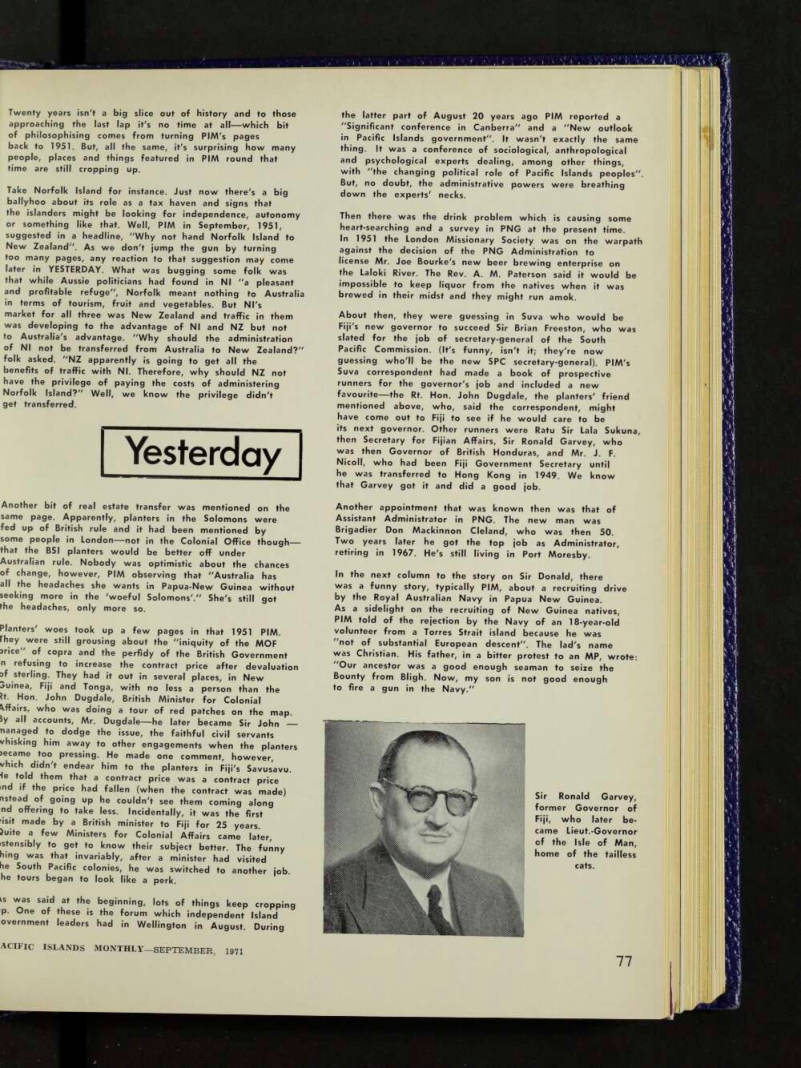
About then, they were guessing in Suva who would be Fiji's new governor to succeed Sir Brian Freeston, who was slated for the job of secretary-general of the South Pacific Commission. (It's funny, isn't it; they're now guessing who'll be the new SPC secretary-general). PlM's Suva correspondent had made a book of prospective runners for the governor's job and included a new favourite—the Rt. Hon. John Dugdale, the planters' friend mentioned above, who, said the correspondent, might have come out to Fiji to see if he would care to be its next governor. Other runners were Ratu Sir Lala Sukuna, then Secretary for Fijian Affairs, Sir Ronald Garvey, who was then Governor of British Honduras, and Mr. J. F.
Nicoll, who had been Fiji Government Secretary until he was transferred to Hong Kong in 1949. We know that Garvey got it and did a good job.
Another appointment that was known then was that of Assistant Administrator in PNG. The new man was Brigadier Don Mackinnon Cleland, who was then 50.
Two years later he got the top job as Administrator, retiring in 1967. He's still living in Port Moresby.
In the next column to the story on Sir Donald, there was a funny story, typically PIM, about a recruiting drive by the Royal Australian Navy in Papua New Guinea.
As a sidelight on the recruiting of New Guinea natives, PIM told of the rejection by the Navy of an 18-year-old volunteer from a Torres Strait island because he was "not of substantial European descent". The lad's name was Christian. His father, in a bitter protest to an MP, wrote; "Our ancestor was a good enough seaman to seize the Bounty from Bligh. Now, my son is not good enough to fire a gun in the Navy."
Sir Ronald Garvey, former Governor of Fiji, who later be came Lieut.-Governor of the Isle of Man, home of the tailless cats.