Book Reviews
pp. 89-91 · Read in the full issue

His Enemies Made Him Famous
“The name of Shirley Waldemar Baker stands recorded in the history of the Western Pacific. His enemies made his name.”
That’s the last sentence in a pathetic little book published privately in New Zealand in 1927, titled Memoirs of the Rev. Dr. Shirley Waldemar Baker, DM, LTD, Missionary and Prime Minister,”' and written by Dr.
Baker’s daughter, Beatrice.
Pathetic, because it was so ob viously a dedicated attempt by a loyal daughter to defend her father’s name, yet it failed because it was incoherent.
The disjointed ramblings of Beatrice Baker’s book were no match for the literary skills of Sir Basil Thomson, most prominent detractor of the mis sionary, but certainly not the only one. Dr. Baker’s enemies did in fact make his name.
Although his South Sea heydays were the 1870 s and ’Bos and he has been dead almost 70 years, only now have we been given an objective ac-
count of the career of this extra ordinary missionary to Tonga, in Noel Rutherford’s Shirley Baker and the King of Tonga.
Dr. Rutherford did the original re search as a PhD thesis for the Aus tralian National University in 1966 and its publication in book form is yet another reason for those with an in terest in the contemporary Pacific to be grateful for the existence of the ANU’s School of Pacific Studies.
Shirley Baker and the King of Tonga supplies the vital background for an understanding of today’s Tonga (although, in passing, one wonders why the book should be quite so ex pensive).
Shirley Baker was born in London in 1836 and arrived in Australia, most likely as a stowaway, in 1852. After varied work in the goldfields he was ordained a Methodist minister and sent to Tonga in 1860 by the Austra lian missionary body, which then con trolled the Tonga church. The new boy was something of an upstart, with a background not as grand as he liked to pretend; ignorant, pompous, plausible, self-righteous and probably lecherous. But he had great energy and capacity for work, and a driving ambition to make something of him self, and it was not long before he started to become a bigger fish in his small pond.
Tonga, under the remarkable King George I, was already Christianised and had achieved considerable unity, and the king was anxious now for the world to recognise the kingdom as a civilised state, able to take its place with other democratic nations.
For advice he more and more turned to Baker, who had quickly learned the language and who more easily had fitted into Tonga society than most of his brethren, who took a patronising attitude. The long and close relationship with the king that thus began, brought Baker, in the en suing 20 years, into violent conflict with his fellow missionaries, with mis sion headquarters in Sydney, sections of the Tongan nobility, the European traders and finally the British Gov ernment.
In that always-controversial, often chaotic span of years, the little Englishman was up to his neck in Tongan politics, was recalled by the mission, assisted mightily in Tonga se vering relations with the Methodist Church and establishing a separate church of its own, was victim of an attempted assassination, was made Prime Minister of Tonga and was finally deported to NZ by Britain.
Shirley Baker was without doubt the biggest single troublemaker in the Pacific of his day.
All Baker’s many critics have been critical more than anything of what they believed to be Baker’s influence with the king. The relationship was seen as an unhealthy, unholy hold
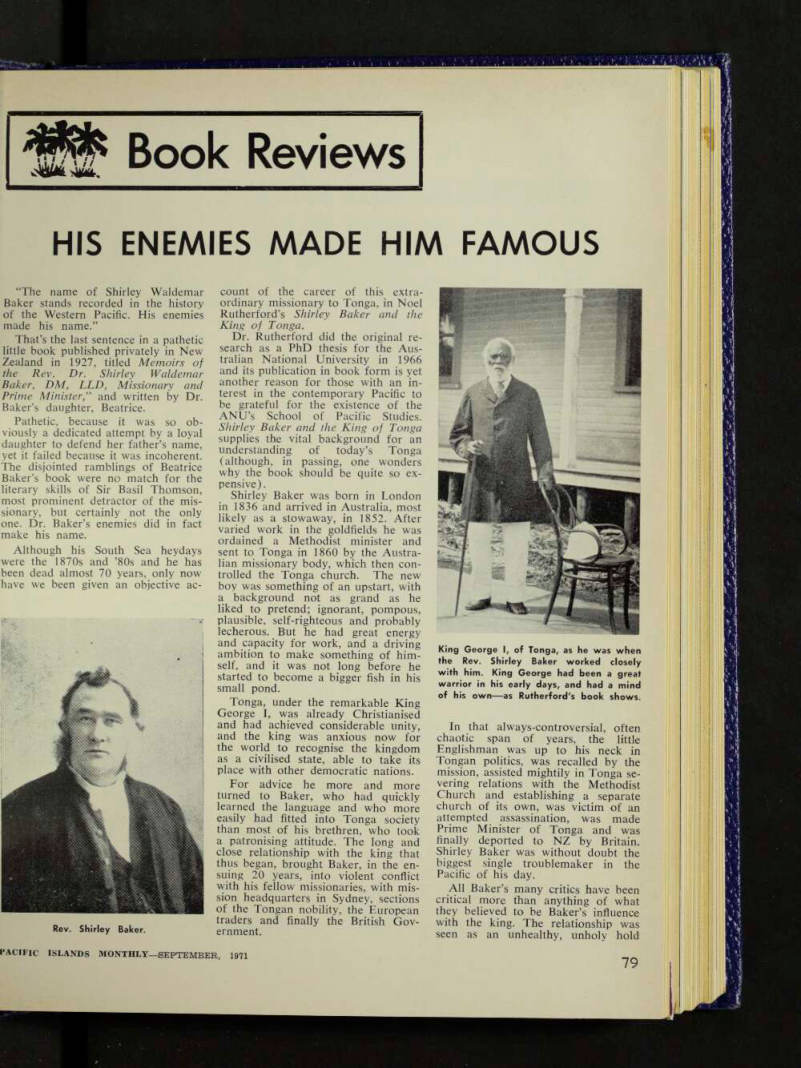
Rev. Shirley Baker.
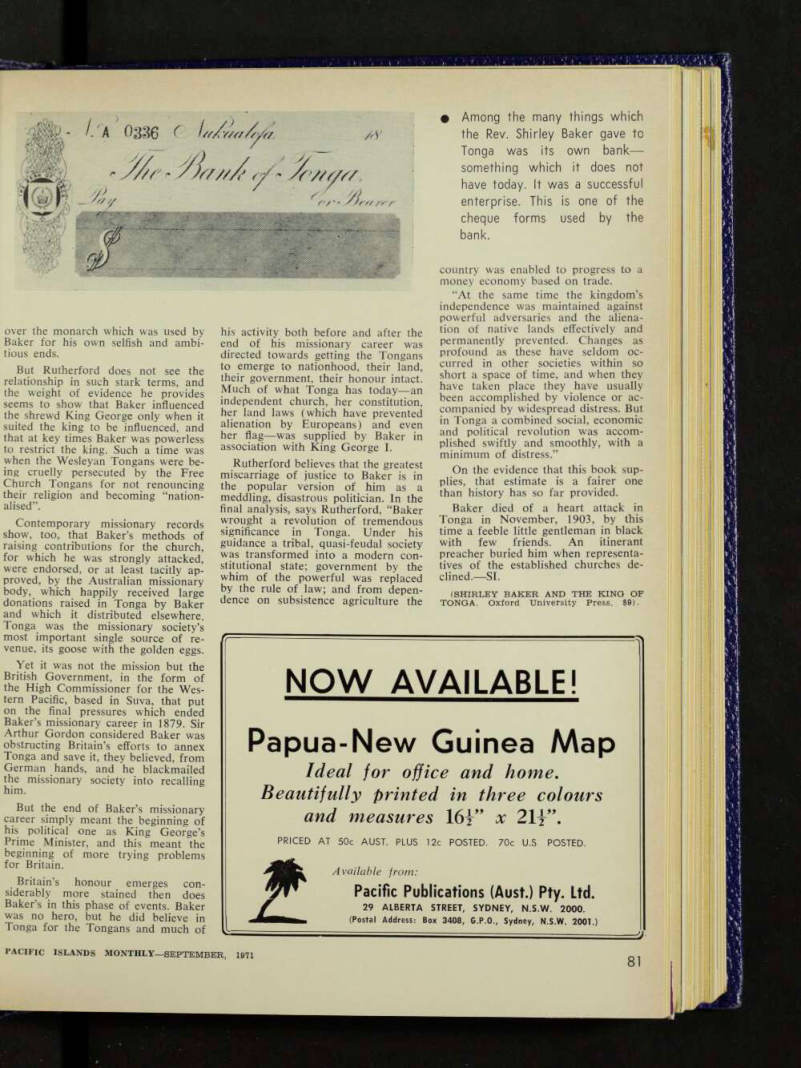
King George I, of Tonga, as he was when the Rev. Shirley Baker worked closely with him. King George had been a great warrior in his early days, and had a mind of his own—as Rutherford's book shows.
over the monarch which was used by Baker for his own selfish and ambi tious ends.
But Rutherford does not see the relationship in such stark terms, and the weight of evidence he provides seems to show that Baker influenced the shrewd King George only when it suited the king to be influenced, and that at key times Baker was powerless to restrict the king. Such a time was when the Wesleyan Tongans were be ing cruelly persecuted by the Free Church Tongans for not renouncing their religion and becoming “nation alised”.
Contemporary missionary records show, too, that Baker’s methods of raising contributions for the church, for which he was strongly attacked, were endorsed, or at least tacitly ap proved, by the Australian missionary body, which happily received large donations raised in Tonga by Baker and which it distributed elsewhere.
Tonga was the missionary society’s most important single source of re venue, its goose with the golden eggs.
Yet it was not the mission but the British Government, in the form of the High Commissioner for the Wes tern Pacific, based in Suva, that put on the final pressures which ended Baker’s missionary career in 1879. Sir Arthur Gordon considered Baker was obstructing Britain’s efforts to annex Tonga and save it, they believed, from German hands, and he blackmailed the missionary society into recalling him.
But the end of Baker’s missionary career simply meant the beginning of his political one as King George’s Prime Minister, and this meant the beginning of more trying problems for Britain.
Britain’s honour emerges con siderably more stained then does Baker’s in this phase of events. Baker was no hero, but he did believe in Tonga for the Tongans and much of
his activity both before and after the end of his missionary career was directed towards getting the Tongans to emerge to nationhood, their land, their government, their honour intact.
Much of what Tonga has today—an independent church, her constitution, her land laws (which have prevented alienation by Europeans) and even her flag—was supplied by Baker in association with King George I.
Rutherford believes that the greatest miscarriage of justice to Baker is in the popular version of him as a meddling, disastrous politician. In the final analysis, says Rutherford, “Baker wrought a revolution of tremendous significance in Tonga. Under his guidance a tribal, quasi-feudal society was transformed into a modern con stitutional state; government by the whim of the powerful was replaced by the rule of law; and from depen dence on subsistence agriculture the
country was enabled to progress to a money economy based on trade.
“At the same time the kingdom’s independence was maintained against powerful adversaries and the aliena tion of native lands effectively and permanently prevented. Changes as profound as these have seldom oc curred in other societies within so short a space of time, and when they have taken place they have usually been accomplished by violence or ac companied by widespread distress. But in Tonga a combined social, economic and political revolution was accom plished swiftly and smoothly, with a minimum of distress.”
On the evidence that this book sup plies, that estimate is a fairer one than history has so far provided.
Baker died of a heart attack in Tonga in November, 1903, by this time a feeble little gentleman in black with few friends. An itinerant preacher buried him when representa tives of the established churches de clined.—Sl.
(Shirley Baker And The King Of
TONGA. Oxford University Press. $9).
• Among the many things which the Rev. Shirley Baker gave to Tonga was its own bank— something which it does not have today. It was a successful enterprise. This is one of the cheque forms used by the bank.