Cook relic or what?
p. 83 · Read in the full issue
A Tanna mystery could it be a Cook relic or what?
From Robert Langdon, In
Canberra.
Recently, Bob Paul and Reece Discombe, two of the best-known characters in the New Hebrides, spent some time in the vicinity of Port Resolution on Tanna asking the local people if they knew of any relics that might still exist of the gunboat reprisals of about this time last century.
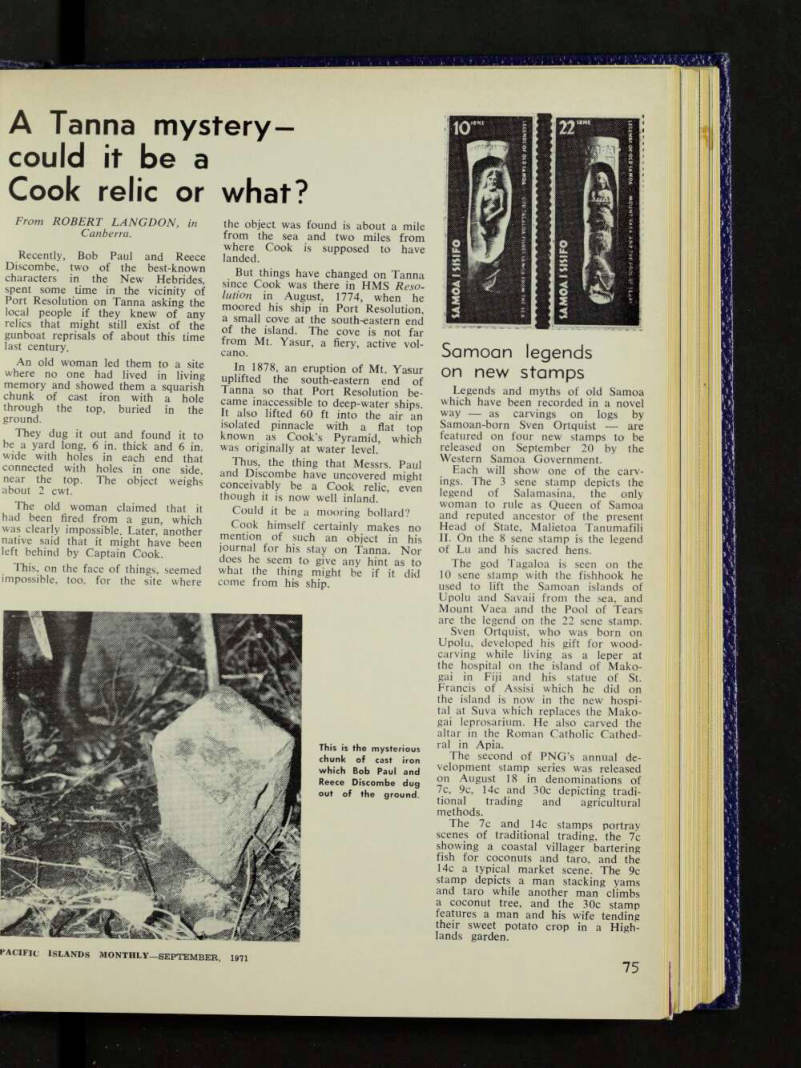
An old woman led them to a site where no one had lived in living memory and showed them a squarish chunk of cast iron with a hole through the top, buried in the ground.
They dug it out and found it to be a yard long, 6 in. thick and 6 in. wide with holes in each end that connected with holes in one side, near the top. The object weighs about 2 cwt.
The old woman claimed that it had been fired from a gun, which was clearly impossible. Later, another native said that it might have been left behind by Captain Cook.
This, on the face of things, seemed impossible, too, for the site where
the object was found is about a mile from the sea and two miles from where Cook is supposed to have landed.
But things have changed on Tanna since Cook was there in HMS Reso lution in August, 1774, when he moored his ship in Port Resolution, a small cove at the south-eastern end of the island. The cove is not far from Mt. Yasur, a fiery, active vol cano.
In 1878, an eruption of Mt. Yasur uplifted the south-eastern end of Tanna so that Port Resolution be came inaccessible to deep-water ships.
It also lifted 60 ft into the air an isolated pinnacle with a flat top known as Cook’s Pyramid, which was originally at water level.
Thus, the thing that Messrs. Paul and Discombe have uncovered might conceivably be a Cook relic, even though it is now well inland.
Could it be a mooring bollard?
Cook himself certainly makes no mention of such an object in his journal for his stay on Tanna. Nor does he seem to give any hint as to what the thing might be if it did come from his ship.
Samoan legends
on new stamps Legends and myths of old Samoa which have been recorded in a novel way — as carvings on logs by Samoan-born Sven Ortquist — are featured on four new stamps to be released on September 20 by the Western Samoa Government.
Each will show one of the carv ings. The 3 sene stamp depicts the legend of Salamasina, the only woman to rule as Queen of Samoa and reputed ancestor of the present Head of State, Malietoa Tanumafili II. On the 8 sene stamp is the legend of Lu and his sacred hens.
The god Tagaloa is seen on the 10 sene stamp with the fishhook he used to lift the Samoan islands of Upolu and Savaii from the sea, and Mount Vaea and the Pool of Tears are the legend on the 22 sene stamp.
Sven Ortquist, who was born on Upolu, developed his gift for wood carving while living as a leper at the hospital on the island of Mako gai in Fiji and his statue of St.
Francis of Assisi which he did on the island is now in the new hospi tal at Suva which replaces the Mako gai leprosarium. He also carved the altar in the Roman Catholic Cathed ral in Apia.
The second of PNG’s annual de velopment stamp series was released on August 18 in denominations of 7c, 9c, 14c and 30c depicting tradi tional trading and agricultural methods.
The 7c and 14c stamps portray scenes of traditional trading, the 7c showing a coastal villager bartering fish for coconuts and taro, and the 14c a typical market scene. The 9c stamp depicts a man stacking yams and taro while another man climbs a coconut tree, and the 30c stamp features a man and his wife tending their sweet potato crop in a High lands garden.
This is the mysterious chunk of cast iron which Bob Paul and Reece Discombe dug out of the ground.