Magazine Section
pp. 79-81 · Read in the full issue
There's No Savagery, Only
Soul In The Loyalties
By Kathleen Hancock
You couldn’t imagine a more British-sounding name for a group of coral atolls than the Loyalty Islands. It conjures up visions of outposts of empire, stiff upper lips and the best of British luck, old boy. But a lot has gone on to divert the Loyalty Islanders’ way of life from the British pattern, since the group was discovered lying off New Caledonia by Captain William Raven in 1793.
Nothing much happened to change the Loyalty Islanders’ mode of living for a long time after Raven first sighted them through his spyglass.
The British merchant navy captain merely named them. His mind was on sailing as quickly as possible to Batavia with a cargo of sandalwood.
Dumont D’Urville was more cur ious than Captain Raven and he charted the eastern shore. But he didn’t bother to land either. So the Loyalties, like so much of the Paci fic, made their first contact with Europeans through odd sandalwood ers and traders and blackbirders.
And a pretty unsavoury lot they were. It’s pretty obvious when you read old accounts of Pacific trading and trafficking in human bodies that reports of treachery and murder by the islanders have to be judged with some knowledge of the dreadful things done to Island peoples by the cut-throats and riffraff who made a precarious living in the sandalwood trade and its ugly sister, the slave trade of the blackbirders.
Mind you, the islanders were pretty tough customers themselves!
In the Loyalties cannibalism was a way of life. In a lot of so-called cannibal islands, the eating of human flesh was a kind of religious ritual. If you didn’t eat your enemy or, at least, a piece of him he’d haunt you for life. And that was enough of a spur to pop the bodies of the vanquished into the earth oven.
But in the Loyalties, as recently as the middle of last century, there was a really deep and urgent crav ing for human flesh. A lay mission ary from the Cook Islands visited the island of Mare in the 1840’s and he sadly reported the gusto with
which a local priestess cried, “Oh, there is no food as sweet and sav oury as human flesh!” And the chiefs, especially, weren’t too fussy about family ties, when it came to the food shortages that cropped up from time to time. The man who had the greatest number of wives and children was considered a lucky fellow. He had a built-in supply of emergency rations.
The next contact the Loyalty Islanders had with Europeans was through the missionaries of the Lon don Missionary Society, or rather with the Rarotongan and Samoan
lay missionaries that the canny cate chists dropped off hither and yon in the Pacific. The job of these lay missionaries was to test out the islanders’ reaction to the idea of a new religion to replace the spirits and totems that had ruled their lives for so long. This cautious approach usually paid dividends and once it was clear that it was safe to set up a mission proper, the English mis sionaries used to follow. In the Loy alties they didn’t find much opposi tion to their efforts to convert the locals and it wasn’t long before the whole group embraced the Christian faith.
Things were going splendidly for the LMS in the Loyalties when the French, who had in the meantime occupied New Caledonia, suddenly discovered that the Loyalty Group had become practically a British sphere of influence. To have the co horts of perfidious Albion, even in clerical collars, entrenched only 60 miles east of the new French colony, caused the French administration to break out in a cold sweat. What to do??? There was only one answer.
A. force de jrappe! So 30 brave French soldiers set off for the shores of Lifou where they met with a more than chilly reception from the Reverend Mr. MacFarlane.
Then, as now in Ireland, certain Protestant parsons were as militant as any soldier and MacFarlane was no exception. With 500 natives be hind him he confronted the 30 un fortunate Frenchmen, who stub bornly held their ground in the little camp they’d set up. Finally their food ran out, and they were relieved when the Governor of New Cale donia himself turned up with rein forcements to subdue the fire-eating
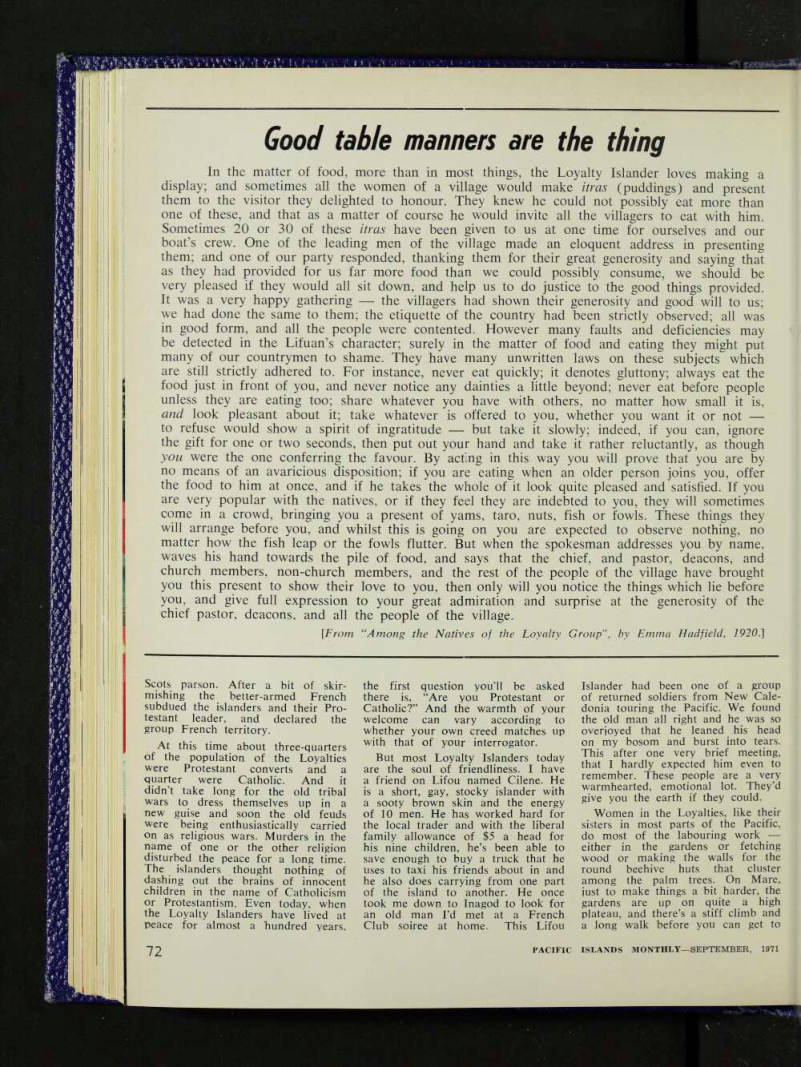
Mother and child, a charming character study taken on Ouvea in the Loyalty group by Kathleen Hancock.
Scots parson. After a bit of skir mishing the better-armed French subdued the islanders and their Pro testant leader, and declared the group French territory.
At this time about three-quarters of the population of the Loyalties were Protestant converts and a quarter were Catholic. And it didn’t take long for the old tribal wars to dress themselves up in a new guise and soon the old feuds were being enthusiastically carried on as religious wars. Murders in the name of one or the other religion disturbed the peace for a long time.
The islanders thought nothing of dashing out the brains of innocent children in the name of Catholicism or Protestantism. Even today, when the Loyalty Islanders have lived at peace for almost a hundred years,
the first question you’ll be asked there is, “Are you Protestant or Catholic?” And the warmth of your welcome can vary according to whether your own creed matches up with that of your interrogator.
But most Loyalty Islanders today are the soul of friendliness. I have a friend on Lifou named Cilene. He is a short, gay, stocky islander with a sooty brown skin and the energy of 10 men. He has worked hard for the local trader and with the liberal family allowance of $5 a head for his nine children, he’s been able to save enough to buy a truck that he uses to taxi his friends about in and he also does carrying from one part of the island to another. He once took me down to Inagod to look for an old man I’d met at a French Club soiree at home. This Lifou
Islander had been one of a group of returned soldiers from New Cale donia touring the Pacific. We found the old man all right and he was so overjoyed that he leaned his head on my bosom and burst into tears.
This after one very brief meeting, that I hardly expected him even to remember. These people are a very warmhearted, emotional lot. They’d give you the earth if they could.
Women in the Loyalties, like their sisters in most parts of the Pacific, do most of the labouring work either in the gardens or fetching wood or making the walls for the round beehive huts that cluster among the palm trees. On Mare, just to make things a bit harder, the gardens are up on quite a high plateau, and there’s a stiff climb and a long walk before you can get to
your family plot of land. Then there’s another trek back to the vil lage loaded with a bundle of yams and kumera that may weigh any thing up to a hundredweight.
However, an enterprising or pos sibly compassionate missionary im ported a few donkeys into this island many years ago. And lucky families who own one of the descen dants of these rather incongruous additions to the tropical scene can relieve their women of a good bit of the drudgery that gardening de mands. Actually Mare is the only island I’ve visited in the Pacific where animals have replaced the female sex as beasts of burden.
The men of the Loyalties cut copra, go fishing and talk. They make splendid sailors and wharf labourers and a lot of the male population finds its way to the New Caledonian mainland to work from time to time. Saturday night in Noumea is often enlivened by punch ups involving Loyalty Islanders and mainlanders whose traditional rivalry tends to erupt under the influence of the beer or vin ordinaire that flows on payday.
However, your Loyalty Islander is a gentle creature at heart and hospitality is his middle name. He is so generous and warmhearted that if you give him a present and he knows a friend who would like it, he’ll find that friend and present him with your gift, just for the sheer joy of giving. Here in these islands it really is more blessed to give than to receive. No one will take money for bed and board. It would be a terrible insult. Even a gift has to be offered tactfully, so that it doesn’t look like a quid pro quo for shelter or services rendered.
Life in the Loyalties still proceeds at much the same pace as in pre- European times. Storm lanterns may be used in the villages but the bam boo torch still lights your way along the beach at night. Most adult males own a gun, but they can still bring down a fruit bat or a fat pigeon for the pot with the same slingshot that ancestors used. But the islander is well educated these days; unlike his forebears he doesn’t run in fear from a horse and rider thinking it is one centaur-like beast.
Education is free and compulsory and the French have made the Loy alties a Reserve Indigene no European may own land or live there, other than officers of the ad ministration.
Lately, however, the traveller with a taste for adventure has been able to visit the Loyalties. New Cale donia’s internal airline flies daily to these lovely atolls. On two of the
islands, Lifou and Ouvea, the local trader has built bungalows for tour ists who are looking for the real South Seas. Simplicity is the key word here, but the cooking is ex cellent and the ambiance has that special “je ne sais quoi” that is characteristic of all French Pacific territories.
In this lovely archipelago, the
people, with the tactful help of the French administration, have adopted new methods of government, but they still retain the framework of the tribe. The old traditions are still strong. The Loyalty Islanders seem to be making a good job of their unhurried progress from a stone-age culture to the complexities of the 20th century.
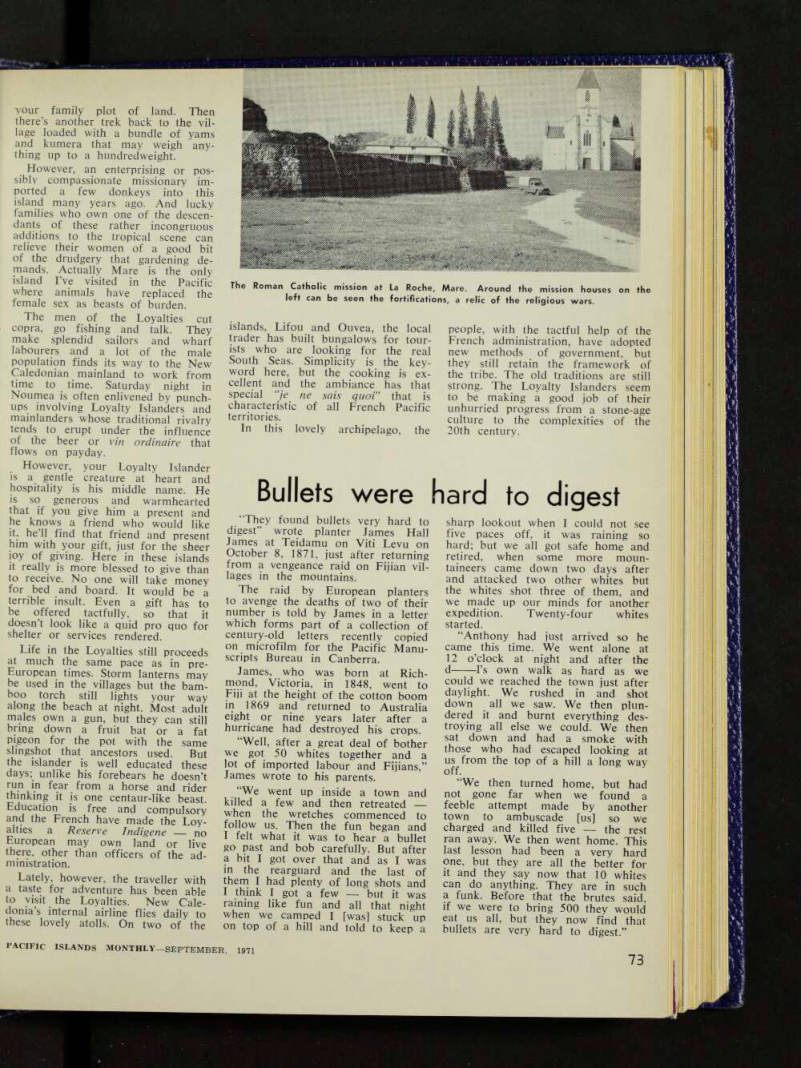
The Roman Catholic mission at La Roche, Mare. Around the mission houses on the left can be seen the fortifications, a relic of the religious wars.