Islands Press
p. 70 · Read in the full issue
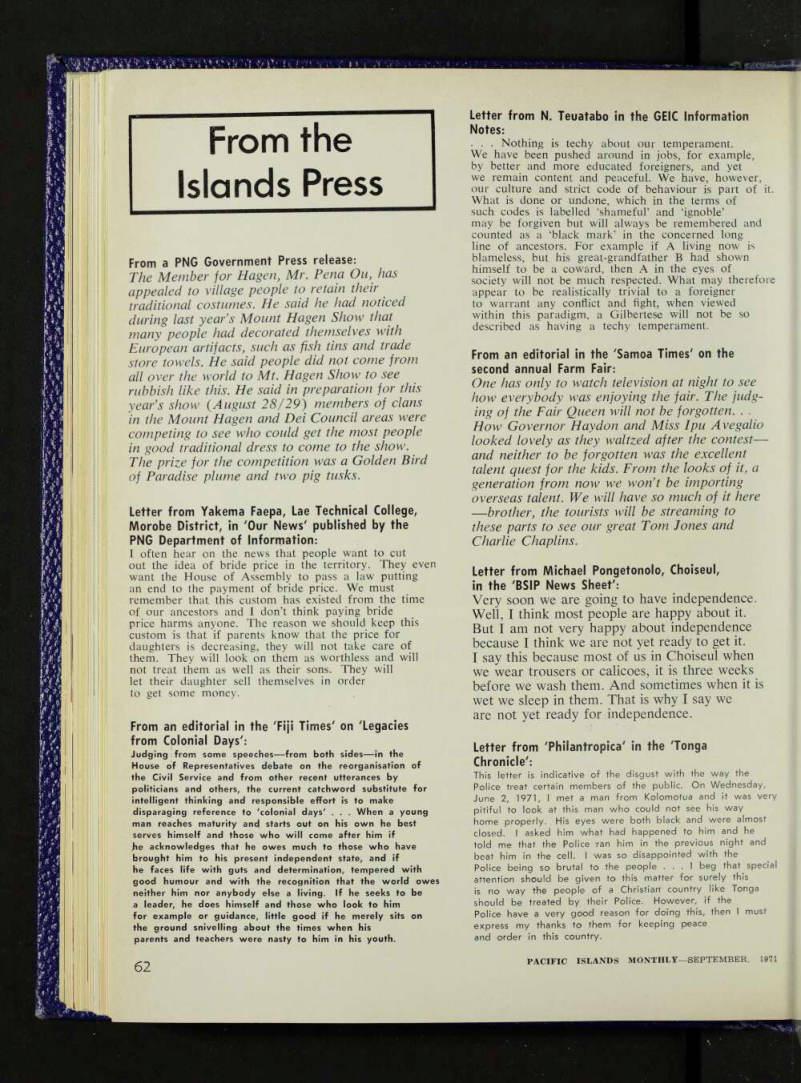
From the Islands Press
From a PNG Government Press release: The Member for Hagen, Mr. Pena On, has appealed to village people to retain their traditional costumes. He said he had noticed during last year’s Mount Hagen Show that many people had decorated themselves with European artifacts, such as fish tins and trade store towels. He said people did not come from all over the world to Mt. Hagen Show to see rubbish like this. He said in preparation for this year’s show (August 28/29 ) members of clans in the Mount Hagen and Dei Council areas were competing to see who could get the most people in good traditional dress to come to the show.
The prize for the competition was a Golden Bird of Paradise plume and two pig tusks.
Letter from Yakema Faepa, Lae Technical College, Morobe District, in 'Our News' published by the PNG Department of Information: I often hear on the news that people want to cut out the idea of bride price in the territory. They even want the House of Assembly to pass a law putting an end to the payment of bride price. We must remember that this custom has existed from the time of our ancestors and I don’t think paying bride price harms anyone. The reason we should keep this custom is that if parents know that the price for daughters is decreasing, they will not take care of them. They will look on them as worthless and will not treat them as well as their sons. They will let their daughter sell themselves in order to get some money.
From an editorial in the 'Fiji Times' on 'Legacies from Colonial Days': Judging from some speeches—from both sides—in the House of Representatives debate on the reorganisation of the Civil Service and from other recent utterances by politicians and others, the current catchword substitute for intelligent thinking and responsible effort is to make disparaging reference to 'colonial days' . . . When a young man reaches maturity and starts out on his own he best serves himself and those who will come after him if he acknowledges that he owes much to those who have brought him to his present independent state, and if he faces life with guts and determination, tempered with good humour and with the recognition that the world owes neither him nor anybody else a living. If he seeks to be a leader, he does himself and those who look to him for example or guidance, little good if he merely sits on the ground snivelling about the times when his parents and teachers were nasty to him in his youth.
Letter from N. Teuatabo in the GEIC Information Notes: . . . Nothing is techy about our temperament.
We have been pushed around in jobs, for example, by better and more educated foreigners, and yet we remain content and peaceful. We have, however, our culture and strict code of behaviour is part of it.
What is done or undone, which in the terms of such codes is labelled ‘shameful’ and ‘ignoble’ may be forgiven but will always be remembered and counted as a ‘black mark’ in the concerned long line of ancestors. For example if A living now is blameless, but his great-grandfather B had shown himself to be a coward, then A in the eyes of society will not be much respected. What may therefore appear to be realistically trivial to a foreigner to warrant any conflict and fight, when viewed within this paradigm, a Gilbertese will not be so described as having a techy temperament.
From an editorial in the 'Samoa Times' on the second annual Farm Fair: One has only to watch television at night to see how everybody was enjoying the fair. The judg ing of the Fair Queen will not be forgotten. . .
How Governor Hay don and Miss Ipu Avegalio looked lovely as they waltzed after the contest — and neither to be forgotten was the excellent talent quest for the kids. From the looks of it, a generation from now we won’t be importing overseas talent. We will have so much of it here — brother, the tourists will be streaming to these parts to see our great Tom Jones and
Charlie Chaplins.
Letter from Michael Pongetonolo, Choiseul, in the 'BSIP News Sheet': Very soon we are going to have independence.
Well, I think most people are happy about it.
But I am not very happy about independence because I think we are not yet ready to get it.
I say this because most of us in Choiseul when we wear trousers or calicoes, it is three weeks before we wash them. And sometimes when it is wet we sleep in them. That is why I say we are not yet ready for independence.
Letter from 'Philantropica' in the 'Tonga Chronicle': This letter is indicative of the disgust with the way the Police treat certain members of the public. On Wednesday, June 2, 1971, I met a man from Kolomotua and it was very pitiful to look at this man who could not see his way home properly. His eyes were both black and were almost closed. I asked him what had happened to him and he told me that the Police ran him in the previous night and beat him in the cell. I was so disappointed with the Police being so brutal to the people ... I beg that special attention should be given to this matter for surely this is no way the people of a Christian country like Tonga should be treated by their Police. However, if the Police have a very good reason for doing this, then I must express my thanks to them for keeping peace and order in this country.