There's Gold For Islanders
pp. 65-69 · Read in the full issue

In A Neglected Industry
By Ann Glenn
“Every locality in the South Pacific is a potential pearl farm.” Greek-born C. Denis George, Australian pearl farmer and consultant in pearl cultivation at Samarai in Papua, was emphatic in his enthusiasm.
“With the current emphasis on economic development, the creation of a pearl industry could become a foreign market of economic im portance, using the ordinary resources of the reefs and lagoons,” said Denis George.
Deeply tanned, with an accent which bends and crackles even more when he becomes excited, Denis George has a chip on his shoulder —an Australian sell-out on pearls to the Japanese. There’s a gold mine in pearls for the Australian and the Pacific Islander, but Australia has failed to capitalise on its chances.
That’s his complaint. He’s had it for years and PIM has reported on it before.
We met on the dock in the pro tected bay near Samarai, in the Milne Bay district of Papua New Guinea. I got the impression that he’s used to the most ignorant of visitors, armed only with curiosity, for his manner was very patient, and he parried random questions, saying, “I’ll come to that point presently”. With the enthusiasm of a dedicated scientist talking about his favourite subject, he set out to educate me, telling me what I should know about pearls, in the order in which I should know it.
We walked out onto the rafts and he pointed out the baskets dangling at varying depths in the clear water below. He pulled up individual baskets, pointing out the different varieties of pearl oysters. I dutifully copied down the scientific names, and clung desperately to the common names: (Pinctada maxima) Golden Lip; (Pinctada margaritifera) Black Lip; (Pteria pinguin) Pinguin; and (Pinctada fucata) Trobriand Islands pearl oyster—a variety similar to the Japanese species, but which, I was told, grows in this area much finer in quality and larger in size.
From the rafts, we progressed to the workroom. Here, C. Denis George, the scientist, was very much m evidence as he showed me his library. The books and publications, many of them written in Japanese, crowded the shelves of the small room and overflowed onto the desk.
“It is a very valuable collection, probably the best available in the
Indo-Pacific,” he said. “But,” he added wryly, “I must constantly battle with the tropical enemies of damp and mildew.” He brought down an enormous volume, The Great Barrier Reef of Australia, published in 1893. His excitement mounted as he introduced me to his personal hero, little-known Australian scientist, William Saville-Kent.
Kent was Commissioner of Fisheries for the governments of Queensland, Western Australia, and Tasmania in the 1880’s. He spent years wandering the shores and islands of northern Australia and the South Pacific. His research and studies eventually culminated in the publication of this extraordinary book. George pointed at the page for emphasis. ‘‘And this is a photo graph of pearls that Kent had pro duced by transplanting mother-of pearl shell from Thursday Island to Suwarrow lagoon in the northern Cook Islands. It is proof that Kent developed the techniques indepen
dently, and several years earlier than any of the better-known Japanese scientists.”
From 1906 to 1909 when he died Kent established the first commercial pearl farm of the South Seas at Albany Pass in the Torres Strait. Most of Denis George’s subsequent research in pearl cultivation is dedicated to the memory of William Saville-Kent, and his voice was bitter when he added that it was a shame that Aus tralia had not followed up this early advantage to become a major pro ducer of cultivated pearls, In the next room, George gave me a copy of the paper he presented to the ANZAAS (Australia and New Zealand Association for the Advance ment of Science) Congress, in Port Moresby last year. And, he showed me a series of slides illustrating the paper and explaining the work he is currently doing at Pearl Bay. Then still following his logical, methodical Progression, he brought out his tools for the processing of pearls, many
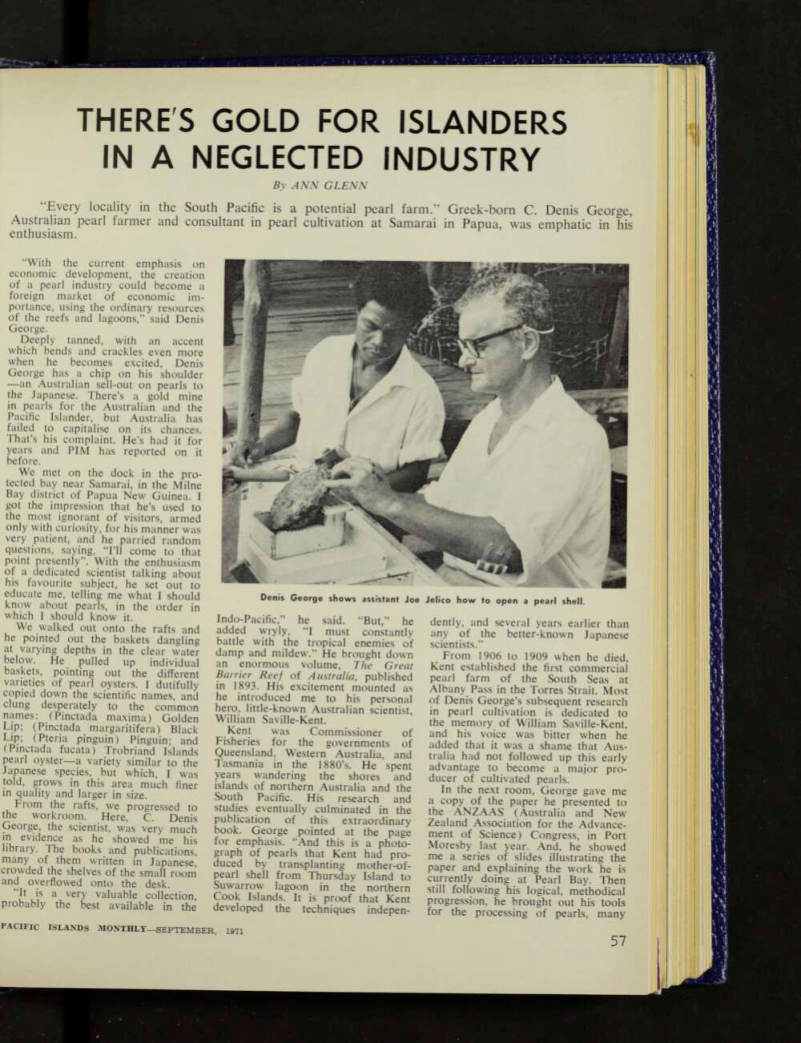
Denis George shows assistant Joe Jelico how to open a pearl shell.
of them developed or adapted by him self to their special applications.
Finally, he showed me a handful of large-sized half-pearls, a catalogue showing settings, and a few sample spherical pearls, including a matched pair of lustrous black pearls that would make any woman sigh with desire.
As we walked back to the labora tory built on piles over the water, George outlined for me the major developments in pearl production that he has achieved in his newest venture at Pearl Bay; • The development of a “middle sized” pearl in the Trobriand Islands pearl oyster, which is a similar variety to the Japanese pearl oyster, but which grows in the South Pacific much larger, and with better quality.
These so-called middle-sized pearls are 10 to 12 mm in diameter, of better quality than the Japanese, but less expensive than the large-size South Pacific pearls; • The development of the tech nique of growing large-size black pearl in the oyster known locally as the Black-Lip oyster. This is a new and different technique, and it is believed that Samarai is producing the only black pearls in the South Seas except some produced ex perimentally by the Japanese six or seven years ago; • The application of the produc tion of half-pearls to all the species of pearl oysters available in the South Seas: that is, the Golden-Lip, the Black-Lip, and the Pinguine, which produces the most magnificent and most expensive of pearls; and the introduction of the half-pearl to the Trobriand Islands oyster; • Success in the artificial repro duction of the pearl oysters. Not long ago, after 12 years’ experimentation, George succeeded in 100 per cent,
fertilisation, under laboratory con
ditions, of all species of pearl oysters: Golden-Lip, Black-Lip, and Pinguine.
He did not attempt to fertilise the Trobriand pearl oyster because he has developed a technique of artificially attaching them to collectors. • Establishment of a well-equip
ped pearl-processing factory with
semi-automatic machinery which includes machinery for the manufac ture of pearl-shell buttons as a by product. There are no similar tech nical facilities in the whole of the Pacific, except in Japan. The half pearls produced in Australian waters and in other similar Pacific localities by the Japanese are then exported to Japan for processing. George claims that research and experimentation have led to the development of his own techniques, which he says are at least equal to the Japanese methods.
• Development of an active train ing programme for local people to enable them to carry on current pro duction and to establish further pearl production in other South Pacific locations on the basis of village industries. ‘There is no single source of pearl culture tuition in the whole Indo- Pacific region, except the facilities provided here at Pearl Bay, Samarai,” he emphasised. “Present Australian agreements with Japan contain clauses to the effect that the techniques shall remain secret. They have never dis closed their techniques, published scientific papers, or trained indigenous
personnel.” The current series of training at Pearl Bay is the second, and George admitted that the first had not been too successful. Of the 25 Papuans who started, one reached his C-Class certificate. This qualified him to dive and collect the pearl oyster, construct the rafts, and intro duce the half-pearl nucleus. The B- Class certificate would include the production of spherical pearls. The A-Class certificate would qualify one as a chief technician—someone per fectly capable of going somewhere and organising pearl production and training other people.
“This person would be able to do
just what I am trying to do at Samarai,” George commented.
That George has paid more than mere lip service to the principles of training was patently obvious as he stood quietly by and watched two Papuans demonstrate their skill.
They laid out the tools, gathered a basket of shells, and deftly ex hibited the techniques of opening the oysters and inserting the half-pearl nucleus, using heat and a resin to cement it in place. To end the demonstration, George smiled and said, “A puff of smoke, a little co operation from the oyster, and we harvest a perfect half-pearl.” His tone was more earnest when he added, “The economics are very attractive when one realises that from two to five half-pearls can be produced in a single mother-of-pearl shell, and in a cultivation period of less than one year.”
As we walked back to the dock, I asked him to explain his apparent bitterness toward the Australian Government. In reply, he went back again to the early discovery of pearl production by William Saville-Kent and traced for me the history of that industry and his own part in it.
“It is a tragic irony and contra diction that Australia, the country which originated pearl cultivation, and has the greatest resources of pearl oysters, so far does the least toward the development of a pearl cultivation industry.” He added emphatically, “The present Austra lian pearl industry, as it is performed, is nothing less than an extension of the Japanese pearl farms operating m Australian waters.”
Although the need for economic development of the South Pacific was apparent and urgent, and although the ecological and other conditions were most suitable, and four ex ceUent species of pearl oysters were available in Australia, the early understanding gained by Kent was not utilised. Instead, it was left to the Japanese, working under less favourable conditions, and limited to a lesser species of pearl oyster, to make rapid advances, he said.
The same conditions which led 9 eo t r S e ‘°, establish his pearl farm in the Milne Bay district of Papua as he pointed out, are very similar to those which apply in practically every country of the South Pacific, bnvironment conditions are ideally suited for the development of pearl a fra< r tion of th e normal cost, ihe natural resources are there; *he technical training is now avail able. The local people can take an active part m the industry’s develop ment if their part is patterned on the existing systems of co-operatives and village industries.