Footnotes
pp. 58-59 · Read in the full issue
ON September 2, 1969, the House of Assembly agreed that Papua New Guinea’s traditional mid-September holiday, previously known as Commemoration Day, should be renamed “National Day”.
The events, which had in the past been com memorated on this day, having been purely colonial ones, this was quite a switch in emphasis.
However, memories are short, the colonial asso ciations of the day will soon fade, and, if we are to have a “national day”, one day is as good as another for celebrating it. Perhaps when Papua New Guinea’s father figure—Chairman X— appears, it will be found that by a beneficent dispensation of providence he was born in Sep tember. After that it will all be plain sailing.
In proposing the change of name, Tom Leahy, Member for Markham and “spokesman” for the Administrator’s Executive Council, said: “Chang
ing the name of a holiday will not in itself bring about unity. How ever, a change will help to remind us that we are building a nation which, like other nations all over the world, must develop a sense of unity if it is to prosper”.
The first “National Day” came along a few days later, and not unnaturally attracted little atten tion.
For the second National Day in 1970, little organised preparation was made. The Day was mildly
promoted by Press and radio, the Department of Information and Extension Services came up with the over-optimistic slogan “We are One People”, and in various places celebrations in what the British Navy used to call “Dance and Skylark” vein were organised.
This year the government took the initiative by setting up National Day committees in each district, together with a central committee to act as an ideas factory for them. The Department of Education and the Political Education unit of the Department of the Administrator have also been very active.
National Day 1971 will be the first formal occasion on which our National Flag, adopted
In Search Of
Something To
Skylark About
by the House of Assembly at its March meeting, is flown, and, in many parts of Papua New Guinea, the first time it will have been seen at all.
Granting, as I think we all do, that a National Day and a National Flag can only sustain national unity and not create it, we may well ask ourselves: Is national unity in Papua New Guinea attainable? And, is it worth having?
Dr. Margaret Mead, passing through Port Moresby recently on her way to her beloved Manus Island, had some very wise words to say
on these issues.
“The big question for Papua New Guinea on the edge of inde pendence,” she said, “is to work out how you are going to remain proud of the fact that your an cestors were different at the same time as you are looking for a national way of doing things.
“Nation building here,” she went on, “is a new, strange, dif ferent problem and has to be solved by people who have only one tradition in common —that
they are all different.
“It is just as good a tradition as having every one alike, and it is more fitted to the modern world. There is safety in diversity if you are proud of it.”
This point of view is in contrast with the call we sometimes hear to “create a national identity”.
Whenever I hear this phrase, my mind conjures up a picture of a sort of cultural sausage machine.
Into one end of this machine we are to feed Kiwai and Tolai, highlander and islander, Suau and Sepik; and from the other end will emerge a line of Paradesians, all exactly alike, all speaking the same language, wearing the same sort of clothes, eating the same kinds of food, singing the same
With Percy Chatterton
in Port Moresby
songs and dancing the same dances.
Even if this dream could be realised, would we like the result when we got it? I doubt it.
I think that Margaret Mead’s vision supplies the answers to both the questions I have pro pounded. Unity in diversity, a unity which means that the wildly-differing groups which make up the population of Papua New Guinea contribute their varying skills and dreams to the common good, is not only attainable but is also worth
having.
Most of the other arguments for national unity
are phoney.
The “defence” argument is ridiculous. With 100. million Indonesians to our west and 800 million Chinese and 100 million Japanese to our north, 2i million Paguineans are no less vul nerable than 80,000 Bougainvilleans would be if they decided to go it alone.
The “prosperity” argument wears thin as we realise that, for the rest of this century and beyond, all the world’s nations, big and small, will have to subordinate economic development to conservation if the earth is to remain habitable.
If they don’t, the grandchildren of today’s Paguineans may find themselves living on a slag heap on which no green thing will grow, sur rounded by seas in which no fish can live.
It is not without significance that one of the voices recently raised to counsel us not to be too gloomy about the possible effects of a measure of “hiving off”, if this should occur, is that of a well-known economist, Professor A. I.
Clunies Ross of the University of Papua New Guinea.
The only unity which is worth having in a situation like ours is the unity of people who come together because they want to come to gether and stay together because they want to
stay together. A “unity” imposed by the arro gant upon the unwilling can only end in disaster, whether the arrogant are Australian politicians wielding a big stick or local ones aspiring to be big fish in a big, big pond.
Currently, the voices of Australian politicians of both the major parties are loud in the land, extolling the blessings of unity and inveighing against separatism.
These gentlemen would do well to remember that not a few of our present problems stem from the acts of their predecessors.
If the Australian politicians of 1906 had changed British New Guinea’s name to “Austra lian New Guinea” instead of pulling out of the air the exotic name “Papua” (a name which many of their successors don’t even know how to pronounce properly), one of our major head aches would never have existed.
If the Australian politicians of 1920 had seized the opportunity which then presented itself of uniting the two territories, instead of per versely and unnecessarily keeping them separate for another 25 years, many of the problems which are now very present realities would have become dim memories of the past.
Now the successors of those politicians have the colossal cheek to lecture us on unity.
If then, national unity is both attainable and worth having, how do we go about getting it?
In many ways, no doubt; but I think that two are fundamental.
First, if our aim is to build unity out of diver sity rather than to eliminate diversity, we must plan for such a measure of decentralisation of decision-making as will allow diversity to exer cise and express itself.
Second, if our unity is to be a unity of people who come together because they want to come together, it must be built on personal face to face contacts and developed friendships between individual Paguineans from diverse parts of the country. At present, outside the centres of higher learning and organisations such as the Army and the Police, there are far too few opportunities for such contacts to be made and such friendships formed.
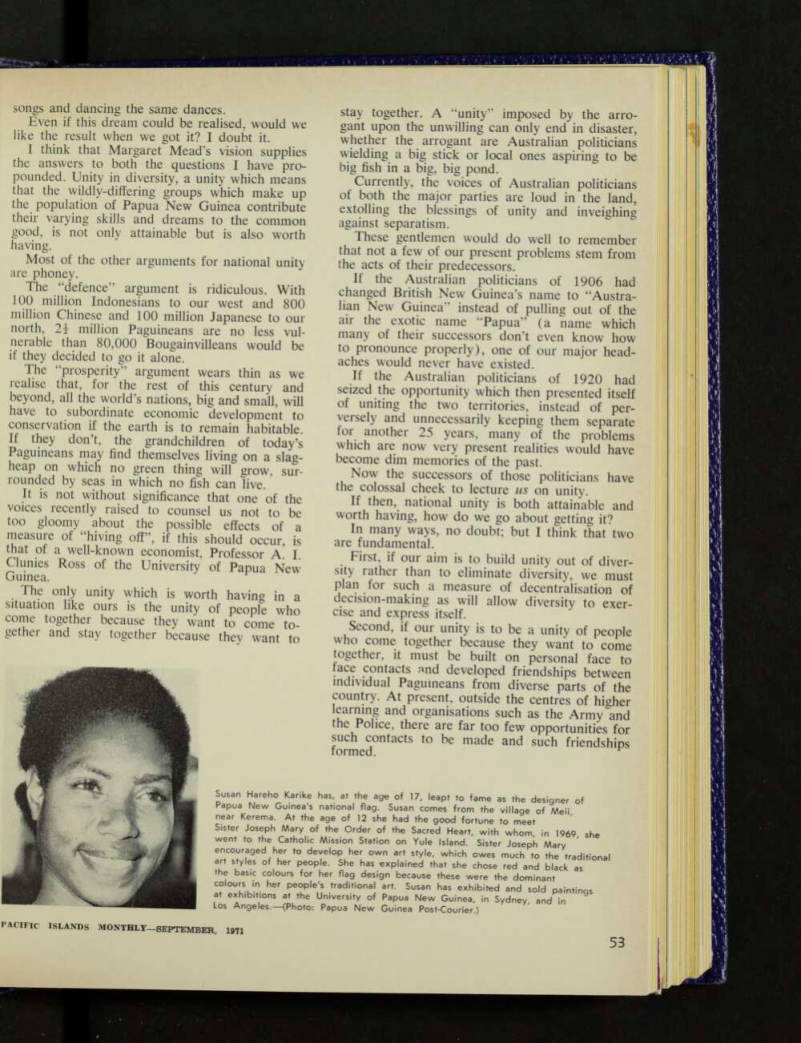
Susan Hareho Karike has, at the age of 17, leapt to fame as the designer of Papua New Guinea's national flag. Susan comes from the village of Meii, near Kerema. At the age of 12 she had the good fortune to meet Sister Joseph Mary of the Order of the Sacred Heart, with whom, in 1969, she went to the Catholic Mission Station on Yule Island. Sister Joseph Mary encouraged her to develop her own art style, which owes much to the traditional art styles of her people. She has explained that she chose red and black as the basic colours for her flag design because these were the dominant colours m her people's traditional art. Susan has exhibited and sold paintings at exhibitions at the University of Papua New Guinea, in Sydney, and in Los Angeles. (Photo: Papua New Guinea Post-Courier.)