King
pp. 55-57 · Read in the full issue

of the Western Islands
By Sheree Lipton
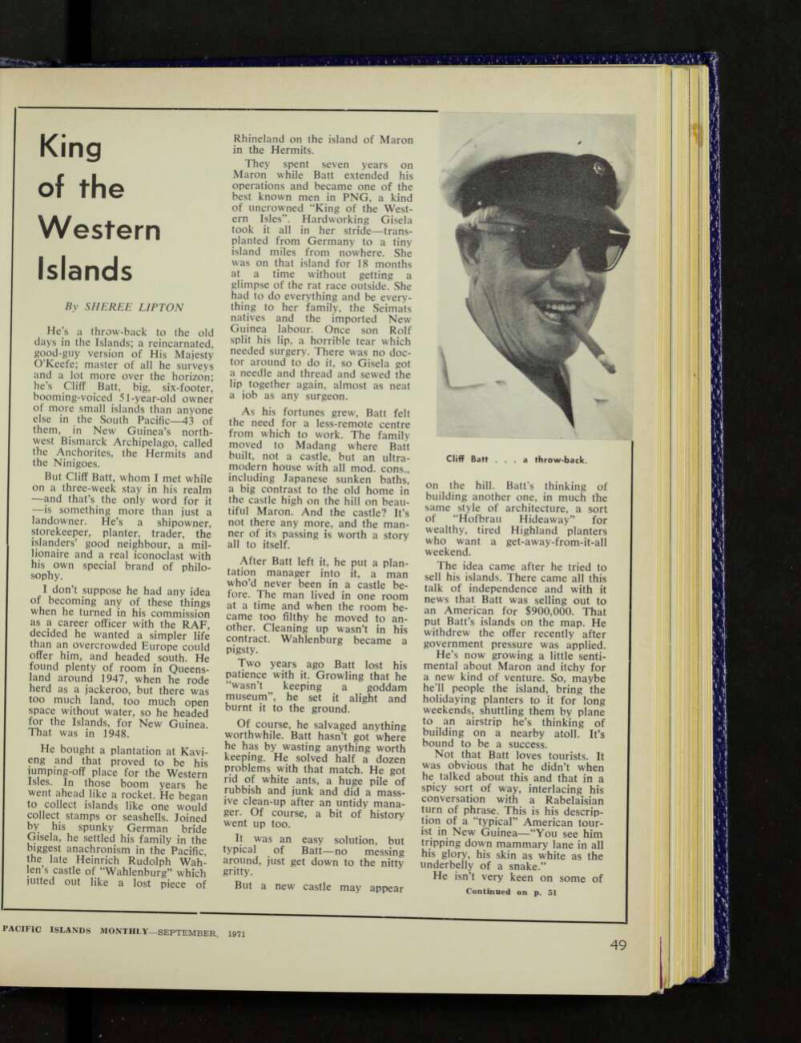
He’s a throw-back to the old days in the Islands; a reincarnated, good-guy version of His Majesty O’Keefe; master of all he surveys and a lot more over the horizon; he’s Cliff Batt, big, six-footer, booming-voiced 51-year-old owner of more small islands than anyone else in the South Pacific—43 of them, in New Guinea’s north west Bismarck Archipelago, called the Anchorites, the Hermits and the Ninigoes.
But Cliff Batt, whom I met while on a three-week stay in his realm —and that’s the only word for it —is something more than just a landowner. He’s a shipowner, storekeeper, planter, trader, the islanders’ good neighbour, a mil lionaire and a real iconoclast with his own special brand of philo sophy.
I don’t suppose he had any idea of becoming any of these things when he turned in his commission as a career officer with the RAF, decided he wanted a simpler life than an overcrowded Europe could offer him, and headed south. He found plenty of room in Queens land around 1947, when he rode herd as a jackeroo, but there was too much land, too much open space without water, so he headed for the Islands, for New Guinea.
That was in 1948.
He bought a plantation at Kavi eng and that proved to be his jumping-off place for the Western Isles. In those boom years he went ahead like a rocket. He began to collect islands like one would collect stamps or seashells. Joined by his spunky German bride Gisela, he settled his family in the biggest anachronism in the Pacific, the late Heinrich Rudolph Wah len s castle of “Wahlenburg” which jutted out like a lost piece of
Rhineland on the island of Maron in the Hermits.
They spent seven years on Maron while Batt extended his operations and became one of the best known men in PNG, a kind of uncrowned “King of the West ern Isles”. Hardworking Gisela took it all in her stride—trans planted from Germany to a tiny island miles from nowhere. She was on that island for 18 months at a time without getting a glimpse of the rat race outside. She had to do everything and be every thing to her family, the Seimats natives and the imported New Guinea labour. Once son Rolf split his lip, a horrible tear which needed surgery. There was no doc tor around to do it, so Gisela got a needle and thread and sewed the lip together again, almost as neat a iob as any surgeon.
As his fortunes grew, Batt felt the need for a less-remote centre from which to work. The family moved to Madang where Batt built, not a castle, but an ultra modern house with all mod. cons., including Japanese sunken baths, a big contrast to the old home in the castle high on the hill on beau tiful Maron. And the castle? It’s not there any more, and the man ner of its passing is worth a story all to itself.
After Batt left it, he put a plan tation manager into it, a man who’d never been in a castle be fore. The man lived in one room at a time and when the room be came too filthy he moved to an other. Cleaning up wasn’t in his contract. Wahlenburg became a pigsty.
Two years ago Batt lost his patience with it. Growling that he “wasn’t keeping a goddam museum”, he set it alight and burnt it to the ground.
Of course, he salvaged anything worthwhile. Batt hasn’t got where he has by wasting anything worth keeping. He solved half a dozen problems with that match. He got rid of white ants, a huge pile of rubbish and junk and did a mass ive clean-up after an untidy mana ger. Of course, a bit of history went up too.
It was an easy solution, but typical of Batt—no messing around, just get down to the nitty gritty.
But a new castle may appear
on the hill. Batt’s thinking of building another one, in much the same style of architecture, a sort of “Hofbrau Hideaway” for wealthy, tired Highland planters who want a get-away-from-it-all weekend.
The idea came after he tried to sell his islands. There came all this talk of independence and with it news that Batt was selling out to an American for $900,000. That put Batt’s islands on the map. He withdrew the offer recently after government pressure was applied.
He’s now growing a little senti mental about Maron and itchy for a new kind of venture. So, maybe he’ll people the island, bring the holidaying planters to it for long weekends, shuttling them by plane to an airstrip he’s thinking of building on a nearby atoll. It’s bound to be a success.
Not that Batt loves tourists. It was obvious that he didn’t when he talked about this and that in a spicy sort of way, interlacing his conversation with a Rabelaisian turn of phrase. This is his descrip tion of a “typical” American tour ist in New Guinea—“ You see him tripping down mammary lane in all his glory, his skin as white as the underbelly of a snake.”
He isn’t very keen on some of
Continued on p. 51
Cliff Batt ... a throw-back.
Batt- Policeman
the European residents of PNG either.
“They come up north to the territory looking for a way out of their family problems,” he boomed. “Some looking for a free and easy life, for ‘hang-up’ cures and ending up as ‘gin jockeys’.”
Batt’s not very fond of the mis sionaries. He thinks they take too much from his Ninigo natives in tithe payment represented by coco nuts and their earnings from copra.
“Once,” he said, “they didn’t pay the Seimats enough for their copra, so I upped my own price and they had to follow suit.”
Batt flies his own flag in the Western Isles, two interlocking rings, one white, one black, on a green background, which is his idea of what he’s got there—two races working together in har mony.
Few government officers call in and Cliff Batt does his own policing when he has to, saying he uses the citizen’s power of arrest to protect his people.
Sometimes the Seimat chiefs come to him with a complaint, usually about a mission teacher or a “doctor boy” sent from Manus.
On one occasion he made a citi zen’s arrest of a “doctor boy” who he claimed made a habit of seduc ing girls on the first-aid post table in the one-room hospital.
Although Batt has now moved to Madang, he hasn’t forsaken his islands. He spends half of each month going round his domain in his own ship, a copra boat, a bulky Japanese-built carrier. He’s a great admirer of Rudolph Wahlen, so what better name for his boat than the Rudolph Wahlen? It’s becom ing as well known as was the late Rudolph Wahlen, because it helps Batt to display the tender side of his many-sided nature.
Hardly a week goes by without the Rudolph Wahlen setting out on a mercy mission for one of the islanders, and it carries the mail regularly—free.
And that’s Batt.
• Mortar boards are out at the University of the South Pacific in Suva because most people in the areas served by the university never wear headgear. Gowns for graduates are in, of course, and they’ll reflect the Polynesian-Melanesian influence, being in tapa brown, lightweight, with hoods of the same material and lined with the degree colour.