Law Looks
pp. 53-54 · Read in the full issue
At A
'Bizarre'
Funeral
From a Dam correspondent
The clerk who opened the Crown Prosecutor’s morning mail in Port Moresby recently was, understandably, taken aback when an obviously gnawed human thigh bone fell from a bundle of court papers.
The bone represented the sole re mains of a cannibal feast conducted at a village near Nomad, in Papua’s pnmitive Western District. On July 24 the seven men responsible ap ne^? d T^ n the Supreme Court in uaru. The case was adjourned while the court considered a rather perplex ing problem. The laws of the terri tory, or the laws of Australia for that matter, make no provision for the offence of cannibalism!
In fact, it is the first case since the war and probably the first case m the territory ever. To date there need for such a law.
In the old days of head hunting and cannibalism, justice was swift, usu ally at the end of a rope. Nowadays :" is m t vi . rtua lly unknown, although the Biami, around Nomad are known to indulge intermittently n the sport. In all the cases to date lowever, the offenders have been :onvicted of the principal crime of uurder. The recent cases differ in
that the offenders did not kill the victim, a deranged old man, who himself had committed a murder and was subsequently killed, but merely ate him. The old man’s killer was sentenced to three years im prisonment in an earlier sitting of the Supreme Court.
The seven cannibals have been charged under another section of the adopted Queensland Criminal Code, which relates to the improper inter ference with a dead human body.
The court was considering whether this section was applicable. The offence carries a maximum penalty of two years.
Another problem arising from the case is the consideration of local custom, particularly in determining sentence, as outlined in the Native Customs Recognition Ordinance of the territory. To date, no anthro pological surveys have been carried out in the area and the people’s natural reticence in discussing such matters with government officers has yielded little information.
Possibly the only thing known about Nomad cannibalism is that it is carried out primarily as a gastro nomical exercise, rather than ritual istic, although young initiates were once expected to kill and consume a victim to attain manhood status.
These days pigs have been substi
tuted, Occasionally, a clan might donate one of their murdered mem bers’ bodies to a nearby clan for consumption, as was the case in the recent cannibalism.
Declaring that cannibalism was not improper or indecent in the commun ity to which the seven men belonged, the Supreme Court Judge, Mr. Justice Prentice, acquitted them when he gave a reserved judgment on August 10.
He said he did not think the Queensland authorities, when they framed the laws, had cannibalism in mind.
“One cannot conceive that the legislature would have intended to im pose uniform standards of decency and propriety on all the peoples of this country,” the judge said. “In seek ing to construe whether the behaviour of the villagers amounted to impro priety and indecency, I conceive that I should look at the average man in the particular community as it was at the time of these happenings.
“I do not consider that the legis lature had in contemplation the ban ning of a method of disposal of the body, namely by eating, as an alterna tive to burial or cremation.
“The funerary customs of the people of Papua New Guinea have been, and in many cases remain, bizarre in the extreme.”
So, the men go free and it’s a sure
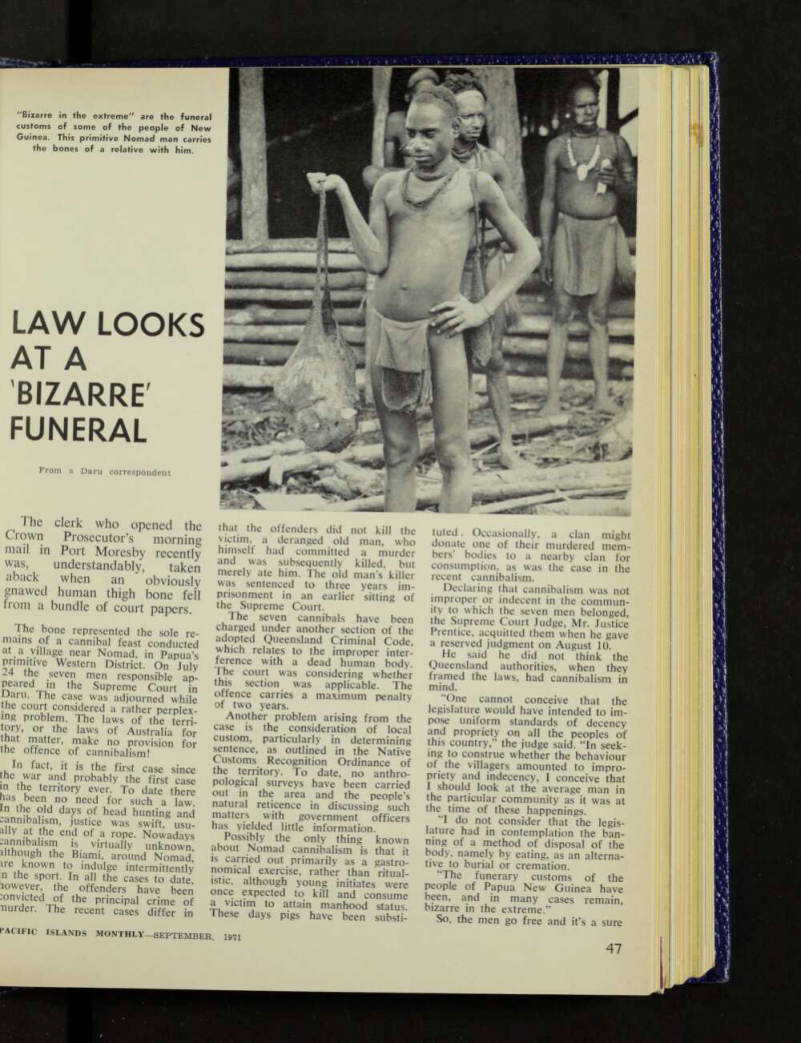
"Bizarre in the extreme" are the funeral customs of some of the people of New Guinea. This primitive Nomad man carries the bones of a relative with him.
thing that the Nomad people, and others, will accept the acquittal as the green light to continue with their “bizarre” funerary customs. We can expect, therefore, some move from Crown Law to introduce an anti cannibalism law for consideration by the House of Assembly. The passing and enforcement of such a law is likely to cause more than a little head scratching among the Nomad people.
“The policemen said we couldn’t. The man in red with a big wig said we could. Now you say we can’t,” is sure to be their reaction.
It will be interesting to see how far such a law progresses, particularly after the government’s firm stand over criticism of its lifting of restrictions from the last primitive areas in the territory. The Nomad area featured prominently in the various criticisms, although it was not one of the areas, and as a result a challenge was issued to the Administrator and his secretary to walk unarmed through the Biami Census Division.
Contrary to the beliefs of the par ticular journalists making the chal lenge, the Biami is quite safe for Europeans walking through it. The Biami engage in inter-clan fighting in much the same way as the con siderably-more-sophisticated clans of the Highlands, the only difference being the consumption of victims.
Nevertheless, the government and more sophisticated members of the House of Assembly are going to be reluctant to recognise the existence of cannibalism in the territory, par ticularly since the United Nations has been assured it was stamped out some time ago. And this is going to hinder, if not prevent, the pass ing of any such law.
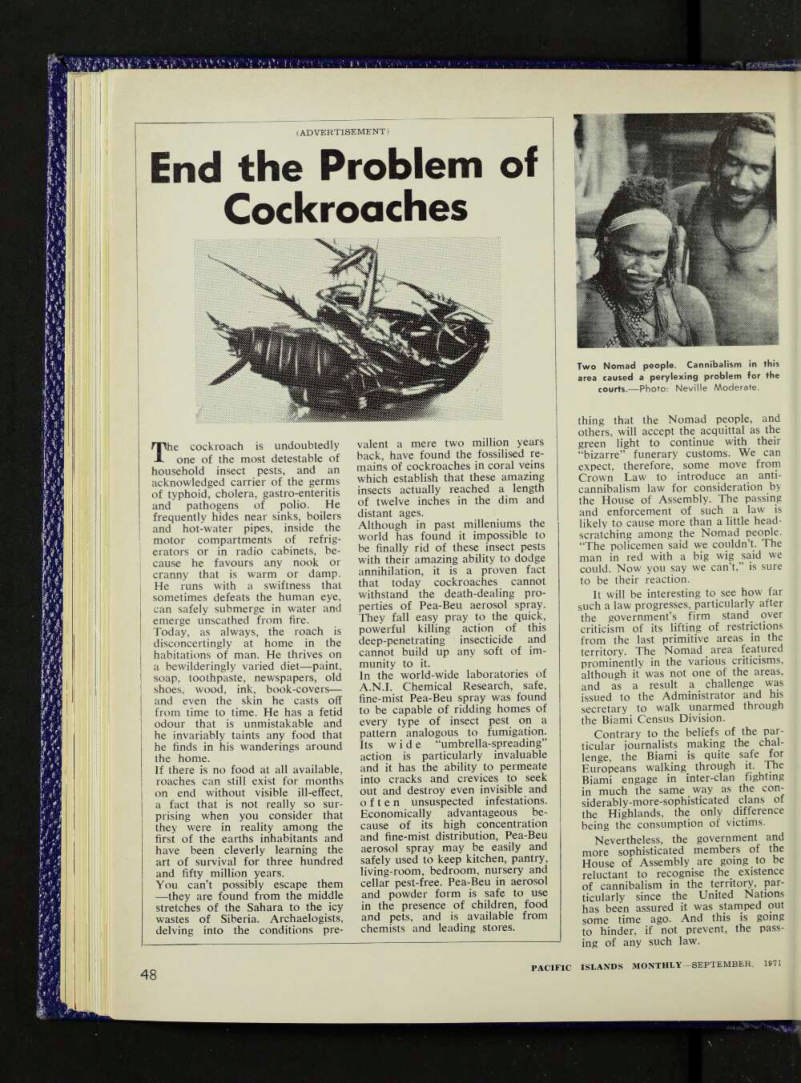
Two Nomad people. Cannibalism in this area caused a perylexing problem for the courts. Photo: Neville Moderate.