Talked About At The
pp. 60-135 · Read in the full issue
Things The Leaders
South Pacific Forum
The meeting of the leaders of the self-governing Pacific terri tories, including Australia and New Zealand, held in Wellington in August, was of historic significance because it was the first time that these states had got round the table to discuss common problems.
It marks the beginning of a new era in Pacific politics.
The meeting was private, and only at the end of the session did the delegates issue an official com munique outlining their discussions.
Because of its significance it is here published in full.
The paragraphs set in italics are not part of the official text, and the information in these was collected by the PIM staff man at the con ference and has been added to help elucidate the wide-ranging discus sions.
The communique follows: The President of Nauru, the Prime Ministers of Western Samoa, Tonga and Fiji, the Premier of the Cook Islands, the Australian Minis ter for External Territories, and the Prime Minister of New Zealand met in Wellington from August 5 to 7 for private and internal discussion of a wide range of issues of com mon concern. They concentrated on matters directly affecting the daily lives of the people of the of the South Pacific, devoting particu lar attention to trade, shipping, tour ism and education.
The talks were essentially explora
tory. Those present discussed, as neighbours and partners, a number of problems which concern them and possible ways of solving them.
Useful ideas and information were exchanged; helpful and prac tical comments were made; and new lines of inquiry were suggested.
Quite apart from being of immedi ate value to individual participants, the talks significantly advanced the spirit of regional co-operation and mutual confidence.
The Wellington meeting could be described as an ad hoc gathering of Island leaders and representatives of Australia and New Zealand. The in itiative came from the leaders of the independent and self-governing Island states, all of which are as sociated with the Commonwealth.
During the course of the discus sion attention was drawn to the forthcoming series of nuclear tests to be conducted by France in the South Pacific. Participants expressed deep regret that atmospheric tests of nuclear weapons continued to be held in the islands of French Poly nesia despite the Partial Test Ban
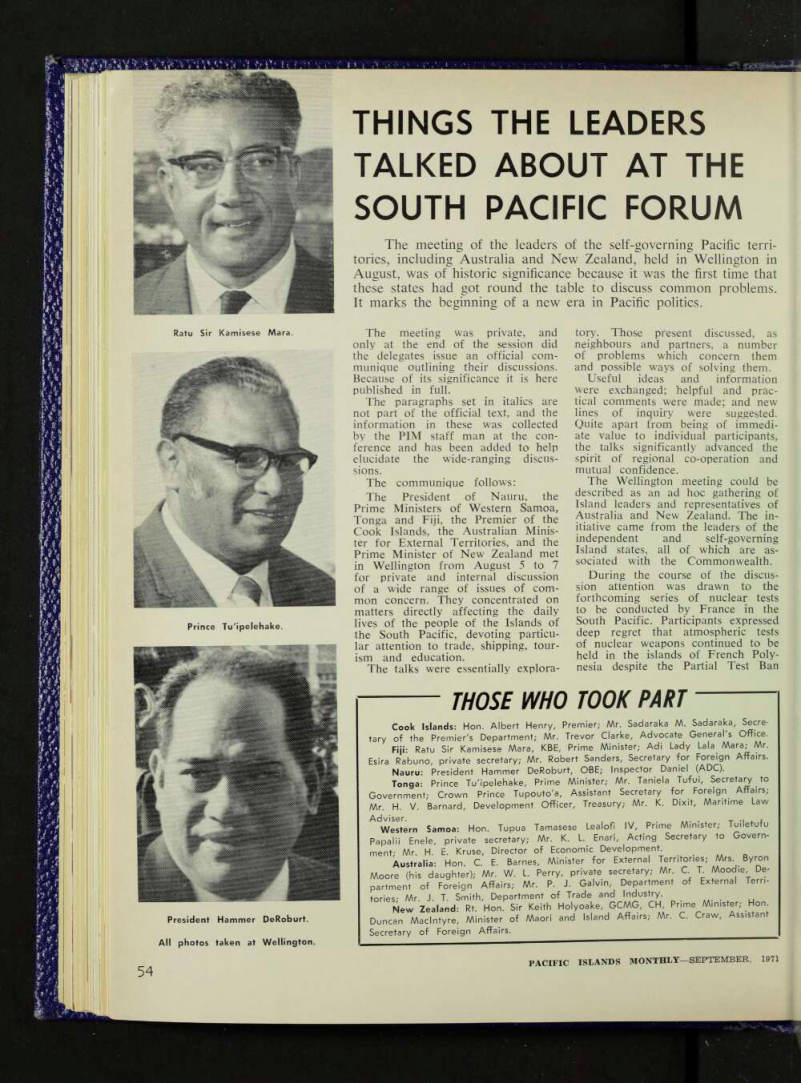
Ratu Sir Kamisese Mara.
Prince Tu'ipelehake.
President Hammer DeRoburt.
All photos taken at Wellington.
Treaty and the protests repeatedly made by a number of the countries attending as well as other Pacific countries.
They expressed concern at the potential hazards that atmospheric tests pose to health and safety and to marine life which is a vital ele ment in islands’ subsistence and economy and addressed an urgent appeal to the Government of France that the current test series should be the last in the Pacific area. The forum requested the New Zealand Government to transmit this appeal to the French Government.
Almost at the same time as New Zealand transmitted the appeal to the French Government, France an nounced a new series of Pacific tests to begin the following week.
Trade The forum made a close examina tion of the South Pacific trade, and particularly that between the Island states themselves and with Australia and New Zealand. A programme was instituted to identify trading problems requiring further study by the forum members. It was recog nised that changes in the world trad ing situation, as well as develop ments in the Island economies, cre ated a need for regular consultations between the participants on trade matters. The forum resolved accord ingly that a meeting of senior offi cials of the five Island governments be held within three months to sur vey production potential and mar keting prospects for Island commo dities in the region, and to study and report on statistical, economic and agricultural implications with a view to making recommendations about
the possibility of establishing an Economic Union for the area.
It was hoped that New Zealand and Australian officials would join in this task in order to promote trade and economic co-operation in the region. It was agreed that New Zealand should, in liaison with other members, co-ordinate the necessary preparations for the meeting.
The forum decided in addition that the officials’ meeting should in vestigate the situation with regard to existing regulations that may be regarded as unnecessary barriers to inter-island trade and the feasibility of establishing a regional Bulk Ordering Scheme. The question of treatment for Islands products enter ing Australia and New Zealand would also be studied.
Quarantine, shipping, customs tariffs and the difficulties of market ing products were also discussed.
The forum recognised that there were a number of problems affect ing inter-island trade and trade be tween the Islands and Australia and New Zealand and welcomed pro posals made for increasing the fre quency of trade missions between the Island groups and with Australia and New Zealand.
The discussion on trade was the longest and probably the liveliest of the subjects raised at the forum.
Consensus was that there was not enough information available, hence the decision to arrange for a survey.
The Islanders did most of the talk ing and they were united in their undoubted aim to get Australia and New Zealand involved in their trade problems. Prime Minister of Fiji, Ratu Sir Kamisese Mara, summed up Islands’ attitudes when he said that one of the main Pacific prob lems was that the pattern of trade was inherited from the colonial per iod, and “this wasn’t a suitable ar
range merit for independent terri tories”, The colonial territories had produced for the factories of the colonial powers, and any change or modification of the trade pattern could best occur if the people who controlled it could be influenced i.e., Australia and New Zealand. Al though the Islands accepted aid glad ly, they preferred trade to aid.
Australia and New Zealand said they would co-operate but pointed out that because of GATT agree ments and other international ar rangements the matter of protective tariffs in particular was complicated and needed much study.
There was little discussion on the form any Economic Union or South Pacific EEC would take, and there was no pressure put on Australia or New Zealand to receive Islands produce. The Islanders re lied on the cool approach, the soft
Continued on p. 117
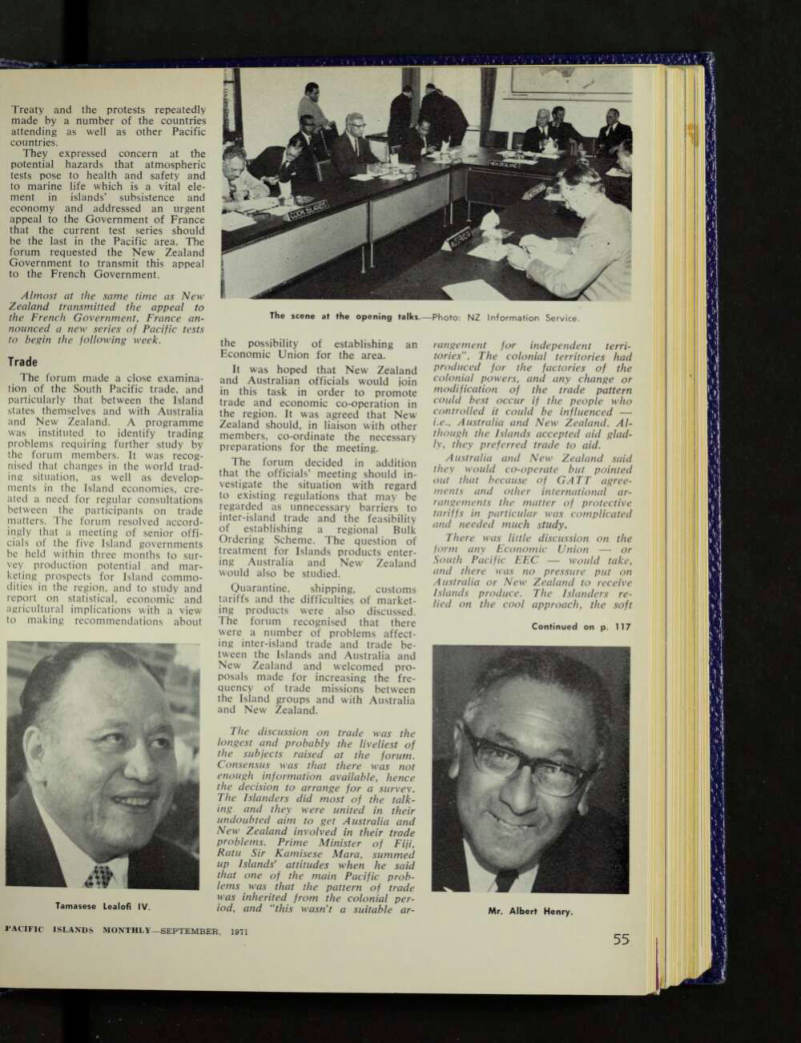
Tamasese Lealofi IV.
The scene at the opening talks. Photo: NZ Information Service.
Mr. Albert Henry.
sell, and specifics were put aside until later meetings of the forum.
The Cook Islands proposal for bulk ordering, whereby the Islands would join together in ordering some of their overseas requirements so as to get substantial price benefits, got a poor reception because it was felt the details needed to be spelled out.
Shipping
Tlie forum agreed that a consider able amount of further study in this field was required. It was noted that a ioint working party had already been formed of representatives from each PIPA [Pacific Islands Produc ers’ Association] member country to investigate fully the organisation and operation of a regional shipping line. An UNDP regional transport survey is also under way. The forum decided that further discussions on shipping would be held in the light of the information provided by these two investigations and the results of the senior officials’ trade meeting.
High freight rates for shipments to the Islands, and the Union Steam Ship takeover, were given as being two of the more important reasons for the establishment of a regional government-owned shipping line, which it has been proposed should be operated through the existing ships and management of the Tonga Shipping Agency. Fiji was particu larly anxious that an acceptable structure for such a regional line be worked out before the matter of was taken much further, and Fiji’s attitude probably guaran teed that there would be no firm decisions at the meeting. Nauru, which operates its own shipping ser vice, made it clear that it would continue to operate independently, but would work in with a regional line if it were established. There was no need for the two lines to com pete against each other, Nauru said.
Civil aviation The forum heard a survey of cur rent developments in civil aviation in the region. After a general dis cussion it was agreed that the pre sent system of liaison and close co operation among all the countries represented at the forum was most valuable and should be continued and strengthened.
The “survey of current develop ments” was a presentation by Aus tralian and NZ experts aimed at making the Islanders aware of pos sible activities of unscheduled opera
tors, particularly charter operators who might compete with established airlines. There were no special re quests by any of the territories, and it was agreed that orderly develop ment of regional airlines, with no unreasonable competition, was what was required. There was no discus sion on the recent decision by Nauru to purchase its own Fokker jet, and to ask for increased services between Australia and Nauru.
Foreign investment, including
tourism in the Pacific There was general agreement on the great importance for all mem bers of welcoming and offering in centives for investment, and the de sirability of ensuring a substantial local equity in all enterprises. Tour ism, in particular, was regarded as most important to the economies of the member countries.
The forum recognised the advan tages of joint tourist promotion, and noted that further consultation would be desirable, especially in the light of the results of the current UNDP survey.
There was no criticism of Aus tralia and NZ during the discussion on investment, and no accusations of exploitation. On tourism, there was comment that indigenous cul ture should not be used as a gim mick to enhance appeal for tourists.
But there was not much concern over any bad effects from tourism, and tourism was regarded as desir able because it was labour intensive.
Law of the seas The meeting discussed the question of territorial sea claims in the South Pacific. It was considered that the unique dependence of countries of the South Pacific on marine resources merited special consideration in the recognition of territorial claims. The meeting welcomed the offer of Aus tralia and New Zealand, as members of the United Nations Seabed Com mittee to keep Island governments informed of progress of the com mittee’s deliberations and to draw the attention of the Seabed Com mittee to the special needs of the South Pacific Islands.
Much of this discussion was on the legal matters affecting fishing rights, such as the 12-mile limit, and there was mention of 200-mile limits in South America. A paper presented by NZ listed Soviet ships sighted in NZ waters since 1965, and said most of them were scientific and economic
(fishing), rather than military or political. The USSR had the world’s largest fishing fleet, and there would be a big increase as a result of the current five-year plan, and more might come to the Pacific. But on flag-showing trips, the South Pacific would probably have a low priority by the Russians for several years to come, although naval vessels would appear.
Development of oceanic resources The meeting took note of the work being done by the Hawaii Oceanic Institute for research and economic development of fisheries in the region, and learned with interest of initial trials in the Cook Islands. The Premier of the Cook Islands would report in six months how the scheme was progressing.
Education The meeting considered the rele vance of a Western academic oriented education to meet the needs of the Island territories in their de velopment, and discussed ways in which the University of the South Pacific could be influenced to take account of traditional values and adapt curricula to the requirements of life in the Islands.
The importance of technical train ing to develop the needs of the region was emphasised, and the advantages of doing this within the region were recognised. While it was necessary to find solutions to these problems, the meeting affirmed their strong and continuing support for the University of the South Pacific.
Main concern was to try to pre vent the Island “brain drain”. How to keep the good men home.
Telecommunications
The forum discussed the possibility of improving telecommunications facilities in the South Pacific with a view to catering, in particular, for the needs of the smaller islands. It was agreed that Australia and New Zealand would undertake a prelimi nary study of this matter for future consideration and that Australia should present the views put for ward in the forum at the forthcoming Telecommunications meeting in Sydney, Nauru pointed out that although Australia, NZ and Fiji had good communications links because they were on the main cables, places like
Nauru, the Gilbert and Ellice, Tonga, Samoa and the Cooks were out on a limb with poor radio telephone services, restricted in time. Nauru proposed that the undersea cable from Guam be extended to Majuro, Nauru, Tarawa, and taken on to the eastern Polynesian islands so there would be complete Pacific links. The meeting thought this proposal was likely to be too expensive.
National parks
The Island leaders heard about conservation of national parks, for historical, recreational and tourist purposes and welcomed the offer of the New Zealand Government to assist with technical advice and train ing.
Regional Disaster Fund It was agreed that the establish ment of a Regional Disaster Fund would mean that some relief should be available immediately; it would show that the region was prepared to help itself and show an awareness of the close ties binding the Pacific countries. The establishment of such a fund was agreed in principle and detailed proposals would be brought forward at the next meeting by the President of Nauru.
This proposal came from the Presi dent of Nauru, Hammer Deßoburt, who said the Pacific territories shouldn't rely on outside agencies for disaster relief all the time. The pro posal was accepted as being a good one.
Joint diplomatic representation
Considering the expense of foreign representation the Island leaders agreed that there would be advant ages in joint representation where appropriate, and that those interested could pursue the matter with each other.
Expense was seen as the key factor in preventing greater representation by the Pacific at the UN, for example. Only Fiji is represented there. It was thought that the forum countries might get together and arrange joint UN representation, possibly working it through Fiji.
Regional co-operation
The forum noted with satisfaction the growing strength of regional co operation in the area through the work of such bodies as PIP A. While reaffirming their support for the South Pacific Commission, represen
tatives expressed the hope that its procedures and activities would be modified and improved to suit present-day conditions. It was agreed that it would be useful to have a catalogue and analysis of the activi ties of all the organisations serving the region and Australia undertook to prepare a paper and circularise members on this subject.
Meanwhile it was agreed that the forum had significantly advanced regional awareness and co-operation, and had produced positive proposals for further joint action.
There was no specific criticism of the SPC, but it was generally under stood that the charter of the SPC had a lot of defects. Political matters could not be discussed there, for instance, although economic and social questions were frequently closely involved with politics. The forum was a better place for such discussions because it was not re stricted by formality and hedged around with tabus. The matter of the deadlock over the appointment of a secretary-general of the SPC was, surprisingly, not brought up.
Future meetings
Recognising the values of the frank and informal interchange of views and the opportunity for planning for Future regional development afforded lay the South Pacific Forum, the neeting said they would like to see :ts continuation on an annual basis.
It was considered premature to institute a formalised arrangement, although this could emerge in due course as and when the need for it aecame apparent. The matter would ae reconsidered at the next meeting.
It was agreed that Australia should ae invited to host the next meeting af the Pacific Forum.
The Island leaders agreed that as aountries of the Pacific attain nation uaod it would be open to them to oin the forum.
Nauru had proposed that a Secre tariat be established for the forum, o there would be some permanent iaison and secretarial assistance. But he meeting preferred to let the host countries fill this role in the early 'tage of the forum’s existence. Un ioubtedly there was the feeling that he success of the forum would rely ~>n informality and lack of any great structure, such as the SPC had. The f orum was to be a meeting in real Pacific style. The next forum will be n Canberra in February.