Death on the Gazelle
pp. 28-122 · Read in the full issue
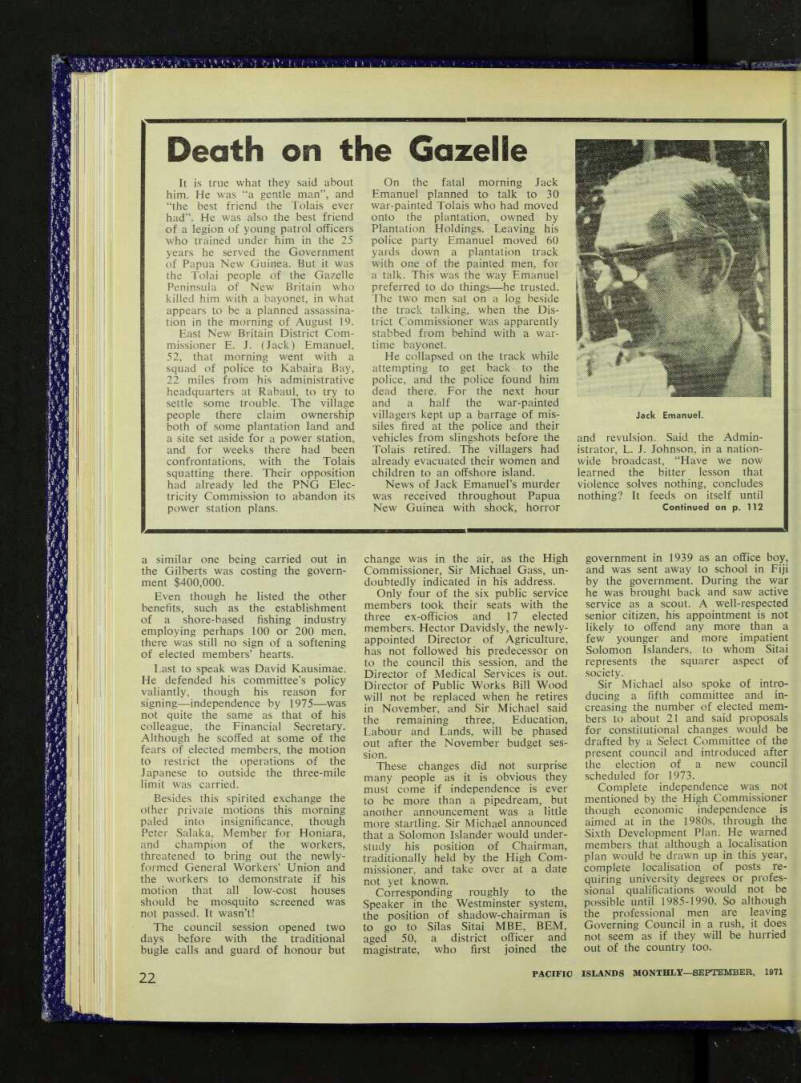
It is true what they said about him. He was “a gentle man”, and “the best friend the Tolais ever had”. He was also the best friend of a legion of young patrol officers who trained under him in the 25 years he served the Government of Papua New Guinea. But it was the Tolai people of the Gazelle Peninsula of New Britain who killed him with a bayonet, in what appears to be a planned assassina tion in the morning of August 19.
East New Britain District Com missioner E. J. (Jack) Emanuel, 52, that morning went with a squad of police to Kabaira Bay, 22 miles from his administrative headquarters at Rabaul, to try to settle some trouble. The village people there claim ownership both of some plantation land and a site set aside for a power station, and for weeks there had been confrontations, with the Tolais
squatting there. Their opposition
had already led the PNG Elec tricity Commission to abandon its power station plans.
On the fatal morning Jack Emanuel planned to talk to 30 war-painted Tolais who had moved onto the plantation, owned by Plantation Holdings. Leaving his police party Emanuel moved 60 yards down a plantation track with one of the painted men, for a talk. This was the way Emanuel preferred to do things—he trusted.
The two men sat on a log beside the track talking, when the Dis trict Commissioner was apparently stabbed from behind with a war time bayonet.
He collapsed on the track while attempting to get back to the police, and the police found him dead there. For the next hour and a half the war-painted villagers kept up a barrage of mis siles fired at the police and their vehicles from slingshots before the Tolais retired. The villagers had already evacuated their women and children to an offshore island.
News of Jack Emanuel’s murder was received throughout Papua New Guinea with shock, horror
and revulsion. Said the Admin istrator, L. J. Johnson, in a nation wide broadcast, “Have we now learned the bitter lesson that violence solves nothing, concludes nothing? It feeds on itself until
Continued on p. 112
Jack Emanuel.
it becomes a monster that devours J „ Co.-H t vlp Tnrlpv at lack Fmanuel’s funeral in Rabaul attendedby 10,000 people: directly responsible for this bloody act have begun a way of life which will end in abject misery for everyone”.
Said the Secretary for the Department of the Administrator, Mr. Tom Ellis, speaking at the graveside, deepy incensed at the death of his friend; “August 19 is a black day for the people of the Gazelle Peninsula.”
Behind the shocked appeals for sanity there was a determination by the government not to rest until it brought everybody con nected with the crime to trial, and to take strong action against civil disorders. In many areas in recent months community leaders have deplored what appear to be widespread unprecedented out breaks of lawlessness.
Within a day or two police had arrested and charged seven Tolais with the murder, and there were many arrests on charges con nected with the stoning of the police. Police were on round-the clock duty, and Acting District
Commissioner A. Carey told Tolai leaders bluntly that the govern ment would not return to the negotiating table to help solve the internal strife of the Gazelle until it was satisfied that there was respect for the rule of law, and that men did not openly advocate the breaking of the law. Those who broke the law would be dealt with firmly.
There was wild talk by some Europeans of “getting even with the Tolais”. For others there was the hope that this violent crime would act as a blood letting and help bring peace to the Gazelle.
The Anglican Bishop of New Guinea, Bishop David Hand, said PNG should have self-government as soon as possible, for people could only learn to be respon sible by taking responsibility.
Self-government would remove all kinds of misunderstanding and bitterness that would otherwise poison the nation. But Bishop George Ambo, PNG’s only in digenous Anglican bishop, dis agreed with his superior, and said local people were not yet ready to take control of either the church or the nation. They did not have the necessary sense of dedication and responsibility. They were often treated better by whites than by their own people, and he hoped and prayed national independence would not occur
during his lifetime.
By month’s end, Canadian anthropologist Professor R. F.
Salisbury, who by chance had been appointed by the government at the beginning of August to give advice on how the conflicts on the Gazelle should be resolved, reported that lack of communica- ion wa f s of the major prob lems, of * e a «=. a - B overn ' ment wasn t getting its messages across.
This advice echoed that of a half-dozen other well-informed advisers over the years, for the Gazelle has been an almost constant battleground for the government, with the Tolais op posing many government-spon sored developments including local government councils. It is the home of the Mataungan Associa tlon> a nationalist movement parti cularly interested m economic equality, which has recently spon -Bpred a ew Guinea Development Corporation aimed at winning for tbe TcdaiB the same rewards that are won by expatriate corporations m tbe territory, But the problems of the Gazelle are many and complex, and the murder of Jack Emanuel, who had had many years’ experience among the Tolais, and spoke the language, may help resolve some of them by making all sides try harder—and return from the brink.