Micronesia: Crunch Is On The Way
p. 29 · Read in the full issue
By a staff writer
time, other members of the committee hurried to Japan to discuss they said, what help Micronesia could expect from there should Micronesia become independent.
Again this move was aimed at twisting an arm of the US. Washing ton is well aware, and not happy, about the swift increase in Japanese economic pressures in the Pacific Islands.
Japanese tourists are flooding into Guam and spilling over into every Trust Territory island, and Japanese tourist plant would like to invest in the TT, as in Guam. It can’t, because at present non-American investment in the TT is not permitted by law.
President Nixon’s current attack on the yen is an indication of what the US believes it has to fear from growing Japanese economic strength.
The Micronesian Congress is quite capable of using both the threat of Japan and UN intervention to bring Washington to its senses.
Washington appears to be in a better position to come to terms than it was 12 months ago, when Depart ments of Defence, State and Interior all took different views on what should be done about Micronesia. The Defence Department’s view that Micronesia was needed for strategic purposes is believed to have been the major reason for Washington’s decision to offer nothing better than Commonwealth status.
But there has been an awareness in Washington recently that America’s and Micronesia’s views on defence requirements are not necessarily in conflict. It is really a matter of
We’ll know the truth of it by the time this issue of PIM is circulated, but the hot tip in Honolulu in August was that the much-awaited con frontation between the Washington administration and the spokesmen for Micronesia will take place in September on a plantation on the Hawaiian island of Kauai.
It’ll be a crucial meeting. If those talks break down, it’s possible that by next January the Congress of Micronesia will decide on a unilateral declaration of independence.
It’s taken more than twelve months for the two parties to agree to get together and break the stalemate over the Trust Territory of Micro nesia’s political future. Last year Micronesians asked for self-govern ment in free association with the US, and were rejected by Washington.
The Micronesians in turn rejected an American proposal that they take Commonwealth status, rather like the Puerto Rico kind.
The plantation locale is designed to be neutral, and private, with no pressures from outside. The US delegation will meet members of the Congress of Micronesia’s Joint Com mittee on Future Status.
What developments have there been on either side in the last 12 months? The Micronesian attitude seems to have toughened.
The status committee leaders in May flirted with the UN Committee of Twenty Four, as a signal to Washington that they are prepared to pull in help from that radical quarter if necessary. At the same
America deciding what, specifically, it wants—it probaby needs no more than access to the Marianas— and then coming to some treaty arrangement to preclude the TT from being used by any other military power.
It is not seen as likely that Micro nesia would object. Even an indepen dent Micronesia would probably agree to bases in its territory so long as it had some degree of control over them, and America allows this con trol in other countries now.
In short, defence problems are not now seen in some quarters as being insurmountable (America could even propose that all Pacific Islands be neutralised).
A swift solution is seen as being far more important, for delay will enable pressures to build against America from inside and outside Micronesia and a solution satisfactory to the US might then be impossible to achieve.
Micronesian student Moses Uludong, 21, brother of Francisco Uludong who edits The Young Micronesian, in August was still awaiting trial—on nominal bail—on charges of criminal libel and dis turbing the peace. He was arrested in Palau in July, the charges growing out of letters he allegedly mailed to government officials on the indepen dence issue. His arrest coincided with the arrival in Palau of President Nixon’s envoy for the status negoti ations, Ambassador Franklin Williams.
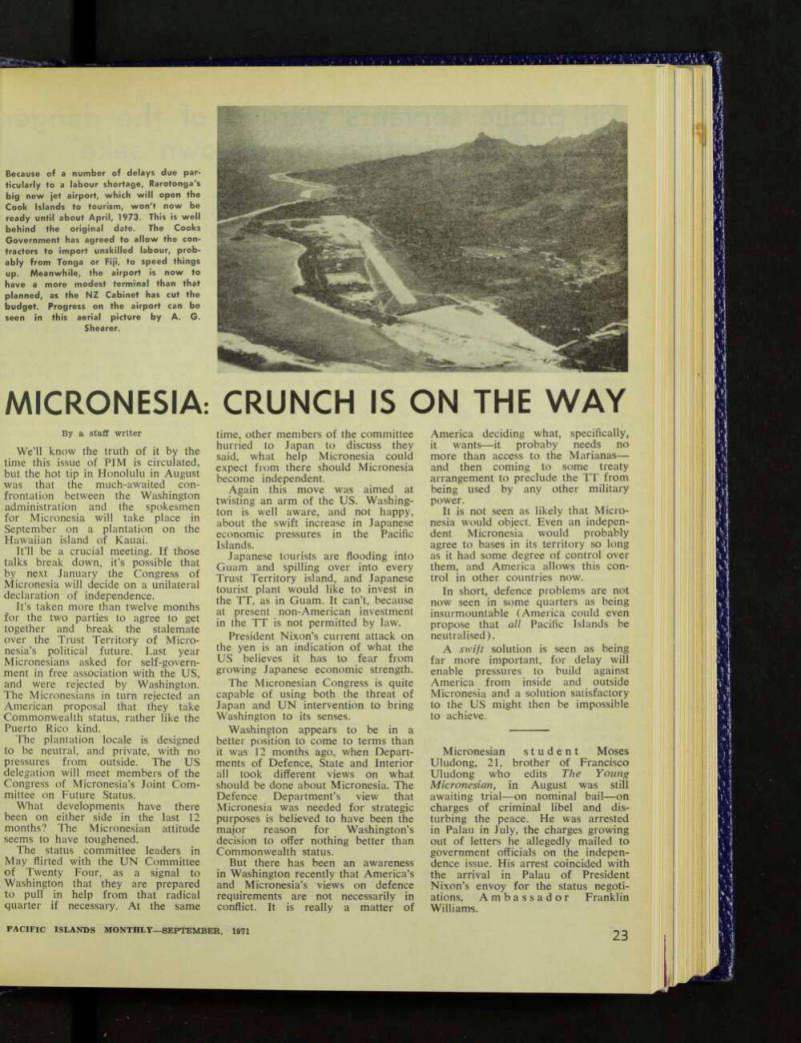
Because of a number of delays due par ticularly to a labour shortage, Rarotonga's big new jet airport, which will open the Cook Islands to tourism, won't now be ready until about April, 1973. This is well behind the original date. The Cooks Government has agreed to allow the con tractors to import unskilled labour, prob ably from Tonga or Fiji, to speed things up. Meanwhile, the airport is now to have a more modest terminal than that planned, as the NZ Cabinet has cut the budget. Progress on the airport can be seen in this aerial picture by A. G.
Shearer.