Pacific Islands Monthly
pp. 27-28 · Read in the full issue
The Solomons (Speaker appointed) talks of independence in 1975
Prom a Honiara correspondent
At last it has been said! An elected member in today’s (August 20) Solomons Governing Council session spoke up and put 1975 as his goal for complete independence of the Solomons from Britain.
Ever since last year’s constitutional changes brought independence very much closer to reality, elected mem bers have never voiced in council when they expected this to happen, and one sometimes had the feeling this was caused by a feeling of politeness towards the people who have been guarding their interests for so long.
But today in council, goaded by his colleagues who accused him of being merely an instrument of the Financial Secretary when he signed the much-disputed agreement in Tokyo authorising the T'aiyo Fishing Company to survey fishing potential in the Solomons for 18 months, David Kausimae, Chairman of the Natural Resources Committee, told members that he had signed the agreement because it would bring much-needed revenue to the Solomons and he wanted to see his country indepen dent in 1975.
This statement came at the end of a spirited debate on a private motion brought by Father Edmund Kiva that the Japanese be restricted to fishing within three miles of in dividual islands. (Under the agree ment the company’s six-boats fleet may fish to within 500 yards of the shore, though not in lagoons) Describing the sea as the Garden of the Solomons, Father Kika painted a gloomy picture of the Solomons, denuded of fish, at the end of the survey and accused the Government af trying to make a quick dollar at the expense of the well-being of Solomon Islanders.
In this he appeared to be voicing the opinion of many and was sup ported by four elected members, all pf whom spoke eloquently of the ill-feeling that the agreement had :aused among their constituents. (A few weeks ago the powerful Malaita Council passed a resolution
demanding that the government rescind the agreement, and it was only with some difficulty that David Kausimae—himself a Malaitaman— persuaded them to cancel the demand).
Jonathan Fiji, always the champion of his Malaita constituency of “background” people, even went so far as to say that the feeling on Malaita was similar to that during the time of Marching Rule—and as one of the leaders of that anti government movement just after the war, he should know.
Apart from being affronted that the government did not consult them before signing such an agreement— an information paper was produced and circulated but not debated in the House—Fiji gave voice to another fear besides that of a fish shortage.
The Japanese were catching small fish, the natural food of sharks. If the sharks were short of food, he said, they would come close to shore and prey on man. This would touch particularly Malaitamen, some of whom swim without fear, and
surprisingly few casualties, in the shark-infested water, claiming an affinity with sharks The main complaints were that the people had not been consulted before the agreement was signed and that 18 months was too long Although several members contrived to make the title Chairman of the Natural Resources Committee sound very sinister by hissing it out, nearly all said they did not really blame him, and one claimed he had been forced into giving his support to the agreement.
Financial Secretary John Smith replied calmly but with some spirit to all the accusations, but although he gained applause from public service members, he had little from others. He explained that nobody except those six boats of the Taiyo Fishing Co. had the right to fish inside the three-mile territorial limit, and said even now his com mittee was trying to negotiate the extension of this to the more normal 12 miles. He reminded members that the Solomons had no navy to police the waters and prevent offences, and everyone knew some illegal fishing went on, particularly at night.
He was perhaps less than kind to the Japanese when, quoting the old adage “set a thief to catch a thief”, he suggested that they would act to keep out illegal fishermen, as it would be in their own interests, but elected members appeared unim pressed by this.
He then put the issue to them in simple, stark phrases. Government was entitled to say “No” to the fishing company if they felt it was best for their country. But they must remember that if they did so they would also be saying “No” to a possible quarter million dollars annually within three to four years.
And this income would be without comparable investment by the Solomon Islanders themselves, as would be the case in agriculture, forestry or mining development. He reminded them too that the survey wasn’t costing them anything, though
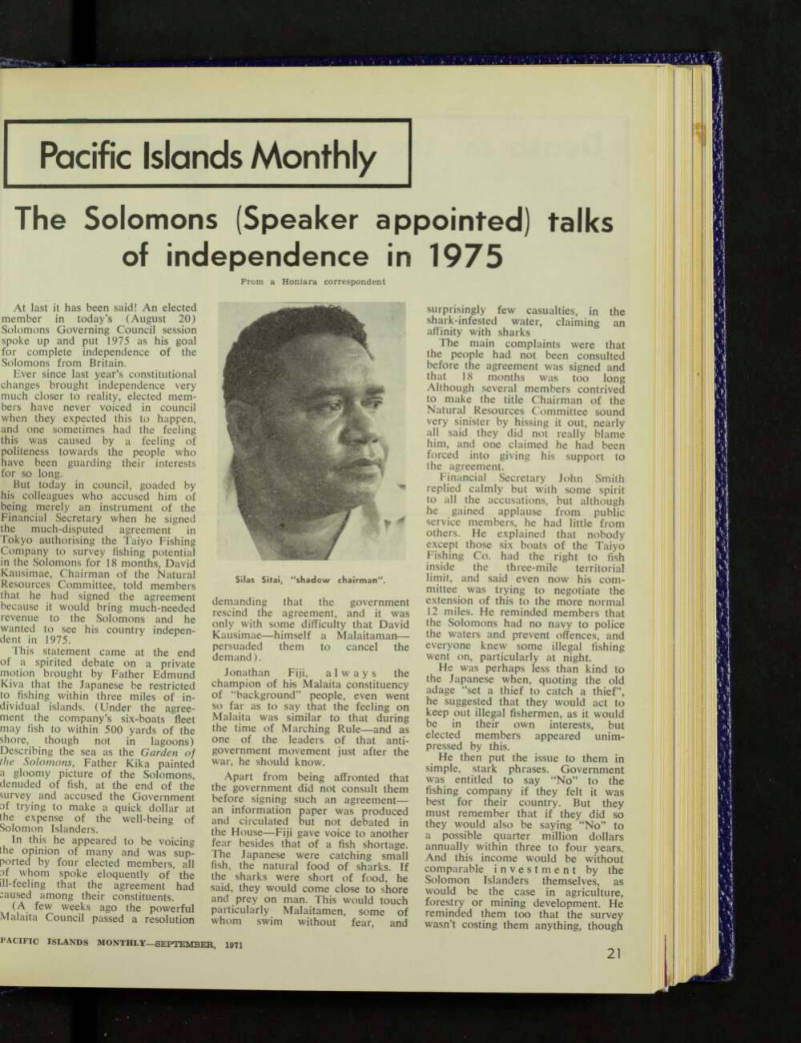
Silas Sitai, "shadow chairman".
a similar one being carried out in the Gilberts was costing the govern ment $400,000.
Even though he listed the other benefits, such as the establishment of a shore-based fishing industry employing perhaps 100 or 200 men, there was still no sign of a softening of elected members’ hearts.
Last to speak was David Kausimae.
He defended his committee’s policy valiantly, though his reason for signing—independence by 1975—was not quite the same as that of his colleague, the Financial Secretary.
Although he scoffed at some of the fears of elected members, the motion to restrict the operations of the Japanese to outside the three-mile limit was carried.
Besides this spirited exchange the other private motions this morning paled into insignificance, though Peter Salaka, Member for Honiara, and champion of the workers, threatened to bring out the newly formed General Workers’ Union and the workers to demonstrate if his motion that all low-cost houses should be mosquito screened was not passed. It wasn’t!
The council session opened two days before with the traditional bugle calls and guard of honour but
change was in the air, as the High Commissioner, Sir Michael Gass, un doubtedly indicated in his address.
Only four of the six public service members took their seats with the three ex-officios and 17 elected members. Hector Davidsly, the newly appointed Director of Agriculture, has not followed his predecessor on to the council this session, and the Director of Medical Services is out.
Director of Public Works Bill Wood will not be replaced when he retires in November, and Sir Michael said the remaining three. Education, Labour and Lands, will be phased out after the November budget ses sion.
These changes did not surprise many people as it is obvious they must come if independence is ever to be more than a pipedream, but another announcement was a little more startling. Sir Michael announced that a Solomon Islander would under study his position of Chairman, traditionally held by the High Com missioner, and take over at a date not yet known.
Corresponding roughly to the Speaker in the Westminster system, the position of shadow-chairman is to go to Silas Sitai MBE, BEM, aged 50, a district officer and magistrate, who first joined the
government in 1939 as an office boy, and was sent away to school in Fiji by the government. During the war he was brought back and saw active service as a scout. A well-respected senior citizen, his appointment is not likely to offend any more than a few younger and more impatient Solomon Islanders, to whom Sitai represents the squarer aspect of society.
Sir Michael also spoke of intro ducing a fifth committee and in creasing the number of elected mem bers to about 21 and said proposals for constitutional changes would be drafted by a Select Committee of the present council and introduced after the election of a new council scheduled for 1973.
Complete independence was not mentioned by the High Commissioner though economic independence is aimed at in the 1980 s, through the Sixth Development Plan. He warned members that although a localisation plan would be drawn up in this year, complete localisation of posts re quiring university degrees or profes sional qualifications would not be possible until 1985-1990. So although the professional men are leaving Governing Council in a rush, it does not seem as if they will be hurried out of the country too.