Faith can move mountain markers
pp. 16-17 · Read in the full issue
Odd Side Of New Guinea
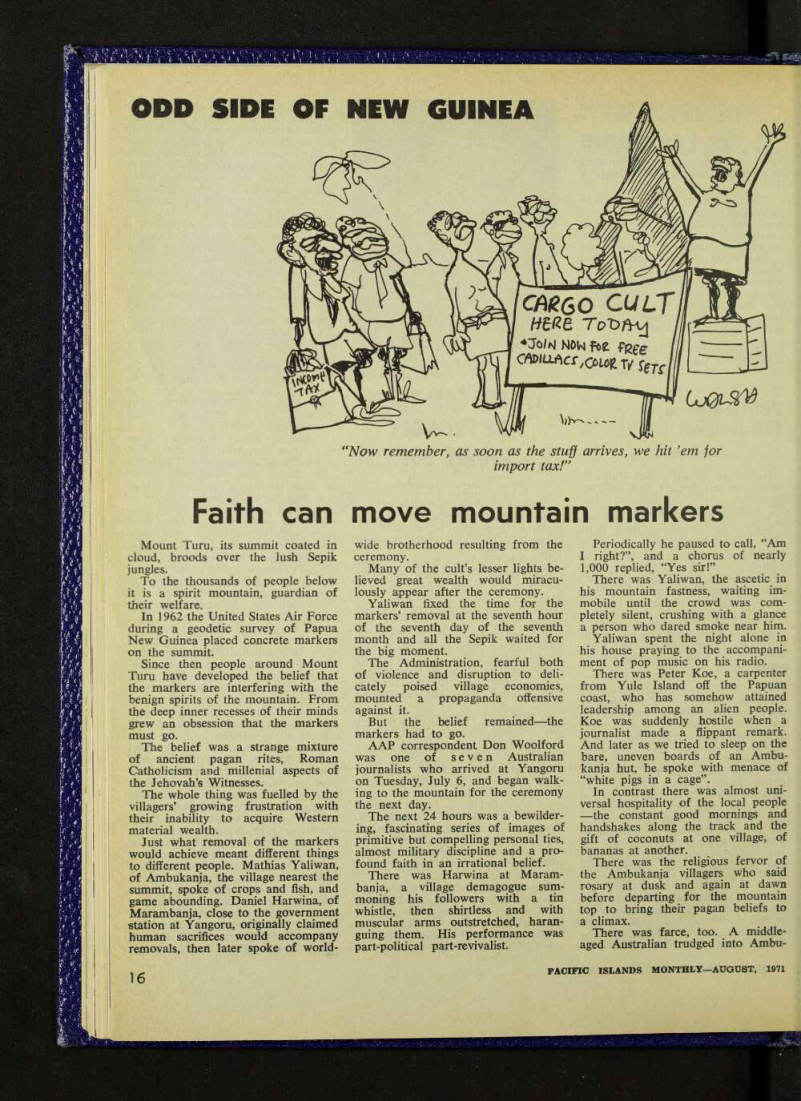
“Now remember, as soon as the stuff arrives, we hit ’em for import tax!”
Mount Turu, its summit coated in cloud, broods over the lush Sepik jungles.
To the thousands of people below it is a spirit mountain, guardian of their welfare.
In 1962 the United States Air Force during a geodetic survey of Papua New Guinea placed concrete markers on the summit.
Since then people around Mount Turu have developed the belief that the markers are interfering with the benign spirits of the mountain. From the deep inner recesses of their minds grew an obsession that the markers must go.
The belief was a strange mixture of ancient pagan rites, Roman Catholicism and millenial aspects of the Jehovah’s Witnesses.
The whole thing was fuelled by the villagers’ growing frustration with their inability to acquire Western material wealth.
Just what removal of the markers would achieve meant different things to different people. Mathias Yaliwan, of Ambukanja, the village nearest the summit, spoke of crops and fish, and game abounding. Daniel Harwina, of Marambanja, close to the government station at Yangoru, originally claimed human sacrifices would accompany removals, then later spoke of world-
wide brotherhood resulting from the ceremony.
Many of the cult’s lesser lights be lieved great wealth would miracu lously appear after the ceremony.
Yaliwan fixed the time for the markers’ removal at the seventh hour of the seventh day of the seventh month and all the Sepik waited for the big moment.
The Administration, fearful both of violence and disruption to deli cately poised village economies, mounted a propaganda offensive against it.
But the belief remained —the markers had to go.
AAP correspondent Don Woolford was one of seven Australian journalists who arrived at Yangoru on Tuesday, July 6, and began walk ing to the mountain for the ceremony the next day.
The next 24 hours was a bewilder ing, fascinating series of images of primitive but compelling personal ties, almost military discipline and a pro found faith in an irrational belief.
There was Harwina at Maram banja, a village demagogue sum moning his followers with a tin whistle, then shirtless and with muscular arms outstretched, haran guing them. His performance was
part-political part-revivalist.
Periodically he paused to call, “Am I right?”, and a chorus of nearly 1,000 replied, “Yes sir!”
There was Yaliwan, the ascetic in his mountain fastness, waiting im mobile until the crowd was com pletely silent, crushing with a glance a person who dared smoke near him.
Yaliwan spent the night alone in his house praying to the accompani ment of pop music on his radio.
There was Peter Koe, a carpenter from Yule Island off the Papuan coast, who has somehow attained leadership among an alien people.
Koe was suddenly hostile when a journalist made a flippant remark.
And later as we tried to sleep on the bare, uneven boards of an Ambu kanja hut, he spoke with menace of “white pigs in a cage”.
In contrast there was almost uni versal hospitality of the local people —the constant good mornings and handshakes along the track and the gift of coconuts at one village, of bananas at another.
There was the religious fervor of the Ambukanja villagers who said rosary at dusk and again at dawn before departing for the mountain top to bring their pagan beliefs to a climax.
There was farce, too. A middle aged Australian trudged into Ambu-
kanja just before nightfall with a brand-new movie camera saying he was going to the ceremony out of curiosity. There was widespread re ports that he really was working for the government, but if he was doing some part-time spying he was hardly a success, for by the time he struggled to the summit the ceremony was over and his camera broken.
Villagers also told of a local man whom the government had infiltrated but who had come to believe in the cult and was now acting as a double agent!
At the summit there were more prayers in the swirling morning mist before the markers were dragged out.
The crowd surged forward to grab a piece of thick mud that clung to them and carefully wrap it in leaves so that later it could be put in their food garden.
Then there was the three-hour procession back to Yangoru.
A man holding the New Testament led the way, followed by two markers strung under a carrying pole.
It was solemn procession.
Few talked, none laughed. i- A} eac fi village on the way men lined the muddy path, standing to attention and often praying or count ing rosary beads. They joined in at the tail, so long before Yangoru was reached a line stretched out of sight in both directions.
At Yangoru there was no need k°[- jl e , xtra Police, some lurking behind hedges around the sub-district omce, or the hastily upgraded radio network.
The head of the procession stopped outside the office and the markers were placed on the lawn.
A government officer spoke a few quiet words and the line of men passed gently across the adjacent grass air strip before dispersing.
The deed was done, the offending markers were removed and returned to their owners, the government. lhe ceremony was over—but are he repercussions?
Immediate government reaction was had all § one off so y . but concern remains. hen benefits fail to materialise nere may be resentment. If there is ikei e v nc t e n H , arwin ? the most kely target as he is the custodian 21 579 • S asure chests with '21,572 the faithful have subscribed.
If past cult experience is any guide he followers will gradually accept hat the anticipated wealth will not Pf/ DOt hOWeVer con ’ ! he 1 C ’i lt actlvit Y is of no In * tead , the y will believe that kX h ?u W failed to pre isely the right ceremony.