Fine Friendly
p. 15 · Read in the full issue
Where Can These
People Go?
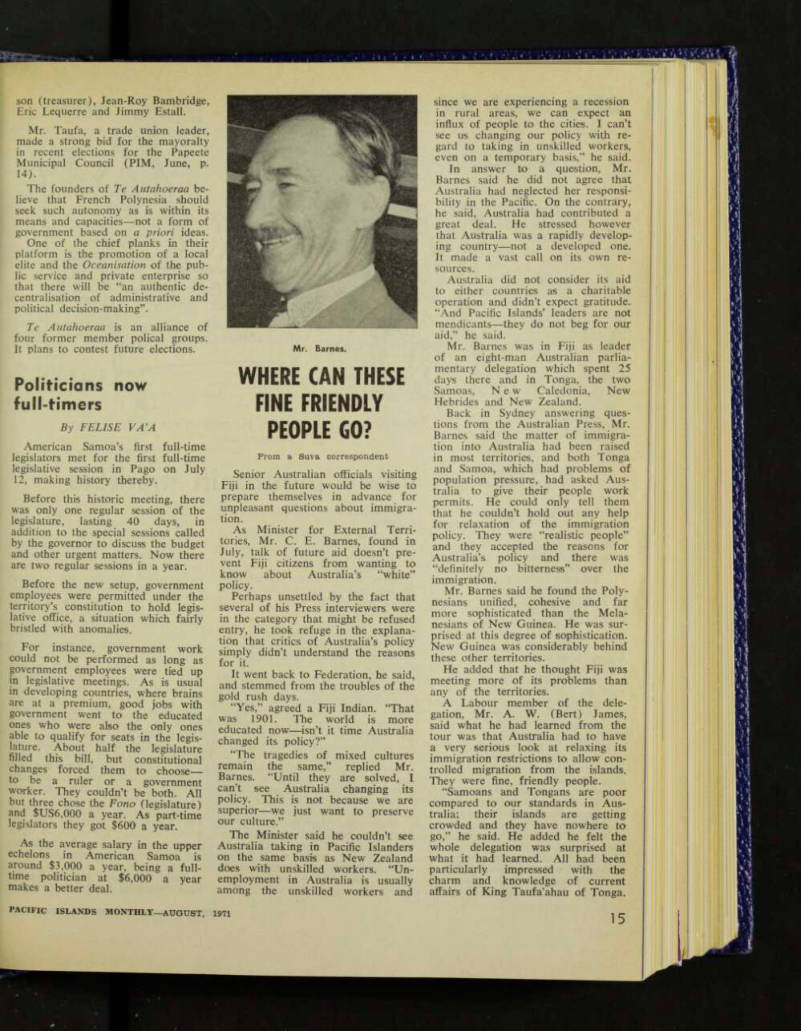
Mr. Barnes.
From a Suva correspondent Senior Australian officials visiting Fiji in the future would be wise to prepare themselves in advance for unpleasant questions about immigra tion.
As Minister for External Terri tories, Mr. C. E. Barnes, found in July, talk of future aid doesn’t pre vent Fiji citizens from wanting to know about Australia’s “white” policy.
Perhaps unsettled by the fact that several of his Press interviewers were in the category that might be refused entry, he took refuge in the explana tion that critics of Australia’s policy simply didn’t understand the reasons for it.
It went back to Federation, he said, and stemmed from the troubles of the gold rush days.
“Yes,” agreed a Fiji Indian. “That was 1901. The world is more educated now—isn’t it time Australia changed its policy?”
“The tragedies of mixed cultures remain the same,” replied Mr.
Barnes. “Until they are solved, I can’t see Australia changing its policy. This is not because we are superior—we just want to preserve our culture.”
The Minister said he couldn’t see Australia taking in Pacific Islanders on the same basis as New Zealand does with unskilled workers. “Un employment in Australia is usually among the unskilled workers and
since we are experiencing a recession in rural areas, we can expect an influx of people to the cities. I can’t see us changing our policy with re gard to taking in unskilled workers, even on a temporary basis,” he said.
In answer to a question, Mr.
Barnes said he did not agree that Australia had neglected her responsi bility in the Pacific. On the contrary, he said, Australia had contributed a great deal. He stressed however that Australia was a rapidly develop ing country—not a developed one.
It made a vast call on its own re sources.
Australia did not consider its aid to either countries as a charitable operation and didn’t expect gratitude.
“And Pacific Islands’ leaders are not mendicants—they do not beg for our aid,” he said.
Mr. Barnes was in Fiji as leader of an eight-man Australian parlia mentary delegation which spent 25 days there and in Tonga, the two Samoas, New Caledonia, New Hebrides and New Zealand.
Back in Sydney answering ques tions from the Australian Press, Mr.
Barnes said the matter of immigra tion into Australia had been raised in most territories, and both Tonga and Samoa, which had problems of population pressure, had asked Aus tralia to give their people work permits. He could only tell them that he couldn’t hold out any help for relaxation of the immigration policy. They were “realistic people” and they accepted the reasons for Australia’s policy and there was “definitely no bitterness” over the immigration.
Mr. Barnes said he found the Poly nesians unified, cohesive and far more sophisticated than the Mela nesians of New Guinea. He was sur prised at this degree of sophistication.
New Guinea was considerably behind these other territories.
He added that he thought Fiji was meeting more of its problems than any of the territories.
A Labour member of the dele gation, Mr. A. W. (Bert) James, said what he had learned from the tour was that Australia had to have a very serious look at relaxing its immigration restrictions to allow con trolled migration from the islands.
They were fine, friendly people.
“Samoans and Tongans are poor compared to our standards in Aus tralia; their islands are getting crowded and they have nowhere to go,” he said. He added he felt the whole delegation was surprised at what it had learned. All had been particularly impressed with the charm and knowledge of current affairs of King Taufa’ahau of Tonga.