Planners take the lid
pp. 17-18 · Read in the full issue
off island suburbia
From a Suva correspondent • .. battle against the abysmal problems accompanying urban isation m the Islands may already be lost. Or so it would seem from some of the observations by delegates to the Second South Pacific Seminar in Suva in July
They came from all over the Paci fic to offer ideas on “Living in Town” urbanisation in developing countries and the picture that emerged was far from bright, or even hopeful.
Their papers made interesting and, frequently, disturbing social com ment. Many of the problems were common to most of the Island terri tories. Others were unique. But whether anything really effective will be done to stop the rot rests not with those who do the talking—but those who make the decisions. And there weren’t too many of those at the seminar.
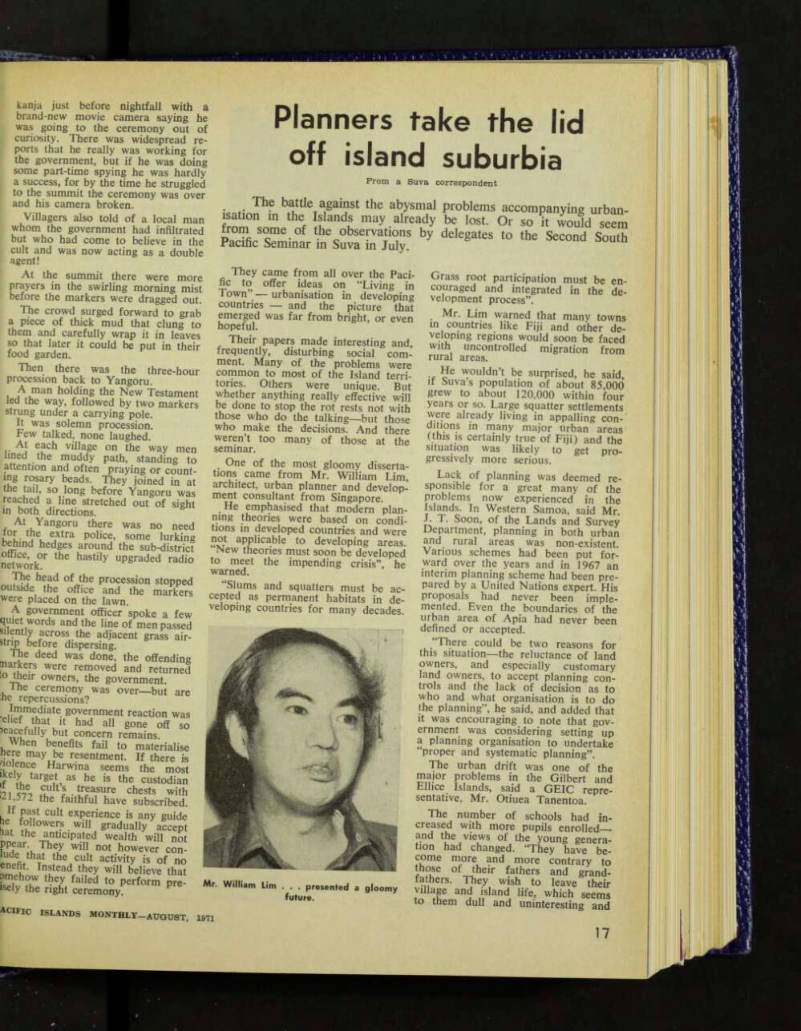
. One of the most gloomy disserta tions came from Mr. William Lim, architect, urban planner and develop ment consultant from Singapore.
He emphasised that modem plan ning theories were based on condi tions in developed countries and were not applicable to developing areas.
New theories must soon be developed to meet the impending crisis”, he warned.
“Slums and squatters must be ac cepted as permanent habitats in de veloping countries for many decades.
Mr. William Lim... presented a gloomy future.
Grass root participation must be en couraged and integrated in the de velopment process”. . Mr. Lim warned that many towns in countries like Fiji and other de veloping regions would soon be faced with uncontrolled migration from rural areas.
He wouldn’t be surprised, he said, it Suvas population of about 85,000 grew to about 120,000 within four years or so. Large squatter settlements were already living in appalling con ditions in many major urban areas (this is certainly true of Fiji) and the situation was likely to get pro gressively more serious.
Lack of planning was deemed re sponsible for a great many of the problems now experienced in the Islands. In Western Samoa, said Mr.
J. T. Soon, of the Lands and Survey Department, planning in both urban and rural areas was non-existent.
Various schemes had been put for ward over the years and in 1967 an interim planning scheme had been pre pared by a United Nations expert. His proposals had never been imple mented. Even the boundaries of the urban area of Apia had never been defined or accepted.
There could be two reasons for this situation—the reluctance of land owners, and especially customary land owners, to accept planning con trols and the lack of decision as to who and what organisation is to do the planning”, he said, and added that it was encouraging to note that gov ernment was considering setting up a planning organisation to undertake “proper and systematic planning”.
The urban drift was one of the major problems in the Gilbert and Ellice Islands, said a GEIC repre sentative, Mr. Otiuea Tanentoa.
The number of schools had in creased with more pupils enrolled— and the views of the young genera tion had changed. “They have be come more and more contrary to those of their fathers and grand fathers. They wish to leave their village and island life, which seems to them dull and uninteresting and
begin to move to urban areas to see for themselves what they have heard of and read about in their text books.
“They have heard about western type buildings, ships, aeroplanes, motor cars. They live amongst Euro peans and learn English, the only foreign language learned at school .
Young people in the Gilbert and Ellice Islands considered copra-cutting and fishing to be unattractive occupa tions. They preferred to be teachers, seamen, doctors, nurses and clerks. . . so they went to the towns.
Speakers agreed that one of the greatest difficulties caused by the urban drift was that of housing.
Newcomers in GEIC usually had relatives employed by. the govern ment, the wholesale society or in pri vate enterprise.
“The relatives then, according to our custom, must invite them to stay or the family relationship would be broken for ever if they did not”, said Mr. Tanentoa. “The number of people to occupy one house may be increased from about four to nearly 20,, if two or three families are invited”.
Adult and juvenile delinquency was another problem facing the GEIC.
When people had to wait two or three months, or even a year, for a
job, while living off perhaps one rela tive earning a low salary, the next step was to bubuti (cadge) from other relatives or steal.
Other problems were caused by lack of water and lack of proper sewerage. Most people in urban places used latrines built over the reef.
“These small latrines create no prob lem during spring tide, but the situ ation is terrible during neap tide as the sewage is uncovered and breeds flies and causes bad smells”, he said.
The colony needed more finance, legislation controlling the movement from rural to urban areas, and more development in rural islands, Mr.
Tanentoa declared.
Outspoken Mr. Francis Bugotu, from the Solomons Department. of Education, pointed out that urbanisa tion problems were created not by buildings but by people . . . “people sleeping in houses, buying in shops, loving in beds, fighting in the street and drinking in the pubs.
“They are created by us when we are supposed to become more and more civilised”. , . . i The effects of urbanisation, al though at a comparatively early stage, were to be seen clearly in the Solo mons, he told delegates. The first generation town lad was the most conspicuous and would set the pattern for the future unless checked. Ihose boys thought they owned the town.
They felt it was their right to own a motor bike and would go to the ex tent of stealing money or forcing
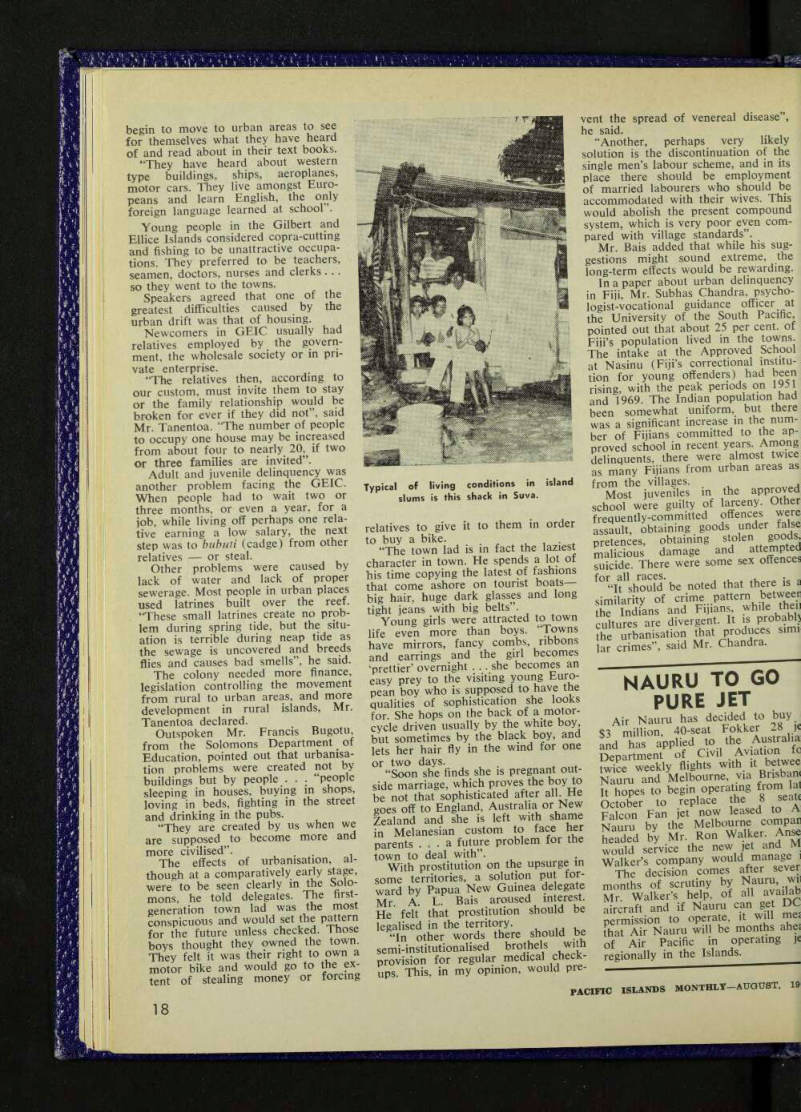
Typical of living conditions in island slums is this shack in Suva.
relatives to give it to them in order to buy a bike. .
“The town lad is in fact the laziest character in town. He spends a lot of his time copying the latest of fashions that come ashore on tourist boats big hair, huge dark glasses and long tight jeans with big belts”.
Young girls were attracted to town life even more than boys. “Towns have mirrors, fancy combs, ribbons and earrings and the girl becomes ‘prettier’ overnight . .. she becomes an easy prey to the visiting young Euro pean boy who is supposed to have the qualities of sophistication she looks for. She hops on the back of a motor cycle driven usually by the white boy, but sometimes by the black boy, and lets her hair fly in the wind for one or two days. .
“Soon she finds she is pregnant out side marriage, which proves the boy to be not that sophisticated after all. He goes off to England, Australia or New Zealand and she is left with shame in Melanesian custom to face her parents ... a future problem for the town to deal with”.
With prostitution on the upsurge in some territories, a solution put for ward by Papua New Guinea delegate Mr. A. L. Bais aroused in^re^ t - He felt that prostitution should be legalised in the territory.
“In other words there should be semi-institutionalised brothels with provision for regular medical check ups This, in my opinion, would pre-
vent the spread of venereal disease”, he said.
“Another, perhaps very likely solution is the discontinuation of the single men’s labour scheme, and in its place there should be employment of married labourers who should be accommodated with their wives. This would abolish the present compound system, which is very poor even com pared with village standards”.
Mr. Bais added that while his sug gestions might sound extreme, the long-term effects would be rewarding.
In a paper about urban delinquency in Fiji, Mr. Subhas Chandra, psycho logist-vocational guidance officer at the University of the South Pacific, pointed out that about 25 per cent, of Fiji’s population lived in the towns.
The intake at the Approved School at Nasinu (Fiji’s correctional institu tion for young offenders) had been rising, with the peak periods on 1951 and 1969. The Indian population had been somewhat uniform, but there was a significant increase in the num ber of Fijians committed to the ap proved school in recent years. Among delinquents, there were almost twice as many Fijians from urban areas as
from the villages.
Most juveniles in the approved school were guilty of larceny. Other frequently-committed offences were assault, obtaining goods under false pretences, obtaining stolen goods, malicious damage and attempted suicide. There were some sex offences “it should be noted that there is a similarity of crime pattern between the Indians and Fijians, while then cultures are divergent. It is probably the urbanisation that produces simi lar crimes”, said Mr. Chandra.