from home
pp. 52-54 · Read in the full issue
Mod cons ... a long way from home
Ann Glenn Reports
On Bougainville
“Come to sunny Bougainville . . . ” said the advertisement, like a travel brochure. . . attractive surround ings, good working conditions, excel lent pay . .
So we came in our trimaran Rebel, after five years of Pacific cruising, and found our anchorage just off Camp 6 at Loloho, 100 yards offshore from one cf the prettiest swimming beaches we’ve seen anywhere.
The surroundings were all that had been promised. The pay was good, too —but there any resemblance to a “working holiday” ended, because it is work—lo hours a day, six days a week.
Loloho is located six miles north of Kieta, at Anewa Bay, the site of the newly-constructed port facilities for the Bougainville copper project.
The mine site, to begin producing next year, is up in the ranges at Panguna, and there are thousands of men working there and around the
various camps to get it into opera tion.
The Loloho single men’s camp, the married quarters, and the Loloho hos pital have been completed, and the waterfront has been filled and re shaped to take the new wharf. The major construction jobs now in pro gress in Anewa Bay are the giant power station, which will be almost double the present generating capacity of the entire territory of Papua New Guinea, and the storage areas for the heavy fuel oil and the ore concentrate. Most of the men who live at Camp 6 are involved in these projects.
Camp 6 at Loloho is just one of the “instant communities” that have been established to house the influx of workers. In it, 900 men live in pre fabricated “dongas”, eat in the single mess, and suffer the “nothing-to-do syndrome”.
During the day the 40 ft x 10 ft pre-fabricated buildings are deserted except for the minority on night shift who wander to the laundry and toilet blocks before disappearing into the 10 ft x 10 ft bedroom shared by two men. Each room is attractive and comfortable, lined with wood veneer and containing two beds, two lockers, two chairs and a desk. To dispel the atmosphere of “little boxes”, the men assert their individuality in their col lections of calendar pictures and king sized posters.
In the evening after the 5 o’clock whistle blows, the camp comes alive.
In the hour between 5 and 6, mates meet in the wet canteen or relax on their verandas after their long day.
A group of regular bathers troop to the beach where some snorkel and dive, a few clown on the rope swing, and others take their exercise seri ously, swimming strong and finishing with a run up the beach.
Through the dusk, the sounds of Simon and Garfunkle compete with Herb Alpert and Tom Jones, all at peak volume. Radios and tape re corders are less expensive here, and music provides a popular relaxation.
Dinner, like all the meals, is served in two sittings. The food is good quality, served in enormous quantity.
If it is not always as well prepared
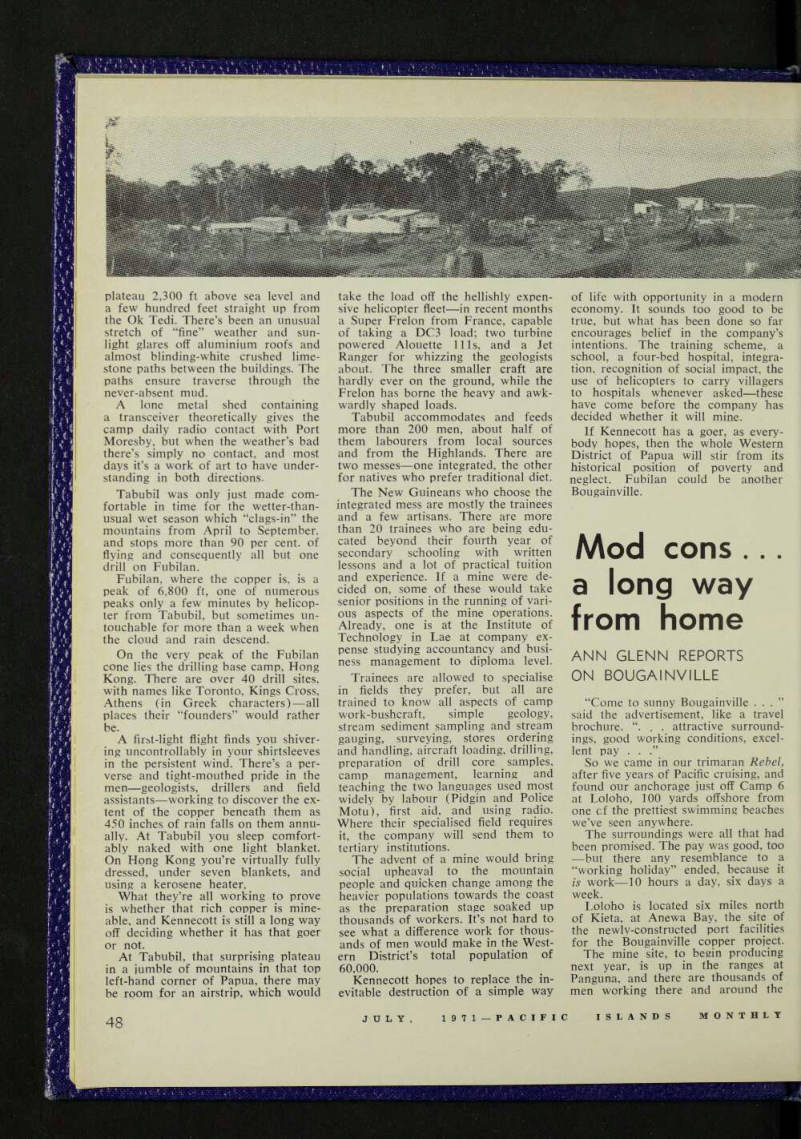
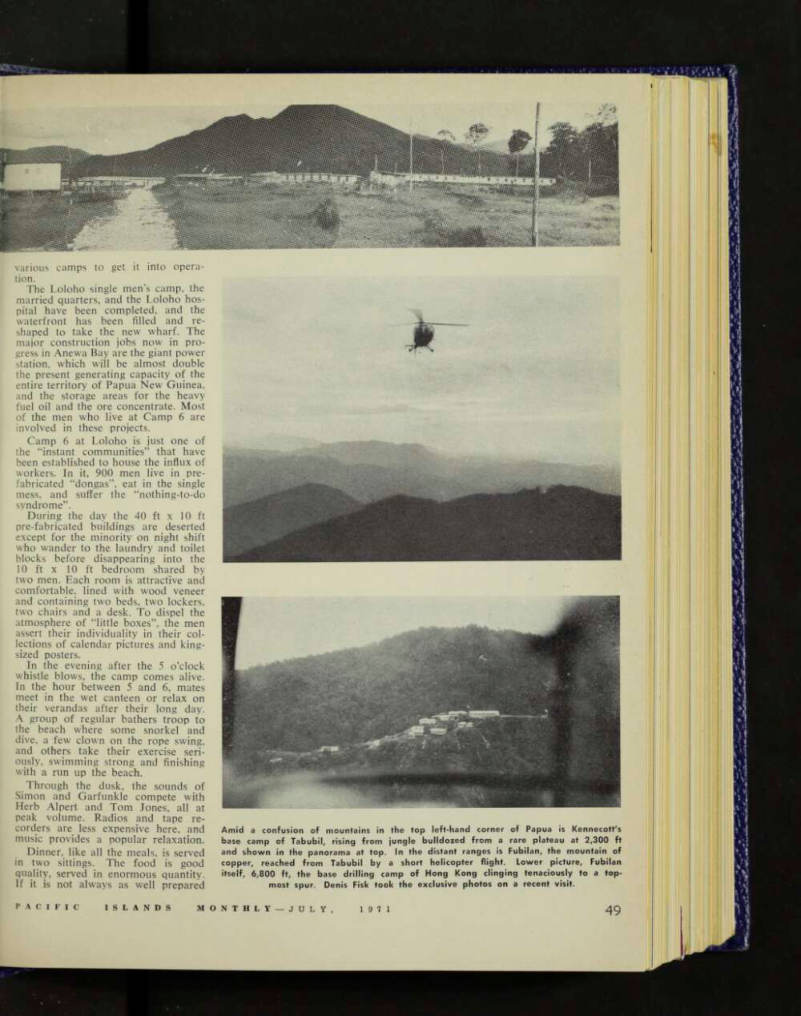
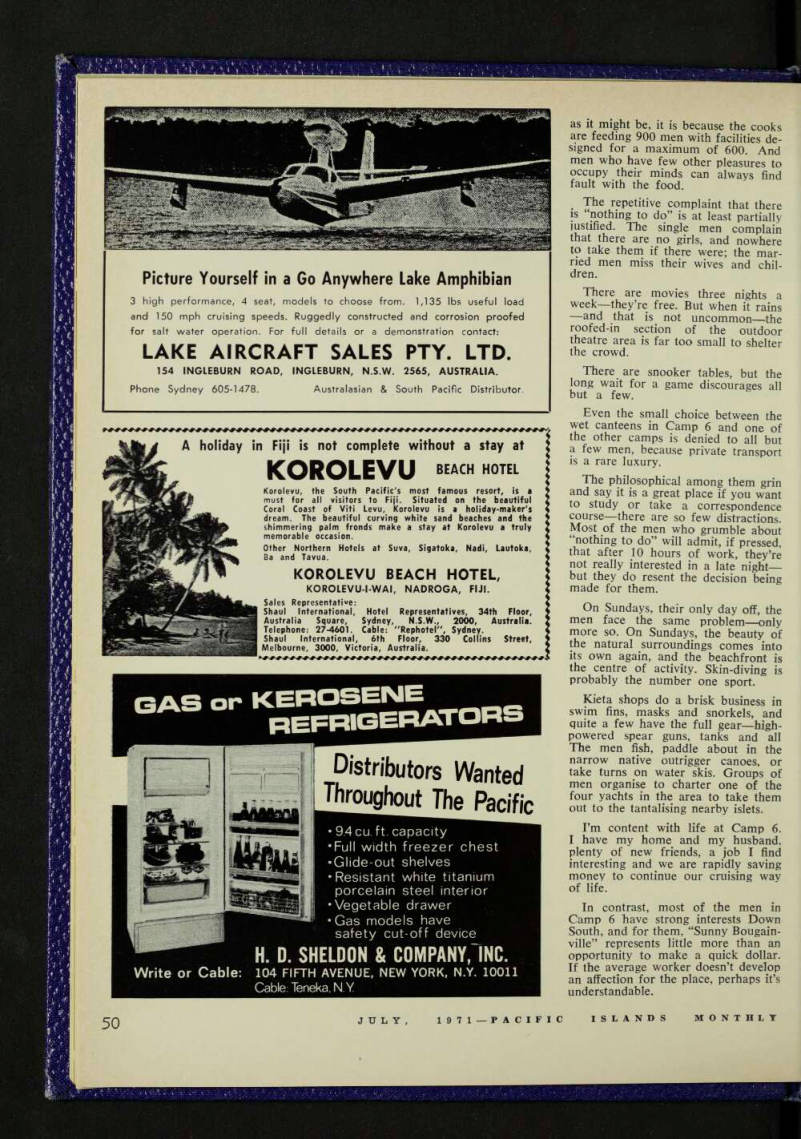
Amid a confusion of mountains In the top left-hand corner of Papua is Kennecott's base camp of Tabubil, rising from jungle bulldozed from a rare plateau at 2,300 ft and shown in the panorama at top. In the distant ranges is Fubilan, the mountain of copper, reached from Tabubil by a short helicopter flight. Lower picture, Fubilan itself, 6,800 ft, the base drilling camp of Hong Kong clinging tenaciously to a top most spur. Denis Fisk took the exclusive photos on a recent visit.
as it might be, it is because the cooks are feeding 900 men with facilities de signed for a maximum of 600. And men who have few other pleasures to occupy their minds can always find fault with the food.
The repetitive complaint that there is “nothing to do” is at least partially justified. The single men complain that there are no girls, and nowhere to take them if there were; the mar ried men miss their wives and chil dren.
There are movies three nights a week—they’re free. But when it rains —and that is not uncommon—the roofed-in section of the outdoor theatre area is far too small to shelter the crowd.
There are snooker tables, but the long wait for a game discourages all but a few.
Even the small choice between the wet canteens in Camp 6 and one of the other camps is denied to all but a few men, because private transport is a rare luxury.
The philosophical among them grin and say it is a great place if you want to study or take a correspondence course—there are so few distractions.
Most of the men who grumble about ‘ nothing to do” will admit, if pressed, that after 10 hours of work, they’re not really interested in a late night— but they do resent the decision being made for them.
On Sundays, their only day off, the men face the same problem—only more so. On Sundays, the beauty of the natural surroundings comes into its own again, and the beachfront is the centre of activity. Skin-diving is probably the number one sport.
Kieta shops do a brisk business in swim fins, masks and snorkels, and quite a few have the full gear—high powered spear guns, tanks and all The men fish, paddle about in the narrow native outrigger canoes, or take turns on water skis. Groups of men organise to charter one of the four yachts in the area to take them out to the tantalising nearby islets.
I’m content with life at Camp 6.
I have my home and my husband, plenty of new friends, a job I find interesting and we are rapidly saving money to continue our cruising way of life.
In contrast, most of the men in Camp 6 have strong interests Down South, and for them, “Sunny Bougain ville” represents little more than an opportunity to make a quick dollar.
If the average worker doesn’t develop an affection for the place, perhaps it’s understandable.