Fiji's A Beaut
pp. 47-49 · Read in the full issue

Place For
A Holiday
But
By Judy Tudor
Fiji is a beaut place for a holi day but, according to my reading of the newly revitalised Immigra tion Act, I’ve had my chips, having worked here on my normal busi ness for a couple of weeks (in this case revising the Pacific Islands Year Book).
I should now quietly move on, as the first 14 days is the limit a visitor is supposed to work in this country on the job in which he is “normally employed” outside it.
As it happens I’m going, any way—to that land of the free, New Hebrides—but if my work were unfinished I am supposed to hire myself a local journalist to com plete the job or apply for a permit to continue.
These lunatic provisions apply to anyone who comes here in the course of his business—overseas representatives, commercial travel lers, advertising salesmen, even people doing research.
It will be interesting to see how many jobs are created if any real attempt is made to police this one.
Most of the so-called new provi sions of the Immigration Act are rehashed from the 1962 Act, but in those bad, old colonial days a blind eye was turned conveniently on some of them, to the infinite benefit of Fiji.
For example, in the past wives of men who came in on work per mits were permitted to take jobs, if they could find them. Now de pendants of work permit holders must get work permits of their own and getting them makes the biblical passage of the camel through the eye of a needle look like minor league stuff.
Some of these women are talented persons in their own right, whose services should be welcomed by this developing country. They seem now to be doomed, during the currency of their husband’s short term con tract, to sit at home being bored to
death and probably giving their husbands hell as a consequence.
If, instead of working in a job, an expatriate wife attempts to start a small business, she still has to apply for a work permit and a permit to start a business. Her case will be considered on the basis of whether similar businesses al ready exist.
Women aren’t the only victims of this passion for localisation.
Dead-sets are frequently made at other members of local society who are performing a needed ser vice, for no other reason I some times think than that the framers of the legislation and those who put it to work are male as well as bumble-footed.
By Grace And Favour
Restrictive migration policies always have inbuilt side-effects and this one, in terms of stultification, won’t be different. With all the usual exceptions, the general level of efficiency in this country js about one-third that of Australia or NZ.
Investment above a certain sum in a Fiji enterprise, or independent means, gives residential entry and the people who, hopefully, are go ing to settle at Pacific Harbour, Deuba, doubtless come into this category.
The project has got government blessing and, after spending an average SUSI3,OOO on a block of land and that much and up-and-up for a house, these grace-and favour residents are hardly likely to want to settle for a tourist visa.
If all goes well, there should be several thousand foreign bodies living there near Deuba within a few years. The first 1,150 acres (out of a total 7,500 acres) have been cut up into 1,304 lots of from one-sixth of an acre to an acre. In May 200 lots had been sold, half of them in Fiji and the rest in UK, Europe, and Hong Kong. Australians and New Zea landers have to get the permission of their Reserve Banks for funds to buy foreign land, and only a few with overseas funds have in vested at Deuba. And, in spite of the fact that half of the people in Fiji will tell you that the place is designed as an American retire ment village project, none has gone to Americans except those who are already domiciled in Hong Kong or elsewhere. Some legal techni cality has to be overcome before the developers begin selling in North America, Under the terms of sale a house must be built within three years and therein, it seems to me, lies the first real problem. If 1,000 new landowners, or even the existing
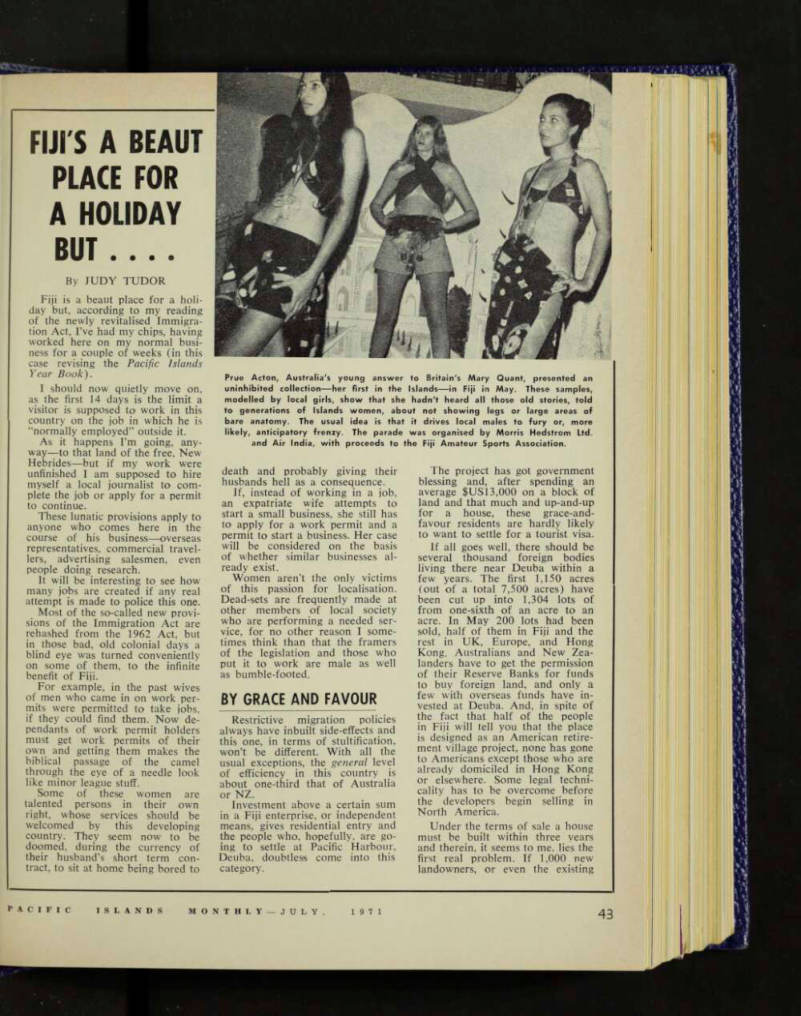
Prue Acton, Australia's young answer to Britain's Mary Quant, presented an uninhibited collection—her first in the Islands—in Fiji in May. These samples, modelled by local girls, show that she hadn't heard all those old stories, told to generations of Islands women, about not showing legs or large areas of bare anatomy. The usual idea is that it drives local males to fury or, more likely, anticipatory frenzy. The parade was organised by Morris Hedstrom Ltd. and Air India, with proceeds to the Fiji Amateur Sports Association.
200, all start to try to build their houses together, the work force of the local building industry, already stretched to the limit, is likely to crack off in the middle.
Meantime about a million dol lars worth of earthmoving equip ment is literally moving mountains at Deuba, or slithering around in the mud forming roads, digging canals or artificial lakes.
Whatever you might think of this sort of development you have to give the promoters an E-for- Effort and a great big O-for- Optimism.
Not only will they shape up the whole basic conception and put in most of the services, but they will supply plans to customers, build and even furnish their houses, maintain them and rent them to tenants when not required by the owners.
Against the Fijian background my heart quails at the prospect of the vast and ulcer-making job en tailed.
Obviously, great sums of money have already been sunk at Deuba —to such an extent it is hard to see how the scheme can be allowed to fail. Yet a lot of sound Fiji citizens still say they can’t see it getting off the ground. Mr. Jack Hackett, who has been govern ment PRO in Suva for the past 15 years or so is to join the company shortly. Probably part of his job will be to persuade sceptics that they are wrong.
Clean-Up Campaign
Suva now has some prestigious buildings, including the Develop ment Bank Building and the new National Provident Building which is situated out to hell-and-gone, on the edge of the city in Grantham Road.
It also has some that once were and are no longer. The Native Land Trust Board building, for example. There is no problem about localisation there—so far as I could see when I was there last week localisation is complete, with everyone a Fijian, all friendly, helpful types.
But what was really needed was a brigade with buckets and mops.
One row of tiles is missing from the top steps of the porch; the tiles of the porch look as though they have never seen soap and water; the two coffin-shaped receptacles that flank the porch, and which I imagine were designed as flower
boxes are full of desiccated earth and cigarette butts; the stairs and passage ways are grimy, with big blobs of black stuff here and there which I would say was dehydrated chewing-gum, except that, so far as I know, Fijians are not gum chewers.
Korotogo Strip
Meantime back at the ranch ... this ranch called Casablanca, pro nounced Thasamblantha, Queens Road, Korotogo.
When I left it, last November, the wet season had scarcely begun; when I returned to it in May, the wet season officially past (it is, in fact, still raining gallons) I ex pected anything—damp, mould, even that the house had slipped from its moorings on the hill.
There wasn’t and it hadn’t. The Fijian staff had kept the place spot less; the garden that was alterna tively a mud slide and a dust heap in November is now clothed from top fence to the beach in green lawn; the papaw trees are 10 feet high; the poinsettias are in bloom and the cannas grown into a forest.
An entirely satisfactory state of affairs.
We formerly had another, smaller house, at the end of the Korotogo strip and near the village, its Fijian name, “Vale Vulavula” (white house). We were finally driven from there by the village dogs which kept up such a racket at night that I, as a natural-born insomniac, rarely ever slept; and by our neighbours’ hens who cleaned up their own environment and then proceeded to clean up ours.
We bought many rolls of chic ken wire and fenced the whole two acres, but the hens and dogs burrowed under it.
We consulted the Sigatoka police who said: “We have exactly the same trouble ourselves. We throw stones”.
I resigned myself to rushing out at intervals, waving my arms and yelling like a banshee, whereupon flocks of hens would take off under or over the chicken wire, while our neighbours sat on their verandahs, fascinated at the sight, but im passive.
When, at a later time they were asked why the hell didn’t they keep their hens locked up, they said in surprise: “Hens! We wondered why the
memsahib sometimes ran up and down, calling out”.
The coupe de grace wasn’t ad ministered to the memsahib, as it happened, but to the sahib. He came home one afternoon and found three goats tethered to his gate.
Up at this end of the settlement the dogs are less numerous, no one keeps hens and so far none of our neighbours has got a goat.
But the house is again white and obviously can’t be called “Vale Vulavula”. Various Fijian circum locutions for “House on the Hill”, “Sea View”, etc., were tried, but didn’t fit. As a joke it began to be called Casablanca, it stuck and now it’s on a board near the front fence. Official.
But it’s a fool of a name for a house in Fiji where “c” is pro nounced “th” and “b” is always pronounced as though it had an “m” in front of it.
Expendable Coconuts
The coconuts right up and down this strip of coast and, for miles on either side, are being ravaged by rhinoceros beetle. Some now have died right out and it looks as though many more will follow. To the authorities our palms are ex expendable because it isn’t a copra producing area and no one can be spared for beetle control here.
It seems short-sighted. Coconuts are still part of the village diet; moreover, they are beautiful to look at and part of the scene. Most householders would gladly pay to have their trees treated, both for their own edification and as a con tribution to the beauty of the area.
What’s a tropical South Sea island without coconut palms?
Aquatic Lunches
Reef Lodge Hotel down the road has now dropped “Lodge” from its name and, after about a year of turmoil, has emerged face lifted, enlarged and as the latest resort on this coast.
Among its amenities are three swimming pools. A small one for small people, a large one for adults and a middling-sized one for those who like to mix business and pleasure. It’s slap-bang up against the snack bar and has submerged bar stools. Customers can sit there, up to their waists in water, while thp.v chew hamburgers or drink beer. Very cute.