Jimmy Stephens'
pp. 43-44 · Read in the full issue
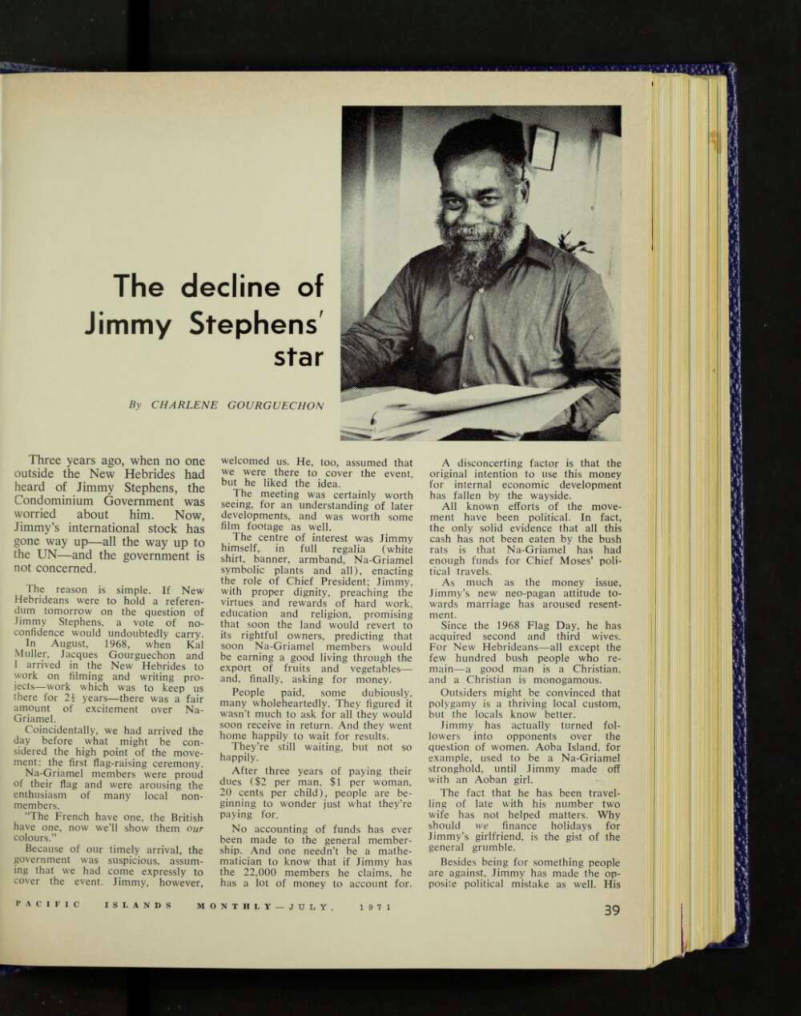
The decline of Jimmy Stephens' star
By Charlene Gourguechon
Three years ago, when no one outside the New Hebrides had heard of Jimmy Stephens, the rnnHnmini,.m rmrornmnnt Condominium Government was WOrnea about him. Now, Jimmy’s international stock has gone wav un all tho wav nn ™ • ana the government is not concerned. . u[ -j reason 18 simple. If New rlebndeans were to hold a referendum tomorrow on the question of JIITI Stephens, a vote of noconfidence would undoubtedly carry.
August, when Kal Muller, Jacques Gourguechon and i arrived m the New Hebrides to work on filming and writing prothere keep us amount of Excitement over 3 NjT Griamel excitement over Nau„a • a
? the
sidereH the hiah nnlnt tH 6 COn m d en^ d ,^ e fi^ h fl a P Na-Griamel members were proud of their flag and were arousing the enthusiasm of many local nonmembers.
“The French have one, the British have one, now we’ll show them our colours.”
Because of our timely arrival, the government was suspicious, assummg that we had come expressly to cover the event. Jimmy, however,
welcomed us. He, too, assumed that were there to cover the event, bu L he like s the idea> • , L T* 16 meeting was certainly worth seeing, for an understanding of later developments, and was worth some f°°tage as well.
The centre of interest was Jimmy himself ’ in full regalia (white shirt, banner, armband, Na-Griamel symbolic plants and all), enacting the role of Chief President; Jimmy, with proper dignity, preaching the virtues and rewards of hard work, education and religion, promising that soon the land would revert to its rightful owners, predicting that soon Na-Griamel members would be earning a good living through the export of fruits and vegetables— and, finally, asking for money.
People paid, some dubiously, many wholeheartedly. They figured it wasn ’ t much to ask for all they would soon receive in return. And they went home happily to wait for results.
They’re still waiting, but not so After three y ears of P a V in g their dues per man > $1 per woman, 2 P S ents per child), people are beginning to wonder just what they’re pa y in g for - No accounting of funds has ever been made to the general membership. And one needn’t be a mathematician to know that if Jimmy has the 22,000 members he claims, he has a lot of money to account for.
A disconcerting factor is that the original intention to use this money [ or i n , t I erna J economic development has fallen by the wayside.
All known efforts of the move ment have been political. In fact, the only solid evidence that all this cash has not been eaten by the bush rats is that Na-Griamel has had enough funds for Chief Moses’ poli tical travels.
As much as the money issue, Jimmy’s new neo-pagan attitude to wards marriage has aroused resent ment.
Since the 1968 Flag Day, he has acquired second and third wives.
For New Hebrideans—all except the few hundred bush people who re main—a good man is a Christian, and a Christian is monogamous, Outsiders might be convinced that polygamy is a thriving local custom, but the locals know better Jimmy has actually turned fol lowers into opponents over the question of women. Aoba Island, for example used to be a Na-Griamel stronghold, until Jimmy made off Wlth ao Aoban girl, The fact that he has been travel ling of late with his number two wife has not helped matters. Why wg finance holidays for Jimmy s girlfriend, is the gist of the general grumble, Besides being for something people are against, Jimmy has made the op posite political mistake as well. His
Jimmy Stephens
stand on temperance, while it may have merit, is not popular. The only New Hebrideans who consistently do not drink are the Seventh-day Adven tists.
There is always resentment towards an attitude with holier-than-thou over tones, and so rumours are current of the days when Jimmy was said to be quite a drinker himself—rumours of the past, and present suspicions.
In remoter areas of the New Hebrides, where people knew we had seen more of the Na-Griamel than they had, we were asked—among other questions, and often over a beer at the local co-operative—whether it was true that Jimmy was an abstainer.
We said we didn’t think so. How did we know? We related the following anecdote.
In April, 1970, two of the three in our film team, taking a walk in Suva, glanced through the open window of an out-of-the-way pub and recognised Jimmy, a beer in his hand. We greeted him.
He rushed outside, rather flushed and flustered, to tell us that he had not really been drinking, that he was there to meet a friend, that it would be good if we mentioned nothing of this in the New Hebrides, as people might misunderstand.
But we saw no reason for keeping secrets.
Though drinking is a relatively minor issue—money and women are not —serious dissent is arising from a change in Na-Griamel’s basic policy.
Three years ago, Jimmy advocated opposition to Europeans over land but nothing else. General opposition to the condominium was not part of the programme. Gradually, it has be come so, and many Na-Griamelers do not agree.
On north Ambrym a few months ago we witnessed a meeting between the people of several villages and the French Delegate, with Olsen Kai, Na- Griamel’s second-in-command, as opposition leader.
The delegate had come to offer condominium funds for a road which the Ambrym Islanders had already started to build, on their own initiative and with hand-tools only.
The Na-Griamel urged rejection of such funds —non-co-operation by not taking money from the Europeans.
The delegate explained that the money in fact belonged to the New Hebrideans, that even those present had contributed, knowingly or not, through export duties on their copra.
The leaders of these villages being firm Na-Griamel supporters, the offer was politely refused. The delegate packed up his money and left. But there was some heated discussion dur ing the next few days.
There were numbers of people who felt that turning down money for road equipment was not the direct route to progress. And when, moreover, will the Na-Griamel be able to make a similar offer?
North Ambrym, like Aoba, used to be a Na-Griamel stronghold.
Overall, these days, New Hebri deans are developing an image of Na- Griamel as something that has no direct significance for them, and pro vides no direct benefits. Those who pay, as several Ambrym Islanders ad mitted frankly, often do so as a form of insurance. For $2, a man can afford to bet against the odds.
Few are convinced of the value of Jimmy’s trips abroad, New Hebri deans generally favouring economics over politics. They associate this par ticular way of spending money with Europeans.
And that observation reminds them of a fact they were willing to over look three years ago: Jimmy is nart- European, also part Tongan. I no olsein mifala, some are beginning to say; he’s not one of us.
Those who know the story of the rifles are beginning to dredge that up, too, and repeat it.
It seems that once, before the birth of Na-Griamel, Jimmy took money from a number of people, promising rifles. The rifles were never delivered, the money was never seen again, and Jimmy wound up in gaol.
The decline of Jimmy’s star, even near Na-Griamel’s headquarters vil lage on Santo, was seen recently in a meeting over a land dispute.
Locals, representatives of the French society which owns the land in question, and government officials were present.
Jimmy took the floor and proposed to speak for the people, whereupon a government official demanded, “And who are you to speak for the people? Who gives you the right?”
Jimmy searched the eyes of his “supporters”, seeking support. But no one said a word. He sat down, silenced.
The Condominium Government, known for attempting little and bung ling much of that, was for once politically right in not taking action on Na-Griamel. It could have put obstacles in Jimmy’s way. But it chose to let him get in his own way, in his own good time, and that is what he is doing.