The Boom
p. 55 · Read in the full issue
At Last?
Judy Tudor Reports
On Rennell
Hard-pressed government officials in the Solomons have been hoping for years for something that would give the protectorate economic lift off. They now think they may have got it.
It won’t be copper, but bauxite on Rennell Island, believed to be in the order of 30 million tons, with enough proved for 10 to 12 years at an ex traction rate of 1.5 million tons a year. If all goes to plan, mining should begin in 1974.
Although the preliminary agree ment over the exploitation of Ren nell’s bauxite has been signed between Japan’s Mitsui and the British Solo mon Islands Protectorate Govern ment (PIM, June, p. 127), it is ex pected that it will be months before legal advisers have dotted all the i’s of the final agreement.
Nonetheless, what has already been achieved is sufficient for the com pany to go ahead with trial mining; with a smallships wharf at Rennell to commence in October when the South-East season with its big swells dies down; and with the building of a road up the cliffs of Rennell, which is an upthrust atoll.
Trial mining is regarded as neces sary to establish the cost of opera tions. Rennell bauxite has a very high moisture content and mechani cal drying will be necessary before shipment. On the other hand, the bauxite is extremely low in silica content which makes it easier to handle, as silica must be removed during the processing of bauxite into alumina. (Rennell silica content is .25 of 1 per cent, while Australia’s Gove bauxite is 3.2 per cent, silica and Weipa 4,7 per cent.) The BSIP Government is hopeful that Rennell bauxite will not only be dried on the island but will re ceive its first processing there to turn it into alumina.
The second stage of processing, from alumina to the aluminium of commerce, requires masses of cheap electrical power and is out of the question on Rennell.
Unquestionably it would be cheaper
There is no world price for bauxite as those who mine it also process it into aluminium. However, if the f.o.b. price of the Rennell bauxite is fixed in the region of 54.50-55.30 per ton, as thought likely, the BSIP Government should get (on an ex traction of 1.5 million tons) some thing like $356,000 a year from royalties, and the landowners some thing like $18,500 annually.
In addition, although the mining will be mechanised, there probably will be jobs for about 170 Rennellese working under a few top Japanese executives and engineers.
It’s expected installation costs will be in the vicinity of $14.3 million, including the cost of a port at $5 million. Because of the physical nature of Rennell it will be necessary to load from mechanised overhead equipment into bulk carriers.
The BSIP also has a bauxite pros pect at Vanguna in the New Georgia Group. If these deposits proved economic it might be the factor that would make a first-stage refinery on Rennell possible. CRA has a two-year extended prospecting licence over the area, and at the end of it, will have to come up with a proposition or pull out.
Through CRA, Japanese companies have already shown an interest in the New Georgia leases. Another Japanese consortium, Aluminium Re sources Development Co. Ltd., is also expected to send a survey team there later this year. The doubt about Van guna is that the bauxite is of much poorer quality than Rennell’s.
to take the dried bauxite to Japan and process it into alumina there, so whether Rennell gets its refinery de pends on how much more it costs to do the first stage of processing there. If Mitsui and the BSIP cannot agree on whether the additional cost is reasonable, provision is made for an independent arbitrator to decide.
One of the reasons why the gov ernment is anxious that the first-stage refinery be established on Rennell is that residue from the processing could then be used to fill in the old workings.
The deposits are all on the north west section of Rennell, making the 600 people living there the luckiest in the BSIP.
They will, each man, woman and child established there at a certain date, get $4OO as a disturbance allow ance—the money paid to minors go ing into trust accounts for them. (Children born subsequent to the fixed date, now past, will not get anything.) In addition, as the workings eat up their gardens and land the people will be compensated for these and for any buildings.
The company will, moreover, build them a model village elsewhere, with school, clinic, club, shops, sports ground with swimming pool.
When the bauxite is worked out, landowners or their heirs will get their land back, and so that there will be no hanky-panky when that time comes, a government lands officer has been stationed on Rennell for some time, registering land.
As well as having shares in the company to be formed (Mitsui Smelt ing and Development (BSIP) Ltd.) the BSIP Government will get a 5 per cent, royalty on the f.o.b. price of the bauxite and of this royalty, the landowners will get 5 per cent.
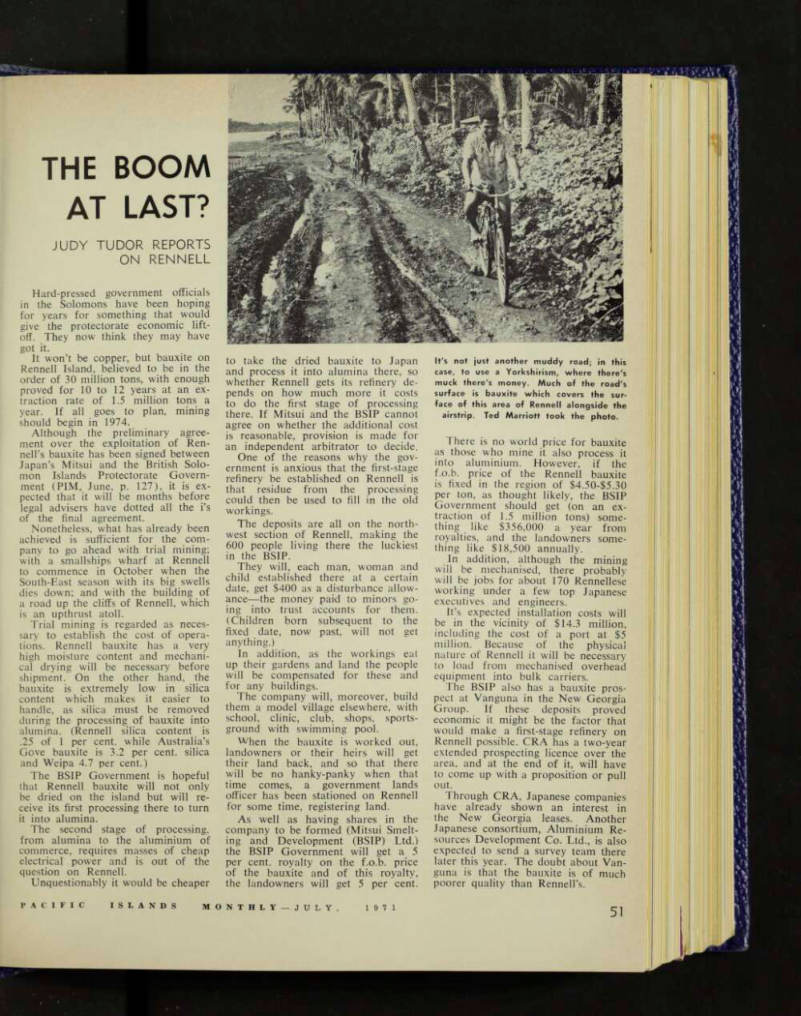
It's not just another muddy road; in this case, to use a Yorkshirism, where there's muck there's money. Much of the road's surface is bauxite which covers the sur face of this area of Rennell alongside the airstrip. Ted Marriott took the photo.