big time
pp. 56-61 · Read in the full issue


Big Nambas are moving into the big time
People who have heard of the New Hebrides (but haven’t been there) tend to imagine the place as a kind of living museum of primitive Melanesia—in which the Big Nambas of Malekula are the prime exhibit. Few have heard of the Small Nambas.
During the heyday of the Big Nambas, when warfare was serious, they were publicised in popular books and articles by daring explorers.
Armchair explorers thrilled to photos of mysterious cannibal smiles.
More recently, their publicity has come from daring tourists, who still bring back reports of cannibal smiles, and from travel agents who promise that while the Big Nambas are still as primitive as ever, they’re really perfectly harmless.
Travel agents present the Big Nambas as perhaps the only group in the New Hebrides to have success fully resisted European culture. They are advertised as being friendly to Europeans now, but nonetheless as keeping to their own timeless Mela nesian ways, complete with exotic costumes, exotic dances, exotic rituals tambus.
One seemingly logical question is never raised: how could they have kept their society intact, given the influence not only of tourists but of missions, government and money?
They couldn’t have, of course—and they haven’t.
The popular image is not entirely false, just somewhat outdated. The
Big Nambas have indeed resisted ac culturation for scores of years. But now that resistance has become super ficial.
Most Big Nambas still wear their big nambas at home (a good thing for tourists, who are often interested only in the decorative trappings of Mela-
Charlene Gourguechon, mem ber of a film-making and writing team that has spent the last two years in the New Hebrides, here reports on the changing ways of the Big Nambas people of the New Hebrides—probably the con dominium's most widely publicised "primitive" group.
But she also tells of the least publicised group, the Small Nambas, who inhabit the same island, and who are more than content to remain in the back ground.
nesian culture, anyway), but they prefer shorts and a shirt for a walk to the Norsup plantation.
They still drink kava, but at least as much for the physical effect as for the old religious reasons. They still have sorcerers, but go down to the dispensary on the coast when they are ill. They make traditional carv ings now as often for sale as for traditional purposes.
The tambus that still exist are be coming soft around the edges. Though the important ceremonies and dances remain, much of what they used to represent has been lost. Only disparate fragments are left. They are no longer the parts of a whole.
The rules have been relaxed even with regard to women. Women should never remove their wigs in the pre sence of men; they do. Theoretically, women are supposed to crouch down low and cover their faces when they encounter a man along a footpath; they don’t—and younger women prob ably don’t even know that they’re sup posed to.
Not only are traditions disintegrat ing, but so is the group itself.
Kali, regent during the youth of
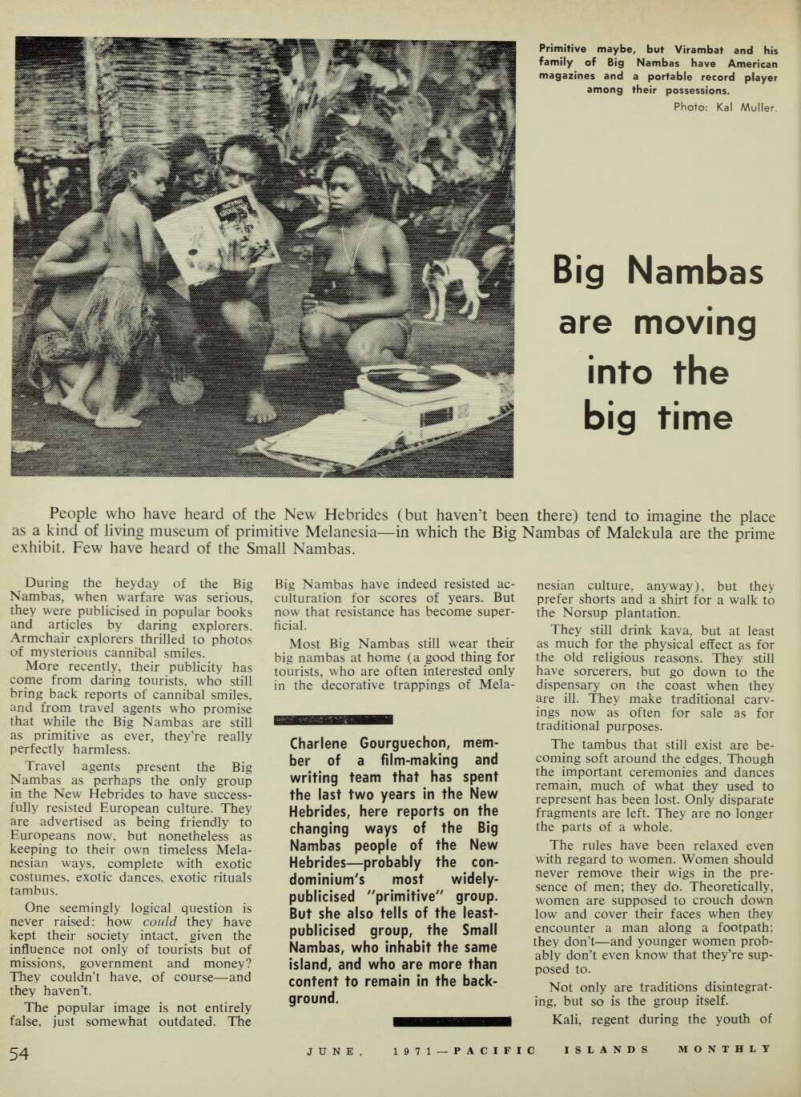
Primitive maybe, but Virambat and his family of Big Nambas have American magazines and a portable record player among their possessions.
Photo: Kal Muller,
the present chief, Virambat, and his uncle as well, set an example which many others have been following. A redoubtable ruler in his day, Kali has since gone down to the coast, turned Christian, and now runs a co-opera tive store. When he goes back to Amok to visit his nephew, he keeps his shorts on, though he isn’t above indulging in a bit of kava drinking away from the mission.
Every year now, people leave the plateau and tradition for the coast and missions or plantations. Some come back and go down again, nambas to shorts and shorts to nambas. But each trip brings them closer to a final break from the old life.
Virambat is trying to hold things together in Amok, the main Big Nambas village, but he realises that certain compromises must be made.
If he is too traditional, he will lose his authority, because people have new ideas, new doubts and new desires. If he is too modern, he will lose his authority, too, because it rests on the fact that he is a hereditary chief.
He has already lost a good deal of his personal influence over the last few years, and the fact that he knows it is making him far less forceful than he used to be.
He has a healthy respect for gov ernment, because it is obvious that well-placed government officials have more power than he has. British and French district agents have been vying for his favour, a competition which has served to bolster his self-confi dence a bit.
The British official (whom Viram bat seems to like) wanted to start a school on the plateau. No, said the chief, the plateau must remain a place “belong custom”. But so that his “no” might seem a little less negative, he offered to send one of his sons to the British school on the other side of the island.
The British district agent proceeded to suggest the building of a road up to Amok as a means of keeping the pop ulation from descending to the coast.
With a road, a cash crop could be planted and transported; people could earn money without leaving home. At the same time the French delegue suggested opening a co-operative store in Amok; if people can buy anything they want in the village itself, they won’t go down to the coast.
The French official (whom Viram bat seems not to like, but whose idea he found more glamorous) won. The co-operative has been inaugurated.
How long it will last and what good it will do is anybody’s guess, con sidering the problem of transporting cargo from the coast with no road and considering the fact that money with which to buy things at the store still must be earned at the coast— where there are stores, too.
The mission influence is less direct, but it exists. Though Christianity has not yet been officially accepted at Amok, most of the Big Nambas who set out to seek their fortunes become Christian. Naturally, they carry the message back home.
The Big Nambas are less impressed by mission teachings than by the mis sion authority they have come to respect.
Virambat recently sat in judgment, as chief, over a dispute regarding compensation for a murder. When did the murder take place, I asked him.
Long time little bit now. One year?
Two years? No, 18 years ago, it turned out—truly a traditional kind of dispute.
But Virambat was not capable of resolving it in the traditional way.
Neither side would accept his deci sion. So, a mission teacher (who, like Virambat, holds the honorific govern ment title of assessor) was summoned from the coast to act as associate judge.
But the effects of government and missions have been accumulating for many years. What is undermining the society more efficiently at present is the growing desire for things that only money can buy. There are a good number of bush knives, axes, sauce-
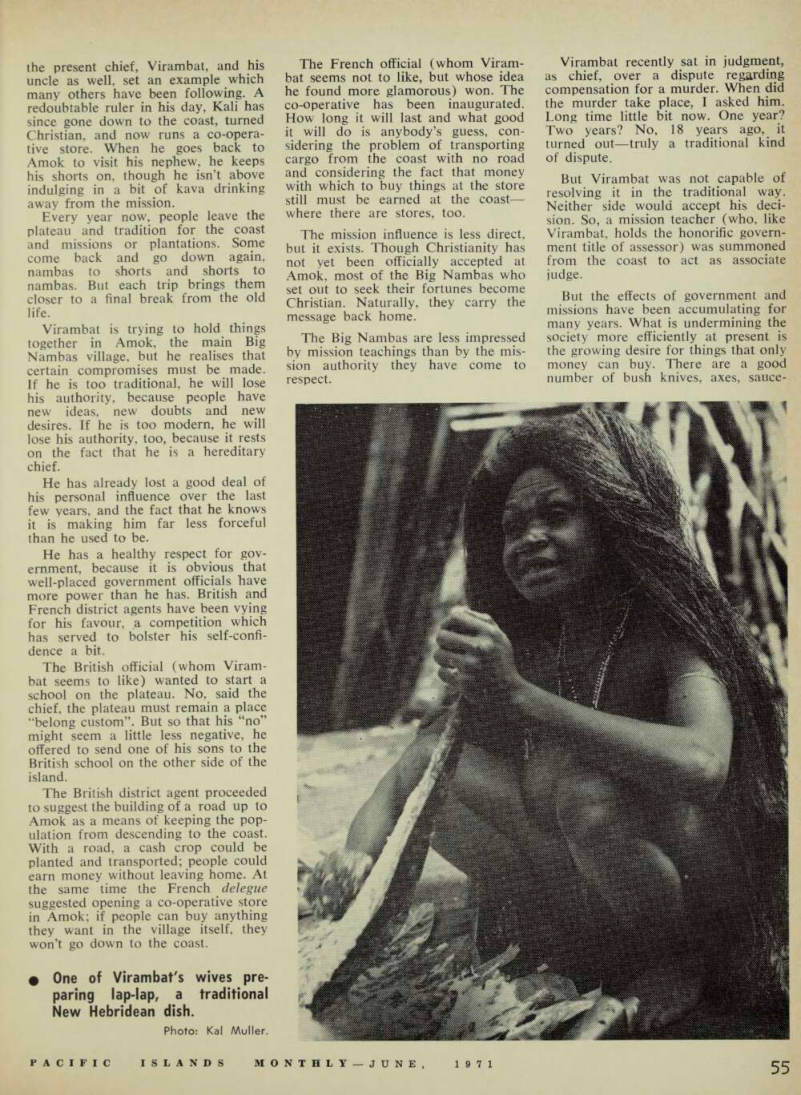
One of Virambat's wives pre paring lap-lap, a traditional New Hebridean dish.
Photo: Kal Muller.
Bride-price
pans, tobacco sticks, tins of meat and fish, kerosene lamps and torchlights, blankets and bits of calico to be seen around Amok.
A little whisky, or a few cart ridges, are most desirable; cartridges being illegal without a firearms licence and hard liquor being illegal in any case, a fair amount of hard cash is necessary to satisfy these desires.
Virambat, being human, is quite as taken with material goods as the others and, being chief, possesses even more. He proudly brings out a small transistor radio and tunes in Noumea or Australia. Then, because the re ception isn’t what it might be, he proudly brings out a large transistor radio.
Money is replacing pigs in many traditional dealings, though often there is still a combination of both.
Virambat is asking 10 tusked pigs and $5OO as bride-price for his eldest daughter, but if offered a thick roll of bank notes, he would probably forego the pigs.
The girl, Witarambat, is certainly worth more than most brides. Besides being the custom chiefs number one daughter, she is easily the prettiest girl in north Malekula. (She’s so bored by tourists wanting to photo graph her that she usually turns a sullen face towards the camera. The tourists don’t notice. It isn’t her face they focus on.) Witarambat should have been mar ried at least two years ago. Her younger sister was married last year.
But $5OO is a lot of money to raise.
It means quite a number of days of sacrifice to plantation work. Or, pos sibly, it means a troupe of tourists with bulging billfolds who will pay $5O for a hastily-carved femwood figure, $25 for a poor but authentic pig’s jaw, $l6 for a round-trip guide, the same for a porter, and anything for a photo, depending on how much they want one.
The Big Nambas are ambivalent about tourism. They like the idea of the money, but they don’t much like the idea of having the tourists around.
They charge too much and give too little in return, not because they want to discourage tourists, but because they know nothing about the advan tages or disadvantages of tourism and don’t know how to handle the situ ation. But they are mercenary.
The mercenary sense is becoming so acute that an unprecedented act has
Dim future
finally taken place: thievery. A visitor recently left $BO in Amok’s guest house and returned to find the money missing.
The honesty of Virambat is always unquestionable. It was he who put his finger on the thief and forced him to confess, justice being justice even though the culprit was Virambat’s own brother. Ten dollars were re covered; the other 70 had somehow been spent.
The future of the Big Nambas as a viable society is very dim indeed. Try as Virambat may to live up to his rank—descendant of powerful chiefs, son of Nisai, grandson of Tusai— there is little he can do. He is also a nephew of Kali, who realised early that the old forces could not com pete with the new.
Only the picturesque veneer of tra ditional culture, the costumes and dances and carvings, are likely to re main, if tourism makes them profit able enough.