Fence
pp. 51-55 · Read in the full issue
DO
Them
IN!
Since the rest of the world discovered the South Seas and aircraft annihilated distance, the Islanders have been looking over their shoulders at the increasing tide of tourists and asking: “Is our culture in danger?”
It is. It couldn’t miss. By a pro cess as subtle as osmosis, by rub bing shoulders with the outsider, by imitation and a-hundred-and-one other processes, the Islander, be he Fijian, Tongan, Samoan or what have-you, is going to absorb some of the foreign culture at the expense of his own. He absorbs some of the vices of the foreigner. So why not some of the culture! It happened in Hawaii. It’s inevitable, but tourism’s impact can be cushioned.
Fence ’em in. Like in Hawaii, for instance.
Recently Pan American, American Airlines, the Hawaii Visitors Bureau and the United States Travel Service combined to organise several seven day educational tours of Hawaii for tour agents from Australia, and I was invited too. And jolly good tours they were.
They mirrored to perfection the American art of installing the Ameri can way of life—the gilt-edged var iety—anywhere on earth and veneer ing it with a spot of local colour and culture.
That way, you can enjoy the thrill of visiting new lands and seeing new peoples without getting homesick— or catching a disease.
And that’s not knocking tourism in Hawaii. There they’ve brought it to a fine art. They’ve got palatial, well-run hotels all over the place; beautiful white, yellow and black beaches—some of them home-made, like Waikiki—fine entertainment of every sort; good air communications and, what’s maybe the most import ant thing, good value for money.
You can get a 17-day air tour from Sydney to Hawaii, taking in resorts on several islands in the group, for a few cents under $6OO.
If you don’t like being shepherded, you can make your own travel plan and stay at any one of the opulent piles in Honolulu before taking rea sonably-priced air trips to Hawaii Island, or Maui, or Kauai.
At most of the hotels, including famous names like the Ala Moana, the Halekulani, the Ilikai and the Royal Aloha in Honolulu, the Kona Inn and the Kona Hilton on Hawaii, the Maui Hilton and the Sheraton Maui on Maui and hundreds of others, there is five-star accommo dation for, in most cases, as low as SUSIS a day for a double room.
Three of you in the room will cost only about another $4, Meals are
reasonably priced and almost always good, and there’s nothing tatty about the entertainment.
Of course, you can pay more. The Kahala Hilton, which admittedly hasn’t got a peer in the whole of the South Pacific, has suites at SUS24B a day!
It all adds up to one of the finest tourist centres in the world. And there is a lesson in it for the South Pacific.
Those who are scared of tourism blighting the cultures of the Islands invariably quote Hawaii as the tragic example of what happens to a people’s culture when the tourist, aided and abetted by the giant finan cial corporations, sets foot in an island paradise.
They say that, when the rubber necking visitor comes in through the door, culture, like love, flies out the window.
Which isn’t strictly true. It’s an over-simplification.
There is little left of the original Hawaiian and the only culture the
Staff writer John Carter, after a look at Hawaii, suggests to Pacific Islanders who might be appre hensive of the influx of tourists . . .
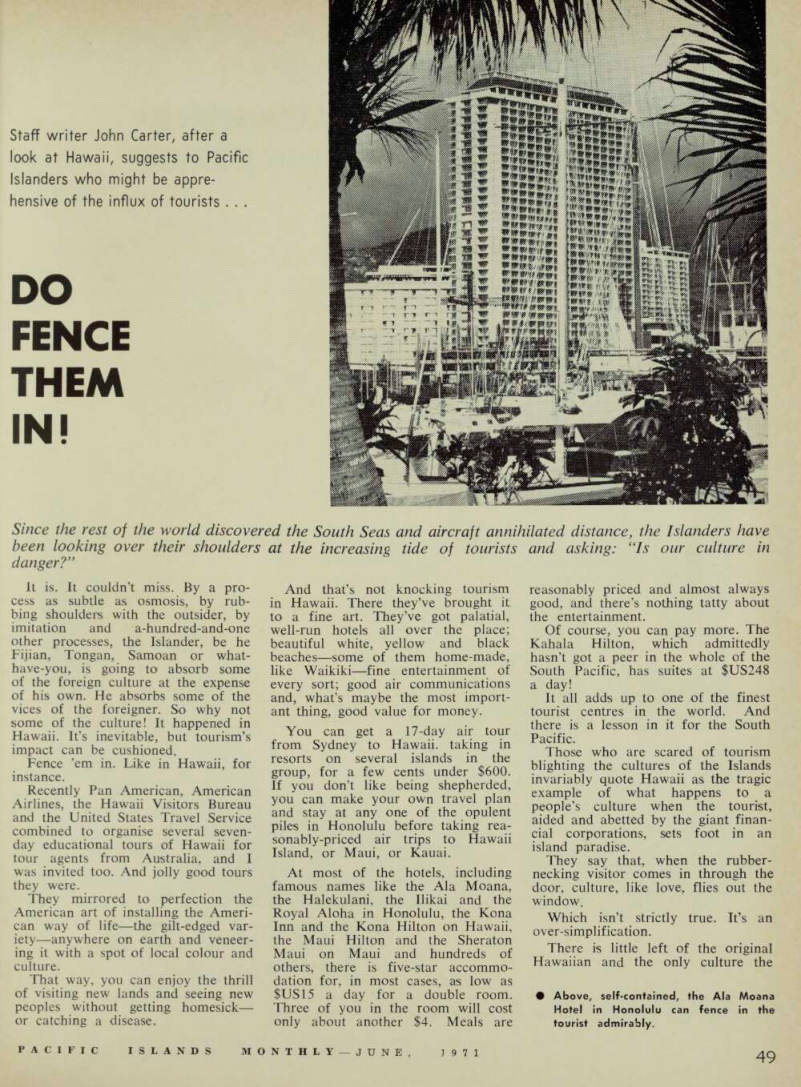
Above, self-contained, the Ala Moana Hotel in Honolulu can fence in the tourist admirably.
Hawaii's charm
tourist sees that is genuine Hawaiian is that preserved by the Bishop Museum, or contained in tiny oases on the fringe of the tourist resorts and existing for the tourist’s benefit.
Maybe, without the tourist, those oases would dry up!
But it can be argued that tourism didn’t kill Hawaiian culture. Integra tion did.
One of the great charms of Hawaii is its multi-racial character. There are Hawaiians, Japanese, Chinese, Americans (and Americans are a mixed lot anyway) and others from the Polynesian communities over which waves the Stars and Stripes, There may be Eskimos as well.
Now they’ve intermarried so that, today, most families have relatives in a dozen different countries. On the surface, at any rate, there are no racist undertones in Hawaii, but, on the other hand, there are few pure Hawaiians. The removal of barriers of race and blood has prevented the worm of racism from eating its way into the Hawaiian apple, but at what cost? Hawaiian culture! Few people of mixed race, busy with the job of daily living, would exert themselves to keep a culture belonging to, may be, only a quarter of their families.
It could in fact, be argued that tourism has managed to preserve the little that remains of Hawaii’s native culture by featuring examples of it in its tourist attractions.
Take the island of Kauwai. On the Wailua River there is a small wharf and from that wharf 40, nay, 50 times a day there depart large launches holding anywhere up to 150 camera-toting, chattering tourists.
The river cruise was started after World War II by a local by the name of Smith. He was more romantic than his name. His launch crews, in the main, Hawaiians, entertain the passengers with romantic Hawaiian songs, and there’s usually a hula thrown in, though the hip and ventre convolutions don’t look so good in a dress or jeans.
The destination is the thing, though—the Fern Grotto in the mid dle of a forest of tropical ferns. No matter that it’s approached along a concrete path edged with kerosene flares and you are herded in pro cession—it’s still romantic, especially if you come from Hoboken or Bos ton, Mass.
As you stand in the grotto, your crew, well below you, sings the hauntingly beautiful Hawaiian Wed ding Song. It’s guaranteed to melt the hardest heart and you come away with the feeling that you’ve penetrat-
A back-scratcher
ed the heart of Hawaii. You haven’t, of course, they’ve merely fenced you in.
Then again, most resorts are mas sive complexes; two or three big hotels, houses for the help, curio shops, clothing, jewellery shops, steakhouses —and blue Pacific rollers which break upon lovely beaches.
What could be more romantic. At night there’s entertainment in the hotels—the hula by experts, Hawai ian songs, guitars, Hawaiian food and a drink called a maitai, a con coction of three types of rum, with fruit juices, a slice of pineapple, a glaced cherry and, once, a back scratcher—honest!
But the tourist enjoys it all and goes home to tell his neighbours and clubmates that he has seen the real Hawaii and absorbed some Hawaiian culture. Not for a moment does he realise he was fenced in. He didn’t see the real locals in their village up the road, and most of the locals didn’t see him either.
Perhaps that was all to the good.
Maybe the tourist’s habits didn’t rub off, even the minutest particle, onto the local.
Meanwhile, the South Pacific Islanders are still worried about their tourist boom.
Nowhere is it expected to boom more than in Fiji. Her rulers, how ever, are determined to make the in dustry their handmaid and not their master.
Fiji’s Prime Minister, Ratu Sir Kamisese Mara, said recently: “We are very much aware of the develop ment of tourism in Hawaii which seems to have run away from their control and is determined mainly by booking agencies on the mainland, and this is what we are afraid may happen in Fiji.
“While there is so much variety of scenery and culture in Fiji, we would like the development of these to be under the control of local people rather than importing over seas agencies to do it for us.”
Tamasese Lealofi, Western Samoa’s Prime Minister, said much the same thing at the same time.
“We realise that the tourist in dustry could help us,” he said. “We like tourist money but we also feel we must go slow in this matter and be careful that the on-rush of tour ism does not over-run and spoil our culture and way of life too quickly,”
All very reasonable. But if tour ism in the South Pacific does look like getting out of hand, the Island ers might like to take a closer look at Hawaii’s method. Fence ’em in and keep everybody happy.