The Editor's Mailbag
pp. 40-46 · Read in the full issue
Those happy, Ha'apai days
Sir, —It was interesting, I am sure, to many old hands to read of Henry Krone’s memories of old happy days in Ha’apai (PIM, Mar., p. 123).
Wtih regard to the Makamaile, the late Walter Murley told me she was Ralph Stock’s “dream ship”—l did not know she was Jack London’s Snark, but as Henry has been aboard her, he ought to know. I have three pictures of her, one at Vavau wharf, and two when she was wrecked in Ha’apai. Perhaps someone else knows more about this. I met a man in Queensland last year whose uncle sailed with Ralph Stock in The Dream Ship and he asked me for a picture.
I knew most of the people Henry mentions, and a lot of colourful char acters they were—but then only colourful characters would have been brought up in a place like Ha’apai, Tonga Islands, at that time.
Darky George, the West Indian negro he mentions, had a very high pitched squeaky voice, and always called himself a white man. He was, in point of law, right, for there was no category for persons of his descent, so he was tossed in with the Euro peans.
Darky was eventually gathered to his (foster) fathers, and his daughter, Sarah, reigned in his stead in the bakehouse. Sarah married in Ha’apai, and their descendants are probably there to this day.
Darky went to Tonga once, and a trader going down the wharf met him on his return and asked: “Any white men come up from Tonga, George?”, and Darky squeaked, “No, only me!”
There were countless tales about him.
Then there was the stately and well loved Captain Frank Cunningham, the harbourmaster, who tried to live up to his grandiose and honorific titles, that Henry mentions, and certainly cut a great dash with visiting ships.
Frankie was very particular about ceremony, and everything had to be just right. When he had to go out to visiting vessels he would dress up in his uniform, very stiffly starched (this had a utilitarian purpose), his boys meanwhile having had the launch scrubbed and polished and shining like a naval pinnace, and when every thing was ready Frankie would issue forth, with all his insignia dazzling,
shoot his cuffs, and go aboard like an admiral boarding his flagship.
The hospitality on those ships was very generous, and when the time came to go, Frank would stand up, full of dignity and the captain’s hos pitality, shoot his cuffs again, and go off home in his launch, his duty done for another month or two.
One of those captains once told me how impressed he was with all this panoply and said he felt it was an honour to himself and his ship for, in Australia, for instance, officials came out in civilian clothes, and often scruffy ones at that. So Frank not only brought honour to the visiting ship, but also to himself and to Tonga.
Eventually time caught up with Frankie, and he passed away sud denly. It was then discovered that there was no suitable minister on the beach, and the good Patele Etuate (Father Edward) was pressed into service; so poor Patele Etuate not only had the unhappy duty of con signing his old friend to his Maker, but also of threading his way through the (at that time) unfamiliar English ritual.
Mourners present said how well everything was done, which would have pleased Frankie, a stickler for punctilio and the fitness of things. I sometimes think of Frankie (rever ently, I hope) confronting St. Peter and looking around to see that all the trumpets were gleaming, and all the harps shined and polished. We may never see his like again.
The good Patele Etuate was Father Edward Tremblay, S.M., and he was a character in his own right, for he was a man out of time in Tonga at that period. He belonged to an earlier age like St. Paul with his tent making, or the worker priests of to day, for he was a man very clever with his hands, being a carpenter, stonemason, bricklayer, builder —you name it.
I came upon him once, clad in an old singlet and a pair of khaki pants, underneath the church, and with his abundant black hair full of shavings and sawdust, engaged in building a boat. This was quite a feat, for there was practically no material available for such a purpose on a flat island
Continued on p. 40
like Lifuka, and he had either to make it himself, import it. or go with out.
This vessel was eventually com pleted after a great many delays, and as the Fetu*iTmoana (Star of the Deep Blue Sea) —a Ha’apai name—she served him for many years, bringing supplies and visiting outlying islands, until in the course of time the reefs caught up with her, too.
Another claim to fame that Patele Etuate had was that he was one of that fortunate (or unfortunate) band who, along with Mr. Aidney and Mr.
Hettig, was aboard the sailing ship Melrose when that vessel, under the skilful Captain Fred Klebingat, got away from the fateful Hakau’fisi Reef before the gale which drove them for three weeks before it, until they found themselves at the Kermadecs, north of New Zealand.
They were lost for a month and we all thought they were gone for good, as the Melrose had no radio, and no one knew what had happened until they eventually beat back to Ha’apai.
They were going to Niuafo’ou (Tin Can Island), but nearly finished up in New Zealand.
About a month later the Mesna packed up on the Hakau’fisi Reef— a beautiful white Swedish ship. Every body was very sorry about that, for apart from the loss of the vessel, the captain was a very young man, and it was his first command.
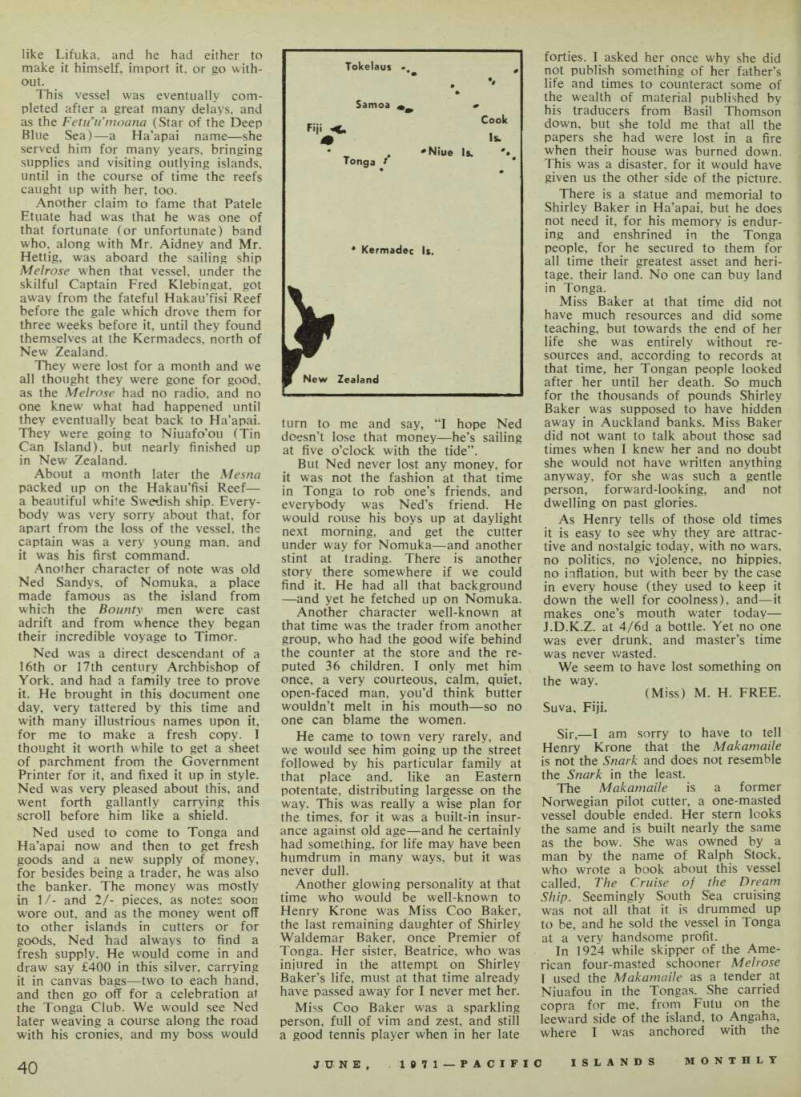
Another character of note was old Ned Sandys, of Nomuka, a place made famous as the island from which the Bounty men were cast adrift and from whence they began their incredible voyage to Timor.
Ned was a direct descendant of a 16th or 17th century Archbishop of York, and had a family tree to prove it. He brought in this document one day, very tattered by this time and with many illustrious names upon it, for me to make a fresh copy. I thought it worth while to get a sheet of parchment from the Government Printer for it, and fixed it up in style.
Ned was very pleased about this, and went forth gallantly carrying this scroll before him like a shield.
Ned used to come to Tonga and Ha’apai now and then to get fresh goods and a new supply of money, for besides being a trader, he was also the banker. The money was mostly in 1/- and 2/- pieces, as notes soon wore out, and as the money went off to other islands in cutters or for goods, Ned had always to find a fresh supply. He would come in and draw say £4OO in this silver, carrying it in canvas bags—two to each hand, and then go off for a celebration at the Tonga Club. We would see Ned later weaving a course along the road with his cronies, and my boss would
turn to me and say, “I hope Ned doesn’t lose that money—he’s sailing at five o’clock with the tide”.
But Ned never lost any money, for it was not the fashion at that time in Tonga to rob one’s friends, and everybody was Ned’s friend. He would rouse his boys up at daylight next morning, and get the cutter under way for Nomuka—and another stint at trading. There is another story there somewhere if we could find it. He had all that background —and yet he fetched up on Nomuka.
Another character well-known at that time was the trader from another group, who had the good wife behind the counter at the store and the re puted 36 children, I only met him once, a very courteous, calm, quiet, open-faced man, you’d think butter wouldn’t melt in his mouth—so no one can blame the women.
He came to town very rarely, and we would see him going up the street followed by his particular family at that place and, like an Eastern potentate, distributing largesse on the way. This was really a wise plan for the times, for it was a built-in insur ance against old age—and he certainly had something, for life may have been humdrum in many ways, but it was never dull.
Another glowing personality at that time who would be well-known to Henry Krone was Miss Coo Baker, the last remaining daughter of Shirley Waldemar Baker, once Premier of Tonga. Her sister, Beatrice, who was injured in the attempt on Shirley Baker’s life, must at that time already have passed away for I never met her.
Miss Coo Baker was a sparkling person, full of vim and zest, and still a good tennis player when in her late
forties. I asked her once why she did not publish something of her father’s life and times to counteract some of the wealth of material published by his traducers from Basil Thomson down, but she told me that all the papers she had were lost in a fire when their house was burned down.
This was a disaster, for it would have given us the other side of the picture.
There is a statue and memorial to Shirley Baker in Ha’apai, but he does not need it, for his memory is endur ing and enshrined in the Tonga people, for he secured to them for all time their greatest asset and heri tage, their land. No one can buy land in Tonga.
Miss Baker at that time did not have much resources and did some teaching, but towards the end of her life she was entirely without re sources and, according to records at that time, her Tongan people looked after her until her death. So much for the thousands of pounds Shirley Baker was supposed to have hidden away in Auckland banks. Miss Baker did not want to talk about those sad times when I knew her and no doubt she would not have written anything anyway, for she was such a gentle person, forward-looking, and not dwelling on past glories.
As Henry tells of those old times it is easy to see why they are attrac tive and nostalgic today, with no wars, no politics, no vjolence, no hippies, no inflation, but with beer by the case in every house (they used to keep it down the well for coolness), and—it makes one’s mouth water today— J.D.K.Z. at 4/6d a bottle. Yet no one was ever drunk, and master’s time was never wasted.
We seem to have lost something on
the way.
(Miss) M. H. Free.
Suva, Fiji.
Sir, —I am sorry to have to tell Henry Krone that the Makamaile is not the Snark and does not resemble the Snark in the least.
The Makamaile is a former Norwegian pilot cutter, a one-masted vessel double ended. Her stern looks the same and is built nearly the same as the bow. She was owned by a man by the name of Ralph Stock, who wrote a book about this vessel called, The Cruise of the Dream Ship. Seemingly South Sea cruising was not all that it is drummed up to be, and he sold the vessel in Tonga at a very handsome profit.
In 1924 while skipper of the Ame rican four-masted schooner Melrose I used the Makamaile as a tender at Niuafou in the Tongas. She carried copra for me, from Futu on the leeward side of the island, to Angaha, where I was anchored with the
Melrose. A year previous to my visit, the sister ship of the Melrose, named Alert, had been lost at Futu. The Makamaile had no engine then.
With me at that time was the Rev.
Father Edward Tremblay, who was stationed at Pangai, Ha’apai and also the Rev. Father Mase. Sad to say, the Rev. Father Tremblay is a patient at the St. Catherine’s Home about a mile from the place where I am now writing. My own doctor is his doctor too, and I spoke to Dr.
Quinn yesterday. He told me that Father Tremblay was in a bad shape due to a series of strokes.
Back to Makamaile : Mr. Krone may have a photo of the Makamaile; he can compare it with the photos of the Snark, and he will be con vinced that the two vessels could not be identical.
Fred K. Klebingat.
Coos Bay, Oregon.
That Racist Cover
Sir, —It was with increasing disbelief and wonder that I read further into the disjointed ramblings of J. S. Sau nana (Editor’s Mailbag, PIM, Apr.).
I got out my November, 1970, issue and took another look at the cover.
With the aid of a strong magnifying glass and enough imagination to fill in the indistinct and hazy background, I finally saw “ ... at first glance the phenomenal contrast between the white child and her light-com plexioned playmate, and the darker, crudely clothed Melanesian boys in the background”. (Of course, maybe the background of the cover on Mr.
Saunana’s copy was printed more clearly than it was on my copy.) Mr. Saunana wants us to believe he is a patriotic racist. Any idiot can be patriotic, but it takes genuine intelli gence (misguided though it may be) to be a successful racist. It is obvious that Mr. Saunana cannot be a success ful racist, patriotic as he is.
It takes a man of small intelli gence to observe a photograph, com pletely ignore the subject matter, and write a long, rambling, inane letter based on the imagined racist implica tions of a background which only in cidentally shows one of the most com mon sights in the Pacific Islands: Three boys standing around talking and planning their next activity. I fail to see any connection between two little girls, and Melanesians “being in the background” of anything.
Three young Micronesian boys live in the same house as myself, not as servants, but as full-fledged members of the household. They share the meals, the cleaning, laundry, enter tainment, trials and tribulations, etc., with myself and others. In short, they
are constantly in the background of the household. That is not to say they are ignored. They definitely are not.
However, no one has ever tried to make a race issue out of these boys being in the background. No one has ever suggested that these boys should control the household and direct its activities and destiny.
In subverting for racist purposes a photograph of two little girls, Mr.
Saunana is showing the inherent ig norance of all those who espouse the extremist “isms” of the world, i.e., Hitlerism, Stalinism, Maoism, racism and the other “hate-isms”.
Mr. Saunana, by his address, indi cates he is a student. I wonder if his closed and narrow viewpoint will allow him to grow academically and, more important, human-loving; or will it confine him to the misery of hate for hate’s sake.
J. P. Jones.
Majuro, Marshall Islands.
Bsip Census
According to his letter to the BSIP News Sheet (PIM, Apr., p. 39) Mr.
James Ofaga is concerned about the quality of the BSIP Census of 1970.
He remarks that the population of the Malaita District apparently has declined and is now smaller than that of Central District.
He cannot believe this and blames the Census enumerators for unsatis factory work. I do not think this is a fair comment.
Whatever the source of Mr.
Ofaga’s pre-1970 data, I am con vinced that they followed the 1959 Census definition and showed de jure figures, i.e., a population classified by place of usual residence or —in prac tice —by home island. The 1970 Census, however, was a de facto enumeration, i.e., the population was classified according to where the people happened to be on the night of the Census.
It was found that at that point in time, out of the 59,118 persons who were born in Malaita, 9,414 (this is 16 per cent.) were enumerated elsewhere, while only few people born in other districts were enumerated in Malaita.
As almost 80 per cent, of all those who had (temporarily) left Malaita were enumerated in Central District (4,201 in Honiara alone) I think Mr.
Ofaga’s queries can be explained without questioning the accuracy of the Census data.
It is probably just a matter of a difference in definition and classifica
tion.
K. Groenewegen.
Demographer, South Pacific Commission.
• More letters on p. 131.