Footnotes
pp. 38-39 · Read in the full issue
on the heels of the March meeting of the House of Assembly, a parliamentary dele gation, led by the Speaker, Dr. John Guise, left for a week’s visit to Indonesia, at the invitation of Dr. Guise’s opposite number in the Indonesian parliament, and as its guests. Of the deplorable bickering which accompanied the selection of the members of the delegation, the less said the better.
The visit itself turned out to be a very success ful exercise in ping-pong diplomacy. Dr. Guise was at his suavest, and repeatedly stressed that the visit was a goodwill mission. All contentious issues were avoided, and both sides were almost exaggeratedly anxious not to tread on any corns.
Indonesia’s Adam Malik, after an early slip of the tongue in which he referred to “East Irian”, was careful to speak of “Papua New Guinea”.
Papua New Guinea’s John Guise not only avoided
the solecism of referring to In donesia’s New Guinean citizens on the other side of 141st meridian as “West Papuans”, but even eschewed the surely innocuous “West Irianese”, and with what was perhaps an ex cess of bending over back wards spoke of “Indonesians from West Irian” when referring to some West Irianese encoun tered in Java.
It is true, of course, that
there are some “Indonesians from West Irian” in the more westerly parts of Indonesia. There also seems to be a heck of a lot of Indonesians from other parts of Indonesia in West Irian. An Australian business man has told me that, when he visited West Irian, he was astounded to find Indonesians from other parts of the republic doing not only the skilled jobs but pick and shovel work too. And I have been told that unemployed Javanese who can raise the fare are able to travel to and enter West Irian without let or hindrance in search of employment.
It seems not unduly cynical to suspect that they receive some measure of preference in job alloca tion, since they can’t be sent back to their villages as easily as the locals.
But let’s get back to the ping-pong. What the astute John Guise really thought about it all is known only to John Guise, and he’s not likelv to tell us. But the VIP treatment they received
Suburban Ideas
Versus Teaching
Of Indonesian
and the friendliness and hospitality of their Indo nesian hosts clearly made a great impression on the less sophisticated members of the delegation, and they came home thoroughly convinced that Papua New Guinea has nothing to fear from Indonesian territorial ambitions.
They may be right. I hope that they are right.
But I think they’re being a bit naive if they sup pose that they can form a worthwhile judgment
on such an issue after a week
of hand-shaking and junketing.
We in Papua New Guinea often sneer at “ten day tourists” who go back to their homes and set themselves up as authorities on the affairs of our country. Let us not fall into the same trap.
But having said that I would say that I heartily agree with almost all of what Dr. Guise said on his return.
The views I expressed at
the time in this column about the Indo nesian take-over of West Irian and the so-called “act of free choice” remain un changed. But Papua New Guinea would be very foolish if it imitated in its relations with the Republic of Indonesia the intransigent attitude of Australia in its relations with the Republic of China, merely because we don’t like some of the things it has done.
For good or ill a Communist regime is in effect ive control of mainland China, and it seems un likely that in the foreseeable future this situation will be changed.
Rightly or wrongly (as I think wrongly) West Irian has been incorporated into the Republic of Indonesia, and it seems unlikely that in the fore seeable future this situation will be changed.
Dr. Guise is absolutely right when he says that we must try to establish and maintain ties of friendship with the people of Indonesia, and that
With Percy Chatterton
in Port Moresby
there must be frequent social and cultural ex changes between the two countries. Nothing but good can come of such exchanges.
Dr. Guise is also right in saying that we should be encouraging Papuans and New Guineans to leam Indonesia’s national language. Bahasa Indo nesia is practically identical with modern Malay, and Malay ranks fifth amongst the world’s languages in respect of the number of people who speak it. It is the major language of the South East Asian region, towards which Papua New Guinea will almost certainly become in creasingly orientated. It is also a member of the “Austronesian” family of languages to which many of the coastal languages of Papua New Guinea, including Papua’s lingua franca Motu, belong. Even those West Irianese nationalists who have fled their country rather than remain under Indonesian rule do not disdain to use it as their lingua franca.
In this matter the Australian Broadcasting Commission has done Papua New Guinea a great disservice.
In 1970 the ABC in Australia broadcast a series of 15 minute programmes called “Learn Indonesian”. I was one of a number of people who urged the ABC in Papua New Guinea to take these programmes, but our plea was rejected.
Listening to them, as far as I was able through the crash of static, from a Queensland station, I found them to be a simple and excellently planned series of lessons. Accompanied as they were by a “book of words” and a set of eight records put out at the incredibly low price of $2 a set, any Papuans or New Guineans who were receiving or had received a high school education would have had no difficulty in following them, and in deed many who had received only primary schooling could have done so.
At the end of the year, I made another plea that they should be broadcast in Papua New Guinea during 1971, but was met by another refusal.
On both occasions the reason given for refusal was that the programme would only appeal to a small section of the listening public. 1 am not convinced that this is true. I understand that the response of the Australian listening public in terms of sales of booklets and records exceeded all expectations.
But even if it is true, so what? There are other programmes broadcast by the ABC in Papua New Guinea which only appeal to a limited listening audience. How about the Aus tralian stock market reports? For that matter, how about “Blue Hills”, which, however large its listening audience in Australia may be, in Papua New Guinea appeals almost exclusively to an ex patriate, and therefore to a minority, audience.
So here we have an organisation whose an nouncers describe it as “the ABC in Papua New Guinea” which inflicts on us 15 minutes per day of Australian stock exchange reports and 15 minutes per day of “Blue Hills”, but will not de vote 15 minutes per week to an attempt to interest Papuan and New Guinean listeners in the major language of the region of which their country will become increasingly a part as the years go by.
If it is worthwhile to encourage Australians to learn Indonesian, surely it is much more worth while to encourage Papuans and New Guineans to do so.
Even if the attempt failed, it would have been
worth making.
I do not think it would fail.
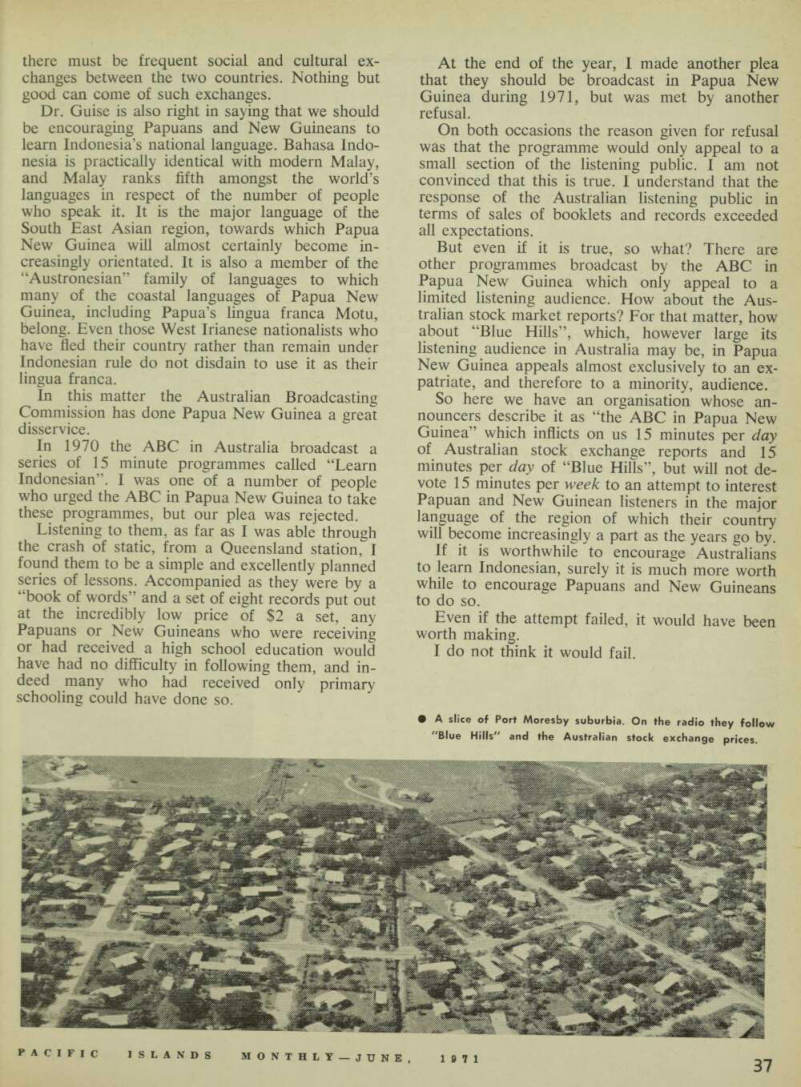
A slice of Port Moresby suburbia. On the radio they follow "Blue Hills" and the Australian stock exchange prices.