The alien beverage'
p. 37 · Read in the full issue
under attack
Concern over drunkenness in Fiji, especially among younger people, has led to some public soul-searching on the subject of Fiji’s drinking habits.
Suva people in particular are growing increasingly disgusted by the familiar sight of staggering, brawling drunks pouring out of the public bars at closing time.
Dozens of arrests are made at weekends.
So bad is the situation that the Senate unanimously expressed concern recently at the incidence of drunken ness, disorderliness and petty crimes in urban areas.
Senator Kapadia stressed that the problem was basically a social one, involving the responsibility of the whole of the community. Unemployment, the impact of tourism and the lack of leisure-time facilities were among the causes, he said.
Senator Felix Emberson said he was appalled at the behaviour of young people in the streets, which were over-crowded with drunks and loiterers at weekends.
He complained that the alcoholic content of Fiji beer was too high and should be reduced. He called as well for increased police activity and an expanded youth movement.
From Senator Ratu Volavola came a suggestion that hotels should be closed from 4 to 6 p.m. on Fridays, so that wage packets could be taken home instead of to the hotels.
In the House of Representatives, the Minister for Social Services, Mr. Jonati Mavoa expressed his own concern about the problem and emphasised that it had special significance in developing countries. “The local population must evolve a pattern and habit of liquor consumption that will avoid serious social con sequences,” he said.
“This is a process which entails considerable adjust ment to the use of an alien beverage, designed primarily as a means of socialisation and social lubrication in Western society, from where it originated.
He said the exercise also involved the assessment of the alcoholic content of local beer, Fiji’s local brew is on a par with Australian beer, containing 8.7 per cent, proof spirit. New Zealand beer is 6,5 per cent, of proof spirit. Some of the beers im ported into Fiji are stronger than the local product.
But they cost more than the 40 to 50 cents charged for a large bottle of Fiji beer.
At present Carlton Brewery (Fiji) Ltd. is the only brewery in Fiji, but a second one—with a production capacity of two million gallons “Australian-type” beer a year—is to be established by the Fiji-registered South Seas Brewing Co. Ltd. during 1972.
Around the time Carlton Brewery was establishing its Suva brewery, more than a decade ago, a liquor commission was reviewing the liquor legislation of the day.
Observing that an 8 oz glass of Australian or Fiji beer contained approximately the same amount of alcohol as an hotel “tot” of whisky or gin, and for less money, the committee raised the question of the alcoholic content of local beer with Carlton Brewery.
The company opposed the idea of reducing the strength of Fiji beer, saying that if such a move was forced on the local brewery without prohibiting the import of high-strength beer, the local industry would go out of business.
The company said also that in Fiji’s tropical climate the high alcoholic content must be maintained, especially
for draught beer, in order to keep it in good con dition.
Members of the liquor committee commented in their report that they were not convinced that the Fiji climate ruled out the possibility of manufacturing a lower-strength beer. They recommended further investigation.
While there is all this discussion about beer, another beverage has made its appearance on the Fiji scene— Fiji wine.
In a former printing shop in the Suva suburb of Flagstaff, two Peace Corps volunteers and three local businessmen are busily turning out this newest home grown product.
Concocted from a combination of limes, ginger, yeast and cane sugar, the wine—a potent, pleasant drink—is selling in local department stores and hotel bottle departments for around 95c a bottle. It is labelled “Takia”.
The company, Wines of Fiji Ltd—with 11 local and four overseas shareholders—is currently producing the lime and ginger wine in batches of 56 dozen bottles, twice a month.
There are plans to make similar wines from passion fruit, mangoes, bananas, pineapples, cumquats, currants and sultanas.
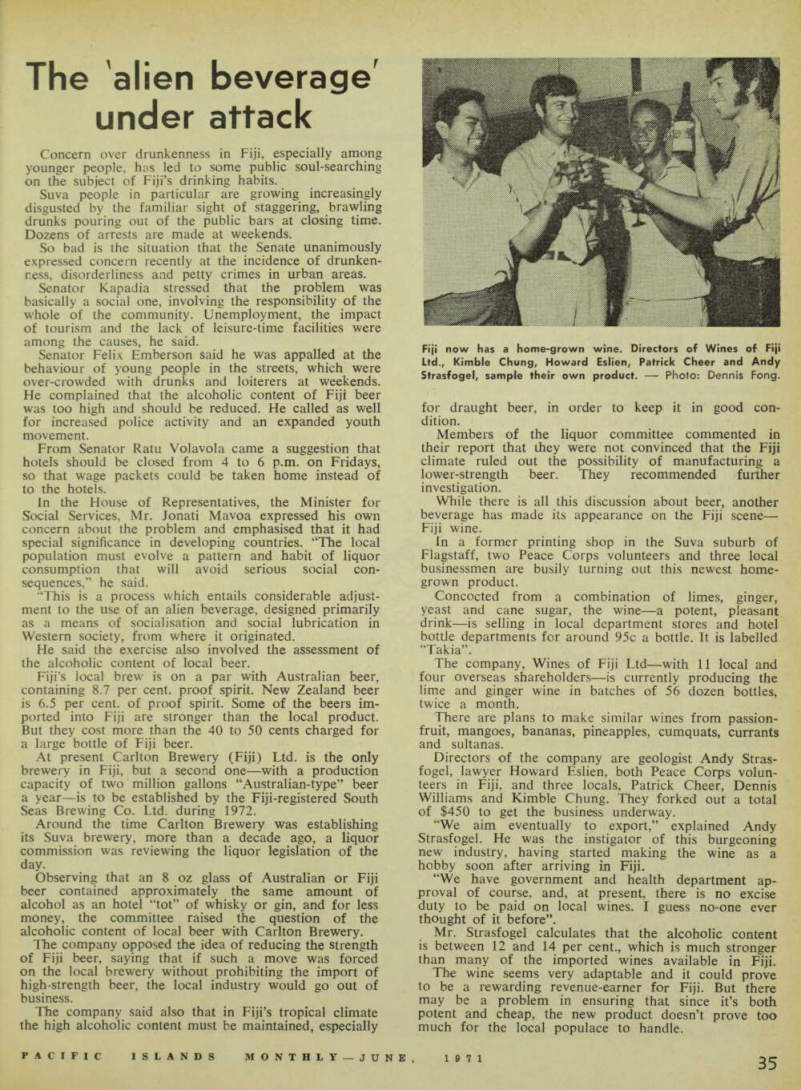
Directors of the company are geologist Andy Stras fogel, lawyer Howard Eslien, both Peace Corps volun teers in Fiji, and three locals, Patrick Cheer, Dennis Williams and Kimble Chung. They forked out a total of $450 to get the business underway.
“We aim eventually to export,” explained Andy Strasfogel. He was the instigator of this burgeoning new industry, having started making the wine as a hobby soon after arriving in Fiji.
“We have government and health department ap proval of course, and, at present, there is no excise duty to be paid on local wines. I guess no-one ever thought of it before”.
Mr. Strasfogel calculates that the alcoholic content is between 12 and 14 per cent,, which is much stronger than many of the imported wines available in Fiji.
The wine seems very adaptable and it could prove to be a rewarding revenue-earner for Fiji. But there may be a problem in ensuring that since it’s both potent and cheap, the new product doesn’t prove too much for the local populace to handle.
Fiji now has a home-grown wine. Directors of Wines of Fiji Ltd., Kimble Chung, Howard Eslien, Patrick Cheer and Andy Strasfogel, sample their own product. Photo: Dennis Fong.