The Small Nambas
pp. 61-63 · Read in the full issue

couldn't care less
All that the Big Nambas are supposed to be, the Small Nambas of south central Malekula come far closer to actually being. Travel agents always talk Big, but it’s not necessarily preference. They have to settle for what they can get.
“Small Namba” is a general term on Malekula, and those in some areas are indistinguishable from any other modern, missionised New Hebrideans.
But inland from the southwest coast of the island, the Small Nambas still have only sporadic contacts with Europeans.
In 1968 we were, I believe, the first Europeans to visit the remotest of the villages, including Lendomb wey, the largest. Although the men had seen Europeans before, most of the women and children had not.
It was not until 1969 that a gov ernment administrator followed our traces. No European missionary has been there yet. Tourists will probably never go.
Whereas the Big Nambas village of Amok is a relatively easy four hour walk from the coast, it takes
two days to reach Lendombwey— two days of interminable climbs and treacherous muddy descents, with ill defined footpaths at best. To go from village to village, and the tiny ham lets are scattered over some 35 miles, is a constant vertical trek.
From time to time a few of the men descend to the Lamongo planta tion on the coast. They work long enough to buy a few trade goods, and then return. Only axes and bush knives are considered important.
Not only does the traditional cul ture survive, but it is undoubtedly the most picturesque in the New Hebrides.
Regardless of what boasts are made about the Big, the Small are probably the best artists in the archipelago.
Here, because nothing is made for sale, there is no shoddy workmanship based on the belief that the tourists
won’t know the difference. The spirits will know.
Some pieces are sold eventually, but only after their original purposes have been served. Some are never sold. It is tambu for them to leave the village, or even to be seen by out siders.
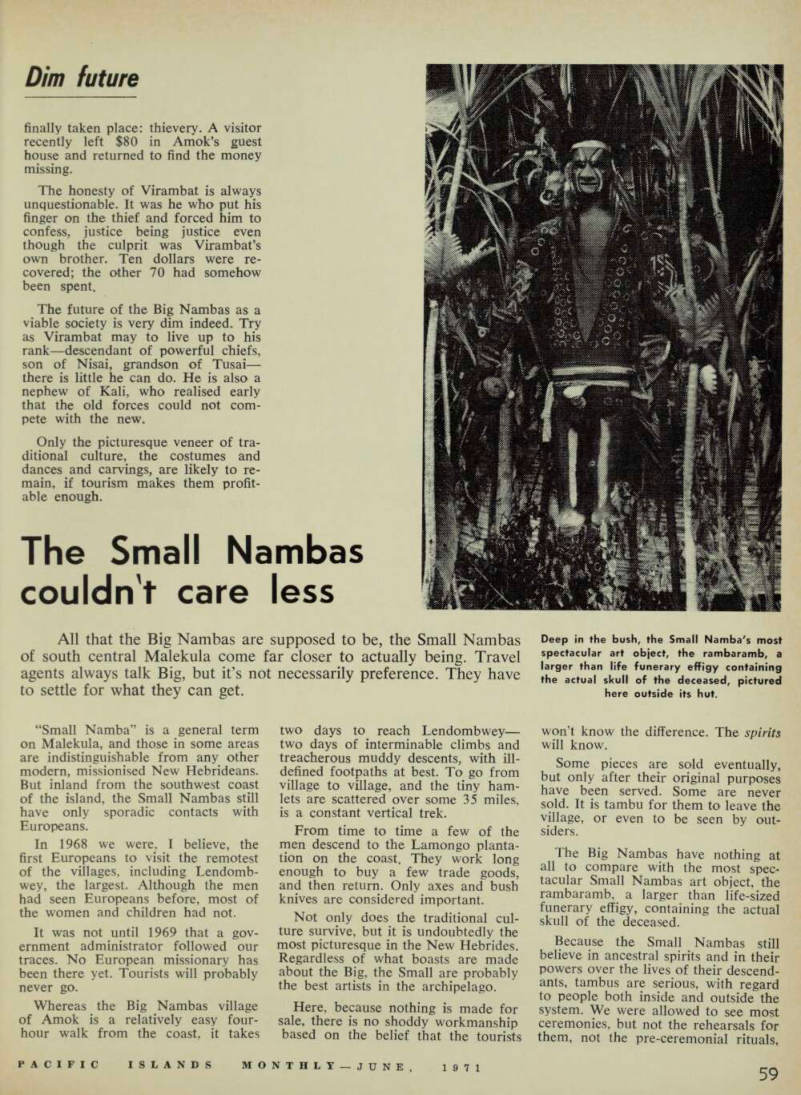
The Big Nambas have nothing at all to compare with the most spec tacular Small Nambas art object, the rambaramb, a larger than life-sized funerary effigy, containing the actual skull of the deceased.
Because the Small Nambas still believe in ancestral spirits and in their powers over the lives of their descend ants, tambus are serious, with regard to people both inside and outside the system. We were allowed to see most ceremonies, but not the rehearsals for them, not the pre-ceremonial rituals,
Deep in the bush, the Small Namba's most spectacular art object, the rambaramb, a larger than life funerary effigy containing the actual skull of the deceased, pictured here outside its hut.
Feared death
the carving and painting of sacred objects, the fabrication of the cos tumes.
Each time a certain whistling noise was sounded, we were to return at once to our huts. On one occasion we didn’t, or not promptly enough, dragging our feet for the sake of curi osity. We thereby aroused the wrath of Metak, the man “responsible” for us (being the only one who spoke a fair Pidgin). Metak, trembling, shouted that if we did not risk being killed over the breaking of the tambu, he did risk being killed on our account.
Whether he feared death through the intermediary of the spirits or another Small Namba was not clear, but the fear was real.
The Small Nambas still administer justice as they see fit, despite a half hearted government attempt to intro duce condominium law. Punishment may be a fine of a given number of pigs, or it may be a musket shot from a convenient ambush.
One man on the coast told us, when we were recruiting porters, that although he came from the bush, he didn’t dare to return. By way of ex planation, he held up his right hand.
The two fingers missing had been shot off. He had received a shoulder wound as well, and was afraid his attackers might be more accurate the next time.
Even if tourists were willing and able to make the inland trek, it wouldn’t do them much good. The Small Nambas do not want guests, sensing that the presence of outsiders is a threat to their way of life.
No physical danger to Europeans would be likely—everyone knows about government power—but no co operation would be likely, either, in the form of shelter, water, food, porters or guides.
There is a small, steady movement to the coast these days, as there is from the Big Nambas plateau, but not for the same reasons. While the Small Nambas society remains compara tively solid, it is becoming unbalanced.
There are not enough women to go round. And the only way a “man bush” can marry a coastal (meaning mission) girl is by becoming a mis sion man.
Perhaps, through the force of things, the Small Nambas too will one day be performing their dances and making their sculptures for the tourists. But, for the moment, every thing they have is their own.