many have-nots
pp. 33-34 · Read in the full issue
Lesson One: Fiji has too many have-nots
From a Suva correspondent What is the significance of the long Fiji shipping strike? What, if any, lessons have been learned from it?
The strike has taught Fiji that her low-paid workers are restless. It has taught her too that she cannot afford future prolonged stoppages.
No country can, of course, but Fiji is smaller and newer—and perhaps has a chance to avoid some of the disastrous mistakes made elsewhere.
Despite some criticism about its handling of the dispute—or, rather, the fact that it didn’t step in earlier, instead of waiting to be invited— the Fiji Government and the Prime Minister, in particular, emerged well from the strike.
Ratu Mara found a solution acceptable to both sides. The country couldn’t afford a wage rise of 3U per cent., he said, but this had to be weighed against the possibility of even worse inroads into the economy if the strike continued.
He had sympathy too for the plight of people attempting to maintain a reasonable standard of living in the face of Fiji’s rising costs.
It is this ability to seem to see and understand both sides of a ques-
tion that has emerged so strongly about Fiji’s PM in recent months. He never emerges, in public anyway, as a man to make high-handed, impetu ous decisions, Because of this he has an image of dependability and statesmanship, The strike situation proved again that he can be depended upon to make considered and wise decisions, The Prime Minister pointed out that much remains to be done to prevent similar strikes in the future.
Nationalising stevedoring might be one solution, though he didn’t say it, since, under the present system of employment on the wharves, there must inevitably be a conflict of in terests. The companies importing goods are also concerned in steve doring, What the Prime Minister has said is, that government is “studying ways and means whereby this vital service could best be organised for the bene f t of the country”.
The Samoa Times, in an editorial, urged Western Samoa “to learn the
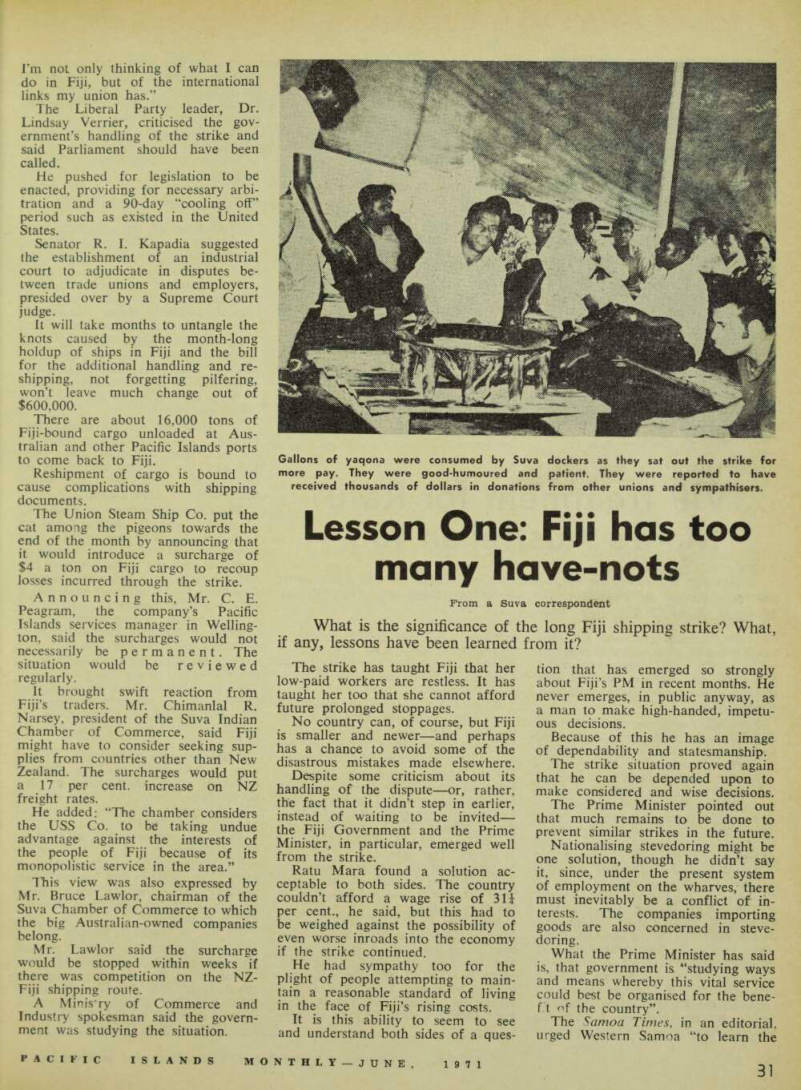
Gallons of yaqona were consumed by Suva more pay. They were good-humoured and received thousands of dollars in donations
dockers as they sat out the strike for patient. They were reported to have from other unions and sympathisers.
lesson Fiji has been taught the hard way by the dockworkers’ strike.”
Echoing Ratu Mara’s statement that it was unrealistic to expect trade unions to exercise restraint in wage claims unless an attempt was made to control prices also, the editorial said the lesson for Western Samoa was that there must be a very close watch kept on the balance between prices and wages.
It quoted a recent example where increased prices of goods were passed on to a “section of the community that is already suffering enough” and warned, “Samoa has no unions at present. This happy situation won’t be enjoyed for ever.”
Visiting Australian trade union leader —Mr. J. R. Grenville, assist ant secretary of the important Vic torian Trades Hall Council, also had a say about the strike.
Emphasising that he was comment ing “only as an observer”, Mr. Gren ville, holidaying in Suva, declared that Fiji’s trade unions should not be shackled with arbitrative pro cedures.
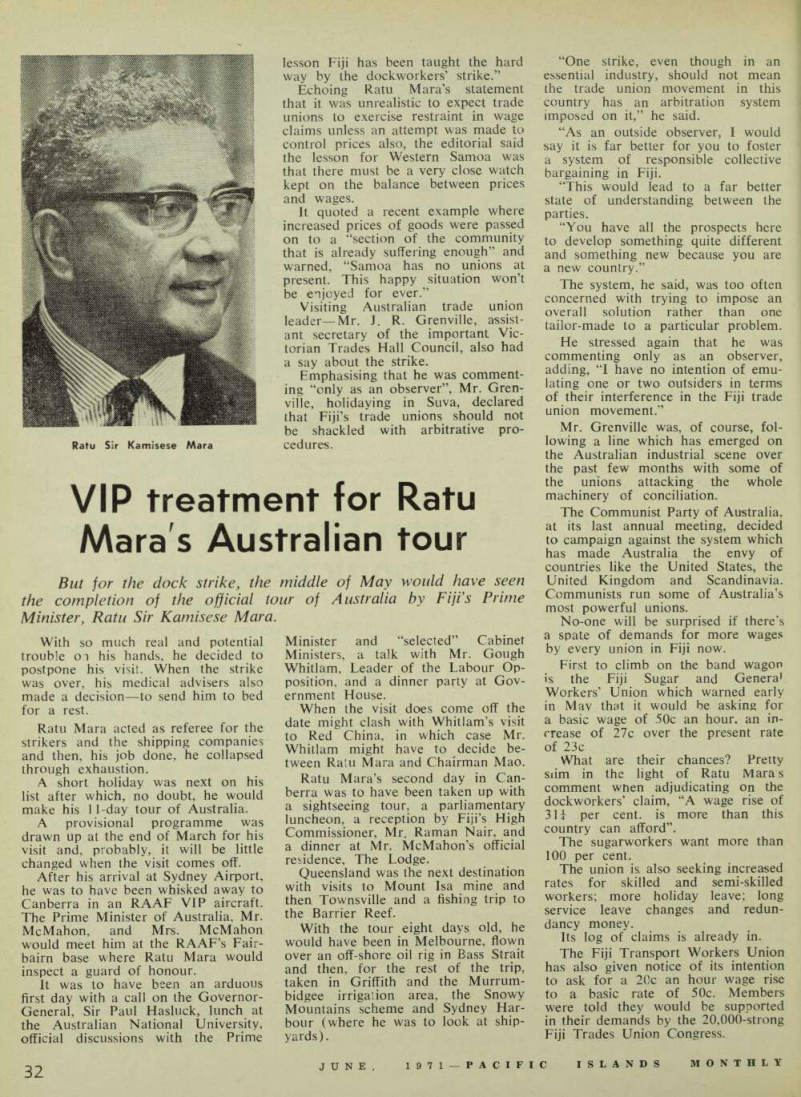
Ratu Sir Kamisese Mara