Mara's Australian tour
p. 34 · Read in the full issue
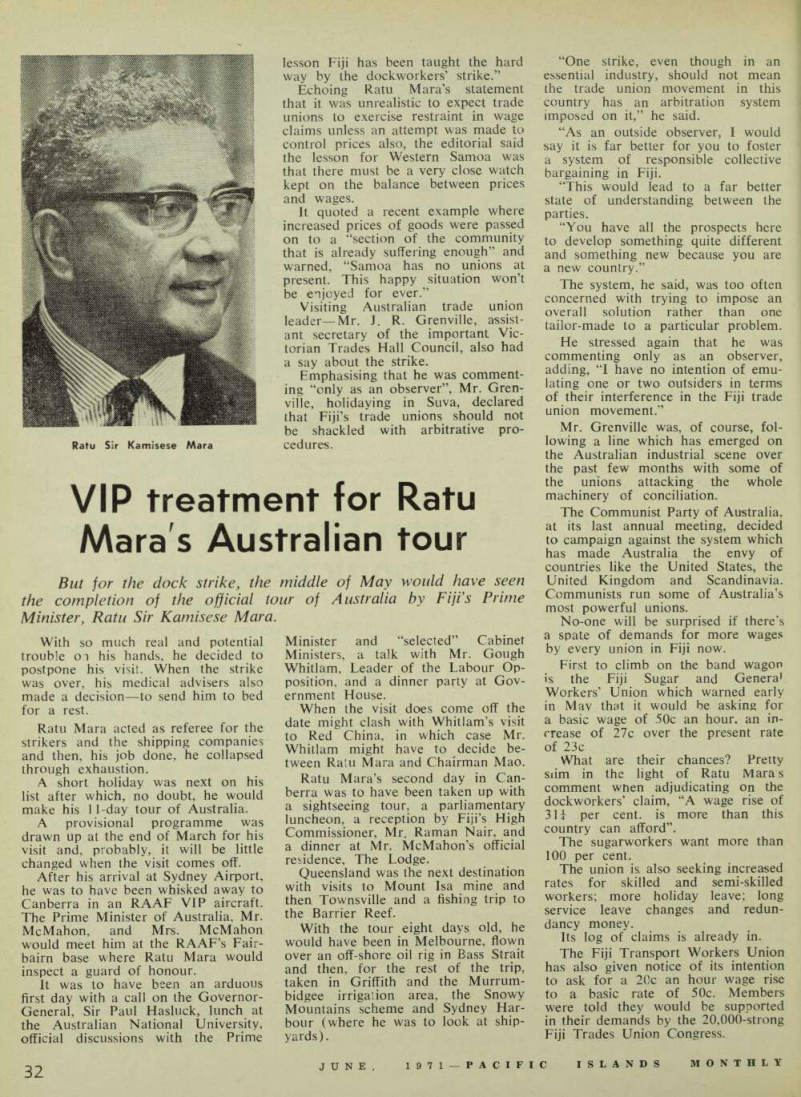
VIP treatment for Ratu Mara's Australian tour
But for the dock strike, the middle of May would have seen the completion of the official tour of Australia by Fiji's Prime Minister, Ratu Sir Kamisese Mara.
With so much real and potential trouble oi his hands, he decided to postpone his visit. When the strike was over, his medical advisers also made a decision—to send him to bed for a rest.
Ratu Mara acted as referee for the strikers and the shipping companies and then, his job done, he collapsed through exhaustion.
A short holiday was next on his list after which, no doubt, he would make his 11-day tour of Australia.
A provisional programme was drawn up at the end of March for his visit and, probably, it will be little changed when the visit comes off.
After his arrival at Sydney Airport, he was to have been whisked away to Canberra in an RAAF VIP aircraft.
The Prime Minister of Australia, Mr.
McMahon, and Mrs. McMahon would meet him at the RAAF’s Fair bairn base where Ratu Mara would inspect a guard of honour.
It was to have been an arduous first day with a call on the Governor- General, Sir Paul Hasluck, lunch at the Australian National University, official discussions with the Prime
Minister and “selected” Cabinet Ministers, a talk with Mr. Gough Whitlam, Leader of the Labour Op position, and a dinner party at Gov ernment House.
When the visit does come off the ? ate p m j sh ‘ - with Vf?
Whhll might have to dedde be" ‘ween Ratu Mara and Chairman Mao.
Ratu Maras second day m Can berra was to have been taken up with a sightseeing tour, a parliamentary luncheon, a reception by Fiji s High Commissioner, Mr. Raman Nair and a dinner at Mr. McMahons official residence, The Lodge.
Queensland was the next destination with visits to Mount Isa mine and then Townsville and a fishing trip to the Barrier Reef.
With the tour eight days old, he would have been in Melbourne, flown over an off-shore oil rig in Bass Strait and then, for the rest of the trip, taken in Griffith and the Murrum bidgee irrigation area, the Snowy Mountains scheme and Sydney Har hour (where he was to look at ship yards).
“One strike, even though in an essential industry, should not mean the trade union movement in this country has an arbitration system imposed on it,” he said.
“As an outside observer, I would say it is far better for you to foster a system of responsible collective bargaining in Fiji.
“This would lead to a far better state of understanding between the parties.
“You have all the prospects here to develop something quite different and something new because you are a new country,”
The system, he said, was too often concerned with trying to impose an overall solution rather than one tailor-made to a particular problem.
He stressed again that he was commenting only as an observer, adding, “I have no intention of emu lating one or two outsiders in terms of their interference in the Fiji trade union movement.”
Mr. Grenville was, of course, fol lowing a line which has emerged on the Australian industrial scene over the past few months with some of the unions attacking the whole machinery of conciliation.
The Communist Party of Australia, at its last annual meeting, decided to campaign against the system which has made Australia the envy of countries like the United States, the United Kingdom and Scandinavia.
Communists run some of Australia’s most powerful unions.
No-one will be surprised if there’s a spate of demands for more wages by every union in Fiji now.
First to climb on the band wagon is the Fiji Sugar and Genera’
Workers’ Union which warned early in May that it would be asking for a basic wage of 50c an hour, an in crease of 27c over the present rate of 23c What are their chances? Pretty siim in the light of Ratu Maras comment wnen adjudicating on the dockworkers’ claim, “A wage rise of 31i per cent, is more than this country can afford”.
The sugarworkers want more than 100 per cent.
The union is also seeking increased rates for skilled and semi-skilled workers; more holiday leave; long service leave changes and redun dancy money.
Its log of claims is already in.
The Fiji Transport Workers Union has also given notice of its intention to ask for a 20c an hour wage rise to a basic rate of 50c. Members were told they would be supported in their demands by the 20,000-strong Fiji Trades Union Congress.