Stocktaking after The Big Strike
pp. 31-33 · Read in the full issue
Prom a Suva correspondent The day the bread supply dried up, Fiji’s month-long dock strike ended. On the advice of the Prime Minister, the nation’s dock workers accepted an increase of 10c an hour and returned, quite cheerfully, to work on May 7.
By refusing to load or unload ships, they had kept Fiji’s wharves at a standstill for 28 days.
Produce rotted in ships’ holds and important supplies were rerouted to places like Tonga and Noumea.
Tinned food, flour, sharps and ghee disappeared from the stores and factories stopped production. Drugs for hospitals were denied entrance.
Local cruise vessels were stopped from carrying tourists to island re sorts because food could not be loaded and villagers in outer islands returned to the old ways of living off the land.
The strike did more. It held up the business of government.
The Prime Minister, Ratu Sir Kamisese Mara, was forced to post pone his long-awaited, official visit to Australia, saying he could not “in good conscience” leave the country at such a time.
The Minister of Finance, Mr. W.
M. Barrett, and the Minister for Communications, Works and Tour ism, Mr. C. A. Stinson, postponed very important journeys overseas for negotiations on loans and financial aid for Fiji which has lost hundreds of thousands of dollars through the strike.
Price control measures were intro duced because, as the Minister for Commerce, Mr. Vijay R. Singh, said, the government had become increas ingly concerned at the rate at which prices of imported and local products had been rising.
Price control had become all the more necessary because of the short age of goods caused by the strike.
Price control caused some early confusion. Storekeepers complained that prices for certain goods listed in the government’s first price control order early in May were too low.
There were reports of salad oil— to be sold at 38c a bottle in Viti
Levu and 40c in other areas—being removed from supermarket shelves, leaving only the more expensive oils for sale.
But the situation was sorted out in short time by the price controller, Mr. Sharda Nand.
Salad oil was later raised to 39c and 42c a bottle and prices for several other food items were also adjusted.
That helped strike propaganda, for the strikers themselves welcomed the price controls, declaring that their wage claims had been brought about by the high cost of food and other effects of inflation.
“Inflation was here in Fiji long before we went on strike and the high prices in the shops are not our doing,” said one union leader.
One dockworker claimed that some shops raised the prices of imported goods every time there was a new shipment.
He argued that, as the father of five children he could not maintain a reasonable standard of living on the 32c an hour paid by the shipping companies.
It was an argument with which
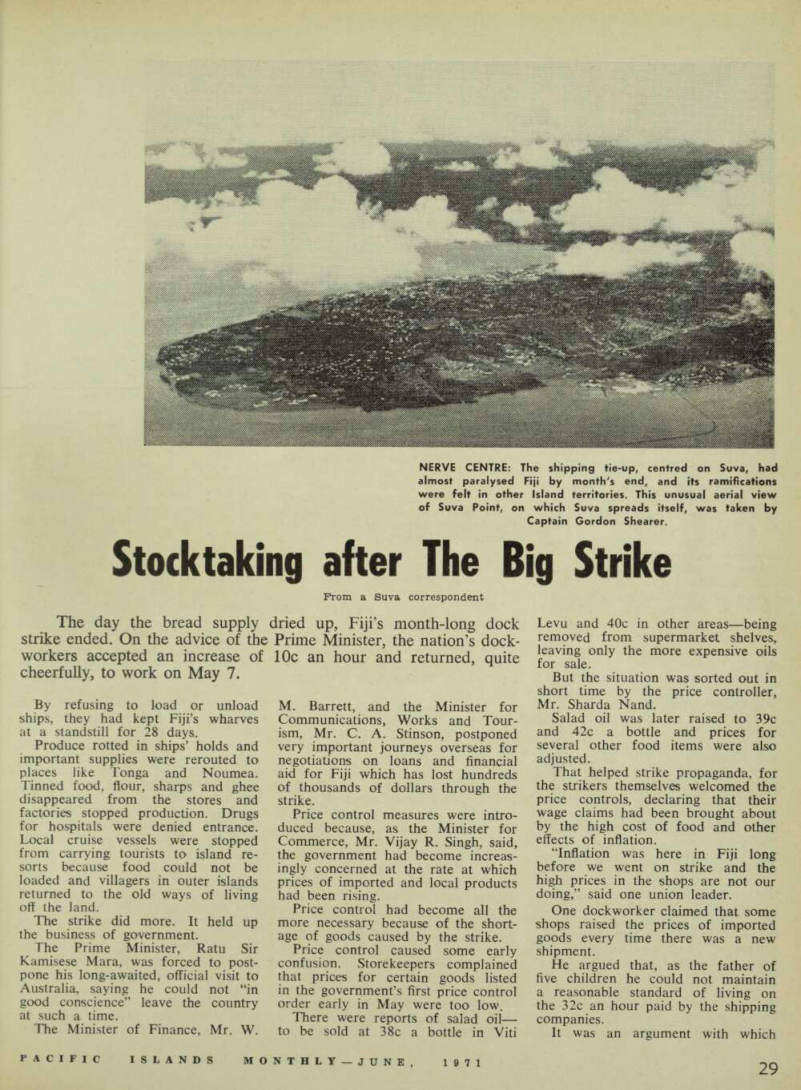
NERVE CENTRE: The shipping tie-up, centred on Suva, had almost paralysed Fiji by month's end, and its ramifications were felt in other Island territories. This unusual aerial view of Suva Point, on which Suva spreads itself, was taken by Captain Gordon Shearer.
Fiji’s low-wage workers were in complete agreement—as their support of the strikers showed. And there’ll be repercussions.
The strike began on April 8 when deadlock was reached on a log of claims presented by the Dockworkers and Seamen’s Union, Among other things, the union demanded an in crease in minimum pay rates from 32c to 62ic an hour.
A Board of Inquiry into the dis pute, in an interim report, said the demand for a 95 per cent, increase was unrealistic, a view generally held by those familiar with the economic implications of such a rise.
The board felt that the shipping companies’ offer of an 18.7 per cent, increase—which exceeded all other offers made to Fiji unions this year—appeared to be the maxi mum the dockworkers could expect, “To ask for more is to demand special consideration over and above their fellow workers,” the report ob served.
After discussions held when and if union members, led by husky Taniela Veitata, turned up at the appointed time—which didn’t always happen— the employers offered to pay attend ance money guaranteeing 24 hours pay a week for each registered dock worker in Suva who reported for work as required, even if no work was available.
They also offered a minimum rate of 38c an hour and agreed to arbi tration provided there was an im mediate return to work.
They agreed to pay winchmen an extra 2c an hour, making a total increase of 8c an hour, and continue negotiations on other outstanding claims.
Later the union reported that mem bers had refused to accept the offer but would return to work for 50c an hour.
The employers replied that they were prepared to resume collective bargaining but were not “prepared voluntarily to agree to demands” which, in their opinion, would have the greatest repercussions on the Fiji economy.
Finally, with the strike about to enter its fifth week, the Prime Minister was approached by union members and employers’ representa tives and asked to adjudicate.
In a broadcast afterwards, Ratu Mara—who only a few days later was reported to have collapsed from exhaustion and been ordered to rest —said he had asked both sides to agree on an award of 42c per hour and take to arbitration in due course the balance of their unsettled claims, including finalisation of the wage issue.
“This has perhaps been our first real test as an independent country,” said the Prime Minister. “And to me, the most impressive aspect of the dispute has been the determination of all sides that the situation should be handled calmly and peacefully.
These are the reactions of a mature people and a mature country.
“But the cost of the strike has been high already. We shall all be paying for it for some time, and if we do not learn its lesson and govern ourselves accordingly, we may find ourselves paying for it for a very long time to come . . .
“Frankly, a wage rise of 3U per cent, is more than this country can afford if it is to progress fast economically, and fully implement Development Plan Six.”
He warned: “Increased handling charges must mean increased freights, and in due course, increased prices.
So workers may find that their weekly pay packet can still buy the same amount of goods or even less”.
Though he made no reference to it, the Prime Minister must have felt stongly about a New Zealand union leader’s intervention in the strike.
Mr. Bill Martin, president of the New Zealand Seamen’s Union, osten sibly in Fiji to meet the Waimate’s crew who had refused to sail, spoke to Ratu Mara about the economic problems facing dockworkers and also acted as their spokesman in a Meet the Press exercise.
During the closing stages of the
strike, two leading New Zealand trade unionists contacted Veitata, giving him advice on the moves to make.
Veitata said the president of the New Zealand Federation of Labour, Mr. Tom Skinner, had told him that New Zealand waterside workers were not handling Fiji cargo or working ships carrying Fiji cargo until they were instructed.
Seamen’s Union president Bill Martin had been right, said Veitata, in predicting that the strike would finish during the first week in May.
“If Mr. Martin had said it would be settled next week, it would have been next week,” he added.
Despite their support of the strikers —with food and money—many Fijians were not happy about the im plications of outside interference in the new self-governing dominion.
“I can’t understand what the Prime Minister means when he says the country cannot afford to pay the dockworkers more wages—Fijians who’ve worked in New Caledonia told me they get four times as much as here,” said one Fijian who earns $ll a week in maintenance work.
“We support the dockworkers, but we didn’t know the union was send ing messages to New Zealand.
“We were surprised when we heard it. I do not think we need outsiders to settle our affairs.”
Obviously, this particular Fijian did not understand the sad fact that very high wages—as in New Cale donia—bring with them a very high cost of living. But he certainly was not happy about outside “advisers”.
Editorially, the Fiji Times com mented: “At a time when Fiji is seeking to follow its political inde pendence with a greater amount of economic independence, it would be ironic if the Fiji union movement became dependent on overseas trade unions and stood less on its own feet . . . Fiji must ensure that out side interests, who do not contribute to its economy and its way of life, are not allowed to direct its affairs, which it must settle itself if its inde pendence is to be fully meaningful.”
Many wondered why the govern ment stayed out of the dispute so long.
Midway through the strike, the Minister for Labour, Ratu Sir Edward Cakobau, appealed to the strikers to return to work. The bid failed.
There was talk too of the Royal Fiji Military Forces being mobilised to unload ships in port, but Taniela Veitata seemed unperturbed by the possibility.
“If the government does this, I still have a few hidden buttons to press,” he said. “When I say this.
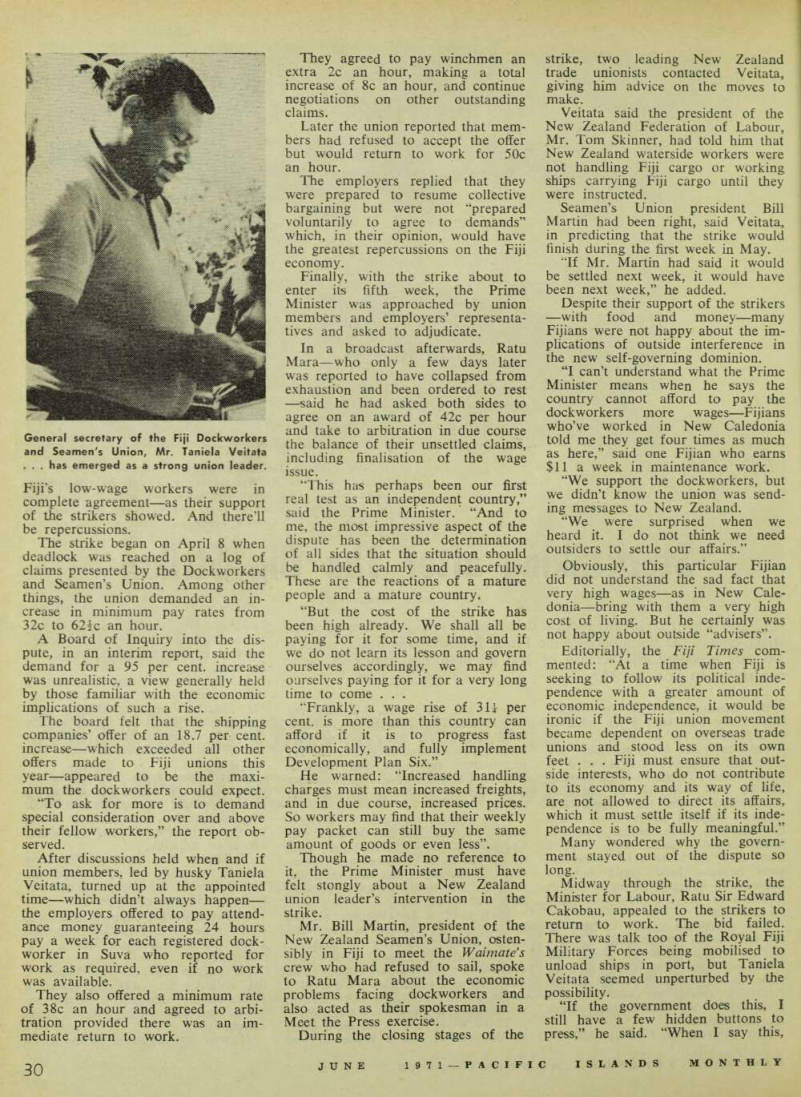
General secretary of the Fiji Dockworkers and Seamen's Union, Mr. Taniela Veitata . . . has emerged as a strong union leader.
I’m not only thinking of what I can do in Fiji, but of the international links my union has.”
The Liberal Party leader. Dr.
Lindsay Verrier, criticised the gov ernment’s handling of the strike and said Parliament should have been called.
He pushed for legislation to be enacted, providing for necessary arbi tration and a 90-day “cooling off” period such as existed in the United States.
Senator R. I. Kapadia suggested the establishment of an industrial court to adjudicate in disputes be tween trade unions and employers, presided over by a Supreme Court judge.
It will take months to untangle the knots caused by the month-long holdup of ships in Fiji and the bill for the additional handling and re shipping, not forgetting pilfering, won’t leave much change out of $600,000.
There are about 16,000 tons of Fiji-bound cargo unloaded at Aus tralian and other Pacific Islands ports to come back to Fiji.
Reshipment of cargo is bound to cause complications with shipping documents.
The Union Steam Ship Co. put the cat among the pigeons towards the end of the month by announcing that it would introduce a surcharge of $4 a ton on Fiji cargo to recoup losses incurred through the strike.
Announcing this, Mr. C. E.
Peagram, the company’s Pacific Islands services manager in Welling ton, said the surcharges would not necessarily be permanent. The situation would be reviewed regularly.
It brought swift reaction from Fiji’s traders. Mr. Chimanlal R.
Narsey, president of the Suva Indian Chamber of Commerce, said Fiji might have to consider seeking sup plies from countries other than New Zealand. The surcharges would put a 17 per cent, increase on NZ freight rates.
He added: “The chamber considers the USS Co. to be taking undue advantage against the interests of the people of Fiji because of its monopolistic service in the area.”
This view was also expressed by Mr. Bruce Lawlor, chairman of the Suva Chamber of Commerce to which the big Australian-owned companies belong.
Mr. Lawlor said the surcharge would be stopped within weeks if there was competition on the NZ- Fiji shipping route.
A Ministry of Commerce and Industry spokesman said the govern ment was studying the situation.