Tropicalities
pp. 24-26 · Read in the full issue
There are pressures building up in Fiji towards establishment of a coalition government. The idea isn’t new, but it is becom
ing acceptable.
The Prime Minister, Ratu Sir Kamisese Mara, thinks it will work, but 12 months ago, certainly two years ago, everyone except perhaps Ratu Mara would have thought it impossible.
Now, Ratu Mara, whose ideal is a united Fiji with racial barriers swept away, has set people thinking by putting forward his support of the coalition system.
He stressed that he would not attempt to force his views on the Alliance Party, of which he is president.
He is believed to favour the Swiss form of government where the various cantons, which are divided by race, each send representatives to the central government.
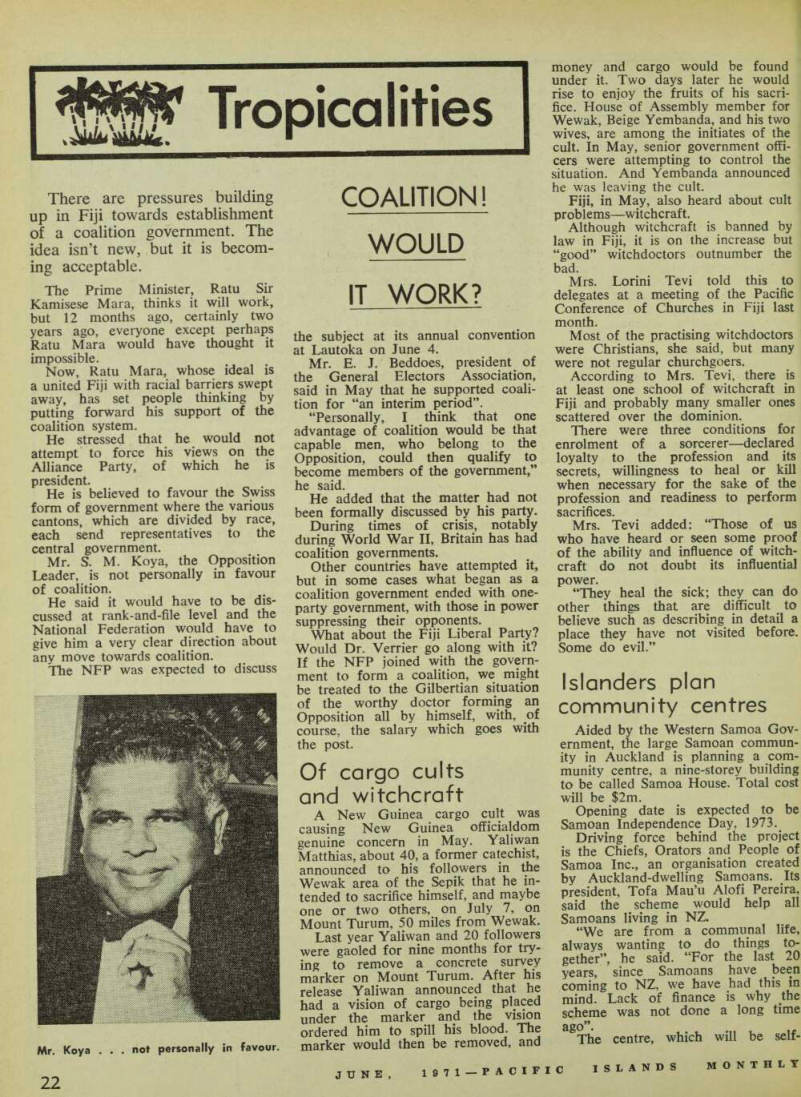
Mr. S. M. Koya, the Opposition Leader, is not personally in favour of coalition.
He said it would have to be dis cussed at rank-and-file level and the National Federation would have to give him a very clear direction about any move towards coalition.
The NFP was expected to discuss
Coalition!
Would
It Work?
the subject at its annual convention at Lautoka on June 4.
Mr. E. J. Beddoes, president of the General Electors Association, said in May that he supported coali tion for “an interim period”.
“Personally, I think that one advantage of coalition would be that capable men, who belong to the Opposition, could then qualify to become members of the government,” he said.
He added that the matter had not been formally discussed by his party.
During times of crisis, notably during World War 11, Britain has had coalition governments.
Other countries have attempted it, but in some cases what began as a coalition government ended with one party government, with those in power suppressing their opponents.
What about the Fiji Liberal Party?
Would Dr. Verrier go along with it?
If the NFP joined with the govern ment to form a coalition, we might be treated to the Gilbertian situation of the worthy doctor forming an Opposition all by himself, with, of course, the salary which goes with the post.
Of cargo cults
and witchcraft
A New Guinea cargo cult was causing New Guinea officialdom genuine concern in May. Yaliwan Matthias, about 40, a former catechist, announced to his followers in the Wewak area of the Sepik that he in tended to sacrifice himself, and maybe one or two others, on July 7, on Mount Turum, 50 miles from Wewak.
Last year Yaliwan and 20 followers were gaoled for nine months for try ing to remove a concrete survey marker on Mount Turum. After his release Yaliwan announced that he had a vision of cargo being placed under the marker and the vision ordered him to spill his blood. The marker would then be removed, and
money and cargo would be found under it. Two days later he would rise to enjoy the fruits of his sacri fice. House of Assembly member for Wewak, Beige Yembanda, and his two wives, are among the initiates of the cult. In May, senior government offi cers were attempting to control the situation. And Yembanda announced he was leaving the cult.
Fiji, in May, also heard about cult problems—witchcraft.
Although witchcraft is banned by law in Fiji, it is on the increase but “good” witchdoctors outnumber the bad.
Mrs. Lorini Tevi told this to delegates at a meeting of the Pacific Conference of Churches in Fiji last month.
Most of the practising witchdoctors were Christians, she said, but many were not regular churchgoers.
According to Mrs, Tevi, there is at least one school of witchcraft in Fiji and probably many smaller ones scattered over the dominion.
There were three conditions for enrolment of a sorcerer—declared loyalty to the profession and its secrets, willingness to heal or kill when necessary for the sake of the profession and readiness to perform sacrifices.
Mrs. Tevi added: “Those of us who have heard or seen some proof of the ability and influence of witch craft do not doubt its influential power.
“They heal the sick; they can do other things that are difficult to believe such as describing in detail a place they have not visited before.
Some do evil.”
Islanders plan
community centres
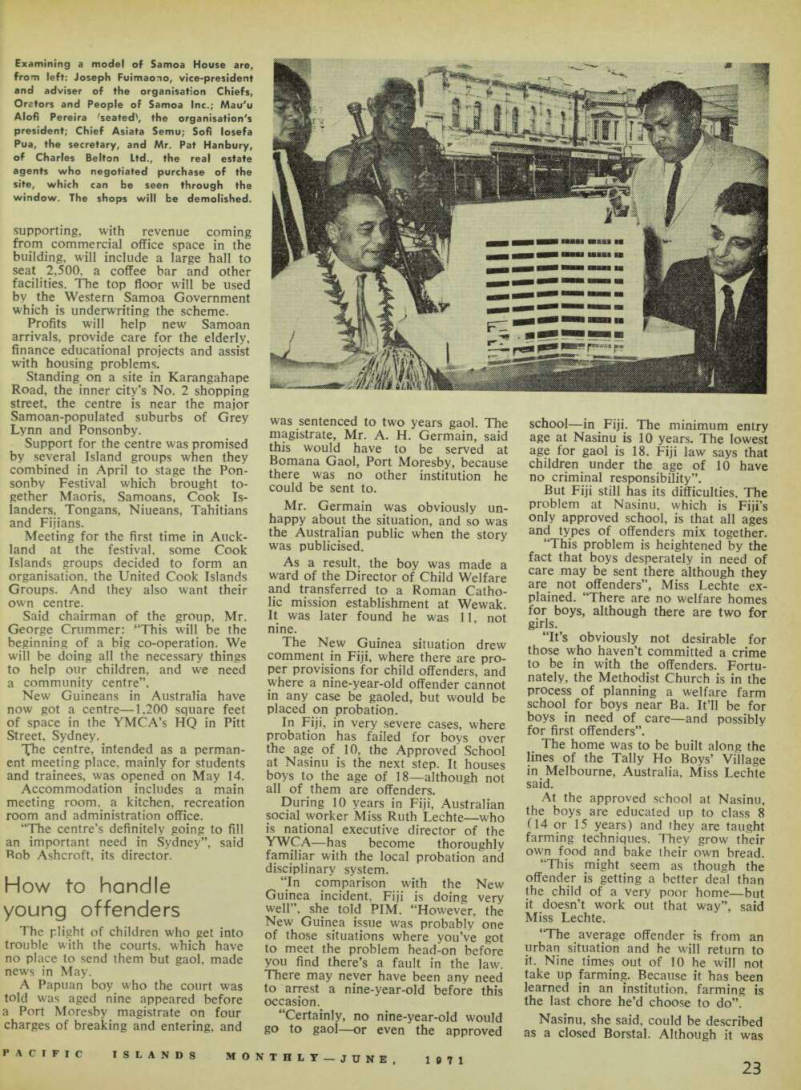
Aided by the Western Samoa Gov ernment, the large Samoan commun ity in Auckland is planning a com munity centre, a nine-storey building to be called Samoa House. Total cost will be s2m.
Opening date is expected to be Samoan Independence Day, 1973._ Driving force behind the project is the Chiefs, Orators and People of Samoa Inc., an organisation created by Auckland-dwelling Sampans. Its president, Tofa Mau’u Alofi Pereira, said the scheme would help all Samoans living in NZ.
“We are from a communal life, always wanting to do things to gether”, he said. “For the last 20 years, since Samoans have been coming to NZ, we have had this in mind. Lack of finance is why the scheme was not done a long time aß The centre, which will be self-
Mr. Koya ... not personally in favour.
supporting, with revenue coming from commercial office space in the building, will include a large hall to seat 2,500, a coffee bar and other facilities. The top floor will be used by the Western Samoa Government which is underwriting the scheme.
Profits will help new Samoan arrivals, provide care for the elderly, finance educational projects and assist with housing problems.
Standing on a site in Karangahape Road, the inner city’s No. 2 shopping street, the centre is near the major Samoan-populated suburbs of Grey Lynn and Ponsonby.
Support for the centre was promised by several Island groups when they combined in April to stage the Pon sonby Festival which brought to gether Maoris, Samoans, Cook Is landers, Tongans, Niueans, Tahitians and Fijians.
Meeting for the first time in Auck land at the festival, some Cook Islands groups decided to form an organisation, the United Cook Islands Groups. And they also want their own centre.
Said chairman of the group, Mr.
George Crummer: “This will be the beginning of a big co-operation. We will be doing all the necessary things to help our children, and we need a community centre”.
New Guineans in Australia have now got a centre —1,200 square feet of space in the YMCA’s HQ in Pitt Street, Sydney.
The centre, intended as a perman ent meeting place, mainly for students and trainees, was opened on May 14.
Accommodation includes a main meeting room, a kitchen, recreation room and administration office.
“The centre’s definitely going to fill an important need in Sydney”, said Bob Ashcroft, its director.
How to handle
young offenders
The plight of children who get into trouble with the courts, which have no place to send them but gaol, made news in May.
A Papuan boy who the court was told was aged nine appeared before a Port Moresby magistrate on four charges of breaking and entering, and
was sentenced to two years gaol. The magistrate, Mr. A. H. Germain, said this would have to be served at Bomana Gaol, Port Moresby, because there was no other institution he could be sent to.
Mr. Germain was obviously un happy about the situation, and so was the Australian public when the story was publicised.
As a result, the boy was made a ward of the Director of Child Welfare and transferred to a Roman Catho lic mission establishment at Wewak.
It was later found he was 11, not nine.
The New Guinea situation drew comment in Fiji, where there are pro per provisions for child offenders, and where a nine-year-old offender cannot in any case be gaoled, but would be placed on probation.
In Fiji, in very severe cases, where probation has failed for boys over the age of 10, the Approved School at Nasinu is the next step. It houses boys to the age of 18—although not all of them are offenders.
During 10 years in Fiji, Australian social worker Miss Ruth Lechte—who is national executive director of the YWCA—has become thoroughly familiar with the local probation and disciplinary system.
“In comparison with the New Guinea incident, Fiji is doing very well”, she told PIM. “However, the New Guinea issue was probably one of those situations where you’ve got to meet the problem head-on before you find there’s a fault in the law.
There may never have been any need to arrest a nine-year-old before this occasion.
“Certainly, no nine-year-old would go to gaol—or even the approved
school—in Fiji. The minimum entry age at Nasinu is 10 years. The lowest age for gaol is 18. Fiji law says that children under the age of 10 have no criminal responsibility”.
But Fiji still has its difficulties. The problem at Nasinu, which is Fiji’s only approved school, is that all ages and types of offenders mix together.
“This problem is heightened by the fact that boys desperately in need of care may be sent there although they are not offenders”, Miss Lechte ex plained. “There are no welfare homes for boys, although there are two for girls.
“It’s obviously not desirable for those who haven’t committed a crime to be in with the offenders. Fortu nately, the Methodist Church is in the process of planning a welfare farm school for boys near Ba. It’ll be for boys in need of care—and possibly for first offenders”.
The home was to be built along the lines of the Tally Ho Boys’ Village in Melbourne, Australia, Miss Lechte said.
At the approved school at Nasinu, the boys are educated up to class 8 (14 or 15 years) and they are taught farming techniques. They grow their own food and bake their own bread.
“This might seem as though the offender is getting a better deal than the child of a very poor home—but it doesn’t work out that way”, said Miss Lechte.
“The average offender is from an urban situation and he will return to it. Nine times out of 10 he will not take up farming. Because it has been learned in an institution, farming is the last chore he’d choose to do”.
Nasinu, she said, could be described as a closed Borstal. Although it was
Examining a model of Samoa House are, from left: Joseph Fuimaono, vice-president and adviser of the organisation Chiefs, Orators and People of Samoa Inc.; Mau'u Alofi Pereira 'seated', the organisation's president; Chief Asiata Semu; Sofi losefa Pua, the secretary, and Mr. Pat Hanbury, of Charles Belton Ltd., the real estate agents who negotiated purchase of the site, which can be seen through the window. The shops will be demolished.
“a remedial institution, the boys were in fact incarcerated there.
“Obviously, a child in need of care and love should be in an orphanage or welfare home, rather than an ap proved school. Ideally too, Fiji should have corrective institutions where older boys could be kept apart from young first offenders”.
Miss Lechte and others would like to see the minimum entry age raised for Nasinu—but this may have to wait until there are more welfare homes.
The former colonial government in Fiji deserves criticism, she feels, for not doing more in the area of pre ventive services for youth. The drift to the cities and the crowded urban situation made crime inevitable.
“The attitude of the present ad ministration towards social problems and welfare within the community is magnificent”, she said. “Naturally though, economic strictures are im posed on developing countries. Re sources are limited—and one has to face up to it”. . . .
At Nasinu, a reformative training centre is planned for 1974. It will be the final project in a programme to provide better segregation of types of prisoners.
Who pays what
for whom
The question of bride price con tinues to be a controversial one in Papua-New Guinea. There are debates and arguments on what is a fair price, and in what circumstances a price should be paid now that old customs are continually under pressure.
In a recent issue of Our News, put out by the P-NG Administration and read mostly by young people, a correspondent, Joseph D. Jubuliant asks in a letter to the editor for some information on what happens about bride price should a European man marry a New Guinea girl, or a New Guinea man marry a European girl.
Moresby resident Mahuru Rarua- Rarua supplies him with the following answer: “In cases where a European man wants to marry a native girl, the man will first ask the parents if they will allow the marriage to take place.
They may ask the man to pay bride price. If the man agrees to pay it, then he does so and there is no more talk about it.
“In the case of a native man want ing to marry a European girl, there is no question of a bride price being paid. In the Australian society a man will ask the girl’s parents if he may marry her and if the parents agree, the marriage takes place. There used to be a custom where the parents of the bride would give a gift of
money, a house or land, to the newly wed couple. This was called a dowry.
This custom has mostly stopped be cause most people do not have enough money or land to be able to do this any more.”
Watered petrol
points a moral
A Cook Islands motorist has ac cused a petrol supplier of watering his gas, but the supplier blames the presence of any water in the petrol on the high humidity. There is a moral to it for other islands The motorist, writing to the Cook Islands News, said the situation was “shocking, especially with the high cost of repairs required due to water in the petrol.”
The petrol station manager denied there was any water in his petrol, which he said was tested regularly for water content with special equip ment. Anyone, could see the inspec tion carried out.
He pointed out that air in the tropics had a high moisture content and when a car’s petrol tank was not full, the moisture condensed in the air space in the tank.
“Many people never fill their tanks completely,” he said. “Some have badly fitted petrol caps and others have a piece of rag in place of a proper petrol cap. The rag acts like a wick and deposits moisture from the air into the petrol tank. All cars in the tropics should be fitted with filters to prevent condensed moisture mixing with the petrol.”
Fijian birth rate up,
Indian down
Although Fiji’s population in creased by more than 10,000 people during 1970, recent figures issued by the government Public Relations Office record a slight drop in the overall birth rate. The population at the end of 1970 was 524,457 —10,740 more than at the end of 1969.
There were 225,102 Fijians, 266,189 Indians, 5,286 Europeans, 9,523 part-Furopeans, 6,512 Rotu mans, 6,837 other Pacific Islanders and 5,008 Chinese.
The Fijian birth rate was 28.60, compared with 27 per 1,000 in 1969.
The Indian birth rate was 30.47, compared with 32.23 per 1,000. The overall birth rate per 1,000 was 29.64, compared with 29.71 in 1969.
A government spokesman said these figures indicated the success of the Family Planning Campaign in Fiji.
Those mysterious
antennae
Our story in April (p. 25), of how the United States is using Canton Island to direct its experiments with nuclear anti-missiles, interested at least one of our readers, Mr. Owen Wilkes, of Christchurch, New Zea land —a university student.
Especially the sentence we tacked onto the end of our story referring to the RNZAF base at Woodbourne, near Blenheim in the South Island of New Zealand, and commenting that a recent visit by students to this base had “revealed nothing military”.
Mr. Wilkes has apparently been in terested for some years in the Wood bourne base and has sent us a long roneoed report, with references.
It claims that the installation at Woodbourne, known as Project Long bank, is for monitoring nuclear ex plosions, “probably determining energy, yield, height, fireball tempera ture and type of bomb”, and that it does this to ensure Russia’s compli ance with the 1963 Partial Test Ban Treaty.
It has underground antennae to help it to do its job, and punched tape and records are regularly sent back to the United States.
But the interesting thing about Mr.
Wilkes’ report is that he says Long bank is merely part of a network which includes similar installations at Nadi in Fiji, Easter Island, Norfolk Island and other places.
Mr. Wilkes comments in his in teresting report that the function of the network “hardly seems to demand the sort of secrecy surrounding it”.
We know he’s right about the sec recy because we have made an effort ourselves from time to time to look into the operations at Norfolk Island and at Nadi, without success.
The Fiji installation is there as a result of an agreement signed by the British Government (before Fiji independence on October 10 last year) and the US Government.
Subsequent requests for information by the Press to Mr. Charles Stinson, Fiji’s Communications and Works Minister, resulted in Charlie clamming up, a most unusual procedure for that voluble and efficient personality.
A visiting Fiji reporter about three years ago asked questions in the Pen tagon about the Nadi installation and was very gently shuffled around from one brass-hat to another with a pat on the shoulder and the advice, “We’d like to help you but we don’t know anything; go and see so and so”.
There were so many of the so-and sos, it would have taken months —as the so-and-sos knew.