Diary
pp. 22-121 · Read in the full issue
New Caledonia Diary
With
Helen Rousseau,
In Noumea
Life in Noumea these days is full of amazing contrasts. One evening you may be drinking champagne with the Baron Guy de Rothschild, celebrating the fact that this year the Societe Le Nickel plans to sell more than 60,000 tons of nickel metal from New Caledonia; then half an hour later you may be driving home through the streets of Noumea, driving in first gear, because your unsealed road has come to resemble an open-cut mine, so numerous are the deep pot-holes.
The Baron has been quite egalitarian about his cocktail.
Among his guests you can meet Gilbert Drayton, leader of the nickel factory workers in the island’s most powerful union, the
Soenc.
Gilbert has been listening during the afternoon to the lengthy assurances and promises of the top men flown out from the SLN in Paris. Their confident predictions for projects in Caledonian nickel serve to reinforce the union leader in his current eight month battle for higher wages for nickel workers.
For the sprightly, 61-year-old Baron it has been a busy day.
On the eve of assuming the presidency of the SLN, he has made his first visit to Noumea.
On the morning of May 10, he has donned a protective helmet and led a party of more than 50
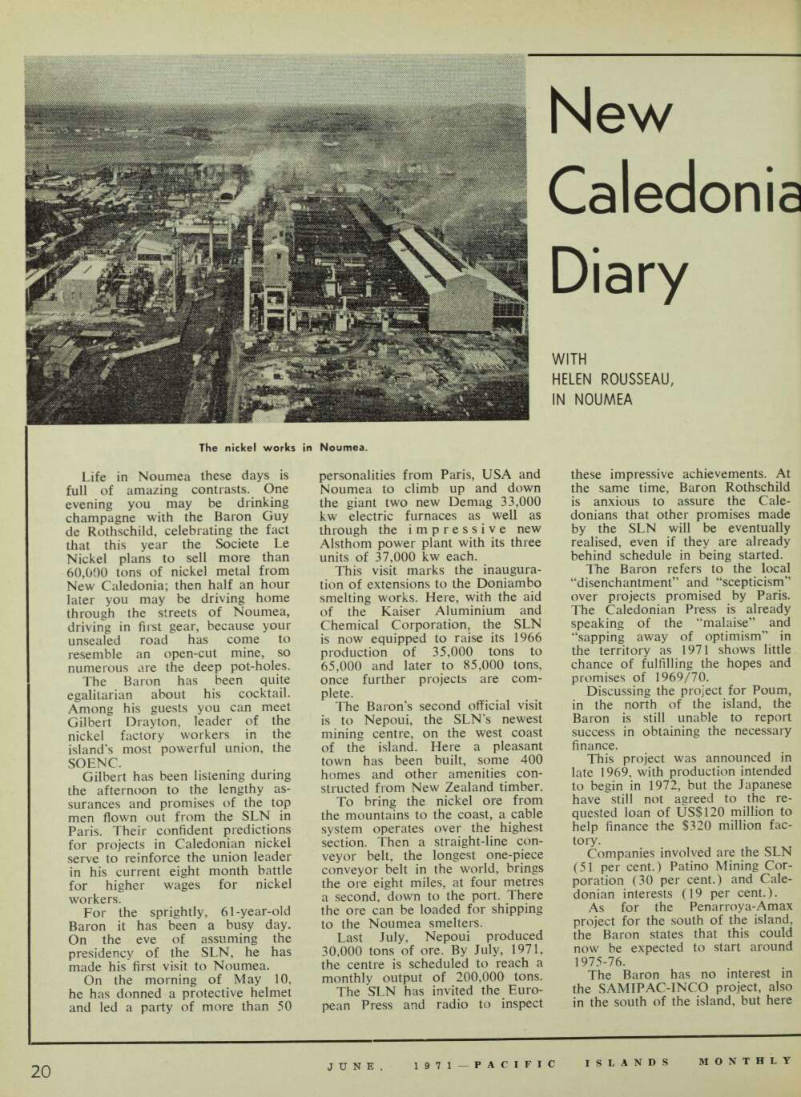
personalities from Paris, USA and Noumea to climb up and down the giant two new Demag 33,000 kw electric furnaces as well as through the impressive new Alsthom power plant with its three units of 37,000 kw each.
This visit marks the inaugura tion of extensions to the Doniambo smelting works. Here, with the aid of the Kaiser Aluminium and Chemical Corporation, the SLN is now equipped to raise its 1966 production of 35,000 tons to 65,000 and later to 85,000 tons, once further projects are corn plete.
The Baron’s second official visit is to Nepoui, the SLN’s newest mining centre, on the west coast of the island. Here a pleasant town has been built, some 400 homes and other amenities con structed from New Zealand timber, To bring the nickel ore from the mountains to the coast, a cable system operates over the highest section. Then a straight-line con veyor belt, the longest one-piece conveyor belt in the world, brings the ore eight miles, at four metres a second, down to the port. There the ore can be loaded for shipping to the Noumea smelters.
Last July, Nepoui produced 30,000 tons of ore. By July, 1971, the centre is scheduled to reach a monthly output of 200,000 tons, The SLN has invited the Euro pean Press and radio to inspect
these impressive achievements. At the same time, Baron Rothschild is anxious to assure the Cale donians that other promises made by the SLN will be eventually realised, even if they are already behind schedule in being started.
The Baron refers to the local “disenchantment” and “scepticism” over projects promised by Paris.
The Caledonian Press is already speaking of the “malaise” and “sapping away of optimism” in the territory as 1971 shows little chance of fulfilling the hopes and promises of 1969/70.
Discussing the project for Poum, in the north of the island, the Baron is still unable to report success in obtaining the necessary finance.
This project was announced in late 1969, with production intended to begin in 1972, but the Japanese have still not agreed to the re quested loan of US$l2O million to help finance the $320 million fac tory.
Companies involved are the SLN (51 per cent.) Patino Mining Cor poration (30 per cent.) and Cale donian interests (19 per cent.).
As for the Penarroya-Amax project for the south of the island, the Baron states that this could now be expected to start around 1975-76.
The Baron has no interest in the SAMIPAC-INCO project, also in the south of the island, but here
The nickel works In Noumea.
too time has been lost, as the French side has been unable to raise its share of the finance to build a factory.
On the promise of what was to be realised, however, many French workers have already migrated to Noumea, incited by the reports of the new “Colorado” and “Kuwait” of the Pacific. Some make their fortune, others return completely disenchanted that the opprotunities they sought simply do not exist, “New Caledonia is a rich c o u n t r y”, the Administration repeats to the Caledonians. But, as the Baron de Rothschild flies over his wealthy domains, the water is cut off for the Cale donians in Noumea.
“Much effort and sacrifice must be made by all” . . . “From 1975, New Caledonian nickel should be earning over US$3OO million an nually in foreign currency for France” . . .
While preparing for this, it’s certainly not very encouraging, just when you are about to bath your baby and prepare her bottle, to find that the water has been cut off for the day, as the Noumea pipeline has burst again.
Of course this has been no rare problem in Noumea over the past few years. You have already provided your home with two bathrooms, to overcome some of this inconvenience. Since then you have invested in a water tank (minimum size $180) and electric pump ($250).
You then only hope that the electricity is not cut off at the same time as the water. When the water does come, there is no time for it all to pass through the full filtration system, so you have invested in your own private filtering apparatus ($3B), As you stand syphoning out the precious drops, you ask yourself, “Wouldn’t it perhaps be easier to do what most of Noumea is now doing and buy mineral water, im ported from France at 38 cents the litre bottle (1.8 pints)?”
Of course, the “boom” has brought much more to Noumea than water and power cuts and over-worked roads: it is bringing lots of visitors, lots of cash and many more ways to spend it.
Visitors to Noumea have been inclined to complain that there is not much to interest them here by way of what the French call “spectacles”. However, they should
realise that, by a bit of investigat ing, they may now expect to dis cover a wider variety of planned activity.
The month of May, for example, began with a magnificent regatta on the lagoon, involving over 50 yachts, including some of the 47 New Zealand crews that had com peted in the Whangarei-Noumea yacht race in April. (The race was won by Chico on corrected time, skippered by Lin Carmichael, followed by Ted Buchanan com manding Kishmul, which won line honours).
The month of May also brought a visit to the territory of the Margand String Quartet. This young musical group was spon sored by the Jeunesses Musicales de France, a youth organisation whose regional representative is Mme. Simone Drouard.
For art lovers, there were two main exhibitions during the month.
At the Museum, which has dis appointed many Caledonians and overseas visitors by still not being open with permanent exhibits, there was an exposition by French painter, Mme. Josette Herard- Marlin. Prospective buyers usually need a generous cheque book at Noumea art shows these days.
Some artists have no oils to offer at less than $l5O.
At the same time, Max Shekle ton was showing lithographs among the antique furniture at his Galerie Ad Lib, next to the Lantana Hotel, on Anse Vata beach.
Behind the Lantana and the South Pacific Commission, by the way, Georges Lavoi has a team of 43 Fijian workmen from W. C.
Hines of Suva, working hard to
try to finish his 64-room hotel, the Isle de France, by August.
An increasing number of journalists and other writers are now coming to Noumea, and among such visitors last month was French historian, Mr. Robert Lacour-Gajet. This writer had just spent two months in Australia, preparing to write the first history of that continent in French. It is scheduled to be published by the Fayard publishing house in Mav. 1973.
Regional trade in the South Pacific was discussed at the South Pacific Commission in May, with 38 delegates coming from nine South Pacific Island groups and from various international aid agencies.
From the list of recommenda tions made at the end of the meeting, it appeared that the Islanders were still asking the commission for the same details on trade statistics, governmental regulations and general market advice as they had sought at the 1967 trade meetings.
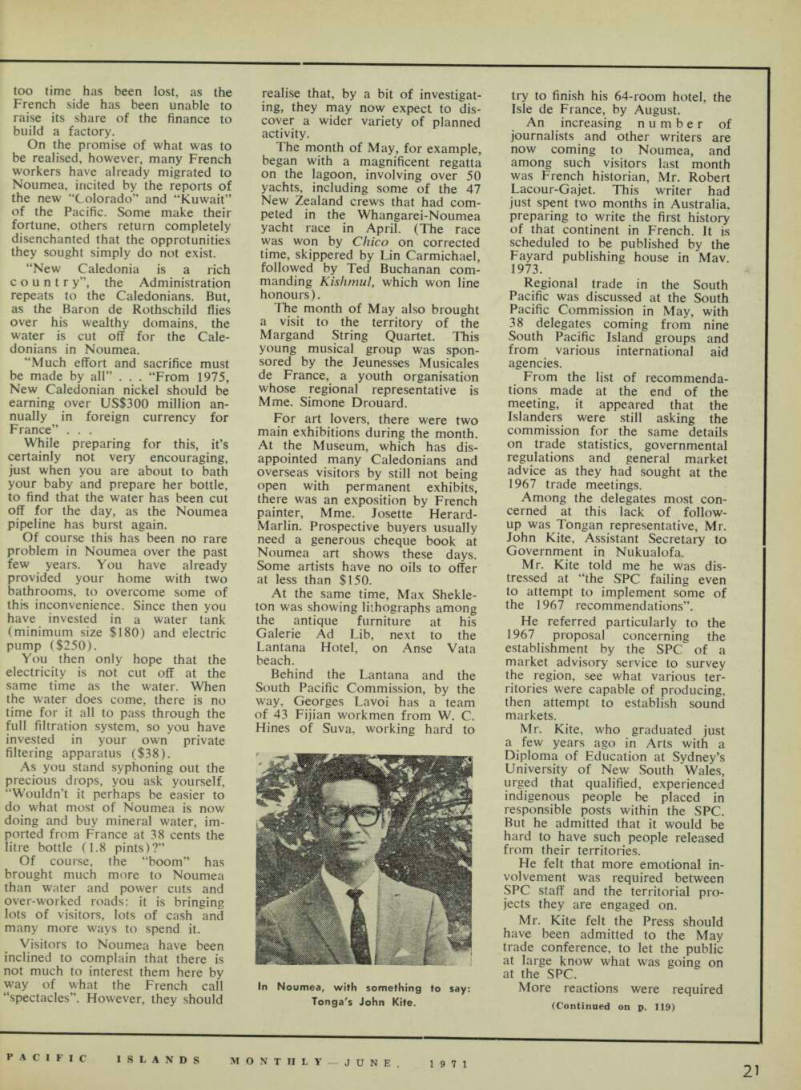
Among the delegates most con cerned at this lack of follow up was Tongan representative, Mr.
John Kite, Assistant Secretary to Government in Nukualofa.
Mr. Kite told me he was dis tressed at “the S'PC failing even to attempt to implement some of the 1967 recommendations”.
He referred particularly to the 1967 proposal concerning the establishment by the SPC of a market advisory service to survey the region, see what various ter ritories were capable of producing, then attempt to establish sound markets.
Mr. Kite, who graduated just a few years ago in Arts with a Diploma of Education at Sydney’s University of New South Wales, urged that qualified, experienced indigenous people be placed in responsible posts within the SPC.
But he admitted that it would be hard to have such people released from their territories.
He felt that more emotional in volvement was required between SPC staff and the territorial pro jects they are engaged on.
Mr. Kite felt the Press should have been admitted to the May trade conference, to let the public at large know what was going on at the SPC.
More reactions were required
(Continued on p. 119)
In Noumea, with something to say: Tonga's John Kite.
from the territories to keep the SPC sensitive to their problems.
In view of the inadequate action taken since the 1967 trade con ference, Islanders at this latest meeting recommended that an ad ditional economist on trade matters should be appointed to the com mission staff in 1972.
It is interesting to note, in this regard, that at the 1969 Ninth South Pacific Conference, in Noumea, the commission recom mended in its budget that the eco nomist at that time could be re placed, when his contract expired at the end of that year, by a person on a lower salary scale.
This replacement officer did not arrive till five months later, in May, 1970, and already the Islanders are pointing out that more strength is required in this field.
In view of the recent chain of departures of personnel from the SPC, one is tempted to ask, “What happens to the keen initiative dis played bv most new staff arriving at the SPC?”