Sound UN report on PNG
p. 21 · Read in the full issue
Intelligent, good sense, sound, useful. These are the words that best describe the report of the UN Visiting Mission to Papua New Guinea earlier this year, released in New York in late May.
The mission, led by Sir Denis Allen (UK), with Mr. Paul Blanc (France), Mr. Adnan Raouf (Iraq) and Mr. Charles Wyse (Sierra Leone), is critical but fair.
It paid tribute to Australia s work, !t said the territory was advancing rapidly with a vigorous and a gifted population , basically happy.
The mission said it would be realistic to plan for Papua New Guinea independence between 1976 and 1980, after the life of the next Assembly. It rejected suggestions that Papua be declared a UN trust territory, like New Guinea, and said the two territories should go forward together with single citizenship. The majority of people wanted a strong central government. An eventual union between PNG and the Solomons might be a solution to Bougainville secessionism.
The report recommended establishment of a PNG Reserve Bank, and a territory currency fully backed by the Australian dollar and convertible.
Although the transfer of powers to Ministerial office-holders was working well, there were important fields in the Public Service where localisation was too slow. The proportion of expatriates in higher positions was exceptionally high for a country moving towards selfgovernment.
The House of Assembly took its duties seriously but there was too much regionalism and no political parties had developed nationally, Expatriates also needed political education; they had to reflect today’s social attitudes and business methods, or else become an alien economic enclave. t-u * ... . , . . fc Tl ? e government was criticised for i‘ s hf.sfncy m undertaking major 5 > * h ‘ ch oontnbu ed “as as - geography , to the lack of communications.
Primary education—in good pro portion on a territory wide basis— was disproportionate in remote areas an d th* B should be accelerated. Efforts should also be made to clear the bottleneck which prevented 60 per ce / , t. of those who finished primary school from going to secondary school. Teachers should be recruited from other countries, such as the Philippines, on contract. A Pacific language should be taught in the schools in addition to English, The mission criticised the “all per vasive” Australian presence in the territory and said many expatriates tended to assume Australian standards were the only valid ones. Everywhere the disparity between the expatriate and indigenous standards of living was marked.
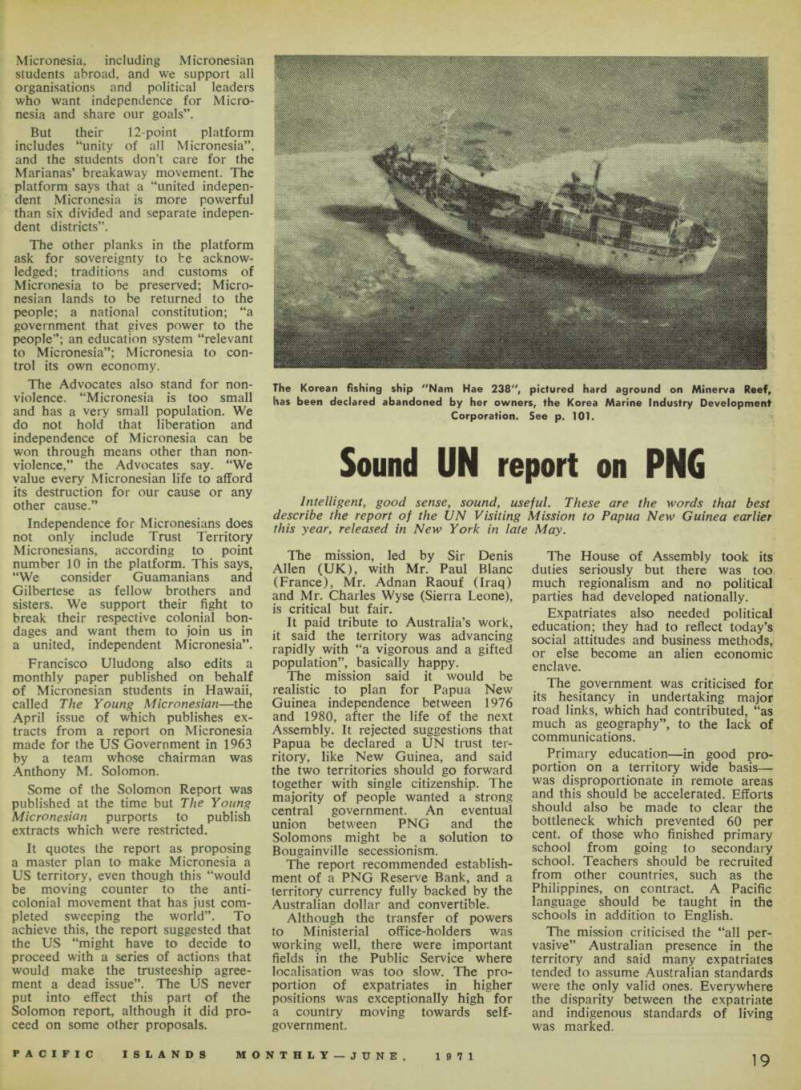
The Korean fishing ship "Nam Hae 238", pictured hard aground on Minerva Reef, has been declared abandoned by her owners, the Korea Marine Industry Development Corporation. See p. 101.