Micronesian disunity will be
pp. 20-21 · Read in the full issue
worse before it s better
Prom a Honolulu correspondent The announcement by Mr. Peter Coleman, Deputy High Com missioner of the US Trust Territory, that he won’t accept nomination for the post of secretary-general of the South Pacific Commission, raises speculation—not about the future of the South Pacific Com mission but about the future of the US Trust Territory of Micro nesia.
The former Republican Governor of American Samoa, Peter Coleman would have been a popular choice for the post of secretary-general, now held in an acting capacity by fellow American John de Young, who has decided to sever his activities in the Pacific and retire to Europe in 1972.
In most circles Coleman’s decision to turn down the offer was a surprise, as the post of Deputy High Com missioner doesn’t call for any great responsibility, and his talents are being wasted here.
But Coleman has explained: “This is a very critical period in the history of Micronesia and I feel my 10 years of experience here can contribute to the political, economic and social development of Micronesia”. For that reason, he said, he wouldn’t want to leave Micronesia for a least three years but if then, he indicated, the job of secretary-general was open to him, he might be interested.
Samoa-born Coleman is known to have high-level Republican connec tions in Washington and Hawaii and it could be that somebody has some thing else in mind for him.
US policy for Micronesia could undergo a radical change soon and it is quite possible that the US might try to establish a separate admin istration of the Northern Marianas.
If so, Peter Coleman could be the first appointed Governor of the 12 islands making up the Marianas. And since a separate administration would be established as first phase in the development in the Marianas as a Commonwealth, a more important Governorship could be just around the corner for Coleman.
Coleman would be one of the few qualified American Administrators who would be acceptable to both the Marianas people and the US Govern ment. As District Administrator for the Marianas District for four years between 1965-69, Coleman main tained very friendly relations with all political and ethnic groups in the Marianas, particularly with the leader ship of the Popular and Territorial political parties.
Coleman has always felt that “Island people should solve Island problems” and maybe history will prove him right. Perpetuation of a US style bureaucracy in Micronesia, with all its attendant, highly centra lised financial and programme con trols, is slowly being changed as de centralisation of central government activities transfers from Saipan head quarters to the District Administra tors of each of the six districts.
The Marianas District, of course, wants to secede. It wants Common wealth status with the US, and the Marianas District Legislature has said that it will secede by “force of arms if necessary”.
Probably from 55 to 65 per cent, of the people on the Marianas agree with their legislature in this, allhough a plebiscite might give another figure.
The others want the status quo.
Although official US policy is that there should be no fragmentation of the six districts of Micronesia, it seems likely that the Marianas Legislature will become more and more hostile to America over its demands, and although the Washing ton executive might not want to give in, the Micronesian Congress will.
While the more conservative Trust Territory politicians would like the Marianas to remain as a sixth district, the rest of them probably have so much contempt for the Marianas people that they will be inclined to say to hell with them—five districts will do.
After being burnt out of its build ing on Saipan in February, it looks now that the Congress of Micronesia will never go back to Saipan. Its permanent home is likely to be at Palakir, about eight miles from Kolonia town on Ponape.
Meanwhile Congress had its first full meeting, since the House’s de struction, on May 5 at Moen Island in Truk—using the facilities of the Truk district Legislature. The five Marianas members of Congress weren’t in attendance. They boycotted the meeting. The boycotters included
Olympic Boja, who is a Territorial Party member, a party which at least stands for the status quo. The other four all represent the Popular Party, which supports the Marianas District Legislature, favouring secession. The Territorial Party had some doubts about it all and later sent two people as observers.
The Marianas delegation announced that the decision to boycott the ses sion was taken partly because of the resolution in February to secede.
Surprisingly, the Marianas decision got the support of US Congresswoman Patsy Mink who is a member of the Sub-committee on Interior and Insular Affairs. She said if the Marianas delegates were sincere in their desire to secede from the Trust Territory then it was right that they should not attend the Congress ses sion. The Marianas secession move will probably be aimed at Congress men, as the Washington Administra tion is treating them very coolly.
Meanwhile there has been an interesting sidelight in Hawaii, with the establishment of a group called the Micronesian Independence Advocates. This organisation has been established by Micronesian students in Hawaii, led by Francisco Uludong.
The platform and programme of the Advocates describe the organisa tion “as a nationalistic, political organisation dedicated to work towards the independence of all Micronesia from the United States of America.”
The Advocates say they have “as a political base, the young people of
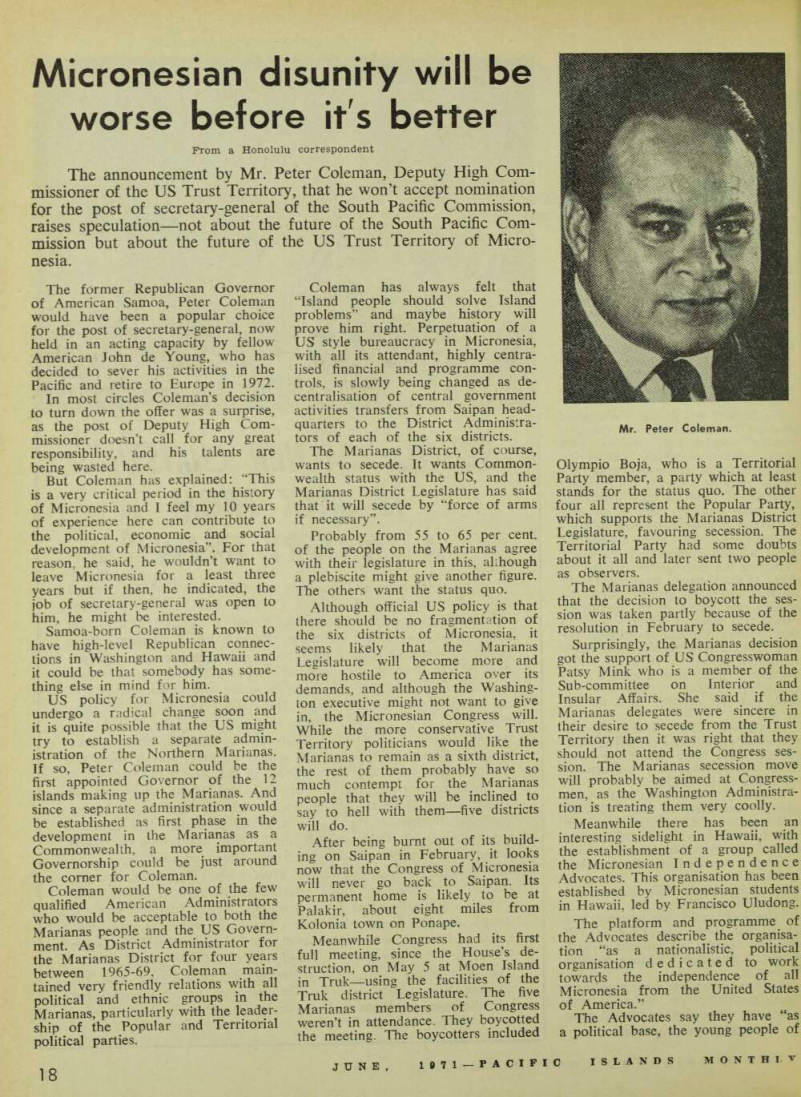
Mr. Peter Coleman.
Micronesia, including Micronesian students abroad, and we support all organisations and political leaders who want independence for Micro nesia and share our goals”.
But their 12-point platform includes ‘‘unity of all Micronesia”, and the students don’t care for the Marianas’ breakaway movement. The platform says that a “united indepen dent Micronesia is more powerful than six divided and separate indepen dent districts”.
The other planks in the platform ask for sovereignty to be acknow ledged; traditions and customs of Micronesia to be preserved; Micro nesian lands to be returned to the people; a national constitution; “a government that gives power to the people”; an education system “relevant to Micronesia”; Micronesia to con trol its own economy.
The Advocates also stand for non violence. “Micronesia is too small and has a very small population. We do not hold that liberation and independence of Micronesia can be won through means other than non violence,” the Advocates say. “We value every Micronesian life to afford its destruction for our cause or any other cause.”
Independence for Micronesians does not only include Trust Territory Micronesians, according to point number 10 in the platform. This says, “We consider Guamanians and Gilbertese as fellow brothers and sisters. We support their fight to break their respective colonial bon dages and want them to join us in a united, independent Micronesia”.
Francisco Uludong also edits a monthly paper published on behalf of Micronesian students in Hawaii, called The Young Micronesian —the April issue of which publishes ex tracts from a report on Micronesia made for the US Government in 1963 by a team whose chairman was Anthony M. Solomon.
Some of the Solomon Report was published at the time but The Young Micronesian purports to publish extracts which were restricted.
It quotes the report as proposing a master plan to make Micronesia a US territory, even though this “would be moving counter to the anti colonial movement that has just com pleted sweeping the world”. To achieve this, the report suggested that the US “might have to decide to proceed with a series of actions that would make the trusteeship agree ment a dead issue”. The US never put into effect this part of the Solomon report, although it did pro ceed on some other proposals.