. . . Akmana,
pp. 41-42 · Read in the full issue

1929
The wigmen were also impressed with the expedition's weapons. When on one occasion wigmen raided the camp and stole the expedition's trade goods, the party got them back by exploding gelignite and firing .303 rifles in the air.
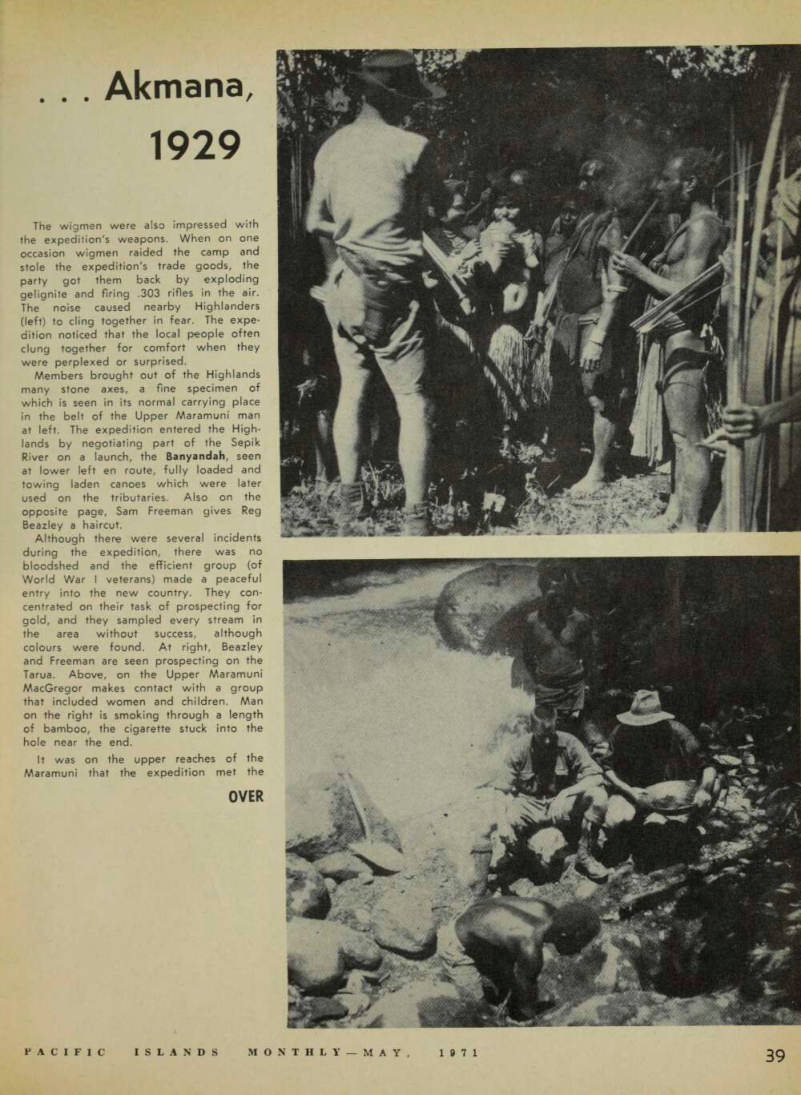
The noise caused nearby Highlanders (left) to cling together in fear. The expe dition noticed that the local people often clung together for comfort when they
were perplexed or surprised.
Members brought out of the Highlands many stone axes, a fine specimen of which is seen in its normal carrying place in the belt of the Upper Maramuni man at left. The expedition entered the High lands by negotiating part of the Sepik River on a launch, the Banyandah, seen at lower left en route, fully loaded and towing laden canoes which were later used on the tributaries. Also on the opposite page, Sam Freeman gives Reg Beazley a haircut.
Although there were several incidents during the expedition, there was no bloodshed and the efficient group (of World War I veterans) made a peaceful entry into the new country. They con centrated on their task of prospecting for gold, and they sampled every stream in the area without success, although colours were found. At right, Beazley and Freeman are seen prospecting on the Tarua. Above, on the Upper Maramuni MacGregor makes contact with a group that included women and children. Man on the right is smoking through a length of bamboo, the cigarette stuck into the hole near the end.
It was on the upper reaches of the Maramuni that the expedition met the
Over
... The little people'
"little people". They were of pygmy height, but among the group were people of normal height, as can be seen in the picture above. (People who are well pro portioned and whose height falls below 4 ft 11 in. are usually termed pygmies.) There are a number of groups in Papua New Guinea that can be described as pygmy, one of them being on the Jimmi River, not far from the eastern extremity of the route taken by the Akmana ex pedition of 40 years ago. — Stuart Inder.